The family of our narrative lived in a small village, having moved there from their home in the country for the benefit to be derived from the village high school, which was considered exceptionally good. This home was not rich in luxuries. Its furnishings scarcely surpassed life’s bare necessities, but it was rich in that love which is the essential element of the home. Its walls were not a stranger to prayer, for a “family altar” was erected when first the home was built; and here each morning and evening the household assembled for the reading of God’s Word and prayer. The parents were godly people who made it their chief aim in life to bring up their children in the “nurture and admonition of the Lord.” Though they might fail in all else, they had determined to accomplish this.
In the circle there were several boys merging into manhood, and a few small children. The father was a man of strong and unusually tender love, and was in the habit of giving expression to it in the home. The mother’s love was also strong and deep, although not usually expressed in words. Though frail in health, she was never too weary to minister to the sick or those in need.
In their new environment, for a time all was well. The young men gratefully improved the opportunity offered for getting an education, and the parents observed with evident satisfaction the appreciation manifested on the part of their sons, of the financial sacrifice made for this privilege.
But the disturber who succeeded in spoiling the peace and happiness of the Eden home, was busy trying to break this circle. At length a son of eighteen had acquired a love for the world. He who had found joy and contentment within the home, began to spend his evenings with the rude and godless in the village loafing places. To him home had become uninteresting, and his heart longed to revel in the gay society of the world. The pleasure party had a bewitching attraction for him. He had come to believe that in the world were his best friends, and any effort on the part of parent or brother to reconcile him was interpreted to be against his personal liberty.
The father had recently accepted a call to the gospel ministry, and according to directions planned to leave home for his field of labor. But before leaving, feeling anxious for the welfare of his wayward son, he called him aside, as was his custom with his children, to pray with him. When the son, who from a child had taken delight in these seasons, knew the purpose of this private interview, he said, “Father, you may pray if you want to. I do not care to. Give me fun. All I want is fun.” The father went on his way with a heavy heart. On reaching the scene of his prospective labor, he said to his fellow worker, “I must return home in the morning.” The astonished brother, who was greatly in need of help, on inquiring for the reason for so speedy a return received the reply, “I have a lost boy at home. I can not stay. How can I labor for others with this burden on my heart? I can not stay.”
The next day before the setting of the sun he was home again. In the evening, on making inquiry for his estranged son, he was informed that he was “down town.” The mother, in her almost impatient anxiety to rescue him from the companionship of the ungodly, suggested to the father that he go with the rod and bring the boy home before him. To this he replied, “If we can not win his heart, he is lost.” Then followed a few anxious days during which every means that love could suggest were employed for the reconciliation of their unfortunate child, but all seemed of no avail.
It was Sabbath evening; the members of the family had gone to rest, but for the father there was no rest. It had been the height of his ambition in this world to raise his family to love and fear God. To this end he and his faithful companion had bent all the energies of their united life. They had watched for the souls of their children “as they that must give an account.” In sickness, when it seemed that death must result should nature have her way, they had cried unto nature’s God, who rebuked the power of disease. These tests of affliction they had a number of times been called upon to pass through. Especially does he call to mind the sickness, when but an infant, of this dear boy. He can even yet feel the agony of soul experienced as it seemed they must give him up. Well does he remember how, in their extremity, as parents they importuned God for the child, promising, if spared, his life should be wholly devoted to God. At that time they dedicated him in a special sense to the Lord. With these memories pressing upon him, can he now give up the struggle and let this son go to the world? Can he now surrender his soul to the enemy to be ruined? — “No,” he in anguish replied, “this can never be. God, help me! This can never be.”
Already it seemed that Satan had succeeded in his work, for all the means that love could devise had been tried to reach the impenitent, apparently to no avail. As the hours of darkness wore wearily away, in deep anguish of soul this father prayed for his son. All that long and terrible night he wrestled with God for power to save the lost. As the light of a new day was breaking, he sought the bedside of the sleeping son, hoping for some word showing that his prayer was heard. As he approached and gently laid his hand upon him, saying, “My son, haven’t you a word for your father this morning?” he was met with the almost cruel reply, “Let me alone; I want to sleep.” At this the father’s feelings can better be imagined than told. But his prayer had been heard. It could not be otherwise; for He who had inspired it could not fail to give the answer, though it be delayed.
It was the Sabbath; and the family, as was their custom, attended the usual Sabbath services; but still a cloud hung over this home. At the dinner-table the wayward son, noticing that the mother was absent, said, in a manner that betrayed something of his restless feelings, “Where’s mother?” The father replied, “Your mother has no appetite for dinner.” The son made no further inquiry, for he understood the situation, which added remorse to his already awakening conscience. The mother was grief-stricken, and alone she wept and prayed. For her offspring her love was stronger than death. For her children she had given the beauty and bloom of her life. Her cheeks, once rosy, and her face, once so fair, had grown pallid, and wrinkled with care. With a burden born of heaven she prayed for her boy. At the dinner-table no more was said, for no one had a heart for words.
The meal being ended, the father invited the son to accompany him into the parlor, saying he wished to talk with13him awhile. The boy, once so loving and sympathetic, reluctantly conformed to his father’s wishes. As the father conversed and read fitting words of inspiration, the young man’s heart was touched; the tears of penitence welled up in his eyes. The time had come for “the spirit of heaviness” to give way to “the garment of praise.” He yielded to the Holy Spirit’s influence, and with weeping fell upon his father’s neck, saying, “O I have longed for this time!” Does this not suggest the heart longing of many a wayward son and daughter bound with the fetters of sin? After making his confession to the father, he sought the mother, and then made wrongs right with the other members of the family. Then there was rejoicing in this home, as well as among the angels in heaven, for the lost son and brother had been found.
Some time after this experience, this son was called to the gospel ministry, and on leaving home for his field of labor, not knowing that he would ever be privileged to return, he said, as he wept upon his father’s neck, referring to this experience, “O if you had not held onto me then, where would I have been now?” Yes, the question might well be asked, “Where?”
Pomona, Cal.
The Prevention of Colds
By Emma E. Walker, M. D.
It is said that a starving man never “takes cold,” but on the contrary that he who overeats is taking one of the surest ways of falling into that all too common pitfall of the overfed and overworked.
Never shall I forget how this was first brought home to me. We were away at school, and on the arrival of a box of dainties my roommate never dared to eat much candy because, as she declared, she always caught a hard cold after such indulgence. At the time, I thought it was merely due to her imagination; but when we consider that a cold is really a disturbance of the equilibrium of the general circulation, it is easy to see how the overloading of the system with food can cause this condition. When one eats frequently, especially if the food taken is rich and highly seasoned, the digestive organs have little or no time to rest, and the drain on the digestive secretions is too great. More nourishment is taken into the body than can possibly be used. Thus an oversupply of material is thrown upon the organs, and has to be disposed of. This quickly causes an obstruction which results in a “cold.”
One of our most noted physicians of this age has said that overeating kills far more people than does overdrinking. This is especially true after the age of forty. It is not by what man eats that he lives, but by what he digests and assimilates. All excess of food is not merely a waste, but is an element of danger, and brings about a condition of self-poisoning.
A throat specialist compares the condition of the body at this time to a chandelier with five gas jets. If one jet is out of order, the other four have to do not only their own work, but the work of the fifth jet also. If a second one becomes stopped, then three jets have to do the work of five, and the gas sufficient for five comes out at the three openings. So it is when we have a “cold.” Blood that should be in other parts is directed to the mucous membrane lining the air-passages, in other words, to the internal skin, as it is called. The congestion of these parts results in an oversecretion of mucus. If the nose is especially affected, we say that we are suffering from a “cold in the head;” if the throat, then we have a “raw” or “sore throat;” if the vocal cords and larynx, then we are hoarse, and have an attack of laryngitis; if the bronchial tubes are bearing the brunt, we call it a “bronchial cold;” whereas, if the trouble penetrates to the tiny air-cells of the lungs, then it is that the dread pneumonia has seized its victim.
In a great many cases of this disease physicians find by inquiring into recent doings of the patient that he has been somewhere in a crowd, such as at a lecture or the theater, where he has breathed and rebreathed impure air. For foul air is far more often the cause of “colds” than pure, cold air. Pure, fresh air taken into the lungs preserves the equilibrium of the circulation, while bad air does not supply enough oxygen to accomplish this. Doubtless many people “catch cold” from sleeping in close bedrooms, where the air is breathed over and over again. Likewise many colds owe their origin to a sedentary life which lacks the proper amount of exercise out in the open air. For no one can get just exactly the same pure air to breathe within four walls — although ventilation may be his hobby — that he can out in the open. It is now generally recognized that in many cases of “colds” microbes play their part.
And just a word here about damp feet. It makes little difference if one gets soaked through out in a rain-storm, even though the feet become drenched, if he will only keep moving; for exercise keeps up the normal balance of the circulation, and as long as this is sustained, there need be no fear of catching cold. It is only when one sits down in damp clothing that the chill comes, because then the blood is directed away from the parts which are cold, and congestion takes place in the respiratory organs.
Although the understanding of the prevention of a “cold” is far more important than a knowledge of its treatment, still most of us see days when we are glad to know something of the latter. The first twenty-four hours is the most telling time for effectual treatment, although later than this the symptoms of a cold may be alleviated. The old adage, “Stuff a cold and starve a fever,” is absurd; for a cold is actually an inward fever, and the more it is stuffed the worse it will become. A quick-acting laxative is the first step, for the body should be relieved of its waste matter.
Heat used both externally and internally must be our chief reliance. In general, the hot foot-bath is preferable to a complete bath, for after the former, one is less likely to become chilled. Hot drinks, as lemonade or flaxseed tea, also help to restore the equilibrium of the circulation. The Turkish bath is excellent, but it has its limitations, as its efficacy depends entirely upon the individual. After the sweating process of this bath the body should be rubbed thoroughly until it is dry.
A great relief for a simple “cold in the head” is the drawing of hot water into the nostrils and blowing it out again several times. In this way the nose is thoroughly cleansed and the membranes are strengthened. This may be done both morning and night.
Rest is the best remedy for hoarseness. The primary cause of colds is found within the body, and not without. So long as one keeps strong his powers of resistance by avoiding fatigue, by following a careful diet, by taking sufficient exercise, and by the breathing of fresh air and the taking of daily baths, he can count himself immune from “colds.” —Emma E. Walker, M. D., in Good Housekeeping.
Do It Well
A job slighted because it is apparently unimportant leads to habitual neglect so that men degenerate, insensibly, into bad workmen.
“That is a good rough job,” said a foreman in our hearing, recently, and he meant that it was a piece of work, not elegant in itself, but strongly made and well put together.
Training the hand and eye to do work well leads individuals to form correct habits in other respects, and a good workman is, in most cases, a good citizen. No one need hope to rise above his present situation who suffers small things to pass by unimproved, or who neglects, metaphorically speaking, to pick up a cent because it is not a dollar. Some of the wisest lawmakers, the best statesmen, the most gifted artists, the most merciful judges, the most ingenious mechanics, rose from the great mass.
A rival of a certain lawyer sought to humiliate him publicly by saying, “You blacked my father’s boots once.” “Yes,” replied the lawyer, unabashed, “and I did it well.” And because of his habit of doing even mean things well he rose to greater.
Take heart, all who toil! all youths in humble situations, all in adverse circumstances. If it be but to drive the plow, strive to do well; if only to cut bolts, make good ones; or to blow the bellows, keep the iron hot. It is attention to business that lifts the feet higher up on the ladder.—Selected.
Where One Dies of Hunger, a Thousand Die of Eating
WHERE one dies of hunger, a thousand die of eating.
Friedensau—Vale of Peace
By Glen Wakeham
GLEN WAKEHAM
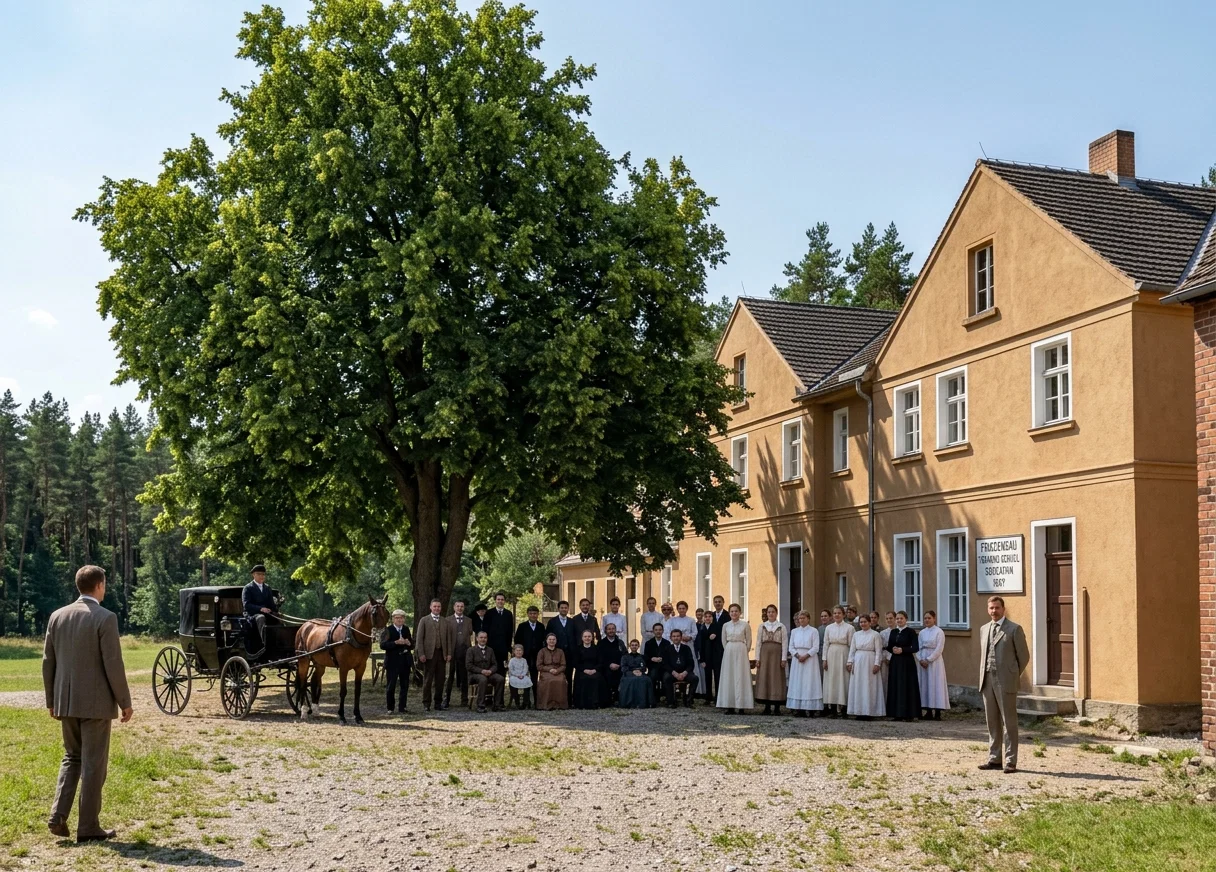
The recent recurrence of the annual meeting of the German Union Conference here in Friedensau, bringing with it the usual influx of hundreds of our people from all parts of Europe, and, indeed, the world, suggested to me that but few of our American brethren and sisters are sufficiently informed concerning Friedensau to realize the magnitude of the work that has grown up here during the last few years, or are aware of the important part it is playing in giving character to the work, not only in the German empire, but throughout Europe. It was, therefore, thought that a short sketch of the history and present status of the institutional work here would be of general interest.
THE MAIN SCHOOL BUILDING AT THE TIME OF THE DEDICATION
It is now more than seven years since the growing demands of the work in the German field compelled the brethren here to recognize the necessity of a training-school for workers. After much searching, a farm of about ninety acres was found, a few miles east of Magdeburg, which seemed to be as suitable as anything to be had for the means at hand. The farm was pleasantly situated in the midst of pine forests, with a small stream, the Ihle, running through from end to end. An old mill, with several houses around it, these forming the village of Klappermuhle, were situated on the farm, which also included a small piece of young timber. Far from the enervating atmosphere of city life, the railroad connections were still sufficient, and the place was finally bought in the autumn of the year 1899, for about
Then began the battle. The place was considerably run down. The central field, where the main building now stands, was a sandy wilderness, sparsely covered with tall weeds. It was difficult to see what could be made out of the place, and few could believe that this wild desert was to become the center of our educational work in Germany. The old buildings were unsuitable and incommodious. But there was no time to wait for new ones, or for money with which to erect them, so a few young people were gathered in, and Brother Lupke started a school in the old mill.
This period is in many ways the most interesting in Friedensau's history. The most ordinary school appliances were entirely wanting. The young men slept in the attic, where things froze up solid every night in the winter, and the snow sifted in through the cracks in thick drifts over the bare floor and cotton
comforters. The young women fared but little better. There was one large room for kitchen and dining-room, through which one was obliged to pass to reach the principal's office—a room about ten by twelve feet, which, by the way, served also as library, study, and bedroom for
Water was carried from the Ihle for all domestic purposes. A little old hut served for laundry and bath-room alike. This establishment boasted at first one, and later, two wooden tubs, which had to do double service. In windy weather, when the old fireplace smoked unendurably, only cold water was obtainable.
But the brethren and sisters did not despise the day of small things. Beginnings were made in other directions. In one corner of the attic a health food factory was started, and with the arrival of Dr. Hoenes from America, another corner was cleared out for a treatment room—the nucleus of the present sanitarium. Definite plans for the future began to crystallize symmetrically. The students spent a large part of their time clearing up and improving the farm, and in working on the new building. A large orchard was planted, and a park was laid out between the plots of land destined for the future school and sanitarium buildings.
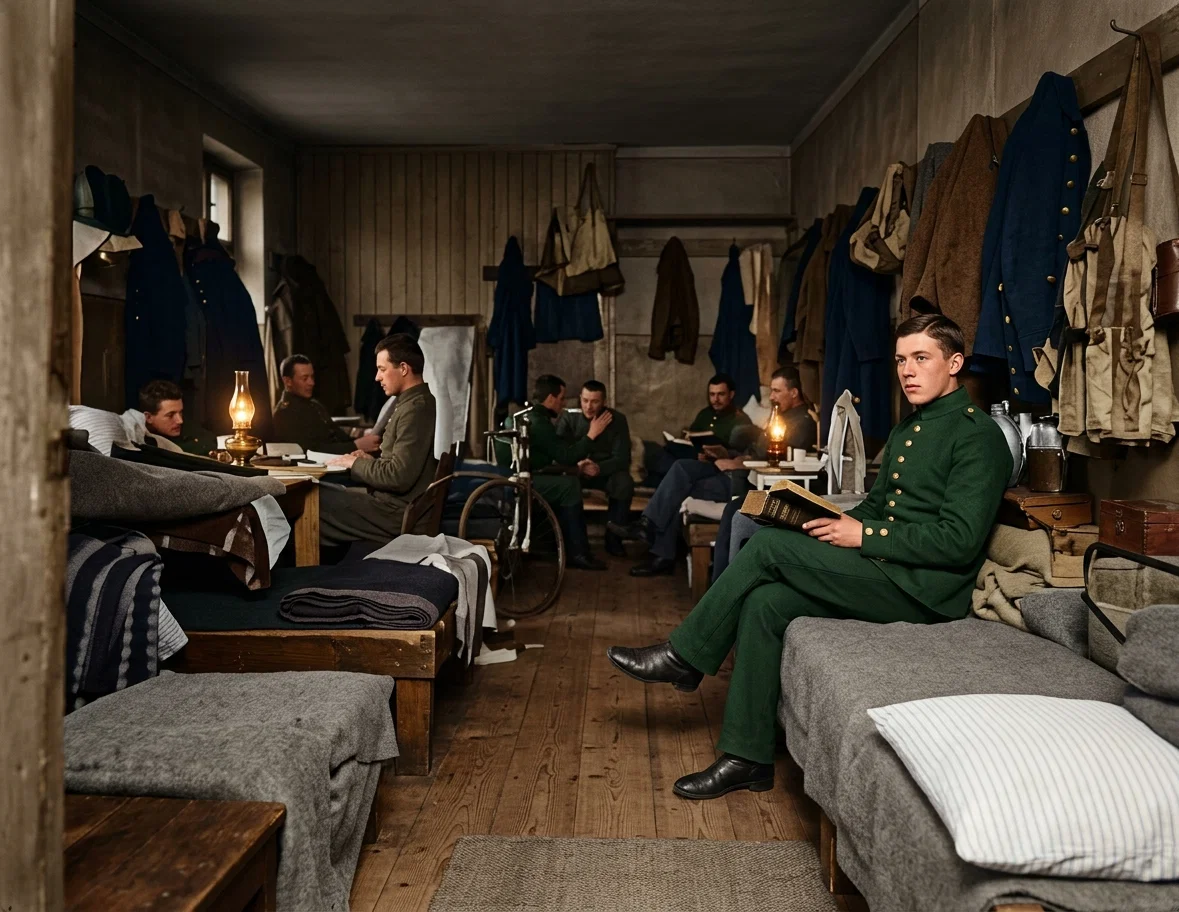
The first buildings to go up were several long, shed-like structures, now known as the “Barracks.” As soon as possible, a part of the school work was moved into these quarters, and the congestion in the old mill was thereby relieved to some degree. But the disadvantages were still very great. The barracks were but lightly constructed, their principal merit being good ventilation; and it was necessary to use them as barns, and storehouses as well. Sacks of grain were piled around the sides of one class room, and the other was cleared out at meal-times, to serve as dining-room. The bill of fare was very simple, consisting of brown-rye bread, oatmeal porridge, with stewed fruit, perhaps, for breakfast; vegetable soup, with boiled beans or potatoes for dinner; and cereal coffee (without sugar), with bread and nut butter, for tea.
INTERIOR OF THE BARRACKS
But in spite of all difficulties, the school grew and flourished. The call for workers was urgent, and the young people in the school were earnest, sincere, and self-sacrificing, thankfully embracing the opportunity to fit themselves for service, and cheerfully bearing inconveniences15actual suffering. The number was small at first, twenty-two being enrolled the first year, and thirty-six the second. But the Lord blessed their efforts, and they are now scattered abroad in many lands, doing efficient service.
The first of the present main buildings to be erected was the sanitarium, which was put up during the first half of the year 1901, at a cost of about $13,500. Then came the present health food factory, in the form of an addition to the old mill. The firm establishment of the earning branches of the enterprise enabled the managers to turn their attention again to the school, where the congestion had become intolerable. In the fall of the year 1901, ground was broken for a school building, and the next year a three-story brick structure, capable of accommodating seventy-five students, was completed and dedicated. Great was the joy of the teachers and students as they moved into the new quarters. True, there were only two class rooms, one of which served also as dining-room, and the other as chapel. The windows were curtainless, and the floors carpetless, but there was a whole bedroom for every five or six students, the building was heated with steam, and the walls were plastered.
(To be concluded)
Canvassing in Honduras
By A. N. ALLEN
A. N. ALLEN
The gift of the evangelist colporteur is no less a gift of God than that of the minister. He has a definite work of searching out and reaching by personal and literary means those not accessible to the living preacher, as he meets, in rapid succession, many people, varying in mental capacity, in education, and in hereditary tendencies, each one with his individual process by which a conclusion is reached. And no less varied and numerous are the standards by which the canvasser, his book, tone of voice, manners, and every act are judged. And the conclusion is always for or against.
Some are quick of perception and comprehension, and can appreciate an intelligent “canvass,” or description of a book, and the subjects treated, while others are slower to receive and comprehend, and thoughts must be presented more slowly, and often repeated in different words.
While the canvasser is undergoing inspection and judgment, he must also be alert to judge and suit his words to the one whose confidence he would win. In no other line of work is there more need of the heart, head, and hand being fully under the control and influence of the Holy Spirit.
There are various gifts to the church, “differing according to the grace that is given to us,” but the canvasser must be so filled with “grace and truth” that he can minister to both bodily and spiritual infirmities, teach the ignorant, exhort the discouraged. Also “the canvasser should carry with him tracts, pamphlets, and small books, to give to those who can not buy. In this way the truth can be introduced into many homes.”
As a member of the body of Christ, and branch of the True Vine, he must “abide in the Vine,” and draw life and nourishment from the same. He that doeth this “bringeth forth much fruit.” “Herein is my Father glorified, that ye bear much fruit; so shall ye be my disciples.” “And if children, then heirs; heirs of God, and joint heirs with Christ; if so be that we suffer with him, that we may be also glorified together.”
The canvasser often breaks the ground, and sows the seed, the result of which is seen in after-years in strong, tithe-paying churches. His work is well expressed in these words: “Sow to yourselves in righteousness, reap in mercy; break up your fallow ground: for it is time to seek the Lord, till he come and rain righteousness upon you.” Hosea 10:12.
THATCHED HUTS IN HONDURAS
The canvasser co-operates with the author, publisher, and minister, yet he has a definite work. “The canvassing work properly conducted is missionary work of the highest order, and it is as good and successful a method as can be employed for placing before the people the important truths for this time. The importance of the work of the ministry is unmistakable; but many who are hungering for the bread of life have not the privilege of hearing the word from God’s delegated preachers. For this reason it is essential that our publications be widely circulated.” “Thus the message will go where the living preacher can not go.”
“That which is done in warning the world must be done without delay. Let not the canvassing work be left to languish. Let the books containing the light on present truth be placed before as many as possible.” “The presidents of our conferences, and others in responsible positions, have a duty to do in this matter, that the different branches of our work may receive equal attention.”
“A great and important work is before us. The enemy of souls realizes this, and he is using everything in his power to lead the canvassers to take up some other line of work. This order of things should be changed. God calls the canvassers back to their work. He calls for volunteers who will put all their energies and enlightenment into the work, helping wherever there is opportunity.”
We have no time to lose. We must encourage this work. Who will go forth now with our publications? The Lord imparts a fitness for the work to every man or woman who will co-operate with divine power. All the requisite talent, courage, perseverance, faith, and tact will come as they put the armor on. A great work is to be done in our world, and human agencies will surely respond to the demand. The world must hear the warning message for this time.
When the call comes, “Whom shall I send, and who will go for us?” send back the answer, clear and distinct, “Here am I; send me.”
Besides being “missionary work of the highest order, and as good and successful a method as can be employed for placing before the people the most important truths for this time,” it is also the most economical method. From the author to the agent, it is self-sustaining. “Self-supporting missionaries are often very successful. Beginning in a small, humble way, their work enlarges as they move forward under the guidance of the Spirit of God. Let two or more start out together in evangelistic work. They may not receive any particular encouragement from those at the head of the work that they will be given financial support; nevertheless, let them go forward, praying, singing, teaching, and living the truth. They may take up the work of canvassing, and in this way introduce the truth into many families.” “God calls for workers to enter the whitening harvest-fields. Shall we wait16because the treasury is exhausted, because there is scarcely sufficient to sustain the workers now in the field? Go forth in faith, and God will be with you.” The promise is, “He that goeth forth and weepeth, bearing precious seed, shall doubtless come again with rejoicing, bringing his sheaves with him.”
The work of the colporteur during the Dark Ages, when to be found with only a small portion of the Scriptures, much more to sell them, was a crime punishable with death; and the part they acted in the great Reformation; and their pioneer work in opening Japan, China, and India to the gospel of peace, would, if written, form a volume of noble lives, not surpassed by any other department of gospel laborers.
In this country, where the only means of travel is a boat, or a mule, if one desires to go inland, one learns to appreciate the bearing of modern transportation on the progress of the gospel. Waiting, perhaps for weeks, for a passage on a boat, and not having animals, the colporteur can do only a small part of the work he otherwise could. We can not take orders and deliver here as in the States. We carry Bibles, books, pamphlets, tracts, and papers, and then besides these things one must carry hammock and blanket for bed, and one or two changes of clothes. For this reason, we can not walk, even if there were not plenty of rivers, creeks, and mud to encounter.
I am planning to spend most of next year in the interior of Honduras, among the mountain villages, and a few cities, such as Olanchito, Juticalpa, Comiagua, and Tegucigalpa, the capital. Brother Moncada is printing, at his own expense, a series of articles, which I believe will be the best yet written to meet the prejudice of the Spanish mind. These will be issued in pamphlet form, and we will arrange to put one wherever a Bible is sold. This will prepare the way for other books and literature. The American Bible Society has promised to send a man with me to sell Bibles, and by traveling together, expenses will be lighter for us both. Thus we hope to do more for the inhabitants of Honduras than has ever been done before.
We have raised among friends and brethren nearly half enough to purchase the animals necessary for this work, but we still lack seventy dollars. The possession of these animals would greatly increase our efficiency, and without them we shall be sadly handicapped the coming year. Is there not some one who would like to lay up treasure in heaven by relieving this need? Or perhaps some fellow canvasser would feel it a pleasure to help us who have to furnish our own means of transportation. Are there not those who came to a knowledge of this precious truth by the hand of the canvasser, who would like to help us carry it to the remote parts of the earth? If there are those who would like to aid, donations may be sent to I. H. Evans, treasurer of the Mission Board.
Indiana
By F. M. Roberts
MT. ZION.—I came to this place three weeks ago, and have held meetings every evening, besides some services in the daytime. I have been in the work of the ministry twenty-one years, but during that time I never witnessed such an outpouring of the Holy Spirit as I have seen here. The church is greatly revived. Some are going from house to house, studying the Word of God. Up to this date, January 15, twenty-two have united with the church,—two by letter, and twenty by profession of faith. Others are interested. Praise the Lord. F. M. ROBERTS.
E. J. VAN HORN
By E. J. Van Horn
Ohio
LAURA.—Nov. 1, 1905, I was called by this church to hold a few meetings. Soon after my arrival I learned that I was on the old battle-field where D. M. Canright had been called twice to crush out the third angel's message, and put to flight the few believers that were here. He talked terribly about Sister White, and also assailed the Sabbath and Sabbath-keepers as Judaizers keeping the Jewish Sabbath. The churches consolidated and hired him to make his second visit to destroy the seeds of truth which had been sown here.
A few dear souls stood firm, although with sad hearts because of the way the truth was ridiculed and contempt heaped upon them as believers in such heresy. To-day, however, the little company are full of hope and courage, the dear Lord having added some precious souls to their number.
The family who entertained Mr. Canright, and paid freely of their money to bring him here, are to-day sound in the faith of Seventh-day Adventists. The oldest daughter was chief operator in the telephone exchange. She notified the company that she would not be in the office on the Sabbath any more. This created quite a stir, and revived the old spirit of opposition, so we have had a most earnest struggle to rescue a few souls; but all to the praise and glory of God.
The Sabbath-school has been increased from ten or twelve members to thirty-five or forty members. We have had two baptisms, and expect others to follow soon. The dragon is wroth, but the third angel's message has power to reach hearts, and lead them to obey, in spite of the severest opposition. Dear brethren and sisters, begin at once to review the old landmarks, and rejoice because the third angel's message is stronger than any apostate from the truth.
E. J. VAN HORN
Spain
By Walter G. Bond
BARCELONA.—A few days ago one who seemed much interested in the truth asked me to spend Christmas with him in his native village. So we are twenty miles from the railroad, among the rolling hills of the province of Serida, surrounded by lovely olive and almond groves, vineyards, and grain fields. We had to walk this distance of twenty miles, as the roads are so bad that the stage does not run during the winter months. The village is called Granena. It is built on the top of a hill, and is nearly surrounded by a wall. It has a population of between six hundred and seven hundred souls. To me the people are extremely interesting; and although some of them have never bathed in their lives, apparently, not even their hands or faces, yet one can not help but appreciate their kindness and hospitality. They call me maestro, or teacher, and the first thing many of them say, as I go from door to door with tracts and Gospels, is, “Read to us from the Book.” I never before saw people listen with such apparent interest. Several have already expressed themselves as wishing to follow this true religion, but when I tell them that in two or three days I must leave them, they exclaim, sorrowfully, “Who will teach us?”
LATER.—I spent four days and five nights in the place already mentioned. During that time I was kept busy reading and explaining the Bible from morning until late at night. The last afternoon I spent there, a crowd of men listened to the Word for two and one-half hours, and when I had to leave, they pleaded, “Can’t you send somebody to teach us? We want the truth.” One noble old lady said, “God helping me, I am going to keep God’s commandments, including the second and fourth.” O that God’s people everywhere would listen to the crying need of the perishing!17
These little inland towns know nothing of Protestantism. There are thousands of such villages here, but where are the laborers? The work here in Barcelona is moving along slowly. Several families seem much interested. A brother, with whom Brother Robinson worked considerable, has just decided to obey the truth. He has discarded both his tobacco and his wine. His decision with reference to the Sabbath has thrown him out of employment. We do not know what he will do to support his family; but God knows, so we look to him.
We beg an interest in the prayers of all God’s people for the work among this needy and down-trodden people. The harvest is ripe. WALTER G. BOND.
China
By W. C. Hankins
KULANGSU, AMOY.—Our message to the people in the home land is this: We are of good courage in the Lord. We are glad that he called us to the work in Amoy, and we have not the least desire to return to the States to labor. The work here is onward, and the harvest is truly ripe. China is awakening out of her long slumber, and now is the time to spread the good news of a soon-coming Saviour. We are praying that the Holy Spirit may be poured out upon our people that they may be endued with power for service, and that they may be willing to sacrifice their lives, their means, and their all for the proclamation of this message.
We are both studying hard and making progress in the language. We are daily seeking to draw nearer to the Lord, and to follow as he leads the way. Many souls are becoming deeply interested in the truth, and in the country some are taking their stand on the Lord’s side. We feel that the Lord has an abundant harvest in this province. We need your prayers, your men, and your means. Pray for us, and do all you can to help the Lord answer your prayers.
W. C. HANKINS.