Your ShelfYour Projects

Review and Herald, Vol. 83, No. 5.

Our Publishing Work
Earlier text: Our Publishing Work

Proper Sabbath Observance

SABBATH-KEEPING, like every other performance of duty toward God, must be “according to the commandment.” We are admonished to “remember the Sabbath day, to keep it holy.” To keep the Sabbath holy is to preserve it just as God made it, a day of rest and spiritual delight. It is to preserve the Sabbath whole, to refrain from any act which would mar it; for “holy” means whole. A thing is whole, in God’s sight, only when it is perfect. A thing is imperfect only because some of its wholeness has been lost.
On this point of proper Sabbath observance the United Presbyterian says:—
It will be admitted on all sides that there must be some ultimate authority which is to govern us in our relation to this day. That authority must be from one of two sources, either the civil or the divine law. To permit every man to be a law unto himself, and decide how the day is to be observed, gives us a condition of anarchy instead of order. The civil law may be in line with the divine law, and when it is, the authority of the divine is then simply re-enforced by statutory law; but where the enactments of the state are silent or in contravention of the divine, then we must obey God rather than men. The resting on the Sabbath must be “according to the commandment.”
When the state undertakes to legislate in regard to Sabbath observance, it specifies a list of acts which will be deemed illegal, and another list which will be considered lawful. For example, the Sunday law of Ontario provides that to sell or purchase “goods, chattels, or other personal property, or any real estate, or to carry on or transact any business,” or employ any other person to do the same, is illegal; but it is lawful to sell drugs or medicines; receive, transmit, or deliver messages; convey travelers or mails to their destination; make repairs to machinery in certain cases; run certain trains which are en route when the “Lord’s day” begins, etc. This legislation is promoted by the “Lord’s Day Alliance,” for the purpose of preserving the day which is held to be the Christian sabbath. The state Sunday laws in the United States are of similar nature, but differ from each other in their lists of legal and illegal acts. In this respect each law is contradictory to the others, and the whole mass of these man-made “Sabbath” laws represents what the United Presbyterian calls “a condition of anarchy instead of order.” Many acts which are allowed in state “Sabbath” laws would be unlawful of performance on the Sabbath day according to the statements of the fourth commandment. An act which may be no violation of the state “Sabbath” law may be altogether contrary to the Sabbath law of God.
“Where the enactments of the state are . . . in contravention of the divine, then we ought to obey God rather than men,” says the United Presbyterian. It ought to be clear to all who have compared man-made “Sabbath” laws with the divine law that state laws regulating religious observances are in contravention of God’s law, and that the only proper Sabbath observance is that which is “according to the commandment.” Why should Christian people, who profess to recognize this truth, plead for state enactments to preserve holy the Sabbath day, when they confess that the only proper Sabbath-keeping is that which is according to the commandment of God?
L. A. S.

Note and Comment

The following item appeared in a recent issue of the Western Recorder:—
The Roman Catholics have organized their Military Federation of America, and it includes eighty thousand armed men, located in different parts of the country. This is a larger force than the whole regular army of the United States. What use, pray, has the Roman Catholic Church in this country got for eighty thousand soldiers? Suppose each denomination should organize an army of its own? They have as much right to do so as have the Roman Catholics. Bodies of armed men not amenable to either national or State control are an element of danger.
The Roman Catholic Church believes in a union of church and state; that is, in the support of the church and the furtherance of church interests by the use of physical force. This being so, it is not strange if in this country, where it is not joined with the state, it should foster secret military organizations for use in a possible time of need.

The Expulsion of the Turk from Europe

RECENT events in Europe have brought the world a step nearer to the fulfilment of the prophecy of the expulsion of the Turk from that continent. Commenting on the subject, the American Review of Reviews says:—
Another stage in the slow but sure expulsion of the Turk from Europe was entered upon last month, when, upon the actual occupation of the islands of Lemnos and Mitylene, and the administration of the customs by the allied fleets of Austria, Russia, Italy, Great Britain, and France, the Turkish sultan yielded to the demands of the powers of Europe for a general European control of the finances of Macedonia.
In an article in the same magazine, on the subject, “Turkey Versus Europe in the Balkans,” the same view is expressed by Dr. Maurice Baumfeld, a correspondent of the Vienna Neue Freie Press. This writer reviews the events which led up to the necessity of the last act of intervention on the part of the powers, and in conclusion says:—
As it is, the dissolution of the Ottoman empire is taking a most unusual course. Paradoxical as it may sound, Turkey will be ruined by reforms which are being forced upon her by degrees. These reforms can not be obstructed, as they will progress automatically, one from the other. The incidents of the last few weeks are surely not the last of their kind. The Armenians will follow the Macedonians. . . . It may be stated, however, that the future of Turkey will not be decided in Constantinople, but will be dependent upon the outcome of the present chaotic conditions in Russia.
“And at that time shall Michael stand up, the great prince which standeth for the children of thy people.”

Be Ye Separate

Lessons From the Life of Solomon—No. 20

Be Ye Separate

MRS. E. G. WHITE
Placed at the head of a nation that had been set as a light to the surrounding nations, Solomon might have brought great glory to the Lord of the universe by a life of obedience. He might have encouraged God’s people to shun the evils that were practised in the surrounding nations. He might have used his God-given wisdom and power of influence in organizing and directing a great missionary movement for the enlightenment of those who were ignorant of God and of his truth. Thus multitudes might have been won to an allegiance to the King of kings.
Satan well knew the results that would attend obedience, and during the earlier years of Solomon’s reign,—years glorious because of the wisdom, the beneficence, and the uprightness of the king,—he sought to bring in influences that would insidiously undermine Solomon’s loyalty to principle, and cause him to separate from God. And that the enemy was successful in this effort, we know from the record: “Solomon made affinity with Pharaoh king of Egypt, and took Pharaoh’s daughter, and brought her into the city of David.”
In forming an alliance with a heathen nation, and sealing the compact by marriage with an idolatrous princess, Solomon rashly disregarded the wise provisions that God had made for maintaining the purity of his people. The hope that his Egyptian wife might be converted, was but a feeble excuse for the sin. In violation of a direct command to remain separate from other nations, the king united his strength with the arm of flesh.
For a time, God in his compassionate mercy overruled this terrible mistake. Solomon’s wife was converted; and the king, by a wise course, might have done much to check the evil forces that his imprudence had set in operation. But Solomon began to lose sight of the Source of his power and glory. Inclination gained the ascendancy over reason. As his self-confidence increased, he sought to carry out the Lord’s purpose in his own way. He reasoned that political and commercial alliances with the surrounding nations would bring them to a knowledge of the true God; and so he entered into unholy alliance with nation after nation. Often these alliances were sealed by marriage with heathen princesses. The commands of Jehovah were set aside for the customs of the surrounding nations.
During the years of Solomon’s apostasy, the spiritual decline of Israel was rapid. How could it have been otherwise, when their king united with satanic agencies? Through these agencies the enemy worked to confuse the minds of the people in regard to true and false worship. They became an easy prey. It came to be a common practise to intermarry with the heathen. The Israelites rapidly lost their abhorrence of idolatry. Heathen customs were introduced. Idolatrous mothers brought their children up to observe heathen rites. The Hebrew faith was fast becoming a mixture of confused ideas. Commerce with other nations brought the Israelites into intimate contact with those who had no love for God, and their own love for him was greatly lessened. Their keen sense of the high and holy character of God was deadened. Refusing to follow in the path of obedience, they transferred their allegiance to Satan. The enemy rejoiced in his success in effacing the divine image from the minds of the people that God had chosen as his representatives. Through intermarriage with idolaters and constant association with them, Satan brought about that for which he had long been working,—a national apostasy.

Unscriptural Alliances

The Lord desires his servants to preserve their holy and peculiar character. “Be ye not unequally yoked together with unbelievers,” is his command; “for what fellowship hath righteousness with unrighteousness? and what communion hath light with darkness? and what concord hath Christ with Belial? or what part hath he that believeth with an infidel? And what agreement hath the temple of God with idols? for ye are the temple of the living God; as God hath said, I will dwell in them, and walk in them; and I will be their God, and they shall be my people. Wherefore come out from among them, and be ye separate, saith the Lord, and touch not the unclean thing; and I will receive you, and will be a Father unto you, and ye shall be my sons and daughters, saith the Lord Almighty.”
Never was there a time in earth’s history when this warning was more appropriate than at the present time. Many professed Christians think, like Solomon, that they may unite with the ungodly, because their influence over those who are in the wrong will be beneficial; but too often they themselves, entrapped and overcome, yield their sacred faith, sacrifice principle, and separate themselves from God. One false step leads to another, till at last they place themselves where they can not hope to break the chains that bind them.
Great care should be taken by Christian youth in the formation of friendships and in the choice of companions. Take heed, lest what you now think to be pure gold turns out to be base metal. Worldly associations tend to place obstructions in the way of your service to God, and many souls are ruined by unhappy unions, either business or matrimonial, with those who can never elevate or ennoble. Never should God’s people venture upon forbidden ground. Marriage between believers and unbelievers is forbidden by God. But too often the unconverted heart follows its own desires, and marriages unsanctioned by God are formed. Because of this, many men and women are without hope and without God in the world. Their noble aspirations are dead; by a chain of circumstances they are held in Satan’s net. Those who are ruled by passion and impulse will have a bitter harvest to reap in this life, and their course may result in the loss of their souls.

Institutional Work

Those who are placed in charge of the Lord’s institutions are in need of much of the strength and grace and keeping power of God, that they shall not walk contrary to the sacred principles of the truth. Many, many are very dull of comprehension in regard to their obligation to preserve the truth in its purity, uncontaminated by one vestige of error. Their danger is in holding the truth in light esteem, thus leaving upon minds the impression that it is of little consequence what we believe, if, by carrying out plans of human devising, we can exalt ourselves before the world as holding a superior position, as occupying the highest seat.
God calls for men whose hearts are as true as steel, and who will stand steadfast in integrity, undaunted by circumstances. He calls for men who will remain separate from the enemies of the truth. He calls for men who will not dare to resort to the arm of flesh by entering into partnership with worldlings in order to secure means for advancing his work—even for the building of institutions. Solomon, by his alliances with unbelievers, secured an abundance of gold and silver, but his prosperity proved his ruin. Men to-day are no wiser than he, and they are as prone to yield to the influences that caused his downfall. For thousands of years Satan has been gaining an experiencein learning how to deceive; and to those who live in this age he comes with almost overwhelming power. Our only safety is found in obedience to God’s Word, which has been given us as a sure guide and counselor. God’s people to-day are to keep themselves distinct and separate from the world, its spirit, and its influences.
‘Come out from among them, and be ye separate.’ Shall we hear the voice of God and obey, or shall we make half-way work of the matter, and try to serve God and Mammon? There is earnest work before each one of us. Right thoughts, pure and holy purposes, do not come to us naturally. We shall have to strive for them. In all our institutions, our publishing houses and colleges and sanitariums, pure and holy principles must take root. If our institutions are what God designs they should be, those connected with them will not pattern after worldly institutions. They will stand as peculiar, governed and controlled by the Bible standard. They will not come into harmony with the principles of the world in order to gain patronage. No motives will have sufficient force to move them from the straight line of duty. Those who are under the control of the Spirit of God will not seek their own pleasure or amusement. If Christ presides in the hearts of the members of his church, they will answer to the call, ‘Come out from among them, and be ye separate.’ ‘Be not partakers of her sins.’
God would have us learn the solemn lesson that we are working out our own destiny. The characters we form in this life decide whether or not we are fitted to live through the eternal ages. No man can with safety attempt to serve both God and Mammon. God is fully able to keep us in the world, but not of the world. His love is not uncertain and fluctuating. Ever he watches over his children with a care that is measureless and everlasting. But he requires us to give him our undivided allegiance. “No man can serve two masters: for either he will hate the one, and love the other; or else he will hold to the one, and despise the other. Ye can not serve God and Mammon.”
Solomon was endowed with wonderful wisdom; but the world drew him away from God. We need to guard our souls with all diligence, lest the cares and the attractions of the world absorb the time that should be given to eternal things. God warned Solomon of his danger, and to-day he warns us not to imperil our souls by affinity with the world. ‘Come out from among them,’ he pleads, ‘and be ye separate, . . . and touch not the unclean thing; and I will receive you, and will be a Father unto you, and ye shall be my sons and daughters, saith the Lord God Almighty.’

The Touch of Jesus

Touch thou my tongue, so strangely still. When all thy works show forth thy praise; May I some grateful song upraise—Sweet echoes from thy holy hill.
Touch thou my feet, that they may keep Thy forward step; teach me to run With sacred haste till tasks are done, And wearied, I sink down to sleep.
Touch thou my hands, that they no more May tighten in their selfish greed; But, open to the sorer need, May some of thy great gifts outpour.
Touch thou my heart, and all on fire Its every beat shall be for thee; Thy love shall make it glad and free, Thyself its one supreme desire. —Henry Burton, D. D.

God and His Dwelling-Place

S. N. HASKELL
The Bible teaches that God has a personality. Man was made in his image. Gen. 1: 26, 27; Heb. 1: 3. “Image” means form or shape. Gen. 5: 3; Rom. 1: 23. Because of sin no man can see God’s face, and live. Ex. 33: 20. But his face will be seen. Rev. 22: 4. The pure in heart will see him. Matt. 5: 8.
If God and Christ have a personality, they must have a local dwelling-place. This place is called by Christ, “My Father’s house.” John 14: 2; Ps. 122: 1, 9. The term “sanctuary,” or “tabernacle,” is applied to it more frequently than any other; and this sanctuary, or tabernacle, is said to be in heaven. Ps. 102: 19; 103: 19; Heb. 8: 1-3. It is also called God’s habitation. Luke 16: 9; Isa. 63: 15. From this habitation God’s voice will be heard. Jer. 25: 30. The term “habitation” occurs thirty-one times in the Bible, and in every instance it implies a dwelling-place in some locality. It is also called the temple, in which is God’s throne. Ps. 11: 4. From this place will one day be heard the words, “It is done.” Rev. 16: 17. It is also said to be God’s dwelling-place where he hears prayer, and whence cometh forgiveness of sins. 2 Chron. 6: 21, 23, 25, 27, 30, 33, 35, 39; 30: 27; Acts 7: 38. It is called a palace. 1 Chron. 29: 1; Luke 11: 21. Here are seven different terms, which in their use in the Bible aggregate many hundreds of times; and every one of them implies a particular dwelling-place in some locality for some one who has a personality.
And yet for some reason there are many who claim Christ as their Saviour, and yet deny that God has any real place in which to dwell. They claim that he has no personality, and if he has, it is of no particular account to us. And yet our salvation depends upon the intercession of Christ at the right hand of the Father in that dwelling-place.
Another consideration is, each of these terms is associated with the sanctuary built on earth, first by Moses, second, by Solomon, third by Zerubbabel, and then with the one in heaven. The one on earth is said to be a figure of the one in heaven. Heb. 9: 9. The study of the work of Christ in this sanctuary, this home, this Father’s house, this God’s habitation, this heavenly palace, reveals to us the real plan of salvation. It is expressly stated that it is where we learn the “ways of God” (Ps. 77: 13); of “his goings” (Ps. 68: 24); the location of his throne. Ps. 80: 1. In the sanctuary we learn of the end of the wicked. Ps. 73: 15-17. We also learn that from the sanctuary cometh all our help. Ps. 20: 2. The strength and beauty of God is displayed in the sanctuary. Ps. 96: 6. Christ turned his eyes toward this sanctuary in heaven when he prayed. John 17: 1. The ark of God’s testimony is in his heavenly temple. Rev. 11: 19. The study of the sanctuary reveals a part of the science of salvation that will be sung throughout eternity. Yet notwithstanding all these facts there are many, yea, very many, who take no interest in this dwelling-place of God, nor in the science of salvation as it is revealed in the sanctuary above.
Loma Linda, Cal.

True Missionaries and a True Missionary Spirit

D. H. KRESS, M. D.
The true missionary is always a home missionary, never a foreign missionary. The one who has a true home missionary spirit will be a home missionary wherever he may be. He will be satisfied to do his best, and will feel perfectly contented, in the place where he is; for he feels he is just where he should be. When the Lord calls him to go elsewhere, he will go, not because he is dissatisfied and desires to flee from his present place or surroundings, but because he recognizes the call of God, and desires to be where God wants him to be. He will be just as true and just as contented in the next place, for he will be a home missionary there. The spirit that he revealed in his previous place, will be revealed in his new place.
Such missionaries are needed everywhere. They are especially needed in foreign fields. From my own observations I have found that the desire to be a foreign missionary is frequently due to feelings of discontent, or arises from sentimental feelings, or a desire to travel. Such workers carry this spirit with them wherever they go, and will surely become dissatisfied with their new work and surroundings.
Home missionaries with a foreign missionary spirit usually manifest a foreign missionary spirit no matter where they are. They are of little value to the work. If they are sent into a foreign field, they soon return to the country whence they came, or go to some other country, with the same unsatisfied feelings. These feelings of restlessness reveal the absence of the true missionary spirit.
I have come to look with suspicion upon young people who have a burden for foreign mission work, and who at the same time give little evidence of being home missionaries. The only ones who are really fitted to be sent forth into foreign fields are those who do their home work so faithfully, and appreciate it so highly, that they would sooner be there than on any other spot on the face of the earth. Their brethren look upon them as indispensable and true home missionaries. The Lord, observing such a spirit of faithfulness, can trust them to stand alone in a foreign field, and will, when faithful workers are needed elsewhere, impress their brethren, and say to them as he did to his servants anciently, “Separate me Barnabas and Saul for the work whereunto I have called them.” Upon such workers' hands may safely be laid, witnessingthat they are sent forth by the Holy Spirit.
Sentimentalism and discontent prevail to such an alarming extent even among Christians that it is unsafe to send forth into foreign fields those who do not bear the credentials of being home missionaries.
Wahroonga, N. S. W.

Our Generosity Is Measured

It is a trite saying that “Our generosity is measured not by what we give, but by what we have left.”

The Hebrew and Greek Originals the Primary Sources of the Protestant Version

The Origin and History of the Text of the American Standard Edition of the Protestant Bible

The Hebrew and Greek Originals the Primary Sources of the Protestant Version
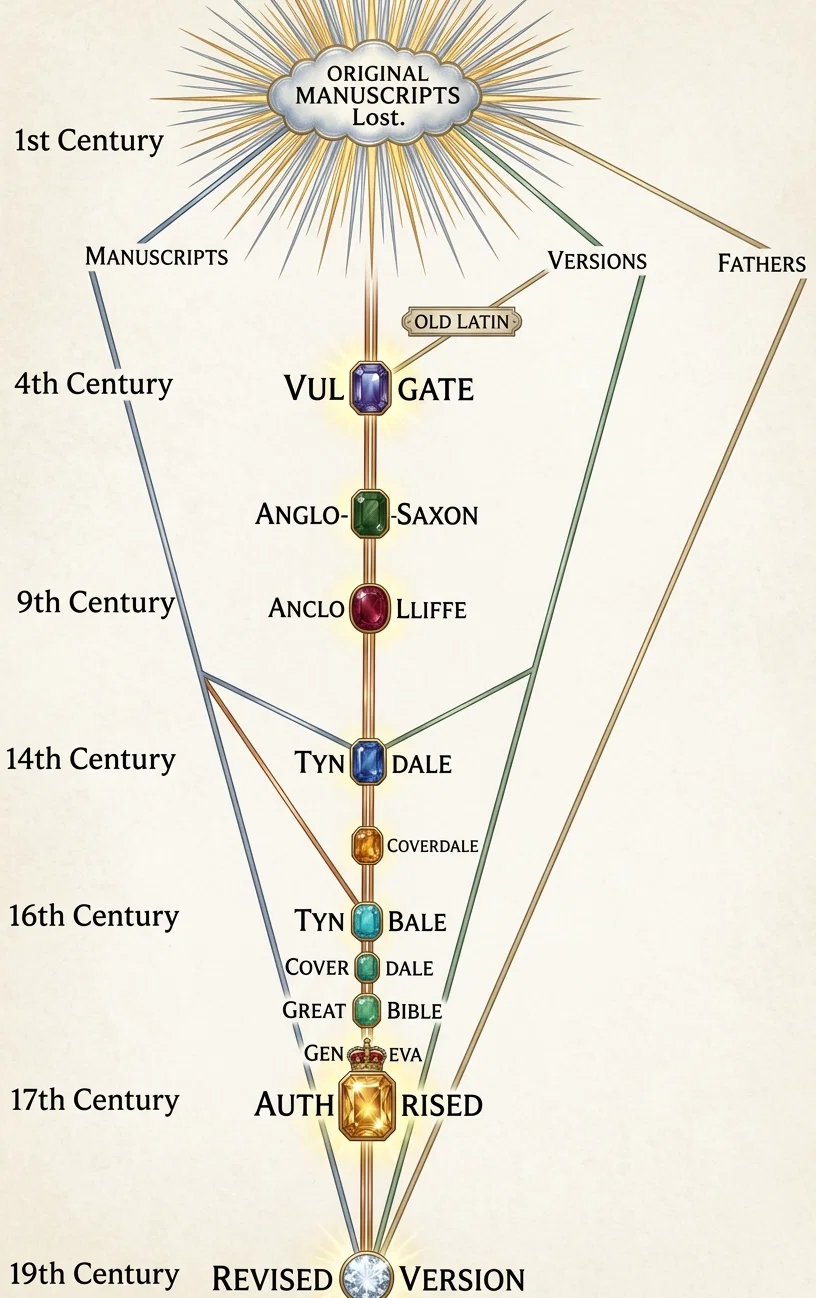
In these days of MSS. discovery and of the science of textual criticism, Protestants rejoice that they are not bound hand and foot by the church to Jerome's Latin, or to any other version merely, of the Scriptures. During the last century, ancient MSS. of the New Testament have come into the possession of scholars which antedate the translation of Jerome by fifty years or more, and which are older than the extant MSS. of Jerome's translation by over two hundred years. And while the oldest known MSS. of the Old Testament in Hebrew are not older than the ninth century A. D., they are approximately as old as the oldest Latin MSS., and there is every reason to believe that they suffered less corruption in the hands of the Jews during the first ten centuries of our era than did the Latin text of Jerome in the possession of the Western Church. The MSS. of the Vulgate differ widely from one another, and there is as yet no complete critical text of them prepared. On the other hand, all the known Hebrew or Massoretic MSS. resemble one another so closely that the best authorities agree that they represent in the main one and the same text. The greatest probability of mistake in the process of transmission was not subsequent to the time of Jerome, but before; namely, when the scribes exchanged the old round character for the square, shortly before the Christian era. As students of the law, the scribes were not simply copyists, but revisers. Yet their text, from which the Vulgate was translated, was regarded by Jerome as the “Hebrew verity.” The Massoretes aimed only to preserve for future generations the Bible text exactly as it has come down to them. Accordingly, they counted every verse (as they conceived of verses) and the words, even the letters, also, and recorded in the Talmud how often certain words and phrases and forms occurred. Jerome's Latin text, on the contrary, was, as we have seen, continually being revised and corrected by the Greek.
DIAGRAM SHOWING HOW WE GOT OUR BIBLE
In view, therefore, of such facts, writers should be careful not to exaggerate the changes which must have taken place in the Hebrew text and minimize those which actually took place in the Vulgate. The probabilities are that the Hebrew suffered far less than the Vulgate; and that the originals, and not the Vulgate, are the truer source of the Bible text.

Tyndale's Pioneer Attempt at Translating the Original Hebrew and Greek (1525 ff.)

“The history of our English Bible,” says Westcott, “begins with the work of Tyndale, and not with that of Wycliffe.” The latter, though the first, indeed, to translate the Bible into English (1382), used as his basis the Latin Vulgate. Tyndale went straight to the originals, and was perfectly capable of doing so. He had sat at the feet of Erasmus, the celebrated professor of the Greek at Cambridge; and his translation of the Bible gives evidence on every page of his superior linguistic ability, particularly in Greek. He also consulted the Vulgate, the Latin translation of the New Testament by Erasmus, and the German translation of Luther.
He lived in an age of persecution—the reign of King Henry VIII, “the most disgraceful monarch that ever sat on the British throne.” Determined to give the Bible to the common people, and knowing that he could not accomplish his purpose at home, he fled to the Continent and pursued his work in exile. He lived to see a part only of his task completed. But before he was strangled and burned at the stake, he had succeeded in translating and publishing the whole of the New Testament (1525), the Pentateuch (1530), and the book of Jonah (1531). He also translated, in prison, the books of the Old Testament from Joshua to 2 Chronicles, which were left in MS., and afterward used by Coverdale in completing his version. He also corrected and published his New Testament in two revised editions (1534-35).
The character of Tyndale's work is unimpeachable. Writing to his friend in Fryth in 1532, he says, “I call God to record against the day we shall appear before our Lord Jesus, to give a reckoning of our doings, that I never altered one syllable of God's Word against my conscience, nor would this day, if all that is in the earth, whether it be pleasure, honor, or riches, might be given me.”
Many excellences of Tyndale's translation are very wonderful. Even Geddes, a Catholic scholar, writes: “In point of perspicacity and noble simplicity, propriety of idiom and purity of style, no English version has as yet surpassed it.” To be sure, his bitter persecutor, Bishop Tunstal of London, claimed that there were some two thousand errors in his translation, but among those cited the most serious are his having employed “seniors” for “priests” or “elders,” “congregation” for “church,” and “love” for “charity.” On the whole, it is a noble translation, and as such has become the basis of every subsequent revision.

Coverdale's Completion of Tyndale's Task (1535ff.)

Coverdale finished what Tyndale, by his untimely death, left incomplete, and published the first complete printed edition of the Bible, in English. But hedid so on the basis chiefly of the German and Latin versions; and, accordingly, it is impossible to class his Bible among primary translations. He appropriated Tyndale's labors along with his own, and dedicated the whole to Henry VIII. In his dedication, he avows that he has honestly handled the Word of God. He says, “I make this protestation, having God to record in my conscience that I have neither wrested nor altered so much as one word for the maintenance of any manner of sect, but have with a clear conscience purely and faithfully translated this out of five sundry interpreters, having only the manifest truth of the Scripture before mine eyes.”
His translation, however, did not succeed in satisfying either the king or Cranmer, the Archbishop of Canterbury; for it did not obtain the king's sanction, and the work of revision went steadily on.

Matthew's Version; or the First Revision of the Protestant Bible in English (1537)

Matthew's Bible possesses very little independent value, as it consisted, with certain alterations, of Tyndale's Pentateuch, his unpublished translation of Joshua to 2 Chronicles, his version of the New Testament and the book of Jonah, and of Coverdale's Prophetic and Poetic books, with the Apocrypha. And yet, though only a composite work of the character described, it was the first version to become “authorized,” and the labors of the next twenty-five years were devoted to improving it in detail. Its merit was to present the earlier texts in a combined form. It has never exerted any independent influence upon any succeeding version; it could not, as it was wanting in originality. Two thirds of it was Tyndale's; the other third Coverdale's. Perhaps this accounts for the editor, John Rogers, adopting an assumed name for his composite production. It was essentially a transitional work.

The “Great Bible;” or the Second Revision of the Protestant Bible (1539)

The publication of the “Great Bible” marked a new epoch in Bible reading. A copy was required to be set up, with the king's authority, in some convenient place in every church in the kingdom. This version owed its origin to the zeal of Thos. Crumwell, Earl of Essex, at that time chief minister of Henry VIII, who, it seems, invited Coverdale to undertake a revised translation on the basis of Matthew's Bible, but with a more systematic collation of the Hebrew and Greek originals than had previously been attempted. Coverdale responded, and describes his mode of procedure thus: “We follow,” he writes, “not only a standing text of the Hebrews, with the interpretation of the Chaldee and the Greek; but we set also in a private table the diversity of readings of all texts.” It became the authorized version for the next twenty-eight years, and strictly speaking still remains the only “authorized” version which the Protestants have, as there is no historical proof that the King James's Version was ever formally authorized.
Seven editions were issued in rapid succession; all except the first having a preface by the Archbishop of Canterbury, and, therefore, sometimes spoken of as “Cranmer's Bibles.” It is, perhaps, not generally known that the psalter of this version is still in use, having been incorporated, on account of its charming rhythm, in the prayer-book of the Church of England (1662) in preference to the version of King James. The text, however, is far from being accurate. Insertions from the Vulgate which are no part of the original, are frequently retained, only printed in smaller type.

The Genevan Version; or the Third Revision of the Protestant Bible (1560)

Tyndale's, Coverdale's, Matthew's, and the Great Bible all belong to the reign of Henry VIII; the result practically of the labors of but two men,—Tyndale and Coverdale. The next step in the process of producing the Protestant Bible was that taken by a group of exiles, who, during the persecutions of “Bloody Mary,” fled to Geneva, and there under the influence of John Calvin translated the Bible into English from the originals throughout. Whittingham's New Testament appeared first (1557). But the exiles of Geneva were not content until they had translated the Bible entire. This occupied them for more than two years. Meanwhile Elizabeth had succeeded to the English throne, and they accordingly dedicated their translation to her (1560). They left on record an account of how faithfully they endeavored to perform their task. For the Old Testament, their basis in English was the Great Bible; for the New Testament, Tyndale's, with Beza's revised Greek text, which with all its faults was the best that was at hand. They printed their version in Roman letters, which was a vast improvement upon the heavy Gothic or black letters of former versions; divided their text for the first time into chapters and verses, introduced italics to show that certain words had no literal equivalents in the original, and produced a Bible, which, though never sanctioned formally by church or state, for seventy-five years was the household Bible of the Protestants of England. Of their version Bishop Westcott says, “It is the most important revision which our English Bible underwent before the settlement of the received text.” It passed, in all, through more than one hundred and thirty editions, and was issued as late as 1644. It was the Bible of the Puritans. Its outstanding feature is that it was the product not of a single individual with two or three assistants, but of a group of earnest revisers.

The Bishops' Version; or the Fourth Revision of the Protestant Bible (1568)

For many Anglicans the Genevan Version was too Calvinistic; at the same time, it became more and more evident that the Great Bible was not able to hold its place alongside of the new version, which was considerably more accurate. Accordingly, Archbishop Parker of Canterbury took measures to have the old translation revised. He designated certain bishops, not less than eight, and apportioned the work among them. After four years of faithful and uninterrupted labor, they completed their assignments, their work was reviewed by the archbishop, and printed, without dedication (1568). As a revision, it was based upon the Hebrew and Greek, but no changes were made in the text of the Great Bible which were not demanded by the originals. The Apocrypha was taken from the Great Bible, but left practically unrevised. Parker's design was to secure a uniform text for public use, to remove all errors, and to produce a popular, not a literary version. But the work of the bishops was of very unequal merit. Not infrequently, the changes which they made were arbitrary. Consequently, the version can not be regarded as a success. Yet it gives evidence of close study and great fairness. It succeeded, indeed, in supplanting the Great Bible, but it was not able to compete with the Genevan.
In all, about thirty editions of it were published, the last appearing in 1606. During the same period more than one hundred editions of the Genevan were issued. The second edition of the Bishops' (1572) was the immediate basis of the King James's Version.—Prof. George L. Robinson, Ph. D., in The Bible Record for November, 1905. (To be concluded)

Only One Sin

MEN with all their ingenuity and skill can not sweep the planets from the starry blue, nor blot the sun from the sky. They can not mar the handiwork of God in the heavens; but one little wound in the eye will eclipse it all, and hide these glories from our view. What men with all their ability can not efface, one little wound will hide!
Thus it is with the cross of Christ. Men may seek to annul, and infidels may ridicule, but the gospel power remains the same, and the blood of Christ can still atone. All the hosts of evil can not change the redeeming power of the cross, but one sin cherished in the heart can make the cross of Christ of none effect to that soul. What all the enemies of Christ can never do, one cherished sin may accomplish. One wound may destroy the sight, and one sin may destroy the soul. Beware of the little cherished sin! — Selected.

A Valuable Bank-Note

“My God [the banker’s name] shall supply [I promise to pay] all your need [the amount] according to his riches [the capital of the bank] in glory [the location of the bank] by Jesus Christ [the cashier’s name, without which it would be worthless].” Phil. 4: 19.

The Angel of Patience

To weary hearts, to mourning homes, God's meekest Angel gently comes: No power has he to banish pain, Or give us back our lost again; And yet in tenderest love our dear And Heavenly Father sends him here.
There's quiet in that Angel's glance, There's rest in his still countenance! He mocks no grief with idle cheer, Nor wounds with words the mourner's ear; But ills and woes he may not cure He kindly trains us to endure.
Angel of Patience! sent to calm Our feverish brow with cooling palm; To lay the storms of hopes and fears, To reconcile life's smile and tear; The throb of wounded pride to still, And make our own our Father's will!
O thou who mournest on thy way, With longings for the close of day! He walks with thee, that Angel kind, And gently whispers, “Be resigned: Bear up, bear on; the end shall tell The dear Lord ordereth all things well!”
— John Greenleaf Whittier.
Continue reading: Saving Power in the Home