O HOW sweet of Maude to send me her little plant! Let me have it here in my bed where I can see it, please, mother."
The voice which uttered the words was thin and weak, and as the mother's hands placed the tiny flower-pot within reach of her daughter, her eyes rested in tenderest love upon the wan face. The girl had evidently seen scarcely twenty years, and now was slowly but surely fading from earth. Suddenly a bright look of pleasure lit the blue eyes and the delicate lips said, hardly above a whisper, yet in an accent of unmistakable happiness,
"O, mother, it is budded and almost ready to open. See, under the highest leaf is hidden the bud almost bursting into bloom. To-morrow it will be a flower."
She lay back on the pillows and closed her eyes a few moments, but soon looked up at the face of her mother and said, "Tell me about the country and the beautiful mountains. It rests me to think of the green grass and trees and shade."
The brave little woman questioned with her own heart one moment. Could she be strong enough to talk; to tell of places and pleasures when her heart was facing the agonizing thought that perhaps e'er the morn should dawn, her loved one would be at rest and she would stand alone between the grave of her husband and the bier of her only child? Could she find words to say aught except the great cry of her torn heart? And yet—the eager eyes must not plead in vain for some glimpse into her past. No, no, to-night she must give over to the last happiness her heart could ever bestow on her loved one. To-night she would live in the comfort of her darling's presence and to-morrow—she would face the future when it came, but not now.
The struggle was but a moment, and then she stooped and kissed the white face, and, sitting down beside the bed said calmly, "Did I ever tell you about the little forget-me-not brook near your grandfather's house?"
"No, tell me mother mine," said the girl, and looked eagerly in her mother's eyes, waiting to hear the story she knew would be a restful one.
"In a field not far from the house was a plat which father set apart for a flower garden for mother and I; we had large beds of flowers, mostly old-fashioned ones. In one corner we fixed a hotbed with some old windows over it, and the pansies grew so fast there. Then farther over was a bed of blue forget-me-nots. We worked there several years, and fairly loved the plants into blossoming. But when mother was taken sick they were neglected, and in a year or two much of the beauty of the place was spoiled by weeds and grass.
"Still the forget-me-nots grew and spread out into a garden in itself, blossoming wonderfully. Then a strange thing happened. There was a brook in the field which came from a spring on the other side of the road. One day father found it necessary to repair the bridge, and in so doing the course of the brook was turned. For several reasons father liked the new course better, and he scarcely remembered that the new path lay directly through the forget-me-not patch.
"I came away soon after and when I went back a few years ago I found some forget-me-nots on the banks of the brook at least a mile from the bed. I followed along and discovered that the entire length was edged with the wild forget-me-nots, which had been washed along from the bed mother and I had planted. It was a pretty stream, so narrow in places that I could easily step over it, then widening into a shallow pool with a yellow sandy bottom, with the bright pebbles glistening where the rays of sunlight shot through the trees and touched their smooth faces. But all the way were the tiny blossoms, so I named it, 'Little Forget-me-not River.'"
"O mama, what a sweet story! I like to think about it and my little budded heartsease. Let me sleep now and dream of the flowers!"
She slept and the brave woman kept her vigil until the morning.
In the early dawn the girl awoke and asked to see again the plant and now it was in full bloom. "I'm sure it blossomed to cheer me and be a heartsease to you when I am gone. It will blossom many times and the flowers will always speak of remembrance. Do not mourn too hard for me, mother mine. My life here is but the leaves, the bud, not complete, but over there in that better world it will be the flowers. We will meet again some day and be all together. Look ahead mother, to the blossoming time."
She lay back exhausted and the heavy-hearted watcher noted how fast she was sinking away, realizing how soon the life would be yielded up to God, and the frail form would be at rest till the Master should call to the life and land where all our brightest dreams find their perfect fulfilment.
Soon the blue eyes opened again and sought the mother's face. The pale lips parted and softly came the words, "It is only a little while, mother mine, till the Master shall call to the morning of the eternal day. It is only a little while—be heart-easy, trust in Him—in Him who giveth life." Too weak to say any more she closed her eyes once more, to open them when the Life-giver should call to that land of flowers she had seen in her dream.
The blossomed heartsease was planted on her grave and as each new bud became a purple-and-gold flower the mother thought of the ones gone before and thanked our Father for the assurance of the resurrection of the dead and the hope that she might see those she had loved and lost on earth in that land where no sorrow comes.
EMMA S. BROMLEY.
LEARNING TO LIKE THE RIGHT.
By Sunday-School Times
WE can learn to like the right, tho we ought to do right whether we like it or not. And God will help us in our desire to learn to like that which we ought to like. Let no one doubt that, nor be discouraged because he finds himself sadly out of tune with, and not attracted by, the very things that he knows ought to attract him.
One who has been called one of the greatest preachers in England, and who is noted for rare spiritual power, has cried out in prayer:
"My Father, I would have a stronger appetite for the right. I turn to it reluctantly when I ought to hunger for it. I turn to it as a sick man to his food, when I ought to long for it as thirsty men seek their water. Breathe upon me, that my appetite may be restored." And that is the prayer that righteous men will have to make so long as the devil is permitted to make it his business to11seek to destroy right appetites and every right desire.
The most effective way to insure the answer to the prayer is to rise from our knees and do the right as hard as tho we really liked to do it. Doing breeds liking. Right-liking is a sure result of right-doing.
THANKSGIVING DAY.
By Frances Eugenia Bolton
The first veil of winter floats soft in the air,
The dun colors blend with the gray of the sky,
A spirit of tenderness broods o'er the mere,
To flowers and to sunshine we've said our
"Good-by."
"Hush! Hush!" seems a voice through the welkin to say,
And footsteps grow silent in soft-falling snow.
"It is time for returning and rest and to pray;
It is time for thanksgiving ere onward we go."
The bins are all bursting, the apples are stored,
The pumpkins and squashes laugh 'round in the stall,
The fagots are plenty, and loaded the board,
And the gay, merry winter is coming to all.
"Hail, friend! Hail, old comrade! Hail, relatives dear!
My heart, like my barn, is too full for my need,
Eat with me; drink with me; God gives for our cheer,
Food, raiment, love's treasures, and the fair future's seed."
Now, bowing the head, while the heart overflows,
Rememb'ring the chorus, the word, and the psalm,
Forgetting our cares, putting by all our woes,
To-day we will pour out Love's comforting balm.
Spread it out, pour it out, to the famished and sad;
Take baskets and bundles and bless every soul.
O, merry our hearts! Aye, so merry and glad,
Let the day go to joy under Heaven's control!
"We bless Thee, O Father of light and of love;
We bless Thee; we praise for December and May;
We join with the angels in anthems above,
And tune up our hearts for this Thanksgiving Day."
FRANCES EUGENIA BOLTON.
THE "BUTTER TOWER."
AMONG the magnificent Catholic cathedrals of Europe is that of Notre Dame de Rouen, in France. Its great central tower is 485 feet high, next to Cologne, the highest in Europe.
Another of its towers, 260 feet high, is called the Butter Tower. It was erected with money paid by devout Catholics who wished to use butter during Lent. They were given by the church authorities permission to do this if the money could be given to the cathedral tower. They thus paid for their butter twice, and the church reaped a harvest from their indulgence.
A LAY FROM THE OLDEN (?) TIME.
By Editor
[One of the great New England dishes, not wholly out of date, we venture to say, one of the most delicious and least harmful generally, of the many tempting edibles, was pumpkin pie. The following from Whittier's "Ode to the Pumpkin" is to the purpose.]
AH! on Thanksgiving day, when from east and from west,
From north and south, come the pilgrim and guest,
When the gray-haired New Englander sees 'round his board
The old broken links of affection restored,
When the care-wearied man sees his mother once more,
And the worn matron smiles where the girl smiled before.
What moistens the lips and what brightens the eye?
What calls back the past, like the rich pumpkin pie?
Personally Conducted
Tourist Cars
ON THE
UNION PACIFIC
Operate daily between principal Eastern points and California. The route of the Overland Limited.
S. F. BOOTH, General Agent,
San Francisco, Cal.
E. L. LOMAX, G. P. A.
Omaha, Neb.
Bank of Mountain View
By Editor
If you haven't already done so, why don't you drop us a postal asking us to send you a copy of our monthly paper, "The Bank of Mountain View Journal." It is very interesting. It is full of good ideas, and it is free to you for the asking. If you live in the East, send for a copy and see how we do it in California. We still hold ourselves ready to furnish you with information about Mountain View. Write us.
Address
Bank of Mountain View
Mountain View, Santa Clara County, California
Overland Limited
Chicago 68 Hours
Electric Lighted Equipment
World's Events Telegraphed, Train Daily
Unexcelled Dining Service
Observation---Parlor---Cafe Cars
Drawing-room---Stateroom Sleepers
Through without Change
Across Great Salt Lake and High Sierra
by Daylight
Fastest Time---Most Direct Route
VIA
Southern Pacific
SINGLE COMB BUFF ORPINGTONS. —
We breed nothing else, for we believe them to be the best. Hens, pullets, and cockerels, $2 each. Trio, $5. Eggs in season, $1.50 per fifteen. Satisfaction guaranteed. Union College Poultry Yards, College View, Neb.
Dairyman and Gardener Wanted
WANTED.—At Loma Linda, a good dairyman; also a gardener who understands all about vegetable growing. Single man preferred. Correspondence invited. Loma Linda Sanitarium, Redlands, California.
Cast Thy Bread Upon the Waters
"Cast thy bread upon the waters; for thou shalt find it after many days." Eccl. 11:1.
Love Better Than Wealth
By Solomon
BETTER is a dinner of herbs where love is, than a stalled ox and hatred therewith.—Solomon.
"TO BE SEEN OF MEN."
By A Pastor's Wife
FROM a child I always felt an unconquerable aversion to that seeming display of one's private devotion, either when a clergyman came in and kneeled in the pulpit, or when a worshiper bowed the head to the back of the forward seat. It seemed to me as if they had forgotten their closest devotion before starting from home, and that I had unwittingly entered their closet. I would suggest that this preparation service be observed at home. He who understands our thoughts afar off will accept the preparation of the heart which may be silently and unobtrusively conducted even while preparing the outward person for attendance upon public worship.
Or, if one chooses to occupy the first moments in God's house in communion with Him, let it be without any change of attitude or appearance of devotion, for our heavenly Father can hear without the bended knee, or the bowed head, or even the closed eyes. Then, indeed, shall the worship not seem to be done "to be seen of men," and the Father which seeth in secret shall approve.—A Pastor's Wife.
Sunset Magazine
By Editor
For November
Rugby Football
A clear, understandable account of Rugby Football, as played by the California Universities, appears in the November Sunset Magazine, the football coaches of both universities contributing. Illustrated.
Commercial Berkeley
Warren Cheney writes about Berkeley in the November Sunset Magazine, and tells of the remarkable strides this town is making as a business center.
California Country Houses
A fine article with the above title appears in the November Sunset Magazine, copiously illustrated with views of typical California homes.
Send It to Your Eastern Friends
10 cents per copy. $1.00 by the year. After January 1st $1.50 a year, including the handsome portfolio, in four colors, "The Road of a Thousand Wonders."
Sunset Magazine
Ferry Building San Francisco
ECUADOR.
By Thomas H. Davis
SINCE 1895, when the Liberal party took the reins of government headed by General Alfaro, evangelical work has been slowly progressing here in Ecuador. The Congregational Church has been operating here some ten years, and has a small church established in Guayaquil. They also have opened missions quite recently among the Quichua and Jivoro Indians, the former being half civilized while the latter tribes are savage.
The Methodists are doing some work also. They have a representative here in Guayaquil, and have furnished English teachers for the high schools of Quito, the capital, which works well, so Bishop Wood says, who visited them lately.
About the last of 1905 a Dunkard missionary came here from the United States, and, while on his way to work among a savage tribe of Indians, took fever and died. This man of faith, a self-supporting missionary, while making his way afoot to his field of labor, with only a few natives to attend his wants, had to give up his long desired labor, before it was really begun.
Brother G. W. Casebeer and wife and myself have just returned from a missionary trip along the coast. From Santa Rosa we took a two-days' trip to Zeruma by mule. At our first stopping place for the night, after Brother and Sister Casebeer had played and sung, I gave the small audience a talk on the soon coming of our Lord. One elderly man became much interested and bought a Bible. The next day we arrived early at the foot of the mountain which consumes about three hours in ascending to the summit. The road on the mountain is noted for its roughness.
Las Tres Esculeras (the Three Ladders) is the worst of the climb. As one man said, it is a ladder without rounds. About half way up this hill there is a brass cross placed in the side of the high embankment, where our horsemen lighted candles. On asking them what this was for they replied that it was to help them on their way. Some who do not have candles along put money in there.
As we neared the summit, which is nearly six thousand feet above the sea-level, one of the most beautiful views was presented before us. As we were above the clouds, the sun shining on them thousands of feet below, they looked like the great foaming ocean.
As now is the dry season here, we could get over the roads quite easily; however, Sister Casebeer's mule stumbled, landing her on the ground. In the winter season many a pack-mule drops down never to rise again. One man told me that on one trip, he counted forty dead pack-animals on the road.
At Portovelo, near Zeruma, where the South American Developing Company have a forty-stamp quartz-mill, Brother Casebeer preached in English on the second chapter of Daniel, showing from history how the great nations of earth, from Babylon to Rome, have fulfilled the prophecy to the letter, and that the kingdom of God will soon be set up. Sister Casebeer played our Bilhorn organ, which was appreciated in the camp, as no organ or piano had ever been taken in there.
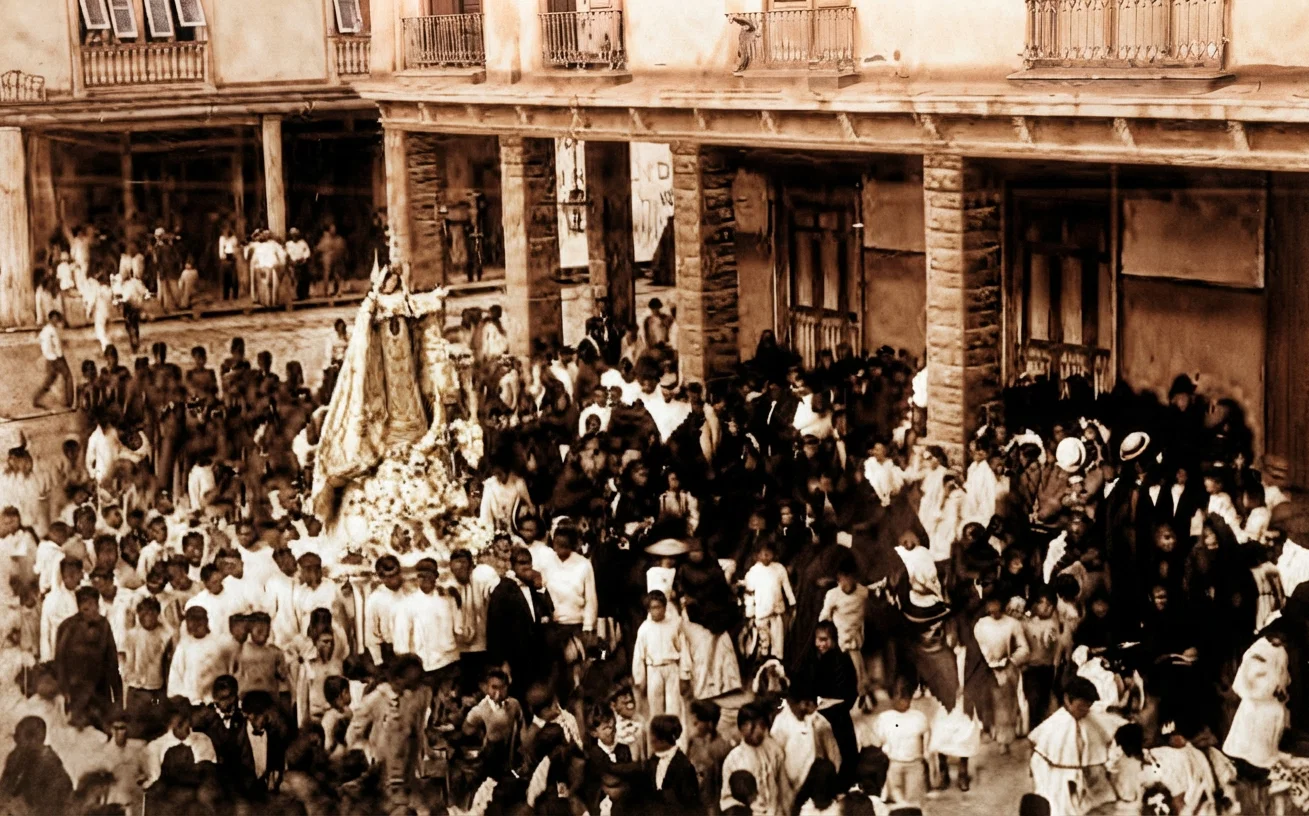
"Our Lady of Mercedes" in Procession, Guayaquil, Ecuador.
At Zeruma, where the Gospel had never entered before, we found very comfortable lodgings. After we had sold a good number of Bibles and Testaments, the priest condemned our books and work, telling the people to burn them. Most of the people, especially the women, were quite worked up over the matter. One man who had quite a large store bought a Testament, then poured coal oil on it and set it afire in the street near our quarters. Quite late in the evening the proprietor of our house sent for us and ordered us to vacate at once, as we were committing a great scandal with our Bibles. As we had nowhere to go, we saw one of the authorities, who, after an hour or two of persuasion, got consent from the
man to let us stay. We could see that the priest was losing his hold on the people, as many would come to see us and buy Bibles.
Soon after we arrived in this place there was a heavy earthquake, and we were told that the priest preached from the pulpit that we were likely the cause of it. The good Lord surely protected us as the comisario said the people were ready to stone us. A few stones were thrown, but no damage done. This is Catholicism in what is called a free republic. We surely ought to sympathize with the missionaries where Rome holds sway.
Ecuador has her doors open for the Gospel of the Third Angel's Message, and many are anxious to read our literature. I am thankful to be here, trying to get the light before the people. The largest number of orders for subscription books and the largest sale of papers I ever made in one day was here. One half-day's work gave me twenty orders for the Spanish "Patriarchs," and in one short day I sold 105 Señales, our missionary Signs of the Times for South America.
What Ecuador needs are some active Christian workers to sound the Gospel throughout this field.
THOMAS H. DAVIS.
AS OUR NEED.
By David Nelson
GREENLAND is without a forest. Do you ask, How are their habitations warmed in winter? Sailors tell us that train-oil is their fuel. Train-oil is obtained by boiling the fat, or blubber of whales. But wood is wanting. Their houses must be covered; their spears and javelins must have handles. Without domestic or hunting utensils, boats or fishing tackle, their homes can not be tenanted; without wood these things can not be made. Travelers tell us that a certain current of the ocean, or certain winds, or both united, bear along in a proper direction the once stately tree, and another and another with abundant constancy, and lodge the needed forest between the islands. There it remains until needed by those whom the Lord forgets13not. The soil does not nourish the needed oak for their convenience, but the billow obeys His voice and bears it to them.
No trees are thus borne along the shores of France, or Spain, or England, or perhaps any other nation. They are not needed, but in the frozen climes. Where these trees are torn from, or how they are swept away, we are not commonly told, and it matters not, so that the Greenlander fails not to receive his mercies. When other shores become naked, and forests wave not there, they are not supplied as is this land of snow, for ocean's current is not freighted thus with trees, or it does not bear in the right direction, or the islands do not stand so as to form a storehouse for the timber. Reader, while looking at these facts, such as are scattered all over the earth, it is evident enough that our Parent designed it all in kindness. To believe otherwise requires an appetite for untruth that no man need covet.
—Rev. David Nelson.
DUTY.
By Max Hill
WHATEVER joy may come to man in life,
Be his lines cast in paths of peace or strife,
The greatest joy that can his soul delight
Is that which comes to him from doing right.
No wrong deed leaves a satisfying calm,
Nor brings the soul a cheering, healing balm.
Tho honesty the safest course may be,
(And for that cause, perhaps, "best policy,")
We honor him who, struggling in the fight
For place with men, does right because 'tis right.
MAX HILL.
OUR WORK AND WORKERS.
By Editor
THREE members were added to the church at Atlantic City, N. J., October 27, and others were soon to follow.
SISTER Mimi Scharffenberg, of Wisconsin, will soon start on a journey to Korea, where she goes as a missionary.
THE General Conference Committee have announced that prayer-week will commence December 15, closing the 22d.
A REPORT of the meetings held at Hartford City, Ind., by Brother U. S. Anderson, says that "nineteen have embraced the truth." The meetings were being continued with good prospects.
THE Wisconsin Reporter says: "The number of SIGNS taken by our people in this state is increasing daily. Distributing this good missionary paper is a very good work. Do you take the SIGNS?"
AT Raymond, Wis., October 14, three young people were baptized by Brother L. H. Christian. It was an outdoor service, and many people were gathered to witness the solemn and imposing ceremony.
THE Southern Illinois' Herald says: "We learn that there are ten precious souls awaiting baptism at Peoria. This is the result of active missionary work on the part of the laity. Let us work as never before."
IN the Pacific Union Recorder, Brother C. D. M. Williams reports the baptism of five candidates in Honolulu, H. T. In the same paper Brother W. M. Healey notes the baptism of three persons in San Diego, Cal.
THE Southwestern Union Record notes the addition of six to the faith at Cleveland, O. T., where Brother J. B. Hampton is laboring; also a like number at Fargo, O. T., under the labors of Brother C. M. Hayhurst. Two new Sabbath-keepers are reported at Shawnee, O. T., where Sister Sophie V. Parker is doing Bible work, and two at Citra, I. T., under the labors of Brother W. E. Baxter.
BROTHER G. B. THOMPSON, of the General Conference Committee, sailed from New York on the 7th inst., for India, to attend a general meeting of the laborers in that field. At the same time Brother J. S. James and family sailed for the same destination, to engage in the book work. He has had charge of a like work in the Northern Union Conference, headquarters at Minneapolis, Minn.
BROTHER B. R. NORDYKE, who went to Kansas City, after our fire, to get editions of some of our books printed for urgent delivery, has returned to the home office. He found getting our denominational work done by the world's establishments a somewhat perplexing proposition. His experience has demonstrated the necessity of conducting our own publishing houses, in the interest of both quality of work and expedition.
THE Mountain View brethren who attended the recent council and publishers' convention at Washington, D. C., are getting back to their regular work. Brethren E. R. Palmer and A. J. S. Bourdeau arrived last week. Brother H. W. Cottrell, president of Pacific Union Conference, has not yet arrived, having been detained on business in New England, where he was formerly connected with the work.
CONCERNING the General Conference vice-presidents, Brother L. R. Conradi, who is also president of the General European Conference, recently spent some time with the German churches in Kansas, accompanied by Brother J. Riffel. He also attended the recent publishers' convention at Washington, D. C. Brother George A. Irwin is now on his way to South Africa, by way of Australia. He stopped for a few days in California, making a brief call at Mountain View.
BY private letter to Brother Robert Leo, of this office, we learn that Brother George A. King, a pioneer canvasser for our books and papers, died in New York City, November 4, of pneumonia. He was an industrious, faithful, and successful book and paper salesman. His regular order for the SIGNS OF THE TIMES was 300 per week. His co-laborers in the cause of present truth will greatly miss him. His daughter, Bertha King, had but recently sailed for India.
THE publishers of the Watchman announce a special issue, to be known as "The Signs Number," dealing with the good proposition to give the Gospel to the world in this generation. The prices are: 1 to 4 copies, 5 cents each; 5 to 24 copies, 4 cents each; 25 to 299 copies, 3 cents each; 300 or more, 2½ cents each. When mailed to lists of names, 1 to 24 copies, 5 cents each; 25 or more, 4 cents each. Order from state tract society, or the Southern Publishing Association, Nashville, Tenn. With fifty or more copies, a Watchman badge will be sent free, if desired.
BROTHER K. C. RUSSELL, of the General Conference Religious Liberty Department, urges that petitions be sent to United States Senators from all the states protesting against the passage of the District of Columbia Sunday Bill, which was laid over at the last session of Congress, and will no doubt be taken up for action at the approaching short session. Shortly before Congress took its recess last spring, the Sunday bill known as H. R. 16483, "To Further Protect the First Day of the Week as a Day of Rest in the District of Columbia," passed the House of Representatives, and is now in the hands of the Senate Committee for the District of Columbia, and may be reported and passed by the Senate at any time during the next session. Petition blanks may be secured on application by any local church to the Religious Liberty Department, Takoma Park, Washington, D. C.
IF you are not a subscriber to the Life and Health magazine, be sure to send for the November number. It is full of good things that will interest and profit you. It will only cost five cents. Address any state tract society, or Takoma Park Station, Washington, D. C.
FROM PAPEETE.
By Rosa Young
SEPT. 26, 1906.
M. C. Wilcox, Mountain View, Cal.
Dear Brother: A day after I sent you my last letter, a copy of the Review containing your telegram to the Review and Herald Office, telling of the sad calamity that befell the Pacific Press, was handed to me, when I learned for the first time of your trouble. Later I read your account in fuller detail. How my heart has been burdened for you all in the distressing trial, God only knows. I wish it were in my power to render substantial aid, but, failing that, I can ever bring you and your work on my heart before Him who is "all sufficient, in all things." "Cast down, but not destroyed" (2 Cor. 4:9), was Paul's experience. May it prove to be yours.
I have been informed by the British consul that in about a month more communication will again be opened up with Pitcairn. I shall then, the Lord willing, return home.
With deepest sympathy in your trouble, and with warm Christian love to yourself, family, and all the brethren,
Your sister in Christ,
ROSA YOUNG.
FOR SALE.
Fine fruit ranch; 10 acres in apricots, cherries, prunes, all bearing. Orchard under irrigation. Good seven-roomed house, tank house, good barn. Other general improvements. Located 2½ miles from Mountain View, Cal., on Rural Free Delivery Route. For full particulars address, care of "F," SIGNS OF THE TIMES, Mountain View, Cal.
Courage Inspires Courage
By Washington Gladden
A BRAVE man inspires others to heroism, but his own courage is not diminished when it enters into other souls: it is stimulated and invigorated.—Washington Gladden.
WANTED FOR MISSIONARY WORK.
(Always prepay postage.)
LATE, clean copies of the SIGNS, Instructor, Life and Health, Liberty, and Life Boat. Address, Mrs. H. C. Lyle, Ridgefield, Wash.
ANY of our literature suitable for a reading rack in a bath-house. Address, Mrs. Addie Draper, Claremore, I. T.
Christlicher Hausfreund Signs-of-the-Times Number
By Editor
A splendid illustrated double number of the Christlicher Hausfreund comes to our desk. This is a "Signs-of-the-Times" number of the Hausfreund, which is published by the International Publishing Association, College View, Neb., in the interests of the German-speaking people of America. It contains articles on the following subjects: "The Bible;" "The Sanctuary;" "What the Return of Christ Means;" "The Prophecies of Daniel 2 and 7;" "The Nearness of the End;" "The Signs of the Times;" "The Evangelization of the World a Sign of the Times;" "Socialism and Christianity;" "In Our Generation;" "The Eastern Question;" "The Law and the Gospel;" "The Sabbath of the Gospel;" "The Spirit of Prophecy;" "Religious Liberty;" "The State of the Dead;" "One Fold and One Shepherd. When?" "Power to Save in the Home." This is a good number to place in the hands of our German-speaking friends and neighbors. The regular subscription price of the paper is $1.00 a year. In quantities of one to ten, this special number sells for 5 cents a copy; ten or more copies, 3 cents a copy. Address Christlicher Hausfreund, College View, Neb.
WHOM CAN YOU TRUST?
By Editor
THE president of a great bank in Philadelphia squandered millions, the trusted treasurer of a great university squandered thousands. There seems to be an impoverishment of moral stamina. It is easy to say, "It is in the air," but as a matter of fact it is in the heart. When large sums of money are accessible, and large opportunities for speculation are present, then temptation reaches its highest point. It is generally understood by students of psychology that man can not stand in his own strength.
The moral tone of society gradually runs down. The vision of God, the apprehension of eternal justice—in short, all those braces and moral supports of human character fall out of place, and when the wind of temptation begins to blow, the pelting storm of allurements and enticements beats upon the character, the human house falls, and great is the fall of it. If a man kneels down daily before God and asks for the right feelings, the right spirit, the right ideals, the right temper, he is less liable to wander from the path of duty.
Men are good toward their fellow men a long time after they forget God. They do not intend to do wrong. They simply forget God. They are too weak to stand alone. This is not fatalism, but human experience. It is evident, more and more evident, that this country needs a great revival of religion. Business men will find that a system of industrialism can not stand alone. Men must have time to read the Bible, say their prayers, meditate upon what is right. They must feel a higher fellowship. The sense of God's presence must be the habitual condition of life.
We are not framing an excuse for wrong-doers, but the situation compels us to say that society does not take itself seriously. It is devoted to accumulations. It has no time, no provision for solemn and serious reflection. It has no adequate place for sacraments of life. Great, strong men go down with a tremendous crash, carrying down with them companions in business, churches, endowments, and eleemosynary institutions. This condition of society can not be changed by a city ordinance, nor yet by a legislature. The fact is, man's heart is weak. He can not stand in his own strength. God only can make and keep a man honest. The primal consciousness of moral distinction and the sense of God in the soul are one and the same. To be conscious of integrity, inward purity, is to be conscious of God.
We are not competent to say that there is no honest agnosticism. That might be too strong. This much we can say: We can not know God apart from honesty, purity, and moral conceptions. It is in these personal attributes that we know Him. Our contention is this: If we would have an honest industrialism, we must have religious conditions. God must be allowed to deal with the heart. The industrial world must intensify conscience, must personalize business. Men can not go into the wheat pit and rob and steal in an impersonal way without weakening the moral restraints of the whole fabric of society. The sense of the reality of sin and wrong is drowned in the volume and excitement of business. The blind excuse that it is not religion, but "business," is wholly inadequate. The church of Jesus Christ can prove, and will prove, the omnipotence, the deity, of Jesus Christ by a great revival of religion. What do bank presidents, university treasurers, and all the business men need? —They need a saving knowledge of Jesus Christ.
The Chronicle says: "It is useless to moralize on occurrences, nor, perhaps, can they be wholly prevented by any general laws. If we come to deal effectively with financial institutions, there is but one real safeguard, and that is publicity, which bankers abhor." That is well enough so far as it goes, as an auxiliary, but, primarily, the question is not one of methods. It is a question of character. There is a business side to religions. Men of high character, high impulses, sustained uprightness, make the best business men. It is worth while to consider that moral power is more valuable than money power. Moral values have suffered, while money values have appreciated. Philadelphia, Chicago, and San Francisco need a new conscience, a new heart. Reformers may theorize as they will, nothing in human experience has been discovered which will take the place of the sense of God in the soul. —California Christian Advocate.
Hon. Z. R. Brockway, Mayor of Elmira.
Campaign against Feathers.
By Editor
A despatch from fashion-making Paris brings good news. A league has been formed among leading ladies to discourage the use of feather trimmings on hats, especially the killing of young birds for that purpose. May the league prosper.