“What is the outlook for peace?” is a question that is anxiously asked by many. In reply it may always be said that the indications are clear, and the outlook good. “But how about the Chinese question? Can that be settled without war?” It is hard to tell. But that does not affect the general outlook for universal peace. “Yes, and there is the quarrel between Spain and the United States; certainly these countries will have to settle their disputes on the battle-field, will they not?” Well, we do not pretend to know as to that. We would not even venture an opinion. But no matter what Spain and the United States do, the universal peace is surely coming. “But have you taken into account the ‘Turkish question,’ the South American questions, the Franco-English-African question, and all the rest of the war problems?” Yes, these have all been thought of. And, notwithstanding all this din of battle preparation, it may be most positively affirmed that the universal peace is right at hand. There can be no doubt about it. It is surely coming.
“Then if all these national and international disputes are amicably settled, there will have to be some wonderful diplomacy, will there not? And statesmen must arise that can not be corrupted by money or influenced by the fear of losing their political jobs.” No, not necessarily. In fact, the universal peace that is about to come does not involve the settling of all or any of these international disputes. When the great peace and tranquillity that is never to be broken, is ushered in, all these disputes among the nations will be at their height, and yet the good times of rest from war and bloodshed come to us in a flood of light and glory, just the same.
“Well, isn’t that good! War is a horrible thing. What joy there is in being assured that we are so soon to have universal and eternal peace!” Yes, it is a cheering hope. For surely no heart that has a single spark of kindness or tenderness left in it can ever desire to see a war in these days of horribly destructive weapons.
“But can you tell us something of how this good time of peace is going to be brought about? The world looks like anything else than peace now. All of the nations are talking loudly of war. And then there is our well-nigh universal political corruption, our capital and labor disputes of the fiercest kind, etc., etc. It hardly seems possible that peace can be reasonably predicted in the face of all this turmoil and pent-up strife that seems ready to burst in fury upon the world at any moment.”
None of these questions need disturb you, friend. We have good news to tell you. The Prince of Peace is soon coming to earth again. And we are told in His Word that He will come this time, not as a babe in the manger, but as King of kings and Lord of lords. And when He comes, we know that there will be peace. For all the wicked who refuse His entreaties and warnings, and abandon themselves to the evils that make our times so perilous, will have thereby shown themselves unworthy of life. And so we are informed in the Word that all this wickedness “the Lord shall consume with the Spirit of His mouth, and shall destroy with the brightness of His coming.” 2 Thess. 2: 8. The Lord has faithfully told us that “as it was in the days of Noah, so shall it be also in the days of the Son of man.” Luke 17: 26. And of the times of Noah He tells us that “the earth also was corrupt before God, and the earth was filled with violence.” Gen. 6: 11. How literally do we see these scriptures fulfilling before us to-day! The war spirit, the mob spirit, the reckless, lawless spirit of murder and general criminality, is even now literally filling our world with “violence.” And the Lord considers the scene now even as He did in the days of Noah. Man’s wickedness and outbreaking “violence” are becoming so great that now, as in the time of the flood, the most tender, the most merciful thing for these wicked ones themselves is to destroy them.
So do not look to the politicians to straighten out the tangles in the world to-day, for too often they are influenced by the sordid desire for money and office. Do not look to the diplomats, for in too many cases the interests of the bondholder and capitalist, rather than genuine statesmanship, guides their actions. Do not look to the churches; for far too much do many professed Christians represent the world in all its vain follies and pleasures, rather than the simplicity and faithful devotion to the needs of humanity enjoined upon us by the life and teachings of the Nazarene. Do not look to the many so-called reform organizations; for they seek to uplift the world through politics, and it is folly to hope that the corrupted and corrupting political fountain can ever become a cleansing stream. No, we must trust to nothing in these times but the sure Word of God. And that Word says that “in the last days perilous times shall come. For men shall be lovers of their own selves, covetous, boasters, proud, blasphemers, disobedient to parents, unthankful, unholy, without natural affection, truce-breakers, false accusers, incontinent, fierce, despisers of those that are good, traitors, heady, high-minded, lovers of pleasures more than lovers of God; having a form of godliness, but denying the power thereof; from such turn away.” “But evil men and seducers shall wax worse and worse, deceiving, and being deceived.” 2 Tim. 3: 1-5, 13.
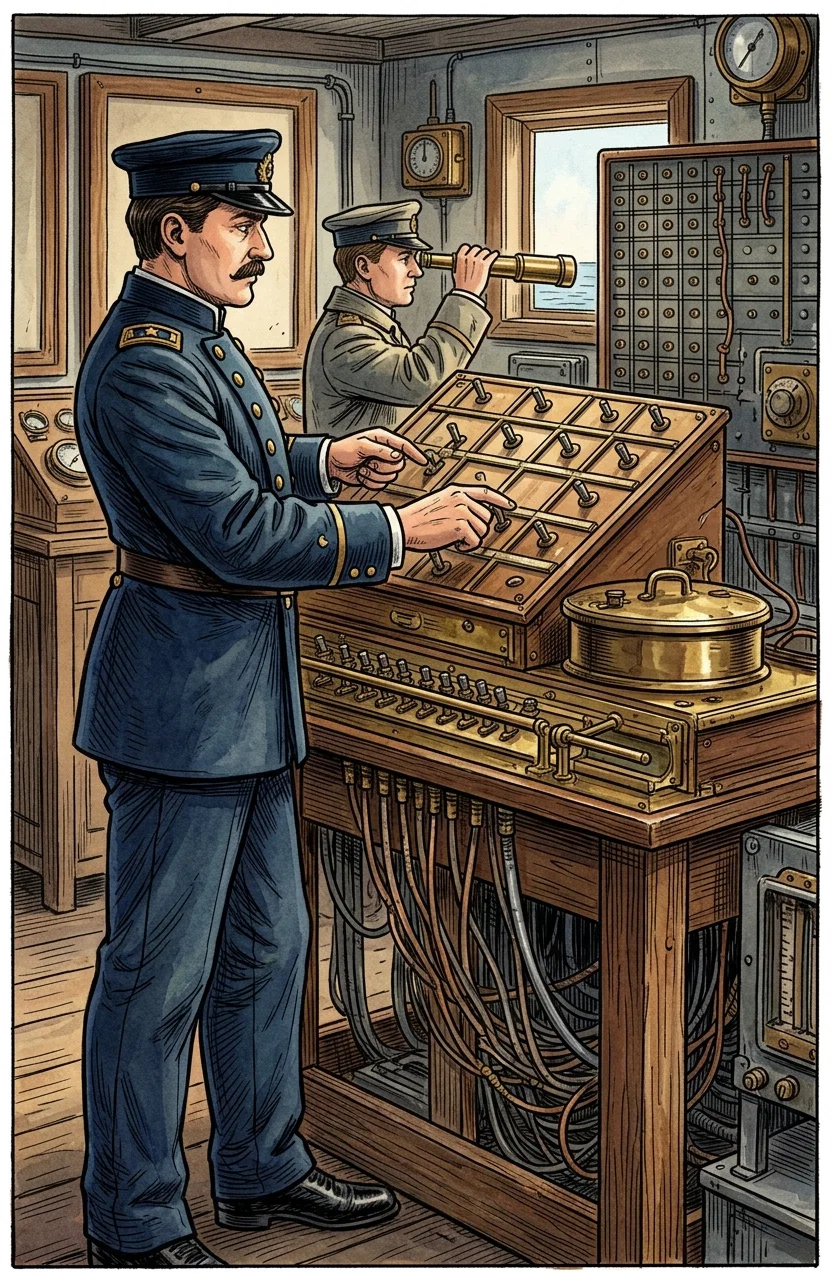
TORPEDO IS EXPLODED BY OPERATING THE SWITCH-BOARD ON SHORE CONNECTED BY WIRE WITH TORPEDO UNDER WATER.
We are surely in the “perilous times” of the “last days.” And “evil men and seducers,” upon the authority of the infallible Word, “shall wax worse and worse, deceiving, and being deceived.” So we may look to this world in vain for peace. “In the world ye shall have tribulation,” says the Master, but “these things have I spoken unto you, that in Me ye might have peace.” John 16: 33. Then there is “peace” in Jesus our Lord, even amid the tribulations of this world and in these turbulent times. Have you found that peace? If not, delay no longer, but accept it from the outstretched hand of our divine Lord.
And then the joy at the thought of His coming! He is the same tender, compassionate Saviour, and while He comes as King of kings and Lord of lords, yet He is the Prince of Peace. And while the “brightness of His coming” will destroy the wicked, the same glorious light of His immediate presence will transform His waiting and watching people into the splendor of immortal life. “Beloved, now are we the sons of God, and it doth not yet appear what we shall be; but we know that, when He shall appear, we shall be like Him; for we shall see Him as He is.” 1 John 3: 2.
Yes, we are to have peace, eternal peace. And the Christian knows it because of the peace that his Master gives him even now. Is your soul in these troublous times crying out for peace? Seek it only through the Prince of Peace; for there alone may genuine peace be found. And ever be it remembered that He is coming soon, and at that time the peace that we now enjoy in mind and heart will broaden into the blessedness of the more perfect peace when sin and sinners, with their distracting influences, will be forever a thing of the past. T.
A GREAT CHANGE IN FOUR YEARS.
By T.
“DIPLOMATICUS,” in the Fortnightly Review for February, says:— “Four years ago it was possible to speak of the Far Eastern Question as a problem reserved for our children. Indeed, even at a late date, Lord Rosebury’s eye detected it only as a shadow lurking ‘in the dim vistas of futurity.’ To-day, however, the question is already definitely posed, and the most sanguine of statesmen will not refuse to recognize that it has introduced a new peril into the field of international politics.”
Is it not perfectly evident that the nations of earth are being plunged with mad fury deeper and deeper and ever more and more swiftly into complications that involve universal war? Who could have predicted three or four years ago that the beginning of 1898 would find the whole of Europe embroiled in a quarrel over the division of the Chinese Empire? The wisest of statesmen, as indicated in the foregoing quotation, until very recently looked upon the necessity of grappling with the “Far Eastern Question” as something a very long way in the future. But how suddenly is it sprung upon the world! And what universal and portentous issues are involved in it!
And the Far Eastern Question is not the only problem that is disturbing the peace of Europe. Before this question came in to demand immediate solution, it seemed as tho the Old World had about all she could attend to in grappling with the complicated Turko-Eastern Question, together with the various more private quarrels that many of the leading nations were having one with the other. But the very suddenness with which the Chinese complications involved all Europe and threatened to embroil the whole of the world, is truly alarming. It clearly shows the pent-up spirit of war that there is in the world.
With such marked examples before our very eyes, how can any one be misled by the false idea that we are about to enter the era of universal peace? The terrible weapons that are being devised, the large armies and navies that are being built up and assembled, are colossal evidences that the spirit of this age is war, cruel, bloody war, and not peace. The Word of God plainly tells us that the “spirits of devils working miracles, . . . go forth unto the kings of the earth and of the whole world, to gather them to the battle of that great day of God Almighty.” Rev. 16:14. We need only open our eyes and look at what is pervading the world to-day to see the most literal fulfilment of this prophecy. T.
THE SUBMARINE MINE.
By T.
In these days of so much war talk frequent mention is made of the submarine mine, designed to blow up the enemy’s ship. Our illustrations give an idea of what the mine is and how by an electric wire it is exploded from the shore. The harbors in which these mines are placed are carefully mapped, and the exact location where the mine is anchored is recorded. It is let down from the side of a ship, the anchor to which the mine is attached sinking it to the bottom and holding it there.
A vessel does not have to be directly over the mine in order for it to be destroyed by the explosion. Mr. Hudson Maxim, in the Journal of the Military Service Institution, gives the distances at which some of the various high explosives would destroy a man-of-war, as follows:—
“Five hundred pounds of gun cotton will be fatal at a distance of about 38 feet; maximite and picric acid, about 47 feet; nitro-gelatin, about 54 feet; one-half ton of gun cotton, about 85 feet; one ton of gun cotton, 168 feet; while a ton of nitro-gelatin would be fatal at 250 feet.”
Something of the power that may be wrapped up in the small compass of the submarine mine can be gathered from these figures. And every fresh evidence shown in the warlike preparations of the world should be an additional incentive to lead us to work all the more diligently in presenting the glad news that Jesus is soon to come and end this strife. T.
HIS MOTHER'S SONGS.
BENEATH the hot midsummer sun
The men had marched all day;
And now beside a rippling stream
Upon the grass they lay.
Tiring of games and idle jests,
As swept the hours along,
They called to one who mused apart,
“Come, friend, give us a song.”
“I fear I can not please,” he said;
“The only songs I know
Are those my mother used to sing
For me long years ago.”
“Sing one of those,” a rough voice cried,
“There’s none but true men here;
To every mother’s son of us
A mother’s songs are dear.”
Then sweetly rose the singer’s voice
Amid unwonted calm,
*“Am I a soldier of the cross,
A follower of the Lamb?
And shall I fear to own His cause?”*
The very stream was stilled,
And hearts that never throbbed with fear
With tender thoughts were filled.
Ended the song; the singer said,
As to his feet he rose,
“Thanks to you all, my friends. Good-night.
God grant us sweet repose.”
—Anon.
WASN'T WANTED THERE.
SHE was a little old woman, very plainly dressed in black bombazine that had seen much careful wear, and her bonnet was very old-fashioned, and people stared at her tottering up the aisle of the grand church, evidently bent on securing one of the best seats, for a great man preached on that day, and the house was filled with splendidly-dressed people who had heard of the fame of the preacher, of his learning, his intellect, and goodness, and they wondered at the presumption of the old woman. She must have been in her dotage, for she picked out the pew of the richest and proudest member of the church and took a seat. The three ladies who were seated there beckoned to the sexton, who bent over the intruder and whispered something, but she was hard of hearing, and smiled a little withered smile, as she said gently:—
“But you are not wanted here,” said the sexton pompously. “There is not room. Come with me, my good woman; I will see that you have a seat.”
“Not room!” said the old woman, looking at her sunken proportions and then at the fine ladies. “Why, I’m not crowded a bit! I rode ten miles to hear the sermon to-day, because—”
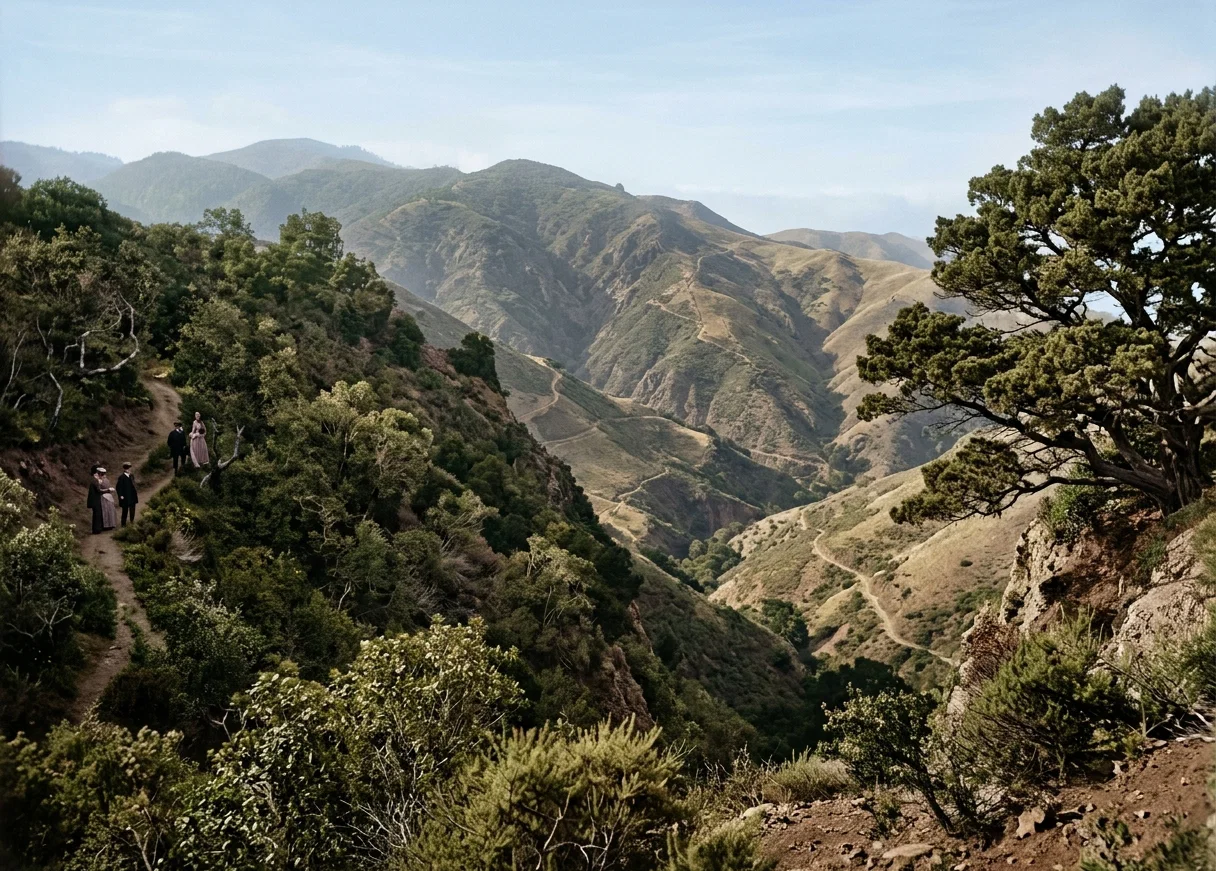
CALIFORNIA SCENERY No. 13. —We herewith present two bits of Marin County landscape. There are few, if any, sections of the world more elaborately endowed with romantic scenery than Marin County, California. It is bounded on three sides by salt water—on the
But the sexton took her by the arm, and shook her roughly, in a polite, underhand way, and she took the hint. Her faded old eyes filled with tears, her chin quivered, but she rose meekly, and left the pew. Turning quietly to the ladies, who were spreading their rich dresses over the spot she left vacant, she said gently:—
“I hope, my dears, there’ll be room in heaven for us all.”
Then she followed the pompous sexton to the rear of the church, where, in the last pew, she was seated between a threadbare girl and a shabby old man.
“She must be crazy,” said one of the ladies in the pew which she had at first occupied. “What can an ignorant old woman like her want to hear Dr. —— preach for? She would not be able to understand a word he said.”
“Those people are so persistent. The idea of her forcing herself into our pew! Isn’t that voluntary lovely? There’s Dr. —— coming out of the vestry. Isn’t he grand?”
“Splendid! What a stately man! You know he has promised to dine with us while he is here.”
He was a commanding-looking man, and as the organ voluntary stopped and he looked over the vast crowd of worshipers gathered in the great church, he seemed to scan every face. His hand was on the Bible, when suddenly he leaned over the reading-desk, and beckoned to the sexton, who obsequiously mounted the steps to receive a mysterious message. And then the three ladies in the grand pew were electrified to see him take his way the whole length of the church, to return with the old woman, whom he placed in the front pew of all, its occupants making willing room for her. The great preacher looked at her with a smile of recognition, and then the service proceeded, and he preached a sermon which struck fire from every heart.
“Who was she?” asked the ladies who could not make room for her, as they passed the sexton at the door.
“The preacher’s mother,” replied that functionary in an injured tone.
How few remember that “while man looketh on the outward appearance, the Lord looketh on the heart”!—Selected.
A LESSON IN BANKING.
“PLEASE, grandpapa, the grocer’s man has just brought his bill.”
Mr. Harding smiled upon Dorothy from the depth of his easy-chair, where he was sitting with his lame foot supported by a heap of cushions, and held out his hand for the bill. “Now, little feet and hands,” said he, after he had carefully inspected it, “you may bring me my writing tablet and pen and check-book in the drawer of my desk.”
Dorothy sprang to do his bidding. To be “feet and hands” to her grandfather during his tedious imprisonment in his room was her dearest pleasure.
When she had brought the desired materials, she knelt down on the floor beside him, and, clasping her hands together upon his shoulders, watched with eager interest while he filled out a blank check for the amount required by the bill.
“What a wonderful thing it is to be able to make money so easily!” said she.
“Do you think so?” asked her grandfather, laughing. “When you have given this check to the grocer’s man, come back and we will talk a little about that.”
“What will the grocer do with the check, Dorothy?” said he, when she was at his elbow again.
Dorothy reflected a moment. “I suppose he will take it to the bank and get the money for it,” she answered.
“Very well, my little business woman. But10suppose I had no money in the bank—what then?”
Dorothy hesitated once more. “Then they would not give him any, would they?” said she, at length.
“Right again. Then, in order to get money out of the bank—so ‘easy,’ as you were saying a minute ago—what must I have done beforehand?”
“I know, grandpapa. You must have put some in.”
“That is just what I was coming at, my dear. And because the same is true of so many things in this world beside money, it is very important, indeed, to understand it. Nobody has any right to expect to take without giving—to draw out without having put in.”
Dorothy’s face sobered, and she was silent. “What is it, girlie?”
“Think what I’m doing then, grandpa. I’m taking everything from you—my clothes, my books and playthings, my pretty room—even the food I eat every day. I have never been afraid to ask you for anything I wanted. And yet I have had nothing to give you—not so much as one little penny!”
“Ah, my child, you have not learned all about banking yet! I do not always draw from the bank the same money, or even the same kind of money, that I have deposited there. I may put in gold, and if I choose, take out silver or notes. Or, I may exchange the coin of one country for that of another, paying what is called a discount, if there is a difference in value between the two.”
“Now, what my Dorothy has stored up in the strong vault of her old grandpapa’s heart is a great treasure of gentle obedience and loving service. From such a fund as that, she may go on drawing forever, without any danger of coming to the end of it. And only think of the discount, darling! For a whole world full of gowns and shoes and knick-knacks wouldn’t be worth so much as love.”
“Love, you know, is the gold of the heavenly kingdom and the measure of value, even here on earth, among the children of the King. The Master Himself gave us two rules for its use—one, rather, since the two only state the same thing in different ways: ‘Whatsoever ye would that men should do unto you, do ye even so to them,’ and, ‘Thou shalt love thy neighbor as thyself.’”
“The gentle words that we speak, the kind deeds that we do, the sacrifices we make for others—all these are laid safely away in the bank of heaven, to come back to us in our own need. He is poor indeed who has no such hoard to draw upon!”
“But, grandpapa—”
“Yes, Dorothy.”
“God gives us everything for nothing.”
“Yes and no, my darling. It is true that in the overflow of His loving-kindness He blesses even the unthankful and the evil; yet of each one of us he asks, ‘Son, daughter, give Me thine heart.’ If we heed His voice, we need never fear want. My child, in all the universe there is nothing else so wonderful as this, that, bringing to God our hearts, with all their weakness, mistakes, sinfulness, if only our love go with them, we may draw in return upon His infinite treasures of wisdom, goodness, and power. Earthly banks may fail, and the strongest safe be broken, but he who has the heavenly riches is afraid neither of loss nor robbery.”
“I know a verse about that, grandpapa,” said Dorothy softly.
“What is it, my child?”
“Lay up for yourselves treasures in heaven, where neither moth nor rust doth corrupt, and where thieves do not break through nor steal.”
“And the next is like it,” said the grandfather, drawing the bright golden head upon his breast. “‘For where your treasure is, there will your heart be also.’”—Advocate.
We Live in Deeds, Not Years
We live in deeds, not years; in thoughts, not breaths;
In feelings, not in figures on a dial.
We should count time by heart-throbs. He most lives
Who thinks most, feels the noblest, acts the best.
—Bailey’s Festus.
REPORT OF ORPHAN HOMES AT HARPOOT, ASIATIC TURKEY.
By Mrs. Mary E. Barnum
December 16, 1897, was the first anniversary of the opening of the Harpoot Orphanages. At first we hired two houses, then two more, and then as the need increased, two more homes were thrown open in the town just at the foot of the steep Harpoot hill, making six in all, three for boys and three for girls, under our immediate care.11
In visiting these homes one is struck by the marked change in the appearance of the children. Last winter many of the children had a sickly look, and some seemed stupid. They were often ailing, or seriously sick, and five boys and two girls died. They were so enfeebled by their previous destitution as to have no power to resist disease. But now nearly all are plump and rosy, while the dull faces have brightened wonderfully, and nearly all are ambitious to learn and are making sensible progress in their lessons. The older boys devote a part of each day to shoemaking, tailoring, and carpentering, in all of which they are doing well. There are no trades for girls, but they spin, knit, sew, crochet, and help in cooking and housework.
Let us go to one of the girls’ homes on Sunday. The bell is soon to ring for Sunday-school, and we find the girls standing in a row in the yard waiting for the first stroke of the bell. They greet us by repeating in concert the golden text of the lesson.
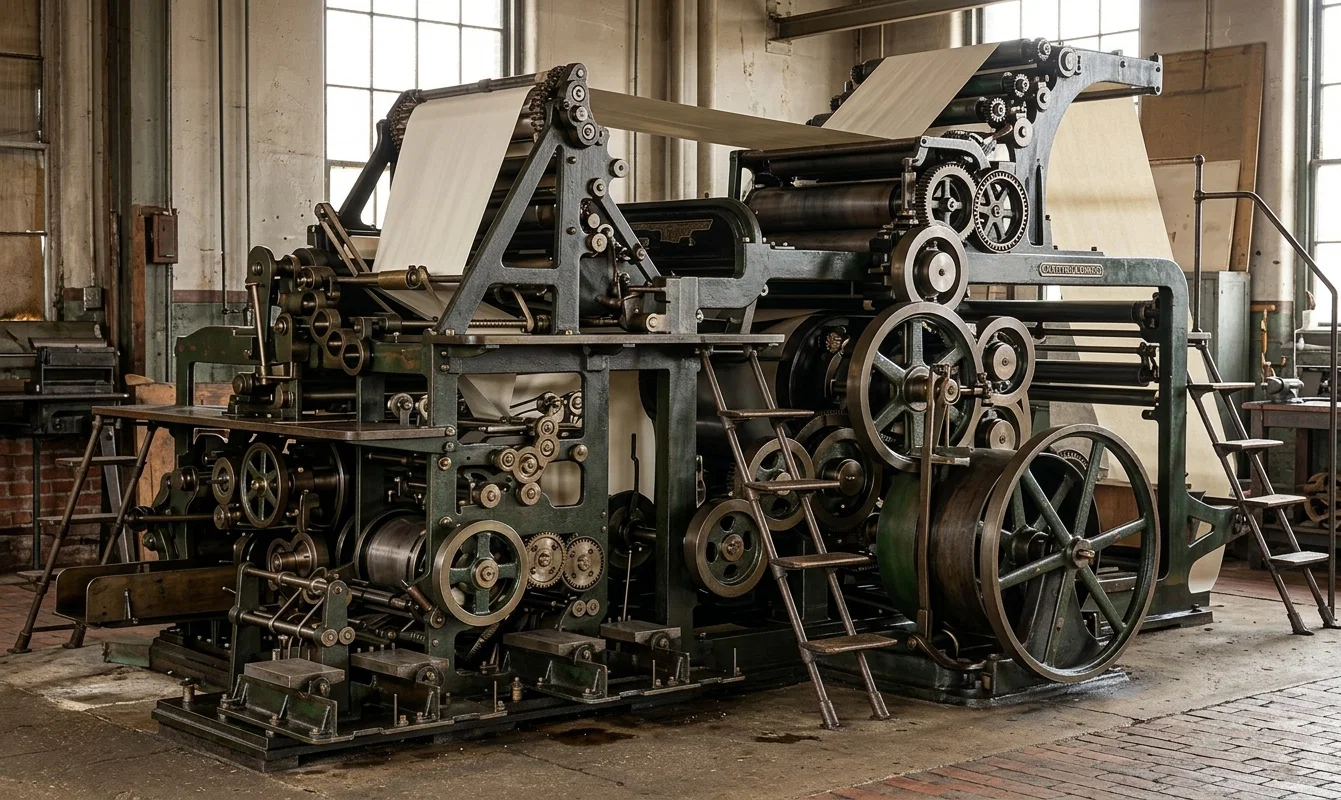
The above illustration shows our new WEB PERFECTING PRESS, built expressly for the “SIGNS OF THE TIMES” by the C. B. Cottrell & Sons Co., of New York. As will be noticed, the sheet is fed into the press from a large roll at the rear. It is then printed on both sides, folded, pasted, and trimmed, and delivered all complete at the rate of from five to ten thousand copies per hour, the grade of work determining the rate of speed. The slower the press is run the better the work appears. Curved electrotype plates are used, and special machinery not shown in the engraving was built for making these plates. This is not a newspaper press, but was built for doing the finer grades of book and periodical work. It is provided with Cottrell’s patent “shifting tympan,” a unique device for the purpose of preventing “offset.” This “shifting tympan” is so arranged that a clean sheet can be made to cover the cylinder at the will of the operator, while the press is in motion. The press is 18 feet 8¾ inches long, 11 feet 7¾ inches wide, 7 feet 7¼ inches high, and weighs 36,000 pounds, including the auxiliary machinery. It is the only press of the kind on the Pacific Coast. Presses similar to this are used on which to print some of the great illustrated journals and magazines of the east.
Now let us take a peep at them on a week-day morning. The little girl who answers our knock runs back to tell her companions, who rush out with beaming faces to give us a welcome and then quietly return to their work. They have breakfasted and are now sweeping and clearing up before going to school. One bright little damsel with a large apron is busy in kitchen work. “How are you, little head cook?” we ask, and she smiles back her answer. The “house mother” privately tells us that she is a very faithful worker. How happy they all are as they flit about, busy with their work!
Five little girls were brought to us one bitter cold day lately, with bare feet and scanty clothing. They had been there several hours and were shivering with cold. Is it any wonder that two became ill? The youngest, six or seven years old, had such a white face, with large, sad eyes; but it was delightful to see how the children who have been in the home longest crowd around the new-comers and take them under their special care.
In one of the homes is a young girl with a scarred face. Her parents were both killed, and she received a cut across her nose. She held the parts together as she fled to the house of a Turkish neighbor, and the wound was healed. One little boy of six has a misshapen head because a part of the skull was cut off with a sword. He is a dear little fellow. Another boy was wounded in two places on his head, and his left hand is disabled. Many of the parents were killed, others died from want, fear, and suffering, after the massacres, and the children were left destitute. Some have mothers who are barely able to keep themselves alive by begging, as work is not to be found. In a few cases the mothers have married again, but the step-father has been unable or unwilling to care for her children, too.
It takes money as well as time to keep these children only decently clad, and their coats and cotton tunics often show many patches. Our winters are cold, and the children must have coats and sacks. We are much indebted to the kindness of Dr. Joseph K. Greene, in Constantinople, who has interested others in sending us not only many articles of clothing, but unmade goods and colored blankets, all of which have been invaluable.
In eight cities belonging to our field we have 18 homes, with 763 boys and girls in them. And in 33 towns and villages are 354 orphans placed in private families, making a total of 1,117. Of these the Germans care for 205, the Swiss for 20, the English for 200, and America for 692.
We have received $25,000 and expended $22,295, leaving $2,705 on hand. We are deeply grateful for the gifts received. The cost this year for caring for so many children has been greater than it will probably be another year, because we have had to furnish the hired houses, and some of them needed no little repair, and we have had to provide beds and bedding for all.
God has wonderfully blessed this work. Our dependence is upon Him, while we still look to His children in Europe and America to send the needed funds. We think you will not wish us to turn out any of these orphans for lack of money.
This is a work which must continue for a number of years till the children can take care of themselves, and we think it is a work which gives much promise for the future.
MRS. MARY E. BARNUM, Matron.
NOW THE GIRAFFE.
The elephant is rapidly being exterminated; the rhinoceros and hippopotamus have already been virtually exterminated; and now the same process, for the same reason, is being applied to the giraffe. The hide of these animals, upon the upper parts, attains a thickness of an inch and from it are fashioned sandals, shields, and whips. Little could be done in the way of destroying them until firearms and horses were introduced into Africa. They are shy and suspicious. They can live for long periods without touching water. They possess considerable speed and great staying power, and can not be overtaken except by the horse. They can run all day, but if pressed beyond their speed, they become winded. The extreme height of a full-grown male is nineteen feet; that of a female, about seventeen. The animals are practically defenseless. All they can do is to “chop out dangerously with the fore feet if approached too closely,” and among themselves they butt. Like the camel, they progress by moving the two legs upon one side of the body simultaneously. A correspondent of a London paper says that a troop of giraffes in motion is, from the magnificent coloring of the creatures, their colossal stature, their strangeness, and the rarity of their occurrence, one of the most notable and extraordinary sights that the African hunter can hope to look upon. Their flesh is extremely good, something like veal, with a game-like flavor. The tongue, about twenty inches long, is good. “A giraffe marrow bone, about three feet in length, roasted over the camp fire and sawn into halves, furnishes, with the accompaniment of toast or bread, a truly epicurean repast for a couple of hungry men.”
We have seen the buffaloes disappear. We know how it is done. One day the writer saw seventeen buffaloes shot in mere wantonness from one of the early trains crossing the continent. For twenty-seven miles on that tour we were never out of sight of buffaloes, and twenty thousand at least were seen by us. Such is “the remorseless stride of man.”—The Christian Advocate.
THE CONQUEST OF THE MOMENTS.
By Anonymous
If you would make the best use of your time, look after the minutes. Keep a strict account of every hour of your time for a single week, setting down the exact manner in which every hour is spent, and see whether, when you come to review the record, you do not find it full of admonition and instruction. In this simple way one can readily understand the secret of his want of time. He will discover that he has given hours to idle talk, to indolence, and to inconsiderable trifles, which have yielded him neither profit nor pleasure. What is the remedy?—Arrange your work in order of comparative importance. Attend first to the things which are essential to be done, and let the unessentials take their turn afterwards. The difference in the amount of work accomplished will be astonishing.—Anonymous.
Confessing Ignorance to Gain Knowledge
“Do NOT be ashamed to confess your ignorance whenever you see an opportunity of acquiring knowledge.”
GOD’S WAYS ARE BEST.
By Frank D. Brown
Tho dark be thy pathway,
And clouded thy sky,
God’s love is around thee,
His presence is nigh.
No matter tho tempests
About thee may rave,
His hand holds the tumult,
His voice calms the wave.
Then trust in His mercy,
And patiently rest
On the “blessed assurance”
That “God’s ways are best.”
FRANK D. BROWN.
McCook, Neb.
“CONVERTS” TO SHINTOISM.
By W. N. G.
I. L. Atkinson, D. D., a missionary of the American Board, writes to the N. Y. Independent about a press rumor that three Americans and a German had become converts to Shintoism at Nagasaki, Japan. The German consul had been asked to inquire about a young man from his country whose parents had lost track of him, and he in turn requested Dr. Atkinson to assist him. As the name was similar to the name of the German who was said to have been “converted” to the Shinto religion, an inquiry was instituted by letter to the temple authorities.
The convert did not prove to be the man for whom inquiry was made, but the mode of conversion was incidentally found out. The men in question have Japanese wives, or housekeepers, who became adherents to the Shinto temple at Nagasaki. Each one was required to pay a fee of fifty sen—twenty-five cents—in consideration of which she was assured that through the influence of the gods thus propitiated she would be protected from sickness and other physical evils, and that the same good influence would be extended to her family. It was said to be necessary, however, that the names of all those included in this general benefit be recorded in the membership book of the temple. In this way the four men were enrolled as converts to the “ancient and celebrated” sect without their knowledge.
This manner of conversion will no doubt cause a smile on the countenance of many a Christian who may read of the incident, but it is not quite as bad as a noted means of making “Christians” in our own country. In 1893 our U. S. Supreme Court solemnly declared that “this is a Christian nation,” when less than one-third of the population were even enrolled on the temple records. So with all our boasted “Christian civilization” we can not consistently criticise the superstition of Shintoism.
W. N. G.
JOTTINGS FROM OUR HELPING HAND MISSION.
By G. W. Reaser
The first meeting at the Mission was held on Sunday evening, February 27. There was a good attendance, and a remarkable degree of interest manifested in the presentation of the Word. The text for the evening was, “Seek ye first the kingdom of God, and His righteousness, and all these things shall be added unto you.” After an earnest appeal at the close of the brief sermon, four men came forward, and expressed their determination to give themselves to the Lord. One man stated that he was deeply impressed by the words of the text, and that he had never looked at the matter of obeying the Lord from that standpoint before. He had been an intemperate man, and had tried several times to stop the use of intoxicating drinks, but had not been able to resist temptation. At one time in his experience he had remained sober for one year, and had, by industry and economy, accumulated about $1,200 worth of property, but, being urged to attend a banquet given to the president of a trade union, of which he was a member, by urgent invitation, drank wine,12and from the moment that the accursed cup touched his lips, he found it impossible to control his appetite, until his property was all swallowed up.
On the following night two came forward, both of whom seemed to make a full surrender, and get a complete victory. The testimony of one of these was that he had long desired to give himself to the Lord, but that never before could he get the courage to stand boldly for the Master. Another came, while under the influence of liquor, and in a pitiful tone of voice said, “Can God forgive, can God forgive a poor drunkard, and one that has robbed fathers of families?”
A young man lately discharged from the United States Navy, because of the expiration of his term of enlistment, came to us for assistance, and told the following story. He said that when he was paid off by the U. S. Paymaster, he had $470 in money, beside his personal effects; $300 of this amount he sent to his mother, who is a widow, and resides in the suburbs of the city of Boston. He then started out to see the sights in the city of San Francisco, and, meeting an acquaintance, was invited into a saloon, to “take a glass of beer.” Altho he was not in the habit of using strong drink, he did not like to refuse his friend’s invitation, and so reluctantly accepted. While in this Satanic den, he was drugged, and robbed of everything of value that he had on his person, including the $170 which he saved for his own use. He was a stranger to us, but we took him in, and supplied his needs. While with us he enlisted, not in “Uncle Sam’s” Navy, but in the army of the Lord. We felt that the Lord had sent him here, and our prayer is that he may prove to be a “good soldier,” and always wear the Christian’s armor. We helped him across the bay, where he hoped to secure employment, and thus be self-supporting.
Up to the present time several who came to the mission out of work, and having nothing to live on, after giving themselves to the Lord, have secured good positions, and thus realized the truthfulness of the assurance that if we seek first the kingdom of God and His righteousness, all we need will be added.