Immediately after the Saviour’s baptism and His anointing by the Holy Spirit, He began to proclaim, “The time is fulfilled.” Mark 1:15. This “fulfilled” time could be no other than that which had before been predicted as the period when the Messiah should be revealed. The only time prophecy which pointed specifically to that event was that of the sixty-nine weeks of Dan. 9:25, and therefore this particular prophecy must have been in mind when the Saviour went from His anointing to publicly proclaim the time fulfilled.
But as the sixty-nine weeks of that prophecy were to end with the anointing of the Messiah, so the seventieth week must necessarily follow on from that limit, to indicate the close of Christ’s earthly mission, and the last special privileges that mission was to confer upon the Jewish nation. The angel had told Daniel that the Messiah would “confirm the covenant with many for one week; and in the midst of the week He shall cause the sacrifice and the oblation to cease.” Verse 27.
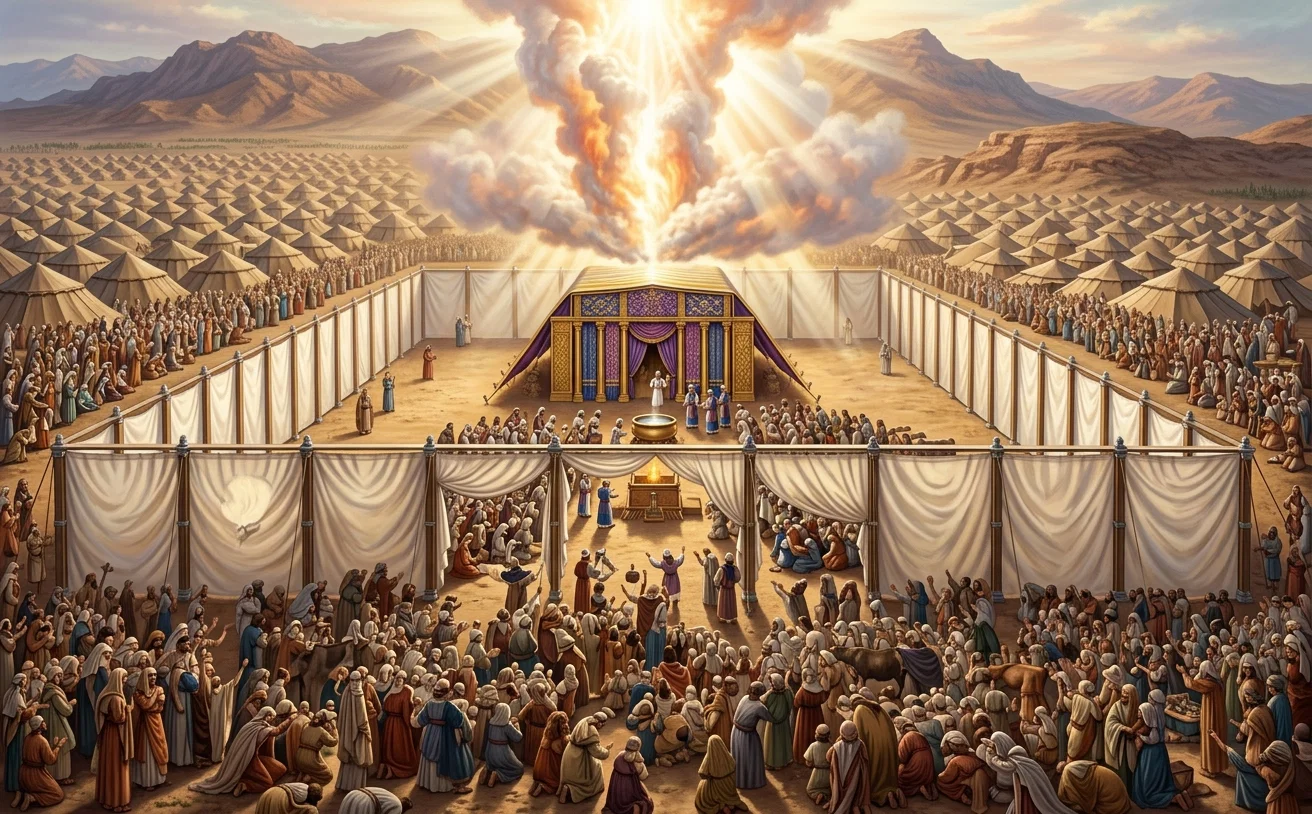
THE DAY OF ATONEMENT IN THE WILDERNESS. (See Leviticus 16.)
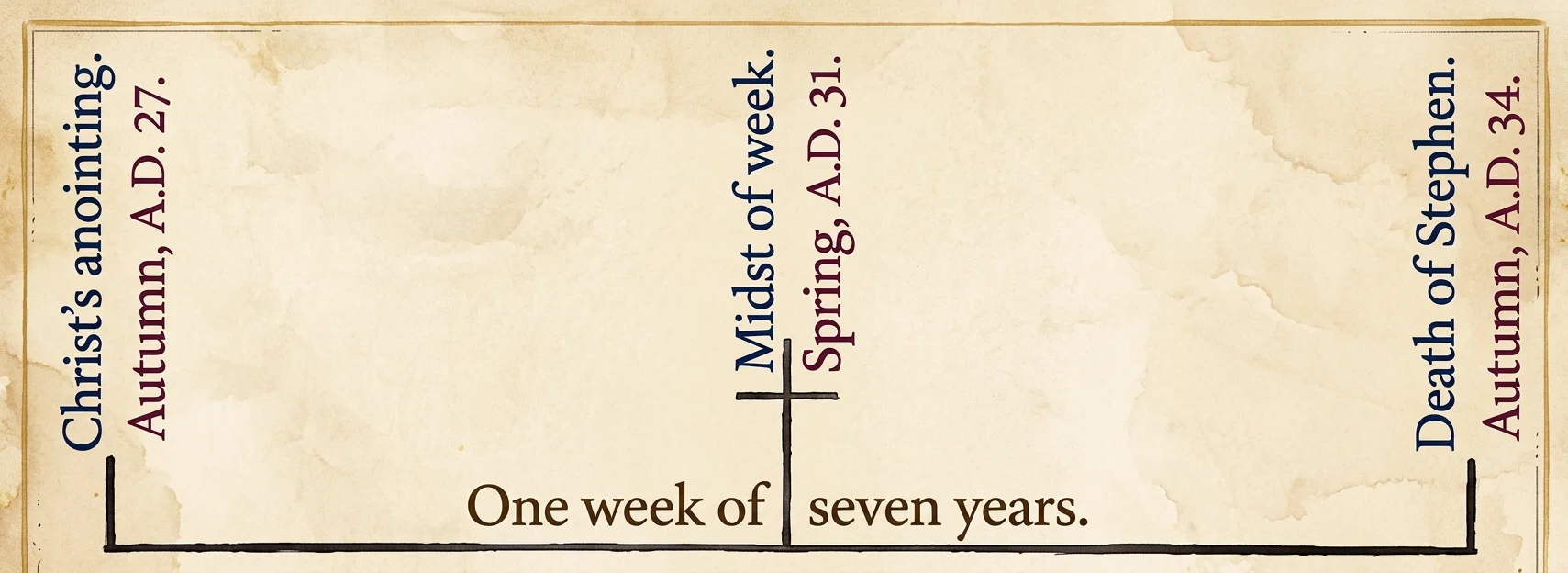
A week being composed of seven days, the “midst of the week” would occur at the end of three and a half days. The time here used being symbolic, it indicates three and a half years, at the end of which the sacrifices and oblations of the Jewish ceremonies were to be of no avail. Since these all pointed to, and were typical of, the work of Christ, which was to culminate in His death, it follows that they could be rendered obsolete only through His death. It is well understood that the earthly ministry of Christ closed at the end of three years and a half from the time of His anointing in the autumn of A.D. 27. At the fourth Passover which He attended (John 2:13; 5:1; 6:4; 13:1), in the spring of A.D. 31, He was betrayed and crucified. That this event marked the end of sacrificial offerings for sin, and the close of the earthly sanctuary service, was plainly indicated by the veil of the temple being miraculously rent in twain, as Christ yielded up His last breath on the cross. Matt. 27:50, 51.
After the death of Christ, His disciples preached to the Jews for three and a half years more, in the endeavor to confirm the work of Christ among them. At the end of this time the Jewish Sanhedrin formally rejected Christ by a systematic persecution of His followers, which resulted in the death of Stephen, and the scattering of the church. Acts 8:1. This final act of separation from Christ by the Jewish nation was in the autumn of A.D. 34. To make this matter plain, we will illustrate by a simple diagram.
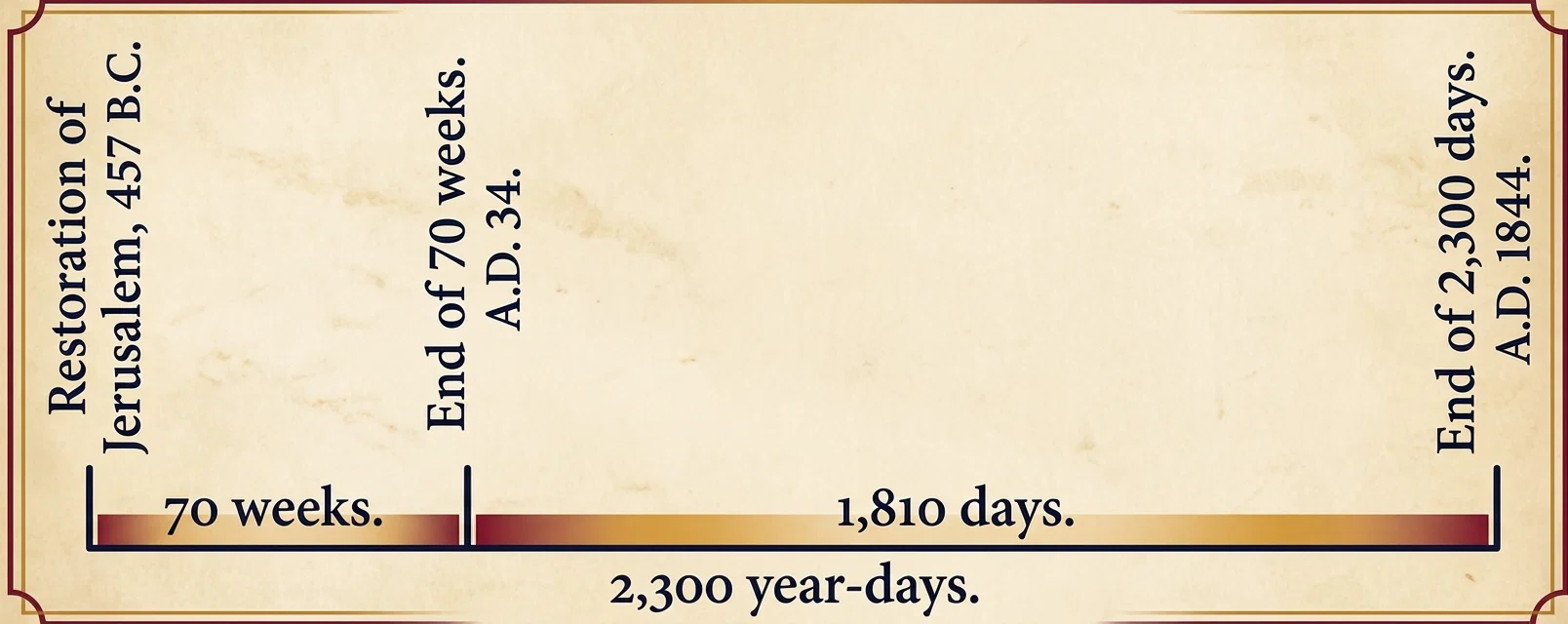
This was the close of the seventy weeks which the angel had said would be cut off from the 2,300 days, and especially given to Daniel’s people, the Jews. From that time forth full attention was to be given to another people, because the Jews had rejected the Saviour’s priesthood in their behalf. In fulfilment of the Lord’s own statement to that people, that the kingdom of heaven should be taken from them, and given to “a nation bringing forth the fruits thereof” (Matt. 21:43), the time had now come for men to be raised up and commissioned to bear the name of the Lord before Gentiles and the kings of the earth (Acts 9:15; 22:21). Referring to this point afterward, when his message was scorned by the Jews at Antioch, the apostle Paul said, “It was necessary that the Word of God should first have been spoken to you; but seeing ye put it from you, and judge yourselves unworthy of everlasting life, lo, we turn to the Gentiles.” Acts 13:46. See also Rom. 1:16 and Matt. 10:5, 6.
Thus the ending of the 70 weeks, or 490 days, of the prophecy is surely established. This time having been cut off from the 2,300 days, the close of which were to bring men to the great day of atonement, we have 1,810 days to add to A.D. 34, to introduce that solemn work. Carrying out this arrangement, we find the 2,300 symbolic days, or literal years, ending in 1844. To make this clear, let us again illustrate; see the second diagram.
The conclusion thus reached is unavoidable, new and startling tho it may at first appear. Every step in the line of thought has been carefully considered before being taken; every point in the chronological inquiry has been fortified in passing, so that there can be no other decision reached. Let us briefly review.
We have found that the atonement work of Christ was foreshadowed in the cleansing of an earthly sanctuary; that this cleansing was performed at the close of the Jewish religious year, and that a single day only was occupied in that work. It was also seen that the services of that typical day of atonement consisted in removing from the people and camp of Israel, all the sins of the year just passing, which had been confessed and borne into the sanctuary, through the body of a sacrificial offering, personally made by each sinner. The very nature of that atonement constituted it a time when every person in Israel must either have all his past sins removed, or bear them himself outside of the camp. In other words, it was virtually a day of judgment to all concerned. But all those ceremonies were the shadow of the real atonement. Whatever is shown in a shadow must appear in the substance which casts the shadow. The real atonement, therefore, is the final summing up of the world’s guilt, and placing it where it belongs. Its work must be to remove those sins from the heavenly sanctuary which have been conveyed there by personal confession, and lay them on the head of the great scapegoat, Satan, who, as the originator of sin, must bear them to their final end. But, as those sins which have not been thus taken into the sanctuary can not be included among those removed from the sanctuary in its final cleansing, they remain on the sinner, who must bear them himself, with all their consequent shame.
This final work of deciding men’s destinies began at the close of the 2,300 days of Daniel’s prophecy, or in the year 1844, as patient investigation has already proved. At that point of time the cases of men, beginning with those most ancient, have been passing under examination, in order to decide who shall be accounted worthy to obtain the better world, and a resurrection from the dead, at the coming of the Lord Jesus Christ to earth. The progress of this work will be noticed in the next paper. JOHN ORR.
The Communion of Saints
By Benson
We lose much of the joy of our heavenly expectation if we do not keep in mind the communion of saints. Our nature expands by sympathy. Miserable victims of selfishness think to find joy in isolation, and measure the possibility of happiness by that which separates them individually from other men. It seems to them as if a joy was well-nigh lost by being shared. God be praised, it is not so. There is no true joy for man but what he shares with others. It is so in time and it will be so in eternity.—Benson.
DOES IT PAY
To BE a solicitor for the Association of Our Blessed Lady of Victory? is a question asked by a little circular sent to us. And the circular gives ten reasons why it does pay. Among these our aid in propagating devotion to “the Blessed Mother of God,” caring for homeless, destitute, orphan, and wayward children, etc. (which any one may do), have the special benefit of 100 masses each at a shrine in Paris, France, and at Rome, Italy; the benefit of participating in 100 masses at each of the following places: Lourdes, France; Loretto, Italy; Knok, Ireland; Paray Le Monial, France; a participation in seven novenas offered by “Father Baker;” a high mass or requiem at death if possible; be remembered every morning of the year, and when dead, three times a week, etc., etc. Surely here are inducements enough offered for one to become a “solicitor” if the things offered are worth anything. If there is any merit in them, why are not fewer of them sufficient? The very fact that they are piled up into masses, 7 novenas, or 2,801 possible masses, 244 benedictions, and 62,000 prayers, in the aggregate 65,052 benefits, would rather indicate that these things were too cheap to be good. Perhaps these things are worth more than we in our ignorance of Protestant belief can realize or appreciate. The lot of a “solicitor” may be a hard one, and it may be worth all these benefits, novenas, masses, etc., but really does it pay?
But it does pay to believe in the Lord Jesus Christ; “believe on the Lord Jesus Christ, and thou shalt be saved.” Acts 16:31. “He that believeth on the Son hath everlasting life.” John 3:36. He “hath the witness in himself.” 1 John 5:10. O, yes, in Jesus Christ by faith we have all things, “the riches of the glory of His inheritance in the saints”! Eph. 1:18. Why turn aside from, or pass by, the life-giving, pure snow waters of Lebanon, and seek the broken cisterns of men? See Jer. 2:13; 17:13; 18:14. It pays to do God’s will, to heed God’s Word, to take the Lord Jesus Christ as a personal Saviour, into whose very presence the lowest repentant sinner can come with no creature mediator between. It pays to seek and to serve God.
“YE HAVE HEAPED TREASURE TOGETHER.”
By T.
IN recent issues of the SIGNS OF THE TIMES, attention has been called to some of the scriptures which show that the “last days” are specially characterized by covetousness, and the heaping together of treasure. The statement is positively and plainly made that “ye have heaped treasure together for the last days.” James 5:3. Language could not be clearer. There is no mistaking its import. Then one of the things by which we may positively know when we are in the “last days” is the “heaping together” of “treasure.” And this “heaping” together of treasure must be something world-wide; for all the world are to see the signs of the coming of the Son of man. And, too, it must be marked and marvelous in its proportions, so that men can clearly see it; otherwise it could not be considered a sign of the approaching end. Of course we could hardly expect that all would recognize these signs as such, for men have ever been prone to disregard the admonitions of the Lord. But this, as well as every other sign of the impending doom of the world, is nevertheless there, and that, too, in monumental prominence. And if men will only heed the voice of God in His Word, they may know of a surety when the “last days” are reached.
So let us ask, Is this scripture fulfilling about us to-day? Is there a marked and marvelous heaping together of treasure in these times? And is it becoming world-wide? If so, we have the fulfilment of one of the signs that we are in the “last days.” And if we look for the other signs given in the sure Word, and find them all fulfilling, we need not guess, but may know where we are in the world’s career of sin and sorrow. But we can only examine these signs one by one, and how is it about this “heaping together” of “treasure”?
In the Forum for November, 1889, Thomas G. Shearman, a leading lawyer of New York City, had an article entitled “The Owners of the United States.” In this article he names two estates valued at $150,000,000 each; five estates worth $100,000,000; and sixty-three others worth from $20,000,000 to $70,000,000 each. Concerning these estates, Mr. Shearman says:—
Making the largest allowance for exaggerated reports, there can be no doubt that these 70 names represent an aggregate wealth of $2,700,000,000, or an average of over $37,500,000 each. The writer has not especially sought for information concerning any one worth less than $20,000,000, but has incidentally learned of 50 other persons worth over $10,000,000, of whom 30 are valued in all at $450,000,000, making together 100 persons worth over $3,000,000,000; yet this list includes very few names from New England and none from the south. Evidently it would be easy for any specially well-informed person to make up a list of 100 persons averaging $25,000,000 each, in addition to 10 averaging $100,000,000 each. . . . The average annual income of the richest hundred Americans can not be less than $1,200,000, and probably exceeds $1,500,000.
Mr. Shearman also made the estimate that 25,000 persons own just about one-half of all the wealth of the United States.
On June 9, 1897, the Hon. Roger Q. Mills made a speech in the United States Senate in which he quoted the figures concerning the concentration of wealth from this Forum article of Mr. Shearman. Regarding the article Mr. Mills said:—
It was published and republished again in the magazines. It was published in 1889. It has never been questioned. It has been sent broad-cast; it has been commented on everywhere, and never have I heard one breath of contradiction or criticism of the article.
Thus, we see that while there has been an abundant opportunity as well as provocation to contradict the startling figures of Mr. Shearman, yet they remain uncontradicted, and without even an attempt being made to disprove their accuracy. Immediately after Mr. Mills’ speech in the Senate the New York World interviewed Mr. Shearman to ascertain if he had any reason for modifying the figures he gave through the Forum in 1889. Upon this point Mr. Shearman, as reported in the Thrice-a-Week edition of the World, June 21, 1897, said:—
The principles upon which these calculations were made have never been impeached, even by those who object most strongly to the inferences drawn. . . . Taken as a whole, my original figures were much too low.
Among Mr. Shearman’s “original figures” may be classed his article in the Forum January, 1891, under the heading of “The Coming Billionaire.” In this article he concludes that if calculation is made on the very lowest basis, some of these vast estates must reach a billion inside of the next forty years. Over seven of the forty years are now in the past, and still this great accumulation of wealth is going on with an ever-increasing ratio.
Is it not truly a striking thought that we are living in a time when money is being “heaped together” so rapidly that it may be said that the simple millionaire is no longer a marvel, and that the billionaire is in sight? Who, with these figures before him, can fail to be impressed with the fact that we are in the closing hours of time. For truly, since the “last days” are to be marked by the “heaping together” of “treasure,” there can be no evading the fact that this unheard-of amassing of wealth is a most literal fulfilment of the prophecy.
Think for a moment about what some of the foregoing figures mean. A man would need to do quite rapid work if he counted one at a time $60,000 in a day of ten hours. And at this rate the man owning $150,000,000 would require seven long years in which to count his fortune, and would have to work every day in the year at that. If his one hundred and fifty millions were all in one-dollar bills and placed end to end, they would reach about two-thirds of the way around the whole earth.
Look at the matter from another standpoint.7
The United States census of 1890 places, in round numbers, the estimated value of the property of all classes in this country at $26,000,000,000. Taken together, the two men worth $150,000,000 each actually own one-eighty-seventh part of the whole of this great republic. The five men worth $100,000,000 each, own one-fifty-second part of all the nation’s wealth, and the seven of them combined own one-thirty-second of all the belongings of this great Union.
When it can be said that seven men only actually own one dollar out of every thirty-two belonging to the whole 70,000,000 people, how much further could we expect concentrated wealth to go? And how much more is needed to show the literal fulfilment of the prophecy? And yet, outstripping these enormous figures, we are assured that the billionaire is in sight. These figures are uncontested. Every one, including many of these wealthy men themselves, are becoming alarmed over the situation. This great aggregation of wealth is a subject of much discussion and deep concern. But, regardless of every admonition, inordinate greed drives ahead in its mad career of piling up millions and ever more millions. And what is true concerning the concentration of wealth in this country, as every one knows, is true the world over.
Reader, you see the facts concerning the “heaping together” of “treasure” as they appear in the world to-day. You have these scriptures before you, telling you plainly what it all means. Now what are you going to do about it? Will you heed the warnings of God’s Word, and prepare to meet the Prince of Peace, so soon to be revealed in the clouds of heaven, or, rejecting the warnings of our heavenly Father, will you plunge into the eternal doom that is hanging over the whole world? You still have the opportunity of making the choice; be sure to make it right.
T.
AN EXAMPLE TO YOU.
ENOCH of old was born of sinful man and woman. He possessed sinful flesh, with all its sinful passions and tendencies. He was a man among other men.
But when Enoch was sixty-five years of age, perhaps before, he gave himself to God, and God accepted him. He then walked with God three hundred years, and the Lord took him home to Himself. This brief record is found in Gen. 5:21-24.
This is a message and example of encouragement to every son of man. “God is no respecter of persons.” He loves you as much as He did Enoch. He is as willing to help you as He was Enoch. He has abounding grace for you as truly as He had for Enoch. And that grace will fit you for translation as truly as it did Enoch. Enoch is an example of what God’s grace did for a man in a very wicked age. The Fountain is not exhausted now. If you think you are a greater sinner than Enoch was, He tells you, “Where sin abounded, grace did much more abound.” Rom. 5:20.
God has superabounding grace for abounding sin. Jesus Christ, the same yesterday and to-day and forever, is able “to save to the uttermost.” He is anxious that you should be translated. He waits for you to accept of His mercy and grace. How long will you have Him wait?
Question Corner
“Enquire and make search and ask diligently.”
745. “Unclean until the Even.”
Please explain the following with special reference to length of time—Lev. 11:24: “Whosoever toucheth the carcass of them shall be unclean until the even.”
Those who were unclean were considered as debarred from touching sacred things, and were shut out from the congregation. The even was sunset. See Mark 1:32.
Does Luke 6:30 mean that if any one should borrow of us and fail to return what they borrowed, that we must not ask them for it? A Subscriber.
No, it does not. If a poor man in need borrows, lend, expecting nothing in return. See verse 35; Deut. 15:7, 8. The last part of verse 30 seems to have reference to goods taken by violence, or by process of law.
Please explain: “But he that is least in the kingdom of God is greater than he [John the Baptist].”
He who participated in the work which Jesus came to do, who was with Him, heard His teaching, drank of His Spirit, was greater in point of privilege and opportunity than was John the Baptist.
Is Rev. 20:5 a proper translation? Our second probationary friends tell us that it is spurious. M. D.
This we have answered several times in the last two years. In one or two early versions it is wanting in the original, but was probably omitted by mistake. It appears in the others, and is by most eminent Greek scholars not even considered doubtful. The best and latest Greek Text of Wescott and Hort does not question. Our translation is correct.
Please explain: “Every man’s work shall be made manifest; for the day shall declare it, because it shall be revealed by fire; and the fire shall try every man’s work of what sort it is. If any man’s work abide which he hath built thereupon, he shall receive a reward. If any man’s work shall be burned, he shall suffer loss; but he himself shall be saved; yet so as by fire.” 1 Cor. 3:13-15. What is meant by “works”? Elbe.
The subject under consideration is working for God, building for Him. The church is the building; Christ is the foundation; the work done is that which gathers out material for that building; the gold, silver, and precious stones are the souls truly converted and built up in God. Those who profess but do not possess Christ’s life are well likened to wood, hay, stubble. And yet a minister who gathered out such as these who will be lost, may be honest and true, and so be saved. The foundation abides. The precious stones abide. But the wood, hay, stubble, are consumed in the day of God, the fire of which, kindled by God’s presence, will test all things.
Is this incident the origin of the Caucasian race?
It is the origin of no race; rather, it is the origin of leprosy in Gehazi’s family, and the beginning of his family’s extinction. The whiteness mentioned was the whiteness of disease.
“Enquire and make search and ask diligently.”
THE CHURCH MILITANT.
By T.
THE term “church militant” is intended to convey the thought of the church, panoplied in the true spiritual armor of heaven, and engaged in warfare against sin. And “the weapons of our warfare,” says the apostle (2 Cor. 10:4), “are not carnal, but mighty through God to the pulling down of strongholds.” And in another place the same apostle says:—
“Finally, my brethren, be strong in the Lord, and in the power of His might. Put on the whole armor of God, that ye may be able to stand against the wiles of the devil. For we wrestle not against flesh and blood, but against principalities, against powers, against the rulers of the darkness of this world, against spiritual wickedness in high places. Wherefore take unto you the whole armor of God, that ye may be able to withstand in the evil day, and having done all, to stand. Stand therefore, having your loins girt about with truth, and having on the breastplate of righteousness; and your feet shod with the preparation of the Gospel of peace; above all, taking the shield of faith, wherewith ye shall be able to quench all the fiery darts of the wicked. And take the helmet of salvation, and the sword of the Spirit, which is the Word of God; praying always with all prayer and supplication in the Spirit, and watching thereunto with all perseverance and supplication for all saints; and for me, that utterance may be given unto me, that I may open my mouth boldly, to make known the mystery of the Gospel, for which I am an ambassador in bonds; that therein I may speak boldly, as I ought to speak.” Eph. 6:10–20.
Thus the scriptures are abundant in showing that the weapons of the Christian are not “carnal,” and that the armor of God is truth, righteousness, faith, the hope of salvation, and the gospel of peace. Clad in such an armor, the disciple of Christ goes forth with the “sword of the Spirit, which is the Word of God,” to do effectual work for his Master. There is no warrant in Scripture for him to lay aside this heavenly armor and in its place take the sword and musket, and sally forth to shed the blood of his fellow-men in carnal combat.
Then how painful to the heavenly host of angels must be the scene when the professed ambassador for Christ advocates the use of the carnal sword and the slaughter of his fellow-men. He may think he is inspired by patriotism in doing it, but what has become of his loyalty and patriotism to the Prince of Peace.
The San Francisco Call makes editorial mention of a number of leading ministers, both here and in Spain, who have some very harsh things to say in connection with the present controversy between Spain and the United States. One minister in this country grew so warm that he said, according to the Call:—
I thought of writing to those patriots to say that my services in leading a regiment will be always at their command, and that I will do all in my power with them to make Spanish the prevailing language of hell.
Commenting on these clerical statements the Call says:—
Verily these followers of the Prince of Peace are “hot stuff.” . . . Officers of the army and navy are cool and circumspect. President and Prime Minister proceed along the formal and polite lines of diplomacy. Even the people plant and sow and delve and dig as usual, and wait in grim patience for the long roll of the war drums. But these of the clergy, meantime, are standing on the picket line exchanging challenges and avowing a gory thirst that seems hardly in keeping with their cloth.
Who will say that the criticisms of the Call are too severe? And who can be so deluded as to believe that we are already in the era of peace, and war forever a thing of the past, when even the professed ministers of Christ in large numbers are not educated beyond the point of clamoring for war?
Make no mistake at this time. The Bible has plainly told us that the last days are to be a time of war and not peace. And the same Word has also told us that, notwithstanding the prevailing war spirit, men in the very midst of its angry clamors will undertake to assure us that it is only “peace.” So be sure to have on the armor of God at all times, and by no means let it be exchanged for the carnal weapons, lest we be deceived and eternally ruined.
T.
Be Not Deceived
“Be Not Deceived.”— “Whatsoever a man soweth, that shall he also reap.” This is not an arbitrary law of God. It expresses a universal and righteous fact. We may deceive men, but we can not deceive God, nor destroy nor avoid the certain harvest. We may deceive men as to our past lives now, but
“Just what we are shall each neighbor know
When the King comes in.”
If we sow to the flesh, we shall reap the corruption of the flesh. If we hope in deception, we shall reap the manifold deception at last. If we sow vice, we will reap its fearful entail of corruption. But, praise God, if we sow to the Spirit, we may reap life everlasting. What are you sowing?
Noble Desires Without Action
“NOBLE desires, unless filled up with action, are but a shell of gold hollow within.”