Your ShelfYour Projects

Signs of the Times, Vol. 22, No. 24.

The Love of God

Signs of the Times

Jun 18, 1896

Pacific Press Publishing Company · Oakland, California · Jun 18, 1896

The Love of God
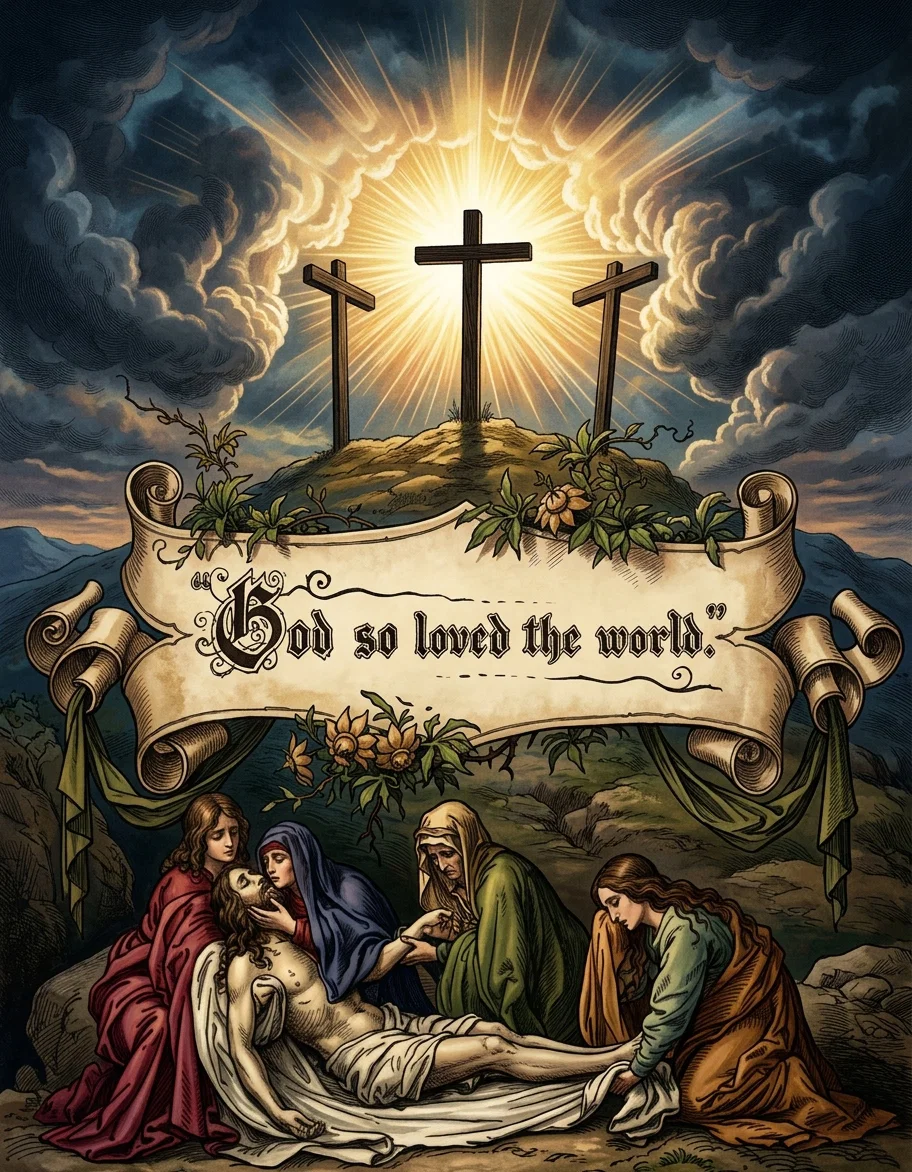
The Love of God.—“For God so loved the world, that he gave his only-begotten Son, that whosoever believeth in him should not perish, but have everlasting life.” Such is God’s love to us.
Not Words but Deeds.—Note the fact that God’s love is not transient passion, but abiding principle. It is not the whim of a moment, nor an affection for that which pleases; for God loves us, the unlovely. That love is not shown in words alone, but in deeds as well. True it is that from the beginning God has said by words that he loved man, but he said it so much louder and stronger in his wondrous works for man, in the wise and beneficent law which he gave to man, in his long-suffering and tender mercy to man in sin and rebellion! God loved man, and his love was expressed in the doing.
How Much.—But in all the early history of the race God had never said—for words alone could never tell—how much he loved man. The tenderest expressions he could use, which man could understand, our Father employed to tell his love; but when his only-begotten Son—“the Son of his love”—died upon the cross—the symbol and climax of his sufferings for the race—God then told man how much he loved him. It cost the sacrifice of the Creator of the heaven and the earth to prove God’s love. And to-day that mighty sacrifice stands as a pledge to every believer; for if God so loved us that he “spared not his own Son but delivered him up for us all, how shall he not with him also freely give us all things?” And so he has given us all things in giving Christ; “for it pleased the Father that in him [Christ] should all fulness dwell,” and “ye are complete in him.”
This is God’s love to us—love in principle, love in exercise, love in deed.
Our Love.—“We love him,” says an apostle, “because he first loved us.” If he had never loved us, we never could have loved him, nor any one else save self; and self-love, pure and simple, is hatred of all things else. “Love is of God.” He who has love must therefore obtain it from God. God’s actuating motive is love; for “God is love.” He, therefore, who would have true love must be actuated by the same principle, ruled by the same spirit. So says the Scrip tures: “Every one that loveth is born of God, and knoweth God.” But it is through the Spirit of God that we are born (John 3: 3–5), and it is through the Spirit of God brought into our hearts by faith that the love of God is shed abroad within us (Rom. 5: 5); and that love in us will be not fleeting passion or transient emotion, but abiding principle.
Manifest in Deeds.—If we have the same spirit which actuated God in giving his Son, which actuated the Son in giving himself, that same spirit will actuate us in like measure. Love in God is manifest in deed. Love in us should be the same. “My little children, let us not love in word, neither in tongue; but in deed and in truth.” That love is thus manifest in works is a proof that the love is of God; for the apostle continues: “And hereby [that is, by the fact that our love moves us to deeds] we know that we are of the truth, and shall assure our hearts before him.” (1 John 3: 19, 20.) Fruit bearing is the proof of the vine. Deeds are the proof of our love. And this fruit, these deeds, are in harmony with the righteous requirements of God. The deeds are not of our way, or according to our own selfish choice, but they must be in harmony with God’s way. “Ye are my friends if ye do whatsoever I command you.” Therefore, the beloved apostle gives us the following means for knowing our love: (1) Every one that loves God will also love the children of God. (2) The proof that we love the children of God is the fact that we keep God’s commandments. (3) And the proof of our love to him, the only true expression of our love, is the keeping of his holy precepts; “for this is the love of God, that we keep his commandments, and his commandments are not grievous.” (1 John 5: 1–3.) Reader, have you this wonderful love? If you have not, why not?
Gospel Liberty.—The “liberty of the Gospel” does not license us to commit sin. Many have a mistaken idea that the liberty to be found in Christ releases one from all obligation to keep the divine law. Such, however, but poorly understand the nature, scope, and power of the redemptive plan, and the relation that the law and the Gospel sustain to each other. When the disciple dwells in Christ, and Christ in the disciple, the law of God will be a delight, and the observance of its righteous requirements an abounding pleasure. As Christ obeyed the law while here in the flesh, so while dwelling by his Spirit in the heart of his followers will he do the same. And if his professed people are living their Christian life “by the faith of the Son of God,” it will be the natural acts of their spiritual nature to observe the law of God. David says, “I will walk at liberty; for I seek thy precepts.”
STUDIES IN ROMANS
STUDIES IN ROMANS

A GLORIOUS PERSUASION.

We come now to the close of the eighth chapter of Romans. It is the Pisgah of the epistle, for from it the eye of faith sees the promised land a certainty. Perhaps at this point a very brief summary of the ground already passed over may be profitable. The following is perhaps about as briefly as it can be put.
In the first chapter we have the theme of the epistle put in a few words. It is the Gospel of Christ, the power of God unto salvation. It is to both Jew and gentile, and has been made known to all through the works of God. The condition of men who have refused to learn of God is then described.
The second chapter shows us that at heart all men are the same; that all are to be judged by one and the same standard; and that knowledge and high profession do not in themselves recommend any one to God. Obedience to God's law is the only mark of an Israelite indeed, and an heir of God.
The third chapter emphasizes the preceding points, and especially that there are no obedient ones. “By the deeds of the law there shall no flesh be justified in his sight, for by the law is the knowledge of sin.” But there is nevertheless hope for all, because the righteousness of the law is put within and upon all who believe in Christ, so that a man is made a doer of the law by faith. One God justifies both Jews and gentiles alike through faith. Faith is not a substitute for obedience to the law, but insures the doing of it.
In the fourth chapter we have Abraham set forth as an illustration of righteousness gained by faith. We learn also that faith in Christ's death and resurrection is the only way by which to inherit the promise to the fathers, which promise embraced nothing less than the possession of the earth made new. The blessing of Abraham is the blessing that comes by the cross of Christ. And since the promise to Israel was only the repetition of the promise to Abraham, we learn that Israel consists of those in every nation who gain the victory over sin, through the cross of Christ.
Abounding love and grace, and salvation through the life of Christ, may serve as the barest outline of chapter 5.
New creatures in Christ may serve to bring to the mind of the faithful reader the main thought of the sixth chapter. It sets forth death, burial, resurrection, and life with Christ.
In the seventh chapter we learn how close is the union between Christ and believers. They are married to him, so that they are “members of his body, of his flesh, and of his bones.” The struggles by which freedom is secured from the first husband,—the body of sin,—are vividly portrayed.
The eighth chapter, the crown of the book, describes the blessings of the free-born son of God. The hope of future immortality is the actual possession, through the Spirit, of the present life and glory of Christ. Those who are in Christ are predestined to eternal glory. And thus we are brought to

The Shout of Triumph.

“What shall we then say to these things? If God be for us, who can be against us? He that spared not his own Son, but delivered him up for us all, how shall he not with him also freely give us all things? Who shall lay anything to the charge of God's elect? It is God that justifieth. Who is he that condemneth? It is Christ that died, yea, rather, that is risen again, who is even at the right hand of God, who also maketh intercession for us. Who shall separate us from the love of Christ? shall tribulation, or distress, or persecution, or famine, or nakedness, or peril, or sword? As it is written, For thy sake we are killed all the day long, we are accounted as sheep for the slaughter. Nay, in all these things we are more than conquerors through him that loved us. For I am persuaded, that neither death, nor life, nor angels, nor principalities, nor powers, nor things present, nor things to come, nor height, nor depth, nor any other creature, shall be able to separate us from the love of God which is in Christ Jesus our Lord.” Rom. 8:31–39.

Everything for Us.

The apostle has asked, “If God be for us, who can be against us?” The answer must be, “No one.” God is greater than all, and none can pluck anything out of his hand. If he who has power to make all things work together for good, is for us, then it is certain that everything must be for us.
But the question often arises in the minds of people, “Is God for us?” People often wickedly charge God with being against them; and even professed Christians sometimes think that God is working against them. When troubles come, they imagine that God is fighting against them. Now that question is forever settled by one fact, and that is, that God is he who gives himself for us, and who justifies. Read the question and answer:—
“Who shall lay anything to the charge of God's elect? It is God that justifieth. Who is he that condemneth? It is Christ that died, yea rather, that is risen again, who is even at the right hand of God, who also maketh intercession for us.”
Who shall lay anything to the charge of God's own chosen? Shall God, who justifies them? Impossible. Well, God is the only one in the universe who has the right to lay anything to the charge of any; and since he justifies instead of condemning, we must be free. We are free if we believe it. Whom does he justify?—“The ungodly.” That leaves no doubt but that he justifies us.
And what about Christ? Will he condemn us? How can he, when he gave himself for us? But he gave himself for us, according to the will of God. Gal. 1:4. “God sent not his Son into the world to condemn the world, but that the world through him might be saved.” John 3:17. He is risen again for our justification, and he is at the right hand of God for us. He interposes himself between us and the death that we have deserved. Then there is now no condemnation to them that are in Christ Jesus.
“But,” says one, “Satan comes to me and makes me feel that I am such a sinner that God is angry with me, and that there is no hope for me.” Well, why do you listen to him? You know his character? “He is a liar and the father of it.” What have you to do with him? Let him accuse all he will; he is not the judge. God is the judge, and he justifies. Satan's sole object is to deceive men, and allure them into sin, making them believe that it is right. Be sure, then, that he never tells an unforgiven man that he is a sinner. God does that by his Spirit, in order that the guilty man may accept the pardon that he freely offers.
The case then stands thus: When God tells a man that he is a sinner, it is in order that the man may receive his pardon. If God says that a man is a sinner, then he is a sinner, and ought to acknowledge it; but “the blood of Jesus Christ his Son cleanseth us from all sin.” And this is true, no matter who tells us that we are sinners. Suppose that Satan tells us that we are sinners; we do not need to parley with him, or to stop a moment to discuss the question; we can let the accusation go, and comfort ourselves with the assurance that the blood of Christ cleanses us from all sin. God doesn't condemn even when he convicts of sin; and nobody else has any business to condemn; if they do condemn, their condemnation does not amount to anything. Therefore there is no condemnation to those who trust the Lord. Even Satan's accusations may serve as encouragements to us; for we may be sure that he will never tell a man that he is a sinner, so long as that man is in his power. Since God is for us, everything is for us.

Everlasting Love.

“The Lord hath appeared of old unto me, saying, Yea, I have loved thee with an everlasting love; therefore with loving-kindness have I drawn thee.” Jer. 31:3. Since this is so, “Who shall separate us from the love of Christ?” His love is everlasting, and knows no change. And his love is for us; therefore nothing can separate us from it. Our own deliberate choice can reject it, but even then his love continues the same; only we have in that case removed ourselves from it. “If we believe not, yet he abideth faithful; he can not deny himself.” 2 Tim. 2:13.
Shall tribulation, or distress, or persecution, or famine, or nakedness, or peril, or sword, separate us from the love of Christ? Impossible, since it was in those very things that his love for us was manifested. Death itself can not separate us from his love, since he so loved us that he gave himself to die for us. Death is the pledge of his love. Sin, that separates us from God, does not separate us from his love, for “God commendeth his love toward us, in that, while we were yet sinners, Christ died for us.” “Him who knew no sin he made to be sin on our behalf; thatwe might become the righteousness of God in him.” 2 Cor. 5:21, R. V.
“Nay, in all these things we are more than conquerors through Him that loved us.” It must be so, since everything is for us. Since Christ suffered hunger, and distress, and peril, and even death itself, in order that he might deliver us, all those things are for us. It was through death that he gained the victory for us; therefore even in death we gain an overwhelming victory. Those whom Satan persecutes even to death, gain the greatest victory over him. That which seems to be a victory for Satan, is his most crushing defeat.
Behold, what a wonderful provision God has made for our salvation! It is easy enough to see that if Satan did not trouble us at all, we should be saved. If our enemy would leave us entirely alone, we should have no trouble. So on that side we are safe. But he will not leave us alone. He goes about as a roaring lion, seeking whom he may devour. Very well, God has so ordered it that even his attempts to destroy us help us along. Death is the sum of all the ills that Satan can bring upon us, and even in that we are more than conquerors through him that loved us. “Thanks be to God, which giveth us the victory through our Lord Jesus Christ.”

A Good Persuasion.

“For thus saith the Lord God, the Holy One of Israel: In returning and rest shall ye be saved; in quietness and in confidence shall be your strength.” Isa. 30:15. “For we are made partakers of Christ, if we hold the beginning of our confidence steadfast unto the end.” Heb. 3:14. Our faith is the victory. God alone is our strength and salvation. Therefore our strength consists in confidence in him. “Trust ye in the Lord forever; for in the Lord Jehovah is everlasting strength.” Isa. 26:4. So the Lord says, “Let him take hold of my strength, that he may make peace with me; and he shall make peace with me.” Isa. 27:5.
The apostle Paul had been “in stripes above measure, in prisons more frequent, in deaths oft.” He says: “Of the Jews five times received I forty stripes save one. Thrice was I beaten with rods, once was I stoned, thrice I suffered shipwreck, a night and a day have I been in the deep; in journeyings often, in perils of waters, in perils of robbers, in perils by mine own countrymen, in perils by the heathen, in perils in the city, in perils in the wilderness, in perils in the sea, in perils among false brethren; in weariness and painfulness, in watchings often, in hunger and thirst, in fastings often, in cold and nakedness.” 2 Cor. 11:24–27. Surely he is one who can speak with the authority of great experience. Hear, then, what he says:—
“For I am persuaded, that neither death, nor life, nor angels, nor principalities, nor powers, nor things present, nor things to come, nor height, nor depth, nor any other creature, shall be able to separate us from the love of God which is in Christ Jesus our Lord.”

No Fear for the Future.

Only to those who wilfully reject the love of God is there “a fearful looking for of judgment.” Christ says to us, “Be not therefore anxious for the morrow.” He does not desire that we should have our minds filled with fear and anxious forebodings. Some people can never be at rest, even under the most delightful circumstances, because they are afraid that something terrible will happen by and by. Now it makes no difference what may come, since neither things present nor things to come can separate us from the love of God in Christ Jesus our Lord. We are assured that things to come, as well as things present, are ours. 1 Cor. 3:22. Therefore in Christ we may sing:—
“Let good, or ill befall, It must be good for me,— Secure of having Thee in all, Of having all in Thee.” E. J. W.

Question Corner

“Enquire, and make search, and ask diligently.”

No. 353. Devouring Fire.

PLEASE explain the meaning of the devouring fire and the everlasting burning of Isa. 33:14. O. C. E.
These expressions evidently refer to the burning, molten earth, the lake of fire, kindled by God’s presence. See 2 Peter 3:7, 10; Rev. 20:9, 10; Mal. 4:1; Rev. 18:8; Isa. 30:33; 2 Thess. 2:8. These teach that this earth will be melted with the fervent heat; that the works marred by sin, and all who have identified themselves with sin, will be destroyed by fire; and that by God’s power this earth will be renewed, upon which “there shall be no more curse.” 2 Peter 3:13; Rev. 21:1-5; 22:3. The everlasting burning means utter destruction, even as eternal fire burned up Sodom and Gomorrah. Compare Jude 7 with 2 Peter 2:6. But the city of God, in the midst of this fire, or the people of God, within the city, will no more be affected by it than were the three Hebrews in the fiery furnace. Our God is a devouring fire to sin and incorrigible sinners, but a Saviour to his people.

No. 354. Creation of the World.

Do the Scriptures anywhere teach, either directly or indirectly or by necessary inference, that the world was created in six days? H. L. H.
To the writer’s mind, no. How long a period may be covered by the first two verses of the first chapter of Genesis we do not know. The six days of the chapter and of the fourth commandment and other passages, was the time in which God brought the cosmos, or arrangement, of that which he saw to be “very good,” out of the previously existing chaos of verse 2. “In six days the Lord made heaven and earth,” made them into the form and beauty which existed when the sixth day was complete. On the seventh day he rested and was refreshed, delighting in his work for man. But some of earth’s mightiest changes can be easily accounted for by the flood.

No. 355. Praying for Faith. “Seven Women,” “One Man.”

(1) Ought a man to pray for his faith to be increased? If so, harmonize with 2 Tim. 1:9. Did he not give us sufficient faith if we will obey? (2) Please explain, “In that day seven women shall take hold of one man, saying, We will eat our own bread, and wear our own apparel; only let us be called by thy name, to take away our reproach.” Isa. 4:1. H. D. H.
1. “Faith cometh by hearing, and hearing by the word of God.” Rom. 10:17. The more we take of God’s word, the more faith will we have. Is it not right, then, to pray with the apostles, “Increase our faith,” or with the grief-stricken father, “Lord, I believe; help thou mine unbelief.” God does not give us faith because we obey; for all true obedience is the obedience of faith. Faith is that which God has given to every man, and which every man may exercise. It is simply taking God at his word, and it is certainly proper to ask for a disposition and heart to do this more and more. 2 Tim. 1:9 is not against this. God gives us all things in Christ, in his Spirit, in his word. Faith appropriates them.
2. To our mind the women spoken of in Isa. 4:1 are symbols of the fallen churches which profess Christ’s name, but clothe themselves with their own filthy garments instead of Christ’s righteousness, and eat their own bread of tradition instead of the word of God.

No. 356. “Ought” and “Ought.”

“If I then, your Lord and Master, have washed your feet, ye ought to wash one another’s feet.” John 13:14. “We ought also to lay down our lives for the brethren.” 1 John 3:16. Does the word “ought” have the same meaning in both cases? J. F. P.
Both words come from the same Greek word, and mean the same thing. We ought—are under obligation—to wash one another’s feet, as Christ enjoined. We are also under obligation to lay down our lives for the brethren, if called upon so to do. In fact, the true Christian, he who gives his life to Christ and his cause, gives it also to all who are Christ’s. If, then, to save the lives of our fellow-men, life is necessary, lay it down. Thousands have done this in the past, and have died in various ways; thousands have done it and have died; thousands have done it—all true Christians do—and have lived, glorifying God by winning souls.

No. 357. The First-day Sabbath.

In a tract entitled “The Christian Sabbath,” by A. R. Reams, the writer says that in all instances where the term “first day of the week” is used in the New Testament, it should read (if properly translated), “the first-day sabbath,” stating that the same word that is translated “sabbath” is in these instances rendered “week” or “of the week.” By explaining this in the query column or otherwise, you will greatly oblige. J. J. H.
There are eight instances where “the first day of the week” occurs in the New Testament, and that the expression is a correct rendering of the original is attested by the Revised Version, and many other translations made by Sunday observers, but who felt that no honest rendering could be made to support a first-day sabbath. For the critical reasons see Bible Students’ Library, No. 142, entitled, “Is Sunday Called the Sabbath in the New Testament?” by U. Smith.

No. 358. The Comforter.

PLEASE explain John 16:7. What is the “Comforter”? and how was it “expedient” for Jesus to go away that the Comforter might come? TRUTH SEEKER.
The Comforter is the “Spirit of truth,” the “Holy Ghost.” See John 14:17, 26. Christ was the manifestation of God to the world. As long as he was here, no one could take his place. The disciples would not receive the invisible presence as long as Christ’s visible presence was manifest. This was illustrated in Christ’s work. The dearest disciples of Christ believed that his bodily presence was necessary in order to work miracles. “Lord, if thou hadst been here, my brother had not died.” John 11:21, 32. The Roman believed that Christ’s word had power to work, or heal or restore, tho he were far away. Concerning that faith Jesus said, “I have not found so great faith, no, not in Israel.” Matt. 8:10. It was therefore expedient that Jesus should go away, that his disciples might know and realize his omnipresent, Spirit, life, and power. The larger faith could only be developed by the unseen Monitor. They must believe in Christ’s spiritual presence and power, even tho they could not see him.

No. 359. “All These Things.”

Does not “all these things,” spoken of in Matt. 24:33, include the “distress of nations, with perplexity; the sea and the waves roaring; men’s hearts failing them for fear,” etc., spoken of in Luke 21:25? And does not “this generation” of Matt. 24:34 mean those who see the present distress of nations and the following signs?
Undoubtedly “all these things” includes all the signs spoken of by our Lord as signs of his coming in his discourse at that time. See SIGNS No. 20, page 4, question No. 339, where it is stated that “these signs—all these things—are set forth in Matt. 24:12-14, 24-26, 29; Mark 13:22-25; Luke 21:25, 26.” This includes the things referred to above. The generation includes those who see these things in the light of the prophecy, those who know God’s last message, and give it to the world.

THE CORONATION.

BY H. P. H.
The czar of Russia is about to be crowned at Moscow. Great preparations for the event are being made at Moscow, one of Russia’s “sacred cities.” Governors or their representatives will be present from every province; ministers, consuls, prime ministers, princes, and rulers of the leading nations of the world, besides a host of others, will be present. This will doubtless be the greatest assemblage the world has seen on such an occasion.
But in the near future another coronation is to take place, which will far eclipse this one. The invitations are already out, and are being sent to all the world; not only the leading nations but every people and tribe are invited; not only rulers and high-titled persons are expected to attend, but “whosoever will” may come. The one to be crowned is the “King of kings and Lord of lords.”
The coronation scene is thus described:—
“I beheld till the thrones were cast down, and the Ancient of Days did sit, whose garment was white as snow, and the hair of his head like the pure wool; his throne was like the fiery flame, and his wheels as burning fire. A fiery stream issued and came forth from before him; thousand thousands ministered unto him, and ten thousand times ten thousand stood before him; the judgment was set, and the books were opened.” “I saw in the night visions, and, behold, one like the Son of man came with the clouds of heaven, and came to the Ancient of Days, and they brought him near before him. And there was given him dominion, and glory, and a kingdom, that all people, nations, and languages, should serve him: his dominion is an everlasting dominion, which shall not pass away, and his kingdom that which shall not be destroyed.” Dan. 7:9, 10, 13, 14.
In connection with this glorious coronation, there will be a wedding; before this is celebrated, the King, with his many thousands of brilliant attendants, will come in great glory to this earth to assemble the guests that have been invited; for they must have a part in the marriage of the King. The wedding takes place in Zion, the golden city of God. Overjoyed at the glorious event and happy future, the invited guests “come with singing unto Zion; and everlasting joy shall be upon their heads; they shall obtain gladness and joy, and sorrow and sighing shall flee away.”
When the King in all his glory reaches the earth, then “he shall send his angels with a great sound of a trumpet, and they shall gather together his elect from the four winds, from one end of heaven to the other.” At this great sound of the trumpet, they “shall all be changed, in a moment, in the twinkling of an eye,” from the corruptible state of sinful flesh “like unto his glorious body;” then they “shall be caught up together . . . . . in the clouds, to meet the Lord in the air.” Together this happy company sweeps through boundless space, past planets and stars, till the heavenly city is reached. Then they call out, “Lift up your heads, O ye gates; and be ye lifted up, ye everlasting doors; and the King of glory shall come in.” Here an unusual scene takes place. All the guests are given a “crown of glory.” The King says: “Come, ye blessed of my Father, inherit the kingdom prepared for you from the foundation of the world.” Then they burst forth in “a new song, saying, Thou art worthy; . . . for thou wast slain, and hast redeemed us to God by thy blood out of every kindred, and tongue, and people, and nation; and hast made us unto our God kings.” Then is “heard the voice of many angels round about the throne; . . . and the number of them was ten thousand times ten thousand, and thousands of thousands; saying with a loud voice, Worthy is the Lamb that was slain to receive power, and riches, and wisdom, and strength, and honor, and glory, and blessing.”
When the coronation and marriage are finished, the marriage supper takes place. A glorious supper it will be! All the delicious fruits of Eden will be there. And now the most wonderful scene of all takes place; the King “shall gird himself, and make them to sit down to meat, and will come forth and serve them.” How different from earthly coronations!
The czar needs 200,000 soldiers to guard him against his enemies, and a host of trained men to serve him, and he alone is crowned. But in the heavenly coronation, every being in existence praises the King; and well they may; for he furnishes a robe of righteousness and a crown of glory to every one that comes to the wedding, and takes them up into his throne, to share it with him. O, “blessed are they which are called to the marriage supper of the Lamb!”
This glorious event is near at hand. It is no fiction; it is solid fact, because it is God’s word; heaven and earth would pass before one word of the Lord could fail. The invitation is to everybody to-day. Who will come? “Blessed are those servants, whom the Lord when he cometh shall find watching.”
Continue reading: The 2,300 Days