Your ShelfYour Projects

Signs of the Times, Vol. 40, No. 8.

Our Bible Band

Signs of the Times

Feb 25, 1913

Pacific Press Publishing Association · Mountain View, California · Feb 25, 1913

Our Bible Band

Schedule for the Week Ending March 1, 1913

Day Month Date Reading
Sunday February 23 Leviticus 11, 16
Monday " 24 " 17, 19
Tuesday " 25 " 23
Wednesday " 26 " 25
Thursday " 27 " 26
Friday " 28 " 27
Sabbath March 1 Psalms 19, 20, 21
We begin with Leviticus 11. We omit chapters 12-15, inclusive; also 18, 20, 21, 22, and 24, closing with the last chapter of Leviticus. Some of these are a repetition of ecclesiastical laws and ceremonies. All of them contain food for thought and meditation; but to those who wish to pass more rapidly, we have omitted them, giving some of the greater essentials in the chapters noted. Leviticus 23 brings before us all the yearly sabbaths and feast days; Leviticus 16 and 23 both note the day of atonement and the sacrifices upon that day; Leviticus 25, the jubilee year; and Leviticus 26, some very solemn warnings from God, emphasized over and over again, of the calamities that would come upon that people if they rejected Him. In Leviticus 27 the law of tithing is presented. We close the week with Psalms 19, 20, and 21. The 19th psalm ought to be learned by every Christian, if possible.

Question Corner

"IF YE WILL INQUIRE, INQUIRE YE."

This Inquirers' Department is conducted for the purpose of helping those who are studying the Bible. The answers are oftentimes only suggestive. They are never to be considered infallible, only as they agree with the infallible Word. The writer who may answer them does not consider that his opinion is infallible. He will simply give the best that he has, and plead with the inquirer to search the Word. Such questions only will be answered as, to the editors, seem to minister to the good of the readers and to the mission of the paper. We can not answer repeatedly in the same volume questions upon the same scripture. The name and address must accompany question, not for publication, but as an evidence of good faith, and that answer may be made by letter if deemed advisable. No letters are answered which do not contain the name of the writer. It is well always to enclose stamp for reply.

3998 — Private Interpretation

Please explain 2 Peter 1:20. What is meant by “private interpretation?” J. F.
It means that no prophecy is to be taken by itself alone. It is to be compared with other prophecies, other symbols. Only so can the unity of prophecy be established and held. For instance, the four beasts of Daniel 7 are symbolized again in the one beast of Revelation 13. The great sea of Dan. 7:2 is also reechoed in Rev. 17:15, in “the waters.” To endeavor to explain one prophecy entirely by itself alone, without regarding the parallel prophecies, is private interpretation, special interpretation, arbitrary interpretation, really vicious interpretation, that which has given rise to the multitude of theories that there are abroad at the present time. Rotherham's rendering of the passage is excellent in explaining it: “Of this first taking note, no prophecy of Scripture becometh self-solving.”

3999 — Urim and Thummim

It was said in an article of the “Signs of the Times,” some time ago, that the Urim and Thummim were two brilliant stones in the breastplate of the priest, and that the mind of God could be ascertained through them. The writer stated that this was indicated by light which encircled the precious stone, with the affirmative answer given by the stone on the right side, and the negative answer by the stone on the left. H. W.
There certainly was some way by which these were used, and which clearly revealed the will of God. See 1 Sam. 28:6; Ezra 2:63; also Num. 27:21. The “Bible Cyclopedia,” by Fausset, says that “The Speaker's Commentary” thinks that lots were the mode of consultation, as in Acts 1:26, Prov. 16:33; more probably stones with Jehovah's name and attributes, “lights” and “perfections,” engraven upon them. By gazing at them the high priest, with ephod on, before the Lord, was absorbed in heavenly, ecstatic contemplation, and by God was able to declare the divine will. The article in the “Signs” probably states the thing as nearly correct as anything could be. The “Popular and Critical Bible Encyclopedia” says that one of the opinions is that these precious stones are so called from their brilliancy and perfection, which stones, in answer to an appeal to God in difficult cases, indicated His mind and will by some supernatural appearance.

4000 — Patriarchs and Polygamy

Why were the patriarchs allowed to live in polygamy, a thing that is a stench to every true Christian? Look at Solomon, the man of great wisdom. See 1 Kings 11:1-3. T. E. W.
God has suffered a great many things on account of poor, human blindness and wilfulness. He has seemed almost sometimes to shut His eyes to these things, and yet the record of His Word shows that where men transgressed in this way it always brought its own trouble. God's original plan was the one wife and the one husband. This is clearly shown in the creation of man. God did not make them male and females, but male and female. He gave man one wife, and said, “For this cause shall a man leave father and mother, and shall cleave [not to his wives, but] to his wife.” And yet polygamy came in. One of the reasons why it crept in was doubtless because of war. Very many of the men were killed, and the women were left; consequently, one man took more than one wife. The second reason why it came in was doubtless because of lust. But it seems to have become a universal custom, and God's people fell into the universal custom, contrary to His original plan and contrary to His command; and especially as regards kings. Jacob's whole life was embittered more or less by the differences that crept in because of his two wives. Isaac seems to have passed one of the happiest of lives, notwithstanding his trouble between his two sons. He had the one wife. Solomon's kingdom was broken up because of jealousies and troubles; and David had more than his cup of sorrow because of multiplying wives to himself. Yet multiplied legitimate wives is a good deal better than the unbridled licentiousness that obtains in many places at the present time. However, there is no excuse for sin at any time, in any way. God knows the heart, and He knew the heart of His people; and if He suffered them to sin, and saw that because of their lack of understanding they did not grasp the clearer conceptions of truth, that we must leave with Him. Let it suffice us to know that it was not in harmony with God's plan; that He always uses the very best instruments that He has at His hand. And if He mightily used some of these who were guilty of polygamy, it was because they were the best that there were, and their hearts and motives were right toward God.

4001 — Done Away

Please explain 1 Cor. 2:7-11. Does not this show that the Ten Commandments were done away, taken in connection with Col. 2:14, 16, and 1 Chron. 16:15? W. A. K.
Our inquirer has made a mistake evidently. He means 2 Cor. 3:7-11; and 2 Cor. 3:7-11 is simply a contrast between the glory of condemnation and the glory of justification. It carries us back to the time that Israel received the law, and gives us the experience of Moses in contrast to the children of Israel. Moses received God's law by faith. The children of Israel listened to God's law, and did not want the Lord to speak to them any more. See Exodus 20. The law was glorious to them, but it was only the glory of condemnation. Moses, who looked beyond the law to faith in our Lord Jesus Christ, saw beyond the condemnation to the justification. God's glory shone into his own heart, and out through his face. It was not the law which was done away, but the condemnation which was done away. “For if the ministration of condemnation hath glory, much rather doth the ministration of righteousness exceed in glory.” See the Bible Students' Library, No. 149, “What Is Done Away in Christ?” Price 2 cents. This will explain the whole chapter much more fully than we can explain it here.
Col. 2:14 simply speaks of those shadowy, yearly sabbaths and feast days which pointed forward to Christ. There is nothing in the Sabbath of the Lord which is a type. It antedates all types, being ordained before sin entered. 1 Chron. 16:15 is a strong statement that God had given the covenant, and all that it embraced, to Abraham forever. So the first part of the verse 15: “Remember His covenant forever, the word which He commanded to a thousand generations, the covenant which He made with Abraham, and His oath unto Isaac, and confirmed the same unto Jacob for a statute, to Israel for an everlasting covenant.” All this, however, was based upon the obedience by faith.

4002 — What Covenant Is Meant?

What is the covenant in Gal. 3:15-17? W. A. K.
The passage reads: “Brethren, I speak after the manner of men. Though it be but a man's covenant, yet when it hath been confirmed, no one maketh it void, or addeth thereto. Now to Abraham were the promises spoken, and to his seed. He saith not, And to seeds, as of many; but as of one, And to thy Seed, which is Christ. Now this I say: A covenant confirmed beforehand by God, the law, which came four hundred and thirty years after, doth not disannul, so as to make the promise of none effect.” The covenant there mentioned is the great everlasting covenant, that which is called “the new covenant,” because later ratified by the death of Jesus. It was the covenant that was confirmed to Abraham, but was made in the very beginning, when man sinned. That covenant is the covenant of faith. Abraham was saved by faith, and the apostle desires that those brethren who wanted to be saved by the works of the law understand that the written law which came to them four hundred and thirty years after could not annul that covenant. The law was everlasting, of course,—it pointed out sin; but the covenant was everlasting also,—it brought salvation through faith in the Lord Jesus. The law coming four hundred and thirty years after, means that it was written, and placed in written form with Israel; but it did not disannul the covenant, for the inheritance is not of the law—man can not work out his own salvation —but it is by promise, for God hath granted it to Abraham by promise.
This will explain, also, Rom. 4:14: “For if they that are of the law are heirs, faith is made void, and the promise is made of none effect.” For, as the next verse declares, “the law worketh wrath;” that is, it shows man to be a sinner, but it does not save him from the sin. The deeds of an unrighteous man can not work righteousness. The salvation is by the promise, and the promise is made effective by faith.

4003 — During the Time of the Plagues

Please explain Ps. 91:7. Does it really mean that 11,000 will fall where one will be saved? And would that mean 11,000 times 144,000? J. F.
We do not regard the statement as at all definite. That is not the thought of Ps. 91:7.—“A thousand shall fall at thy side, and ten thousand at thy right hand.” We have similar statements, such as, “How should one chase a thousand, and two put ten thousand to flight?” They are simply great, general statements to show how God will care for His people, or will give power to His people. Some of His people during the seven last plagues—which seems to be very clearly indicated in Psalm 91—may be where there are none at all. Some may be where there are great multitudes, where more than one thousand fall at their side, and more than ten thousand before them, in the plagues of the last days. The great thought is that God is going to protect His children, and the round numbers of thousand and ten thousand are simply used to show that vast numbers all around on every side would fall, while His own people would be safe.

4004 — Going on to Perfection

Please explain Heb. 6:1. J. F.
The verse is an exhortation for the children of God to go on to better things. They have supposedly accepted the first principles of the doctrine of Christ. They had repented from their dead works. They had by faith become children of God. Now God does not want them to remain there; He does not want them to go back into sin, and lay a foundation again for repentance. He does not want them to take any risks whatever of their salvation. And that is what we all do when we are willing to stay just where we are and not follow the light which God gives, and do the duties which He demands. That is the great thought that He wishes us to get from the text. It is not worth while to discuss the particular things that He mentions in this and the next verse, only as we get from them the lesson designed.

Christ’s Triumph for Us

By Mrs. E. G. White
“For unto you is born this day in the city of David a Saviour, which is Christ the Lord.”
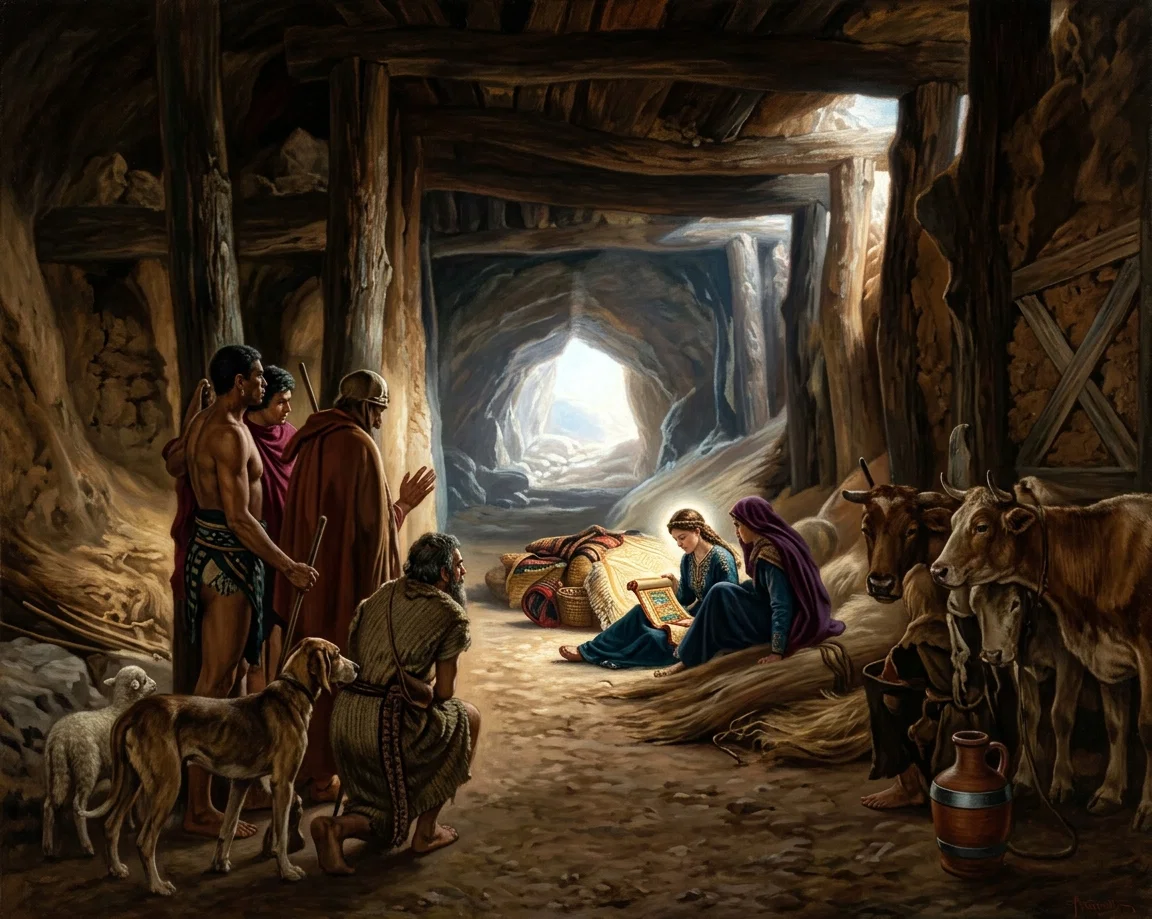
At the birth of Christ, Satan saw the plains of Bethlehem illuminated with the brilliant glory of a multitude of heavenly angels. He heard their song, “Glory to God in the highest, and on earth peace, good-will toward men.” The prince of darkness saw the amazed shepherds filled with fear as they beheld the illuminated plains. They trembled before the exhibitions of bewildering glory which seemed to entrance their senses. The rebel chief himself trembled at the proclamation of the angel to the shepherds: “Fear not: for, behold, I bring you good tidings of great joy, which shall be to all people. For unto you is born this day in the city of David a Saviour, which is Christ the Lord.” He had met with good success in devising a plan to ruin men, and he had become bold and powerful. He had controlled the minds and bodies of men from Adam down to the first appearing of Christ. But now Satan was troubled and alarmed for his kingdom and his life.
The song of the heavenly messengers proclaiming the advent of the Saviour to a fallen world, and the joy expressed at this great event, Satan knew boded no good to himself. Dark forebodings were awakened in his mind as to the influence this advent to the world would have upon his kingdom. He queried if this was not the Coming One who would contest his power and overthrow his throne. He looked upon Christ from His birth as his rival. He stirred the envy and jealousy of Herod to destroy Christ by insinuating to him that his power and his kingdom were to be given to this new King. Satan imbued Herod with the very feelings and fears that disturbed his own mind. He inspired the corrupt mind of Herod to slay all the children in Bethlehem who were two years old and under, which plan he thought would succeed in ridding the earth of the infant King.
But against his plans, Satan sees a higher power at work. Angels of God protected the life of the infant Christ. Joseph was warned in a dream to flee into Egypt, that in a heathen land he might find an asylum for the world’s Redeemer. Satan followed Him from infancy to childhood, and from childhood to manhood, inventing means and ways to allure Him from His allegiance to God, and overcome Him with his subtle temptations. The unsullied purity of the childhood, youth, and manhood of Christ, which Satan could not taint, annoyed him exceedingly. All his darts and arrows of temptation fell harmless before the Son of God. And when he found that all his temptations prevailed nothing in moving Christ from the steadfast integrity, or in marring the spotless purity of the youthful Galilean, he was perplexed and enraged. He looked upon this Youth as an enemy that he must dread and fear.
That there should be one who walked the earth with moral power to withstand all his temptations, who resisted all his attractive bribes to allure Him to sin, and over whom he could obtain no advantage to separate from God, chafed and enraged his satanic majesty.
The childhood, youth, and manhood of John, who came in the spirit and power of Elijah to do a special work in preparing the way for the world’s Redeemer, were marked with firmness and moral power. Satan could not move his integrity. When the voice of this prophet was heard in the wilderness, “Prepare ye the way of the Lord, make His paths straight,” Satan was afraid for his kingdom. He felt that the voice, sounding forth in trumpet tones in the wilderness, caused sinners under his control to tremble. He saw that his power over many was broken. The sinfulness of sin was revealed in such a manner that men became alarmed; and some, by repentance of their sins, found the favor of God, and gained moral power to resist his temptations.
He was on the ground at the time when Christ presented Himself to John for baptism. He heard the majestic voice resounding through heaven, and echoing through the earth like peals of thunder. He saw the lightnings flash from the cloudless heavens, and heard the fearful words from Jehovah, “This is My beloved Son, in whom I am well pleased.” He saw the brightness of the Father’s glory overshadowing the form of Jesus, thus pointing out in that crowd the One whom He acknowledged as His Son with unmistakable assurance. The circumstances connected with this baptismal scene had aroused the most intense hatred in the breast of Satan. He knew then for a certainty that unless he could overcome Christ, thenceforth there would be a limitation of his power. He understood that the communication from the throne of God signified that Heaven was more directly accessible to man.
As Satan had led man to sin, he had hoped that God’s abhorrence of sin would forever separate Him from man, and break the connecting link between heaven and earth. The opening heavens, in connection with the voice of God addressing His Son, was like a death-knell to Satan. He fearedthat God was now to unite man more fully to Himself, and give power to overcome his devices. And for this purpose Christ had come from the royal courts to the earth. Satan was well acquainted with the position of honor Christ had held in heaven as the Son of God, the beloved of the Father. And that He should leave heaven, and come to this world as a man, filled him with apprehension for his safety. He could not comprehend the mystery of this great sacrifice for the benefit of fallen man. He knew that the value of heaven far exceeded the anticipation and appreciation of fallen man. The most costly treasures of the world, he knew, would not compare with its worth. As he had lost through his rebellion all the riches and pure glories of heaven, he was determined to be revenged by causing as many as he could to undervalue heaven, and to place their affections upon earthly treasures.
It was incomprehensible to the selfish soul of Satan that there could exist benevolence and love for the deceived race so great as to induce the Prince of Heaven to leave His home, and come to a world marred with sin and seared with the curse. He had knowledge of the inestimable value of eternal riches that man had not. He had experienced the pure contentment, the peace, exalted holiness, and unalloyed joys of the heavenly abode. He had realized, before his rebellion, the satisfaction of the full approval of God. He had once a full appreciation of the glory that enshrouded the Father, and knew that there was no limit to His power.
Satan knew what he had lost. He now feared that his empire over the world was to be contested, his right disputed, and his power broken. He knew, through prophecy, that a Saviour was predicted, and that His kingdom would not be established in earthly triumph and with worldly honor and display. He knew that ancient prophecies foretold a kingdom to be established by the Prince of Heaven upon the earth, which he claimed as his dominion. This kingdom would embrace all the kingdoms of the world, and then his power and his glory would cease, and he would receive his retribution for the sins he had introduced into the world, and for the misery he had brought upon man. He knew that everything which concerned his prosperity was pending upon his success or failure in overcoming Christ with his temptations in the wilderness. He brought to bear upon Christ every artifice and force of his powerful temptations to allure Him from His allegiance.
It is impossible for man to know the strength of Satan’s temptations to the Son of God. Every temptation that seems so afflicting to man in his daily life, so difficult to resist and overcome, was brought to bear upon the Son of God in as much greater degree as His excellence of character was superior to that of fallen man.
Christ was tempted in all points like as we are. As man’s representative, He stood the closest test and proving of God. He met the strongest force of Satan. His most wily temptations Christ has tested and conquered in behalf of man. It is impossible for man to be tempted above what he is able to bear while he relies upon Jesus, the Infinite Conqueror.

A Bible Study on Man

By L. A. Reed

III. What Man Gains in Christ

We have now come to the most important subject in this series. It may be said to be the fundamental truth of the Bible. At the same time, it is the one doctrine that modern theology is rejecting. Perhaps we may even say it is the doctrine in the Bible which modern thought has rejected.
In all those systems of philosophy, so-called, which teach and emphasize the use of the will in overcoming difficulties and in advancing physically, mentally, and morally, such as new thought and kindred cults, everything is to be accomplished through man's effort alone. In none of them is there any suggestion that one can obtain help through Christ. In fact, whenever the matter is referred to, it is spoken of in the negative manner, that man can receive no help from any other man. Some of them even go so far as to say that it would be selfish for us to attempt to put off our troubles upon another, that it would be cowardly for us not to meet our own difficulties, and fight them out alone.
And in those more religious phases of modern belief where some emphasis is placed upon the life and example of Christ, He is referred to only as the One who gives us an example. Christian Science, along with Unitarianism, gives Him the title and the work of a way shower. By what He did He examples to us what we ought to do.
Many teachers in other denominations are adopting this doctrine.
All this is very foreign to the teaching of the Word. In the Bible, in no uncertain terms, Christ vicariously takes our place. He receives the penalty for sin in our stead. This is the very thing that modern thought denies, and yet the Bible is perfectly clear about it.

Accepts the Atonement or Pays the Penalty

If man pays the penalty of his own sin, he pays it with the penalty of death, and ceases any longer to exist. To prevent this, the atonement through Christ was made. Christ dies for all sinners who will accept Him as their substitute and sacrifice. Words could not make this plainer than the Scriptures state it: “For He hath made Him to be sin for us, who knew no sin; that we might be made the righteousness of God in Him.” 2 Cor. 5: 21. Here is an exchange: Christ is made to be sin, tho He has no sin of His own, in order that we may be righteous, tho we have no righteousness of our own.
“For what the law could not do, in that it was weak through the flesh, God sending His own Son in the likeness of sinful flesh, and for sin, condemned sin in the flesh.” Rom. 8: 3. This last verse shows that Christ was more than an example. Righteousness could not be lived in human flesh. The statement is that what the law could not do, being weak through human flesh, God accomplished by His Son, who condemned sin in the flesh by living a righteous life in the likeness of sinful flesh. This is a plain statement. What was a physical impossibility with man, has been fully accomplished in Christ, and accomplished in such a way as to be available for every man; otherwise it would not condemn the sin in your and my flesh. Note that Christ is not a mere example showing us the way, but He accomplishes what physically in the flesh could not be.
“Who His own self bare our sins in His own body on the tree, that we, being dead to sins, should live unto righteousness: by whose stripes ye were healed.” 1 Peter 2: 24. That Christ's death upon the cross was vicarious, is here clearly stated. He was our Substitute, for His own self bare our sins in His own body on the tree. And He did it that we should have the life of righteousness. He not only took our stripes, but He took those stripes in such a way that it heals our gaping wounds. So it is here clearly declared that Christ takes the penalty of man's wrong-doing, and gives to man the benefits of Christ's right-doing. There are many other texts just as clear as these. Read, for example, this:
“Surely He hath borne our griefs, and carried our sorrows. . . . He was wounded for our transgressions, He was bruised for our iniquities: the chastisement of our peace was upon Him; and with His stripes we are healed. . . . For the transgression of my people was He stricken.” Isa. 53: 4, 5, 8.
Again, a scripture from the New Testament: “But we see Jesus, who was made a little lower than the angels for the suffering of death, crowned with glory and honor; that He by the grace of God should taste death for every man.” Heb. 2: 9.

Accepting the Substitute

Against the proposition that no man can do anything for another man, the familiar illustration is used in the Scriptures of a man acting as a substitute for another. We are familiar with the fact. During the Civil War men with families, who did not wish to go into the field, hired substitutes. In some cases friends who had no families, no one practically dependent upon them, came forward and offered to go for those who had such dependents. And the Scripture, using this idea of the substitute, says: “For a good man some would even dare to die. But God commendeth His love toward us, in that, while we were yet sinners, Christ died for us. . . . If, when we were enemies, we were reconciled to God by the death of His Son, much more, being reconciled, we shall be saved by His life.” Rom. 5: 7, 8, 10. And again, the statement in Heb. 9: 28 is that “Christ was once offered to bear the sins of many.”
And not only was Christ made our Substitute, taking the death which by rights belonged to the human race, and offering in its place the life which was His; but He is the only One who has done this, and therefore it is only through Him that man can escape the penalty of sin. No matter how many books may be written, no matter how many sermons may be preached, no matter what doctrines may be poured out into the world by men attempting to show how this or that or the other thing may be done, by the Word of God it stands forever certain that he who does not accept the substitute of Christ mustbear it for himself, and since the wages of sin is death, it follows that out of Christ there is no hope. “Neither is there salvation in any other: for there is none other name under heaven given among men, whereby we must be saved.” Acts 4:12.
In every case of a substitute there are always three parties who must agree upon it. For example: in the time of the Civil War referred to, there was first of all the government demanding the soldier. There was secondly the one who was drafted; and in the third place was the one offered as a substitute. If the government refuses the substitute as not being a worthy one, the substitution can not be made. If the soldier drafted refuses the substitute, the government will hold him to answer the call. Or if the one put forward as a substitute fails to give himself, again no substitution can take place.
So in this substitution of Christ; God has agreed that Christ the Substitute is a worthy one, capable in all respects of taking the place of man. Jesus Christ Himself, the Substitute, has agreed to make this exchange; and now it is left with each individual to agree whether God shall count the Substitute in his place, or if he refuse the Substitute, that God thereby shall hold him for the penalty of sin. And this last is just exactly what every man does who rejects Christ. God holds him responsible for his sins, and he will have to suffer the penalty. The Word is clear,—“the wages of sin is death;” “the soul that sinneth, it shall die.”
But just as truly, the one who accepts the substitute of Christ shall go free from the consequences of sin. But to accept Christ, he rejects his life of sin, he turns away from all his ungodliness, and here and now, in this life, accepts the righteous life of Christ, to live the life of Christ before the world.
You and I receive our physical equipment, our special cast of mind, even the outlines of our body, from our parents through the fleshly birth. Thus the child of faith is born a new being, receiving spiritual power and spiritual life through Christ as truly as he received physical power and physical life from his earthly parents.

The Plain Message for To-Day

And so the message for to-day, as in Luther's time, is the plain truth of the Word of God, “The just shall live by his faith.”
The substitution that Christ has made is a complete one. He not only takes the death of man and gives the life of Himself, but He buys back all man's estate. All that man lost through sin he shall regain through Christ, and “where sin abounded, grace did much more abound.”
We have found in a previous article that man lost his nature, his life, and his dominion. All these are restored through Christ. As the Word says of the purchased possession, “Unto thee shall it come, even the first dominion.” Micah 4: 8.
The restoration of the divine nature for every one who will accept it, is now going forward. It is our privilege now to become partakers of the divine nature, “having escaped the corruption which is in the world through lust.” Having chosen this life of righteousness here, on the resurrection morning, eternal life shall be given; and following that the child of God shall enter in with Christ into an immortal inheritance. Being an heir with God and a joint-heir with Jesus Christ, he then enters upon his divine legacy. This wonderful event was thus pictured by the prophet, Daniel:
“I saw in the night visions, and, behold, one like the Son of Man came with the clouds of heaven, and came to the Ancient of days, and they brought Him near before Him. And there was given Him dominion and glory, and a kingdom, that all people, nations, and languages, should serve Him: His dominion is an everlasting dominion, which shall not pass away, and His kingdom that which shall not be destroyed.” Dan. 7:13, 14.
And the 21st, 22d chapters of Revelation, the 35th chapter of Isaiah, with other scriptures, gloriously describe that future estate.
All this man gains through Christ.
Continue reading: The Inheritance of the Righteous