Your ShelfYour Projects

Review and Herald, Vol. 79, No. 2.

THE OPEN DOOR

Review and Herald

Jan 14, 1902

Seventh-day Adventist Publishing Association · Battle Creek, Mich. · Jan 14, 1902

THE OPEN DOOR.

WORTHIE HARRIS HOLDEN. (Chicago, Ill.)
The door is open. Why are closed thine eyelids? Behold what Christ in love hath done for thee! The veil is rent in twain,—no more through priesthood Needst thou thy Lord and thy Redeemer see.
The door is open. Now thou mayest behold Him, As Stephen saw, and with enraptured gaze Fastened upon the Prince of Life his vision, The while his heart welled forth in prayer and praise.
The door is open. John the belov'd beheld it, A way into the holiest of all, Where sin and sorrow, strife and pain, are conquered, And lauding Him, the angels prostrate fall.
Ah! would that we were more like unto children Who quickly turn to greet an open door, And press with eager haste the unbarred threshold, Leaving all else to enter and explore.
Lord, grant, I pray, the unguent of thine eyesalve, Ope thou our eyelids with thy touch divine, That naught may seem more real than thy vision, And all our being bow before thy shrine.

PERFECT SERVICE REQUIRED BY GOD.

MRS. E. G. WHITE.
Everything that God could do was done to save a perishing world. “God so loved the world, that He gave His only begotten Son, that whosoever believeth in Him should not perish, but have everlasting life.” God has made it impossible for it to be said that He could have done more than He has done for the fallen race. When He gave His Son, He gave himself. In one great gift He poured out the whole treasure of heaven. He has revealed a love that defies all computation, a love that should fill our hearts and lives with gratitude.
Christ loves human beings, and He died to save them. At an infinite price He ransomed them from the power of the enemy. He invites them to become members of the royal family, children of the heavenly King. He desires to see them prepared to receive the crown of life. He longs to bestow on them the eternal riches. He came to restore in them the image of divinity. He calls upon those who have accepted Him to join Him in this work. He has chosen us as His instruments. By us He desires to carry out His merciful purposes. He says, You are laborers together with me. Shall we not co-operate with Him in His great plan, working earnestly to save His blood-bought heritage?
He has given us grand and solemn truths to impart to those who are in darkness. Let us not mar these truths by imperfect utterance. God has given us voices that we may speak His truth. He desires that the music of the voice shall aid in impressing His word upon minds.
We should train ourselves to take deep, full inspirations, and to speak clearly and distinctly. The voice should not be dropped at the end of a sentence, so that the closing words are hardly audible.
Those who open the oracles of God to the people should improve in their manner of communicating the truth, that it may be presented to the world in an acceptable way. Place proper emphasis upon the words that should be made impressive. Speak slowly. Let the voice be as musical as possible.
God desires His ministers to seek for perfection, that they may be vessels unto honor. They are to be controlled by the Holy Spirit; and when they speak, they are to show an energy proportionate to the importance of the subject they are presenting. They are to show that the power about which they speak has made a change in their lives. When they are truly united with Christ, they will give the heavenly invitation with an earnestness that will impress hearts. As they manifest zeal in proclaiming the gospel message, a corresponding earnestness will be produced in the hearers, and lasting impressions for good will be made.
The greater the influence of the truth upon us, the greater will be our earnestness in seeking for perfection in our manner of imparting truth.
Sin brings physical and spiritual disease and weakness. Christ has made it possible for us to free ourselves from this curse. The Lord promises, by the medium of truth, to renovate the soul. The Holy Spirit will make all who are willing to be educated able to communicate the truth with power. It will renew every organ of the body, that God’s servants may work acceptably and successfully. Vitality increases under the influence of the Spirit’s action. Let us, then, by this power lift ourselves into a higher, holier atmosphere, that we may do well our appointed work.
By constant obedience those who are born again are fitted for service. The entire being is to be placed under the molding, fashioning hand of God, that physical, mental, and spiritual perfection may be attained. Christians are to grow to the full stature of men and women in Christ.
The Lord desires His servants to improve in their manner of praying. He inquires, Where is the vivifying influence of your prayers? He does not accept the tame, lifeless, lengthy prayers, which are so destitute of His Spirit. He calls for a reformation, else He will remove the candlestick out of its place. He desires the candle to burn brightly, sending forth light to all parts of the world. When the Church turns fully to the Lord, lifeless, spiritless prayers will no more be heard.
I urge my ministering brethren to improve in their manner of praying. This can and must be done. I must say to them, The shorter you make your spiritless prayers, the better will it be for the congregation. It is generally the case that the less of heaven’s vitality there is in a prayer, the more lengthy it is. Do not spend a long time in prayer before a congregation unless you know that God is inditing the prayer. Let the prayers made in public be short and full of earnestness. The effectual, fervent prayer of a righteous man availeth much; but the prayer uttered in a low, monotonous tone and spiritless manner is not accepted by God. The voice of prayer should rise to God from hearts burdened by a sense of need. Let there be a revival of the Holy Spirit, that your prayers may be filled with the power of heaven.
Learn to seek the Lord most earnestly for power to reach sinners. Heed the message God has sent to His Church of to-day: “I know thy works, that thou art neither cold nor hot: I would thou wert cold or hot. So then, because thou art lukewarm, and neither cold nor hot, I will spew thee out of my mouth. Because thou sayest, I am rich, and increased with goods, and have need of nothing; and knowest not that thou art wretched, and miserable, and poor, and blind, and naked: I counsel thee to buy of me gold tried in the fire, that thou mayest be rich, and white raiment, that thou mayest be clothed, and that the shame of thy nakedness do not appear; and anoint thine eyes with eyesalve, that thou mayest see.”
The Lord calls for those in His service to make all the improvement He has made it possible for them to make. The truth in our possession is of infinite importance. How essential, then, that it should lose none of its power in passing from us to those who are in darkness. It should not be bereft of its luster by our inefficiency. Our expression of God’s wondrous loving-kindness, frame our words as we may, will be tame enough as it falls from our lips. But when, with sanctified lips, we offer praise for God’s love, hearts are reached. Let us pray that the wondrous message of Christ’s love may reach hearts. Let us watch for the Lord more earnestly than they that watch for the morning. Let us hope in Him and walk in His ways. He is well-pleased when His servants work with implicit faith in Him, asking Him to supply all their needs.
From the experience of Jacob we may learn the power of importunate prayer. On his way to meet Esau, Jacob sent his family across the river Jabbok, while he alone remained behind. He had decided to spend the night in prayer, and he desired to be alone with God.
It was a lonely, mountainous region, the hauntof wild beasts and the lurking place of robbers and murderers. Solitary and unprotected, Jacob bowed in deep distress upon the earth. It was midnight. All that made life dear to him were at a distance, exposed to danger and death. Bitterest of all was the thought that it was his own sin that had brought this peril upon the innocent. With earnest cries and tears he made his prayer before God. Suddenly a strong hand was laid upon him. He thought that an enemy was seeking his life, and he endeavored to free himself from the grasp of his assailant. In the darkness the two struggled for the mastery. Not a word was spoken, but Jacob put forth all his strength, and did not relax his efforts for a moment. While he was thus battling for his life, the sense of guilt pressed upon his soul; his sins rose up before him to shut him out from God. But in his terrible extremity he remembered God’s promises, and his whole heart went out in entreaty for His mercy. The struggle continued till near the break of day, when the stranger placed his finger upon Jacob’s thigh, and he was crippled instantly.
The patriarch now discerned the character of his antagonist. He knew that he had been in conflict with a heavenly messenger, and this was why his almost superhuman effort had not gained the victory. It was Christ, “the Angel of the covenant,” who had revealed himself to Jacob. The patriarch was disabled, and suffering the keenest pain, but he would not loosen his hold. All penitent and broken, he clung to the angel; “he wept, and made supplication,” pleading for a blessing. He must have the assurance that his sin was pardoned. Physical pain was not sufficient to divert his mind from this object. His determination grew stronger, his faith more earnest and persevering, until the very last. The angel tried to release himself; he urged, “Let me go, for the day breaketh;” but Jacob answered, “I will not let thee go, except thou bless me.”
Had this been a boastful, presumptuous confidence, Jacob would have been instantly destroyed; but his was the assurance of one who confesses his own unworthiness, yet trusts the faithfulness of a covenant-keeping God.
Jacob “had power over the angel, and prevailed.” Through humiliation, repentance, and self-surrender, this sinful, erring mortal prevailed with the Majesty of heaven. He had fastened his trembling grasp upon the promises of God, and the heart of infinite Love could not turn away the sinner’s plea.
Jacob prevailed because he was persevering and determined. His experience testifies to the power of importunate prayer. It is now that we are to learn this lesson of prevailing prayer, of unyielding faith. The greatest victories to the Church or to the individual Christian are not those that are gained by talents or education, by wealth, or the favor of men; they are those victories that are gained in the audience chamber with God, when earnest, agonizing faith lays hold upon the mighty arm of power.
We can do nothing of ourselves. In our helpless unworthiness we must trust in the merits of the crucified and risen Saviour. None will ever perish while they do this. The long, black catalogue of our delinquencies is before the eye of the Infinite. The register is complete; none of our offenses are forgotten. But He who listened to the cries of His servants of old, will hear the prayer of faith, and pardon our transgressions. He has promised, and He will fulfill His word.

GOD'S KINGDOM IN THIS WORLD. From Adam to the Call of Abraham.

ELDER A. T. ROBINSON. (Dunedin, New Zealand.)
“For the Lord Most High is terrible; He is a great King over all the earth.” Ps. 47:2.
“I am a great King, saith the Lord of hosts, and my name is dreadful among the heathen.” Mal. 1:14.
“The Most High ruleth in the kingdom of men, and giveth it to whomsoever He will, and setteth up over it the basest of men.” Dan. 4:17.
“That men may know that thou, whose name alone is JEHOVAH, art the Most High over all the earth.” Ps. 83:18.
The preceding scriptures, and many other passages which might be cited, clearly set forth the fact that the Lord God of heaven holds the position of supreme ruler among the nations of earth.
In the beginning, when the work of creation was completed, and the Creator looked with satisfaction upon His handiwork, pronouncing all “very good;” “when the morning stars sang together, and all the sons of God shouted for joy,” the dominion of this earth was given to Adam, as prince, or sub-ruler. Gen. 1:26. The garden, which “the Lord God planted . . . eastward in Eden,” was established as the capital of Adam’s dominion, and the promise was given to him, on condition of loyalty and obedience on his part, that at the touch of his hand the whole earth would be subdued and become like the garden of Eden as rapidly as his posterity should “multiply, and replenish the earth.”
Through the sad story of the temptation and fall of man, we learn that Adam forfeited his position as prince of this world. All that he possessed, all his dominion, then passed over to Satan, for “of whom a man is overcome, of the same is he brought in bondage.” Thus Satan attained to the position of “prince of this world” (John 12:31; 14:30; 16:11; Luke 4:5-7), “prince of the power of the air.” Eph. 2:2.
In giving the dominion and rulership to Adam the Lord did not relinquish His position as supreme owner and ruler of this world. “The tree of knowledge of good and evil” was placed in the garden as a test of recognition on man’s part that the whole world belonged to the Creator.
When man had yielded himself, with all the dominion that had been committed to him, as the lawful captive of Satan, even then the Lord Jehovah did not relinquish His claim to the ownership and dominion of this world. He did not abandon man and his forfeited dominion, as the hopeless captive of Satan. Under the inspiration of the Holy Spirit, the Messianic prophet inquires, “Shall the prey be taken from the mighty, or the lawful captive delivered?” The answer to this hope-inspiring question is not long delayed, for in the next verse comes the glorious response, “But thus saith the Lord, Even the captives of the mighty shall be taken away, and the prey of the terrible shall be delivered.” Isa. 49:24, 25. To open a door of hope, and save man from becoming the helpless, hopeless captive of Satan, a seed of “enmity” against Satan and evil was dropped into the human heart, prompting every man in this world to a better and holier service than that of the master under whose dominion he had fallen. Help was laid “upon One that is mighty,” who took upon himself man’s nature, and on his behalf, met and conquered every temptation that Satan could ever bring upon humanity. Thus sin was condemned in the flesh,—in human flesh,—and its right to rule in the human heart was overthrown.
In the promise given to Adam, that the seed of the woman should bruise Satan’s head (Gen. 3:15), was the promise of the “second Adam,” who would wrest from the usurper the rulership of this world. The prophet Micah, more than three thousand years after the fall of man, strikes this note in the great plan of human redemption, in these words, “And thou, O tower of the flock, the stronghold of the daughter of Zion, unto thee shall it come, even the first dominion; the kingdom shall come to the daughter of Jerusalem.” Micah 4:8.
This plan of salvation was put into operation immediately after the fall of man, and during the generations of the patriarchs, from Adam to Noah, all who would return to the loyalty and obedience of their King had the opportunity of doing so, and were reclaimed as subjects of the kingdom to be restored.
When, as the result of Adam’s failure, “God saw that the wickedness of man was great in the earth, and that every imagination of the thoughts of his heart was only evil every day,” and that “the earth was filled with violence,” He purposed to destroy man from off the earth, save the family of one man, in whose heart the light of truth had not become extinct.

NOAH AS SUB-RULER.

With sin entirely blotted from the earth, except what might be lurking in the hearts of this one family, Noah was instated as Adam’s successor in the sub-rulership of this world. The same dominion was given to Noah which had formerly been given to Adam (Gen. 9:1, 2), with the command repeated to “multiply, and replenish the earth.” It is clearly seen by this command given to Adam and repeated to Noah, to “be fruitful, and multiply, and replenish the earth,” that it was God’s purpose that the whole earth should finally be occupied by His people.
When Noah’s posterity had apostatized from the true God, and had turned to sun worship, Nimrod, the reputed father of the sun god, boldly set at defiance the purpose of God that the whole earth should be peopled, saying, “Go to, let us build us a city and a tower, whose top may reach unto heaven; and let us make us a name, lest we be scattered abroad upon the face of the whole earth.” The Lord, by confounding their language, overthrew this scheme of human devising,making it the very means of fulfilling His purpose that man should scatter abroad over the face of the earth.
Be it carefully noted at this point, that in scattering men abroad, and dividing them into different nations, God’s one and eternal purpose in the existence of these nations was that they should afford men the opportunity of seeking the Lord and returning to Him as their rightful king. For this purpose the time and the territorial limits of every nation that has ever existed on this earth, or that ever will exist, was predetermined before any nation had an existence. For positive proof on this point, compare carefully the following passages: Gen. 9:19; 10:32; Deut. 32:8, 9; Acts 17:26, 27.
In less than three hundred years from the time of the flood, Noah and his descendants had so utterly failed of accomplishing God’s purpose in the earth, that but one feeble torch of truth was left to shed its light upon the surrounding moral darkness. The whole world had relapsed into apostasy and idolatry.
(To be continued.)

OUT OF EGYPT.

PHILIP GIDDINGS.
“Out of Egypt have I called my son.” Come out and go forward. Where else can you go? Pharaoh behind, it is madness to go back; it is hazardous to turn into the trackless wilderness. But the sea is before. Well, what of that? God says: “Speak to the children of Israel, that they go forward.” We walk by faith, not by sight. Israelites indeed, children of Abraham, are children of faith, and like their noble sire, they have to cross the flood, their Mesopotamia, to the land where they should be.
Brethren and sisters, this will be our experience,—hedged in before the sea, and ordered to go forward. Let us not halt; for if we do, we deny that Fourth Commandment, in which is the embodied guarantee of God’s almighty power. He wants us to remember that He is Maker and Master of heaven, and of earth and sea as well; that the sea obeys His voice, as in the beginning, and since, as at Galilee.
That people who know, in spirit and in truth, the Fourth Commandment, by which they have been called out of the profane world and fallen Christendom, sanctified and separated, will go through the earth,—will go through the sea, and will go through the heavens as the climax; for having walked and not fainted, run and not wearied, they will finally mount up with wings as eagles.
Those that shall have been accounted worthy of this calling, having taken their exodus from Egypt, “when the Lord Jesus shall be revealed with His mighty angels,” shall stand with Him on the sea of glass and glory, singing the song of Moses and the Lamb.

Looking Away from Obstacles to Jesus

OBSTACLES present themselves, then we cherish the thought, “I don’t see how it can be done,” thus permitting doubt and unbelief to enter. If we learn to look away from these thoughts unto Jesus, relying wholly upon His merits, we may expect the Lord will do great things for us.        H. E. SAWYER-HOPKINS.

BRIEF SKETCH OF A REVIEW AND HERALD CENTENARIAN.
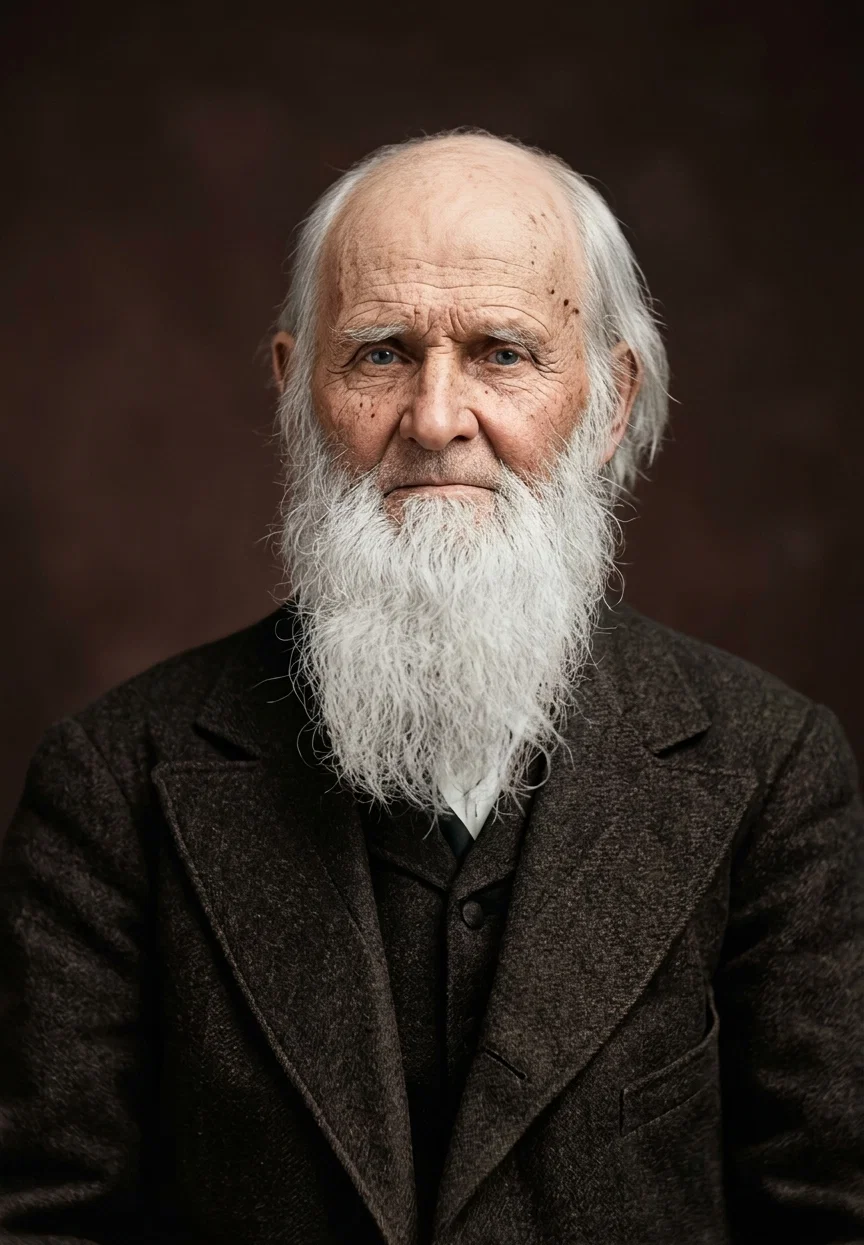
FURNISHED BY HIS DAUGHTER, MRS. A. E. GURNEY, BY REQUEST.
WILLIAM GIFFORD, the subject of this sketch, was born in Rochester, Plymouth Co., Mass., Sept. 22, 1798, and is consequently, at the date of the issue of this number of the REVIEW AND HERALD, one hundred and three years, three months, and twenty-two days old. The accompanying illustration is a good representation of my venerable parent, who has the remarkable experience of having lived in three centuries.
“Father Gifford,” as he is generally called, is of both English and German descent. When very young, he was left without a father; and though his mother had a large fortune, the hand of injustice wrested it from her, and she found herself alone, with a large family, and her means of support all gone. It was then thought best to put young William out at the tender age of seven years. But there he was treated so unkindly that, after a time, he ran away, and went home. His mother thinking it best not to force him to return, the young lad found employment in a cotton factory near by, thus helping to care for those younger than himself.
WILLIAM GIFFORD, BORN SEPT. 22, 1798;
PRESENT AGE, 103 YEARS.
WILLIAM GIFFORD, BORN SEPT. 22, 1798; PRESENT AGE, 103 YEARS.
At the age of fourteen it was decided that he should go to live with his uncle, Captain John Atsatt, and learn the pump- and block-making trade. There he faithfully toiled till of age, when came his years of freedom. He now hired out to work for his uncle, and after a time he was taken into partnership, where he remained till the year 1831, when a son of the captain came home from a whaling voyage, and bought out father's interest. He then went to Fair Haven, about six miles distant, built a shop, and started business for himself.
In 1820 William Gifford was married to Miss Mary Bowlin, daughter of Captain Josiah Bowlin. At this date he was financially prosperous, and business was thriving. My father still is, and We always was, one of those outspoken men who dare to state what they think is right, and who will sacrifice much for a principle.
Politically speaking, he was an old-time Democrat after the stiffest order, also a staunch anti-slavery advocate, and in all respects a thorough teetotaler and temperance man. From this one can readily see the outcome of so much radical truth centering in one individual, so far as business is concerned, with men of decidedly opposite sentiments. Father always kept his political flag at masthead. “No half-masts for me,” was his watchword.
At the time of the William Henry Harrison presidential campaign in 1840, father was wide awake, and constantly advocated his Democratic sentiments. The shipowners at Fair Haven were mostly of opposite politics, and the excitement ran high; and it did not take long at this period to foresee that William Gifford must either change his politics or sacrifice his business; and with him, business was but a secondary matter. He could not be bought, consequently his patronage waned.
During these exciting days, mother would sometimes say to him, “William, I hope I may be permitted to live to see you as wide awake in the cause of religion as you now are in politics,” and she did. Not long after this time the Gifford pump and block firm was sold out, and the proprietor left the business entirely.
There were many proslavery men living in Fair Haven in those days, and father could not tolerate that hated traffic, and he was very outspoken on the subject. This also injured him greatly. While in business, his grandfather encouraged him in his antislavery sentiments, and they were among those early underground railroad men who assisted the slaves in running away from bondage. At one time his grandfather brought a fugitive home, and he settled near by. Grandmother taught him to read, and later, when the Advent truth was preached, the old negro accepted it, and died in the blessed hope of soon meeting his heavenly Master. Then too, father's ardent temperance principles greatly injured his worldly business with the shipowners and sea captains.
In 1856 the writer of this sketch, with her family, moved to Jackson, Mich. Father came in the following spring. Mother died in three weeks after they had settled on a small farm at Parma, this State. So father was completely broken up again. He rented his farm, and lived with his daughter in the city of Jackson for some time. But after a while he traded his land for other property in Brookfield, and there he lived with my brother until he sold out, over twenty-five years ago. Since then he has been with me most of the time.
Father says that some of his ancestors lived to quite an advanced age. His last remaining brother died more than a year ago, at the age of ninety. He has no immediate relatives except his own family, and nephews and nieces, who are quite numerous.
He never married but once, and has now been a widower about forty-four years. My mother gave birth to eleven children, six of whom are still living. I think my father has twenty-seven grandchildren, and twenty great-grandchildren. He has one great-great-grandchild.
My father was converted and joined the old Christian Church at Mattapoisett, Mass., in 1819, when he was twenty-one years old, and remained in that connection till a short time before the Advent doctrine was preached, when he became dissatisfied with the faith and religious life of that people. He belonged to the same church of which Elder Joseph Bates was deacon. Later, he, with several others, took leave of their former church associations, and started cottage meetings in private houses. God blessed this move abundantly, and when the noted WilliamMiller came to the village, heralding the great second advent proclamation, they were all ready to receive the good news of the soon-coming Saviour.
Father brought up his family with the thought that he would rather pay the grocer and butcher than the doctor. Beef and pork, and all else that helped to make up a good New England table, were freely used; but he never had liquors on his table, nor elsewhere, not even as medicine. Tobacco he hated in all its forms. When the children were quite young, father used coffee at breakfast; but after a while his hands began to tremble, and he consulted the family physician, who told him that he drank too much coffee. His reply was, “Well, that puts an end to that, then.” So he would never furnish any more coffee, not even for the family. Then he took to drinking water and milk, and since then he has always used that for his drink. This experience of discontinuing the use of coffee must have taken place about the year 1836. I am now seventy years old, and do not remember that I ever saw my father drink a cup of tea or coffee, as a beverage.
He is very true to all health principles as far as he understands them. He eats no meat nor butter. Formerly when he used meat and rich foods, he frequently had sudden sick spells, but usually recovered soon. One winter he was laid up with rheumatism, and had to go to the hospital for treatment, but he has never suffered from a like attack since. After he moved to Michigan, he had a run of typhoid fever. The foregoing is all the sickness of any account that he has ever had.
He never used many drugs. His general health at present is remarkable for one of his age. Of course he has infirmities, which rather tell on his strength. He cannot get around as he used to, yet in warm weather when it is fair, he goes to church, and bears a decided testimony to those present. His mind is quite clear, and he understands what he reads. He is quite deaf, not having heard a sound for two years. His eyesight is good, though he thinks it is poor. He reads a large part of the day, not merely once in a while, but every day in the week, and no one ever hears him say that he is tired, or that his eyes ache.
In the morning, as soon as breakfast is over, he takes his Bible or the denominational paper, or both, and frequently reads until he is called to dinner. In reading he uses glasses, but for ordinary work he does not need them. He does not remember dates as well as formerly; but when he goes to church, he does not forget to tell the people what is in the church paper, and to call their attention to things of eternal interest.
His appetite is exceedingly good, and he relishes anything that is on the table. The family physician says that his healthful diet is the secret of his long life. His usual diet is oatmeal and graham bread, corn meal served in different ways, with fruit, vegetables, etc. He wants three meals each day; but with him supper is a light lunch at five o'clock. He seldom lies down in the daytime, but sometimes drops asleep while reading. He does nearly everything of a wood-work nature around the house. In summer he works in the garden and in the berry patch, and does many little jobs.
My aged parent is six feet in height. I do not know his weight, but he is in a good, healthy condition. His teeth are nearly all gone. He is some bald, indeed, he never had a heavy head of hair; but what remains is fine and silky, and is of a light-steel color. His beard is perfectly white, as may be seen in his picture.
Father Gifford accepted the Advent message in 1839, in Fair Haven, Mass., and was a full partaker of the joys of those who expected the Saviour in 1844. After the great disappointment he shared in the sorrows of those who were looking for the Lord, but he never went back on the preaching, as so many did. He was personally acquainted with many of those early lecturers upon whom God laid the burden of the great second advent proclamation. He lived in the same neighborhood with Joshua V. Himes, the co-laborer of William Miller, and was well acquainted with him in early life.
Shortly after the time passed, he accepted the Bible Sabbath, through the labors of Elder Joseph Bates; and his home was a place of common resort for those who led out in giving the Third Angel's Message. He is exceedingly well informed concerning the early labors of Elder James White and Sister White in this cause; and though he has now attained to the remarkable age of over one hundred and three years, his lamp is trimmed and burning, and the soon coming of the blessed Saviour is the joy and rejoicing of his heart.

THE WORDS THAT MOVE.

The Christian.
SCOLDING the gospel at people is not the most effective way of presenting God’s message to man. The wrath of man worketh not God’s righteousness, nor man’s salvation.
“Were you ever a fisherman?” said an aged Christian to a student of divinity. “Yes, I have fished with the rod at the rocks,” was his reply. “Oh! but I mean with the net?” “No, I never did.” “Well, you need to learn it. And do you know that when there is thunder, the fish go to the bottom of the sea?” “Yes, I know that to be a fact.” “Well, my young friend, there are very many ministers who don’t seem to think of that.”
Not like hail, and snow, and hurricane, and tempest, does the gracious word of God come most effectively to the hearts of men. The words that break hearts, come from hearts that are broken. Moses said: “My doctrine shall drop as the rain, my speech shall distil as the dew, as the small rain upon the tender herb, and as the showers upon the grass: because I will publish the name of the Lord: ascribe ye greatness unto our God.” Deut. 32: 2, 3.
“Many years ago,” said a writer in the Oberlin Evangelist, “we knew a gospel minister, who had been preaching many a pointed sermon to stir up his people to the work of the Lord. Hope, long deferred, began to threaten heartsickness. At length, his feelings became intensely earnest for the conversion of several of the youth in his congregation. It seemed to him like a mighty baptism of love and prayer for their souls. When the next Sabbath brought him before his people, he tried to tell them, in a plain, simple way, how he had felt for the souls of some of their children, and naturally made some allusions to the need of repentance, and of first love in the Church. It was remarkable, however, that not one stern word fell from his lips. He spoke freely of his own sins, sparingly of theirs. In fact, it seemed to him, that day, as if it would be a great relief to him if—somewhat like his Master—he could bear the sins of his beloved people on his own soul—at least so far as to bow before God, and repent of them all, and especially in view of his own responsibility for those sins. It was natural that he should speak with some feeling of the freeness of pardon through Jesus Christ, even for such grievous sins.
“That day was an era in that church. The house of God was another Bochim, and many an aching heart found relief in tears. The people of God repented, and came up with one heart to the help of the Lord, and many were turned from their sins to praise redeeming love. We noted the lesson at the time, and have ever since deemed it in point to show how those who labor for Christ should bear themselves toward their tardy, and, perhaps, backslidden brethren.”

SHALL WE DELAY HIS COMING?

PROF. E. A. SUTHERLAND.
(Berrien Springs, Mich.)
My heart is deeply burdened for the youth, for the hope of the cause lies in the rising generation. I have been studying carefully the experiences of the children of Israel, for in their history as divinely recorded is to be found our own life-work. God's people are repeating the history of the forty years' wanderings between Kadesh-barnea and the promised land.
Over forty years ago we heard the call of deliverance in the proclamation of the First Angel's Message. There was before us, as it were, the eleven days' journey to the promised land. When the denomination reached Kadesh-barnea, instead of going up to possess the land, spies were sent up who brought back an evil report. The way appeared hard; there were walled cities in the land, and these cities were full of giants. We dwelt upon difficulties until victory became impossible. To us have been spoken the words, “Your carcasses shall fall in this wilderness. . . . Doubtless ye shall not come into the land, . . . but your little ones, which ye said should be a prey, them will I bring in, and they shall know the land which ye have despised.”
Have you thought that you and I who are to-day in the prime of life might have seen the immortal state while yet in our childhood? The only reason we did not was because the previous generation failed to reveal the fullness of Christ. We have now taken the place of those who have fallen asleep. A second time we approach the promised land. We have reached the time described in the thirty-second chapter of Numbers. Success to the whole people depends upon united effort, one mighty forward march.
But just as Israel was then ready to go forward, two tribes asked the privilege of remaining on the east side of Jordan. “This land,” said they, “is good enough for us.” The same expression many, by act, if not by word of mouth, are using to-day when a call comes for volunteers to go into new fields. Hearken to the words of Moses: “Shall your brethren go to war, and shall ye sit here? And wherefore discourage ye the heart of the children of Israel?” There were then some who would go over. There are to-day some who would go. Why do others discourage their brethren?
Do we realize that we may have to remain in this world many more years because of a failure to move forward when the opportunity is given? Vigilance on the part of a few men cannot accomplish the work before us. God waits for His people as a body, and He is to-day waiting for us. Again He says to us, as to Gad and Reuben when the army reached Jordan, “If ye turn away from after Him, He will yet again leave them in the wilderness; and ye shall destroy all this people.”
Can it be that to-day the destiny of the world depends upon our course of action? Does it mean that we may delay His coming for many more years by our insubordination? We fail sometimes to understand how we may hinder. We have been told, for instance, that hundreds should be in the canvassing work where now there is but one; young people should be able to go out, Bible in hand, to teach people the truths of the Scriptures; thousands are needed to teach the children; hundreds, yes, thousands, of others should carry the gospel of health. Not passive goodness, but activity, intense activity, will save our people. I tell you that when I think of these things, when I see a few men struggling to carry the load, while the masses are indifferent, my soul cries out, “Shall your brethren go to war, and shall ye sit here?”
I appeal to the young people, those who, should Israel be numbered, would be among the armed men: Come forward and offer your services. Do not falter any longer. Press in, find your way into our schools for a training. Work, work as though your life depended upon it, for in reality it does.
I am anxious to correspond with every person who feels the burden to work. A way can be provided for you.

WHY NOT?

E. J. HARVEY.
Why not hasten the advent of Christ? Has He not told us how we may do this? Is it not high time for us to awake out of sleep, when we see that our salvation is so much nearer than when we first believed the gospel? God has plainly declared that He is about to cut short His work in righteousness, and His word cannot fail. “There shall be delay no longer.” This applies to the very time in which we are now living; for God himself says so. Who among the people of God has sinned? “If any man sin, we have an advocate with the Father, Jesus Christ the righteous.” Why not take His spotless robe of righteousness, in place of our own filthy garments, and at His command and in His strength and the power of His might, “go, and sin no more”? Thus we shall realize that He has removed our sins as far from us as the east is, from the west; that He has cast them behind His back and into the depth of the sea, to remember them against us no more forever.
Trembling soul, listen to the word of the Lord to you, if you fear that your sins have been too great or too many for His infinite love, His merciful and compassionate heart, to forgive. Oh, listen to His word of eternal truth! “Come now, and let us reason together, saith the Lord: though your sins be as scarlet, they shall be as white as snow; though they be red like crimson, they shall be as wool.” Oh, come!

God Is Not Mocked

WE may make fools of ourselves, but the Almighty will never let us make a fool of Him. God is not mocked; whatsoever we sow, we shall also reap.—Cuyler.
Continue reading: Prayer and Scripture