Your ShelfYour Projects

Signs of the Times, Vol. 25, No. 6.

HUMILITY IN VICTORY

Signs of the Times

Feb 8, 1899

Pacific Press Publishing Company · Oakland, California · Feb 8, 1899

HUMILITY IN VICTORY.
EVERY event connected with the earthly life of our Saviour is one of thrilling interest. From the time He was born a babe in Bethlehem's manger to the time His life was expiated on the cross, and afterwards to the day of His ascension, every word and act becomes, in every age, a subject of closest study to the devoted disciple. It should be so; for Christ, the divine Lord, is set forth as man's perfect example; and if it could be borne in mind that this divine Example never uttered a meaningless word, nor performed a meaningless act, with intense interest to the believer's heart would the Lord's earthly ministry be fraught!
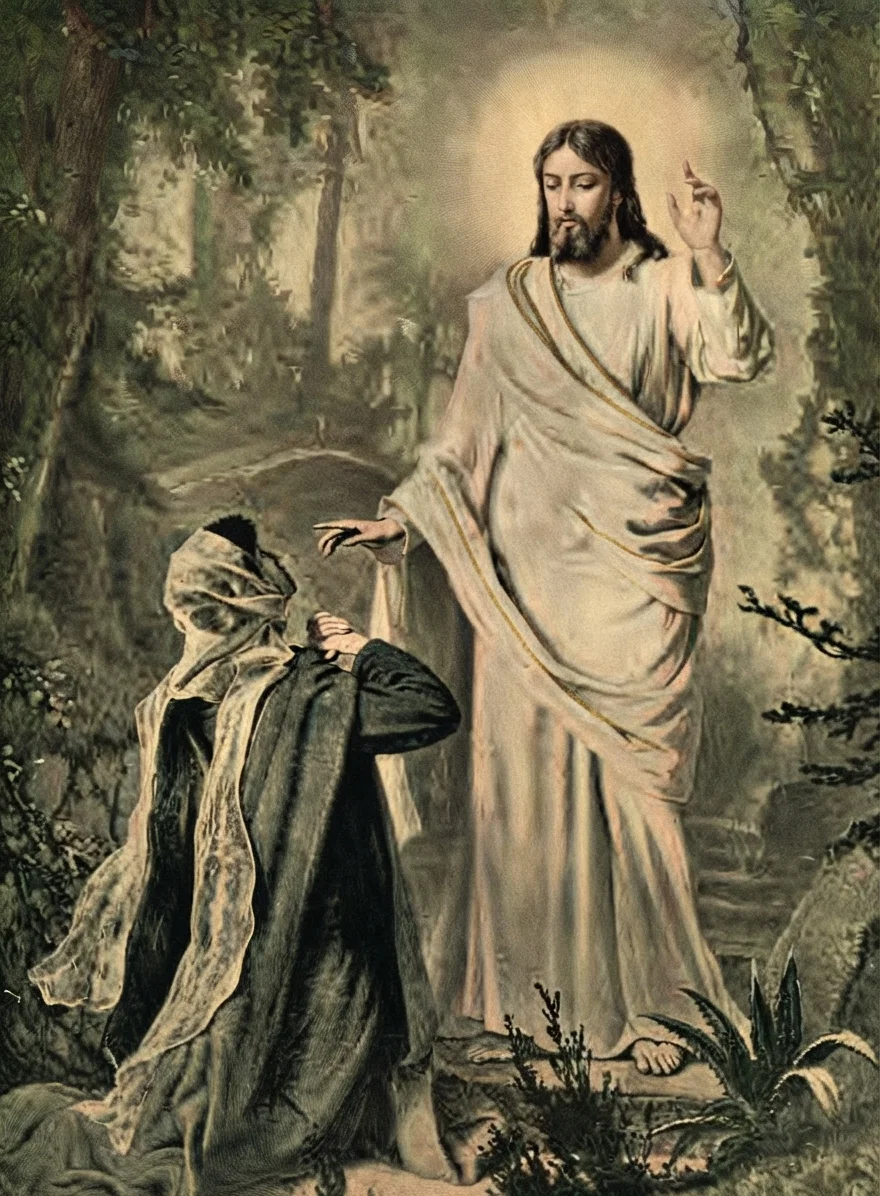
The accompanying illustration presents Mary in the act of worshiping her risen Lord. But a few short hours before she, with the other disciples, had lain His lifeless body in the rocky sepulcher. With bursting hearts of grief and sorrow, they had turned away from the tomb to their lonely homes, with their expectations cut short and their once bright hopes sadly dimmed, if not entirely gone out in darkness. The one whom they thought would have redeemed Israel, in breaking the galling yoke of Rome and restoring the kingdom to its pristine glory and grandeur, had been wickedly slain by the cruel hands of those He came to save; and those who had identified their life's interests with His, who by their influence and means had supported His cause, were now left the gazing stock and reproach of the noisy rabble and the gaping multitude.
But tho Jesus had disappointed their hopes, they could not regard Him as a deceiver. Had they not heard Him give utterance to the divinest truths that ever fell from the lips of man? Had not His words and life given the lie to hypocrisy and deception? Had they not found in His earthly ministry and every-day life a personification of the purity and righteousness advocated in His doctrines? Had He not taught that He was Christ the Lord?
MARY WORSHIPING THE RISEN SAVIOUR.
And did not all His mighty miracles witness to this truth? Hope and doubt contended for the mastery in every heart. Love for the crucified One was stronger than fear of the displeasure of the chief priests or Roman guard. Especially was this true in the case of Mary, in whose life had been wrought such a wonderful transformation by the power of Jesus. She had been forgiven much, and she loved the more. The Sabbath has passed, and she returns to the sepulcher to manifest her love for the One who had been so much to her.
Instead of finding the Roman guards in their position of watch, Mary sees the stone rolled away from the door of the sepulcher. In great haste she returns to the city to acquaint Peter and John with this fact. John, in his haste, is the first to reach the tomb, and while he is anxiously peering within, impulsive Peter enters the door and finds that the Lord has indeed left the sepulcher. But his observations convince him that it is not the work of grave robbers, and that no hasty or indiscriminate work in connection with the removal of the Lord has been done. Order and system have been observed; all the burial clothes are folded, and each is laid by itself. The matter becomes all the more a mystery to the minds of the disciples. Unable to fathom it, Peter and John return to their own homes, but Mary can not tear herself away from the sacred spot. She stands without the sepulcher weeping bitterly, "and as she wept, she stooped down, and looked into the sepulcher;" and now, to her astonished vision, another scene presents itself. Where the body of the Lord lay are sitting two angels, clothed in white, and one of them addresses her: "Woman, why weepest thou? She saith unto them, Because they have taken away my Lord,
and I know not where they have laid him. And when she had thus said, she turned herself back, and saw Jesus standing, and knew not that it was Jesus." He propounds to her the same question. She, supposing that He might be the gardener, said unto Him, "Sir, if thou have borne Him hence, tell me where thou hast laid Him, and I will take Him away." Then it is that Jesus reveals His identity. He pronounces her name, "Mary." How often had she listened to that voice! She has hungupon its very accent and inflection. In the person before her she sees no longer the gardener, but Jesus, her blessed Lord. With the cry of, "Master," she is about to prostrate herself before Him in adoration, but, with tenderness and yet with dignity and authority, Jesus restrains her from this act of worship. "Touch Me not," He said; "for I am not yet ascended to My Father; but go to My brethren, and say unto them, I ascend unto My Father, and your Father; and to My God, and your God."
The question naturally arises, Why did not Christ receive the proffered worship of this redeemed woman? On a later occasion, during the same day, according to Matthew, He received the worship of His disciples, who "came and held Him by the feet, and worshiped Him." Did Christ in the interim, between the manifestation of Himself to Mary and the manifestation of Himself to His disciples, as recorded in the last chapter of Matthew, ascend to His Father? The conclusion is obvious that such was indeed the case, for Mary's worship was refused on the plea that He had not ascended. For what purpose was this ascension made? In this, while we are left largely to conjecture, arguments present themselves which are not at all unreasonable. Christ had taken upon Himself the nature of man. He had lived as a man. He died as a man, and yet He was the Son of God. He died not for His own sins, but to make an atonement for the sins of the human race. He came into the world to bridge the gulf that sin had made between a rebellious race and an offended God. Was His atonement acceptable to the divine Father? Before continuing His earthly work, Christ must have the evidence from His Father's lips that the sacrifice was complete, and that through the merits of His blood guilty man would be reconciled to the government of heaven. That, doubtless, was the occasion of His ascension to the Father. Angels of strength and honor carry Him to the courts of glory. Before the Father's throne He presents the results of His earthly work, reveals in His hands the prints of the nails, in His side the scar of the piercing spear, and He pleads with the Father that all the promised blessings of redemption may fall to the lot of those who accept the merits of His shed blood, and that His people may be identified with Him in reward and in glory.
The decree goes forth from the royal lips, "Let all the angels of God worship Him," and the vaults of heaven ring with glad acclaim to the Lamb who was slain but who is alive forevermore.
Having received this evidence of the divine favor, and being assured of the success of His mission, Christ returned again to earth, to finish the work so nobly begun, and to impart the added blessings bestowed in consequence of His victory over sin and the grave. In this act, as well as in every other act of His divine earthly ministry, we see Christ's self-abnegation, His modesty, His humility. Unlike Lucifer, He would not assume the privileges of the Most High, nor receive the honor which was not His by right. The Father must first pronounce upon His work the divine benediction before He would accept the proffered adoration of men or angels. In the day of triumph He did not forget His relation to the Father or to the government of heaven.
O, the mystery of the union of God with man, as exemplified in Christ! May Christ, the hope of glory, produce in us the same fruits of righteousness unto eternal salvation.
F. M. WILCOX.

SILENCING THE PHARISEES.

"Then began He to speak to the people this parable: A certain man planted a vineyard, and let it forth to husbandmen, and went into a far country for a long time. And at the season he sent a servant to the husbandmen, that they should give him of the fruit of his vineyard; but the husbandmen beat him, and sent him away empty. And again he sent another servant; and they beat him also, and entreated him shamefully, and sent him away empty. And again he sent a third; and they wounded him also, and cast him out. Then said the lord of the vineyard, What shall I do? I will send my beloved son; it may be they will reverence him when they see him. But when the husbandmen saw him, they reasoned among themselves, saying, This is the heir; come, let us kill him, that the inheritance may be ours. So they cast him out of the vineyard, and killed him."
"What therefore shall the lord of the vineyard do unto them?" Christ asked his listeners; and the scribes and the Pharisees answered, "He shall come and destroy these husbandmen, and shall give the vineyard to others." When they said this, they saw that they had condemned themselves, and they exclaimed, "God forbid." And He beheld them, and said, "What is this then that is written, The stone which the builders rejected, the same is become the head of the corner? Whosoever shall fall upon that stone shall be broken; but on whomsoeverit shall fall, it will grind him to powder."
In this parable Christ exposed the deceptions of the priests and rulers, and declared that the Lord would punish the Jewish nation with fearful severity. It had treated His servants with contempt, injustice, and cruelty; the kingdom would be taken from them, and given to those who would obey its Ruler.
The Pharisees watched Christ narrowly as He gave this parable. They were cut to the heart by the Saviour's words; for they could not fail to see that He read every purpose of their hearts. To them these words were an evidence of His divine character; but they dreaded to hear them, because they were condemned by them. They feared that Christ would lay before the people the wicked deeds that those they had been taught to reverence had committed, and that thereby they would lose their popularity. They decided that Christ knew too much of their lives to be allowed to live. They were filled with rage, and had they dared, they would have laid hands on Him, and silenced His voice, so that He would no longer annoy them. But they feared the people.
They had often planned to entrap Him in His words, but thus far their attempts had been baffled. They now took counsel with the Herodians, and, having laid their plans, they sent out spies, "which should feign themselves just men, that they might take hold of His words, that so they might deliver Him unto the power and authority of the governor." They did not send the old Pharisees, whom Jesus had often met, but young men, who were ardent and zealous, and whom, they thought, Christ did not know.
Feigning to be interested in a certain question, the spies approached Christ. With apparent sincerity, as tho desiring to know their duty, they said, "Master, we know that Thou sayest and teachest rightly, neither acceptest Thou the person of any, but teachest the way of God truly." Had the speakers been sincere, these words would have been a wonderful admission, but they were spoken to deceive. Their testimony, however, was true. The Pharisees did know that Christ taught truly, and by their own testimony will they be judged.
"Is it lawful for us to give tribute unto Caesar, or no?" they continued. This was a question over which there was much contention. Many denied the right of the Romans to demand tribute, and the Pharisees paid their taxes unwillingly. The spies decided to ask Christ this question, thinking that He would answer it by a simple yes or no. If He told them it was lawful to give tribute to Caesar, He would be going contrary to the opinions of the Jewish nations, and would be put out of popular favor; and if He said that it was unlawful, they could accuse Him to the Romans. Thus they hoped to catch Him in His words, whatever way He might answer.
The spies thought that by their apparent honesty they had sufficiently disguised their purpose. But Jesus read their hearts as an open book, and revealed their hypocrisy. "Why tempt ye Me?" He asked, giving them evidence of His divinity by showing that He discerned their hidden purpose. "Show Me a penny," He said. They brought it, and He asked them, "Whose image and superscription hath it?" They answered, "Caesar's." Pointing to the inscription, Jesus said, "Render therefore unto Caesar the things which be Caesar's, and unto God the things which be God's."
Thus Christ rebuked the hypocrisy and presumption of the Pharisees, and His answer seemed so wise to the bystanders that they admired His tact and wisdom. His reply was no evasion, but a candid answer, and not only were the Pharisees rebuked by His words, but in many minds a vexed question was settled.
Many who heard these words ever after upheld the right principle. They could not but see that the principle underlying the question had been laid down in straight lines.
When the Pharisees heard Christ's answer, they marveled, and left Him, and went their way. They were convinced; but, altho they marveled at Christ's wisdom, they would not yield. Another evidence of the Saviour's divinity had been given them, but they hardened their hearts against it. And from that time evidence had no effect on their deeply-rooted prejudice.
The Pharisees could not at that time satisfy their wrath, but they were none the less determined to carry out their purposes. At every opportunity they manifested their bitter opposition against Christ. There was no more peace for Him; for the caviling of His enemies was continual, and their plans to entrap Him abundant. They set spies on His track, to report His movements. They thought this unknown to Christ, but He was much more accurately acquainted with their movements than they were with His. He knew every step that would be taken and every event that would take place.
But in spite of the opposition of the priests, Christ kept His mission ever before Him. With a heart ever touched with human wo, He ministered to those around Him. His words were spoken with clearness, simplicity, and authority. His discourses were such as had never before been heard. His principles were so clearly and wisely inculcated that none needed to make a misstep if they but followed Him.
MRS. E. G. WHITE.

Self-Reverence Restrains Vice

The reverence of a man's self is, next religion, the chiefest bridle of all vices.—Bacon.

THE UNIVERSAL FEAST.

[Tune, "Handwriting on the Wall."]
Now THE great queen of Babel, In these latter days of time, Makes a feast that's universal, All the nations drink her wine. (Rev. 18:3.) As they eat, drink, and revel In their lofty-steepled hall, God proclaims her desolation, By the mighty angel's call. (Rev. 18: 1-2.)
CHORUS:— 'Tis the voice of God calling you; 'Tis the voice of God calling me. Shall we need the gracious warning, Or turn away with scorning From the voice that's calling you and me.
All deceived and deceiving (2 Tim. 3:13). See the city and her lords Riot on in carnal pleasure, Heeding not Jehovah's words; For He speaks, now revealing Mystic Babel's utter fall, And the wise they heed the warning Of the mighty angel's call.
Now the churches are drunken, And are sporting in their shame; They are scoffing at the Saviour (2 Peter 3:3); They profane His holy name. Far more blind than Belshazzar, Who so trembled with appal (Dan. 5:6), Still they riot on to judgment, Heeding not the angel's call (Rev. 14 : 9-12).
O, the sin and confusion, O, the vanity and pride Of the multitude of Sodom Who in Babylon reside! But, all praise to our Saviour, We have heard the angel's call, And escaped the sure destruction (Rev. 14 : 10, 11), Of the warning giv'n to all.
O, the saints will come to Zion (Isa. 35 : 10), And possess the holy land (Dan. 7 : 18)! Hallelujah! shout the pilgrims (Heb. 11 : 13, 14), In the living God we stand (Rev. 12 : 11), Since we follow the Saviour (John 15 : 10), Keep His mandates, one and all (Ex. 20 : 1-17). Babel's kingdom now is finished, Says the hand upon the wall.
D. P. ZIEGLER. Topeka, Kansas.
STUDIES IN GALATIANS

THE PROMISE AND ITS SURETY.

WE closed our study last week with the fourteenth verse of the third chapter, the last words being concerning "the promise of the Spirit." Christ hath redeemed us from the curse of the law, in order that the blessing of Abraham might come on us, Gentiles, that we might receive the promise of the Spirit through faith. It is clear, as shown in the last study, that the receiving of the promise of the Spirit through faith, refers not simply to the receiving of the Spirit, and much less to the receiving of the promises that we shall at some time have the Spirit, but to the receiving of that of which the presence of the Spirit is a pledge. From Eph. 1:13, 14 we learned that the Spirit is a pledge, the first-fruits of an inheritance that has been purchased for us. In our study this week we have to do with that promised inheritance. And first we will read the portion of the text that outlines it.

The Lesson for the Week.

"Brethren, I speak after the manner of men: Tho it be but a man's covenant, yet if it be confirmed, no man disannulleth, or addeth thereto. Now to Abraham and his seed were the promises made. He saith not, And to seeds, as of many; but as of one, And to thy Seed, which is Christ. And this I say, that the covenant, that was confirmed before of God in Christ, the law, which was four hundred and thirty years after, can not disannul, that it should make the promise of none effect. For if the inheritance be of the law, it is no more of promise; but God gave it to Abraham by promise." Gal. 3:15-18.
Before beginning our study, it may be well to state that we shall not try to treat of the whole of this portion of Scripture this week, so that if there are some things left untouched, the reader will not feel disappointed. There is no close connection between all the statements in this chapter that it is difficult to select out any special verses for study. All the verses just quoted are necessary to the subject before us this week, yet they must also be considered in connection with the verses that will come in our next week's study.
The Promise Was Made to Abraham.—It will be seen that Abraham is the one about whom this chapter centers. He is the one to whom the Gospel of world-wide salvation was preached. He believed and received the blessing, even the blessing of righteousness. All who believe are blessed with believing Abraham. They who are of faith, the same are the children of Abraham. Christ hath redeemed us from the curse, in order that the blessing of Abraham might come on us. "To Abraham and his seed were the promises made." "If the inheritance be of the law, it is no more of promise; but God gave it to Abraham by promise." Thus it is clear that the promise to us is the promise that was made to Abraham, and in which we share as his children.
The Promise Concerns an Inheritance.—This is evident from verse 18: "If the inheritance be of the law, it is no more of promise; but God gave it to Abraham by promise." This agrees with what has been already noted in Eph. 1:13, 14, that the Spirit is the pledge of a possession that has been purchased. "The promise of the Spirit" is therefore an inheritance.That is, the Spirit not only promises us an inheritance, but the possession of the Spirit is the surety of the inheritance. When, therefore, we read that Christ hath redeemed us from the curse of the law, that we might receive the promise of the Spirit through faith, we can see that it is the same as saying that Christ hath redeemed us from the curse, in order that we might receive an inheritance. And so we read in Heb. 9:14, 15 that Christ, who through the eternal Spirit offered Himself without spot to God, will purge our conscience from dead works to serve the living God; because "He is the Mediator of the new covenant, that by means of death, for the remission of transgressions under the first covenant, they which are called might receive the promise of eternal inheritance."
What the Eternal Inheritance Is.—The last words of the preceding paragraph set us on the track of the answer to this. It is an "eternal inheritance." This of course follows from the fact that Christ has redeemed us from the curse in order that we might receive this inheritance; for the curse is death, and whatever we receive as the consequence of being saved from death, must be eternal. But we must turn to the direct record of the promise to Abraham, and there we shall find the matter clearly stated. The promise is many times repeated, but in order to save time we shall take only one statement of it. In Gen. 17:7, 8 we read these words of God to Abraham:—
"I will establish My covenant between Me and thee and thy seed after thee in their generations for an everlasting covenant, to be a God unto thee, and to thy seed after thee. And I will give unto thee, and to thy seed after thee, the land wherein thou art a stranger, all the land of Canaan, for an everlasting possession; and I will be their God."

The Whole World.

Here we see most clearly that the promised inheritance is land—the land of Canaan. But, let it be borne in mind, it is an "everlasting possession." Abraham himself, as well as his seed, possess it to eternity. Therefore the possession of the land of Canaan, according to the promise to Abraham, involves the possession of everlasting life in which to enjoy it; but immortality is bestowed only at the coming of Christ and the resurrection. This Abraham well understood; for even while he was in the land of Canaan, he sojourned in it as in a strange country, desiring and looking for "a better country, that is an heavenly" (Heb. 11:9-16); and the fact that he "died in faith, not having received the promises," shows that he knew that he was to receive it at the resurrection.
But when the land of Canaan is thus given to Abraham for an everlasting possession, the restoration of all things will take place (Acts 3:20, 21), so that the possession of the land of Canaan will be in reality the possession of the whole earth. So Paul, speaking with direct reference to the record in the seventeenth of Genesis, says: "For the promise, that he should be the heir of the world, was not to Abraham, or to his seed, through the law, but through the righteousness of faith." Rom. 4:13.
Therefore we, "according to His promise, look for new heavens and a new earth, wherein dwelleth righteousness." 2 Peter 3:13. This is the promised inheritance, the possession of which is assured to us by the Spirit.
An Inheritance without a Curse.—"Christ hath redeemed us from the curse of the law; . . . that we might receive the promise of the Spirit through faith." This "promise of the Spirit" we have seen to be the possession of the whole earth made new—redeemed from the curse; for "the creature itself also shall be delivered from the bondage of corruption into the glorious liberty of the children of God." The earth, fresh and new from the hand of God, perfect in every respect, was given to man for a possession. Gen. 1:27, 28, 31. Man sinned and brought the curse upon himself. Christ has taken the whole curse, both of man and of all creation, on Himself. He redeems the earth from the curse, that it may be the everlasting possession that God originally designed it to be; and He also redeems man from the curse, that He may be fitted for the possession of such an inheritance. And this, let it be noted, is the sum of the Gospel. The whole Gospel has reference to this, and to this alone. Man redeemed, but with no place to live in, would present an incomplete work. While the cross of Christ is the sole agent of redemption, yet "Christ crucified" would be nothing if it did not include Christ risen. But Christ risen means Christ risen to the right hand of the Majesty on high; and this means: "To him that overcometh will I grant to sit with Me in My throne, even as I also overcame, and am set down with My Father in His throne." Rev. 3:21. Without this "blessed hope" our faith would be vain, and we should yet be in our sins; for the power by which we are redeemed is the power by which the new heavens and the new earth are made. Their freedom from the curse guarantees our freedom from the curse, for God created the earth not in vain, but formed it to be inhabited; and "some must enter therein." Then will be an earth without any curse, inhabited by people wholly freed from the curse of sin and death. "And there shall be no more curse." Rev. 22:3.
The Covenant of Promise.—That the covenant and the promise of God are one and the same thing is clearly seen from Gal. 3:17, where it appears that the disannulling of the covenant would be the making void of the promise. In Genesis 17 we read that God made a covenant with Abraham, to give him the land of Canaan—the whole world—for an everlasting possession; but Gal. 3:18 says that God gave it to him by promise. God's covenant with men can be nothing else than promises to them; for "who hath first given to Him, and it shall be recompensed unto him again?" Rom. 11:35. God does not make bargains with men, because He well knows that man could not fulfil his part. Knowing that man is "wretched, and miserable, and poor, and blind, and naked" (Rev. 3:17), God counsels him to buy of Him everything that is needed, but to buy "without money, and without price." In short, God promises man everything he needs, and more than we can ask or think, as a gift. We give Him ourselves, that is, nothing, and He gives us Himself, that is, everything. That which makes all the trouble is that even when men are willing to recognize the Lord at all, they want to make bargains with Him. They want it to be a "mutual" affair,—a transaction in which they will be considered as on a par with God. But whoever deals with God must deal with Him on His own terms, that is, on a basis of fact—that we have nothing; and He has everything and is everything.
The Covenant Confirmed.—The covenant, that is, the promise of God to give men the whole earth made new, after having made them free from the curse, was "confirmed before of God in Christ." He is the surety of the new covenant, even the everlasting covenant. "For how many soever be the promises of God, in Him is the yea; wherefore also through Him is the Amen, unto the glory of God through us." 2 Cor. 1:20, R.V. In Him we have obtained the inheritance (Eph. 1:11), for the Holy Spirit is the first-fruits of the inheritance, and the possession of the Holy Spirit is Christ Himself dwelling in the heart by faith.

Confirmed by an Oath of God.

"When God made promise to Abraham, because He could swear by no greater, He swore by Himself; . . . for men verily swear by the greater, and an oath for confirmation is to them an end of all strife. Wherein God, willing more abundantly to show unto the heirs of promise the immutability of His counsel, confirmed it by an oath; that by two immutable things, in which it was impossible for God to lie, we might have a strong consolation, who have fled for refuge to lay hold upon the hope set before us; which hope we have as an anchor of the soul, both sure and steadfast, and which entereth into that within the vail; whither the forerunner is for us entered, even Jesus, made an high priest forever after the order of Melchizedek." Heb. 6:13-20.
It was the oath of God, therefore, that confirmed the covenant made to Abraham; that promise and oath to Abraham are our ground of hope, our strong consolation; but it is "sure and steadfast," because the oath sets forth Christ as the pledge, the surety, and "He ever liveth,"—the covenant is confirmed in Him, and no one can disannul it or add anything to it. That is to say, the Gospel to-day is precisely the same in every particular that it was in the days of Abraham. It is summed up in this: God will give to men "the first dominion," the earth free from all curse; the promise is to all without exception, and the fulfilment is to all who believe in Christ, "in whom we have redemption through His blood, even the forgiveness of sins." Just as the earth was given to Adam in the beginning, without his having done anything to earn it, even so the new earth is a free gift,—the inheritance is solely by promise; but this inheritance is an inheritance of righteousness, and this necessary righteousness God gives to us, creating us new creatures in Christ, even as in the beginning He created Adam a perfect man. And all this is assured to us by the oath of God, in which He pledged His own existence. But this oath was in Christ crucified, and the cross of Christ, bearing the curse everywhere, is the assurance that God in Christ ever liveth.
E. J. WAGGONER.

TWO POWERS.

IN all the world, no matter what our circumstances, there are but two spiritual powers with which we come in contact,—Satan and the Spirit of God,—but they exert their influence in very different ways.
Satan rarely comes tempting us openly to commit sin. He never says, "Do this to please me." O, no! But he entices us to please ourselves. With deceptive art he covers the sin with the tinsel of pleasure, and comes to us urging: "Do this to please yourself. Just see the pleasure and the good you will get from it." Too often the sons of men try the temptations; but they find the promised good like the apples of Sodom, which in the eating turn to bitterness.
The other power, the Spirit of God, calls upon us, "Do this to please Me;" but to every soul that accepts the plea God will bring good, and only good, as the result. God's promises are full and complete, and they are ever verified to the trusting soul; for He does not use deception in His dealings with us.
Reader, now is the time to choose which master we will serve. Now is the time to choose, for eternity is upon us. Intensity is taking hold of every earthly element, and the Spirit of God is giving new life and power to His children. Will you choose to please yourself, or will you yield yourself and your sins to Christ? If you yield to Him, Christ will "dwell in your hearts by faith; that ye, being rooted and grounded in love, may be able to comprehend with all saints what is the breadth, and length, and depth, and height; and to know the love of Christ, which passeth knowledge, that ye might be filled with all the fulness of God." Eph. 3:17-19. C. A. SMITH.

LORD, IS IT I?

IN Isa. 65:5 we read of a class who are represented as saying, "Stand by thyself, come not near to me; for I am holier than thou." Should one attempt to apply the above scripture to others he would bring himself under the same ban; for that would be saying, "You act in that manner, while I do not; hence I am better than you." Thus the accuser would place himself in the very class which he is seeking to condemn.
It would be well for each one to make sure that he himself does not place a stumbling-block, or cause of discouragement, in another's way by manifesting the spirit described in the text, or by leading others to manifest such a spirit; and, farther than this, never mind to whom the scripture may apply. A self-righteous, condemnatory spirit is throughout the Bible denounced as a very unbecoming spirit for a forgiven sinner to display toward others; hence every careful Christian will be cautious about applying to any one a charge so obnoxious to the Saviour and His humble followers.
If we should see a man kill another, we judge him to be a murderer, and it might become our necessity to testify to that fact. Nevertheless, would it not be well to consider that the seeds of the same crime may exist in our own hearts, only awaiting favorable conditions to germinate? It remains that we place as favorable construction upon the conduct of others as facts will allow, and where we can not justify, to reflect whether we might not have taken the same course under the same circumstances. Lord, help us to "consider ourselves." JULIA H. DUFFIE.
Continue reading: THE TENDENCY TO GAMBLING
