Pacific Press Publishing Association · Mountain View, California · Nov 21, 1911
Awake, O Church of God!
By Llewellyn A. Morrison
By LLEWELLYN A. MORRISON
O Church of God, put on thy strength!
Put off the garments fouled by sin,
And let thy Lord clothe thee, at length,
With sacred power all souls to win!
Too long hast thou a vassal lain,
At sensual ease, for sodden gain.
O Church divine, be shod with truth,
And armored by the living Word!
So shalt thou have immortal youth,
And Christ within thy gates be heard,—
The vital Name in all thy creeds,
The crown and glory of thy deeds.
O Church omnipotent, thy light
Is as the light of all the days;
When thou art strong, there is no night
Or shadow—only peace and praise.
They who thy templed courts adore,
Dwell in their wideness evermore.
O blessed Church, thou hast a part
Of every wondrous thing above,—
The life, the zeal, the holy heart,
The freedom and the perfect love,
The rest, the joy, the bliss complete
With Mary—at the Master's feet.
Put on thy robes, O Church of God!
The shield and helmet of His grace;
Unfurl thy banners—bathed in blood—
And stand before Him, face to face!
Go in His name! By faith and prayer
Thou shalt with Him the fulness share.
Sacramento, California.
"IF YE WILL INQUIRE, INQUIRE YE."
By Editor
This Inquirers' Department is conducted for the purpose of helping those who are studying the Bible. The answers are oftentimes only suggestive. They are never to be considered infallible, only as they agree with the infallible Word. The writer who may answer them does not consider that his opinion is infallible. He will simply give the best that he has, and plead with the inquirer to search the Word. Such questions only will be answered as, to the editors, seem to minister to the good of the readers and to the mission of the paper. We can not answer repeatedly in the same volume questions upon the same scripture. The name and address must accompany question, not for publication, but as an evidence of good faith, and that answer may be made by letter if deemed advisable. No letters are answered which do not contain the name of the writer. It is well always to enclose stamp for reply.
3599 — The Lord's Day
What is the Lord's day?
J. D. J., I. H., and others.
First, the Lord's day is not "the day of the Lord." We know that Roman Catholic writers have declared that it is, or at least they have questioned whether it were not. But the expression is entirely different—"the day of the Lord"—from "the Lord's day." John was not in the Spirit on "the day of the Lord." That was centuries and centuries beyond him. Nor did God carry him in vision over to the day of the Lord to reveal to him the things that were to occur. That day is well described in Zeph. 1:14-18, "a day of wasteness and desolation, a day of darkness and gloominess, a day of clouds and thick darkness," and every imaginable evil which can come upon the earth, while John himself was given visions of God's throne, and, from the viewpoint of God's throne, of God's work in this earth.
2. The Lord's day is not the first day of the week. We know there are marginal references which refer to other scriptures where the first day of the week is mentioned, but there is nothing whatever in the words of Scripture which shows that this is the case. Marginal references are merely the opinions of men.
3. Then what is the Lord's day? What does the Bible declare it to be? In the first place, we read in Isa. 58:13 of the Sabbath, and the Lord calls that Sabbath "My holy day." Peter tells us (1 Peter 1:10, 11) that it was the Spirit of Christ who spoke through the prophets. Then it is the Spirit of Christ which calls the Sabbath "My holy day"—Christ's holy day. It was our Lord who created the heavens and the earth (see Col. 1:16; John 1:1-3). The Being who wrought in the six days' work of Genesis 1 was the Being who rested upon the seventh day; and therefore our Lord was the maker of the Sabbath. And therefore Jesus declares, "The Son of Man is Lord also of the Sabbath"—another proof that the Sabbath is the Lord's day.
Again, we are not left in doubt as to what day the Sabbath is, because we read in Ex. 20:10, "The seventh day is the Sabbath of the Lord thy God." And we learn by Matt. 28:1 and Mark 16:1, 2, that that seventh day comes just before the first day of the week. Therefore the day which is called "the Lord's day" in Rev. 1:10 is the seventh-day Sabbath of the Lord our God. If we desire Bible testimony, surely we can ask nothing stronger or clearer.
3600 — How Do They Know?
How do Seventh-day Adventists know they have the truth? E. S. N.
They know simply by the Word of God. Every doctrine held by Seventh-day Adventists save one is confirmed by some other one or more denominations, and by a multitude of scholars. Of course the Bible is sufficient regardless of what men may say or hold or believe, but it is worthy of thought that the Bible has spoken so plainly that men of various denominations acknowledge the truth, even tho it may be contrary to their practise. All this is true concerning the Sabbath, the literal coming of Christ, the nearness of His coming, the teaching of conditional immortality, the inheritance of God's people in the earth made new, the truth concerning the millennium, and various other things. These are held by different ones, and different denominations, not because they are taught in denominational creeds, but because they are taught in the Bible. The one exception to these is what may be called the teaching concerning the sanctuary, the ministry for sin in the Old Testament dispensation pointing out by type the ministry of our Lord in the sanctuary pitched by God, not man. We have not space in this brief note to give the evidences of each or any one of these particular beliefs. They are all found in the Word; and if our inquirer will ask concerning any one in which she may be in doubt, we shall be only too glad to point out the proof from God's Word.
3601 — How Long?
Please explain Gen. 1:1. How long a time was involved in this? Did God create this earth in one day, namely, on the first day of this week? K. S.
We do not know how long a time is expressed in the phrase "in the beginning." There is nothing in Scripture which tells us how long a time. It may embrace a great period of time, and doubtless does. We read of it in John 1:1: "In the beginning was the Word, and the Word was with God, and the Word was God. The same was in the beginning with God." Sometime in that beginning God called at least the matter from which heaven and earth are composed into existence. The language of Gen. 1:1 seems clearly to set off the first verse from the verses which follow. And the verses which follow tell the story of how God took that matter which was brought into existence in the beginning, and made it into the form and condition described in the subsequent narrative. The very first act of the six days was, "God said, Let there be light: and there was light." His creative power had been previously manifest. How long that matter had rested in darkness we do not know. We do not need to know; but we do know that upon this material the work of the six days was wrought. And therefore, it is not said that in six days the Lord created heaven and earth, but, "In six days the Lord made heaven and earth." The creating was antecedent to the making. There is a wonderful lesson in it, a lesson of marvelous encouragement to the soul who is in the waste and void and darkness of sin; for just as God brought the earth out of that condition so that He could look upon it and say, "It is good," so God can bring the soul out of the chaos of sin, and make it after the similitude of His own character.
3602 — The Word "Soul"
Does the word "soul" have the same derivation in the following texts? Ex. 11:7; Ps. 33:19; Prov. 27:7; Job 33:18, 20, 30; 1 Sam. 18:1, 3; Matt. 16:26. Ex. 2:7 and Matt. 16:30 seem to refer to something living within man, or something that might be saved from annihilation. Do you think that "soul" means only life here on earth, and that the soul is improved, or made better, by us as we trust in God for eternal life? W. L. B.
Our inquirer has evidently made some mistake. The word "soul" does not occur in either Ex. 2:7 or Ex. 11:7, nor in Matt. 16:30. There are but 28 verses in Matthew 16. Does our correspondent mean Gen. 2:7?
In all these Old Testament instances, the word "soul" comes from the same word in the original, "nephesh." In the New Testament it comes from a word of similar meaning, the Greek "psuche." We will find less trouble in understanding the places where the word "soul" occurs if we will give it a little more latitude in meaning. We believe that it can be classed under one of the three following meanings: (1) Person; that is, the whole man. "Man became a living soul;" that is, a "living person." Eight souls were saved in the ark, Peter tells us; that is, eight persons. In the 10th chapter of Joshua we read again and again of the souls that were slain; that is, the persons. (2) Life; that is what it clearly means in Matt. 16:26, and the original word is so translated elsewhere in the New Testament. It simply means that life which is common to man and beast, the soul life. (3) It refers to the emotions, mind, mental capacities: "Bless the Lord, O my soul: and all that is within me, bless His holy name." Under one of these three heads the original word will usually fall. Not once is the soul said to be immortal, or capable of sentient existence apart from man.
3603 — The Body of the Resurrection
Will you please explain through the "Signs" 1 Cor. 15:50? Will the resurrected body be without blood? J. H.
This is something, of course, that we can not tell. All the evidence we have, to the writer seems to indicate that in the place of the human blood there will be spirit. This not simply from the expression, "Flesh and blood can not inherit the kingdom of God." That may mean that simply this mortal person, or man in his mortal condition, shall not inherit the kingdom of God. But the expression in 1 Cor. 15:45 seems to indicate that there will be a difference between the progeny of the first Adam and that of the last Adam. "The first man Adam became a living soul; the last Adam [Christ] became a life-giving spirit. Howbeit that is not first which is spiritual, but that which is natural; then that which is spiritual." From this, and other considerations, it would seem that the immortal children of God will have the life of the spirit, instead of the life which is in the blood. See also Rom. 8:9.
3604 — The Ministration of Death
What is the "ministration of death"? Which is the most glorious, a dispensation that condemns without mercy, or one that gives a chance for repentance and conversion? J. H. B.
Anything which condemns is a ministration of death, whether in the days of Moses or in our days. The children of Israel saw God's eternal law, but looked no farther than that. They said, "Let not God speak to us any more." Moses looked beyond the condemnation of that law to the justification which God gave through His Son. He passed through the glory of condemnation to the glory of righteousness, until that very glory was reflected upon his face. That was true in Moses' day; it was true in the days of Paul; it is true to-day. Men look upon God's law and are condemned by that law. Some of them, like Israel of old, shut the law away from them, and say, Let not God speak to us any more. And then they imagine that Christ is their Saviour when they have rejected the very perfect law which points out sin. Others look beyond the law, for the law leads to Christ, and find in Him justification, regeneration, sanctification, and that power which writes the law upon the heart so that it no longer condemns, but witnesses to the justification that comes through Christ.
We would commend the little tract "What Is 'Done Away' in Christ?" which is a study upon 2 Corinthians 3, to our querist.
3605 — Commanding the Sun and Moon to Stand Still
Please explain Joshua 10:12, 13. We are taught that the earth revolves. How are we to understand this scripture? S. E. P.
We are to understand it by a figure that is constantly used, and which we ourselves use—that the language of appearance is used. We speak of the sun rising and setting, and the moon rising and setting, the sun going down, and the sun coming up. No one misunderstands us. Scientists use the same term. So these things appear, and that expresses them in the language of appearance. If God had wished to stop the movement of the earth at that time, He could have done so without bringing any trouble whatever upon the earth. Certainly a marvelous miracle was wrought, because we are told in verse 14, "And there was no day like that before it or after it, that Jehovah harkened unto the voice of a man." It was a wonderful thing for Joshua; it is a wonderful thing to us, but it is not a hard thing for God. He left there a lesson of what is to us a manifestation of mighty power for the comfort of His children.
Our readings for the week include the last three chapters of 2 Corinthians, the book of Galatians, and the first thirteen chapters of Romans. In 2 Corinthians we have Paul's summing up of some of the trials through which he passed, and the triumph, by the grace of God, over them all. Galatians was written, evidently, to correct the difficulties into which the church had fallen on account of Judaizing teachers, that there was salvation in human doing, human works, that it was necessary for man to do something in order to save himself. The key-note to the epistle is salvation through faith in Jesus Christ, with the emphasis upon Christ. We will find that this epistle is emphasized by and parallel with Romans, which follows, altho Romans is much fuller in its argument that we are saved by faith, justified by faith, kept by faith. Only those are under the law who are transgressing the law. Those have peace who are walking in Jesus Christ, who is the personified law. As we read Romans, let us think upon the "therefores" and the "wherefores." We will find it very helpful. The first eight chapters set forth the doctrinal part of the epistle, while the practical part is set forth in the chapters which follow.
Our Divine Sufficiency
By Mrs. E. G. White
By Mrs. E. G. White
"And it came to pass, that, as He was praying in a certain place, when He ceased, one of His disciples said unto Him, Lord, teach us to pray, as John also taught his disciples: And He said unto them, When ye pray, say," "Our Father which art in heaven, hallowed be Thy name. Thy kingdom come. Thy will be done in earth, as it is in heaven. Give us this day our daily bread. And forgive us our debts, as we forgive our debtors. And lead us not into temptation, but deliver us from evil: for Thine is the kingdom, and the power, and the glory, forever. Amen."
At the request of the disciples for instruction in regard to prayer, the Lord gave them the prayer here recorded, every word of which possesses deep meaning.
The Father's Willingness
The Saviour knew that His disciples were dull of comprehension; and as He sought to impress upon them the willingness of their heavenly Father to hear and answer prayer, He simplified His teaching by illustrations. "Which of you," He said, "shall have a friend, and shall go unto him at midnight, and say unto him, Friend, lend me three loaves; for a friend of mine in his journey is come to me, and I have nothing to set before him? and he from within shall answer and say, Trouble me not: the door is now shut, and my children are with me in bed; I can not rise and give thee. I say unto you, Tho he will not rise and give him, because he is his friend, yet because of his importunity he will rise and give him as many as he needeth."
Here, at the unseasonable hour of midnight, a belated traveler is represented as arriving at the house of his friend, who has nothing with which to supply his necessities. But the host does not sit down, and make no effort to meet the needs of his guest. He goes to a neighbor, saying, "Friend, lend me three loaves; for a friend of mine in his journey is come to me, and I have nothing to set before him." The neighbor answers, "Trouble me not: the door is now shut, and my children are with me in bed; I can not rise and give thee." But tho he will not grant his petition because he is his friend, yet because of his importunity, he rises and gives him as many as he needs.
This illustration should be most carefully considered. The traveler needs food; and his friend renders him all the assistance in his power. Tho his neighbor is unwilling to be troubled, he will not desist his pleading; his friend must be relieved; and at last his earnest importunity is rewarded; his wants are supplied.
Not Like the Reluctant Neighbor
But none of the excuses urged by the reluctant neighbor will be offered by our heavenly Father. He says: "Ask, and it shall be given you; seek, and ye shall find;
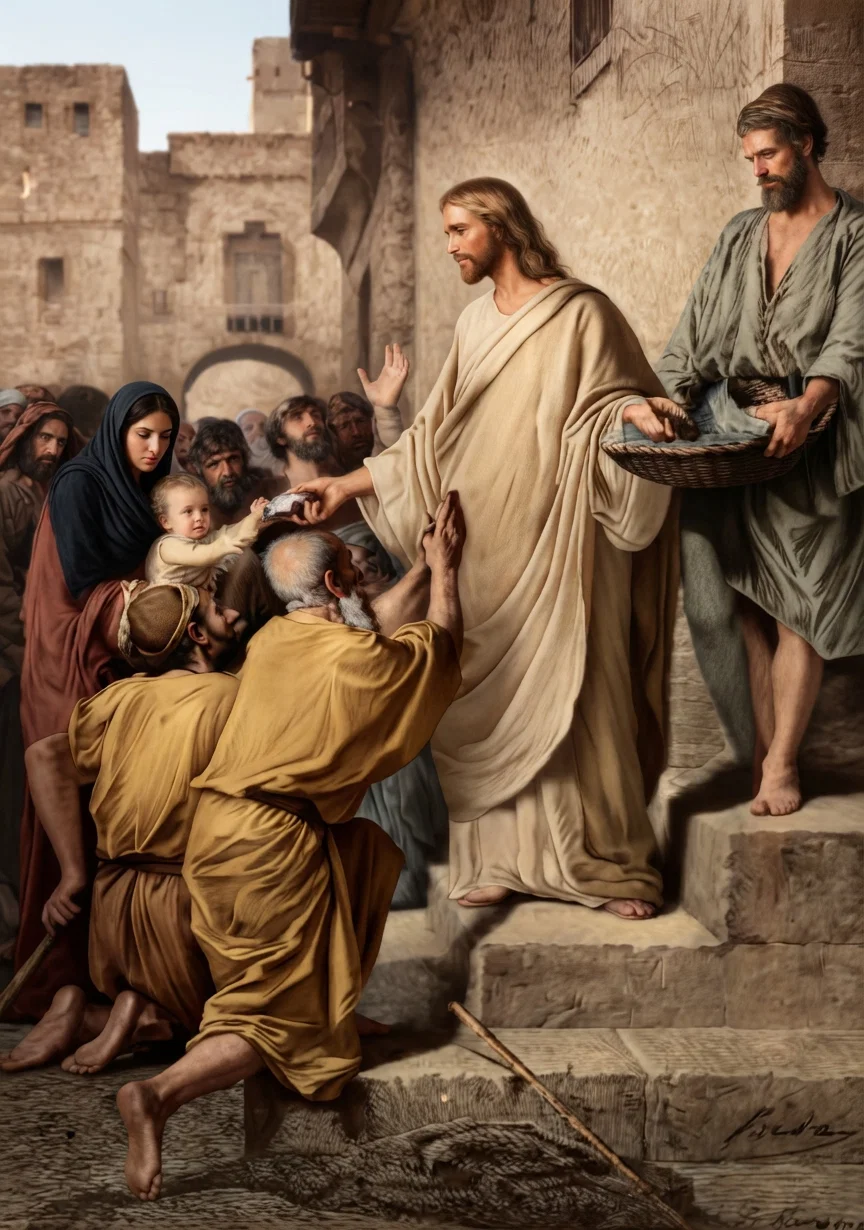
If a son shall ask bread of any of you that is a father, will he give him a stone? or if he ask a fish, will he for a fish give him a serpent?
knock, and it shall be opened unto you. For every one that asketh receiveth; and he that seeketh findeth; and to him that knocketh it shall be opened.
"If a son shall ask bread of any of you that is a father, will he give him a stone? or if he ask a fish, will he for a fish give him a serpent? or if he shall ask an egg, will he offer him a scorpion? If ye then, being evil, know how to give good gifts unto your children: how much more shall your heavenly Father give the Holy Spirit to them that ask Him?"
With such encouragement as this promise affords, why should there be a reluctance on our part to make known our requests to God? Christ compares the love of a parent, who is so willing to relieve the necessities of his children, with that of our Father in heaven. He would impress upon His followers their true relationship to God. They are His children, His by creation, and by redemption. God is their Father in a sense that implies a closer relationship than that of a child to its earthly parents. He "so loved the world, that He gave His only-begotten Son, that whosoever believeth in Him should not perish, but have everlasting life." If earthly parents know how to give good gifts to their children, how much more shall our Father in heaven "give the Holy Spirit to them that ask Him?"
The Refuge in All Perplexities
In His lessons Christ presented the relation that the human agents should sustain to God and to one another. He does not leave one soul in darkness in regard to the source of our strength. He points us to prayer as a refuge in all perplexities and disappointments. He says, "What things soever ye desire, when ye pray, believe that ye receive them, and ye shall have them." The needy soul may be supplied with grace if he will ask in simple, trusting, childlike faith in God as his Father, through Jesus as his Saviour. Christ understands the needs of humanity. He will not be indifferent to the soul who desires His love and His presence. He is waiting to be gracious, to impart the bright beams of His righteousness. It was for this that He came to our world. He says, "I came not to call the righteous, but sinners to repentance." But it is only by our own consent that Jesus can release us from our bondage to Satan. His promise is, "Him that cometh to Me I will in no wise cast out." Then let us not dishonor God by refusing to come to Him.
Deliverance to the Captives
Christ announced His mission to the world, when, in the synagog at Nazareth, He read from the prophecy of Isaiah: "The Spirit of the Lord is upon Me, because He hath anointed Me to preach the Gospel to the poor; He hath sent Me to heal the broken-hearted, to preach deliverance to the captives, and recovering of sight to the blind, to set at liberty them that are bruised, to preach the acceptable year of the Lord." What a work was before Him — to preach the acceptable year of the Lord! This period embraces age after age, extends from century to century, while probation shall last. God is waiting to hear the asking and knocking; watching to see humanity draw nigh unto Him, who alone can help us. He4longs to forgive their sins, to receive them as His own. He will receive every contrite soul who comes to Him; for it was to do this work that God anointed His only-begotten Son.
But why did not Christ finish the statement recorded in Isaiah? Why did He omit the clause, "and the day of vengeance of our God"? The latter portion of this sentence was just as much truth as the first part; and Christ did not deny the truth by His silence, by withholding a portion of His own words given to His chosen prophet. But this last clause was that upon which His hearers delighted to dwell, and which they were inclined to practise, pronouncing judgment upon all who were not of their religious faith. Instead of giving to the people words of truth and righteousness and forgiveness, they had taught them that God hated all the heathen world. The paternal character of God had been misrepresented, and buried beneath human traditions.
Presenting the Open Door of Mercy
But the time had come for the fulfilment of the prophecy, "The people that walked in darkness have seen a great light: they that dwell in the land of the shadow of death, upon them hath the light shined." Isa. 9:2. The work of Christ was to present to the world the open door of mercy, through which all might have an abundant entrance through faith and repentance. He held in His hand all the treasures of wisdom. Eternal truth fell from His lips like precious jewels, and its meaning was flashed into the minds and hearts of those who received His words. He had come to uproot tradition and superstition, and sow the earth with truth; in the place of the commandments of men, to give them the commandments of God. The insufficiency of formal, ceremonial obedience to save the soul, He made to appear in its true light when contrasted with the eternal obligations resting upon the human family.
Christ encourages the sincere requests made to Him in simple, trusting faith. All who seek of Him shall find; all who knock will have the door opened to them. The excuse will not be made, Trouble me not; the door is closed; I do not wish to open it. God's is a divine friendship, a treasure-house where abundant supplies of spiritual riches are stored for every one who has a sense of his need and asks in faith.
The Lord desires that we shall avail ourselves of the rich supplies awaiting our demand, that we may relieve the necessities of those who are hungering and thirsting for the bread and water of life, by pointing them to the source of righteousness and salvation. But unless dependent upon the grace and wisdom that come alone from God, we can not supply the help of which humanity around us stands in such great need. We can not work successfully for perishing souls unless we often and urgently make our requests known to God, our Friend in every emergency.
Meeting Perplexities
In the work that Christ has left for His followers to do, we may have divine help. His promise is, "Ye shall receive power, after that the Holy Ghost is come upon you: and ye shall be witnesses unto Me both in Jerusalem, and in all Judea, and in Samaria, and unto the uttermost part of the earth." And this promise is "unto you,
and to your children, and to all that are afar off, even as many as the Lord our God shall call." When perplexities arise, the first thought should be directed to God in prayer. This was the practise of Christ, and He is our efficiency. We need not fail nor be discouraged. In looking to Him whom our sins have pierced, we see the One whom the Father has given to be "the propitiation for our sins; and not for ours only, but also for the sins of the whole world."
The Manner of Christ’s Coming
By C. P. Bollman
By C. P. Bollman
NOMINALLY the whole Christian world accepts the doctrine of the second coming of our Lord Jesus Christ; but in reality many reject it, by substituting for the Biblical doctrine of Christ’s personal return, some vague theory, as for instance, that He comes the second time at conversion, or at death, or by the descent of the Holy Spirit, or in this or that movement, reformation, or manifestation.
But that Christ comes “the second time” in any of these things, can not be true; because there must of necessity be some similarity, something in common, between an event and its repetition. The present king of England never visited the United States, tho his father did when prince of Wales; therefore were George V to visit this country now, or at any future time, it would be absurd to speak of his coming as a second visit.
Again, tho Edward, prince of Wales, visited this country when a young man, yet when, as king, he afterward sent an ambassador or personal representative here, it would have been manifestly misleading to speak of the coming of that ambassador as the second coming or visit of Edward VII to this country. There could be a first and a second visit by the same person, no matter how different those visits might be; or there might be a first and a second sending of an ambassador, however different might be the circumstances; but there could be no second without a first, and the second must bear to the first some logical, some reasonable resemblance or feature of identification.
Literally Fulfilled in First Advent
The first advent of our Lord was literal and personal. It was prophesied of Him that He should be the seed of the woman. Gen. 3:15. He was literally “made of a woman, made under the law, to redeem them that were under the law.” Gal. 4:4, 5. The prophecy declared, “Behold, a virgin shall conceive, and bear a Son, and shall call His name Immanuel.” Isa. 7:14. This prophecy, remarkable as it was, met a literal fulfilment in the birth of Jesus of Nazareth. See Matt. 1:18-25. And shall the equally literal predictions of His second coming be fulfilled in some way so mystical as to forbid a certain knowledge that they are fulfilled at all? Nay, verily; heaven and earth shall pass away, but the divine Word shall not pass away. See Matt. 24:35.
It was foretold of Christ in His first advent that He should be “despised and rejected of men; a man of sorrows, and acquainted with grief;” that “He was wounded for our transgressions, He was bruised for our iniquities;” “He is brought as a lamb to the slaughter;” “He was cut off out of the land of the living.” All this was fulfilled to the letter; and shall not the prophecies of His glory in His second coming be just as literally accomplished? To this question the apostle makes reply in these words: “Cast not away therefore your confidence, which hath great recompense of reward. For ye have need of patience, that, after ye have done the will of God, ye might receive the promise. For yet a little while, and He that shall come will come, and will not tarry.” Heb. 10:35-37.
Must Be Literally Fulfilled at Second Advent
Neither the descent and presence of the Holy Spirit, conversion, death, nor any so-called reformatory movement or wonderful manifestation, without the literal Christ, can possibly be His second advent. He Himself said, “I will come again.” John 14:3. Knowing, before, the deceptions that would come in the last days, both in false, unscriptural theories and in deceptive appearances, our Lord Himself gives us this5gracious warning: "If any man shall say unto you, Lo, here is Christ, or there; believe it not. For there shall arise false christs, and false prophets, and shall show great signs and wonders; insomuch that, if it were possible, they shall deceive the very elect. Behold, I have told you before. Wherefore if they shall say unto you, Behold, He is in the desert; go not forth: behold, He is in the secret chambers; believe it not. For as the lightning [or light of the sun] cometh out of the east, and shineth even unto the west; so shall also the coming of the Son of Man be." Matt. 24: 23-27. Compare Ps. 50: 1.
Not Secret or Local
The second coming of Christ will be in no sense secret or local; for "every eye shall see Him," Rev. 1: 7. In the temptation the devil took Christ "up into an high mountain," and "showed unto Him all the kingdoms of the world in a moment of time" (Luke 4: 5); and can not the divine Son of God manifest Himself personally and visibly to all the world? There can be but one answer to this question; namely, that He can; and not only has He the power, but He has told us that He will thus manifest Himself.
Not only is there assurance in Christ's promise to His disciples, "I will come again," that He Himself will come, personally and visibly; but we have in the words of the angels to the disciples on the occasion of the ascension a most explicit assurance that this will be even so. The Word tells us that as He was talking to them, "while they beheld, He was taken up; and a cloud received Him out of their sight. And while they looked steadfastly toward heaven as He went up, behold, two men [angels] stood by them in white apparel; which also said, Ye men of Galilee, why stand ye gazing up into heaven? this same Jesus, which is taken up from you into heaven, shall so come in like manner as ye have seen Him go into heaven." Acts 1: 9-11.
Could language be plainer? The words, "This same Jesus," could convey to the minds of those eager disciples no other thought than that Jesus Himself would really return in His own proper person. They had seen Him, had put their hands upon Him after His resurrection; they had eaten in His presence, had talked with Him, and had seen Him eat, and had heard and recognized His familiar voice as when they companied with Him daily before His crucifixion; and to them these precious words, "This same Jesus" "shall so come in like manner," could have no occult or hidden meaning; they could only mean what similar words would have meant if spoken of any other person under the most ordinary circumstances of life.
Paul Received the Same Faith
The apostle Paul, not being at this time a believer in Christ, was not present to hear either the words of the Saviour, "I will come again," or the cognate assurance of the angels, "This same Jesus" "shall so come in like manner;" but he cherished the same "blessed hope" of himself seeing the very same Jesus who spoke to him and appeared to him on the way to Damascus. To him the second advent was as real as the first; His coming again as literal as His dying upon the cross. "As it is appointed unto men once to die," writes this servant of God, "but after this the judgment: so Christ was once offered to bear the sins of many; and unto them that look for Him shall He appear the second time without sin unto salvation." Heb. 9: 27, 28.
Again, to the Thessalonians the apostle writes, "The Lord Himself shall descend from heaven with a shout, with the voice of the Archangel, and with the trump of God." The words, "The Lord Himself," convey the same idea exactly as the words of the angels, "This same Jesus." But the apostle was not simply repeating in substance what He had heard from others. Doubtless he had many times heard from eye-witnesses those cheering words of angelic assurance, "This same Jesus" "shall so come in like manner;" but of the truth which he taught he testifies, "I neither received it of man, neither was I taught it, but by the revelation of Jesus Christ." Gal. 1: 12. Thus in Acts 1: 9-11 and in 1 Thess. 4: 16 we have from the original source of all truth, but through different channels, the most explicit testimony possible to be given in human speech, that Christ Himself will return to this earth, not in some mystical, unreal, secret manner, but openly, literally, and personally.
Ever the Hope of the Church
The coming of the Just One, not to die, but to be glorified in all His saints, has been the hope of the church of Christ from that day when "He was taken up; and a cloud received Him out of their sight," down to the present moment, and will continue so to be until His promise, "I will come again," shall be grandly realized by His waiting church.
Our Christian songs, as well as the Word of God, and much of our sermonic literature, attest this fact. Charles Wesley wrote:
Whatever ills the world befall,
A pledge of endless good we call,
A sign of Jesus near.
His chariot will not long delay;
We hear the rumbling wheels, and pray,
Triumphant Lord, appear.
A more recent writer sings:
Some day our raptured eyes shall see
He's just the same Jesus.
O blessed day for you and me!
The very same Jesus.
Amen. Even so, come, Lord Jesus.
Are You Just Singing It?
PAUL says to Timothy, "Suffer hardship with me, as a good soldier of Christ Jesus." That is the heritage of the soldier. How many sing stirring Gospel songs as tho their heart were aglow with zeal for the Master, but the song has scarce died away before the enthusiasm is gone! A service was held in a college chapel. Phillips Brooks thus described it, says an item in the Sunday School Times:
"It was an inspiration to see all those young men singing so heartily. Especially they seemed to throw all their strength into the hymn, 'Am I a soldier of the cross?' Even Dr. X——, the college president, sang as if he caught the contagion of their enthusiasm." "Did Dr. X—— sing that hymn? Does he really believe himself a soldier of the cross?" interrupted a somewhat incredulous listener. "O, no," answered Bishop Brooks quickly, "he was simply asking for information." There is a vast deal of difference between calling ourselves soldiers, and the enduring of hardness as good soldiers.
"I Shall Not Pass This Way Again"
By Arthur V. Fox
By Arthur V. Fox
I shall not pass this way again;
But far beyond earth's where and when,
May I look back along the road
Where on both sides good seed I sowed.
I shall not pass this way again.
May Wisdom guide my tongue and pen,
And Love be mine, that so I may
Plant roses all along the way.
I shall not pass this way again.
May I be courteous to men,
Faithful to friends, true to my God,
A fragrance on the path I trod.
Los Angeles, California.
Unappreciated Value
ONE of the first diamonds found on South African diamond fields was picked up by the child of a small farmer, as he was playing beside a brook near his father’s cottage. Some months afterward a pedler came to the cottage with a pack on his back. As he was displaying his wares, the pedler spied the stone on a shelf in the room. He took it up and examined it, and then asked the mother what she would take for it. She pointed to the child, and said, laughingly, “It belongs to that bairn, not to me.” The pedler then offered the boy a box of wooden soldiers, worth a few cents, in exchange for the stone, and the child gladly accepted the offer. That stone was a very precious jewel. The pedler took it to Cape Town, where he sold it for a large sum to a jeweler. When the jeweler sent it to Europe to be sold, he obtained $125,000 for it, and it now adorns a royal neck. Neither the child nor the parents were wise enough to know its value. Similarly multitudes barter away for a mess of pottage the pearl of great price which is within the reach of all.—Preacher’s Helper.
Love in Service
By Mrs. Walter Clair Thompson
By Mrs. Walter Clair Thompson
"I love you, mama," said a child;
Then off she went to play,
Forgetting love means service
For mother, through the day.
"I love Thee, Lord, with all my heart,"
Is older children's prayer,
Then straightway their own way pursue;
But love means service rare.
Why is it that we see not, love
Means deeds, not words alone,
And service, daily service, leads
Us upward to His throne?
The love shown by our Master great
In tender words of cheer,
Brought healing to the sufferers,
When Jesus Christ was here.
And while we talk of loving Him,
Let us remember still
The love He counts is doing well
The Father's spoken will.