Your ShelfYour Projects

Signs of the Times, Vol. 40, No. 36.

Question Corner

Signs of the Times

Sep 16, 1913

Pacific Press Publishing Association · Mountain View, California · Sep 16, 1913

Question Corner

“IF YE WILL INQUIRE, INQUIRE YE.”
This Inquirer's Department is conducted for the purpose of helping those who are studying the Bible. The answers are oftentimes only suggestive. They are never to be considered infallible, only as they agree with the infallible Word. The writer who may answer these questions does not consider that his opinion is infallible. He will simply give the best that he has, and plead with the inquirer to search the Word. Such questions only will be answered as, to the editors, seem to minister to the good of the readers and to the mission of the paper. We can not answer repeatedly in the same volume questions upon the same scripture. The name and address must accompany question, not for publication, but as an evidence of good faith, and that answer may be made by letter if deemed advisable. No letters are answered which do not contain the name of the writer. It is well always to enclose stamp for reply.

4177 — What Became of Mary the Mother of Our Lord?

At the time of the Saviour's death, He turned His mother over to His beloved disciple's care. I take it by that that her husband Joseph was dead. Was her husband Joseph the son of Jacob, who was sold into Egypt? I have been told that she was taken up to heaven after she died, and is with Jesus pleading with those who are passing through purgatory. E.
First, this Joseph and the Jacob referred to in the New Testament in Matt. 1:15, 16, are not the Jacob and Joseph of Genesis. That Jacob lived 1,750 years before Christ. Jacob and Joseph were common names among the Jews. Joseph the husband of Mary was simply a son of one who was named Jacob. Names ran through families then the same as now.
Yes, in all probability Joseph was dead when Jesus died upon the cross. The fact that He commended her to John intimated that she had no other support. We have no record whatever of her death or end. In all probability she died the same as other women die. She was not immortal. There is nothing in the teaching of the Bible to indicate that she was. In fact, the Bible very clearly states that man is mortal, and that God “only hath immortality.” The traditional teaching of the immortality of the soul, that there is something in man that survives the body and that lives on after the body is dead, is all based on that first falsehood of Satan (Gen. 3:4), “Ye shall not surely die.” If this Bible truth were accepted, there would be no teaching of purgatory nor ever-burning hell.
Mary was the honored medium through which our Lord was brought into the world and became a partaker of human flesh, but nowhere in God's word is there any intimation that she was made God. Jesus Himself distinctly says in Mark 3:31-35, on a certain occasion when some came to Him and said that His mother stood without desiring to speak with Him, “Who is My mother and My brethren? And looking round on them that sat round about Him, He saith, Behold, My mother and My brethren! For whosoever shall do the will of God, the same is My brother, and sister, and mother.” A knowledge of the truth of the Bible does away forever with purgatory, invocation of the saints, and the worship of Mary. There is one God, and one Mediator between God and man—the Man Jesus Christ.

4178 — Silence in the Churches

Will you kindly explain 1 Cor. 14:34, 35? I always thought that this meant to speak with authority, but this verse seems to contradict this. W. H. B.
If we understood all the various customs of the days of the apostle Paul, some of these scriptures would not trouble us. The very context itself would seem to indicate that there was a great deal of disorder in the church at Corinth. Every one had a tongue, and every one had a doctrine, and every one had a revelation, and there was more or less confusion, of which the apostle tells them that God is not the author. Some of their women seemed to be doing as did those devoted to heathen worship. The apostle certainly did not mean that they should not testify of Christ, or should not speak to His praise. Some of the women associated with him in his labors, and whom he mentions in the 16th chapter of Romans, were women who labored in the Lord. We read in Acts, the 21st chapter, the 9th verse, that Philip the evangelist “had four daughters, virgins, which did prophesy;” that is, they taught for God. The great object of the apostle seems to have been to correct the disorders that had sprung up in the Corinthian church. “Let your women keep silence in the churches.”
Another meaning, however, is given to the scripture by some critics, and it is not unreasonable; namely, that verses 34 and 35 are the language of the objector. It is the objector that says, “Let your women keep silence,”—do not permit them to speak; let them learn at home; and so on. And Paul's response to this is in verse 36, “What? came the word of God out from you? or came it unto you only?” And then what should they do? Verse 39: “Wherefore, brethren, covet to prophesy, and forbid not to speak with tongues.” But “let all things be done decently and in order.” This last supposition certainly is not unreasonable.

4179 — Clean and Unclean Fowls

Is it correct to classify all the unclean fowls as those that do not have gizzards, and the clean as those that do have gizzards? I have heard this stated by those who claim to know. Will it always work? O. F. F.
We do not know. We have no authority as to the facts in the case. It might be well to follow out the study and so learn. The “Bible Companion” on Leviticus 11, regarding the unclean fowls, says: “No general rule is given for the distinction between clean and unclean birds, but there is a list of nearly twenty which are prohibited, nothing being said of those which might be eaten. It will be seen that as far as they can be identified, the birds here mentioned are such as live upon animal food. The ‘Mishna’ [a Jewish work] lays it down as a rule that every bird is unclean which strikes its talons into its prey. It quotes one authority which puts into the same class every bird which divides its toes equally in climbing, like the parrot and woodpecker. The distinction between birds in the Moslem law seems similarly to hinge upon their food.” In a further note, the same commentary says: “Many have considered that the prohibition of the unclean animals was based mainly or entirely upon sanitary grounds, their flesh being regarded as unwholesome.” “The instinct of our own nature points in the same direction. Every one dislikes the snake and the toad; no one likes the form and habits of the pig; we shrink from the notion of eating the flesh of the hyena or the vulture. When we are told of our fellow creatures eating slugs, snails, and earthworms, and accounting the grubs found in rotten wood a peculiar delicacy, the feeling of disgust which arises within us would not seem to be the offspring of mere conventional refinement. This conclusion is not invalidated by the fact that our own repugnant feelings have been subdued in the case of the oyster and the pig.”
The “Bible Companion” has this pertinent note: “Food plays a chief part in health and sickness. It is our wisdom to obey these laws now as far as possible. All are based on the preservation and health of the race, some for sanitary reasons, some from peculiarities of climate, some for separating from other peoples.”

4180 — Voting

Is voting a sacred or a civil right? C.
Voting is not necessarily a right at all. It is that which is given by a civic organization—state, county, or municipality—to classes of citizens that are considered to be worthy of it. Of course if a man is a constituent of any body or organization, contributing to the success of that organization, etc., etc., as a simple right he ought to have a voice in it the same as any one else. In that case, it would be a sacred right in the sense of being that which belonged to him as a matter of justice. But that is not so considered as regards voting in a republic like the United States, for instance. It is presumed that the laws themselves will protect every man equally, and therefore it is not regarded as so important that absolutely every person should have a voice in the matter of lawmaking and election of government officials. However, there is coming to be more and more a sentiment that it ought to go to all of full age who are not foreigners, idiots, insane, or who do not belong to some alien, unassimilable races.

4181 — What Was in the Ark?

I have noticed several times, in your paper, that there was nothing in the ark but the book of the law. Please harmonize with Ex. 16:33; 25:16, 21; Heb. 9:4. Your statement agrees with 1 Kings 8:9. L. J. R.
Ex. 16:33 is simply God's instruction to take some of the manna and lay it up before Jehovah. Verse 34 declares that as the Lord commanded Moses, so he did—he laid it up before the testimony. The testimony, of course, was the ark, and what was in it; not “within” it, but “before” it. Chapter 25:16 simply declares that “thou shalt put into the ark the testimony which I shall give thee”—that is, the tables of stone. Verse 21, the same thing: “And thou shalt put the mercy-seat above upon the ark; and in the ark thou shalt put the testimony that I shall give thee.” As before stated, that testimony was the tables of stone, those which testified for God. “And He gave unto Moses, when He had made an end of communing with him upon Mount Sinai, two tables of testimony, tables of stone, written with the finger of God.” Ex. 31:18.
As our correspondent intimates, 1 Kings 8:9 agrees with this. There was nothing in the ark save the two tables of stone which Moses put there at Horeb when Jehovah made a covenant with the children of Israel, when they came out of the land of Egypt.
Referring to Heb. 9:4, there is a seeming contradiction; but may not the “wherein” refer to the holy of holies? “After the second veil, the tabernacle which is called the holy of holies; having a golden altar of incense, and the ark of the covenant overlaid round about with gold, wherein [that is, in the holy of holies] was a golden pot holding the manna, and Aaron's rod that budded, and the tables of the covenant.” So it is understood by some. Others have thought that they were placed by the side of the ark, or in a pocket at the side of the ark, but not directly within the ark under the mercy-seat itself. And that would be in perfect harmony with what the Lord directed Moses in the 16th chapter of Exodus, to place the manna “before” the testimony, not within upon it. When Moses set up the tabernacle according to the instructions given of God, as recorded in Ex. 40:20, it is said, “And he took and put the testimony into the ark, and set the staves on the ark, and put the mercy-seat above upon the ark.” Nothing whatever is said of his putting anything else in the ark, but we do have a command concerning the book of the law: “Take this book of the law, and put it in the side of the ark of the covenant of the Lord your God, that it may be there for a witness against thee.” This, it would seem, is all that is meant by Heb. 9:4. There may have been made a pocket, or something of that sort, in connection with the ark, where these things were kept.

Our Bible Band

Schedule for Week Ending September 20, 1913

Day Date Book Chapters
Sunday September 14 Zechariah 1, 2
Monday " 15 " 3, 4
Tuesday " 16 " 5, 6
Wednesday " 17 " 7, 8
Thursday " 18 " 9, 10
Friday " 19 " 11, 12
Sabbath " 20 " 13, 14
Our entire week covers an entire book, that of Zechariah, contemporary with Haggai as a prophet of the restoration. His name means “Jehovah hath remembered.” This prophecy was given in 520 and 518 B.C. It consists chiefly of visions presenting motives for confidence and earnest effort. Chapters 9 to 14 seem to have a different historical setting and a different style. They are thought by some to have been written by the Zechariah of Isa. 8:2. Others have contended that these chapters were a part of Jeremiah's prophecy, because of the use of a term that is common to Jeremiah, “the burden of the word of the Lord,” and also because Zech. 11:12, 13 is ascribed to Jeremiah in Matt. 27:9, 10. The theory is that this manuscript became separated in some way from Jeremiah's prophecy, and when the manuscripts were put together, was attached by mistake to that of Zechariah. It does not, of course, affect the moral of the prophecy, or the import of the words, or its inspiration. It would affect this only, that if it was written by Jeremiah, it came before the restoration from Babylon; if by Zechariah, after that event, which might make a difference in the interpretation of some of the promises. And it is a possible thing, of course, that Jeremiah may have written some things to which the Jews of our Lord's time had access which have since been lost. The easier view to accept, it seems to us, is that these later chapters were written by Jeremiah. From the restoration from Babylon, the entire prophecy looks forward to the last glorious restoration, when Christ shall come.

The Sabbath of the Fourth Commandment
By Mrs. E. G. White
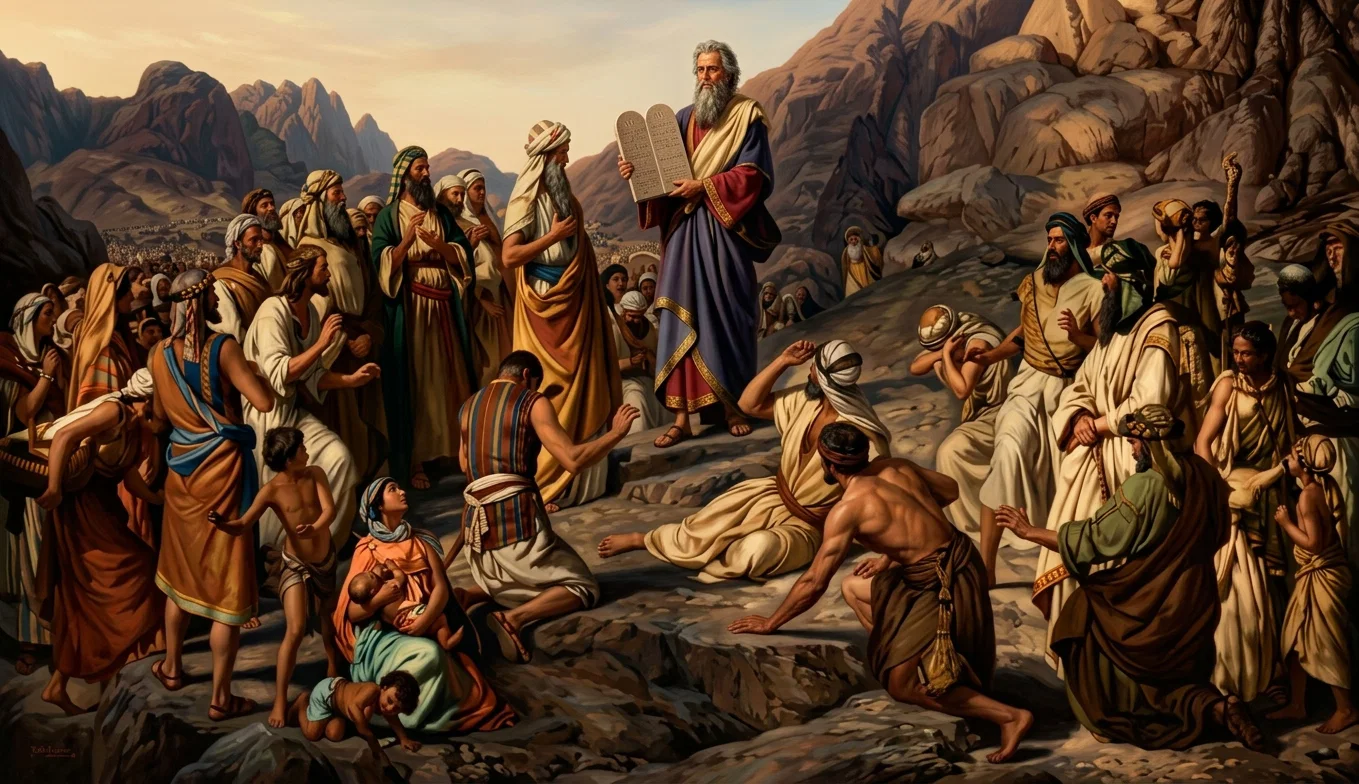
MOSES COMING DOWN FROM MOUNT SINAI WITH THE LAW
“Remember the Sabbath day, to keep it holy. Six days shalt thou labor, and do all thy work: but the seventh day is the Sabbath of the Lord thy God: in it thou shalt not do any work, thou, nor thy son, nor thy daughter, thy man servant, nor thy maid servant, nor thy cattle, nor thy stranger that is within thy gates: for in six days the Lord made heaven and earth, the sea, and all that in them is, and rested the seventh day: wherefore the Lord blessed the Sabbath day, and hallowed it.”
THE law of God is binding upon men of every age and in every country. All mankind are under obligation to obey every injunction set forth in its ten precepts.
The fourth commandment is a part of that law. God has made that command specially significant, by placing it in the very bosom of the Decalogue.
God’s holy law was not instituted at Sinai, altho it was there first proclaimed. The thunder and lightnings that enveloped Sinai presented a scene of awe and terror which no voice or pen can describe. The splendor and majesty of God’s glory there revealed, caused the people whom He had rescued from the bondage of Egypt to tremble with fear. And as they heard the voice of God amid the smoke and the fire, the thunderings and the lightnings, and the noise of a trumpet, they moved afar off from the mount, and said to Moses, “Speak thou with us, and we will hear: but let not God speak with us, lest we die.” “And Moses said unto the people, Fear not: for God is come to prove you, and that His fear may be before your faces, that ye sin not. And the people stood afar off, and Moses drew near unto the thick darkness where God was. And the Lord said unto Moses, Thus thou shalt say unto the children of Israel, Ye have seen that I have talked with you from heaven.” “Six days thou shalt do thy work, and on the seventh day thou shalt rest: that thine ox and thine ass may rest, and the son of thy handmaid, and the stranger, may be refreshed.”
During the absence of Moses in the mount, whither he had gone to receive the tables of the law, the children of Israel lapsed into idolatry. When Moses returned and saw that they had broken their covenant with God, shame and confusion on their account took possession of him, and he there threw down the tables and broke them. As they had broken their covenant with God, Moses, in breaking the tables, signified to them that so also God had broken His covenant with them.
“And the Lord said unto Moses, Hew thee two tables of stone like unto the first: and I will write upon these tables the words that were in the first tables, which thou brakest.”
In writing the law upon tables of stone, it was God’s design to teach men the lasting character of His law, and the perpetual obligation of all mankind to obey that law which is the transcript of His character.
At the very beginning of the fourth precept, God said, “Remember,” knowing that man, in the multitude of his cares and perplexities, would be tempted to excuse himself from meeting the full requirements of the law, or in the press of worldly business would forget its sacred importance. It is not the first day, or any common day, but the seventh, that God has blessed and set apart for a sacred use. As He surveyed His work of creation, He saw that it was very good, and He rested on that day. And He designed that man should keep it holy because He Himself on that day had rested. The teachers of our day, however high their claims to sanctity, who would pronounce the law of God Jewish, are wresting the Scriptures, misleading the people, and making God’s law of none effect.
The Sabbath was given to Adam and Eve in Eden for all their posterity. The Jews were not more closely related to Adam than were any of the other nations on the earth. Instead of losing its force now, the law is to be more fully understood. When the typical sacrifices ceased at the death of Christ, the original, as engraved on the tables of stone, stood immutable, holding its claims upon men in all ages. And in the Christian age the duty of man is not limited, but more especially defined and simply expressed.
God rested on the seventh day, not merely to furnish an example to the Jews. The Sabbath commandment is obligatory upon all men to the end of time. And not only this, its observance is to be carried into the future world, to be perpetuated throughout eternity.
God has given man six days in which to do his work, and carry on the usual business of life; but He claims one day, which He has blessed and sanctified. And He gives this to man as a day in which he can rest from labor and devote himself to the worship of his Maker. It is the grossest presumption for mortal man to venture upon a compromise with the Almighty in order to secure his own petty temporal interests. “I the Lord thy God am a jealous God,” was thundered from Sinai. No partial obedience, no divided interest, is accepted by Him who declares that the iniquities of the fathers shall be visited upon the children unto the third and fourth generation of them that hate Him, and that He will show mercy unto thousands of generations of them that love Him, and keep His commandments.
Christ was the foundation of the whole Jewish economy; and in all His specific directions regarding the ceremonial observances, these were distinguished from the Decalogue. They were to pass away. Type was to meet antitype in the one great offering of Christ for the sins of the world.
Christ and His disciples kept the Sabbath. When accused of breaking the Sabbath by rubbing the ears of wheat in His hands and eating with His disciples to satisfy His hunger, He denied the charge made against Him. He assured His accusers that they had condemned the guiltless; for He had done only those things that were perfectly in harmony with the Sabbath commandment. If the priests and rulers could have substantiated their accusation, they would have had no need to suborn men to bear false witness against God at His trial.
The death of Christ upon the cross shows the immutability of the law of God. His death magnified the law and made it honorable. From His own divine lips are heard the words: “Think not that I am come to destroy the law, or the prophets: I am not come to destroy, but to fulfil. For verily I say unto you, Till heaven and earth pass, one jot or one tittle shall in no wise pass from the law, till all be fulfilled.”

Is the Law Done Away?

“Do we then make void the law through faith? God forbid: yea, we establish the law.” Rom. 3:31.
ACCORDING to this statement, if we exercise faith, we establish the law. But what is faith? In Rom. 5:1 we read, “Therefore being justified by faith, we have peace with God through our Lord Jesus Christ.” This being so, we must have faith in Jesus to give us this peace with God; but “there is no peace, saith the Lord, unto the wicked.” Isa. 48:22. It must be only those who have ceased sinning, therefore, who enjoy this peace. We read that “if we confess our sins, He is faithful and just to forgive us our sins, and to cleanse us from all unrighteousness.” 1 John 1:9.
But what is sin? This question is very definitely answered in the following scriptures:
“Sin is the transgression of the law.” 1 John 3:4.
“I had not known sin, but by the law: for I had not known lust, except the law had said, Thou shalt not covet.” Rom. 7:7.
“By the law is the knowledge of sin.” Rom. 3:20.
When a man breaks the law of the land, and is put in prison, he may have his term of imprisonment shortened because of good behavior. Some one reports his good conduct to the authorities, and he is released. He owes his full term to justice, but is pardoned by the grace of the governor, that he may be a better citizen.
Now if we break the law of God, and are sorry, and determine not to do it again, we may, by exercising faith in the saving power of Jesus, who has already met our sentence, find forgiveness; for if we confess our transgression of the law, He is faithful and just to forgive us our transgressions of the law, and to cleanse us from all unrighteousness.
It is evident, therefore, that every time we come to Jesus for forgiveness, we admit that the law is still binding. “Do we then make void the law through faith? God forbid: yea, we establish the law.”
F. A. BOWER.

Is the Seventh-Day Sabbath Still Binding?

By E. Hilliard
THE Sabbath was instituted at creation as a memorial of the work done by the Creator during the first week of time. He kept an accurate count of the days of that week, created man on the sixth day, rested on the seventh, and blessed and sanctified it. As long as the earth should remain, each successive seventh day was to be observed; for, said Jesus, “The Sabbath was made for man.” Mark 2:27, 28.
The Sabbath as the memorial of creation keeps ever present the true reason why worship is due to God. It is because He is our Creator, and we are His creatures. It lies at the very foundation of divine worship; for it teaches this great truth in the most impressive manner, and no other institution does this. So long as the fact that God is our Creator continues to be a reason why we should worship Him, so long will the seventh day continue as a memorial of His creative power, that power that supplies our spiritual and physical needs. Our Creator has given us the Sabbath as a sign, that we may know that it is the Lord our God that sanctifies us; that it is He who creates in us a clean heart. Eze. 20:12, 20; Ps. 51:10; Eph. 2:10.
The keeping of the Sabbath is a sign of loyalty to the true God; and had it always been kept as the memorial of the created works of Him who alone can create, there would never have been an idolater on the earth. We are to “worship Him that made heaven, and earth, and the sea, and the fountains of waters.” Rev. 14:7. The same power that created the earth, sea, and fountains of waters, creates a new heart in man. He who keeps the Sabbath, instituted at creation, keeps it not only as a memorial of the physical creation, but also as a sign that there has been created in him a new heart. Without this change of heart, no man can keep the Sabbath.
The fourth commandment of the moral law requires us to work six days and rest on the seventh. It reads: “Remember the Sabbath day, to keep it holy. Six days shalt thou labor, and do all thy work; but the seventh day is the Sabbath of the Lord thy God: in it thou shalt not do any work: . . . for in six days the Lord made heaven and earth, the sea, and all that in them is, and rested the seventh day: wherefore the Lord blessed the Sabbath day, and hallowed it.” In this commandment, the times for labor and rest are separated, each set apart for its purpose.
Now without motion, there can be no measurement of time. The diurnal revolution of the earth measures the day, the beginning and ending of which is marked by sunset. “From even unto even, shall ye celebrate your sabbath.” Lev. 23:32. “At even, when the sun did set, they brought unto Him all that were diseased.” Mark 1:32. These texts simply show when the day begins and ends. It extends from even to even, or from sunset to sunset.
Now if a change of the Sabbath should be made from the seventh to the first day of the week, it would subvert the order of things instituted at the beginning and commanded at Mt. Sinai. To effect such a change, one would have to work seven days and rest the first day of the following week, or work but five days and rest two days, either of which would be contrary to God’s established plan for labor and rest. He has sanctified — set apart — every seventh revolution of our globe to be observed as holy time, and has commanded that no unnecessary manual labor shall be done during the time measured by this diurnal revolution.
Even after the earth is restored to its primitive, Edenic condition, the seventh-day Sabbath will be observed as the day for worship. We read: “For as the new heavens and the new earth, which I will make, shall remain before Me, saith the Lord, so shall your seed and your name remain. And it shall come to pass, that from one new moon to another, and from one Sabbath to another, shall all flesh come to worship before Me, saith the Lord.” Isa. 66:22, 23. The Sabbath upon which the redeemed will convene for worship in the earth renewed, is the very day that was instituted at the close of creation’s week. We can rest assured that it was not changed, at the resurrection of Christ, to the first day, to be changed back again to the seventh day, as the day for worship in the world to come, and this by the “Father of lights, with whom is no variableness, neither shadow of turning.” Our heavenly Father is not a changeable, unfaithful God. We read in Deut. 7:9, “Know therefore that the Lord thy God, He is God, the faithful God, which keepeth covenant and mercy with them that love Him and keep His commandments to a thousand generations.”
From this scripture, we learn that the covenant of God’s mercy is extended to those who keep His commandments to a thousand generations. These commandments, spoken by God, and written with His divine finger upon tables of stone, include the seventh-day Sabbath. This conditional promise of God’s attendant mercy to commandment-keepers was given six hundred years after the birth of Abraham. There were forty-two generations from Abraham to Christ. Matt. 1:17. These forty-two generations covered a period of 2,056 years. Now allowing twenty-five years for a generation this side of Christ (which is a very fair estimate), to cover the period of nearly two thousand years, it gives us eighty generations from A.D. 1. Adding the eighty to the forty-two generations from Abraham to Christ we have 122 generations from Abraham to our days. Deducting 122 from the one thousand generations in whichthe commandments are to be kept, we have 878 generations at least left us in which the Sabbath is still binding upon men. But the “thousand generations” is only another expression for eternity. As surely as our earth revolves, and thereby measures her days, so surely is each successive seventh day under divine appointment for rest and worship. Who will obey the mandates of the faithful, unchangeable God?
Long Beach, California.

Two Different Weeks

WE present, in connection with this little article, a simple diagram showing the difference between the rival weeks which this world has known from indeterminate times. The older week is the Bible week, made up of seven Bible days. The later week differs radically from the former. This suggestion has come to us from Brother and Sister J. R. Shurvinton, and also the suggestion of this little study, for which we give them credit.
The Bible Week and Bible Days
Beginning at Sunset and Closing at Sunset
The Bible Week and Bible Days Beginning at Sunset and Closing at Sunset
The World's Week and the World's Days
Beginning at Midnight and Ending at Midnight
The World's Week and the World's Days Beginning at Midnight and Ending at Midnight
The one week he calls the Roman week,—it is really a world week; the other he calls the Jewish week, but it is really the Bible week. There is no difference, however, in the meaning. It will be noticed that the Bible week set forth in the first chapter of Genesis is made up of seven days; that each one of these days is made up of evening and morning.—“The evening and the morning were the first day,” “The evening and the morning were the second day,” etc.; that the names of these days are the numbers of the days, with the exception of the closing day of the week, which is the seventh day, or Sabbath. It will be noticed further that each one of these days is numbered with respect to the Sabbath, and that the Sabbath itself is the crowning day of the week. All the other days are given with reference to that one alone. The day begins with the evening, or sunset, and closes with the evening, at sunset. See Mark 1:32; Matt. 8:16; Luke 4:40.
The world’s day, received from the Egyptians through the Romans, noted also in the ancient Chinese calendars, evidently began from the watches in the night, the night being divided into four watches, and the division between the two watches beginning the day. It will be seen that one fourth of the Bible day is gone before the world’s day begins; consequently the world’s week begins one fourth of a day later than the Bible week. Hence the days are not synchronous. It can not be said that the first day of the Bible week is Sunday, because it includes only three fourths of Sunday. It can not be said that the seventh day of the Bible week is Saturday, because it includes only three fourths of Saturday. Saturday continues on for six hours longer than the Bible Sabbath. Note the contrast between the two sabbaths. The world’s sabbath comes to us at midnight and leaves us at midnight. The great part of the people of the world do not know when it comes to them, or when it leaves them. It comes as a thief, and it goes as a thief. It brings no blessing in its coming or in its going, more than do the other days of the week.
This, however, is not true regarding the Bible Sabbath. It comes to us at the close of a week of labor. All who observe it, know when it comes. It comes bringing with it all the blessing which God has placed in the day. After welcoming it with due worship offered to the Creator of the heavens and the earth, it puts us to sleep with the Sabbath blessing upon us. We wake in the morning and are still with the Lord in His Sabbath; and when the blessed friend leaves us at evening, we know that he leaves us with the blessing which is designed to continue all through the week to come, until a greater added blessing comes at the next Sabbath.
Observing the Lord’s Sabbath, there never could have been an idolater in the world, because the Sabbath itself would have been a reminder to the worshiper, of the one God who created the heavens and the earth.
Another thought: The seventh-day Sabbath can indeed be a Sabbath, or rest, after work, for “Sabbath” means rest, and implies labor previously performed; but the first day could never be a logical Sabbath, or rest from labor, because it comes before labor has even begun.
There are still other contrasts which could be drawn between the two. The more we study them, and study the way in which God gave His, and in which the unbelieving world has perverted it, the more beauty will we see in the Sabbath of the Lord; the more will we see in the attempt of Satan, many times through innocent men, to change the Sabbath in order to pervert the worship of God’s children. And seeing this, we will all the more turn from the man-made sabbath to the Sabbath of the Lord, which speaks to us of His creative power in the beginning, of His re-creative power manifest in the saving of men, and read in it all a glorious prophecy of a future which shall be made sinless by the same power, in which His people will reign with Him forever. Isa. 66:22, 23; Revelation 22.
Continue reading: Not Under the Law, but Under Grace