Signs of the Times, Vol. 34, No. 7.

THE THREE MESSAGES

Signs of the Times

Feb 12, 1908

Pacific Press Publishing Company · Mountain View, California · Feb 12, 1908

THE THREE MESSAGES
"For God so loved the world, that He gave His only-begotten Son, that whosoever believeth in Him should not perish, but have everlasting life." —John 3:16.

THE THREE MESSAGES.

These words, said the Master, "I'm coming again, That with Me My people forever may reign; That they may be ready My coming to see, I send forth My angels with messages three." The first with this message was sent thru the land: "Fear God, and give glory; His judgment's at hand; And worship the Maker of earth, sea, and sky, And the fountains of waters, who ruleth on high." The second this message of wo did repeat: "The church is not ready her Master to greet; She's fallen, backslidden, departed from heaven, And her love to earth's kings has unlawfully given." The third message follows, the last to be given, To point, once again, dying sinners to heaven: "If any the beast or his image adore, On him shall God's judgments abide evermore." The law of the Father, the faith of the Son, Must be kept by the church all united as one; The mark of rebellion refuse to receive, Be sealed with God's seal, and eternally live. —G. W. Page.
"He that spared not His own Son, but delivered Him up for us all, how shall He not with Him also freely give us all things?" —Rom. 8:32.

With Our Inquirers

“If ye will inquire, inquire ye.”
[All questions to this department will be answered which to the editors will seem to minister to the good of the readers and to the mission of the paper. The same question can not be answered repeatedly in the same volume. The name and address must accompany question, not for publication, but as an evidence of good faith, and that answer may be made by letter if deemed advisable. It is well always to enclose a stamp for reply.]

2382.—Answers to Various Questions.—F. M.

—1. Gen. 12: 3. The word family here doubtless means nations, those who sprang from the families of the sons of Noah. And yet the blessing of Abraham’s Seed has come to every family on the face of the earth. They may have rejected the blessing of Christ, but nevertheless it is because of Christ’s offer that the world has existed.
2. The term “commanded” in Gen. 2: 16 is the proper word.
3. The name of God in Ex. 3: 14, “I am that I am,” denotes self-existence. This was to be God’s name forever, a constant, eternal pledge of His own present existence and His care for His children. This, the name of the God of Abraham, Isaac, and Jacob, was to be the name forever to the children of Israel.
4. Israel is said to be God’s first-born in contradistinction to Esau who was the first-born in time, just the same as Isaac was the first-born in contradistinction to Ishmael, the Ishmael was the elder, and both were sons of Abraham, as Esau and Jacob were the sons of Isaac.
5. The meaning of the name of Jehovah is best expressed in Ex. 34: 6, 7. It is the covenant name of God, and stands for all His promises. Sometimes we have a term added to Jehovah expressing some special manner of His goodness, as in Ex. 17: 15, “Jehovah-nissi.” The margin there gives the meaning, “Jehovah my Banner;” that is, He had caused Israel to triumph and He it was that should be exalted.
6. Regarding Ex. 21: 21, it is impossible to discuss in this department to any extent the matter of slavery in connection with Israel. The simple fact is that all captives of ancient times were held by all the various nations as slaves. Israel was a long way from a perfect nation; the hardness of their hearts was such that God could not bring them up to the standard that He desired, and give them free will, and therefore He did the best He could with the material He had to work upon. But the system of slavery which was permitted of God, regulated by Him, was so far in advance of that of all other nations around Israel that it was more desirable than citizenship in many of those nations; for the lives of their citizens were many times held at the mercy of the rulers, so that life was not safe anywhere. But according to God’s laws the lives of even the slaves were guarded.
7. The meaning of the showbread is presence-bread. It was the bread of God’s presence, and represented the bread of life of God’s word thru Christ. A burnt-offering represented absolute and full consecration.
8. How much was represented by the stones in the breastplate as given in Exodus 28, we do not know. They were mementos of the tribes. Further than that we can not say.

2383.—Joining with the World.

Is it wise and right for seventh-day Christians to be connected with financial corporations where business is done on the Sabbath, and would it be wisdom to elect a man for elder in a church who is the president of such a corporation where Sabbath work is conducted and where the institution is closed on Sunday?
LOVER OF TRUTH.
The best light which comes to our mind on this question is found in 2 Cor. 6: 14-16, “Be ye not unequally yoked together with unbelievers: for what fellowship hath righteousness with unrighteousness? and what communion hath light with darkness?” etc. Now it certainly is wrong in the light of that passage for Christians to enter into marriage contracts with unbelievers, or for Christians to enter into business contracts with unbelievers where they become compromised thereby. There may be those who are doing it and it may be good for their brethren to suffer them hoping that they will see the true light. Some are so connected with corporations when they accept the truth of God that it is impossible for them to extricate themselves at once. These should be borne with all patience; but to our mind however good or talented these men are they should not be placed in responsible positions in God’s church as long as their business or their connections with the outside continues. It compromises the truth of God; not only are they themselves losers, but the reputation of the church to which they belong and the reputation of the brethren who belong to the church are also concerned. God’s promise to such as are unequally yoked is, “Come out from among them, and be ye separate, and I will receive you.”

2384.—The Time of Christ’s Birth.

I read last week the statement that it is not known within months or a year when Christ was born. This seems strange that the most momentous event that ever occurred in the world is not recorded. May I ask how this is explained? We read that Christ was twelve years old when He was found in the temple by His parents, that He was thirty-three years old when He finished His mission on earth. How could these figures be given with no knowledge of the date of Christ’s birth? We know that Easter day is the resurrection day of Christ; how could it be of greater importance than the birth of Christ? Must we not admit that if there was no birth of Christ there could be no resurrection?
AN INQUIRER.
1. The birth of Christ is one of the great events in the work of God thru His Son for this world, but it is only one. It is not more important than the day of His baptism, or several other important periods in His earthly work.
2. The record is quite brief and all can read it. The simple record gives us no definite light upon the question at all. It tells us where He was born, in fulfilment of the prophecies of Him that went before. Those same prophecies point out the very year of His baptism (Dan. 9: 25) which took place in the year A.D. 27, when Christ was thirty years old.
3. It tells us when He was twelve years old for the same reason that it tells us when He was eight days old. When He was eight days old, He was circumcised, according to the law. According to the Jewish law, when a child was twelve years old he became a man, or responsible to God, and therefore He was taken by His parents up to Jerusalem, and we find Him in the temple questioning the doctors.
4. The Lord must Himself know what is best to reveal to us, and what is not. If there had been anything about the birth of Christ which would make it necessary that we should know the day, He would have told us. The great, important fact is that the “Word became flesh and dwelt among us;” and the very most important fact to every soul on earth is that Christ shall be born in him, so that the Son of God will live in the flesh of the Lord’s children as truly as He lived in the flesh of Jesus.
5. The Scripture does not tell us when Jesus was thirty-three years old, but it does tell us that He was thirty years old at the time of His baptism, when He entered on His ministry. That was the age that the priests themselves began service in the temple.
6. We may, however, approximate the time of the year when He was born. All are agreed that He began His ministry in the autumn of A.D. 27, about six months previous to the Passover. His baptism had taken place just previous to this. See Luke 3: 16-23. Thirty years before that, Jesus must have been born; therefore He was born in the autumn of the year instead of the midwinter. He certainly was not born in midwinter, because at that time the shepherds and their flocks are not out in the fields at night. Snow frequently falls in Palestine. The season of Christmas occurs at the very close of the week of the pagan festival formerly called the Saturnalia, celebrated in Rome and other pagan cities, and the period of the shortest days in the year, which occur about December 20 or thereabout. December 25, the last day of the feast, the days had begun to grow a little longer and there was great jubilation, sending of presents one to another; and the greatest looseness and licentiousness were indulged in the celebration of the feast. Some of those same things have come down to us at the present time.
7. The birth of Christ is not for a day, but for every day in the year. God therefore did not give us a day in which to celebrate it. The resurrection of Christ was not for a day, but for every day in the year. God therefore did not give us a day in which to celebrate it. When there are reasons for these things, God in His wisdom has given them, and if we will take His instructions as given in His word and study them, we will see definite and ample reasons for doing. But poor, unwise human solicitude has tried to supplement His wisdom, and always to the exaltation of the human and to the lowering of the divine standard.

2385.—Our Condition by Nature. 1 John 1: 8-10

Please explain verses 8 to 10 of the first chapter of 1 John.
C. D.
We do not know how we can add to the clearness of these verses. “All have sinned, and come short of the glory of God.” Rom. 3: 23. Therefore, “if we say that we have no sin, we deceive ourselves, and the truth is not in us.” The man who stands in harmony with truth will say he is a sinner. “There is none righteous, no, not one.” Sin means missing the mark, and no one ever lived who reached the mark apart from Christ Jesus, and that is even true of the professed Christian in and of himself. He makes mistakes and blunders and misses the mark. But the maker of mistakes and the Christian may confess their sins and so come into harmony with God; and if they confess their sins, God is faithful and just to forgive their sins and to cleanse them from all unrighteousness, so that in His sight, looking up to Christ, they stand clear. Verse 10 is a stronger affirmation of the truth than verse 8, “If we say that we have not sinned, we make Him a liar, and His word is not in us.” The sinner has the strongest plea in the world in coming to Christ, for “this is a faithful saying, and worthy of all acceptance, that Christ Jesus came into the world to save sinners.” When Satan would discourage us by taunting us with our sins, our strength is in Christ. It is said that the devil came to Martin Luther one time with a long list of sins and said to Luther, “You are guilty of them all.” Luther did not deny it, but admitted that it was so, but he replied, “Right at the bottom of that list is written ‘The blood of Jesus Christ cleanses from all sin.’”

2386.—Number of Beasts in the Ark. Gen. 7: 2, 8, 9.

Verse 2 seems to contradict verses 8 and 9. Please explain.
H. C. M.
Verse 2 tells us the number of each of the clean and unclean beasts that should be taken into the ark; of the clean beasts there should be taken in fourteen, or two sevens, the simple plural being dual in the Hebrew; and the unclean beasts by twos. Verses 8 and 9 simply tell us how they went into the ark, two and two, the male with his female, without any regard to the number at all, whether of clean or unclean; they went into the ark that way, each male and his mate. There is no contradiction between the accounts.

2387.—Two Enochs.

The record very clearly shows that there were two Enochs, one the descendant of Cain, the other a descendant of Seth. We should not consider that identical names mean identical persons in the Bible, any more than elsewhere.

Christ the Teacher and Healer

By Mrs. E. G. White

The Touch of Faith.

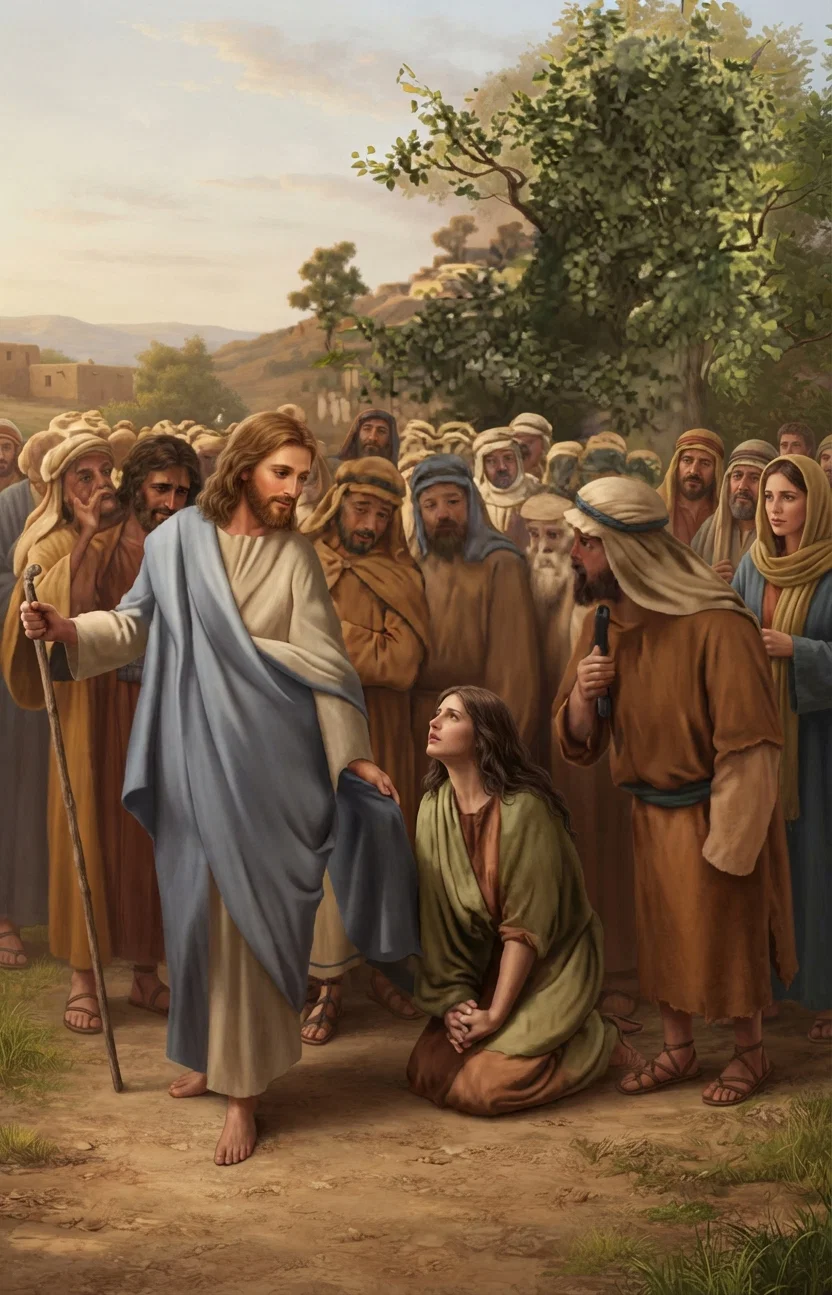
"If I may but touch His garment, I shall be whole." It was a poor woman who spoke these words,—a woman who for twelve years had suffered from a disease that made her life a burden. She had spent all her means upon physicians and remedies, only to be pronounced incurable. But as she heard of the great Healer, her hopes revived. She thought, "If only I could get near enough to speak to Him, I might be healed."
Christ was on His way to the home of Jairus, the Jewish rabbi who had entreated Him to come and heal his daughter. The heart-broken petition, "My little daughter lieth at the point of death; I pray Thee, come and lay Thy hands on her, that she may be healed," had touched the tender, sympathetic heart of Christ, and He at once set out with the ruler for his home.
They advanced but slowly; for the crowd pressed Christ on every side. In making His way thru the multitude, the Saviour came near to where the afflicted woman was standing. Again and again she had tried in vain to get near Him. Now her opportunity had come. She could see no way of speaking to Him. She would not seek to hinder His slow advance. But she had heard that healing came from a touch of His garments; and fearful of losing her one chance for relief, she pressed forward, saying to herself, "If I may but touch His garment, I shall be whole."
Christ knew every thought of her mind, and He was making His way to where she stood. He realized her great need, and He was helping her to exercise faith.
As He was passing, she reached forward, and succeeded in barely touching the border of His garment. That moment she knew that she was healed. In that one touch was concentrated the faith of her life, and instantly her pain and feebleness disappeared. Instantly she felt the thrill as of an electric current passing thru every fiber of her being. There came over her a sensation of perfect health. "She felt in her body that she was healed of that plague."
The grateful woman desired to express her thanks to the mighty Healer, who had done more for her in one touch than the physicians had done in twelve long years; but she dared not. With grateful heart she tried to withdraw from the crowd. Suddenly Jesus stopped, and looking round He asked, "Who touched Me?"
Looking at Him in amazement, Peter answered, "Master, the multitude throng Thee and press Thee, and sayest Thou, Who touched Me?"
"Somebody hath touched Me," Jesus said; "for I perceive that virtue is gone out of Me." He could distinguish the touch of faith from the casual touch of the careless throng. Some one had touched Him with a deep purpose, and had received answer.
Christ did not ask the question for His own information. He had a lesson for the people, for His disciples, and for the woman. He wished to inspire the afflicted with hope. He wished to show that it was faith which had brought the healing power. The woman's trust must not be passed by without comment. God must be glorified by her grateful confession. Christ desired her to understand that He approved her act of faith. He would not have her depart with a half blessing only. She was not to remain in ignorance of His knowledge of her suffering, or of His compassionate love and of His approval of her faith in His power to save to the uttermost all who come to Him.
Finding concealment vain, she came forward trembling, and cast herself at His feet.
Looking toward the woman, Christ insisted on knowing who had touched Him. Finding concealment vain, she came forward trembling, and cast herself at His feet. With grateful tears she told Him, before all the people, why she had touched His garment, and how she had been immediately healed. She feared that her act in touching His garment had been one of presumption; but no word of censure came from Christ's lips. He spoke only words of approval. They came from a heart of love, filled with sympathy for human wo. "Daughter," He said gently, "be of good comfort; thy faith hath made thee whole; go in peace." How cheering were these words to her. Now no fear that she had given offense embittered her joy.
To the curious crowd pressing about Jesus there was imparted no vital power. But the suffering woman who touched Him in faith received healing. So in spiritual things does the casual contact differ from the touch of faith. To believe in Christ merely as the Saviour of the world can never bring healing to the soul. The faith that is unto salvation is not a mere assent to the truth of the Gospel. True faith is that which receives Christ as a personal Saviour. God gave His only-begotten Son, that I, by believing in Him, "should not perish, but have everlasting life." When I come to Christ, according to His word, I am to believe that I receive His saving grace. The life that I now live, I am to "live by the faith of the Son of God, who loved me, and gave Himself for me."
Many hold faith as an opinion. Saving faith is a transaction, by which those who receive Christ join themselves in covenant relation with God. A living faith means an increase of vigor, a confiding trust, by which, thru the grace of Christ, the soul becomes a conquering power.
Faith is a mightier conqueror than death. If the sick can be led to fix their eyes in faith upon the mighty Healer, we shall see wonderful results. It will bring life to the body and to the soul.
In working for the victims of evil habits, instead of pointing them to the despair and ruin toward which they are hastening, turn their eyes away to Jesus. Fix them upon the glories of the heavenly. This will do more for the saving of body and soul than will all the terrors of the grave when kept before the helpless and apparently hopeless.

Trials as Divine Refinement

"The fact that we are called upon to endure trial proves that the Lord Jesus sees in us something very precious, which He desires to develop. If He saw in us nothing whereby He might glorify His name, He would not spend time in refining us. We do not take special pains in pruning brambles. Christ does not cast worthless stones into His furnace. It is valuable ore that He tests."

The Law of Rest in the Healing of Disease

By G. D. Ballou, for Many Years a Devoted Student of Physical and Mental Therapeutics
(Concluded from Last Week.)
WHEN the natural law of rest is invoked the natural result will follow, whether the mind rests on God as the Creator or on a heathen joss or the assurances of the family doctor or the occult formulas of Mrs. Eddy. Rest is the medicine, apart entirely from the vessel which bears it to the troubled soul. This Christian Science scheme is a case of a rival power stealing the weapons from the armory of heaven to advance a cause that was organized ages ago to oppose the work of Jehovah in this earth.
But here comes another rival to Christianity from the same region of occultism. She is known by the names of

Suggestion and Hypnotism.

Within a few years medical men have been putting forward suggestion and hypnotism as a new branch of medical science—suggestion for mild cases and hypnotism for the more difficult.
The use of suggestion to divert the mind from its unhappy moods and channels consists in one's own case in exercising the will to a certain degree in trying to make one's self believe differently and better than what the habits of thought would naturally permit. This is all right as far as it recognizes the truth that it is "God which worketh in you both to will and to do of His good pleasure," and that without Christ we can do nothing. Conformity to this truth will lead to Paul's statement, "I can do all things thru Christ which strengtheneth me." The weapons of the Christian's warfare "are not carnal, but mighty thru God to the pulling down of strongholds, casting down imaginations and every high thing that exalteth itself against the knowledge of God, and bringing into captivity every thought to the obedience of Christ." The human will may be enabled to control all the weak spots in the mind and bring all in subjection to the will of the Creator. Suggestion with this mainspring of help ignored is a poor, broken staff.
Another step in suggestion leads one to accept readily the cheerful advice and submit fully to the counsels of another, for the time giving the suggestion of the physician or some friend more weight than the weak and fearful thoughts which have been in control during a weakened condition of the mind. The effort on the part of the operator is to inspire a better line of thought, to get something more hopeful, cheerful, and happy before the vision of the mentally afflicted one. This is a most commendable procedure, provided the human agent uses only such influences as will direct the faith and hope to the great Source of life. It is the privilege of every true teacher and healer to become the agent of Jesus the Saviour of men, to help Him save them, not only from sin, but from weakness and folly. But if the human agent is satisfied with inspiring confidence in himself alone, the results of his efforts will be infinitely small as compared with the true Christian course we have just outlined.

What Hypnotism Requires.

The third phase—hypnotism—allows, encourages, and incites the subject to give up his will and mind wholly to the operator. This places the subject entirely under the control of another and produces in him a condition of irresponsibility.
Now, whatever the power or spirit that actuates the hypnotizer, the yielding of the will and judgment on the part of the subject—which after all is the greatest part of the transaction—is a moral wrong which no Christian can afford to tolerate. Christ is the only One who has a right to such control, and His control does not rob the creature of his own responsibility. It is dangerous to mind and morals to have the will thus surrendered. The will is weakened, the power of self-control lost, the subject becomes more and more susceptible to this subtle, occult influence, and if the work is often repeated a condition of driveling irresponsibility is established.
Yielding the will to Christ and His principles brings in life and strength thru the power imparted to exercise self-control. This yielding, let me repeat, makes self-control possible and certain, and fully establishes personal responsibility.
Not so with the hypnotic yielding. The person loses all semblance of self-control, and is nothing but a mere machine, to do, if called on, the most absurd and criminal things. The Christian who really knows God, has no use for hypnotism any more than for Christian Science, falsely so-called, even tho it does give relief and bring about the healing of disease. He has the original Fountain from which to draw, and needs not to drink from the broken cisterns or the fouled waters.
Let us summarize:
1. God's law of rest is the natural and spiritual remedy for ailments caused by mental conditions. The law is, "Rest in the Lord, and wait patiently for Him," "trust also in Him, and He shall bring it to pass."
2. Christian Science says, Rest in the formulas of Mrs. Eddy for the cure of all your maladies.
3. Medical science begins to say, Suggestion and hypnotism are sufficient remedies in connection with good hygiene for nearly all maladies caused by mental overwork.
4. Why not drink from God's pure fountain of healing? There is full and sure relief for all mankind just for the trusting, without money and without price. There is some relief in either of the others, but it is a contaminated relief. They are mere farcical exploitations of God's great rest cure and would never have become possible if those who professed to had really believed in God.
Resting the mind on a heathen joss will give the same kind of relief as Mrs. Eddy's formulas or the work of hypnotism.

Conclusion.

The world is ripe for quackery and humbug. Substitutes shrouded in mystery are in demand. Is it not just as easy and more sensible to rest the mind and soul on that creative Power which keeps this world in position and guides it among the stars and sustains all the operations of life we see about us as to accept one of these modern substitutes? The glamour and mystery with which these frauds clothe themselves is but a gauze of cobweb to the great, solid realities from which they are hiding the eyes of the people. Let sensible men and women turn from the hazy darkness of these newly vamped ancient systems of philosophy of every name and kind to the clear light of God which will and does shine into every soul that draws back the shutters of unbelief. Jesus says, "Come unto Me, all ye that labor and are heavy-laden, and I will give you rest. Take My yoke upon you, and learn of Me; for I am meek and lowly in heart; and ye shall find rest unto your souls. For My yoke is easy, and My burden is light."
Put the yoke on right. If it galls in spots just put one-half as much submission, patience, and faith into it as Christian Science demands, and one-half the self-renunciation that hypnotism demands, and you will find Christ's burden both easy and light. A few years since the writer found himself under very straitened circumstances. Following the hereditary bent of his own mind he took to worrying and fretting. One night after the midnight hour it seemed to him that a hand was suddenly laid on his shoulder and instantly he was wide-awake and all attention. Then he heard these words as if audibly spoken: "What is worrying, anyway?" It seemed to him that an answer was demanded. After a moment of heroic mental effort in which it was impossible to formulate anything like a coherent answer, and a mental "I give it up," the answer came as distinctly as the question: "Simply feeling bad because you can not have your own way." It had a most subduing effect at the moment, and the reverie which followed was something like this: "Yes, you lay plans and you try to carry them out, and, failing to do this, you sit down and grieve and fret over the tangled ends. Yes, it is because I am hindered fromhaving my own way." I am glad to say that the mental anxieties were laid aside and rest and peace came in the simple effort to do the thing that came first to hand and be faithful in trusting Him for the future. "In whose hand is the soul of every living thing, and the breath of all mankind." "Commit thy way unto the Lord."

Open the Door.

"Behold, I stand at the door and knock." Rev. 3:20.
OPEN the door, my brother, And let the Lord come in: His presence is sweeter, my brother, Than all the delights of sin. The way that seems broad and flowery Is the way that will end in gloom; The way that is straight and narrow Is the path toward love and home.
Open the door, my brother, So long it was closed and barred That the opening may not seem easy, It may seem exceedingly hard; But it's only in the seeming, To do is the one sweet thing, For opening the door, my brother, Is welcoming in the King.
Open the door, my brother, And open it now to-day, No promise have you of the morrow, The Spirit may turn away; And when you are ready to open, When life has been spent in vain, You may find you too long have waited, And He will not come again. J. A. POWERS.

Sin; Is It All Voluntary?

[The following paragraphs selected from Rev. Charles G. Finney's theological works are not only very interesting, but they are exceedingly suggestive. They will richly repay a thoughtful reading.]
CAN there be any other than voluntary sin?
What is sin?—Sin is the transgression of the law. The law requires benevolence, goodwillling. Sin is not a mere negation. It is a willing contrary to the commandment of God. Sin, as well as holiness, consists in choosing, willing, intending. Sin must be voluntary; that is, it must be intelligent and voluntary. It consists in willing, and it is nonsense to deny that sin is voluntary. The fact is, there is either no sin, or there is voluntary sin. Benevolence is willing the good of being in general, as an end, and, of course, implies the rejection of self-gratification, as an end. So sin is the choice of self-gratification, as an end, and necessarily implies the rejection of the good of being in general, as an end. Sin and holiness, naturally and necessarily, exclude each other. They are eternal opposites and antagonists. Neither can consist with the presence of the other in the heart. They consist in the active state of the will, and there can be no sin or holiness that does not consist in choice.
Continue reading: Studies in the Book of Daniel