The Gospel by Royal Proclamation. A Troubled King—A Dream and Its Interpretation—Self-Exaltation—Humiliation and Humility—A Converted Soul.
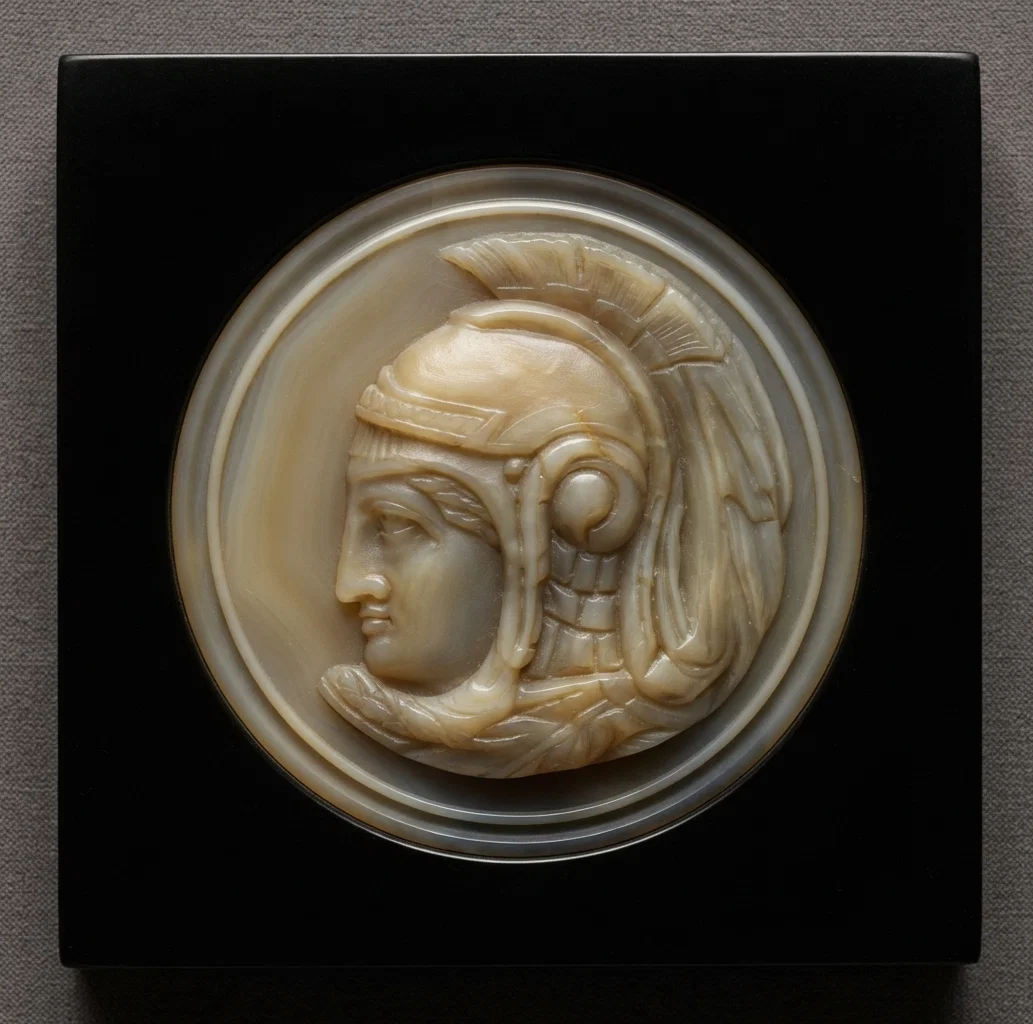
Cameo portrait of Nebuchadnezzar. A votive offering dedicated to Merodach. Engraved on a black stone.
IT is a wonderful lesson that the fourth chapter of Daniel opens before us. It is a lesson, which, if it had been learned by Nimrod, first king of Babylon, one of the earliest of earth's kings, and had been followed ever since, would have wrought out a far different story of earth's ages. It is worthy of profoundest study by the mightiest of earth; it is a lesson for these very days thru which we are passing; for let us repeat again, as we abundantly showed in the beginning of these studies, that the book of Daniel is pre-eminently God's instruction to statesmen, to nations, in these last days.
The story is set before us in the Scripture; read it. Note first of all that this chapter is a royal proclamation. It is not a story that Daniel tells himself; it is a story which the king of Babylon tells of himself and Babylon and Daniel and God. The story has not yet been found among the archives of Nebuchadnezzar by the archeologists. We doubt greatly if it ever will be found. Yet we believe that the king wrote it for all posterity. Daniel himself may have copied it from the clay tablets, or the black basalt slabs upon which the king caused it to be inscribed or engraved. But Babylon remained idolatrous, and it is easily understood how the devout pagans who succeeded Nebuchadnezzar, notably Nabonadius, aided by the priests of heathen cults, did their best to obliterate the knowledge and worship of the true God from Babylonian history. It would not have been flattering to their wisdom and position as teachers to let it remain, to reveal to future generations that their mightiest emperor had been humbled and taught by the God of a despised nation. But God has, thru Daniel, given us the faithful record.
It is a beautiful introduction with which the king opens his proclamation:
"Nebuchadnezzar the king, unto all the peoples, nations, and languages, that dwell in all the earth: Peace be multiplied unto you. It hath seemed good unto me to show the signs and wonders that the Most High God hath wrought toward me. How great are His signs! and how mighty are His wonders! His kingdom is an everlasting kingdom, and His dominion is from generation to generation." Dan. 4:1-3, A.R.V.
The Dream and Its Purpose.
Then follows the reason of the royal proclamation. In his highest prosperity, his kingdom at peace, Nebuchadnezzar again dreams, and the dream troubles him. He sends again for the magicians, the enchanters, the astrologers, the soothsayers, the men of learning, the men of experience, the men of craft. He this time tells them the dream; but they do not know the interpretation. He at last sends for Daniel, tells him the dream of the great, overshadowing tree, reaching in height to the heavens, seen by all the earth, beautiful in foliage, furnishing fruit and shade for all. He sees a holy watcher, who takes cognizance of things earthly, come down and command, "Hew down the tree, and cut off his branches, shake off his leaves, scatter his fruit; let beast and fowl flee for safety, but do not destroy utterly. Leave of his roots in the earth, bound as with iron and brass; let him be humiliated to the utmost, till seven times pass over him." This is the substance of the dream. The purpose is thus stated:
"The sentence is by the decree of the watchers, and the demand by the word of the holy ones; to the intent that the living may know that the Most High ruleth in the kingdom of men, and giveth it to whomsoever He will, and setteth up over it the lowest of men." Dan. 4:17.
The Interpretation.
Reluctant was Daniel to tell the interpretation to the king. He informs the king that he could wish that the dream and its interpretation referred to the king's enemies, but he tells it as God gave it.
1. The great tree referred primarily to Nebuchadnezzar, the great ruler of Babylon. He had "grown and become strong." Everywhere among earth's nations his power and greatness were acknowledged.
2. God also had seen the king. Heavenly watchers had noted his sins—pride, arrogance, and oppression of the poor. His continuance of rule in that way could not be suffered. In the face of the light hitherto given of God and acknowledged by the king, he could not be permitted to go on in transgression. God would make one more effort. The king would not walk in humility; God would humiliate him. Read verses 24-26. This was the decree: He had chosen the natural selfishness of the beasts; he would be driven out to dwell with them, to eat as did they, be separated from his kingdom and friends,—a practically insane man,—till seven times should pass; till he knew that the Most High ruled in the kingdom of men, and gave it to whom He would. The word rendered "times" means a set period. Josephus tells us that Nebuchadnezzar thus suffered seven years, tho there are those who hold that it means months. Yet the word indubitably refers to years in Dan. 7:25.
3. Daniel told it all as a warning to the king that he might escape the evil, according to the instructions of Jeremiah (18:7-10). He therefore pleads with the king to break off his sins by righteousness, and his iniquities by showing mercy to the poor.
How to Break Off Sin.
This appeal not only shows Nebuchadnezzar's sins, but reveals the true secret of co-operation with God in successful character-building. "Break off thy sins by righteousness." There is no other way. "Nature abhors a vacuum." There is no righteous idle soul. There is no righteous empty life. The character which God requires is positively righteous, bearing the fruits of righteousness. Righteousness—right being, right doing—must take the place of sin. Mercy must reign where lawlessness oppressed the poor. Mighty temples erected to the gods would avail naught if their material came from the sweat and blood of the needy.
It was Nebuchadnezzar's privilege to save his humiliation by humility. God desires to humble no man. He wishes man to see and know and recognize by faith his true condition,—a creature of a moment, dependent on God for every breath he draws. Realizing this, man will be humble. He will acknowledge God as Ruler, himself as servant. This was the privilege of Babylon's proud king. Great as he was in human comparison, he was nothing in God's sight. But Nebuchadnezzar had not yet learned humility; so God in His love for the man, and generations to follow, humbled him.
The Spirit of Babylon.
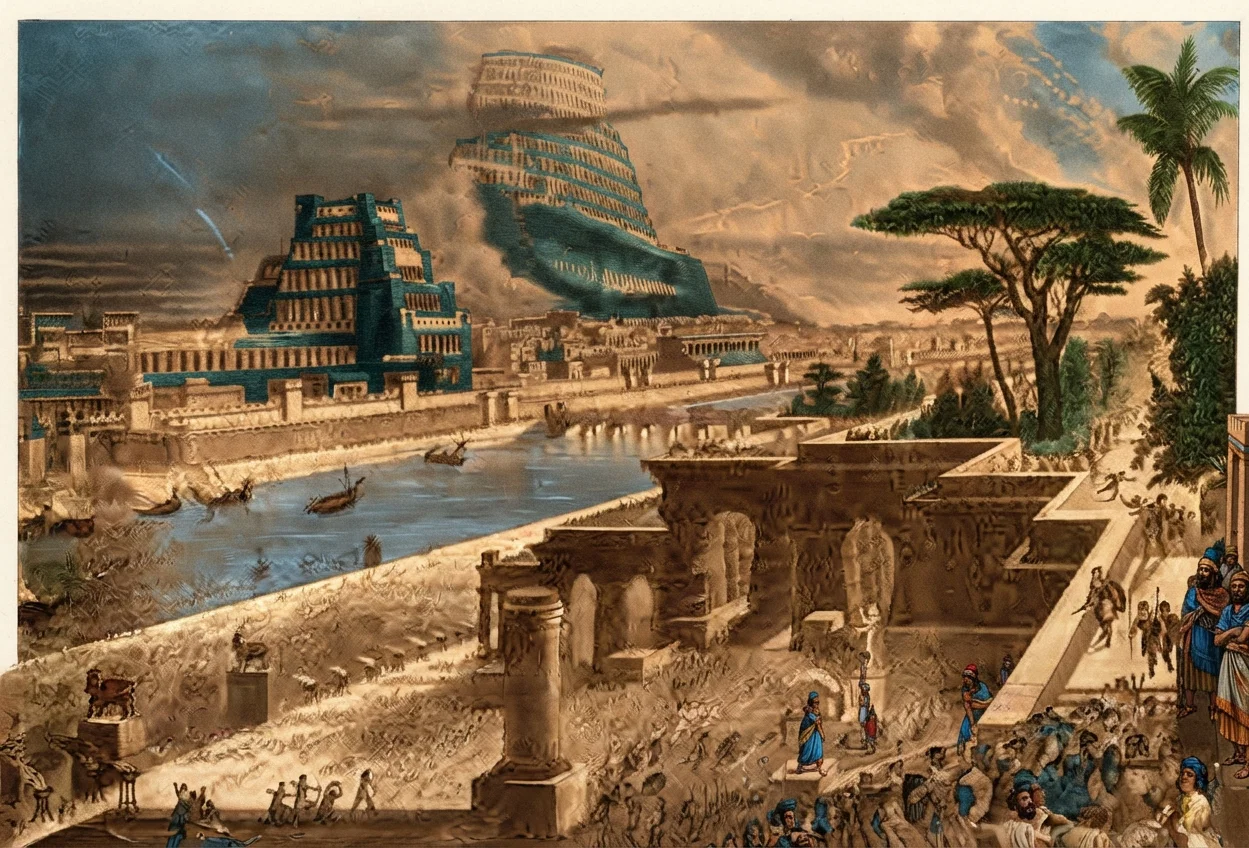
Not willing to learn thoroly by faith, the king must learn by experience. For a time he walked more softly before God,—a year the record tells us,—pursuing his great work of building; and then, ascending the top of his gold-plated palace, he looked over the magnificent city which he had been so instrumental in enlarging, embellishing, and beautifying;—he saw its walls, its temples, its palaces, its canals, its bridges, its hanging gardens, and his heart swelling with the pride of his own greatness, he exclaimed: "Is not this great Babylon, which I have built for the royal dwelling-place, by the might of my power and for the glory of my majesty?" Verse 30.
It was the spirit of Babylon's founders: "Let us build us a city, and a tower, whose top may reach unto heaven, and let us make us a name; lest we be scattered abroad upon the face of the whole earth" (Gen. 11:1-9), altho God had told them to multiply and fill the earth (Gen. 9:1). It was the spirit of Babylon's original king, who, in the beginning of all rebellion, rebelled against high Heaven, and said: "I will ascend into heaven, I will exalt my throne above the stars of God; and I will sit upon the mount of congregation, in the uttermost parts of the north; I will ascend above the heights of the clouds; I will make myself like the Most High." It was rebellion against the instruction of God thru Daniel, "The Most High ruleth in the kingdom of men." And this is a characteristic of Babylon in all ages.
The Fulfilment.
Perhaps Nebuchadnezzar had persuaded himself that the sentence of the dream would not come true. But he could no longer deceive himself. No sooner were his boastful words uttered than the voice came from heaven:
"O King Nebuchadnezzar, to thee it is spoken: The kingdom is departed from thee: and thou shalt be driven from men; and thy dwelling shall be with the beasts of the field; thou shalt be made to eat grass as oxen, and seven times shall pass over thee; until thou knowest that the Most High ruleth in the kingdom of men, and giveth it to whomsoever He will."
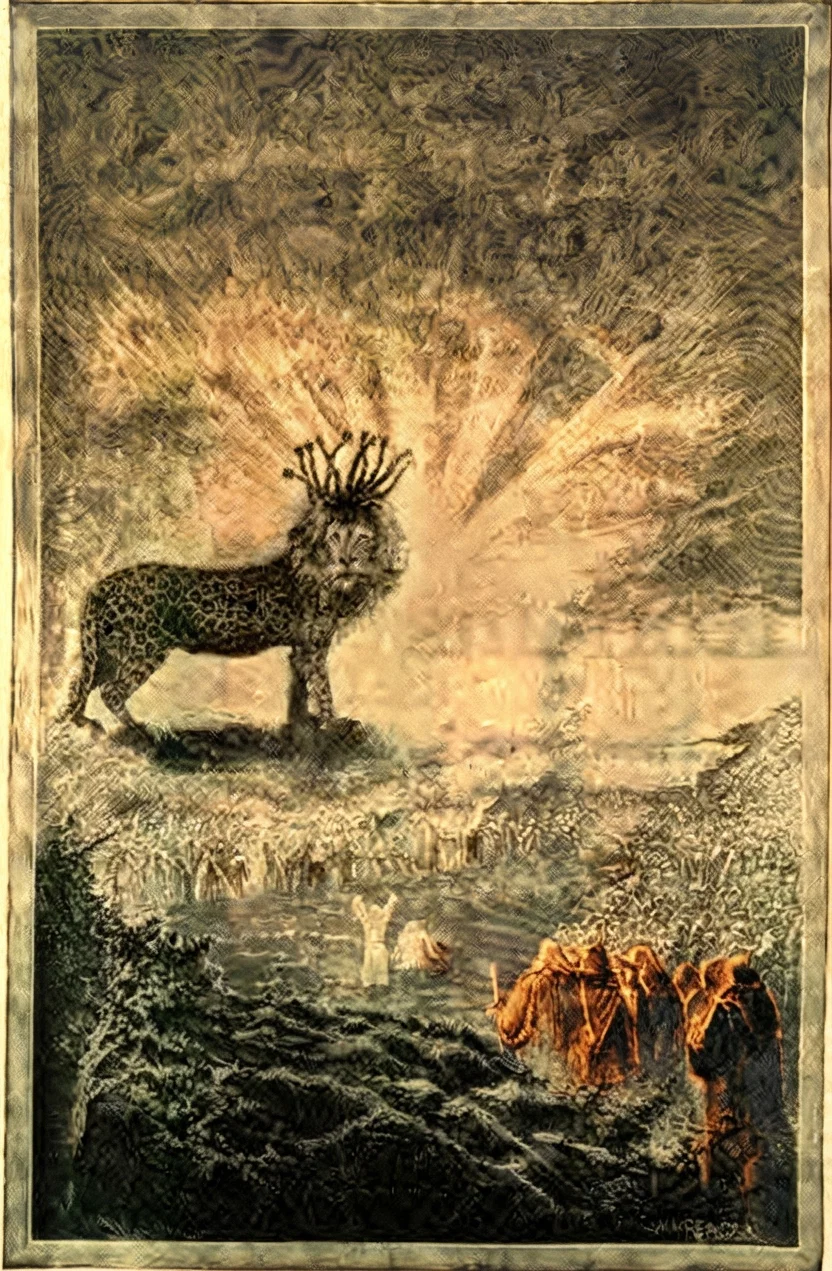
The same hour it was fulfilled. The king was driven out from among men, ate grass as the oxen, his body unsheltered, and his hair grown coarse and long like lion's hair (so the Septuagint), and his nails as birds' claws.
But God did not leave him. During all the time, doubtless, the cause of his humiliation was with him; and the proud king learned the lesson, and thus he records it:
"And at the end of the days I, Nebuchadnezzar, lifted up mine eyes unto heaven, and mine understanding returned unto me, and I blessed the Most High, and I praised and honored Him that liveth forever; for His dominion is an everlasting dominion, and His kingdom from generation to generation; and all the inhabitants of the earth are reputed as nothing; and HE DOETH ACCORDING TO HIS WILL IN THE ARMY OF HEAVEN, AND AMONG THE INHABITANTS OF THE EARTH; and none can stay His hand, or say unto Him, What doest Thou? . . . Now I, Nebuchadnezzar, praise and extol and honor the King of heaven; for all His works are truth, and His ways justice; and THOSE THAT WALK IN PRIDE HE IS ABLE TO ABASE." Dan. 4:34-37.
This is the burden of the converted king's message to all people—GOD RULES; we are at the most and best but instruments, suffered to remain for our testing and salvation, for His glory. The king's insanity passed away; his clearness of intellect returned; the kingdom and all its glory was restored to him; his counselors and lords sought him; he was established in his kingdom; and more excellent majesty was added. He learned that man could rule better under the great God of heaven than to trust in himself.
The Lesson for the Ages.
For the last days it is written, "THE MOST HIGH RULETH," God is Governor over the nations. He suffered earth's true original prince, Adam, to rebel, and yield his dominion to Satan. He has for thousands of years suffered the usurper Satan to exercise his limited control; God has made a portion of the usurper's wrath to praise Him, the remainder He has restrained. He permitted Babylon to come to the throne of empire; He gave into her power the kingdoms; but the Most High did not abdicate. When Babylon could be used no longer to God's glory, Medo-Persia followed; but the Most High ruled. After Medo-Persia came Grecia; but the Most High ruled. After Grecia came the iron imperial kingdom of Rome,—came the intermingling of the principles of democracy and socialism, the clay; but the Most High ruled.
To-day Great Britain, France, Germany, the Great Bear of the North, and the Great Eagle of the West, are talking proudly and arrogantly and boastfully of their prowess, their deeds, their culture, their wealth, as tho they reigned by right of themselves; and never did Babylon need more than they to know the truth of our lesson,—"THE MOST HIGH RULETH IN THE KINGDOM OF MEN, AND GIVETH IT TO WHOMSOEVER HE WILL." Their tenure of stay is their recognition of God, not in words, but deeds, the glory to Himself which will accrue from their existence. When the time comes that they fail, as it certainly will, according to the "more sure word of prophecy," the everlasting kingdom of God will succeed all earthly rule and dominion, and the temporal kingdoms of men will have passed away forever.
Babylon in the Time of Nebuchadnezzar.
The Most High rules. He permits sin to work out its own evil fruit, that the unbelieving may be forever satisfied, that His own word may be forever demonstrated to be true, even on its negative side. Its positive side will, to the children of faith, be an eternally unrolling demonstration of the truth, the righteousness, and love of Him who alone has the right to reign.
The Great Threefold Message
1. What is the first part of this message?
A great, positive, "everlasting Gospel" message to the world to bring men back to God, as given last week. "Fear GOD, and give glory to HIM; for the hour of HIS JUDGMENT IS COME; and WORSHIP HIM that made heaven, and earth, and the sea, and the fountains of waters." Rev. 14:7.
NOTE.—All positive Christian truth is implied in this message. If heeded it would lead from all error to the eternal verities of God. It would sever the church of Christ from her senseless, hoary traditions, from her bondage to dead hands and from "scientific" delusions, and would clothe her with the beautiful garments of truth and salvation.
2. What is the second part of this great Threefold Message?
A sad announcement of the consequences of rejecting the first message. "BABYLON IS FALLEN, . . . because she made all nations drink of the wine of the wrath of HER FORNICATION." Verse 8.
NOTE.—Babylon means "confusion," caused by false standards, errors, traditions. The Gospel message, if received, would have healed all these divisions. Failing to receive the divine remedy, as shown last week, Babylon turned to the world for help, and the sad announcement is made that she is guilty of fornication with the world, and is fallen.
3. What warning does the Lord send against this result of Babylon's fornication?
"And the third angel followed them, saying with a loud voice, If any man WORSHIP the BEAST and HIS IMAGE, and receive his MARK in his forehead, or in his hand, the same shall drink of the wine of the wrath of God, which is poured out without mixture into the cup of His indignation; and he shall be tormented with fire and brimstone in the presence of the holy angels, and in the presence of the Lamb: and the smoke of their torment ascendeth up forever and ever; and they have no rest day nor night, who WORSHIP THE BEAST AND HIS IMAGE, and whosoever receiveth the MARK OF HIS NAME." Rev. 14:9-11.
4. To whom does the warning come?
To "any man;" therefore every man, every soul.
5. Against what is it uttered?
Against the worship of "the beast," the worship of the "image" of the beast, and against the reception of the "mark" of the beast.
What Is the Beast?
6. What beast is meant?
"And I stood upon the sand of the sea, and saw a beast rise up out of the sea, having seven heads and ten horns." Rev. 13:1.
7. What was the beast like?
"And the beast which I saw was like unto a LEOPARD, and his feet were as the feet of a BEAR, and his mouth as the mouth of a LION." Verse 2.
NOTE.—It will be seen by the student of prophecy that this beast is the successor of the three first beasts of Daniel 7,—the lion, Babylon; the bear, Medo-Persia; and the leopard, Grecia. This beast of Revelation 13 is therefore the same beast-power, successor of Grecia, and identical in part with the nondescript beast of Daniel 7 in both phases, but with some additional features.
8. What is the character of this beast?
"And upon his heads the name of BLASPHEMY." "And there was given unto him a mouth speaking GREAT THINGS AND BLASPHEMIES." "And he opened his mouth in BLASPHEMY AGAINST GOD." "And it was given unto him to make WAR WITH THE SAINTS, and to overcome them; and power was given him over all kindreds, and tongues, and nations." Verses 1, 5, 6, 7.
9. From whence does the beast receive his authority?
"And the DRAGON GAVE HIM HIS POWER, and HIS SEAT [literally, "throne"], and great AUTHORITY." Verse 2.
10. Who is represented by the dragon?
"The great dragon, . . . that old serpent, called the DEVIL, and SATAN." Rev. 12:9.
11. Has the devil any power to give world dominion?
"The devil, taking Him [Jesus] up into an high mountain, showed unto Him all the kingdoms of the world in a moment of time. And the devil said unto Him, All this power will I give Thee, and the glory of them, for THAT IS DELIVERED UNTO ME; and to whomsoever I will I give it. If Thou therefore wilt worship me, all shall be Thine." Luke 4:5-7.
NOTE.—We may not stop now to study all that is implied in the devil's statement. Jesus twice calls him "the prince of this world." John 12:31; 14:30. It was no temptation to Christ if there was no possibility of Satan's power to give the kingdom. Suffice to say that under God the dominion belonged to man. Gen. 1:28. When man fell, he yielded himself and all in his possession to Satan, and so the devil is prince of the world de facto, while Christ is King de jure. In other words, Satan has temporal possession by usurpation; Christ will sometime reign eternally. "The servant [slave of sin] abideth not in the house forever; but the Son abideth ever." John 8:35.
12. What, therefore, does the beast represent?
Church-and-state government.
NOTE.—No purely secular government will persecute; it has no reason to, no desire so to do. It does not meddle with the religion of its subjects, the relationship solely between them and God. A church separate from civil power can not persecute howsoever much it may desire; it has not the power. There must be some union of the two, and this union God designates as a beast.
13. How extensive is this beast power?
It had "seven heads."
NOTE.—"Seven" denotes completion, and here refers to the seven forms of government, or dynasties, thru which Satan has worked and will work against God's truth and people to the end. God does not permit the evil spirits to use their supernatural power against man except with man's consent; but the devil has ever used humanity to oppress the children of God. The head, the seat of the brain and intellect, is what determines the character of the thinking thing it is upon. The beast represents the dominant church-and-state kingdom of the world. Each head, for they are successive, determines the character of the beast during the life of the head.
These heads began with the first oppressor of God's people, when their kingdom was overthrown, and they went into captivity to Babylon. From that time to the application of the prophecy of Rev. 13:1-10, world empire has passed thru five of its seven phases, as follows: Babylon, Medo-Persia, Grecia, Pagan Rome, Papal Rome. In all these, religion has been in the purview of the state. In the first four the state has dominated, the ruler or king representing divinity. In the fifth, diverse from all before it, the church dominates the state. Either form is not of Him who declared, "My kingdom is not of this world." A government which claims to represent Him while exercising such tyranny is guilty of blasphemy.
Worship—True and False.
14. What does this beast demand, and how many will eventually yield to its demand?
"Worship." "And all that dwell upon the earth SHALL WORSHIP HIM, whose names are not written in the book of life of the Lamb slain from the foundation of the world." Rev. 13:8.
15. Who alone should be worshiped, and what is truest worship?
"Thou shalt WORSHIP THE LORD THY GOD, and HIM ONLY shalt thou SERVE." Matt. 4:10.
16. What, then, has the beast always demanded?
Service, obedience to its laws even tho those laws are contrary to God's laws.
NOTE.—Even so Babylon demanded that all should bow to the golden image, and refusal so to do meant death in the fiery furnace. Daniel 3. Medo-Persia demanded worship of the king, exalted by law to the throne of Deity. Refusal meant death in the lions' den. Daniel 6. So with the decree obtained by Haman to destroy the Jews, it was because "their laws are diverse from all people; neither keep they the king's laws; therefore it is not for the king's profit to suffer them." Esther 3:8. Thus has it ever been.
17. What does the beast under the fifth head do to those who will not worship?
"It was given unto him to make war with the saints, and to overcome them." Rev. 13:7. "He . . . shall wear out the saints of the Most High." Dan. 7:25.7
18. How long will it exercise this high-handed power?
"And power was given unto him to continue forty and two months." Rev. 13:5.
"And they shall be given into his hand until a time and times and the dividing of time." Dan. 7:25.
NOTE.—It will be seen that the beast of Rev. 13:5-7 is identical with Daniel's fourth beast dominated by the little horn; the little horn is identical with the fifth head of the beast. They are both of the same character, do the same work, exist as dominating, persecuting powers the same period of time.
19. In what power are all these and other specifications fulfilled?
In Papal Rome, the fifth head of world dominion in succession from Babylon and the overturning of the kingdom of Israel.
NOTE.—Let us discriminate between the Roman Catholic Church and the Papacy. The former is corrupt, ambitious, intolerant, but she has many souls in her fold who know naught of the ambition, the intolerance, but who truly know God and His Son Jesus Christ; who are Christians despite the error and corruption which exist, but who know no other way, having been taught that any other way is the way of death. God recognizes their purpose of heart. But the Papacy, that union of church and state devised and carried out by ambitious men, before whose wicked assumptions thousands were put to death for consciences' sake, is not of God, tho so averred in every moment of its history.
20. Of what did Jesus warn His disciples?
"They shall put you out of the synagogs; yea, the time cometh, that whosoever killeth you will think that he doeth God service." John 16:2.
21. What is the image to the beast?
It is a union of church and state to be formed in this government, represented by the two-horned beast (Rev. 13:11-17) with its lamblike horns symbolic of Christ (Rev. 5:6) and its ultimate laws of a dragonic or Satanic character (Rev. 12:13). More of this in our next.
22. What then is the meaning of God's warning by the message of the third angel?
That to yield to or serve any authority whatsoever, contrary to God's law or service, is to incur His just wrath against the most heinous of sins.
23. What class will be developed by this great Threefold Message, whose character is opposed to that of the beast-worshipers?
"Here is the patience of the saints: here are they that keep the COMMANDMENTS OF GOD, and the FAITH OF JESUS." Rev. 14:12.
24. What is the next event?
The coming of the Son of Man to reap the harvest of the earth. Verse 14.
Life in the Cities.
VERY much has been said of the season of prosperity thru which the country has been passing, and yet it has been again and again pointed out that this prosperity was enjoyed only by certain classes. Others had found existence growing rapidly worse on account of the much greater advance in the prices of commodities than in wages.
Mr. Maily, a journalist who has made a special study of the lower East Side of New York City, writes in a recent Independent some of the reasons for the rent strike which has taken place in that city. We are informed that one section in New York City has a population which averaged in 1900, 382 9-10 to the acre, and in 1905, 432 8-10. Other parts of New York show from 90 to 96 per acre. If the whole city was settled as densely as the lower East Side, it would have a population of 90,549,610, or as much as the whole United States. Think of it! One block alone had a density of 1,458 to the acre.
And yet the rents under these wretched conditions are continually increasing. Where it is possible at all, the whole family works, and the average income is estimated at $600 per year; and of this income at least 30 per cent is paid out for rent alone. These buildings are not rented as a general thing direct by the owners, but are farmed out. Sometimes as many as five transfers of the same property have been made in one year, each man raising the rent and so getting his profit out of his investment. What wonder is there that the people should unite their interests and strike for lower rents?
——o——
Continued Peace, if—The Rev. Benjamin Chapell, M.A., of Tokio, quoted in an article sent out by the American Peace Society of 31 Beacon St., Boston, does not hold out much hope of peace unless the race prejudice which exists in America can be taken away. He maintains that "the troubles are only just beginning, that the problem will grow graver until Oriental emigrants are placed on a basis of equality of treatment with those from Europe. One purpose of the Society [of peace] is to bring this about without appealing to the sword." We are face to face, he tells us, with an immense question, the greatest of the centuries, with India and China arising, with Japan, to national and Oriental consciousness, and the Pacific a mere Hellespont, a ferry. America desires peace with the consideration that Japan is an inferior nation; but he tells us that "this is certain, no ministry in Tokio could live a month that would in any slightest way admit Japanese inferiority to any other people beneath the sun. There is no prospect that America will ever meet the wishes of the Japanese, and the question will never be settled right until it is settled in harmony with the Japanese ideas of equality."
"And all that dwell upon the earth shall worship him, whose names are not written in the book of life of the Lamb slain from the foundation of the world." Rev. 13:8.
Our Bible Band.
By Editor
SCHEDULES for the year's reading will be sent to all club members who enclose stamp. To all those who sent in lists of names as far as we could, we have sent schedules. We can not send to those not belonging to the Band as enough are not printed; nor can we very well return stamp without using its equivalent.
Leviticus 16 contains instructions for the ceremonies of the great day of atonement, the last day in the yearly round of Jewish service. It was the judgment day of the year. Each year's service carried out in full is typical of the entire ministry of our great High Priest, Christ Jesus. The services of the closing day are typical of the closing work of Christ. The offering of Christ is symbolized by the Lord's goat, the priesthood of Christ by the high priest, only Christ ministers His own blood. Heb. 9: 28. The scapegoat, or the goat "for Azazel," is a type of Satan, cast at last into the bottomless pit. Revelation 20.
Chapters 17 to 24 are made up of various laws, ordinances, prohibitions, and precepts, the reason for most of which is self-evident. Note that it is not a law of the New Testament alone to "love thy neighbor as thyself." Chapter 19: 18.
Chapter 25 is that pertaining to the great jubilee, typical of the time when all God's people shall pass from the environments of the bondage and slavery of this world to the liberty of the glory of the kingdom of God.
Chapter 26 presents before Israel the two ways of good and evil, good if they walk in God's ways, evil if they turn from His commandments. The "seven times" of verses 18, 21, 24, 28 have reference to degree, as sevenfold, and not to periods of time. In chapter 27 are laws concerning vows and tithes. Study them.
We give only three chapters in the book of Numbers instead of four as usual for the closing day of the week. There will be found a sameness in the numbering of the tribes, but note how definitely the numbers of men of certain age are given. When we reach chapter 26, at the close of the forty years, it will be worth while to refer back to this chapter and note how the tribes have gained and lost.
Chapter 2 describes how the camp of Israel was arranged; the sanctuary in the center, the tribes pitched under twelve tribal standards, under four great standards, on the four sides of the tabernacle. These four standards, tradition tells us, bore the following symbols: that of Judah a lion; Reuben, a man; Ephraim, an ox; Dan, an eagle. Chapter 3 describes the divisions of the sons of Levi. No words are required upon the beautiful devotional Psalms.
God's Message for To-day.
STUDY our Bible-reading on pages 6 and 7. It is important. That study and the one last week deal with a great Threefold Message, recorded in Rev. 14: 6-12. Study that message.
Its first part is named "the everlasting Gospel." The Gospel is God's means of saving men. That message declares that "the hour of His judgment [not will come or may come, but] is come." It is a judgment impending.
That message teaches that we should turn from the fear of man, from the exaltation of man, to the fear and the honor of God. "Fear God, and give glory to Him." It demands that we turn from obedience to men, and "worship" the Creator.
These are vitally important and eternally practical truths, given in view of the impending judgment of God, before whose tribunal all must appear.
This is a reform message to bring men back to God, heal all divisions, cover all defects, and make of His church a mighty body of shining lights. It is God's balm of Gilead to heal the ills of His people and the world. It is the banner to lead them out of the Babylon, or confusion, of present theology to the unity of truth and righteousness.
The second part of the message "follows with" the first and becomes a part of it. It announces the sad fact that Babylon is fallen because she would turn from God's healing remedy to fornication with the world.
The third part of the message "follows with" the two parts and makes one great Threefold Message. That message warns against all connection with the world, all yielding to earthly powers contrary to God's will, all acceptance of the badge of authority of any save God in spiritual things; and it closes with the unmixed wrath of God upon the incorrigibly impenitent, and the development of a class of people keeping the commandments of God and the faith of Jesus, followed by the second coming of Christ.
Is not this important? Do you know, reader, of any more important message in the word of God? Do you know what it means? Then study it, and may God guide thee.