THE study in Romans last week called attention to the last part of the third chapter, in which are presented the promises of the righteousness of God as a free gift to those who accept Christ. The method by which this desirable gift is bestowed is stated in the following verses:
“What then shall we say that Abraham, our forefather, hath found according to the flesh? For if Abraham was justified by works, he hath whereof to glory; but not toward God. For what saith the Scripture? And Abraham believed God, and it was reckoned unto him for righteousness. Now to him that worketh, the reward is not reckoned as of grace, but as of debt. But to him that worketh not, but believeth on Him that justifieth the ungodly, his faith is reckoned for righteousness. Even as David also pronounced blessing upon the man, unto whom God reckoneth righteousness apart from works, saying,
“Blessed are they whose iniquities are forgiven,
“And whose sins are covered.
“Blessed is the man to whom the Lord will not reckon sin.” Rom. 4: 1-8.
Abraham was not justified by “works.” “Abraham believed God, and it was reckoned unto him for righteousness.” In other words, the Lord came to Abraham with certain promises of what He would do for him, and Abraham accepted those promises, then the Lord did the “reckoning;” His reckoning was that the righteousness of His own character must flow into the life of Abraham in answer to his faith.
And it should be observed that God does not give His righteousness as ordinary hire or wages to Abraham in order to get him to exercise faith. But it is a divine law that the free gift of righteousness comes to every one who accepts the promises of God. And it would be well in this connection to refer again to the following verse that was in the lesson last week:
“Where then is the glorying? It is excluded. By what manner of law? of works? Nay: but by a law of faith.” Rom. 3: 27.
Then there is a “law” of faith. God has established a law for the operation of faith, and it is as positive and as certain in its action as any of the other laws that He has established. We are likely to look upon the laws that God has established in the physical world as being more positive in their action than the laws that He has established in the spiritual world. But such is not the case. If we put our hand in fire, we know that we will get it burned. This is a natural law that is always sure to act promptly. Water will always flow down-hill when left to follow its own course; a stone thrown into the air will invariably fall to the earth again. Every one recognizes these unfailing “laws of nature.” But they are not one particle more unfailing in their nature than is the Lord’s “law of faith.”
Do not neglect to notice that the text just quoted above (Rom. 3: 27), presents a “law of faith.” Our heavenly Father has established a law to govern the workings of faith just as surely as He has established a law to govern falling bodies or to govern anything else in what we call the “natural world.” We recognize the law in the natural world because we have cultivated our minds in that direction. But if we will put forth the same effort to cultivate the mind in the realm of the spiritual we will find that God has spiritual law that governs just as positively as does His natural law.
God’s “law of faith” is for the purpose of maintaining righteousness, or right-doing, which are one and the same thing. The angels of God and the inhabitants of the worlds that have not sinned are kept in the realm of right-doing by faith. They believe God, and therefore they do not go wrong. Our first parents did not hold to their faith in God. They allowed themselves to doubt the rightfulness of God in forbidding them to eat of the tree of knowledge of good and evil. They dared to exercise their unbelief, and we have the result of it in all the sin and wrong-doing that have come upon this whole world. If they had cultivated faith in God instead of cultivating doubt they would not have sinned. For we may cultivate doubt just as well as we may cultivate faith. “For I am not ashamed of the Gospel: for it is the power of God unto salvation to every one that believeth; to the Jew first, and also to the Greek. For therein is revealed a righteousness of God from faith unto faith: as it is written, But the righteous shall live by faith.” Rom. 1: 16, 17.
The righteousness of God is revealed “from faith unto faith.” From one step to another in faith we are to progress. The pathway of God is the pathway of faith, and note that it is also a pathway of progress.
The law of faith is not only for the purpose of keeping those who have not sinned in the path of righteousness, but it is also provided that the sinner may avail himself of the law of faith and be cleansed from the sins that are past. This point was quite fully covered in the lesson a week ago, but it is well to refer to it again here. After the individual has received pardon and cleansing from past sins, then the law of faith is for the purpose of keeping him in the path of right-doing.
If we will but exercise faith in God as He would have us, this law of faith will keep us right in a much broader field than we are likely to think. We are likely to think that the law of faith is only for the field of spiritual things; that it only applies to the right-doing of religious duties. But the religion of Jesus Christ has a much wider application than most people give it. The religion of Jesus takes cognizance of our temporal affairs as well as of the things that we denominate religious.
When the mechanic is doing a piece of work he must have right measurements if his piece of machinery, or his building, or whatever he is constructing, is to come together properly. He needs righteousness in this the same as he does in telling the truth in a trade or deal he is making with a neighbor. We look at a falsehood as something very wrong, and if we cut a piece of iron or wood wrong that is going into any piece of work, we call that a mistake. But both these things violate the principle of perfect right-doing. The falsehood is a moral wrong and a grievous sin because it violates one of the plain precepts of the Ten Commandments. But that which we call only a “mistake” is also a wrong, tho of a different character, but it may also be overcome by the law of faith.9But in the exercise of this law of faith we must not become discouraged; we must go on “from faith to faith;” from one experience to another and still broader experience.
Thus may the child of God have Him with him in all things. Whether it is to tell the truth to his neighbor, or whether it is to arrive at right results in his work, he may ever exercise the law of faith that his divine Father has provided for him. But in order to get the good results from this law of faith we must make use of it. God has established the “laws of nature” for the benefit of His creatures, but if we do not take the pains to study and understand those laws we can get but little if any benefit from them. And so it is with His “law of faith.” We must study it and appropriate it if we would enjoy its benefits.
T.
“Nothing but Wine”
NEW YEAR’S EVE in New York City witnessed one of the “wildest orgies” that ever took place anywhere. The New York “World” in reporting it has these prefatory statements.
“The custom of celebrating New Year’s Eve in public began not more than ten years ago. A group of people accustomed to dine regularly at Shanley’s got together on New Year’s Eve and ‘saw the new year in.’ Next year there were more. Then they spread to other restaurants. Then the city took it up.
“Last week’s celebration [Jan. 1, 1908] saw seventy-five thousand diners at the various big hotels and restaurants along Broadway. Dinners averaged in price five dollars each. At least two quarts of champagne were consumed, on an average, by each diner. Some took less, some more. At four dollars a quart, this wine cost $600,000. The dinners cost $375,000 more. Carriages cost another hundred thousand. Considerably more than $1,000,000, therefore, was spent on this gigantic orgy.
“What will it be next year?”
These paragraphs from the “World” give an idea of the feast in dollars, but it would be hard to describe it so as to give a correct idea of what the revelers did. While the “viands” that were eaten were costly, the wine was more costly still. The feasting did not begin in earnest till about midnight, and the watchword soon came to be “nothing but wine.” Other drinks were sometimes called for, but the waiters promptly replied, “We serve nothing but wine to-night.”
Well-dressed men and women filled the fashionable hotels and restaurants till morning, and gorged, and drank “nothing but wine.” It is easy to see that in carrying out such a program the participants would soon be led into the most hilarious carousals. The women were as immoderate (if not more so) as the men. And perhaps their condition and conduct seemed fully as bad as it really was for the reason that we do not expect such things from those we have been wont to look upon as our “wives, our mothers, and our sisters.” A few paragraphs selected from the trenchant pen of the “World” reporter will give a general idea of what was done:
“Midnight. Just a few women were drunk here and there. But it was genteel intoxication. Nothing but wine. True, its degrading effects were the same as if the cause were the slops dispensed in a mixed ale dive, but here were women in costly gowns, bejeweled with gems of price, who drank nothing but wine.
“One o’clock. More drunken women on nothing but wine. Two o’clock, and more. Sentimentally maudlin women singing songs, bitter women in whom nothing but wine aroused old hates, jealousies and animosities.
“Some were led off, some staggered off to the retiring rooms deathly sick on nothing but wine.
“As the new year grew older all shame or concealment died down in the dressing-rooms. The doors stood open, maids and attendants, who also had had nothing but wine, worked perfunctorily with ice-bags and restoratives over the retching and comatose.
“This was not alone in one place, but in all the women’s retiring rooms in every great hotel and restaurant on Broadway. . . .
“Women got as far as the door and fell over in stupor from nothing but wine. There they lay. ‘Down and out and all in’ said the maids, helping only those who could still speak or stagger.
“Jewels fell from burnished locks or from gowns torn open for more air or easement from qualms. Paris dresses, bedraggled and polluted, were torn and disheveled as their owners were dragged out of the gangway.
“Drunken men clamored at the doors, ‘Wher’sh my wife? She lef’ me an hour ago!’
“ ‘Aw, come in and pick her out!’ snapped the maids, if the man gave no indication of coming, like the Greeks, with gifts. Did he wave a bill, assistance was forthcoming to carry his lady to a cab.
“But as the hours crept on to the dawn and the number and helplessness of the drunken women increased, and when all semblance of dressing-room decorum and segregation was thrown to the winds, drunken escorts came to the doors to ‘pick ’em out.’ Sometimes they picked out the right ones, but in several cases they picked out one better of looks or of less bulk to carry. Who cared on the morning following New Year’s Eve, the night of nothing but wine?
“Think this no fanciful picture. Hold up your hands in horror no more when told of wretched women lifted from the gutters and carried on hand-barrows to the station-houses of a Saturday night in London, Liverpool, Belfast, and other towns of Britain where such things be.
“These were not the gin-swilling wives of mechanics. They were New York women ‘of the gay set,’ many that say of themselves, ‘We are decent.’ They did not stagger out from the public bar to fall in the kennel, stupefied with the cheapest and vilest of liquors. They were ‘ladies,’ they were carried out to cabs. They had drunk nothing but wine.
“They numbered not two or ten or even twenty. Their name was legion. And every retiring room was the shameful scene of nothing but wine.
“This counts not the thousand and one that were not wholly overcome, but who, blear of eye, blurred of speech, disheveled of hair, could yet stagger out on the arms of escorts, and ride home with the window of cab or motor car thrown open to give them the benefit of the blessed morning air.
“They laughed about this when, still trembling, they braced themselves for headache and nausea, and with sickly pride boasted that they had not gone down and out in the dressing rooms.
“Nothing but wine! Everybody is ‘having a good time.’ Detached gentlemen are making friends with women whose escorts are somnolent with excess champagne. Nothing but wine has aroused the dormant affectionate dispositions of the hitherto morose. Portly men are visiting around and pressing chaste salutes upon the lips of the best-looking women and wishing them ‘A Happy New Year!’ Some of the gayer feminine spirits are not to be outdone, and they too visit around and bestow kisses as New Year souvenirs.”
A lady reporter was also sent out by the “World” to “write up” the revels of that night, and while she was separated from the gentleman reporter whose paragraphs appear above, her report is in full agreement with his, and she presents some scenes as even worse than what we have quoted.
Much more might be quoted from the report of this bacchanal carousal. But the foregoing is sufficient to give a general idea of the view that the reporters took of the occurrence. It is usually considered necessary to make liberal allowance for the coloring that newspapers give to things of this kind, but after all this allowance is made there is still enough fact left to make a serious picture for the people of this nation. It is a well-known fact that this country in particular and the world in general is witnessing the spectacle of the concentrating of wealth in the hands of the minority of the people. In a great many cases these large fortunes take care of themselves, and the owners of them are left to what are called the “luxuries of idleness,” but what are in reality the dissipations of ease.
The thing that naturally follows such dissipations is licentiousness, drunkenness, and gluttony. The moral backbone is broken and crumbles to decay. This process of dissolution may go on under the glitter of a delicately painted gentility. It may be labeled “good society,” and the “upper class,” but still the degeneration is there, even tho it may be concealed so delicately and so artistically that it really looks like a thing to be desired.
History is of no use if it does not teach us that when nations give themselves to the vices, feastings, and drinkings that so generally attend luxurious and excessive wealth, they soon degenerate into absolute ruin. The moral fiber is broken up and both society and the state must go to pieces. The poorer classes see the luxurious and extravagant doings of the wealthy, and imagine that they are the only real pleasures that earth affords. They become jealous because they can not have the same things, and revolutions and riots follow that break up all the foundations of the social structure.
While the luxurious debaucheries of wealth are breaking to pieces the moral structure of society, it must not be considered for a moment that all of the vices of the time are confined to the wealthy class. The wealthy people have the preponderance of influence. This must be admitted even by those who would decry them, and thus seek to bring contempt upon them. The very, very wealthy are followed by those who are a little less wealthy, and then these in turn are followed by those who are still a little less wealthy, and so the disintegrating and destructive work goes on thru all the grades of the social organism.
All the outward semblance of “correct form” may be kept up. All the veneer elegance of “polished society” and “advanced civilization” may dazzle the eyes as the hilarious functions succeed each other in the passing pageantry of the time. A superficial view might lead one to think that the “high ideals” that the people talk about, and the elegant and refined sentiments that they express are indicative of the highest civilization and the deepest and purest morality. But a closer view will disclose the indisputable fact that these high pretensions are only paraded for effect. This talk that would indicate a deep moral character and a true refinement is merely a part of the program in following the style in what is said as well as in what is worn. It is merely a part of the etiquette of the day. But the true moral worth is not there.
Ancient Babylon went to her downfall and her doom amid the merry music of feasting and drinking and dancing. Her social functions were of the most elaborate and elegant character. She shined out with dazzling splendor in all that went to make up the gaiety of her luxurious rounds of pleasures, her periods of feastings, and her days spent in the revelries of “nothing but wine.”
Persian wealth and Persian luxury became famous the world over. But it proved her undoing and her overthrow. When Greece thru her great Alexander had conquered the world and stood on the very broadest foundations of her strength and power, it was then that she became broken thru her world-conquering king dying in a fit of drunkenness during a prolonged period of bibulous and hilarious banqueting[s]. Rome stood as the iron monarchy of the world for centuries. But her iron strength was dissolved and swept away by the insidious and seductive charms of the halls of feasting and the tables of wine.
Read the story of Sodom and the philosophy of her overthrow in the words of the Book: “Behold this was the iniquity of thy sister Sodom: pride, fulness of bread, and prosperous ease was in her and her daughters; neither did she strengthen the hand of the poor and needy. And they were haughty, and committed abomination before Me: therefore I took them away as I saw good.” Eze. 16:49, 50. These words of the prophet are a very terse and strong presentation of the real reason that is at the bottom of the overthrow of great cities as well as great nations. The selfishness that is produced by “prosperous ease” breeds a species of weakened character that can not stand up; it must go to pieces and go down. All the history of all the past utters a continued and completely accordant voice of warning upon this subject.
The downfall of Tyre, of Venice, and of the rest might be adduced. But why prolong the illustration? The evidence is overwhelming and it clearly points the way in which the nation is going. If this occurrence in New York was all there was to be seen, the condition would not be so alarming. But New York is only the center and the example of what is apparent in the great cities of the country at large. And what is true of the cities of this country is quite generally true of the cities of all the world.
There are no longer any outlying nations that are preserving the strength of temperance and of righteousness. And so the only thing that can correct the evil and the ruin that is right before us is the second coming of Christ. The prophecies all show that the time for His second advent is right at hand, and surely it is apparent that the conditions in the world loudly demand it.
T.
Delmonico's, One of the Oldest and Most Noted Restaurants of New York City.
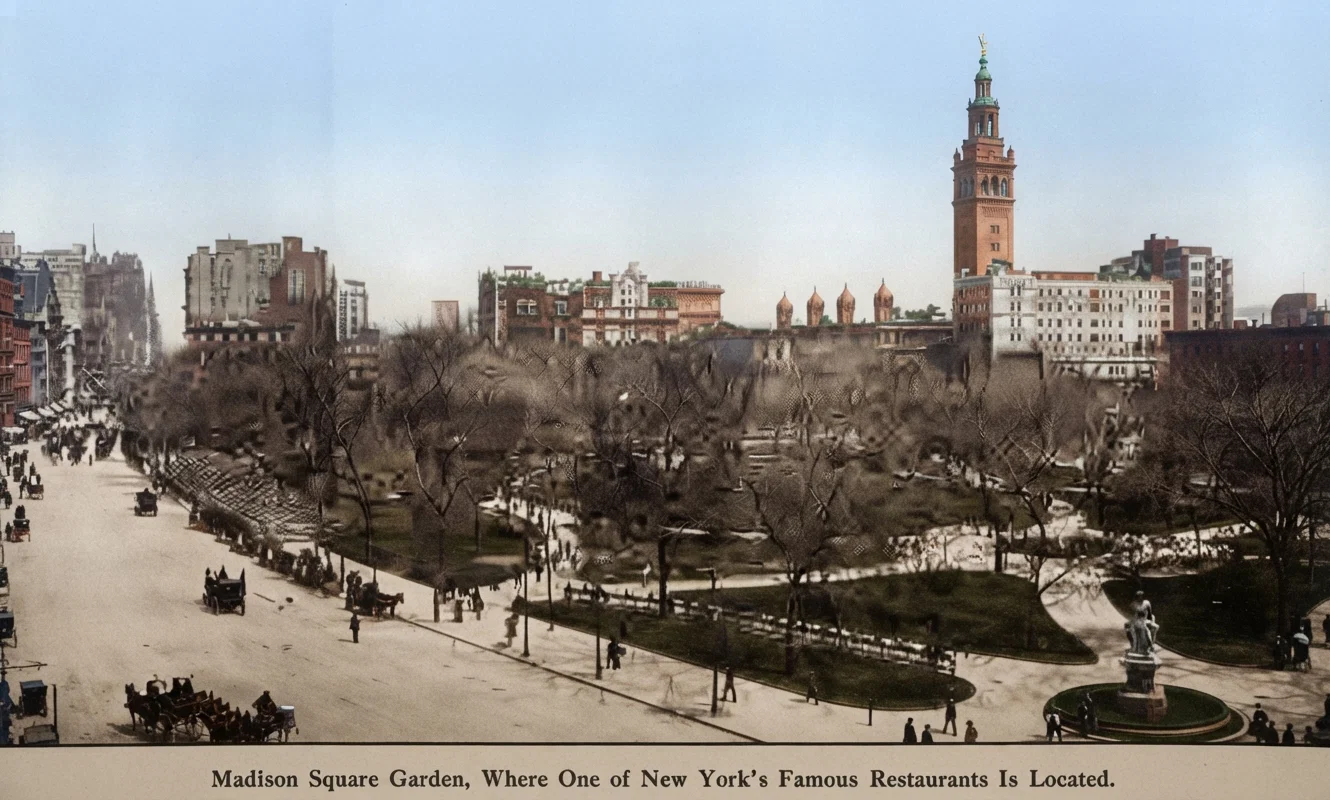
Madison Square Garden, Where One of New York's Famous Restaurants Is Located.
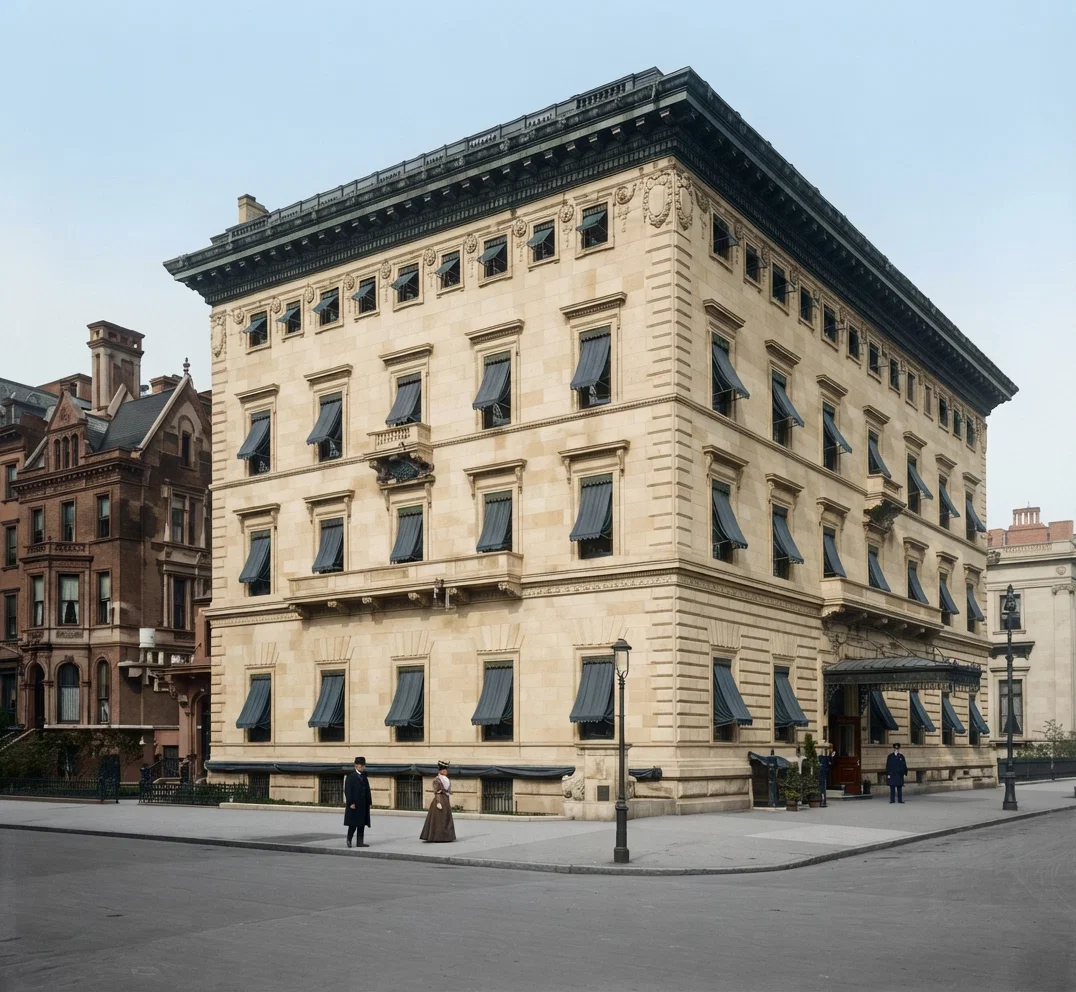
The Metropolitan Club, New York City.
The Plaza, New York City, in the Aristocratic Restaurant District.
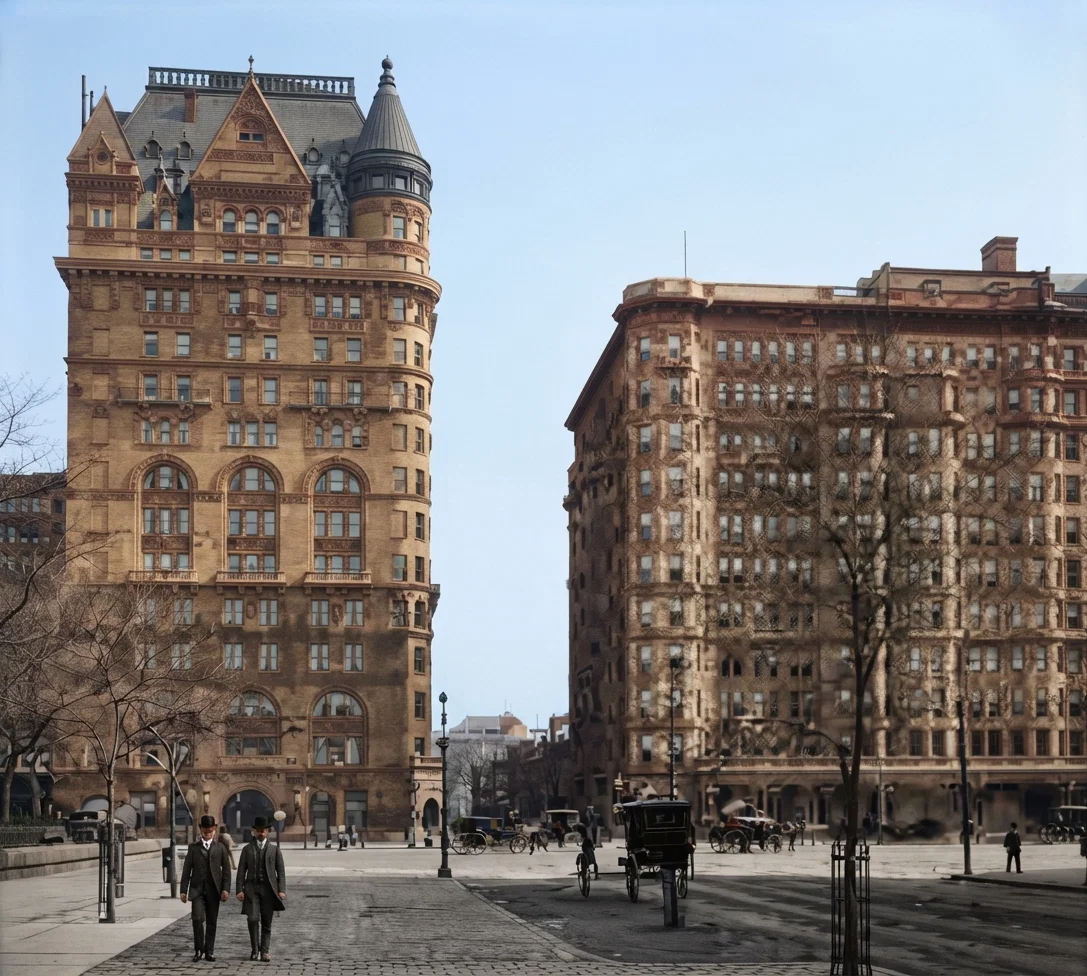
The Waldorf-Astoria, New York's Most Fashionable and World-Famous Hotel.
Not Quite Correct.
By Editor
The Call of January 14 in a news item on a state-wide law for "tight" Sunday, says that at the last session of the Legislature Seventh-day Adventists and theatrical managers of San Francisco succeeded in defeating the bill declaring Sunday a day of rest. A slight correction ought to be made in this. The Seventh-day Adventists stood entirely alone. In the legislative hearings no others appeared against the bill.
Court Decision Shocks Common Sense
Referring to the recent decision of the District Court of Appeals in San Francisco, in the case of Abraham Reuf and ex-Mayor Schmitz, a prominent journal of the East says, "No wonder San Francisco is staggered. The court's decision shocks common sense. It insults decent public opinion. It means that a crook in office and a crook at the side door represent a political necessity that must be protected by law. It means that a criminal in office, and a criminal serving as a go-between, altho caught with the goods, are not to be disturbed in the confidential relations of client and counsel. Public thieves in high places are notified to take notice and to regulate their business on these proper lines. The cause of reform in California is hapless, indeed, when such decisions are possible on the bench of one of its high courts."
The Power of Missions
JUST before His ascension from earth at the close of the work of His first advent, the Master made an appointment with His eleven disciples to meet them on a mountain. And the record says that, "Jesus came to them and spake unto them, saying, All authority hath been given unto Me in heaven and on earth. Go ye therefore, and make disciples of all the nations, baptizing them into the name of the Father and of the Son and of the Holy Spirit: teaching them to observe all things whatsoever I commanded you: and lo, I am with you always, even unto the end of the world." Matt. 28: 18-20.
These eleven disciples represented a large part of the visible results of the Saviour's work while upon earth. And, humanly speaking, it would seem that He was placing a very great task before a very small and very uninfluential company of men. He meets them and tells them to go into all nations and make disciples, and baptize them into the name of the Father, the Son, and the Holy Spirit.
Not Sent in Weakness
But He does not send them in the weakness of humanity to do this great work. He tells them that "all authority hath been given unto Me in heaven and on earth," and then He adds, "Lo, I am with you always, even unto the end of the world." All the mighty power that is in the Son of God is right with the disciple of Christ. For does not this word say that "I [Christ] am with you"? And does it not say still further that I am with you "always"? He is "with" His follower, and He is with him all the time. Not alone was He with the disciples to whom He addressed those words in person with audible voice on the mountain; but He is with every believer "always, even unto the end of the world."
Then every one who believes in Christ has the Master with him at all times and everywhere, no matter in what age of the world he may live. And to have the great Teacher with us means to have all the authority of heaven and earth exercised by the divine hand thru His devoted believer in making disciples for Him.
The Mighty Work Accounted for.
It is this power that Christ Himself exerts thru His followers that accounts for the mighty work that has been done in carrying the Gospel into all lands in all parts of the world. The missionaries for the cross of Christ are just ordinary persons so far as their general appearance and attainments are concerned. They are not above the average in mental endowments. As you would meet them in the ordinary course of business or social life you would not notice anything striking or remarkable about them. And yet these same missionaries will leave all the pleasant surroundings and endearments of home and native land and go into the most uninviting parts of distant and heathen countries to plant the truth of the cross. The people that these missionaries have to associate with are not only uncongenial, but often are decidedly hostile. The missionary's life is in constant danger. But regardless of all these seemingly insuperable hindrances, the missionary goes right on with his work, and these hostile, superstitious, benighted people are won to the life of the Christ.
There is only one way in which to account for all this. It requires a mighty power in the first place to lift the man or woman into the position where they will have the unconquerable and uncontrollable desire to leave behind all that men of this world hold dear in order to go to these dark lands to reclaim and elevate the hostile votaries of the heathen shrines. And in the second place it requires a mighty power to keep men and women devotedly engaged in their work in foreign missions when there is so much to discourage them.
When any one stops to really consider this subject he must be overwhelmingly convinced that nothing short of the mighty power of the personal presence of Christ thru His Spirit could accomplish such a miraculous work. No miracle could be greater than for a power to take hold of men and cause them to make a complete sacrifice of this life in order to help degraded, uncompanionable, uninviting, and hostile heathen tribes to learn of and accept the desirable Christ-life. If any one is looking for present-day miracles, let him turn his attention to the vast army of men and women who have gone into these inhospitable lands to spend their remaining days in the service of Christ. Think you that they could have endured such things unless the mighty Saviour had been with them to encourage, enthuse, and strengthen them?
During the Last Hundred Years.
There has been a mighty work done in the missionary field during the last hundred years. Every continent, every inhabited island, and every nation and tribe in these continents and islands have been sought out and labored for by the consecrated representatives of the cross of Christ. The missionary has gone to foreign lands to spend his whole life. He has broken everything that binds him to his home land and gone into the field to stay. The soldier goes into the army, always with the possibility that he may be killed, but there is also the hope that after the war is over he may return to his home and to greater honors and joys than if he had not enlisted. But the missionary gives up the thought of ever reaching his home and native land again. He gives himself a living sacrifice to the cause of God. Nothing but the mighty miracle of the grace of God acting on the heart could ever accomplish such results. Do you ask for some of the evidences of the power of Christianity? Then look at the army of missionaries who have actually given themselves for life-service to the Master in the hostile and disease-infected regions of the benighted lands of earth.
Love of Home Does Not Deter Him.
The missionary has the same love for home and kindred that others have. Indeed, it may be said that he has even a keener love for his home folks than is possessed by the ordinary individual. But all this is given up as a constant daily sacrifice in order that the sacred duties of giving the Gospel to all the world may be performed.
The last century has seen a mighty forward movement in missions; but we have entered a time when a much mightier work will be seen. We have come to that time in the world's history when the prophecies all declare that the "Gospel of the kingdom" of Christ shall be given in all the world for a witness. The soul-possessing thought is taking hold of a great army of men that this mighty work will have to be done in this generation in which we now live. The prophecies all show that the end of time is at hand, and they also tell of the work of making this good news of the second coming of Christ known in all the world. The great work of the missionaries during the past century is the development of God's plan so that His message of the soon-coming Christ can be given in all the world in a brief space of time. God has worked with mighty power in former days, but the days upon which we are entering will witness the greatest work that has ever been seen.
Some Will Not Recognize It.
There were multitudes of men living in the time when Christ was on earth in person who did not recognize the work that the great Teacher did. Altho He spake as never man spake, and worked the mighty works of God as man had never done or seen, yet the multitude failed to see or sense this, and so did not reap the reward that was offered them. Many men will make the same mistake in this time. How will it be with you? T.
Home at Last.
By Mary Wakeham
HERE in the world as lone pilgrims we roam,
Waiting and watching and longing for home.
Often we sigh for the glories untold,
Sigh for the city whose streets are of gold.
Feet growing weary of life's toilsome way,
Eyes strained to catch the first glimpses of day,
Hearts filled with longing the music to hear,
Angelic songs falling sweet on the ear.
O, for the clear, placid River of Life,
Far, far, beyond the blue vault of the skies,
O, in green pastures of Eden to roam,
Wanderings over, forever at home.
Far, far beyond the blue vault of the skies,
Safe, safely sheltered in fair Paradise,
Ever with Jesus, forever at rest;
Home, home at last in the land of the blest.
MARY WAKEHAM.
Wanted for Missionary Work.
By Editor
Continuous supply of SIGNS, Watchman, Instructor, Life Boat and Review; address Ethel Halfrich, 1823 Dorr St., Toledo, Ohio.
SIGNS, Watchman, Instructor, tracts; address M. W. Delhorbe, P. O. Box 82, Magara Falls, Ont.
Large quantities of SIGNS; address E. C. Jaeger, 1462 W. Sixth St., Riverside, Cal.
Denominational papers and tracts for city distribution; address J. S. Killen, 183 Flint St., Ashville, N. C.
Clean copies of SIGNS, Review, Instructor; Wm. Sterling, General Delivery, Ogden, Utah.
The Vegetarian Cook Book.
While in almost every kitchen there are one or more "cook books" on hand for reference, we have no apology to make for the appearance of this new Vegetarian Cook Book.
The need of good, wholesome advice as to what people should eat and drink is emphatically shown by the alarming increase of disease on every hand.
Mr. Fulton, the author of this volume on vegetarian cookery, is a person of wide experience in vegetarian restaurant work, and is at present manager of the popular and well-known Vegetarian Cafe of Los Angeles. He has embodied in his book the results of his long experience and observation in the combination of foods and their healthful and palatable preparation.
The book has 226 pages, including a handy and well-arranged index of all the recipes given. Bound in cloth, post-paid, 75 cents. Address this office.
Christian Science
By Editor
The articles on Christian Science which recently appeared in the Signs of the Times are now in pamphlet form. The price is 10 cents. Place orders with your Tract Society, or
Pacific Press Publishing Co.
Mountain View, Cal.
A GREAT WINTER RESORT.
Do you know that Colorado, and especially the valley in which is situated the Boulder-Colorado Sanitarium, is a most delightful winter climate, equal in every respect to that of California or the sunny South?
The Boulder-Colorado Sanitarium is a well-equipped medical institution, employing the very best and most approved methods of treatment.
The medical staff comprises four physicians—two men and two women—graduates of leading medical schools, together with a large corps of nurses of both sexes.
No tubercular or consumptive patients received. Special reduced rates are afforded during the winter months. Write to-day for large illustrated catalog, with card of rates. Address, Boulder-Colorado Sanitarium, Boulder, Colorado.
Our Work and Workers.
By Editor
A CHURCH of twenty members was organized at Showhegan, Me., Sabbath, January 4.
ELEVEN were baptized at Denver, Colo., on the first Sabbath of the year, and six more the Sabbath following.
NEW church buildings have been dedicated at Liberal and Shaffer, Kan., with growing companies at each place.
ABOUT forty accepted present truth in Baltimore, Md., thru the labors of Brethren Morris Lukens and H. S. Prener, during the year just closed.
IN New York City about one hundred and eighty have come into church fellowship during the past year. These include English, German, Scandinavian, Swedish, Italian, and a number of other nationalities.