The debt of France is the heaviest ever incurred by any nation in the world. At the close of the American Civil War, the debt of the United States was about two and three-fourths billions of dollars. But the present debt of France is now equal to six billions of dollars; and yet her population is less than one half that of the United States. The yearly interest alone on France’s debt is equal to $4.20 for every man, woman, and child in France. What the proportionate tax burden on that people is may be realized a little better, perhaps, by the statement of the fact that the interest on our own national debt is only 44 cents per capita, about one-sixth of what the people of France pay.
That is the burden of burdens which that people is carrying to-day; and what is the cause?—War and the preparation for war is what has fastened this crushing burden upon the French people. France’s regular army numbers 580,000 men, and her navy, from battle-ships down to torpedo-boats, numbers 810 vessels, of which 209 are battle-ships, cruisers, and gunboats. Thus with a population of only 38,500,000, France has a navy larger than the United States, Germany, Italy, or Russia. But that is not the whole extent of the war burden which she carries; for in addition to her regular army France must arm and drill 4,362,000 men to be ready for war when it shall come.
It is this worship of war by the people of this world that has placed upon France the grinding burden which she carries to-day; and not upon France alone, but upon every other great nation of the world. Germany now arms and trains 5,534,199 men, of whom 691,870 compose her regular army. Italy arms and drills nearly 2,000,000 men; Austria, 1,713,000; Russia, 5,406,000, of whom 883,000 comprise her regular army; and England 612,000, of whom 254,000 comprise her regular army. China supports about 850,000 armed men, and Japan about 280,000. They are all planning upon greater expenditures for both land and naval forces. Even China is waking up, reorganizing and rearming her land forces, and planning for the construction of another navy. England’s expenses on her navy alone for the coming year will amount to the enormous sum of $152,212,850. She puts 49 new war vessels into the water this year. Next year she will have in various stages of construction 87 others. The naval expenses of America for the coming year will be greater than for any previous year; and the other great nations are launching out similarly.
Why all this feverish preparation? Why all this compounding of already heavy burdens? The disease of war has become epidemic; it is firmly seated; its never-loosening roots are beginning to grip the very vitals of the world; and the impending dissolution is hastening on. It is one of the unimpeachable signs that we are in the last days of this earth’s history. “Prepare war; wake up the mighty men,” was to be the clarion call to the world’s last mighty conflict. Every nation is now taking account of its supply of men able to bear arms, taking account of the ability of its people to bear taxation. No census is complete which does not give the number of men the country could depend upon in time of war. Is it all for naught? Every nation sees before it many possibilities of war, many possible or probable entanglements which could lead to war; and they are growing more numerous every day. No nation feels that it could afford to be found unprepared when that time shall come; for its very existence would then be at stake. There is the Turkish question, which may set Europe on fire at any time; there is the Chinese question, which is equally dangerous to both Asia and Europe; and some are now coming to look upon the Monroe doctrine as a challenge which America has flung down to united Europe. Every increase in one nation’s navy is looked upon as a menace to the colonial possessions of the other nations; and nations upon the same continent look with similar distrust upon every increase in their neighbor’s facilities for war.
And within these nations there is growing a power which is bringing troubled sleep to every ruler, a power whose fortress is the darkness of secret organization; whose ammunition is demand and discontent; whose mines are laid beneath the foundations of government and social order; and that power is growing into a force which the nations feel they must reckon with. They are reckoning with it by piling on the burden of taxation to protect themselves from the unseen foes within the household, even as they do from the manifest ones without. Verily we are nearing the time when the trial must be made, a time that will try men’s souls, a time of gloominess and darkness for those who are not hid in Christ. That is the day of conflict for which the nations are preparing now, and the burdens of taxation under which the people groan are the burdens which that preparation brings. The gloom and darkness of that day come to those who have turned their back upon God; but that day of gloom will be a harbinger of everlasting life to the one who has made God his fortress and his trust.
S.
THE WOMEN WIN.
By G.
At last the women of the Methodist Episcopal Church have won their way to a voice in the General Conference. It has been a long, hard contest, but they have won; and the laymen also won a recognition for which they have been contending some time. If there is any class in that church that deserve recognition, it is the women. They have done much to build up and sustain the denomination. They faithfully rocked the cradle in its infancy, and bore the brunt of ridicule that was heaped upon its humble beginnings—especially in their giving public testimonies to the love of God in their meetings. It does not need “the memory of the oldest inhabitant” to recall instances when Christians of some other denominations, then more popular, would piously censure, yes, even sneer at, the Methodist women for speaking in meeting. The idea that a General Conference is more holy or more dignified than a prayer-meeting is not born of the injunction, “In honor preferring one another,” or, “In lowliness of mind let each esteem other better than themselves.”
At the last General Conference a new constitution was adopted. But before it could become operative it was necessary that it be ratified by three-fourths of the local conferences of the denomination. It now has received this indorsement, and therefore is in force. The principal changes are these:—
It gives women the right to sit as delegates in the general conference.
It gives laymen’s electoral meetings authority to vote on constitutional questions.
It changes the vote necessary in the general conference to amend the constitution from three-quarters to two-thirds.
The first proposition was the one that attracted the most attention and the deepest interest. The “conservatives” resisted it quite strenuously, but they have been obliged to yield. The new innovation received not only the required majority of conferences, but about four-fifths of the total vote in the conferences.
G.
Revolutionary Plot in Italy
ITALY has just defeated a great revolutionary plot said to have been concocted by Socialists. As the result of a blunder on the part of the promoters of the plot, the government brought the whole scheme to light before its promoters were prepared for it, and thus blocked the conspiracy, which it was expected would bring about a practical revolution. Little news has been permitted to be sent out by the government; but it is reported that nearly 200,000 troops were mobilized by the government, which immediately assumed control of all railroad employees. Nearly all the workmen in Italy and many of the agriculturists had been gradually enrolled in the scheme until the leagues numbered 10,000, and the membership more than a million. So great was the power of this organization that it was possible within a day to paralyze the industrial, commercial, and agricultural life of the country. The promptest measures of the government were necessary to prevent the scheme being carried into execution. But it will come sometime, and governments will fall before it.
THE proposed railway from Constantinople to Bagdad is being delayed by England and Russia, though from different motives on the part of each. German and French bondholders obtained from the Turkish Government on December 23, 1899, a concession for this line, and the route has since been surveyed. It was a part of the agreement that Turkey was to furnish $6,000,000 per annum, which she was to raise by an increase in her customs charges. Great Britain refuses to consent to this increase on commercial grounds, and Russia objects for political reasons; also because this new railroad will bring Mesopotamian wheat into competition with Russian wheat, and the railroad itself will eventually be a competitor of the Siberian road. With this prospect the road which was to open up Asia Minor may be a long time in building.
THE French inventors who have perfected a system of wireless telephony have received from the French Academy of Science an acknowledgment of the value of the invention. It is claimed that when the instruments are put deep into the earth, messages may be transmitted over enormous distances; for instance, bringing commanders of bodies of troops operating at long distances from each other into direct communication. The claim is also made that messages can be received through the sea from shore to shore; or between ships passing on the ocean. The voice is said to be transmitted without the least difficulty, and the most delicate articulations reach the ear.
THE Colombian Government has given notice to the Panama Canal Company that it must not turn over its property and concessions to another company or nation without first obtaining the consent of the Colombian Government. This will either result in taking the Panama route out of the consideration of Congress, or else in indefinitely postponing the beginning of work on any isthmian canal. Those who oppose any canal can now urge that consideration of the canal question be postponed until the government can deal with the French company.
SEVERE storms have swept the whole country during the week, from the Atlantic to the Pacific. The greatest amount of damage was done and the largest number of lives lost in the eastern and southern States. The destruction of property has amounted to many millions of dollars, and probably not less than 100 lives, all told, have been lost as a result of the storm and accompanying floods. In several of the eastern and southern States and some of the western, railroad traffic and telegraph communication have been either blocked or seriously interfered with. Many factories erected alongside of the flooded rivers have been destroyed or temporarily crippled, and thousands of persons thrown out of employment.
DURING the week Prince Henry of Prussia, brother of the German emperor, has been making a tour of some of the eastern, central, and southern States, visiting the battle-ground of Lookout Mountain, the grave of George Washington, passing through Maryland, Pennsylvania, Ohio, Kentucky, Tennessee, Missouri, Indiana, and Illinois, and receiving enthusiastic demonstrations from the people all along the route. Formal receptions were given him in the various large cities through which he passed, and every effort was put forth to make the royal visitor welcome. The prince has announced repeatedly that his mission is to strengthen the friendship of the two nations.
THE London Spectator of March 2 declares that a wave of commercial depression has struck the whole continent of Europe, being most visible to outsiders in Germany, and that in the south of that country, where the margin of comfort is always thin, the wave produces intense suffering. This journal holds America responsible for this in her tremendous expansion of trade. It is due also to the reflex action of opening up Asiatic countries. It is this commercial depression in Europe which is making European countries come to look upon America as an enemy and to plan combinations against her.
A NATIONAL memorial service was held for President McKinley in the Hall of Representatives at noon on February 27. There were in attendance the President, Prince Henry of Prussia, the members of the cabinet, the justices of the Supreme Court, the general of the army, and officers of the army and navy who have received the thanks of Congress, the ambassadors and other diplomatic representatives of foreign countries, senators and representatives, and a large number of distinguished guests. The eulogy was pronounced by John Hay, Secretary of State.
PRESIDENT ROOSEVELT, through the medium of the Interstate Commerce Commission, has warned the railroad managements throughout the country that the interstate and Sherman laws will be enforced to the letter, and that the administration will not favor any amendment of the law until the present laws have been enforced and their results noted. The new order is reported to have caused much consternation among the executive officials of the roads centering in Chicago.
A CONVOY of empty wagons was attacked and captured by the Boers at Klerksdorp, Transvaal, on February 24. Six hundred British troops and two guns were also captured. On February 27, as the result of concerted action by the British, an engagement took place in which the Boers lost 800 men in killed and captured, together with 28,000 head of cattle, 2,000 horses, and 60,000 sheep. General Botha was captured, but escaped because he was not known by his captors.
THE educational authorities in the Philippines are planning lecture courses accompanied with stereoptican views for the purpose of educating the Filipinos in regard to the United States, its development, resources, and people. Large numbers of lantern slides will be sent for that purpose. It has been specially requested that a considerable number of these slides should show snow and ice scenes, the Filipinos having a very hazy idea of such phenomena.
THE question of precedence at State functions is now agitating official Washington. The ambassadors of foreign powers have been compelled to take a place second to the members of the Supreme Court, and are protesting that their positions entitle them to a place next to the President of the United States. The question is said to involve the friendly relations of the United States with foreign nations.
In a discussion in the German Reichstag on March 3 over appropriations for maintaining German troops in China, the chancellor declared that Germany’s aim was economic wholly and not territorial; that she had no purpose of acquiring territory, and would not interfere in the quarrels of others, her object being to maintain the open door for commerce.
THE HOUSE committee on agriculture proposes a $40,000 appropriation for the purpose of establishing telegraphic communication between San Francisco and the Farallon Islands, either by cable or by the wireless system. It is expected that such communication will be of great service to the weather bureau in forecasting weather changes.
THE RIVER AND HARBOR bill has been completed in committee and its provisions made public. It carries an appropriation of $60,700,000, a large portion of which will be expended on the Pacific Coast.
A REBELLION is now in progress in Arabia, headed by Abdul Aziz Ben Feysul. Many tribes are said to be flocking to the standard of the leader, and the city of E’Riad has been captured.
IN Russia the habit of smoking cigarettes made of green tea is growing rapidly, and coffee cigarette-smoking has been adopted in France. Whether these forms of the baneful habit are worse than that of the ordinary cigarette we do not know. It is a disgusting habit in whatever form it is indulged and by whomsoever it is practised.
MORE disorders are reported from the mining districts of Spain. The miners refuse to return to work until their imprisoned comrades are released. They have burned the tax offices with the documents which they contained, and are constantly assaulting their comrades who have returned to work.
THE Imperial Health Department of Germany is considering the practicability of exterminating the rats infesting the empire. It is known that rats are one of the chief agents in carrying contagious diseases, and it is hoped by exterminating them to reduce the danger from that source.
THE British Government has refused Marconi license to establish wireless telegraph signal stations in the United Kingdom for fear of interrupting the extensive experimental work now being carried on by the admiralty, from which that government hopes to obtain most satisfactory results.
THE representatives of the European countries who have been in conference over the question of sugar bounties have finally decided to abolish bounties on the production of that article, and to impose a countervailing duty upon sugar coming from countries in which a bounty is paid.
SIGNOR MARCONI, who arrived at New York on March 1, reports having sent and received messages by his system of wireless telegraphy while 1,500 miles at sea. The captain and mate of the steamer signed all the messages as witnesses, testifying to the genuineness of the messages.
THE Senate subcommittee on the isthmian canal has brought in an adverse report on the proposition of buying the property and rights of the Panama Canal Company. The advocates of the Panama route, however, will continue to work for the Panama scheme in the Senate.
THE viceroy of India reports that the rainfall in India has been very light and of practically no value in the famine districts. About 359,000 persons are now receiving relief. A despatch from the Punjab states that 3,000,000 acres of wheat are suffering from total drought.
THE Honolulu Merchants’ Association has headed a movement to secure from the Congress of the United States an appropriation for the thorough sanitary renovation of that city; in other words, to have done for Honolulu the same work that was done for Havana.
THE United States minister at Constantinople has presented a note to the Turkish Government demanding the punishment of the captors of Miss Ellen M. Stone. The Porte, in replying, repudiates responsibility and denies all liability in the matter.
A REPORT from Turkey states that 26 Albanian towns have determined to demonstrate their independence of the sultan by refusing to pay taxes to the Turkish officials. The rebels are said to be now besieging the seaport town of Avalona.
NOTWITHSTANDING the reverses which the Boers have received during the past ten days, General Botha declares that the Boer Government has determined to continue hostilities, and has already outlined the proposed summer campaign.
ON February 28 the Senate passed a resolution censuring Senators Tillman and McLaurin of South Carolina for disorderly conduct in the Senate on February 22. The resolution then formally restored them to the privileges of the Senate.
MISSIONARIES in Nan Ning, China, have been again compelled to flee, a rebellion having broken out in that part of the province of Kwang Si. A pledged escort has been sent with the missionaries to convey them safely to Wu Chow.
THE Senate, on March 2, passed the western irrigation bill with only one opposing vote. Even the most sanguine friends of the measure do not look for any such easy victory in the House.
THE educational test which Alabama has adopted for the purpose of eliminating the illiterate colored vote is reported to have also eliminated 43,000 white votes in that State.
THE senatorial fight on the postponed ship-subsidy bill was formally opened in the Senate on March 3, with a long and carefully prepared speech by Senator Frye of Maine.
PROMINENT Englishmen are entering a strong protest to the government against the practice of court-martialing and shooting Boer prisoners of war.
FOURTEEN men lost their lives as the result of an avalanche near Telluride, Colorado, on February 28. As many more were more or less seriously injured.
GREAT enthusiasm was aroused in the Japanese Diet on February 12 when the treaty of alliance between England and Japan was announced.
ON February 20 the pope celebrated the 25th year of his pontificate. The main celebration of his jubilee will be postponed until March 3.
CHANGE IN JEWISH ATTITUDE TOWARD CHRIST.
I regard Jesus of Nazareth as a Jew of the Jews, one whom all Jewish people are learning to love. His teaching has been an immense service to the world in bringing Israel’s God to the knowledge of hundreds of millions of mankind. The great change in the Jewish thought concerning Jesus of Nazareth I can not better illustrate than by this fact: When I was a boy, had my father, who was a very pious man, heard the name of Jesus uttered from the pulpit of our synagogue, he and every other man in the congregation would have left the building, and the Rabbi would have been dismissed at once. Now, it is not strange to hear in many synagogues, sermons preached eulogistic of Jesus, and nobody thinks of protesting—in fact, we are all glad to claim Jesus as one of our people.—Dr. Isadore Singer, editor Jewish Encyclopedia.
THE SUN.
By Frederick Griggs
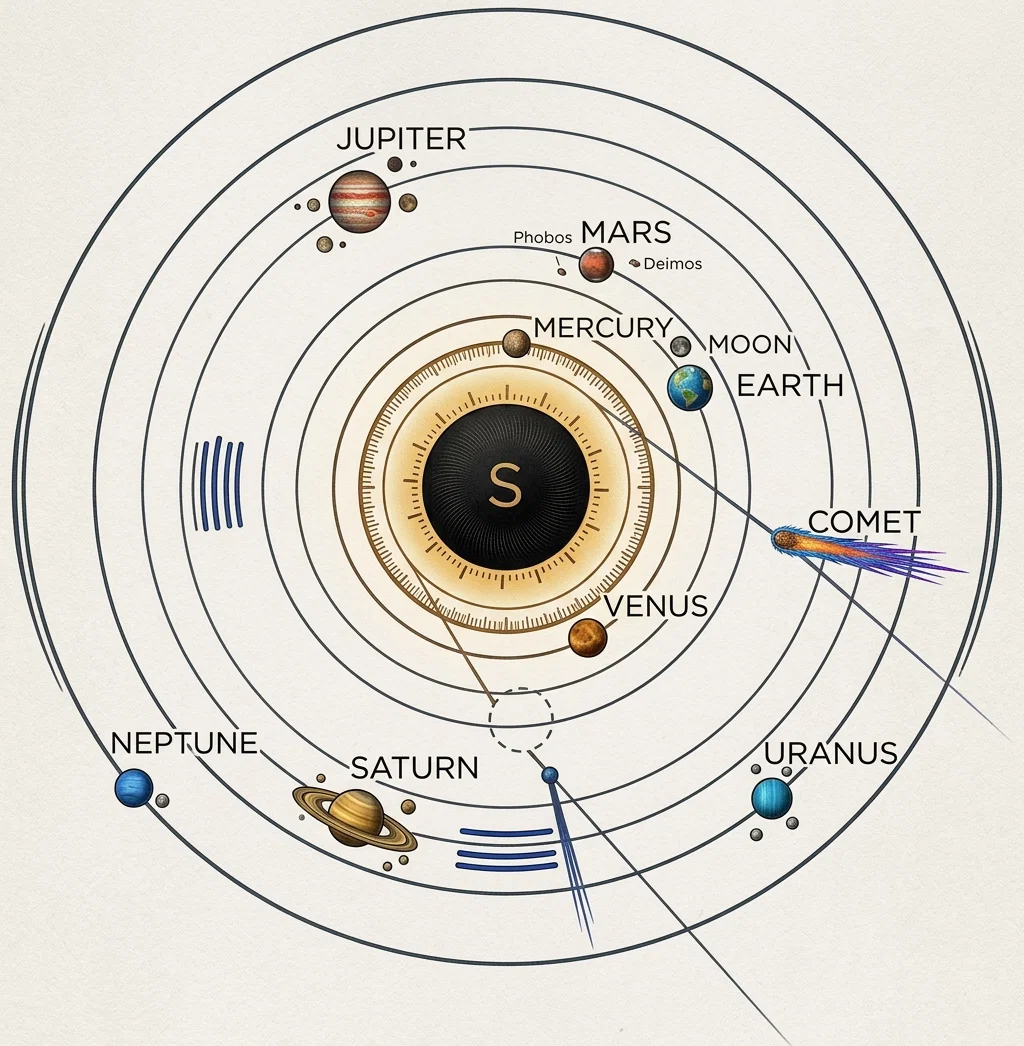
Our Heavenly Father has bound up His lessons of love and truth in all His works, from the little mote that floats in the sunbeam to the mighty leviathan of the waters; from the tiny flower by the wayside to the immense planets whirling through space. Everywhere there is seen His power, wisdom, and delicate touch. Over and again in His Holy Word, when speaking to His children, He has called attention to the planets, all moving in orderly procession, as an evidence of His love and care for His children, for those who are discouraged, for those who feel that their ways are hidden from the sight of the Lord. I say that the heavens speak of His love and care for even the minute. How do these immense bodies show this love and care? In one way they show it by the absolutely accurate and precise revolutions through which they pass in completing their orbits.
When we look at a photograph of the heavens, and see nearly every particle of its space covered with the pictures of stars, we are lost in amazement at the great host of celestial bodies for which our Heavenly Father has a care. Amid these has He set a tabernacle for our sun, which goes forth on his daily march as a bridegroom coming out of his chamber, clothed with strength as a strong man able to run a race. Day after day throughout all time he has taken his journey across the heavens, and nothing has been hidden from his heat.
A marvelous body indeed is this sun. Look at its size. Our earth is 8,000 miles in diameter, but the sun has a diameter of 866,000 miles and a consequent mass of matter equal to about 1,300,000 globes of the size of our earth. The world to us is a synonym for bigness. But traveling at the rate of 900 miles a day, which is about the average rate of the fastest express trains, it would take eight years to pass once around the circumference of the sun. Were the sun a hollow sphere, and were there several hundred holes in the shell of this sphere, and a luminous atmosphere outside, and were the earth placed in the center and the moon at the distance from it which it is now, it would be quite as far from the moon to the shell of the sun as it is from the earth to the moon, and the view presented to us on the earth because of the openings in the shell would be similar to our present view of the universe.
Diagram of the Solar System.
There are many striking comparisons which might be given, showing the great extent and size of this immense luminary of our solar system. Its light and brilliancy are no less remarkable. Euler estimated that “the light of the sun is equal to 65,000 candles at a foot distant, while the moon would be but one candle at 7½ feet, and Venus one at 421 feet, and Jupiter one at 1,320 feet.” These comparisons are only relative, for it is not easy to form any definite comparison of the light of the sun by figures expressed in “candle power,” for any of these artificial illuminations are black in comparison with the light of the sun. Even the most brilliant electric light when placed between the sun and the eye seems black; for the sun is nearly four times brighter than the brightest part of the electric arc. Langley made an experiment at a steel manufactory in Pennsylvania in comparing the direct sunlight with a stream of molten metal directly from the Bessemer converter. Altho the metal was absolutely dazzling, the sunlight was found to be 5,000 times brighter. It is said that the light of the sun is equal to that received from 600,000 full moons.
It has been lately discovered that the rays of light and the rays of heat which come from the sun are distinct from each other; for it can be shown that some of the rays of the sun produce heat, and yet they have no power to give light or color. It is said that the red rays produce the greatest heat, and the violet the least, and the temperature is greatest beyond the red rays where there is no light. Not only this, but it is also noted that different rays of the sun produce different chemical effects. Thus white muriate of silver will be blackened by the violet rays in fifteen seconds, while it will take twenty minutes for the red rays to produce the same effect. Phosphorus will be kindled by the red ray, but extinguished by the violet. It is therefore seen that the light of the sun consists of three different kinds of rays, one producing color, another producing heat, and another chemical effects. Our study some time ago on the subject of light will be remembered in this connection.
While it is difficult to give an adequate idea of the sun’s light, it is more difficult to give anything like a definite conception of its enormous heat. It is said when the sun is at its zenith, its heat is so great that if continued, it would every year melt a layer of ice over the whole earth nearly 170 feet in thickness. This heat is nothing more than energy— working power; and the amount of energy coming from the sun and resting upon five square feet of the earth, is said to be that of one horse-power, or it will do the work of about five men. Ericsson, the great Swedish engineer, who it will be remembered built the Monitor that defeated the Merrimac in the Civil War, built a solar engine, as did also Mouchat another celebrated engineer. There is enough heat falling upon the deck of a steamer in tropical regions, if it could be utilized, to propel it about ten knots an hour. The intensity of the heat of course decreases as we come away from the sun. This rate of decrease is such that the heat of a certain area on the surface of the sun is considered to be about 46,000 times greater than that received by a similar area of the earth. So that if we could utilize the heat as it is on the surface of the sun, we would have coming from one square yard of surface 100,000 horse-power. Indeed, it is so great that if a column of ice could be extended from the earth to the sun, three miles in diameter, and then all the heat of the sun suddenly turned upon it, it would melt it in a second of time, and convert it into steam in eight seconds.
Altho the sun has a circuit, going forth from one end of the heaven to the other, yet it may be said, so far as our globe is concerned, to be fixed and immovable; for the apparent motion, as all so well know, is due not to that of the sun, but to the turning of the earth upon its axis. The phenomenon is just the same as that when on a boat passing down the river, the banks seem to be moving and not we. However, the sun does rotate, or turn upon an imaginary axis, as does the earth. It has been said to take about twenty-five of our days for the sun to perform its revolution. This motion has been determined by dark spots which are discovered through the telescope upon its disk, these spots passing from the eastern side to the western in regular succession. The whole solar system, including the sun and its attendant planets, has a movement through space, but of that we may speak later.
God’s laws, not only moral but physical, are not only marvelous, but they are perfect, converting the soul, and His testimony is sure, making wise the simple.
FREDERICK GRIGGS.
So. Lancaster, Mass.
QUESTION-ASKING CHILDREN.
Several people were at the dinner table last evening, and the conversation turned upon the treatment of young children in matters pertaining to truthfulness and other things. The memory of that conversation leads the writer to say that the question-asking age of childhood is of vital importance to the child, and places great responsibility upon the parents. To every bright child the question-asking age must come.
We fear that too many parents do not regard this age as a natural stage in the intellectual and moral development of the child. Too many persons look upon children's questions as a matter of annoyance or amusement, and think that no great pains need be taken to give proper and instructive answers. Parents often retort by telling the child that its question is foolish. It is too common a thing for parents to turn the child away without making any serious effort to answer questions or to make judicious use of the opportunity presented for instructing the child. Such a course on the part of the parent is inexcusable.
The interrogative stage in a child's development is as significant and as necessary as are the various stages in the child's physical development. Parents and teachers ought to be more eager to furnish food for the hunger which the questioning of children indicates than to furnish food for their growing bodies. The questioning age is to the developing intellectual and spiritual life of the child what incessant activity is to physical development. Still more lamentable is the tendency on the part of some parents not only to make light of the child's questions, but to deceive and confuse the child by indirect or false answers. This is wickedness and not wit. Such treatment of children degrades the parent, wrongs the11child, and insults the Creator, who has implanted the question-asking faculty in every child. Few things mark a man or woman as unworthy of parenthood more strongly than such wrong treatment of children at the questioning age.
Sincerity of Such Questions.
Improper treatment of children at this stage of their development is the more unkind and mischievous in view of the sincerity with which children put their questions. They are eager to know; and if it seems that their eagerness is from curiosity alone, the case is not altered, for curiosity is a God-given faculty which leads us to seek knowledge. This is as true in matters pertaining to right-doing as in other things. Unless the child has received such inheritance as makes him dull touching right-doing, the sense of right and wrong may be developed and cultivated at an early age. This is done by interchanging views and giving information when questions are asked much more than by any set of rules.
That children do not understand what is right and wrong is often due to the bungling way in which such questions are treated by parents and teachers. Rightly understood, the question-asking age on the part of an intelligent child is the most favorable opportunity the parent can have for aiding in the intellectual and moral development of the child. The questioning mood is the receptive mood, and the parent who is indifferent, frivolous, or impatient because a child heaps up questions, is hardly worthy to be a parent. If the mind of the child be directed properly, the questions he will ask open the way for imparting the richest and best lessons possible touching duty and conduct as well as facts. It may be a troublesome age, and you may be inclined to wish the child would keep quiet; but the tendency to seek information through questions is not only a laudable one, but it is in keeping with the divine order that childhood should thus grow and develop in all matters pertaining to its highest good.—Sabbath Recorder.
GALILEE
By Eugene H. Pearce
[Eugene H. Pearce, D. D., in Christian Advocate.]
“And it was dark, and Jesus was not come unto them.”
MASTER of wave, of throbbing heart,
Come near!
Softly the quiv’ring pulse will beat
To greet the music of Thy feet—
And faith shall then Thy name repeat—
Come near!
For fever-cry, for storm-swept hour,
Come near!
The sea dirge chants with sobbing shore,
Clouds pall the stars of friendless skies—
Grim forms of shade with tearless eyes—
Starboard and port the breakers roar;
Come near!
For life, for love—Thou who art dear,
Come near!
Doth heart deceive? Nay, rifted gloom
Flees far apace; the wail of doom
Is hushed before Thee; Thou hast room!
Come near!
Frownless the sky—its smile is here;
For Thou art near!
Noiseless the surge—its soft refrain
Breathes music sweet o’er land and main;
Deep calls to deep Thy name again,
For Thou art here!
SHE REIGNED WHERE SHE WAS QUEEN.
By Andora
[Andora, in Ladies’ Home Journal.]
I knew a beautiful and wealthy woman who as a girl had been a reigning belle. Her old friends crowded about her, but she had no time for dancing or picnics. She literally never lost sight of her children. She nursed the baby and bathed it herself. She inspected every meal the older children ate, and talked and played with them constantly. Her friends protested. “You are degenerating into a mere nursemaid! You give yourself no chance to grow,” they said. “God just now has given me nursing to do,” she said quietly, “and I can grow in that line.”
I lost sight of her for three years. Then her husband removed to the country where I lived. Her children were at school, but she still kept close to them. She took drawing lessons with Mary, studied mathematics with Joe, and taught Jim history. Her mother eye was on each child, and when a teacher drove one of them too hard, the child was promptly brought home and turned loose on the farm for a few months.
Her friends protested that she took no part in the modern affairs of women. She belonged to no clubs. “I must be about my own business,” she said. Her husband was a large cattle grower. She knew his affairs to the least detail. When Joe was ordained a minister, she threw herself into his parish work. When Jim became a magazine editor, she plunged into literature, and read scores of manuscripts for him.
She is still living, still keeping step with her boys and husband. They carry all their worries to her; they consult her in all their plans. Her life has broadened in their lives. Her friends still complain that she does no public work. But “her children rise up, and call her blessed.”
There is no more important work than the work of the mother in the home, and nowhere can more lasting and more valuable results be achieved than in the home by the mother. Were this work of women elevated by themselves to the high plane which it should occupy, the world would be a better world to live in than it is to-day. There might be fewer women’s clubs, but there would be more happy homes, more gentlemanly men, and more womanly women; and the world would welcome and appreciate the change.