Signs of the Times, Vol. 22, No. 39.

A Personal Saviour

Signs of the Times

Oct 1, 1896

Pacific Press Publishing Company · Oakland, California · Oct 1, 1896

A Personal Saviour.
The one precious truth above all others which the Bible reveals to the sinner is that Jesus Christ is a personal Saviour. The precepts, the invitations, come to us in the singular number. The command is, "Thou shalt," and, "Thou shalt not." "For God so loved the world, that he gave his only-begotten Son, that whosoever believeth in him should not perish, but have everlasting life." "And the Spirit and the bride say, Come. And let him that heareth say, Come. And let him that is athirst come. And whosoever will, let him take of the water of life freely."
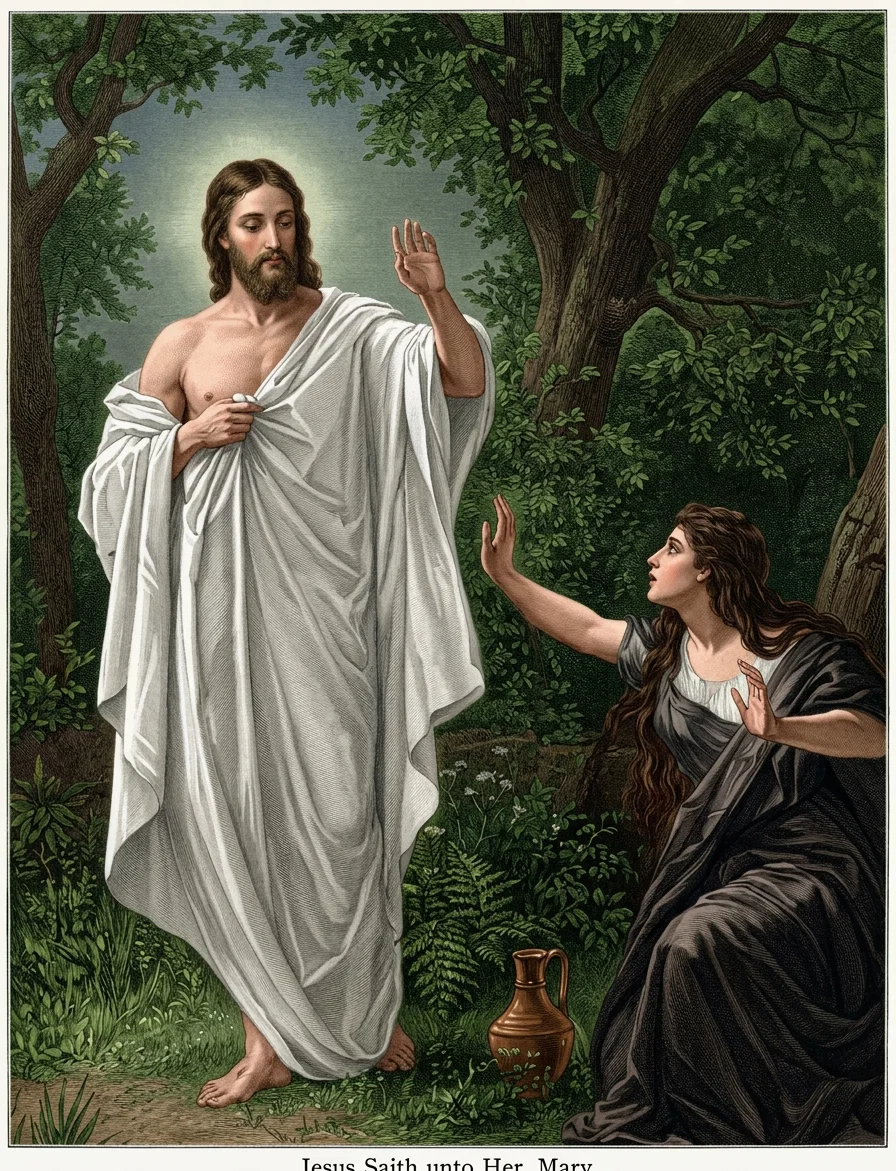
Jesus Saith unto Her, Mary.

We May Come Alone.

These promises appeal to every individual heart. Belief must be personal. No man can believe for his fellow. No one can obey for his fellow. No one can submit to God for another. God has given every man a will and power of choice which he alone must exercise. And it is because of this that Christ comes to every man by his Spirit, and appeals to his heart personally. God authorizes no cordon of priests or prelates between himself and the soul who would approach his throne. He needs not a number of lackeys to wait at the doors of his palace, to whom the sinner or child must bow in his journey toward the Master. The trembling sinner needs no one to introduce him to his Saviour, to usher him into the Divine Presence. Christ calls him, journeys with him, opens the door to him, welcomes him home.

The Strength of Union.

The man who seeks Christ with all the heart will find him. And when two or more who thus know Christ seek him with all the heart together, the power and confidence is increased proportionately with the number thus united. For however sincere a man might be, he is not infallible, and may make mistakes. If his brother who seeks God's glory is perfectly agreed with him, the likelihood that the wish is selfish or the purpose wrong is greatly lessened. And so Jesus says: "If two of you shall agree on earth as touching anything that they shall ask, it shall be done for them of my Father which is in heaven." But they must agree.
The original word means sounding together, inner concord, showing that the hearts have been attuned by the same Spirit. And when two are thus united, it shows that the Spirit of God is with them. Of such it can be truly said, "One shall chase a thousand; and two shall put ten thousand to flight."

Any One.

But God hears also the single sinner who comes to him, or the discouraged child who returns to his presence. All the church may depart; all kindred souls may forsake us, professors of religion prove false, yet Jesus is still the same, and hears us as in the past. After telling Laodicea her sad state, Jesus shows in the following gracious invitation that reformation must be wrought by individual work: "Behold, I stand at the door and knock; if any man hear my voice, and open the door, I will come in to him, and will sup with him, and he with me." Gracious, pitying, condescending Saviour, who notices, invites, receives, any one, every one, who will come to him. He is touched with the feeling of all our infirmities.

Illustrations.

How many illustrations has God given of this! Hagar is driven forth—justly, perhaps—by Sarah in her wrath; but God in compassion remembers the lonely mother, the thirsty lad, and the spent water-bottle. God sent the great prophet Elijah to the lone widow of Zarephath, of Zidon, that she might be preserved in time of famine. Jesus takes his disciples, leaves the crowds of Judea and Galilee, and journeys up into the coasts of Tyre to relieve the aching heart of one poor Syrophenician woman. After his resurrection, instead of first showing himself to companions, he gladdens the heart of the weeping Mary, whose Saviour, it seemed to her, had been stolen away. He had forgiven her many sins; she loved him much; and he did not forget her in the hour of need. The one word, "Mary," spoken in tones of divine endearment and comfort, revealed his identity to the ear attuned to his voice, and "my Father and your Father" and my "God and your God" assured her that all was well, that her own personal Saviour yet lived. Jesus did not forget another soul weighed down with grief because of his rash denial: "Tell His disciples and Peter," said His angel. These are illustrations of all. O soul! Jesus knows you, remembers you, loves you. He would have you know him. Day after day his voice calls; do you not hear it? Day after day he knocks at your heart's portals; will you not open the door?

EZEKIEL, CHAPTERS 36 TO 48.

A Suggested Explanation.

THERE are various explanations given of the last part of the book of Ezekiel. There are those who contend that it has been fulfilled; others that it is yet to be fulfilled, and by various expositors its fulfilment is placed before Christ's coming, during the millennium, and after the millennium.
In its fulfilment, whether in the past or future, is the hand of God. He directly and explicitly promises great blessings which he himself will bestow in the salvation of Israel, his people, and in the glory with which he will invest the land, the city and the sanctuary.
Chapter 36 is a prophecy concerning the mountains, the land, and the people of Israel. Chapter 37 promises a resurrection and a uniting of the scattered hosts and kingdoms. Chapters 38 and 39 are prophecies of judgments against the wicked nations which, controlled by Satan, seek to destroy God's people. Chapters 40 to 48 relate to the new sanctuary, its offerings, its glory, the division of the land, etc.
That this has not been fulfilled is evident. No such city or sanctuary is standing to-day. That it will not be fulfilled is also evident; for the sacrifices of the thousands of sheep and oxen can never be renewed without making the offering of Christ "once for all" of none effect. It would be building again the things destroyed. It would be returning from the sunlight to the shadow. The offerings of the past were for the time then present, shadowing forth the only offering effectual, that of Jesus Christ. (See Hebrews, chapters 8 to 10.)
What, then, is the true explanation of these prophecies? The key to it, we believe, is furnished in the book of Jeremiah, who was contemporary with Ezekiel. The same Spirit spoke through both, and the one rule of the one Spirit applies to both books equally. This key is found in the following (Jer. 18:7-10):—
"At what instant I shall speak concerning a nation, and concerning a kingdom, to pluck up, and to pull down, and to destroy it; if that nation, against whom I have pronounced, turn from their evil, I will repent of the evil that I thought to do unto them."
"And at what instant I shall speak concerning a nation, and concerning a kingdom, to build and to plant it; if it do evil in my sight, that it obey not my voice, then I will repent of the good, wherein I said I would benefit them."
In the same chapter the Lord illustrates the principle by the work of the potter, and declares that because of the wickedness of his people he will scatter them. See the same principle set forth through Ezekiel in chapters 18 and 33. It is a general principle of God's working among the children of men; and if not always stated, it is always implied.
Bearing the above principle in mind, it is not difficult to understand the prophecies in question. God desired to take Israel from her low estate, from her captivity in Babylon, where she had been carried on account of her sins, and restore her, not only to the glory she once possessed, but to a greater than she ever knew. All he desired was that Israel should let him do this for them.
He prophesied for Israel even as he had prophesied against other nations. (Compare Eze. 27:2; 29:2; 35:2, with 36:1.) God would cause his people to triumph. He would cleanse them from sin. He would give them new hearts. More than this, he would bless the land; and the true Israelites who slept in the dust he would release from the prison-house of Satan, and David and his Seed would rule over them. He would bring back the scattered ones from the various nations. The strong foes from the north, howsoever numerous, he would utterly defeat, and he relates even many of the details of the overthrow of the vast host which would come against a people trusting in God. The temple burned by Babylon would rise from its ashes in greater glory and splendor than had ever been witnessed. The glorious shechinah of God would be ever visible. From the Glorious Presence would flow out the life-giving waters, carrying healing and blessing to the land poisoned and made barren by sin. And last of all, that glorious land would be divided between the tribes, and the Lord would dwell among them. Sacrifices and offerings would still be made, for not yet had the Redeemer given himself. All this God promised with wonderful detail if Israel would "put away their whoredoms, and the carcasses of their kings." (Eze. 43:9.) All this goodness of God in all its minutiae was to be shown them "that they may be ashamed of their iniquities;" "and if they be ashamed," then the work was to go on. (Verses 10, 11.) This was to be God's restoration from the Babylonian captivity.
Was it fulfilled?—Only in a small degree. Israel was not ashamed, only in part. The books of Ezra, Nehemiah, Haggai, and Zechariah reveal the sad half-heartedness which characterized that reformation. A temple was built, but it did not fill up God's promises through Ezekiel. Many Jews returned, but many did not care to return. The altar to the twelve tribes was erected, but few of all were present. The worthy dead were not raised, God having some better thing for them. Israel would not let God do for them what he desired to do.
But "shall their unbelief make the faith of God without effect? God forbid." (Rom. 3:3.) God will gather his people one by one from all nations through the One Shepherd. He will cleanse them, not through the offerings of the blood of bulls and goats, but by the virtue of that One Offering typified by all others. He will cleanse the land, yea, all the earth, and he will fulfil all that he promised by Ezekiel, and even more, so that there will be no heathen to mock in that glad day, no country to conquer, no foes to molest; no dead to remind of sin. All the earth shall be filled with the glory of the Lord, Christ will be King forevermore, and his "people shall be all righteous." To this holy, happy state, as given by the later prophet (Revelation, chapters 21, 22), the Lord invites all. "Come," "whosoever will."

THE IRREPRESSIBLE CONFLICT.

Two Principles.

FOR ages, in deadly antagonism to each other, two great principles have existed in the earth, molding the characters of men. Between these principles there is irrepressible conflict, and will be until the existence of one is forever ended. Of vital importance—and it should be of vital interest—is this conflict to the children of men; for they are factors in the great problem that is being worked out in the universe, and upon its solution depends their eternal weal or wo. There is no neutral grounds. There is no escape from the inevitable result on one side or the other.
On one side of this conflict is the principle of Love, or Good, or Truth, or Light, or Righteousness, or Life, for they are all of One. Opposed to these are Hatred, or Selfishness, Evil, Error, Darkness, Sin, Death, and these are all of one.
The former of these principles is of God, the center and circumference of all goodness, truth, light, righteousness, and life; for "God is love." That is his character; and love unperverted is light and life.
The latter principle, Selfishness, is of the great adversary of God. In selfishness is found hatred, evil, error, sin, darkness, death.
Love is diffusive, seeking others' good. Hatred or selfishness is self-centered, seeking the good of one at the expense of all others and all else. The one seeks to build up all, and is itself built up as a consequence; the other seeks to build up self at the expense of any and all, hence it is destructive. Love asks what is right, what is for the best good of one and all. Evil asks what is expedient? what will benefit me?

Embodied in Law.

For the benefit of his creatures God has embodied his righteousness in his law of love, unchangeable and eternal as his throne. Theology has divided the history of God's dealings with sinners into three great dispensations according to priesthoods, namely, Patriarchal, Levitical, Christian, and out of this division men have tried to build different systems of morality and plans of salvation. But it is only by perverting God's word that such things may be made to appear. The following scriptures, condensed to save space, spoken to or of men in the various "dispensations," conclusively show that God's requirements of men are and always have been the same, and that what he requires is nothing less than the perfection and holiness which he himself possesses:—
"An Enoch walked with God [by faith, Heb. 11:5]; and he was not; for God took him." Gen. 5:24.
How "can two walk together, except they be agree?" Amos 3:3.
"Noah found grace in the eyes of the Lord. . . . Noah was a just man and perfect in his generations, and Noah walked with God." Gen. 6:8, 9.
"And the Lord said unto Noah, . . . . These have I seen righteous before me in this generation." Gen. 7:1.
"God . . . . saved Noah, . . . . a preacher of righteousness." 2 Peter 2:4, 5."By faith Noah . . . became heir of the righteousness which is by faith." Heb. 11:7.
"The Lord . . . said unto him [Abraham], I am the Almighty God; walk before me, and be thou perfect." Gen. 17:1.
"And he [Abraham] believed in the Lord; and he [God] counted it to him for righteousness." Gen. 15:6.
"Abraham obeyed My voice, and kept My charge, My commandments, My statutes, and My laws." Gen. 26:5.
"Know ye therefore that they which are of faith, the same are the children of Abraham?" Gal. 3:7.
"For in Jesus Christ neither circumcision availeth anything, nor uncircumcision; but faith which worketh by love." Gal. 5:6.
"This is the love of God, that we keep his commandments." 1 John 5:3.
"If ye were Abraham's children, ye would do the works of Abraham." John 8:39.
"He hath showed thee, O man, what is good; and what doth the Lord require of thee, but to do justly, and to love mercy, and to walk humbly with thy God." Micah 6:8.
THE PROOF OF GOD'S LOVE TO MAN.
"Ye shall be holy; for I the Lord your God am holy." Lev. 19:2.
"As He which hath called you is holy, so be ye holy in all manner of conversation [conduct]; because it is written, Be ye holy; for I am holy." 1 Peter 1:15, 16.
"Let us hear the conclusion of the whole matter: Fear God, and keep his commandments; for this is the whole duty of man. For God shall bring every work into judgment, with every secret thing, whether it be good, or whether it be evil." Eccl. 12:13, 14.
"For whosoever shall keep the whole law ["the royal law"], and yet offend in one point, he is guilty of all. For He that said ["that law which said," margin], Do not commit adultery, said also, Do not kill. Now if thou commit no adultery, yet if thou kill, thou art become a transgressor of the law. So speak ye, and so do as they that shall be judged by the law of liberty." James 2:10-12.
"I delight to do thy will, O My God; yea, thy law is within My heart." (Prophetic of Christ at his first advent.) Ps. 40:8.
"My meat is to do the will of Him that sent Me, and to finish His work." John 4:34.
"I have kept My Father's commandments, and abide in his love." John 15:10.
"He that saith he abideth in Him ought himself also so to walk, even as He walked." 1 John 2:6.
"Blessed are they that do His commandments, that they may have right to the tree of life, and may enter in through the gates into the city." Rev. 22:14.
Such scriptures might be multiplied indefinitely, but it will not be needful for the candid Bible student. The great facts that the injunctions to be perfect, to be holy, to walk with God, implying agreement; the doing of his will; the keeping of his commandments; the exercise of the same faith, resulting in obedience to the same holy law; the injunction to keep the law in view of the judgment, of which the law is the rule; the obedience of Christ, and the duty to walk as he walked; the blessing pronounced upon the keeper of God's commandments, and much more which might be cited, show unmistakably that God's requirements are always the same, and, in the very nature of things, can no more change than his character can change.
The love which Christ enjoins is the love enjoined through Moses. (Deut. 6:5; Lev. 19:18; Matt. 22:27-40.) The Scriptures and the morality to which the New Testament writers continually appeal are the Scriptures and morality of the Old Testament. God and his law are eternal, unchangeable (Ps. 111:7, 8; Isa. 51:6, 7; Matt. 6:17-19); and that law which reveals sin, is embodied in the Decalogue (1 John 3:4; Rom. 7:7).

Two Masterpieces.

These opposing principles in the great conflict are not purely abstract. Both are personified. Each principle is represented by a person in whose character the principle is wrought out or developed. These the word of God, the Gospel of Christ, holds out before us, that we may see the principle in the character, and so accept the good and refuse the evil. Love—unselfishness—finds its personification in

The Son of God, Our Saviour.

Thus is his character portrayed:—
"Have this mind in you, which was also in Christ Jesus: who, being originally in the form of God, counted it not a prize [a thing to be grasped] to be on an equality with God, but emptied himself, taking the form of a servant, becoming in the likeness of men; and being found in fashion as a man, he humbled himself, becoming obedient even unto death, yea, the death of the cross." Phil. 2:5-8; see R. V., margin.
This is love. If any being in the universe had a right to aspire to the throne of the Eternal, it was his divine Son, but he did not count it a prize, "did not meditate a usurpation" (as some translate), did not seek to advantage self, as long as other lives were in jeopardy. So he stepped down to an angelic messenger, and lower still, to man, and even to the lowest, death, or sin full-grown, and did all this that man might be saved, that man might possess the same character. He emptied himself of himself, and God filled him. Christ therefore revealed not himself to the world, but the Father. (See John 14:6-10; Matt. 11:27.) The sacrifice, the suffering, the sympathy, the love, the yearning tenderness for lost humanity seen in the life of Christ, were but the manifestations of the love of God that filled him; and when at last the climax was reached by his death upon the cross, that said to the world, This is love, this is God's love even to the sinner.
Selfishness, or sin, finds its personification in him who was once Lucifer, the Daystar, now known as

Diabolus and Satan,

And here is the record of the mind that was in him:—
"How art thou fallen from heaven, O Lucifer, son of the morning! . . . For thou hast said in thine heart, I will ascend into heaven, I will exalt my throne above the stars of God; I will sit also upon the mount of the congregation, in the sides of the north; I will ascend above the heights of the clouds; I will be like the Most High." Isa. 14:12-14.
Here is self salvation, self exaltation. He that is of like nature is of Satan. He that is of love, of unselfishness, is, through Jesus Christ our Lord, born of God. (See 1 John 3:8-14; 4:7, 8.)
It is the purpose of God to gather out of this earth a company which shall bear his name and character, a part of the great family of God. For that purpose he in love gave them his holy law, "ordained unto life," (Rom. 7:10.) But through Satan, man sinned, perverted God's law to the law of death, came short of God's glory (Rom. 3:23), and was doomed to die (Rom. 6:23). But Christ gave himself, that man might live, and that through Christ the law might work out in sinful flesh what God designed it should do in sinless flesh in the beginning. The law was "ordained to life," but sin found it to be unto death. Sin perverted that law, turned its life power into an unlawful channel, and it worked out wrath, and became "the law of sin and death." (See Rom. 7:10, 23; 4:15.) The law of gravitation is a beneficent and life-sustaining law; it preserves in equilibrium the things of earth; but let man cast himself from a tower or precipice, and the same law proves his destruction. The law in itself is good, but it is perverted and used unlawfully; and thus the law of life becomes a law of death. It is even so that the carnal heart has perverted the beneficent and life-giving power of God's law; and it becomes a law of sin and death to the sinner.
In Christ, however, the Spiritual-hearted, who did no sin, the law is normal in its workings, "the law of the Spirit of life;" andhe who by faith receives Christ, receives in Christ the law in its normal condition—righteousness and life. (Rom. 8:1-4, 9, 10.)

Always Faith.

But righteousness and life are always by faith. "Without faith it is impossible to please Him" (Heb. 11:6), not on the part of the sinner alone, but the righteous as well; for there is no true righteousness but by faith in God. A righteousness without faith in the Supreme is self-centered, and has within it the root of all sin, selfishness. But he who has faith in Almighty Power, Eternal Goodness, and Infinite Wisdom will be ever led and drawn out of self and toward the Great Center of light and love.
In faith, therefore, there is union and strength. It brings one into union with the Eternal Spirit and make him a partaker of its life. It does the same with each and all of the children of faith, and thus it unites by the bond of that Spirit and Life all the children of faith, all who are submitted to God's holy law, who receive in God's own appointed way—Christ Jesus—the riches of his grace. But self, howsoever righteous it may seem, is weak and divisive. It has as many separate centers as there are minds controlled by its influence. These may unite in groups on some common idea or plan or conception, but the union is essentially selfish, lasting only so long as selfish interests seem to be served. This was true from the beginning; it is true now. True faith among men will issue in the prayer of Christ recorded in John 17. It seeks God's glory and the good of all; eventually it will reap God's glory in its fulness and be served by all the saints in light. So it will be in the glad day of universal restoration, when all of sin is destroyed. Each will by love serve God and one another, and each will be served by all. Glad, happy service! Come, thou glad day!

Some Historical Facts Worth Remembering

THE SABBATH AND THE SUNDAY. NO. 4.

Some Historical Facts Worth Remembering.

IN previous articles we have, by the statements of reliable historians, or references thereto, brought the Sabbath question down to A.D. 364, where resting upon that day was prohibited by anathema by the Council of Laodicea. Previous to this time, and even later, it was generally observed by the Christians of the Eastern churches. The apostasy crept in from the west. We traced Sunday down to A.D. 325, when it was officially given the title of "Lord's day" by Sylvester, bishop of Rome. Just previous to this the first Sunday law on record was promulgated, a heathen law by the heathen emperor Constantine, for a partial and urban observance of the day. In 323 Constantine professed conversion, was hailed as Christian emperor, and his heathen law in behalf of "the venerable day of the sun," which remained unrepealed, was used by the corrupt church to further the claims of Sunday as a Christian institution.
During this period both days were observed. The church rules for the Sabbath—making it a fast day—were such as to make the day odious to a backslidden church. The rules for Sunday, which was made a feast day, to a backslidden or half-converted church, made that day popular, and assisted in setting aside the truth for the error of tradition. Following are testimonies concerning the observance of both days in those evil times on which the church had fallen:—
47. Of Constantine's relation to Sunday Dr. Peter Heylyn (Hist. of the Sabbath, part 2, chap. 3, sec. 1) says: "So natural a power was it in a Christian prince to order things about religion, that he not only took upon him to command the day, but also to prescribe the service." This was about A.D. 325
48. Says Eusebius, the friend and flatterer of Constantine (Life of Constantine, 3, 33, quoted in Elliott's Horæ Apocalypticæ, vol. 1, p. 256): "And all things whatsoever that it was duty to do on the Sabbath, these we [Constantine, Eusebius, and other bishops] have transferred to the Lord's day, as more appropriately belonging to it." This is a fair example of apostasy's assuming authority to alter what Christ or his apostles did not even presume to change in any way. Eusebius wrote in A.D. 338
49. It was considered by many devoted men who observed the Sunday festival that the Sabbath was still obligatory. Thus says Gregory, bishop of Nyssa, to the Christians of his day: "With what eyes can you behold the Lord's day, when you despise the Sabbath? Do you not perceive that they are sisters, and that in slighting the one you affront the other." (See Hessey's Bampton Lectures, pp. 72, 304, 305.) Gregory flourished about A.D. 372
The above testimony shows the progress of apostasy in the Christian church. That day which had no divine authority, a heathen festival in fact, was now considered a sister to the Sabbath of the Lord. Heylyn quotes Tertullian (A.D. 200), Origen (A.D. 250), Socrates (A.D. 400), as saying that Wednesday and Friday were both observed in about the same way that Sunday was. (See Hist. of the Sabbath, chap. 2, part 2, secs. 8, 9, 10. See also chap. 3, secs. 4, 5.)
50. Says St. Jerome (see Dialogues on the Lord's day, by Morer, p. 234): "Paula, with the women, as soon as they returned home on the Lord's day [Sunday], they sat down severally to their work, and made clothes for themselves and others." This was about A.D. 400
51. Labor, courts, theaters, and games and sports of various kinds were common on Sunday after service down to the fifth century. According to Justin Edward (Sabbath Manual, p. 123), Pope Leo the Great decreed "that on the sacred day wherein our own integrity was restored, all do rest and cease from labor." A.D. 440-461
52. According to Morer (Dialogues on the Lord's day, p. 259, 260), the emperor Leo decreed that "the holy days," "especially the Lord's day, which we decree to be a venerable day, should not be spent in sensual recreations, or otherwise profaned by suits of law." "Let not the circus or theater be opened." "We command all, therefore, as well husbandman as others, to forbear work on this day." A.D. 469
53. A Greek, or Eastern, church historian thus writes: "For altho almost all churches throughout the world celebrate the sacred mysteries [the Lord's supper, etc.] on the Sabbath of every week, yet the Christians of Alexandria and at Rome, on account of some ancient tradition [two centuries before Roman apostasy had made the Sabbath a fast day], refuse to do this. The Egyptians in the neighborhood of Alexandria, and the inhabitants of Thebais, hold their religious meetings on the Sabbath, but do not participate of the mysteries in the manner usual among Christians in general; for after having eaten and satisfied themselves with food of all kinds, in the evening, making also their oblations, they partake of the mysteries."—Socrates, book 5, chap. 22. About A.D. 450
Sozomen, a contemporary of Socrates, speaks to the same effect. Rome and Alexandria were the two chief seats of apostasy. These historians conclusively show that by the greater part of the Christian world the Sabbath was still observed.
54. During these first four centuries existed another people, probably from the time of the Ethiopian eunuch (Acts 8:26-40), whose religious life was molded by the apostasy which affected the whole church. Sunday eventually crept in as a festival day, a sister day to the Sabbath, but the observance of the Sabbath continued. About the time that the Roman bishop gained the supremacy in the church Abyssinia became lost to the nations of Europe. Says Gibbon: "Encompassed on all sides by the enemies of their religion, the Ethiopians slept near a thousand years, forgetful of the world, by whom they were forgotten." During this time they imbibed error and darkness, but not the gross errors of the great apostasy. They observe the Sabbath still, a living testimony of a whole people of the perpetuity of the Sabbath in the Christian church for eighteen centuries. It is said of them: "Transubstantiation, and the adoration of the consecrated bread in the sacrament, were what the Abyssinians abhorred. . . . They deny purgatory, and know nothing of extreme unction; they condemn graven images; they keep both Saturday and Sunday."—Geddes' Church Hist. of Ethiopia, pp. 34, 35; Purchas' Pilgrimage, book 2, chap. 5.
(To be continued.)

Insulting God.

This is what many professed Christians do, who would be shocked at the bare suggestion. Moreover, they are not ashamed to do it to his face. Let us illustrate. Suppose I had an acquaintance to whom I would say on almost every occasion, when we met, "I find it very difficult to believe what you say to me; I wish you would help me to believe what you say." That would not be complimentary, to say the least; but the man might be so forbearing as to repeat his statements and promises. He might even go so far with me as to take a solemn oath that his words were true. Nevertheless, I continue to say to him, "It is so difficult to believe you." And then when I meet with friends, I speak of this one, and tell them how hard it is for me to believe him. Would not such conduct be justly called an insult to the man? Would what I say have a tendency to give others confidence in him? Everybody can see that such language would be the same as saying to others, "Be very cautious in your dealing with that man; look out for him, and do not trust him too much, or you may be deceived." Now that is just the way thousands of professed Christians treat God. It is an insult to God, and a disgrace to the cause of Christ, for any professed Christian to talk about lack of faith. They do not treat God with the ordinary courtesy that they would show a neighbor. Who can expect to see sinners converted to God, when those who profess to be acquainted with him talk and act as tho he were not to be trusted?
E. J. W.
Continue reading: THE MOTHER AND BRETHREN OF CHRIST