Your ShelfYour Projects

Signs of the Times, Vol. 33, No. 16.

Contained in this Issue
Earlier text: WHO WAS TO BLAME?

THE LOST SUNDAY AMENDMENT IN CALIFORNIA.

IN the "California Christian Advocate" of March 21 there is an article by the Rev. E. D. McCreary, D.D., stating how the Sunday Amendment was lost. He frankly tells us that the appeal made to the Legislature was for a constitutional amendment for "Sunday betterment." The plea made before the Committee on Constitutional Amendments of the Assembly was for the aid of the WORKING MEN.
The religious idea was utterly and absolutely disavowed, and all the plea that was made was for a day for the poor, oppressed working man.
Dr. McCreary tells us who made the plea for the amendment and also those who spoke against it, declaring that they were all ministers or members of the "Seventh-day Adventist Church," and that "the ministers and members of this church made a vigorous and successful canvass of the state, circulating petitions against the amendment, which were numerously signed by members of that denomination, and by saloon-keepers and bartenders, brewers, and other opposers of Christianity."
Mr. Chauncey H. Dunn, in his speech before the Assembly Committee, declared as he presented his petitions, that these petitions were circulated
"without great effort to get names at all, in various portions of the state, in order to show that there was a general sentiment, and that sentiment extended thruout the state; and we have, therefore, at this time, a petition to present to the Legislature thru this committee, containing between seven and eight thousand names, only of voters—and they represent voters from about forty counties in the State. We have not attempted to make any large canvass, etc."
And yet Dr. McCreary tells us on their petition question:
"The apathy of the ministers and members of the churches in regard to the Amendment was appalling. Three thousand petitions, each one having space for thirty signatures, were sent out all over this state to pastors of all denominations. The petitions were sent out from headquarters two months before the Legislature convened, accompanied by an urgent appeal that immediate attention be given to their circulation for signatures. Less than one-third of these petitions were returned, and many of these had only from five to ten signatures. The whole number of signatures only aggregated about 8,000, while the signatures on opposing petitions aggregated 14,000 [15,000]. Some of the largest and most influential churches of our own and other denominations did not send in a single petition nor a single signature. Had the pastors of the state given to this movement the support and attention its importance demanded, at least 50,000 signatures could have been easily gotten; and, with such a constituency as these signatures would have represented, the Legislature would at least have given the Amendment much more careful consideration."
Why can not the good doctor surmise, rather why does he not know, that a great many of these who he thought ought to sign his petition because they keep Sunday, signed the opposing petition because they believe in religious liberty? He charges that the opposing petitions were signed by Seventh-day Adventists and whisky people largely, and yet Seventh-day Adventists are among the
most sincere and strenuous opponents of the saloon; and in this entire campaign and in the speech of Mr. J. O. Corliss before the Assembly Committee, it was expressly stated that we are opposed in toto to the manufacture and sale of intoxicating liquor. This has been kept in the very forefront of our literature, and we are known as prohibition people thruout the United States. That there may have been men of this character who signed the petitions is probable, and they had the perfect right so to do; but there are also those who signed the petitions that are members of various Protestant churches, and even ministers of evangelical denominations, who utterly repudiate the union of Church and State and the fostering and protecting of religious institutions by statute law.
There is a reason for the apathy of the ministers and members of the churches in regard to an amendment of this character. There may come a time when that apathy is lifted and church-members may be driven to petition for such laws as this, under a combination of arguments for political purposes. But at the present time, thank God, there are Christians in all the various denominations who utterly repudiate the trailing of the garments of Christianity in the mire of politics, who utterly repudiate fornication between Church and State.
Seventh-day Adventists did do a little in this campaign. They did not do anything at all compared to what ought to have been done, but we are glad that Dr. McCreary tells us that the "movement for Sunday betterment is not dead;" that "arrangements are being made for a more thorough explanation of the moral and religious forces of the State along these lines." We are glad to know what will be again attempted. We are sorry, so sorry that no words can express it, that the Christian church, the professed spouse of Jesus Christ, can not learn that He is all-sufficient; and that if they have any institution which they call Christian, which has not enough of divinity in it, and divine support in the living word of God behind it, to stand, that it ought to be utterly repudiated and die, rather than to seek to uphold it by legislation. More than this we are sorry they will not repudiate that confessed weakness of character, that they are not willing that what they believe and profess shall stand on just the same ground as the belief and profession of every other citizen of the State. He who believes in religious liberty believes in it for the other man, and he would scorn to take any advantage of that other man, however much in the minority the other man might be.
Let the Sabbath, let the Sunday, stand on the inherent qualities which they respectively possess. We have the word of the Lord Jesus Christ that "every plant which My heavenly Father hath not planted shall be rooted up." We may build Sierra-high walls around a California or an American or a Methodist or any other Sunday, and if it is not of God's planting, in the great day of God those walls will fall. That is true of every other institution, nor need we wait till the day of God to know whether it is of God's planting or not. Study His word, and let that word guide us, notwithstanding the traditions and creeds of men.

Italian Immigration to America

Signor Nitti, a deputy in the Italian Senate, says that every year an Italian province is transferred to America. It is stated that there are more Italians in New York than there are in Venice. Something like half a million come every year, most of whom settle in the large cities, Boston, New York, Washington, New Orleans, and Chicago. Not all of these immigrants are undesirable; in New York alone their property holdings are valued at $60,000,000, one-fourth of which is in the savings banks. It is proposed to relieve the congested conditions by the organization of agricultural colonies.

Peace Congress

Peace Congress.—Do not forget that the SIGNS OF THE TIMES will have a capable representative at the Peace Congress in New York, who will report that great meeting for this paper alone.
We make a break in our series of articles on China in our Missions Department to permit a few words on a matter of great importance. The $150,000 is a worthy enterprise, and if all would lift as they are able, it would be soon raised, nobody would be distressed, and the cause of God would be greatly blessed, and this blessing would flow back upon His people.
The Standard Bible Dictionary.—Funk and Wagnalls Company announces an early completion of the above work. Its price when complete will be $6.00. They make an advance offer to clergymen of $4.00. It is an absolutely new work, containing the very latest determinations of facts, making the book not a volume of speculations about the Bible, but a Bible dictionary. Address, Funk and Wagnalls Company, 44-60 East Twenty-third Street, New York, for particulars.
In a recent speech by Senator Beveridge, of Indiana, he declared, according to the New York American, that Indiana is eager for the time when the whole government of the country shall be nationally administered. He said, "We Americans live in one big house with many rooms, not in separate houses, fenced and guarded against one another." Among the things demanded was the election of Senators by the people, the nominating of all candidates for office by the people at the polls, the making of internal improvements by the nation, and referred to a great many other things which the government had already done, such as the prevention of the scattering of obscene literature, suppressing lotteries, prohibiting the selling of poisonous and adulterated foods, sanitation of packing houses, the inspection of meats, irrigating the arid West, ending of child labor, control of trusts, etc. And these are the arguments put forth for a stronger and greater centralization of power.
Extravagance the Order.—It takes a resolution like that of John Wesley (was it?), who would spend only so much a year whatever his income, to withstand the environing extravagance and its temptations. The federal government is no exception to the rule. The last session of Congress appropriated almost $920,000,000; and a member of the House appropriations committee contends that $75,000,000 should be added to this for river and harbor work and naval construction. As compared with ten years ago, just prior to the Spanish War and the era of imperialism, the figures stand as follows: For 1898, $528,735,000; for 1908, $919,948,000, almost twice as much within a decade. Of this increase, $55,000,000 must be charged to the army, and $66,000,000 to the navy. One party, counting on a continuance of prosperity, predicts that the present revenue system will yield a surplus of $20,000,000; while the other party contends that there will be a deficit of $100,000,000. The people may have to pay more heavily in additional taxation for our billion-dollar Congress if flush times should not persist. Then "distress" and "perplexity." Luke 21:25-27.

TO OUR READERS.

Some Specially Good Things.

BEGINNING May 1, we are going to publish a series of 26 special numbers of this paper on the leading topics of the Bible. Each article will be complete in itself, and yet so arranged as to form a connected history of the great events outlined in the Scriptures. Studies will be given on the great symbolic prophecies and prophetic periods in the books of Daniel and The Revelation, showing the fulfilment of prophecy and where we now stand in the stream of time. The following are some of the topics which will be considered in these 26 special numbers:
  1. The Bible.
  2. Prophecy.
  3. Coming of the Lord.
  4. Our Sacrifice and Priest.
  5. The Signs of the Times.
  6. The Law and the Gospel.
  7. Man and His Destiny.
  8. Spiritual Gifts.
  9. Election, Predestination, and Free Will.
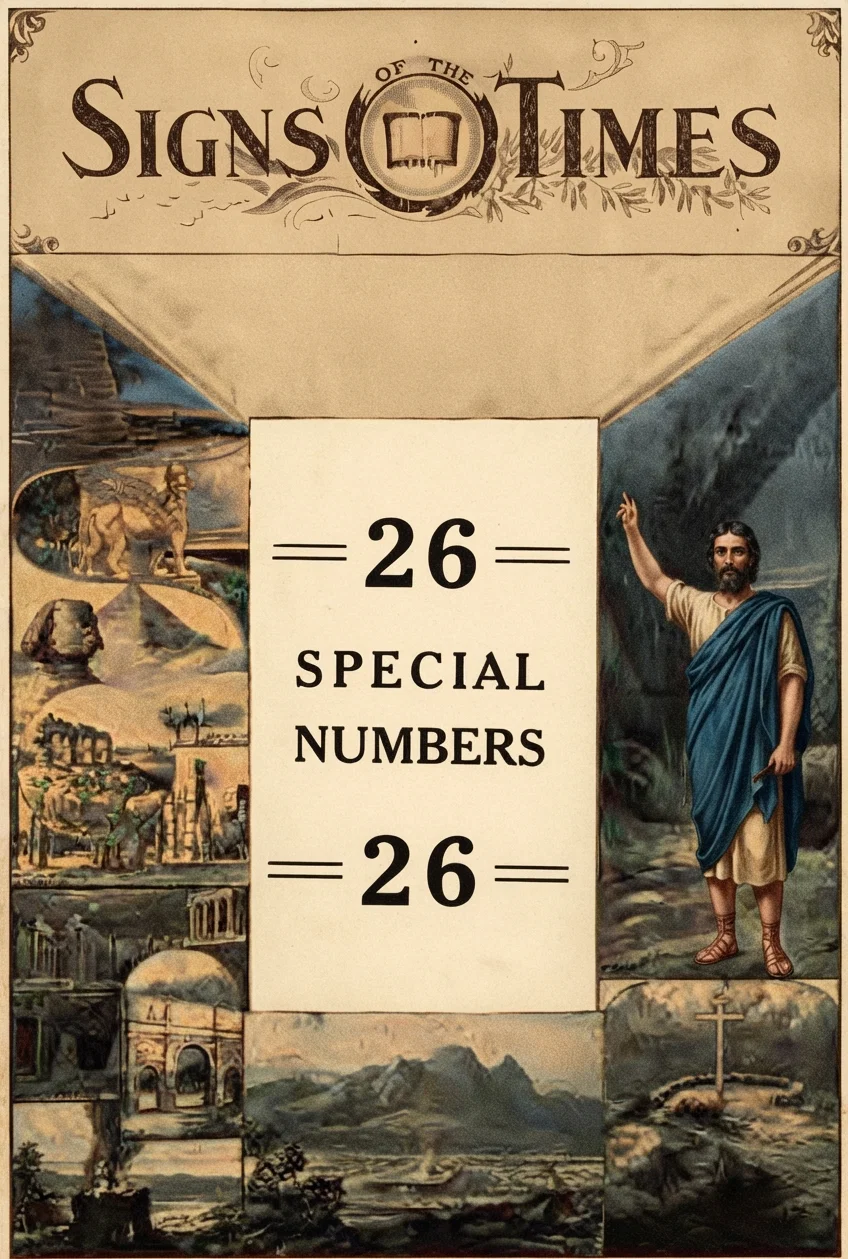
Reduced Facsimile of Cover Page.
  1. The Great Threefold Message.
  2. The Church.
  3. Bible Temperance.
  4. The Sabbath, the Test of the Ages.
  5. The Great Federation Movement.
  6. Religious Liberty.
  7. The Outpouring of the Spirit.
These articles will be well illustrated and supplemented by Bible-readings. Above we give a reduced facsimile of the cover-page of one of these series, which is a study in itself. The original drawing was made by Mr. Chas. Mente, our New York artist.
Besides these special articles, the regular departments of the paper will be kept up during this period the same as usual. Particular attention will at all times be given to the Outlook Department, taking up current events and showing what they mean in the light of prophecy.
This series will be one of the most interesting and instructive that we have ever published, and not a single number should be missed. Remember that the first number will be issued May 1. Subscriptions should be sent in at once.
We call your particular attention to the following special rates, which include the Gospel Series of 26 special numbers: The 26 special numbers, six months . . . . . . . . . . . . . . . . . . $ .75 Five or more copies to one address, six months, each . . . . . . . . . . . . . . . . . . . . . . . . . . . . . . . . . . . . . . . . . . . . . . . . . . . . . . . . . .50
Four or more to single names and addresses, one year, each . . . . . . . . . . . . . . . . . . . . . . . . . . . . . . . . . . . . . . . . 1.00 Regular subscription price, one year . . . . . . . . . . . . . . . . . . . . . . . 1.50
Yearly subscriptions will not only include the 26 special numbers, beginning May 1, but also the great Missions number to be issued in November, as well as all other special numbers which have been planned. Subscribe now and secure the complete set.
Address, SIGNS OF THE TIMES, Mountain View, Cal.
The Bible in Japan.—The report of the American Bible Society for March informs us that "the liberal donation of money on the part of Christians in the United States and elsewhere has not only made a deep impression on the minds of the famine sufferers, but also on the nation, as evidence of the Christian spirit of unselfish devotion to the welfare of mankind, regardless of creed and race. One of the residents in the famine region reports a deep and widespread interest in the teachings of Christianity, and in numerous places there are now not only a goodly number of inquirers, but also many who are true believers. At Iwanuma, near Sendai, one hundred are reported to have decided to become Christians. At one church in Sendai there have been forty-two baptisms. Among these there were officials, bankers, business men, and university, college, and middle-school students. There are still many earnest inquirers who are being instructed in the Bible. At another church were forty-six baptisms, and one of the missionaries writes that during an experience of thirty-two years he has never before seen such a hunger for soul food. From present appearances it would seem that this movement is likely to become general."
INDIA MISSION FUND. Received to March 1 . . . . . . . . . . . . . . . . . . . . . . . . . . $3,241.50 Alfred Karlson . . . . . . . . . . . . . . . . . . . . . . . . . . . . . . . . . . 5.00 Jennie M. Fisher . . . . . . . . . . . . . . . . . . . . . . . . . . . . . . . . 1.00 Total to March 31 . . . . . . . . . . . . . . . . . . . . . . . . . . $3,247.50 This does not include the amounts sent to the Foreign Mission Board; only that which came direct to this office.
An excellent letter comes from one of our round-the-world missionaries, Pastor G. B. Thompson, with a most interesting article on India. This will appear as soon as the series on China is finished. Brother Thompson writes that he is of excellent health, and meets signs of encouragement everywhere. He in a few days expected to organize a church in Rangoon.
The highest record of singing at one respiration is by Courtice Pounds, who in 1898 sang three hundred and sixteen notes without taking breath. Previous to this, Norman Lallmond sang two hundred and eighty-seven notes at one respiration. The average man can scarcely sing fifty.
Famine in Russia.—Reports from Russia are to the effect that famine conditions prevail over a territory half as large as the United States. It is a greater loss to Russia than the immense cost of the Japanese war. These facts speak eloquently of the times in which we live.
Great men and mighty men in their plenitude of wisdom may leave God's cause, nevertheless it moves on. For "the weakness of God is stronger than men," and "the foolishness of God is wiser than men."
The National Educational Association Convention will be held this year in Los Angeles, July 8 to 13. 30,000 visitors are expected, among them the greatest educators in Europe and America.
Now we are told that the great Bible companies are forming a Bible trust. We hope this is not the case. More about it later.

You have reached the end of this edition.

Signs of the Times · Apr 17, 1907