A YOUNG mother, holding up her first baby for papa's kisses: "Now, see him shake his fist at his old father! Isn't that cunning? Did you ever see anything so cute and sweet?" The soft, rosy, dimpled fist is covered with kisses. Baby learns what will bring the applause of his little world.
Time rolls on—a way time has—the same three persons five years older. Papa speaks, "Come out here into the woodhouse with me, sir! I'll teach you to shake your fist at me, young man! Off with that jacket now!" Mother lies on her bed, vainly trying to shut out the sound of blows and shrieks for mercy. Ah! the time to have shown mercy was years ago. Father may say, "I'll teach you, young man!" but the wee baby was taught, and he has only learned what was taught him.
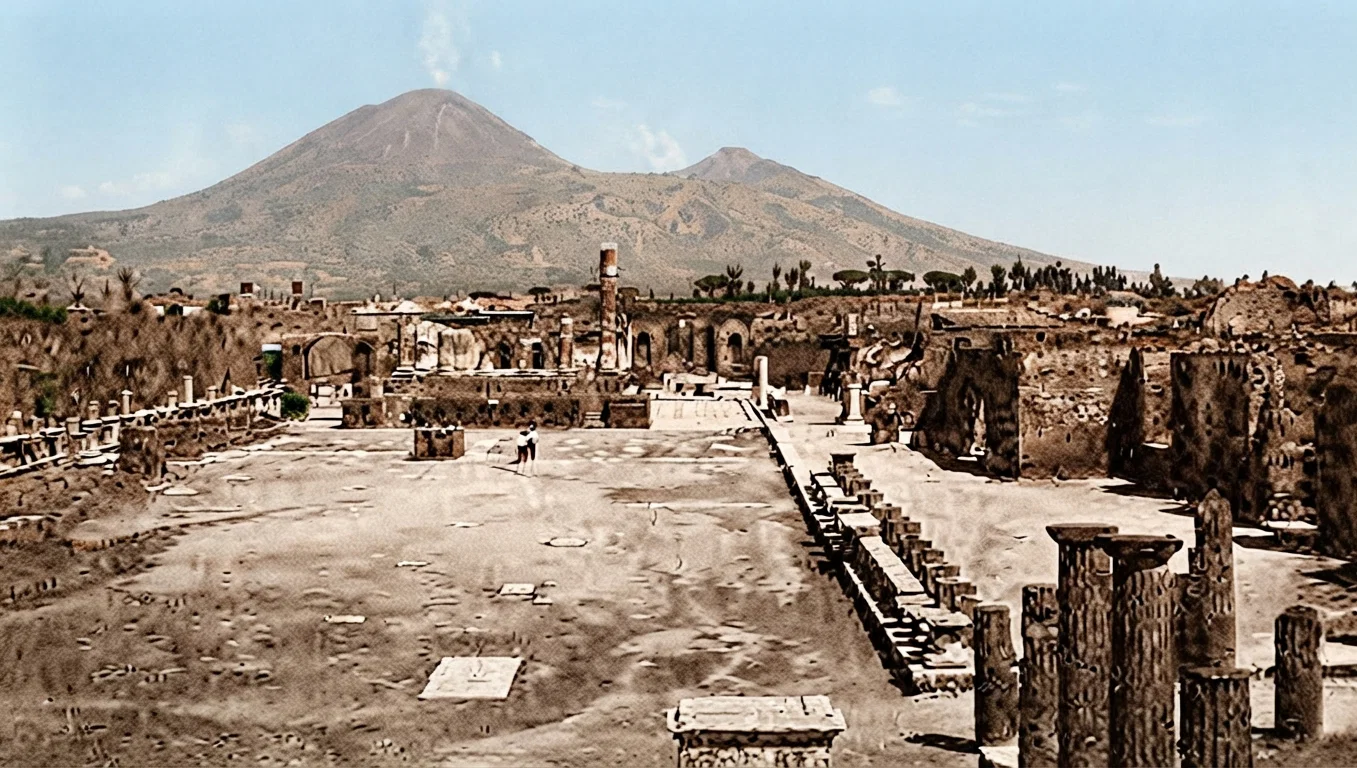
Forum of Pompeii, exhumed from the ashes of Vesuvius, which buried it in A.D. 79. The volcano, Vesuvius, in the distance. These calamities—volcanic and seismic—are increasing in frequency as the centuries roll by. They are indications that the sin-laden earth is waxing old. See article on page 14.
O for justice, wisdom, and common sense in Christian homes!—Mrs. McVean Adams.
WHERE ALL THE PINS REALLY GO.
AN old gentleman in the north of London has been making a series of interesting experiments with a view to finding a solution to the question often asked: "What becomes of the countless myriads of pins, etc., that are annually lost?"
As he expected, he finds that it is the disintegrating effects of the air which resolve even these intractable little instruments into their elements. He put some hundreds of brass and steel pins, needles, hairpins, etc., in a quiet corner of his garden, where they would be subject to all the destructive agencies of dampness, earth, wind, etc.
The results are curious. Ordinary hairpins were the first (taking 154 days, on an average) to oxidize into a brownish rust—ferrous oxide—which was scattered by the wind as it was formed, and not a trace of a single one could be detected at the end of seven months. Common bright pins took as long as eighteen months before their combustion was complete, but brass ones had been entirely turned into green verdigris long before that.
Polished steel needles of a small size lasted a very long time (over two years and a half), but a black lead pencil proved itself to be practically indestructible, both cedar and plumbago being almost as good as when new, even tho harder things had quite rotted.
LOMA LINDA COLLEGE OF EVANGELISTS.
By Editor
The regular opening of this school for the next year's work begins September 19, 1907, but some classes in preparatory branches will begin soon after April 15, 1907, and continue until the regular school opening in September, to prepare any who may need to make up studies required for entrance. Loma Linda College offers a three years' course in nursing, and two years in Evangelistic-Medical work, making it perhaps the most complete course offered by any sanitarium training-school anywhere. Besides being very complete on the educational side, students are only required to work a total of forty-two hours per week in order to cover all expenses of board, room, and tuition, which is about two-thirds of the time usually required of nurses. Besides this, a few will be allowed to pay cash for part of their expenses, and thus gain some additional time for study. We will be glad to correspond with any who wish to take up studies along the lines of Nursing or Evangelistic-Medical work. For circulars and full information, address,
COLLEGE OF EVANGELISTS
Loma Linda, Via Redlands, - - - - Cal.
A GOOD PROPOSITION.
to men and women. Send four ten-cent stamps for one dozen packages of E-Z Washing Tablets and instructions, post-paid. This may start you in a good, easy business as it has many others. E-Z Washing Tablets remove the dirt and stains without rubbing and positively without injury to clothes. Want agents in every State. Good profits. Address,
ALFRED MALLETT
Elkridge, - - - - Baltimore, Md.
Henton Fruit Truck
By George E. Henton
Buy the celebrated HENTON FRUIT TRUCK when you intend purchasing wagons. For Carriages, or anything in the line of Farm Machinery, correspond with me. Can make it an object to you. Will lay goods down at your station at less than you pay local dealers. Satisfaction guaranteed. Geo. E. Henton, Mountain View, Cal.
Address
By Editor
If you haven't already done so, why don't you drop us a postal asking us to send you a copy of our monthly paper, "The Bank of Mountain View Journal." It is very interesting. It is full of good ideas, and it is free to you for the asking. If you live in the East, send for a copy and see how we do it in California. We still hold ourselves ready to furnish you with information about Mountain View. Write us.
Address
Bank of Mountain View
Mountain View, Santa Clara County, California
Poverty as a Providential Hindrance
"WHAT some men call poverty is often only a kindly, providential hindrance to the securing of hurtful superfluities for one's self or friends."
The Value of Reading
By Macaulay
If anybody would make me the greatest king that ever lived, with palaces and gardens, and fine dinners, and wine and coaches, and beautiful clothes, and hundreds of servants, on condition that I would not read books, I would not be a king—I would rather be a poor man in a garret with plenty of books than a king who did not love reading.
Character Reveals the Future
By T. H. Nelson
TELL me a man's moral worth—describe his strong qualities and his weak points and I'll read his future with the skill of a conjurer, for character is life in embryo.—T. H. Nelson.
RAISE IT QUICKLY.
By Editor
The $150,000 Fund.
At the spring council of the General Conference Committee in 1906, it was recommended that $150,000 should be raised for various purposes. At that time it was decided that $100,000 was to go for the work in Washington, D. C., and $50,000 to the South.
Just as the enterprise was being launched, the information was received that fire had consumed the Pacific Press at Mountain View, Cal. Another council was therefore called and the following distribution of the fund was made:
The South . . . . . . . . . . . . . . . . $ 50,000
Apportioned as follows:
Nashville Sanitarium . . . . $25,000
Huntsville Sanitarium . . . . 5,000
Graysville Sanitarium . . . . 1,500
Atlanta Sanitarium . . . . 3,000
Graysville Academy . . . . 2,000
"The Watchman" . . . . 2,500
To be apportioned by the
Southern Union Conf. . . 11,000
Washington Sanitarium . . . . 50,000
Pacific Press Building . . . . 20,000
Review and Herald Building . . . 10,000
British School (near London) . . . 10,000
Williamsdale Academy (Nova Scotia) 2,000
Skodsburg Sanitarium (Denmark) . . 2,000
West Indies (school and publishing
work) . . . . . . . . . . . . . . . . . . . . 4,000
Chilean Printing-house and School . . 2,000
Total . . . . . . . . . . . . . . . . . . . . $150,000
It has been mutually agreed that the first $50,000 raised on this fund is to go to the South. The remainder of the fund is to be divided on a pro-rata basis to each of the various enterprises benefited.
The World-wide Work.
All these agencies are educational and mighty helpers in carrying the Gospel message. All are needy and worthy. This $150,000 fund is itself illustrative of the world-wide progress of the third angel's message. The accomplishment of this enterprise will bring strength into all departments of our cause—educational, publishing, medical missionary, and evangelistic. It is a stroke for missions, and will hasten the evangelization of all lands with this message. Even the help given the home enterprises is help for mission fields, as the institutions assisted are to be training centers from which the light must go out to all parts. And the great Southern field is counted in our work as in itself a mission field. The providences of God that press this call upon us are evidences that we are in the days of the finishing of the work.
The raising of the $150,000 fund is a magnificent test of loyalty. If accomplished quickly, it will be a glorious achievement.
Nothing that we have undertaken has a better foundation, (a) In the value and urgency of the enterprises to be assisted; (b) In the unqualified approval and promises of support from the responsible leaders in our cause; (c) In clear, distinct, and urgent appeals from the Spirit of God.
THE CERTAINTY OF GOD'S PROMISES.
By John O. Corliss
To believe the Bible in its entirety is to trust God implicitly. The faith of Seventh-day Adventists in the immediate coming of Christ is based upon the promises of Jehovah as given in His word. But in considering these promises, it is well to embrace all the conditions attached to them. That is to say, we ought carefully to study those things to be fulfilled, which must precede the glorious revelation of the Lord's personal advent.
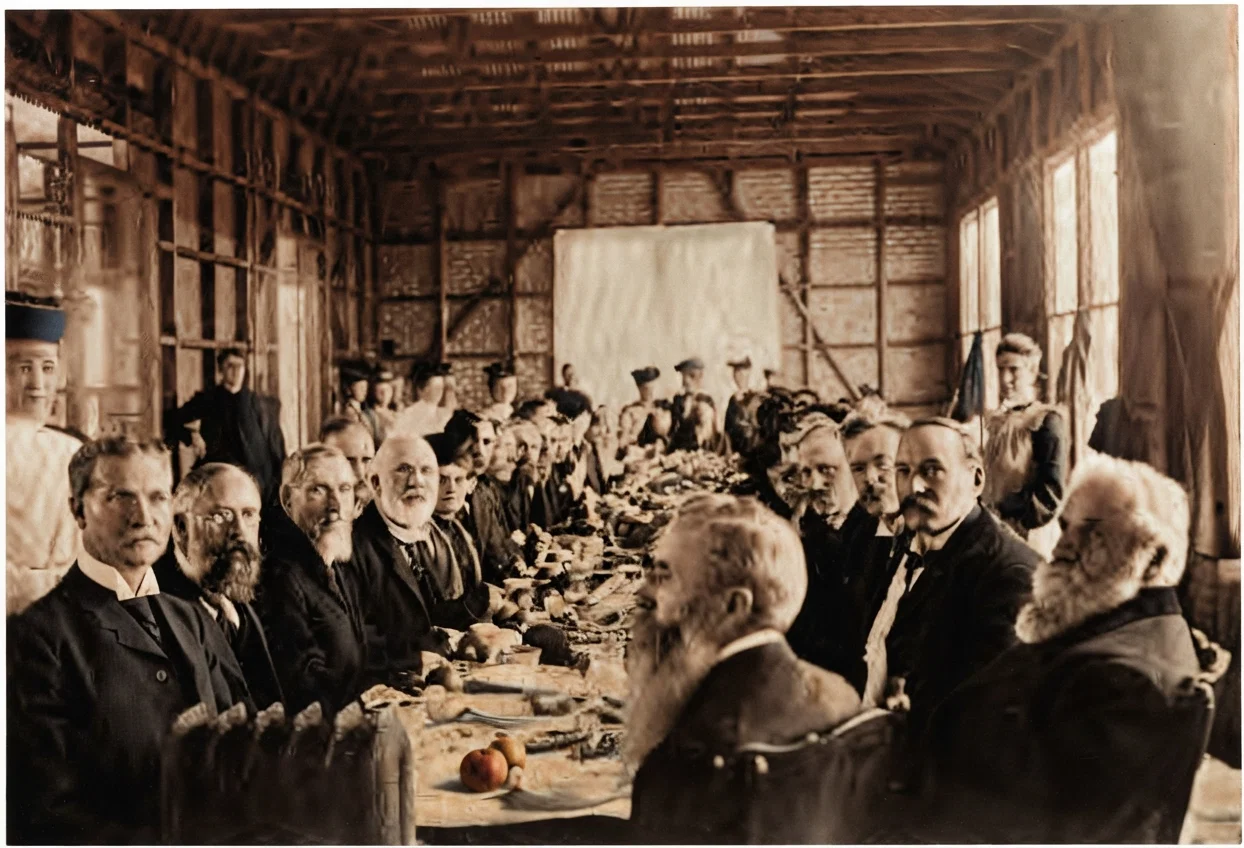
At our last stockholders' meeting, Jan. 28, 1907; lunch generously provided by the ladies of Mountain View Church. The building is now occupied, tho not quite completed. Work is more than we can do at present. Before many months the congestion will be relieved.
First of all, let us emphasize the Saviour's own words which tell us that "this Gospel of the kingdom shall be preached in all the world for a witness unto all nations; and then shall the end come." Matt. 24:14. It is well to note that the Gospel of the Lord's kingdom MUST BE SOUNDED IN ALL PARTS OF THE WORLD as a witness to the nations, before the message can culminate in the Lord's coming. This is indeed a great work which with only human power would be impossible for many reasons. The greatest of these is that without a cementing force, no unity of purpose could be maintained, by which to bring those in darkness to see "eye to eye" in preparation for the Lord to "bring again Zion." Isa. 52:8.
By consulting the apportionment of funds by the General Conference, it will at once be seen that the division of the $150,000 now being raised was a wise one, looking to the end in view. No single portion of the field receives a major part of this money, but it is assigned to each section, according to the revelation of its needs. We call attention to the fact that Great Britain receives $10,000 for its educational work. Considering for a moment the wide range of influence that country has over other nations, and the amount of good it may accomplish by this, all must agree that this entire amount is needed there. Crossing the North Sea to Scandinavia, with its extended connection with other parts, we must see that the $2,000 devoted to educational work there is none too much to meet its needs.
Coming to the Western World, we note the struggling efforts to establish a school in the West Indies, in which to educate the people of that region for a part in the Master's work. We believe the $4,000 to be given there is a modest sum for that region. Turning to the west coast of South America, we witness the strenuous efforts there made against papal error; and why should not that country have the sum of $2,000 with which to establish a modest printing plant and a school?
Viewing our own country, and the work assigned it in God's providence, why should we not prepare ourselves at once to discharge the responsibility that we know rests upon us? The sooner we place all our institutions on a basis from which they may become instrumental in carrying out the plans they are designed to accomplish, the sooner will God be able to give through their united work the resonant cry which will arrest the attention of the entire universe. In this establishment of centers of influence in various parts of the world, we may see the wisdom of God. He designs that His last message shall attract men by its harmony and sweetness of tone. To become thus it must sound thru an instrument fitted to give the positive notes of rhythm and harmony.
Makers of band instruments well know that to make the exit-end of the contrivance no larger than the entrance, no amount of breathing thru it would produce the desired sound.13Therefore such instruments end in greatly enlarged proportions, and in bell-shaped form, in order to give the proper volume and beauty of tone. The closing notes of the third angel's message to be produced by the breath of God, must have the instrument thru which they are to be produced given the proper proportion and shape. The larger and more extended the bell of the instrument, the wider the range of sound that will be produced.
In the closing of this message, God wants coworkers who will be willing to give the material of which to make the great instrument thru which His Spirit may herald forth the speedy coming of the Master to judgment. Why should not every one esteem it a rare privilege to be invited as a partner into such a firm, and for such a work? Why should not the necessary funds for this preparatory work be on their appointed mission now?
J. O. CORLISS.
CHRISTIAN COURAGE.
By Frederick W. Faber
WORKMAN of God, O, lose not heart!
But learn what God is like;
And in the darkest battle-field
Thou shalt know where to strike.
Thrice blest is he to whom is given
The instinct that can tell
That God is on the field when He
Is most invisible.
Blest, too, is he who can divine
Where real right doth lie,
And dares to take the side that seems
Wrong to man's blindfold eye.
Then learn to scorn the praise of men,
And learn to lose with God;
For Jesus won the world thru shame,
And beckons thee His road.
—Frederick W. Faber.
A UNITED EFFORT.
By William Clarence White
LET us all unite in a supreme effort to raise quickly the $150,000 fund. The work can soon be accomplished if we all take hold with faith and enthusiasm. Let us devote our best energies to this work just now, and see what can be accomplished in April.
In May, the representatives of our work in all lands will be assembled in Gland, Switzerland, as a General Conference Council. And there, in the presence of the grand old mountains that witnessed many of the severest struggles of the Great Reformation, our brethren from every continent will be engaged in conference. On the banks of the beautiful lake, midway between Geneva and Lausanne, two strong citadels of ancient Protestantism, they will engage in prayerful study of the ways to keep the later Protestantism pure and active.
Reverently will they study the way in which the Lord has led this people, and the commission to go into all the world and preach the Gospel. Diligently will they study the world's map to see how they can place the few workers in newly entered fields where they can accomplish the most for the Master in a short space of time. Faithfully will they study the ranks of the workers in the older fields, to see who can be spared to go to the frontier. Earnestly they will plan for the strengthening of every educational agency, so that all may be doing their utmost in the training of workers to go to the front.
Our schools, our publishing houses, and our sanitariums will be brought into faithful review as regards their value as training-places for missionaries. And broad plans will be laid for the strengthening of every known agency for the education and fitting up of laborers for the great harvest field. The importance of such councils can not be estimated.
Let us unite in earnest prayer that a full measure of grace and wisdom be given to our representatives at this council. And shall we not also pray that grace and wisdom be given to us, that we may keep step with the advance movements that shall be inaugurated at the council?
As our brethren consider plans for broader work in China, Japan, India, Africa, and South America, the question will always arise. What promise is there of sufficient means to support the present work, and the proposed enlargements? How long will it take to make up the large fund we are now working on? And how soon can we give our principal financial support to the strengthening of numerous other agencies for the training of workers?
The answer to many of these vital questions will be found in the results of the efforts made just now by ministers, teachers, physicians, and managers of our institutions, to do a full and acceptable work in raising the large fund. The enthusiasm that we put into this work in April, and the results telegraphed to the General Conference Council in Switzerland, will largely influence the brethren in their plans for broader work in the newly opening fields.
What Shall We Do?
Let us plan a big surprise for our brethren who assemble in Gland next May. Let us all, ministers, licentiates, teachers, physicians, and managers of institutions and enterprises, take hold of this matter at once, and, uniting our efforts with church officers and others having a burden to help, let us do a quick work in raising the balance of the big fund. Thus we can count its accomplishment as a mile-post of progress, and go on to other work.
W. C. WHITE.
OUR WORK AND WORKERS.
At Seymour, Ind., a church of nineteen members was recently organized, all but four being newly converted.
THREE have accepted present truth at Columbia, Okla., under the labors of Brother and Sister T. J. Hickman.
OF the work in Indianapolis, Ind., the Reaper states: "Three adults who have received Bible-readings from our workers united with the church."
BROTHER C. L. BUTTERFIELD, writing from Tillamook, Ore., to the North Pacific Union Gleaner, says: "The Foley Sunday-school voted to discontinue the Sunday-school and meet on Sabbath. Accordingly, last Sabbath when the time arrived there were over twenty persons gathered for Sabbath-school and meeting. Of this number, there will be about fifteen that will be regular members."
THE company at Keokuk, Iowa, has been increased by seven members during the last three months thru the labors of Brother and Sister G. R. Hawkins.
A CHURCH of nine members was organized at Maynesburg, Ky., March 16, by Brethren Pogue and Sanford of the Cumberland Conference.
A GERMAN bark called at Pitcairn Island, Dec. 24, 1906. The commander was informed that there was no sickness on the island, and that everything was well with them.
THE total number of believers in the Australian Union Conference, which includes Australia, the Philippines, Singapore, and a number of other island groups, is reported to be 4,095.
O. H. MCCRILLIS, of Bethel, Wis., makes a plea that the Signs and Life Boat should be furnished for the people in insane asylums, not only for many of the patients who are rational,—cured or nearly so,—but also for the helpers and caretakers. His experience leads him to believe that such good reading would be greatly appreciated in these asylums throughout the United States.
A SMALL company of believers are holding forth the truth in Ketchikan, Alaska, where Brother A. M. Dart and wife are laboring. He writes: "At our Sunday night meeting we have a regular attendance of a score or more of Metlhakatla Indians. They are quite well educated, speak English well, and are better acquainted with their Bibles, on the whole, than many professed Christians wearing a fairer skin."
A LETTER from Prof. J. L. Shaw, of India, tells us that more special attention is being given to the work among the natives and the learning of native languages. Brother James has been sent to southern India to open up the work among the Tamil people. In the Tinnevelly district there are five hundred Sabbath-keepers. We hope soon to report the establishment of a home in the hill country for which funds have been raised. The matter is under consideration now, but the missionaries there wish to decide wisely and well.
NOW IS THE TIME.
By H. W. Cottrell
HE is a true soldier who stands by his gun in the heat of the battle.
His labor is most appreciated who lifts when the work is most difficult and the load the heaviest.
Have you and your church contributed your sisterly share to the $150,000 fund?
We are not our own. We are bought with a price. Our money is not our own. We are stewards of the Lord's means, and He is thereby testing each one of us as to our fidelity in the use we make of it. The gold and the silver, and the cattle of the valleys and upon the many hills, are His; but He permits us to gather from His earthly storehouse, to hoard or to expend, as we will; but as stewards over His means, and as representatives of His work on earth, we shall be required by the Lord to render an impartial account of our stewardship.
There has never been a time when some department of our Father's cause did not need financial help, but just now it is in special need. There is a call for men and women and children who will lift where the work for the hour needs them most. And the raising of the $150,000 is the work for the hour. Let us at once finish it, and advance to other duties.
Jesus said, "It is more blessed to give than to receive." True, it may not always be more PLEASING, but it is "more BLESSED."
Each person should purpose in his heart to give "as God hath prospered him." The first step is "a willing mind." Then the Lord will accept the gift "according to that a man hath." This is Jehovah's plan for securing from His people freewill offerings. Some will therefore give thousands, others hundreds, and the remaining multitudes among us—thus arising to their privilege—will contribute thousands of lesser amounts, which in the aggregate will make up the $150,000; and no one will have been burdened or financially oppressed.
"He which soweth bountifully"—according to that he hath—"shall reap also bountifully." Let us not postpone for the future that which can be done to-day.
H. W. COTTRELL.
PAPERS IN FOREIGN LANGUAGES.
By Editor
A SPECIAL series of each of our foreign papers will be issued by the International Publishing Association, at College View, Neb. for six months following May 1, 1907, corresponding with the SIGNS OF THE TIMES as to subject-matter and date of issue. This will enable our readers to supply their foreign-speaking neighbors and friends with the same precious truths in their own language.
The German paper is issued semi-monthly at $1.00 a year or 50 cents for six months. Ten copies to one address, 75 cents a year, or 40 cents for six months. The Swedish and Danish-Norwegian papers are issued weekly at $1.25 a year, or 65 cents for six months. Ten copies to one address, 90 cents a year, or 45 cents for six months.
We have been told that "a far greater effort should be made to extend the circulation of our literature in all parts of the world. The warning must be given in all lands and to all peoples. We should multiply publications on our faith in English, German, French, Danish-Norwegian, Swedish, Spanish, Italian, Portuguese, and many other tongues; and people of all nationalities should be enlightened and educated that they, too, may join in the work." Let us see that this work is not neglected in our own land.
[This article is a little late in reaching us, a little late in publication, but it is from an eye-witness, recording an event which may occur to-morrow anywhere on the earth.—ED.]
MONDAY afternoon, January 14, 1907, the people of Kingston, Jamaica, in utter ignorance of the great disaster which was soon to overtake them, were busily engaged in their usual occupations. In every part of the city, streams of shoppers, sightseers, visitors, pleasure-seekers, and men of business were to be seen passing to and fro. The business section of the city was nearing the hour of closing, and in session at the Old Minco on Hanover Street, sat the members of the West Indian Cotton Conference, a body gathered from all the British West Indies Islands, together with many notables of the British Isles themselves.
A number of schools were in session at the time. At the Seventh-day Adventist church on Text Lane, a session of the Bible Institute in connection with the West Indian Union Conference was being held. The hotels were filled with tourists, the factories were in full swing; in fact, the city was busier than ever before, with the conferences gathered within its precincts and the heaviest tourist traffic known in its history.
Kingston, tho in many ways quaint, old-fashioned and ancient, is a city of extraordinary beauty. Its very quaintness, its peculiar houses, and its air of old-time superiority are in themselves things which attract the eye and bind the heart to the delightful place. The city was built after the destruction of Port Royal by earthquake, June 7, 1692. Its streets run mostly at right angles, are narrow with few exceptions, and closely built up with houses peculiar to Jamaica itself. Most of them are brick inlaying among the poorer and middle classes, and brick, stone, and cement among the richer portion of the community. Of these latter, many beautiful mansions may be found which would do credit to any city either European or American. In several portions of the city may be found parks, some of which, well-kept and abundant in their display of tropical plants and flowers, are gems of beauty. To the eastward at Rockfort is a seaside garden of great attraction, and to the north of the city at the foot of the hills which flank the western end of the Blue Mountains, is a delightful park and botanical garden known as Hope Gardens.
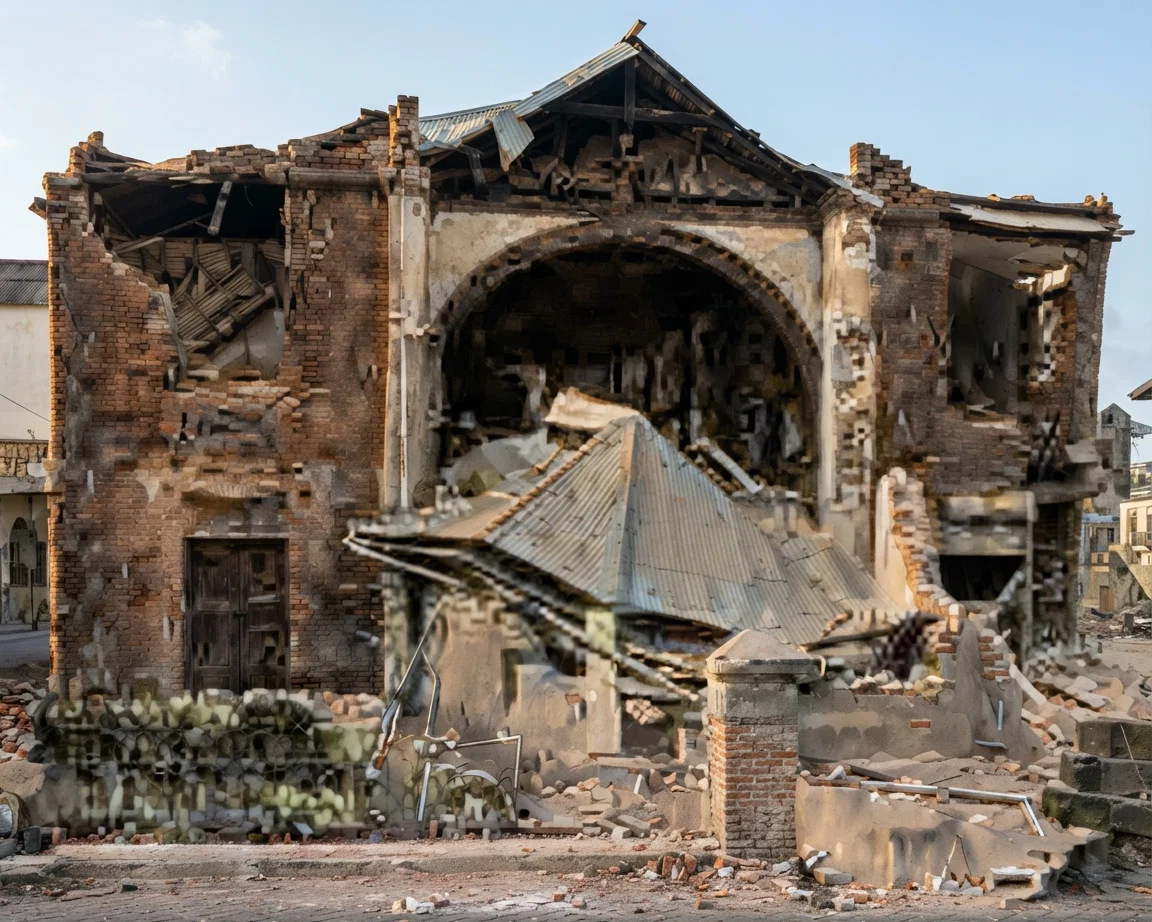
Protestant Episcopal Church, East Street, Kingston, Jamaica.
Such was Kingston in the early hour of Monday, Jan. 14, 1907. At 3:32 p.m., as registered by the clock in the Parish Church tower, there came a terrific shock from below, which in the short space of twenty seconds made the fair city of so many beautiful memories a blot on the face of nature, a ruin irreparable, chaotic, supremely awful. Only to those who passed thru those trying moments will it ever be more than an empty dream. To them it is a nightmare of horror never to be forgotten.
We were standing in a small wooden office building on Text Lane conversing with some friends thru an open window when, without warning, the earth, the building, the very firmament, seemed to be shaking together.
We were almost thrown from our feet, when a short lull came, and we rushed to the open court on the street, about forty feet away. Ere we had gained half the distance, more violently than before, the earth again seemed to be moved by a power incredible, and all around us buildings began to give way. The arch of the porch of the Seventh-day Adventist church gave way with the last violent jerk, and it seemed as tho for a moment the whole building with its living freight must follow in inevitable destruction. However, a merciful Providence kept it safely, and the one hundred fifty worshipers, with the exception of three who fell with the front arch, escaped uninjured.
We looked about us, and on every side saw the ruin of homes without number. Here the whole side of a house had fallen out, there the building had collapsed entirely; in other places buildings and heavy brick walls had fallen, burying men, women, and children beneath them. Yet from our situation we did not realize the extent of the disaster. Having provided for those who had been injured at the church, we went to our home, finding it practically ruined, the east wall down, the walls perilous, but none of the inmates injured.
Fire had broken out almost immediately in the business section, and fearing lest our services might be needed in places where men and women were buried, we started to go to the aid of those who were in need. As we went cityward, the horror of the situation grew upon us. Great crowds were hurrying to and fro with no knowledge of what they were doing, wandering aimlessly here and there, and crying upon God for mercy. The uninjured seemed to be crazed with fright, paralyzed with fear, and were doing nothing toward the work of rescue. We reached East Queen Street and were arrested by a cry from an adjacent yard that five children were buried beneath a brick building there. Hurriedly we made ready for work and rescued three poor little ones, mangled, maimed for life, from the ruins. They were but a few of the hundreds similarly buried that day in every part of the city.
We went on toward the heart of the city. Everywhere was ruin. Every street was lined with a terror-stricken multitude. Some had collected their few treasures and were making for the parks, fearing lest the fire should reach them, as it was rapidly spreading. On every side was confusion, uproar.
As night drew on, the light of the conflagration kept the city illuminated. In our part the dazed inhabitants still wandered about. Many too dazed, too utterly broken to make their way to the parks, were sitting on the curbing in the streets, guarding the little that they had managed to bring from their delapidated homes.
The Holocaust.
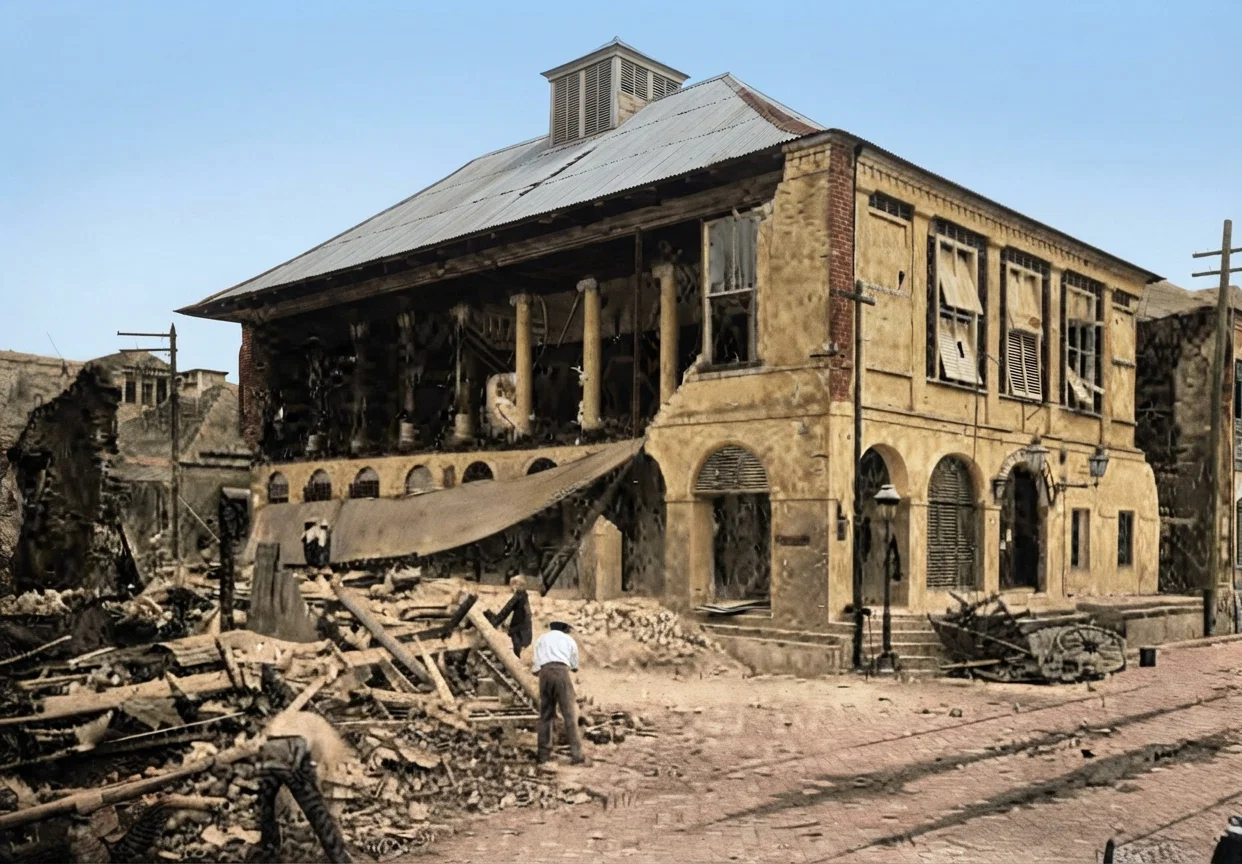
It was early seen that the business section with hundreds beneath the ruins was doomed to burn. The fire brigade, a few at least, did all that was possible to stop the flames, but only managed to do so after they had swept out to Orange Street, and east to Duke Street as far as the post-office and treasury building, and north almost to the Parade Gardens. Many within this section, pinned down by falling walls and debris, met a horrible fate as the fire crept over them. Tuesday, in passing thru this district, one might behold the half incinerated bodies of these unfortunates in attitudes which betokened a violent struggle for freedom as they attempted to avoid the devouring flames.
The power of the earthquake was incredibly awful. Buildings with massive walls, considered absolutely safe, were crushed into powder. The great structures, which nearly every one had counted on as withstanding just such conditions, went down into ruin, while some which were considered unsafe withstood the violence of the shock. It seemed almost as tho the power which shook the earth desired15to show men the little value which could be placed upon their opinions.
Noted Buildings Destroyed.
The well-known Myrtle Bank Hotel is a complete ruin. Its walls are nearly all a mass of brick on the streets or within the courtyard. Here a large number of the victims of the earthquake lost their lives. Fortunately, a large number of the guests, Americans and English, were elsewhere at the time, and very few among them were either killed or injured, the majority of the fatalities being among the employees.
The magnificent hotel at Constant Springs, tho not ruined entirely, was so badly cracked and broken, especially its towers, that it will cost thousands of pounds to put it in a safe condition.
The Roman Catholic Cathedral and Art Gallery on Sutton and Duke Streets is a great brick heap. Works of art were destroyed, and several persons met death under the crumbled walls of the formerly magnificent structure.
Cope (Wesleyan) Chapel, tho presenting a good front, is a ruin, both its sides having fallen in.
Among the other public buildings either badly damaged or destroyed are the theater, Scotch Church, Free Church, Episcopal Church, Parish Church, the Jewish Synagog, Government printing-office, Government buildings, many school buildings, including the Minco, High School, the Malabar Training College, the Government House, or Governor's residence, the hospital and barracks at Up Park Camp, the station of the West India Regiment, together with thousands of residences thruout the city.
The Monetary Loss
will reach nearly $30,000,000. Of this it is said one-fifth only is insured, and it is questionable if there will be any possible way of collecting even this portion, owing to the earthquake clauses in the policies. Thousands lost every cent they possessed, and every item of clothing except what remained upon their persons.
The Sacrifice of Life.
Men can never tell all the sad story connected with this portion of the fell destroyer. Ruins still cover the forms of those who were crushed to death by the walls of falling buildings. Many burned to ashes beneath the ruins will never be known to men. Only an all-seeing eye in the courts of God beholds and records their resting-places. The latest returns give the registered dead as 1,800, and the probable total as 2,000. Without doubt, even this estimate is small, and will be found so when the records are completed. Had the earthquake come at a time when the people were in their homes, the loss must have been much greater, judging by the awful ruin in which many of these homes are found.
Are These Things "Judgments of God" as so many of the distracted people pronounced them on that fatal day? Are they not rather the result of sin upon an earth cursed by its awful load of guilt? Are they not the breakings forth of that punishment which will eventually come to this sin-cursed planet because of transgression, as mentioned in Isa. 24: 5, 6, 18, 19? We assuredly can not say Kingston is more wicked than the other cities of the West Indies, or of the world; there is the same wickedness, the same cause of sin, everywhere. Let us remember our Master's words when He said, "Think ye these Galileans [Jamaicans] were sinners above all Galileans [West Indians], because they have suffered these things? I tell you, nay; but except ye repent, ye shall all likewise perish." See Luke 13: 1-5.
Not to Jamaica, San Francisco, Valparaiso, alone come these lessons. God is thus warning the whole earth; and our telegraph wires, our newspapers, our periodicals, and books, are presenting the awful facts to every nation. These warnings came to nations in the past. Babylon had its handwriting on the wall; Jerusalem had its prophetic utterances foretelling what would befall her. To-day God is warning us. Will these awful lessons, these fearful sights and scenes, awaken in us a desire to be right, or implant anew right principles in our hearts? S. A. WELLMAN.