Your ShelfYour Projects

Signs of the Times, Vol. 33, No. 16.

Contained in this Issue

Signs of the Times

Apr 17, 1907

Pacific Press Publishing Company · Mountain View, California · Apr 17, 1907

Contained in this Issue.

AHAB, JEZEBEL, ELIJAH. A Present Lesson from the Ancient Past.
GOD'S PURPOSE IN ELECTION.
QUESTIONS. 2048.—Observance of the Sabbath; 2049.—Will the Sabbath Save? 2050.—The Fourth and Fifth Plagues; 2051.—David's Conduct; 2052.—Renting Land.
"MY SERVANT JOB."
THE OLD AND NEW COVENANT.
SEARCH THE SCRIPTURES. Second Peter.
THE SABBATH. No. 3. Observance.
THE KINGDOM WITHIN.
A THOUGHT FROM THE ARBUTUS.
THE MOTHER LOVE.
RAISE IT QUICKLY.
THE CERTAINTY OF GOD'S PROMISES.
A UNITED EFFORT.
NOW IS THE TIME.
THE KINGSTON EARTHQUAKE.
THE LOST SUNDAY AMENDMENT IN CALIFORNIA

Poetry

He Knows. Cross Bearing. The Simple Life. Christian Courage.

DATE OF EXPIRATION.

The Signs wrapper bears date of last issue due on your subscription. Unless renewed in advance, paper stops with expiration date.
If herewith is an order blank, you will know you have overlooked sending renewal. You will not wish to miss a single issue. Back numbers often can not be furnished.

INTEREST IN THE “SIGNS OF THE TIMES.”

“I read with great interest several copies of the SIGNS OF THE TIMES given me by a kind Christian lady of this city. I have become so deeply interested in the teachings of your paper that I desire to have it mailed direct to me for three months, and if I like it as well as the copies I have received, I will continue my subscription to it.”
“Some time ago, while staying in the city of Pomona, Cal., I took from the public case, or receptacle, for gratuitous literature, a copy of your paper. Becoming interested in your views of prophecy, etc., I watched for each number as weekly they were placed there by some kind friend. Having recently settled in Los Angeles, I write to know if the paper is still published, and, if so, will you send me some sample copies for the enclosed ten cents; also give me the street and number of your church or place of meeting in this city.
“Yours very sincerely.”
“SIGNS OF THE TIMES: Enclosed find $1.50 for your weekly visits for another year. I remember well when I first got acquainted with you in the Ferry waiting-room at San Francisco. How I used to look for you every time I crossed the bay. I like you now better than ever.
“Yours respectfully.”
From an agent who has 100 regular customers:
“I need a Bible worker to help me, as I create a demand for reading by the use of the SIGNS.”
From another agent:
“I was out last Saturday evening, took sixty-three papers with me, and sold them in time to catch the half-past-nine car for home. One gentleman told me he enjoyed reading the paper. Another said, ‘There is such good, solid reading in these, and they are so different from other papers.’”
From an Indian reservation:
“The SIGNS OF THE TIMES is the best missionary paper published. The interest it has created on this reservation would keep six Bible workers busy if they were here. I could not succeed in my work without this best of silent ministers.”
“I received your SIGNS OF THE TIMES, and they are just grand. Please send me $5.00 worth of SIGNS OF THE TIMES. Send them as soon as you can, as I do not want to be idle long. I want to keep up the good work. Enclosed please find $5.00.”
Subscription Dept. SIGNS OF THE TIMES.

School Text-Books

We are glad to make the following announcement concerning text-books:

Church School Readers

The readers known as the "Christian Educator Reading Series," were adopted by the General Conference at its Educational convention held in College View, Neb., June 29 to July 10, 1906, and recommended for use in all our church and primary schools. The first edition of this series of readers has for some months been exhausted. A new edition is now in preparation. It is to be known as the "True Education Reader Series." The series consists of the following books:
  • Book One for grade one.
  • Book Two for grade two.
  • Book Three for grade three.
  • Book Four for grade four.
  • Book Five for grade five.
  • Book Six for grade six.
  • Book Seven for grades above six.
Books Nos. 1 and 2 are now ready. Price, 75 cents each. Book No. 3 is also ready; price, 90 cents, and No. 5 will follow soon. Book No. 7 is being pushed along rapidly, but we can not promise exact date of publication.
The author of books No. 4 and No. 6 promises us copy in time to have these books on the market before the fall terms open.
"True Education Reader Series" is the result of successful experience in teaching. An experimental edition of these books was issued during the year 1904. During the two succeeding years they have been used quite largely in our schools on the Pacific Coast. In many other conferences they have also been used to some extent. Almost without exception they have been welcomed by teachers as a blessing in their schools. Even from Australia and Africa have come words of the heartiest commendation.
These readers are no longer regarded as an experiment. The call has come for a new and larger edition. In preparing the present edition, the authors have counseled with a large number of our leading educators and our best teachers in different parts of the country. To these we owe many valuable criticisms and suggestions. We feel clear in saying that in every way the present edition greatly excels the former.
Most careful attention has been given to the subject-matter. No fairy tales or other objectionable matter has been admitted. Readings from the Word of God, readings on the works of God and His dealings with His people, occupy the chief place. All other matter has been measured by this standard. A pleasing variety of prose and poetry on a large number of subjects makes the books a delight with the pupil.
All the books are well illustrated, many of the master-pieces of art having been secured for this purpose. Every teacher knows the value of illustrations in the work of education.
Special attention has been given to developing the work in language, composition, and spelling. The lessons in these subjects, as well as the reading-matter itself, have been carefully graded. It is almost universally conceded by educators that language and spelling are greatly neglected in most schools. Experience has shown that this natural method of presenting these subjects not only saves the time of both teacher and pupil, but insures more thoro work, and, consequently, better results.
Prices on No. 1 and No. 2 will be 75 cents each post-paid. Book No. 3 is 90 cents post-paid. The prices on the other books are not yet decided upon.
As an evidence of the wide-spread interest in these readers, will say that we have just received an order from Australia for one hundred eighty copies to go to a school by mail.

McKibbin's Bible Lessons

Nearly all these books were destroyed in our fire. There are a limited number of No. 1, however, the post-paid price on which is 50 cents.

Bible Nature Studies

A few hundred signatures of these books were saved and are now being bound. Price, $1.00 post-paid.

Bible Nature Study Notebooks

These notebooks are now published in two ways,—the complete book bound in cloth at 85 cents post-paid,—in three paper-covered volumes containing about one hundred twelve pages each, at 40 cents each post-paid.
No. 1 is for fourth-grade work, No. 2 is for fifth-grade work, and No. 3 is for sixth-grade work. All the above books may be obtained by addressing your state tract society, or

PACIFIC PRESS PUBLISHING COMPANY

Mountain View, Cal.

285 Salmon Street Portland, Ore. 1109 East 12th Street Kansas City, Mo.

AHAB, JEZEBEL, ELIJAH.

A Present Lesson from the Ancient Past.

(Read from 1 Kings 16:29 to 22:40.) THERE is no more striking lesson recorded on the pages of Sacred Story than that of King Ahab and his times. Apart from the weak and vacillating king, there are two other figures which loom large in the graphic picture, Elijah and Jezebel. Both of these figures are used by Inspiration as types of later persons and movements, either for the work of God or against it.
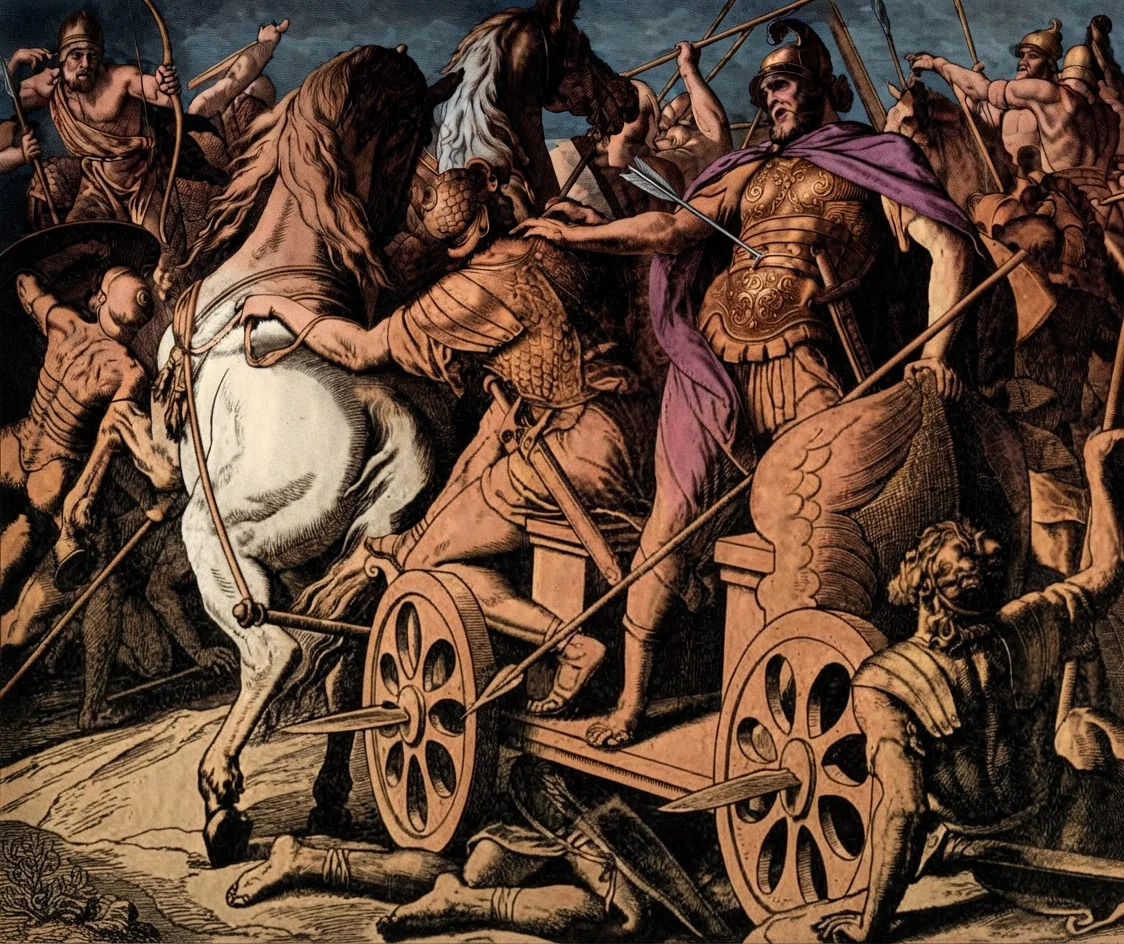
THE DEATH OF AHAB.
THE DEATH OF AHAB.
THE kingdom of the Ten Tribes was a stormy one from the time they rebelled against Rehoboam, the son of Solomon. Had the pampered son of the great king acted wisely, the Ten Tribes would have remained with him, and the energetic, ambitious agitator, Jeroboam, might have been content to have filled some important office under him. But Rehoboam refused the reasonable demand of the people and Jeroboam became the first king of the turbulent Ten Tribes. Succeeding his stormy reign came that of his weak son, Nadab, who after two years' reign was slain by a traitor, Baasha, of Issachar's tribe. Slaying all the unworthy house of Jeroboam, the people submitted to his rule; He was succeeded after twenty-four years' reign by a drunken son Elah, who reigned two years, and who was slain in a drunken debauch by one of his chief generals, Zimri. That he might have no rival in reign, Zimri slew all the house of Baasha. But his inglorious reign lasted only seven days, when Omri, the other chief general, conquered him, and the poor traitor committed suicide.
IN a brief time Omri had possessed himself of the kingdom, and ruled strongly for twelve years. He made a center for the kingdom, by building Samaria, its capital city. But he held with all who had preceded him to the worship of the golden calves, set up by Jeroboam. The son and successor of Omri was Ahab, a weak man who wanted to be popular and wanted to do right, who at times believed and wanted to serve God, but who wanted to please men, and make as magnificent royal display as did the kings around him.
EVIDENTLY the ambitions of Ahab were in his military father before him. The king of Israel was a friendly visitor at the court of Sidon, and the king of Sidon at the court of Israel. The kingdom of Israel under Omri was at the height of its glory and Ahab was the crown prince. An alliance of the two houses would be considered a desirable thing by both kingdoms to fortify them against many possible foes; how could that alliance better be strengthened than by a union of the royal families. And so Ahab took for his wife and queen, Jezebel, the daughter of Ethbaal, the king of Sidon.
"Wo worth the day!" Ethbaal, whose very name means "living with Baal," was himself a murderer of his predecessor, a priest of the licentious Astarte, and a devoted worshiper of the sun-god Baal. His daughter's name belied her character. "Jezebel" means "chaste; free from carnal connection; unmarried." As shown by the worship she fostered, she was licentious, stern, cruel, fanatical. In her designing hands Ahab became a veritable puppet for working all manner of wickedness, till he did "more to provoke Jehovah the God of Israel, to anger than all the kings of Israel that were before him." Jezebel established on a royal scale in Israel's court the whole Phoenician idolatry. Four hundred and fifty prophets of Baal, the sun-god, four hundred prophets of Astarte, the licentious Sidonian Venus, goddess of love, were supported by her. She slew without stint the true prophets and servants of Jehovah, and her royal example corrupted all Israel.
God in His goodness sought to win to his duty the recreant king. Ben Hadad the King of Syria came against him with a mighty army, and boasted against the God of Israel. A prophet of Jehovah warned and reproved the king, and God gave him a mighty victory, so that the king knew that it came from Jehovah. But greater disobedience followed. Then came famine, predicted by "Elijah the Tishbite," who appears with startling suddenness upon the scene. He is no royal flatterer. He makes no long introduction. His message strikes home mightily by one having authority to give it. "As Jehovah, the God of Israel, liveth, before whom I stand, there shall not be dew nor rain these years but according to my word." And then he was gone. We may imagine the sneering king and queen and courtiers; but the months pass. No clouds cover the brazen sky. No dew glistens in the morning sun. Vegetation perishes. The brooks and rivers go dry.Food becomes scarce. The infatuated king curses the prophet instead of repenting of his sin. Nay, more, he hunts thruout his kingdom and other kingdoms to find and kill him, but God preserves the life of His servant, by the ministration of ravens if need be, by a poor widow of Sidon later, to whom He makes the prophet a blessing.
ONCE again, after the land had dried for three and one-half long years, God sends His prophet. Troubler of Israel, the wicked king calls him. Elijah throws back the charge upon him and his wicked house. After this came the test at Carmel before the people "limping between the two sides." Let Ahab's army and priests come to Mount Carmel and pray for rain. Let two bullocks be brought. Let them choose. Elijah, the one prophet of Jehovah, will be there to pray, and will prepare for sacrifice the other bullock. Let the God who answers by fire be the God for Israel. They come. The priests of the sun-god prayed. From morning till noon they prayed. From noon till sun's decline. To show the vanity of their worship the prophet mocked them. But no answer came. The brazen heaven gave forth no fire as it had for years no rain. They grew frenzied in their worship. They leaped upon the altar; they cut themselves with knives, till the blood gushed out; they cried till the skies echoed back, "Baal, hear us;" but there was neither voice, nor any to answer, nor any that regarded.
THEN came the prophet of God. Calmly he built an altar of twelve stones in the name of Jehovah. He dug a trench about the altar. He placed upon the altar, properly prepared, the bullock. He caused them from the mountain spring to pour water upon the sacrifice and altar till they were drenched and the trench was filled. Then in a brief prayer, translated into sixty-five English words, He asked Jehovah to vindicate His own name and His prophet's commission. "The fire of Jehovah fell," consumed altar and sacrifice, and licked up the water in the trench. Then the poor, limping, double-minded people cried, "Jehovah, He is God; Jehovah, He is God." Then came the slaying of the false prophets, and the coming of abundant, fruitful rains in answer to the sevenfold prayer of the prophet.
BUT the poor, weak king has no power to break from his imperious wife. She vows vengeance upon Elijah, and the prophet flees for his life. Again and again does God seek to reach the king. Once the poor man humbles himself, and finds respite of judgment. But he still loves sin; he is still dominated by Jezebel; he still hates God's prophets, till at last he perishes in a battle as predicted by a prophet of God whom he imprisoned. That last scene the artist has endeavored to portray. By disguise the king sought to make of none effect God's word; but the arrow of death pierces his armor, and he dies, and in a little time his seed becomes extinct.
FOR the weak governments and rulers of subsequent generations, Ahab is a type, who, knowing what is right, what is true, what is just, yield their ambition and fear of offending to unholy religious influences brought to bear upon them by idolatrous or backslidden religionists. Jezebel stands as a type of a backslidden, error-drunk, ambitious church, whose connection with God has been severed by unbelief, and who hopes to substitute for her lack of divine power, the power of a manipulated State—fornication with earthly government. Thus is she set forth in Rev. 2:20-23. Her children still live in religious bodies to-day. We still have put forward "the wild solar holiday" of the worship of the sun-god Baal, the State-fostered Sunday. We have the clamor in the church that it shall be supported by law. We have our weak politicians yielding to the clamor. We have repeating on a world-wide scale the apostasy in both Church and State—that of Israel of old. We have God's message of protest (Rev. 14:6-14), recorded over and over again in various forms in His Book, against the awful apostasy. O, for more of the power of Elijah behind the message. He who bears it or they who bear it will not claim to be an Elijah, or "Elijah the Restorer." Rather, like one of God's servants of old, of whom Elijah was a type, they will be content to be a "voice" crying in the wilderness of sin and error for men to turn from all tradition, all human creed, all State power, all which is not of God, to "keep the commandments of God, and the faith of Jesus." Reader, have you heard that message? It is not of man; it will not exalt man. It is of God. But, O, it will save men from sin and wickedness and death unto God and eternal life.

GOD’S PURPOSE IN ELECTION.

THE key to the proper understanding of the doctrine of Bible election is the purpose of the election. If we clearly understand the purpose of God in calling and choosing the children of men, there will be little trouble over its other phases. We are assured in Rom. 8:28 that to them who are the called “according to His purpose,” and who, it is implied, accept of that call, God will work with them all things for good. Surely, that is a gracious promise. And here is another: “Who saved us and called us with a holy calling, not according to our works, but according to His own purpose and grace, which was given us in Christ before times eternal.” 2 Tim. 1:10. What, then, is the purpose?

I. As Regards Man.

The important thing in man is not his physical size, or beauty, or skill, or knowledge, or wealth, or culture. It is character. The most precious thing in God’s sight in humanity is character. Therefore man was created in God’s image (Gen. 1:27, 31; Eph. 4:24); not a mere physical image, but a moral likeness, possessing Godlike attributes, capable of being developed. When God created man, man was “very good.” One thing, however, was wanting—something which even the Creator could not supply—human experience developed by trial into character.
For this God made man. The “preacher” declares that God made him “upright.” Eccl. 7:29. The original word is “Israel.” God created man to be Israel, prevailer with God. So Jacob obtained the blessing and became Israel—by prevailing faith. Gen. 32:24-28. Connect this thought with Rev. 21:12. The holy city, into which all the redeemed shall enter, has gates named from Israel, the twelve gates after the twelve tribes. The saved of God’s people are the Israel of God from creation down.
God’s purpose in these characters dates from the “times eternal;” for “before the foundation of the world” it was His purpose that His children “should be holy and without blemish before Him.” Eph. 1:4. It is His will that there shall be harmony thruout all His realm and this could exist only in a righteous universe.
All this was purposed in and thru the eternal Son of God. In Him was the creation wrought; and when man sinned, in and thru Him was wrought redemption. Col. 1:16-22. But that His work may be made effectual in us, we must believe and “continue in the faith.” Then will His purpose be assured in us.

II. As to the Earth.

God created the earth. He created man upon the earth. The earth was made for man. Gen. 1:31. Man was given dominion over it and over all upon it, even tho now in its sinful condition the earth has dominion over man, and the greater portion of the race are sleeping in earth’s bosom, “dust to dust.” “The heavens are the heavens of Jehovah; but the earth hath He given to the children of men.” Ps. 115:16. But when the curse came upon the earth thru sin, it rested most keenly upon man, its lord and master, who yielded to the tempter. Gen. 3:17, 18. He, Satan, to whom man yielded, became its lord, its prince, its god (John 12:31; 2 Cor. 4:4), and man became his servant, the bondslave of sin.
But God’s purpose still holds good: “The bondservant abideth not in the house forever.” John 8:35. God created the earth “not in vain [“not a waste”];” “He formed it to be inhabited,” and He pledges His own existence on its fulfilment—“I am Jehovah; and there is none else.” Isa. 45:18.
The One thru whom this earth will be redeemed from the curse is the One who redeems man; for He came to save not only all who, but “that which is lost.” Luke 19:10. To Him, the Tower of the flock, the Christ of God, will the kingdom be restored, and His people will share it with Him. Micah 4:8; Rev. 11:15; Matt. 25:34. Then from sea to sea, from the river to the ends of the earth, the whole kingdom and dominion under the whole heaven, shall belong to Christ and the children of the Most High, who are in harmony with the eternal purpose of God. Dan. 7:27; Rev. 21:1. There will “be no more curse.” Rev. 22:3. Sin and death shall be forever banished. “Affliction shall not rise up the second time.” And the people who inhabit that land will be “all righteous.” 2 Peter 3:13; Isa. 60:21.Then, and not till then will God’s purpose be complete.
["The Fulness of God’s Purpose" in our next issue.]

2048.—Observance of the Sabbath

Questions
Questions
[We are willing to answer all questions in this department that are practical for the department and that would minister to the general good of our readers, but we answer no questions unless the name and address accompany the question. We do not ask this for publication, nor will it be published unless the inquirer so desires; we ask it, however, as an evidence of good faith, and that we may answer by letter if deemed best. Inquirers will please take notice. There is no departure from the rule. Unsigned questions reach the waste basket by the most direct route.]

2048.—Observance of the Sabbath.

In the true observance of the Sabbath is it possible for us to allow contractors to do work for us on that day?
That would depend on the nature of the contract and where the work is done. If it is on premises under one's own control, it certainly should not be. The commandment forbids this very clearly, "thou, nor thy son, nor thy daughter, thy manservant, nor thy maidservant, nor thy cattle, nor thy stranger that is within thy gates." When a man contracts with a railroad to have freight carried from a distance, he has no power to compel that railroad to refrain from hauling that freight on the Sabbath. If he contracts to get a suit of clothes made, in all probability the tailor would work as seemed best to him in making the clothes. They do not belong to the man who employs the tailor until they are finished. If he contracts to have a house built for him, on his own premises, without specifying in the contract, he certainly lacks forethought, and will have to settle the matter the best way he can. He failed to remember the Sabbath day in order to keep it holy. All agreements, all bargains, touching our premises, our own homes, our own families, can be so arranged that the Sabbath shall be truly and properly kept. When the missionary ship Pitcairn was built on San Francisco Bay, there was not a stroke of work done on that ship on the Sabbath at all; it was done entirely by those who did not keep the Sabbath, rather by those who kept the first day of the week. For that reason it was called "The five-day boat," because only on five days of the week was any work performed on it. Sometimes, carelessly, there is failure to make definite specifications, and trouble ensues. Those who make the mistake will have to get out of the difficulty the best way they possibly can, but it is always safe to give the Lord the benefit of every doubt.

2049.—Will the Sabbath Save?

A correspondent asks us if we think that if she does not keep the Sabbath, would that shut her out of heaven. On the other hand, she feels so sure that if she should die any day she would be saved.
The outward keeping of the Sabbath, or any other commandment of God's law, will not save us. We are saved only thru Jesus Christ our Lord, for "there is none other name under heaven given among men whereby we must be saved." To the one to whom God's word has come there must be faith in Him. Faith is not mere belief, or assent, to a thing, it is such a yielding to God on our part and such an acceptance of Him that will bring Him into the life. There is a nominal belief which will condemn us at last, for "the devils also believe and tremble." True Christian belief is that set forth in the following words of the apostle: "With the heart man believeth unto righteousness; and with the mouth confession is made unto salvation." The belief which stops short of believing UNTO RIGHTEOUSNESS is a spurious belief, and in that last great day will profit nothing. The belief which believes unto righteousness is that which not only accepts the righteousness of God in Jesus Christ for all the sins of the past, but which accepts God's living righteousness now, so that "the righteousness of the law [margin, "the requirement of the law"] is fulfilled in us who walk not after the flesh, but after the Spirit." Rom. 8:4. Or in the words of the apostle in another place, "I am crucified with Christ; nevertheless I live; yet not I, but Christ liveth in me; and the life which I now live in the flesh I live by the faith of the Son of God, who loved me, and gave Himself for me." Gal. 2:20. When the Lord Jesus Christ lived here upon earth He kept all the commandments of God. He delighted to do His Father's will. If Christ is living in us, He will delight to do the same will and will keep the same commandments in us. Now there are millions who have not kept the seventh-day Sabbath outwardly because they did not have the light upon the question, yet who will be saved, because they believed in the Lord Jesus Christ, and found the rest that Christ gives us as set forth in the institution of the Sabbath,—the creative power to give us life, and creative power of redemption to save us from sin; and he who knowingly rejects this or any other truth of God's word, it matters not how small, in that very thing shuts out Christ. He who closes his eyes to a single ray of sunlight closes his eyes to the sun; he who turns from one single ray of light turns from it all; and he who rejects one of God's commandments rejects all, for in that very thing he rejects the Lawgiver. We are told of those who profess to know God, but whose works deny Him (Titus 1:16); and the beloved apostle in that wonderful epistle of love, 1 John, tells us over and over, in various forms, that he who professes to know God and keeps not His commandments is a liar and the truth is not in him; that is, all the commandments which God in His goodness and mercy has revealed to him. The Lord takes the will for the deed, and the one whose heart is perfect toward God is accepted of Him, even tho he be in the darkness of heathendom; but he who having the light of God's word turns from that light, or wilfully refuses to learn the will of the Lord, by that very means shuts Christ from his heart.

2050.—The Fourth and Fifth Plagues. Rev. 16:8-11.

Please explain this passage. These plagues are poured out after probation is ended, and the language says, "They repented not to give God the glory." It seems to imply that repentance was expected. What effect would repentance have after probation is closed?
There are two ways of looking at the question. It seems very clear in the teaching of the word that the plagues are poured out after probation is closed. In these plagues is filled up the wrath of God. Rev. 15:1. That is, wrath unmixed with mercy. Rev. 14:11. They come in that little time set forth in Rev. 22:11, 12 just before our Lord comes.
Men are contending now, contrary to God's word, that humanity is divine, a part of Deity, that Jesus Christ dwells in every man. They have so perverted the Gospel that it does not mean a message of life from on high to man, but is a revelation to man that he has this life within himself, apart from faith, that this faith does not bring the life, but that faith is the mere recognition on his part that he has life; and this "divine immanence" in the man is that which leads him, helps him, strengthens him, saves him. And that, contrary to all Gospel teaching, is "Christ within, the hope of glory." On the other hand, God's word teaches that those who do not have living faith in the living Christ for all things that Christ brings have no hope and are without God in the world. Eph. 2:12. They are alienated from the life of God. Eph. 4:18. More than that, they would not even come to God, except the Father drew them. When probation closes, man will have rejected every means by which God saves, Jesus Christ, His word, His Spirit. There can then be no true repentance; and this is the testimony of Rev. 16:8-11, that when men come into that condition, which is the result of sin, and their own sins, there is absolutely no heart for repentance in them, no desire for true repentance, no sorrow for sin. It is God's testimony that when we reach that place there is nothing in and of ourselves that would lead from sin; and so the divine testimony is not that repentance is expected, but it is to the effect that there can be no repentance, because they have, as Esau did, bartered their birthright and separated themselves from God for the desires of this world, and consequently can find no place for repentance. So it will be when, in the second resurrection, the wicked are brought forth from their graves. It will be demonstrated to the whole universe that mankind rejecting God's word, trusting to himself, is wholly within the power of Satan and sin.

2051.—David's Conduct.

How is it that in 1 Kings 15:5 that David did that which was right in the eyes of the Lord, and turned not aside from anything that He commanded him, all the days of his life, save only the matter of Uriah the Hittite? In 2 Sam. 24:10 it speaks of David numbering Israel, and in other places we read of his wives and concubines, which was not in keeping with God's plan.
All of which is true. In these things where David failed there was either no expressed command forbidding his doing what he did, or it had not been clearly brought before him so that he himself understood just what his duty was. Whenever the Lord told him to do anything, he did it. Transgression against the Lord in the matter of Uriah the Hittite was flagrant, open wickedness, directly contrary to the command of God. The numbering of Israel was doubtless a matter of ambition on David's part to show how Israel had increased, which he himself evidently did not clearly see. The real test of David's loyalty was seen in his taking reproof and in ever submitting to God when he had done wrong and was reproved. But where the king clearly saw his duty there seems to have been no question but what he always did it, save in the exception that is made. While we never can or should excuse ourselves in any sin from ignorance, because just as soon as we begin to excuse ourselves we admit our knowledge of the sin, God does excuse us, just as He has overlooked many failures on the part of His servants in the past. He knows the heart.

2052.—Renting Land.

Is it wrong for a Sabbath-keeper to rent land isolated from his home and place of residence to one who is not a Sabbath-keeper?
No, we do not see that it would be wrong, if the business transactions are such that they will not involve the owner in any Sabbath transaction. To put it in another form, he sells his land for that time to that individual and is not responsible for the man or the kind of work which the individual puts upon it, or the time when he does it. During the time the renter is in possession of the land until the expiration of his lease, he is the practical controller of the property. Where the man lives within his own gates, it is another matter.

THE OLD AND NEW COVENANT.

I. Old Covenant Made at Sinai.

GOD suggested the making of a covenant with the children of Israel at Mount Sinai, in order to reveal the Gospel in a visible way to the whole world; therefore God said, "If ye will obey My voice indeed, and keep My covenant, then ye shall be a peculiar treasure unto Me above all people; for all the earth is Mine: and ye shall be unto Me a kingdom of priests, and an holy nation." Ex. 19: 3-6.
The people did not realize the importance of that which God required of them, and without taking any time to consider, they thought that in their own strength they were able to meet God's requirement, and they answered, "All that the Lord hath spoken we will do." Verses 7, 8. But God in His love moved slowly forward, so the people might see that all things connected with His service must be carefully observed.
By special arrangement, and under terrible solemnity, the Lord spoke the Ten Commandments from Sinai. But the people's minds were so blinded and corrupted thru slavery and heathenism, that they could not comprehend the principles of the Ten Commandments. So, in order that the moral connections of the law could clearer be apprehended, other statutes were given, which revealed and applied the principles of the Ten Commandments, Exodus 21 to 23. These statutes God spoke from the thick darkness to Moses only. Ex. 20: 21. And Moses told all these words to the people, and they answered the second time, "All thewords which the Lord hath said will we do." Ex. 24: 3. Then "Moses wrote all the words of the Lord" in the book of the covenant. Verse 4.

Confirming the Covenant.

Then Moses sent young men, who sacrificed burnt and peace offerings of oxen unto the Lord. "And Moses took half of the blood, and put it in basins; and half of the blood he sprinkled on the altar. And he took the book of the covenant, and read in the audience of the people." The conditions of the covenant were solemnly repeated, and all were free to declare whether they would obey or not. But none had discerned the great truth, that without Christ man can do nothing, and for the third time the people answered, "All that the Lord hath said will we do, and be obedient." Ex. 24: 7. Then "Moses took the blood, and sprinkled it on the people, and said, Behold the blood of the covenant, which the Lord hath made with you concerning all these words." Verse 8. Thus the Lord set them apart from the world, to be "a kingdom of priests, and an holy nation" (Ex. 19: 6) in order that He could trust them with a holy commission. In this way the Lord made visible the truth that the true Israel must be separated from the ways of the world, and carry forward the commission that Christ gave to His disciples, "Go ye into all the world, and preach the Gospel to every creature." Mark 16: 15.
After Moses had completed his work, he went up to the Lord in the mount, to receive tables of stone inscribed with the Ten Commandments that God had written. And Moses was on the mount forty days. Ex. 24: 12, 15-18. While the people waited for Moses to come down from the mount, they had opportunity to consider the book of the covenant and prepare their hearts to receive further instructions. But they neglected to do this, and they soon became inattentive and lawless. They were impatient and wanted to start on the way to the promised land, the land which flowed with milk and honey. It was only on this condition that they would be obedient, but they soon forgot this, and worshiped an idol. Ex. 32: 1-6.
Moses was overcome by this dreadful degradation of Israel. He became angry, and in order to show his disapproval of their sin, he threw the tables of stone down, which thereby were broken to pieces, in the sight of all the people. This showed that as they had broken God's law, the covenant between them and God had likewise been broken.

The Trouble with the Old Covenant.

This proves that not one soul was saved by or thru the old covenant. This is called the first or old covenant because it was the first that was ratified with blood, and was the first that was made with the Jewish people as a nation. In this covenant the people promised to keep the commandments of God, and thereby be qualified for God's kingdom. This was really a promise to make themselves righteous, for God did not promise to help them, but only to reward them. But Christ says, "Without Me ye can do nothing." John 15: 5.
The fault in the old covenant consisted in this; that the people had not experienced the new birth. They promised to keep the covenant, the same as people now promise at the "confirmation." They promise to believe in Christ, and to forsake the devil and all his works. But immediately after they have made this holy covenant, their lives are just as worldly as before.
The object of the Jewish covenant was to lead the Jews, as well as the whole world, to see that it is impossible for man to live in obedience to God's commandments in his own strength, and by this to bring before us the need of the Gospel. Since the covenant was broken by the Jews, and dissolved by God when Moses broke the tables of stone on the mount, then it remains only as a warning and an object-lesson for succeeding generations.
OSCAR EINERSON.
[The New Covenant will follow next week.]
Continue reading: MY SERVANT JOB