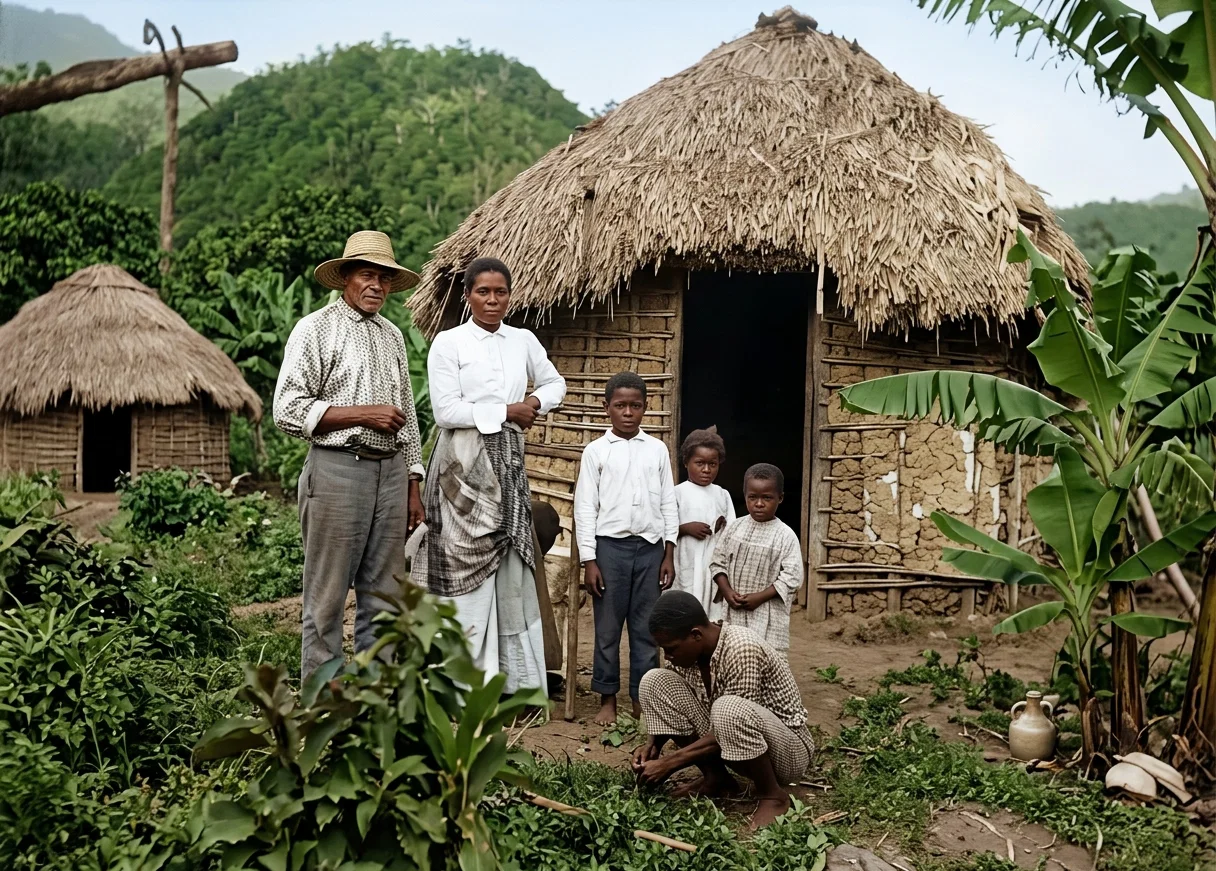
At our baptismal service in April, seventeen natives from three tribes received the ordinance, administered by the writer in a small stream crossing our land. One of the candidates was a chief of local prominence in the Angoni tribe. He is a skilled carpenter, and is doing the woodwork on the church building, now nearing completion. Twenty other candidates who had been at the mission only one year were deferred for more instruction. These are now in a special Bible class receiving the necessary preparation.
The new building is a combined school and church. Its dimensions are twenty-eight by sixty feet, having two class rooms at the rear, twelve by sixteen feet. It is made of brick, the material for which is taken from the ant-hill found one hundred yards from the building. Already over one hundred thousand good bricks have been made from this ant-hill, and it is not quite exhausted. While the workmen were digging one day, I found the white ant queen larva, measuring one and one-half inches long. The age of these ant-hills is unknown, but I would estimate it at many hundred years. The brick is made by native brickmakers, one by one with the hands, in a wooden mold. A good workman makes one thousand a day, and his wage is ten shillings ($2.50) a month of twenty-seven days.
The floor is of tile made in the same way. The walls are plastered with sand found on the mission farm, with only water added. This plaster looks like the best rough cement-plaster of America. The outside is pointed with lime and sand, a little Portland cement being used on the foundation and chimney.
All wood used grows on the mission land. Door- and window-frames, and beams to strengthen the walls, are sawed by natives with pit-saws, from the mbauwa (African mahogany) tree. One log of this tree sold in Liverpool, in 1903, for £1,046 sterling, a little over five thousand dollars. It contained 1,674 sale feet, bringing $3 a foot. But the report fails to say how much it cost to transport and market it.
The rafters are poles from another native tree, as also all braces. The roof is thatch, supported on the rafters by bamboo tied with bark of another tree. The only imported articles are nails, glass, and locks.
Malamulo Mission School holidays are from May 1 to July 31. During the holidays many of our boys and some families walk to their home villages, one hundred to three hundred miles distant. This year a teachers' summer school was held during July for our sixteen native teachers. The subjects taught were Bible, reading, writing, arithmetic, and school methods.
The school opened August 3, with an enrolment the first week of one hundred twenty-four, later increased to one hundred thirty-one, with a daily attendance of one hundred twenty-five.
We have constant opportunities for opening village schools far and near. At present we have only four village schools and two small out-stations. We should have scores of them. Our great need is well-trained native teachers for the village schools, and converted, soul-loving European overseers for out-stations. Africa awaits the message of the coming Saviour.
The present enrolment of our school is one hundred forty-two, the daily attendance one hundred thirty-nine. The proportion of attendance will be somewhat less in the rainy season. Last term the average attendance in all our schools was three hundred. It is a peculiar fact that the attendance at Sabbath-school is less than at the day-school. Evidently some village children are not so much interested in the Sabbath-school as in the day-school; but in an attendance of one hundred nineteen at Sabbath-school, seventy-six had verses memorized.
Our teachers who went out to hold village meetings last Sabbath, reported one hundred eighty-four in attendance at the several meetings held in seven different villages. At our Monekera out-station, north of Blantyre, the Sabbath attendance is about one hundred. Malinki, our head teacher there, has just reported two schools, with ninety-one enrolled. Another school in that district is to be reopened soon, with an attendance of fifty or more. All being well, I shall spend next Sabbath at that station, where a Bible class of twenty-one is preparing for baptism.
Three boys have just come to Malamulo School from the Kirk Mountains, whose homes are near our Matandane out-station. This out-station is one hundred miles from our main station at Malamulo. As soon as we have a European teacher for that out-station, it will not be necessary for them to come so far.
Last month a chief came to Malamulo from Angoniland, some two hundred miles away, begging us to send a teacher who would teach his people the Word of God. On inquiry, I found that other missions have schools not far from his villages, and they have asked his permission to open schools for him. He told me that he declined because he has been waiting several years for a teacher of the Sabbath truth. He heard this truth of a former Sabbath missionary, and has patiently waited for a teacher ever since. It was hard to put him off still longer, but we have not one teacher to spare from our schools already open. May the Lord of the harvest soon give us more reapers!
Our hearts were refreshed last Sabbath by having three young men for whom we have worked and prayed a whole year, come to us to confess that they want to give their hearts to God. This is the one thing above all others that keeps the worker's courage up in a field like this. The people do seem to desire to know God's Word and to serve him. The change from heathenism to16Christianity is a great one, and few can grasp the mighty work of God required to bring about this change. It is beyond mortal comprehension. But God is doing the work, and we praise his name. I often wonder that such wonderful changes can be wrought in one generation.
Sleeping-sickness has made terrible havoc among the natives of Uganda, on our northern border. Reliable authority states that already two hundred thousand out of the population of three hundred thousand are dead, and the end is not yet. It is moving southward, and no one knows where or when it will stop. It has no known remedy at present. May God give power to his Word to turn many heathen hearts to him before this plague is upon them. We need health for the work; we need money; we need men.
J. C. ROGERS.
The Isles Shall Wait
“Who are these that fly as a cloud, and as the doves to their windows? Surely the isles shall wait for me.”
Norfolk Island
By Harry Mitchell
WE send Christian greetings to all of like precious faith from our far-away island in the South Pacific. We are all of good health and courage, and our work among the islanders is very interesting. We have purchased a fine site for a mission home up in the hill country. A small running stream passes through the property, which makes the place much more valuable. We are very comfortably settled now, and our work here has a far better appearance in the eyes of the natives of the island, as they judge our work largely by the property we possess. No church, no people. I suppose it would be hard to find a place in foreign fields where any missionary society has spent more than the Church of England has spent on Norfolk Island. The representatives of that church have purchased a thousand acres of land, and have many elaborate dwellings, besides schools, churches, and a hospital and a museum costing thousands of pounds. These people always point to our small station, and compare it with their expensive structures; and the contrast has weight with these simple islanders. We are ever keeping the truth before the people, and we wish to thank the kind friends who have been assisting us with American papers, such as the Signs of the Times and Youth's Instructor. We assure you every paper is valued and faithfully used. Our Australian brethren have helped us also with papers. The Australasian Union Conference has done nobly in supporting the work here. They have a large territory, which is very scattered and expensive to work, yet they are ever sending out more workers, and extending the work as well as maintaining that already begun. This field will need some support outside itself, as the people are very poor. This island is so situated in the Pacific that it lies out of the track of trading vessels; hence we do no trade whatever with the great world; money is consequently very scarce, and the people are very poor. We have forty-three Sabbath-keepers here now, and many interested ones with whom we hold meetings. We find that to get the message before the people we have to go to their homes, as the islanders generally are slow to attend meetings. Norfolk islanders are a good-natured people, very kind and respectful. We feel that God has many precious jewels that will finally take hold of the truth here. We shall always be glad to receive papers on present truth from our people. This is the only way these people will be able to read, as they are too poor to buy any papers. Some of our best men do not have two shillings in cash in six months. We thank the praying ones for their interest in our little mission field.
HARRY MITCHELL.
West Indies
By Mrs. F. G. Lane
MONTSERRAT.—Those helping to support the work in this part of the great harvest-field will be interested to learn of its progress. First, let us imagine ourselves out on a small plot of land eight by twelve miles, for those are the dimensions of the island of Montserrat, with the broad sea encircling us on all sides, and surrounded by such dwellings as we see in the accompanying picture. Then, again, we may climb the mountain’s height, and see on either side a living crater, giving out large volumes of steam and strong sulphureous fumes which tell of the terrible condition beneath, and of the doom which is liable at any time to settle down upon the inhabitants, who number over eight thousand, all living in the depths of sin and ignorance.
A HOUSE ON MONTSERRAT, W. I.
Facing these conditions, we can but feel our helplessness as we endeavor to proclaim the message for the first time in this island. But we can say, Of a truth the Lord is good. It is ours to sow the seed, and God in his own good time will give the increase.
You will rejoice with us to know that we now have a small company of believers who meet every Sabbath for worship, as the result of our first tent effort, which is just now drawing to a close. We expect after a short time to pitch our tent again, hoping that some will listen to the truth the second time, and that we may gain the attention of many others for the first time. As we have stated heretofore, there is great need of personal work. At present we have one native laborer with us who is doing some personal work among the colored people, while we are compelled to confine the most of our house-to-house work to the few white people on the island. I might state that it is impossible to reach the white people here through the tent-meetings, as they will not come to the tent, so that all our work for them must be personal. We are at present conducting Bible studies in our home for those who are interested, and three white women have already taken a firm stand for the truth, for which we praise God.
The promulgation of the third angel’s message is as much due to the liberalities of God’s people at home who support the work, as to the messengers who have gone as pioneers to the frontier. Both are necessary in the forwarding of the work in the earth. Both will share the reward, when God gives to every man according to his work.
MRS. F. G. LANE.
The Canvassing Work in North Carolina
By T. H. Jeys
BECAUSE of frequent inquiries, and because of the excellent opportunities for labor, and because of the crying need for the same, I am constrained to speak to my brethren everywhere concerning the work of the canvassing evangelist in our State.
First, as to the inquiries: I have answered by personal letter every question that has come to me. Some have asked about the price of land, the opportunities for farming, stock-raising, merchandizing, etc. I have not refused to answer such, but will say plainly that I much prefer to answer questions of another class. North Carolina is ripe for the third angel's message, and to those who have a soul-hunger more than a land-hunger, it offers exceptional opportunities. If there are those who desire to go somewhere to plunge into a career of money-making, I would advise them to stay away; but if any wish to take up a line of work that will pay heavy dividends in the world to come, I would say, Come with us, and we will do you good.
Second, as to the opportunities: I have never been in any place where the people are more considerate and hospitable, or where a larger percentage of the population were willing to purchase publications on present truth. There are scores of counties that have never seen a Seventh-day Adventist canvassing evangelist. This year the crops are good, the prices are fair, the panic is relaxing, and there are many who want the books containing the last warning message. Where are the men to carry them the books? A few weeks ago two of our boys from one of the local churches started out with “The Coming King.” They had no experience, and but little instruction in canvassing. I confess to some fear and anxiety for them. But at the end of the week they came in, one with twenty dollars' worth of orders, and the other with nearly as much. Their faces shone with interest and zeal. Their testimony in the social meeting was inspiring. They had not17had everything easy, to be sure, but they had tasted of the fellowship of Christ's sufferings. Since then they have been climbing steadily. As they learn their work, and become more efficient, they have better success. Last week one came in on Friday with thirty-two dollars' worth of orders. These boys are not giving up the message. They are not backsliding. They are growing in grace and the knowledge of our Lord Jesus. Last week brought a report from another young man who has taken fifty-nine dollars' worth of orders; and in his note to the State agent he said: “Next week I mean to make it sixty dollars.” This was a young man who has been in the truth about two years, and whose relatives and friends have bitterly opposed him, and who predicted that if he went to canvassing, he would starve. Another item of interest is that it is now demonstrated that our larger books can be successfully sold here. No longer is the thought entertained that we can sell only twenty-five-cent books, with those of the dollar price for the outside limit. “Daniel and the Revelation,” “Great Controversy,” and “Patriarchs and Prophets” can be sold here as well as elsewhere.
Third, as to the need: The statement that the South is one of the most difficult fields is never fully appreciated until one is actually in contact with the real situation. The people are conservative, and very slow to give up their old customs. Before the message can be successfully presented by the living preacher, the territory should be thoroughly leavened by the introduction of our books into the homes. Silently, quietly, unostentatiously, the consecrated canvassing evangelist can go his way, and the books he leaves in the homes become the sappers and miners to reduce the strongholds of prejudice and superstition.
If there are those who desire a part in this good work in North Carolina, they may get further information by writing to our State agent, H. B. Tilden, 608 Newbern Ave., Raleigh, N. C., or the writer at Spero, N. C.
T. H. Jeys,
President North Carolina Conference.
Upper Parana Mission
By Arturo Fulton
The Upper Parana Mission consists of the republic of Paraguay and the territory of Missiones, Argentina. The superintendent of this mission, Elder Luis Ernst, reports as follows for the REVIEW, which I translate from the Spanish:—
“I arrived with my family the third of May at Villa Encarnacion, Paraguay. From the time we left Uruguay, we had a pleasant trip. As soon as I could settle my family in this town, I set out to visit the church in Posadas, Missiones. I found the brethren encouraged in the Lord. Although it is four months since I visited them, they have let the light of the third angel’s message shine in Posadas, with the result that there were several new observers of the Sabbath, with whom I have had some very blessed meetings, which were well attended. Yesterday we had an excellent meeting, and had the privilege of adding five precious souls to the church by baptism. They were ready to give up all their vices, including the taking of maté, for the sake of the Lord Jesus. The church at Posadas now has forty-one members. Truly we see that the last message advances with rapid step. Praise the Lord for this.”
“I also visited the brethren in San Carlos, who live a distance of thirty-six miles from Posadas, and found them alive in the Lord. In this group we have five who have been baptized, and ten others are keeping the Sabbath; some of these are awaiting my return to receive baptism. Brethren, pray for the work in the Upper Parana.”
At present Brother Ernst is the only worker in this field. He finds more to do than he can well attend to. New interests are springing up, with no one to respond. In many ways it is the most difficult field in our union conference. Here vice and ignorance go hand in hand. The first of this month a revolution overturned the government. Yet there are honest hearts to be gathered out, and the last message must reach not only the more enlightened races of this country, but also the Indian tribes of Paraguay who understand only the Guarani.
The country itself is beautiful, with its tropical fruits and flowers. Here the orange grows wild, the banana and the pine produce in abundance. Men and means are needed to publish the good tidings of the Saviour’s return. Are there not young men and women who hear the call to come and help in this work? We repeat the words of Elder Ernst, “Brethren, pray for the work in Upper Parana.”
ARTURO FULTON.
School Work in Argentina
By R. H. HABENICHT.
WE are filled with joy as we read the reports from our schools in the home land, and note that they are all filled with earnest young people who are preparing themselves for work in some branch of the Master's cause! We know this means, in a short time, more help in the dark corners of the earth.
In our part of the world we find a large number who can not read or write; still there is a great awakening in educational matters. Many young people are striving for an education, but against great odds. In many cases the parents do not realize that their children need an education, and without their aid it is nearly impossible to go ahead. Opportunities to work and pay one's way are few.
It has given me great pleasure to help some of these energetic young people. To see several engaged in the work whom we have had in our home pays us many times for the sacrifices we have made.
Our Argentina School is not quite so large as last year, yet we have a nice group of students, and some are making good progress.
One very interesting and significant feature of our work here is our “polyglot” family. At a reception of the students a few evenings ago, eighty-six were present. One part of the program was short speeches from persons of different languages. Responses were made in nine living languages. As I listened to the various tongues spoken by our students, the possibilities of the near future came before me. It seemed as if I could almost hear the message we love so well ringing out in these nine different languages. May the day soon come when we shall see thousands of these youth now in training hastening out into the field with the last message of mercy.
We are receiving many rich blessings in our school work this year. The students are doing better work, the order is better, and the influence of the school is extending. Many persons of the world are turning their eyes toward us and our school.
We are planning to raise the standard of our work, so as to give a better preparation for service in the message. We are very thankful for the help sent us in Prof. Walton John and wife. In praying for the work and the workers in foreign lands, do not forget the Argentine School.
R. H. HABENICHT.
The Work in Colorado
By Francis M. Wilcox
WE are glad to report that the message in Colorado is rising in volume and power. The recent camp-meeting and conference held at Pueblo, August 20-30, was one of the best meetings in the history of the cause in this State. Several important decisions were rendered at this meeting which vitally affect the interests of the local work.
The churches west of the continental divide were formed into a new conference, known as the Western Colorado Conference. W. M. Kennedy was chosen president of this conference, with G. F. Watson, J. W. Norwood, J. F. Pearson, and W. M. Andress as members of the conference committee. J. L. Humbert was elected secretary of the tract society, and the State office is located at Grand Junction.
The churches east of the range constitute what is known as the Eastern Colorado Conference. J. W. Lair, of Kansas, was called to the presidency of this conference, with F. M. Wilcox, E. E. Farnsworth, H. A. Aufdehar, and Malcom Mackintosh as members of the conference committee. Later, on the resignation of Elder Mackintosh, Elder Meade MacGuire was chosen as a member of the committee. R. M. Rockey was elected secretary of the tract society. The headquarters of the Eastern Colorado Conference remains at Denver. This division of the conference was most harmoniously effected, and all believe that it will result in marked benefit to the cause throughout the entire State.
Several resolutions were adopted by the two conferences, in the interests of our people in the various kinds of church work. Colorado has always manifested a deep interest in the work in other lands, and this was the more fully shown in the adoption of the following resolution:—
“Recognizing the great needs of the world-wide mission fields, and the solemn responsibility which rests upon us, as well as the blessed privilege accorded us of sounding the last gospel message, not alone in Jerusalem and Judea, but to all the world as well; therefore,—
“Resolved, That this conference dedicate hereafter one third of its income of tithes to this world-wide evangelization, and that the officers of this conference be instructed to turn over, quarterly, to the General Conference the18money thus dedicated to be used for gospel work as the needs of the general work shall demand.”
This was unanimously adopted, and received more hearty and enthusiastic support than any other resolution before the conference. The conference likewise pledged its hearty support to the ten-cent-a-week plan for the support of foreign missions.
This meeting was particularly favored in the help provided by the General Conference laborers. Elders A. G. Daniells, G. A. Irwin, E. T. Russell, C. C. Lewis, B. E. Huffman, H. Shultz, and J. S. Wightman rendered most excellent help throughout the meeting. The practical instruction given by Elders Daniells and Irwin was especially appreciated, and contributed in a large measure to the excellent results attending the meeting. The meeting was largely educational in its character. Important underlying principles affecting the government and direction of our work were dwelt upon, and while no marked excitement attended the work, our people probably received a better foundation for faith through the instruction given than they have had before in their experience. About twenty-five were baptized at the close of the meeting.
Since the camp-meeting the work in the State has continued to progress. In western Colorado our brethren have been busy perfecting their new conference organization. The academy at Palisades opened under most favorable auspices under the direction of Prof. A. M. Woodall; and the Eastern Slope Academy, at Campion, has made a most favorable opening under Prof. E. E. Farnsworth. Both these schools give promise of becoming important factors in the education of young men and women as workers in these two conferences.
Our laborers have taken up their work for the winter with new courage, and the hope of future success and final triumph is bright and strong in every heart.
Francis M. Wilcox.
Canvassing in Mexico
By J. A. P. GREEN
TACUBAYA.— Though at first we felt like strangers in a strange land, we are now beginning to feel at home. In a few months we shall be able to make ourselves understood. I must confess that it looked like a great undertaking, still we entered the field with our “Spanish canvass,” committed to memory, and faced all we met. The homes here are not like the homes in the States. The rich are very rich, and live in small palaces. It requires much tact to gain an entrance into these homes. We first pass through the tall, heavy iron gates. A servant stops us, asking “Que quiere V?” meaning, What do you want? I hand him my card and say, “El señor.” That is all I could say. He then turns me over to another servant; and many times, before I see the señor, a third servant takes care of me. Their homes seem to be full of servants.
From this you can see that much time elapses before we give an exhibition of our books. Sometimes we spend from five to fifteen minutes before seeing any one. The time is well spent; for if we get a name for a book, it helps to take other orders. Names have a wonderful influence here. Thus far I have succeeded in getting the names of several of the best physicians and lawyers in Mexico City, also the ambassador of the republic of Cuba.
I am convinced that these people have been neglected, and are hungering for something they have not. I believe that the Saviour wants us to go at our work as if we meant to do something. At first we were told that the rich could not be reached. If we listened to human words, we should have but little success. “I will, with God’s help,” conquers every time. My orders for the first week amounted to fifty-eight dollars; the second, seventy-one dollars and a half. The Lord has truly done great things for me, inasmuch as I had to work with many who did not know the English.
I hope you will pray for this field. I can see great things to be accomplished here by the one who will persevere. The poor are very poor, so we shall have to work differently with them. There are many rich people throughout the republic.
Our afternoons are spent in studying the language. J. A. P. GREEN.
The Canadian Union Conference
By E. R. PALMER
THE fourth biennial session of the Canadian Union Conference of Seventh-day Adventists convened according to appointment at Williamsdale East, Nova Scotia, Sept. 10-20, 1908.
This session of the union conference was called in connection with the annual camp-meeting of the Maritime Conference.
The meetings were held in Williamsdale Academy, and all who attended were pleasantly entertained in the students' home, and among friends in the immediate neighborhood.
Although this was not the most central place in the union for the meeting, it was thought best to hold it at Williamsdale because previous meetings had been held in the local conferences farther west. But when we take into consideration the distance that Elder C. H. Keslake and others from Newfoundland and Prince Edward's Island had to travel from the east in order to attend this meeting, Williamsdale was really not so far east of the center of the union as might at first appear. The Canadian Union Conference covers a territory noted for "magnificent distances," stretching from the Great Lakes to Newfoundland, a distance which requires about the same time and nearly the same expense as to travel from San Francisco to Boston. Delegates were present from all the conferences and mission fields of the territory, besides a fairly good attendance of the brethren and sisters in the Maritime Conference. Elder W. H. Thurston, president of the Canadian Union Conference, and the writer were present throughout the meeting as general laborers.
The key-note of the conference was renewed consecration to God and his service. Resolutions were passed, and definite plans were laid, for strengthening all features of the union conference work. An important step was taken concerning the location of the union conference headquarters. For several years the secretary and treasurer, Brother B. B. Noftseger, has been located in Toronto, Ontario, far from the eastern portions of the union; and in addition to the responsibilities he has carried in the union conference and publishing house, he has been drawn largely into the detail work of the Ontario Conference. At the same time the president and general agent have been in distant parts of the union, where there was very little opportunity for counsel between the officers. Now that the work is developing more rapidly in the east, it is thought advisable to locate the headquarters in a more central place, and arrange for the officers to have a common general office, so as to be able to counsel together frequently. Accordingly, a resolution was unanimously adopted recommending that the Canadian Union Conference and the Canadian Publishing Association move their offices to Ottawa, the capital of the Dominion, and that the president, secretary and treasurer, and general agent establish a common office there. It is the purpose of the officers of the conference to make this move before cold weather sets in.
Resolutions were also passed having as their object the strengthening of the publishing, educational, and religious liberty work.
Officers were elected as follows: President, W. H. Thurston; vice-president, William Guthrie; secretary and treasurer, B. B. Noftseger; general missionary agent, Ira S. Jones; superintendent Newfoundland Mission Field, C. H. Keslake; religious liberty secretary, Eugene Leland; educational secretary, W. J. Blake; auditor, R. A. Heard. Executive committee: The19president, the secretary and treasurer, the educational secretary, the general missionary agent, the presidents of the three local conferences, the superintendent of the Newfoundland Mission Field, and Elder Geo. H. Skinner. Directors of the Newfoundland Mission Field: C. H. Keslake, W. H. Thurston, William Guthrie, J. R. Johnston, and G. H. Morgan.
A spirit of unity and deep devotion characterized all the meetings, and the delegates returned to their respective fields rejoicing in the privileges they had enjoyed, and with fresh courage and faith in the speedy triumph of the third angel's message.
Such gatherings mean much to laborers who are so widely scattered as are those in the Canadian Union Conference. To the writer this meeting and the local camp-meetings attended in the Canadian field were among the most pleasant experiences enjoyed in field work.
We shall earnestly pray that the Lord will greatly bless this struggling work in the eastern Canadian field.
E. R. PALMER.
Alabama
By A. J. HAYSMER
WOOLEY SPRINGS.—July 15 we removed the tent from Elkmont to Wooley Springs. We began meetings Sunday morning, the nineteenth, and continued the effort at this place until Sunday night, September 13. We had beautiful weather throughout, enabling us to hold three services every Sunday, and one nearly every night. From the first, the attendance was good, some coming ten or twelve miles. We have had several invitations to hold services in surrounding districts. We are planning to follow up these openings during the fall and winter. About a score have expressed a determination to obey the Lord, and we believe a good company will be developed. Elder and Mrs. E. Van Deusen have moved from Elkmont to this place to carry on the work. Brother and Sister Ross Lindsay have taken the tent to Toney, about six miles east. Brother Hugh Jones will join them in this effort, while the writer visits some of our companies and isolated Sabbath-keepers in the State.
Our first Sabbath service at Wooley Springs after the tent was removed was held in a grove near by. There were twenty-six adults, besides children, in attendance. A sawmill near by was compelled to close down, as one of the owners and some of the employees were keeping the Sabbath.
We receive good reports from the tent efforts put forth at Gadsden, Selma, and Cullman. We give the Lord all the glory for what is being accomplished.
A. J. HAYSMER.
An Interesting Occasion in Singapore
By Nettie Mills
ON Thursday morning, June 25, a company of about thirty Sabbath-keepers sailed across the waters of Singapore harbor to a quiet and shady spot, for the purpose of witnessing the burial in baptism of seven precious souls.
In conducting the ceremony, Brother G. F. Jones announced the scriptures in English, and read and commented upon them in Malay, after which one of our Chinese brethren read the same from his Chinese Bible. In this way all present were benefited by the service. After prayer had been offered in the same three languages, the congregation joined in singing the hymn, “I Will Follow Thee, My Saviour,” as the candidates were buried with their Lord in baptism.
Brother Chan and wife, who were the first to be led to the water’s edge, are the parents of our young Chinese lady canvasser. For more than a year they have taken a very active part in interesting Chinese in the truth for these days. They, with their daughter, are planning to go to Penang, where they will continue the same work they have been doing in Singapore. Their eldest son also was baptized on this occasion. He has been assisting in the tract society work for several months.
The remaining four were young men from our school, one of whom was formerly a student in China, under Brother Keh, and after coming to Singapore was a preacher among the Chinese Presbyterians. He will now visit the Chinese of Singapore, and work up an interest among them.
Another of these four was a young Chinese of about seventeen years of age, who has been our mainstay in the general industrial work at the school for a number of months, and has proved himself faithful in every particular.
Ezekiel and Gaius, who are from Batakland, Sumatra, were the other two. We have every reason to believe that all these individuals are sincere in the step which they have taken, and it did our hearts good to see them go forward in this ordinance. We regret that Immanuel was not here to take part also.
While we sailed to and from the place of baptism, songs of praise and thanksgiving ascended to God from the happy company.
On the Friday evening following, about the same number gathered in the mission house at the beginning of the Sabbath to take part in the ordinances of the Lord’s house.
On both these occasions we were forcibly impressed with the words of the prophet Isaiah: “Behold, these shall come from far: and, lo, these from the north and from the west; and these from the land of Sinim [China].” Several distinct nationalities were represented at these gatherings, which reminded us of the great gathering when representatives from all nations, kindreds, tongues, and people shall come to worship before God. We trust many more from this place will yet take their stand among God’s people. Pray that this may be so.
NETTIE MILLS.
The Quebec Camp-Meeting
By H. F. KETRING
THE camp-meeting of the Quebec Conference was held according to appointment in a beautiful grove near the fair-grounds at Waterloo, Quebec, August 27 to September 6. The first Sunday of the meeting a temperance rally was held, in which a minister from Waterloo and a temperance worker from Montreal participated, together with the workers of the camp-meeting. The meeting was well attended, and all seemed well pleased with the results.
The business sessions were held in connection with the camp-meeting, and perfect harmony prevailed throughout the meeting. The business was all disposed of by Wednesday, and the remainder of the meeting was devoted exclusively to spiritual work. Elder W. H. Thurston, president of the Canadian Union Conference, has been filling the office of president of the Quebec Conference the past year.
The following officers were elected for the coming year: President, Elder Wm. Guthrie; secretary and treasurer, Darwin Dingman; Sabbath-school and Missionary Volunteer secretary, Mrs. G. H. Skinner; field missionary secretary, Elder G. H. Skinner; missionary field agent, I. S. Jones; religious liberty secretary, Elder Wm. Guthrie; auditor, W. H. Knowlton. Executive committee: Elder Wm. Guthrie, Darwin Dingman, Elder G. H. Skinner, John Booth, and O. Davis.
Elders E. R. Palmer and Wm. Guthrie, and the writer, were the workers present from without the conference. The work of Brother Palmer was especially appreciated, as he pointed out the advancement the publishing work has made during the years since its beginning.
The weather for the meeting was all that could be desired, and the last few days showed a marked increase in the attendance of our people. The last Sabbath was especially marked by the presence of the Holy Spirit in the camp. Nearly every one in the tent manifested an earnest desire to get nearer to the Lord, and we believe all went to their homes greatly encouraged by the meeting. The attendance from the city was good during the entire meeting. Every thing indicates that the Quebec Conference will have a prosperous time during the coming year. May the Lord give special wisdom to those in charge, that the work in that part of the field may be quickly done.