Your ShelfYour Projects

Review and Herald, Vol. 85, No. 43.

A Great Empire

Review and Herald

Oct 22, 1908

Review and Herald Publishing Association · Takoma Park Station, Washington, D. C. · Oct 22, 1908

A Great Empire
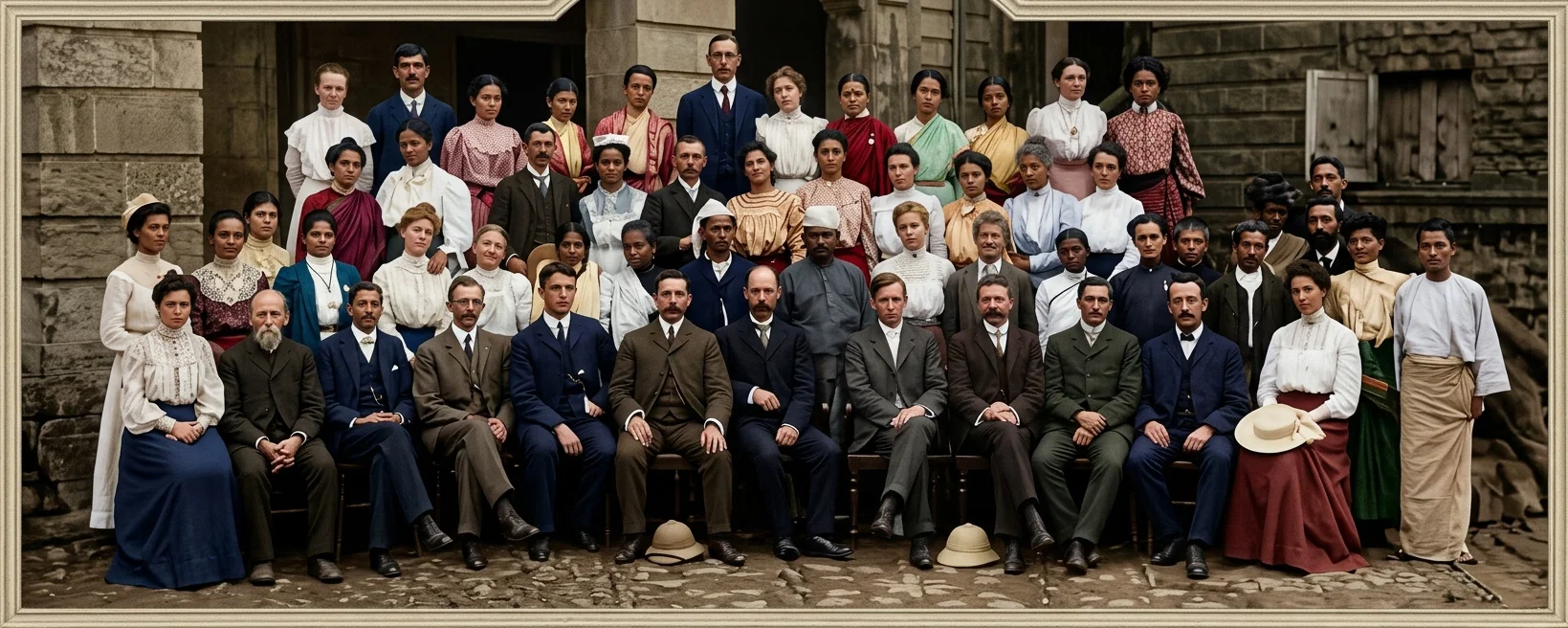
THE Indian empire, including Burma, is a vast aggregation of nations and tribes and tongues. It is like a human beehive of over three hundred million people. The United States has about twenty-two inhabitants to each square mile, while India has nearly one hundred seventy to each square mile.
Religiously it is the “Gibraltar of heathenism.” The two hundred seven million Hindus are divided into innumerable sects, and the Mohammedans number over sixty-two million. The Parsees, the Jains, the Sikhs, the Buddhists, and others, enrol still other millions of votaries. Their gods are innumerable, in earth and sea and sky.
In among these people, judgment-bound, the message of the coming of the Lord is being carried. “From the Himalayas to Cape Comorin” is the phrase that sums up the expanse of India. Though our work in India is but fairly beginning, our line stretches from the Himalayas to the cape.
A GROUP OF OUR WORKERS IN INDIA
Our Indian mission headquarters is in Calcutta, where there are also sanitarium treatment-rooms. The publishing office is in Karmatar, West Bengal, in connection with the orphanage school. At Mussoorie, in the Himalayas, is the mountain headquarters, with a hill sanitarium and medical mission in successful operation. On the Bombay side, and in South India and Ceylon, in Dehra Dun and Lucknow, on the plains of the North, in the Santal country, in Bengal, and in Rangoon, Moulmein, and other points of Burma, work is going forward from various mission centers. The very heathen are expecting the end of the age. The message of the coming King is due to India’s millions.

A Lepér Who Was Healed

THE HEALED LEPER
THE HEALED LEPER
Near Gopalgunj, in East Bengal, lives Sadhan Chandra Sircar, an aged brother who, in answer to prayer, was healed of the leprosy over thirty years ago. From a child he had been a victim of that awful disease. For many years—nearly half a century—he had prayed to all the Hindu gods for deliverance from it, but no relief came. One day a godly missionary came to his home in a boat, told him about the true God, and left him a copy of the Gospel of Matthew. He read it, and learned that Jesus of Nazareth healed the leprosy. He began to pray to him, and for three days he and this faithful missionary sought the Lord in his behalf. God heard their cries, and he was healed. For thirty years he has stood before the world a living testimony of the power of Jesus to cleanse the leper.
A TOWN CARRIAGE
A TOWN CARRIAGE
About a year ago this brother, now eighty years of age, received our Bengali tract, entitled “Christ and the Sabbath.” He learned that the same Jesus who healed him of the leprosy kept the seventh-day Sabbath, and he began keeping it also. In many villages among the jungles of India there are other faithful souls who are seeking for light.
GEO. B. THOMPSON.

A Step in Advance

The steadily growing interest in the extension of this message among all the people of the world is an encouraging feature of our work. Only a few years ago all the tithes of the home conferences were devoted to local work, and no one seriously thought of sending such funds outside of the local conference limits. Six or seven years ago the idea of using a portion of such tithes for mission work began to be agitated, and some of the conferences adopted the plan of appropriating a part of their surplus tithes at the close of the conference year for the use of the Mission Board. The number of conferences making such appropriations and the amounts donated have increased until, during the year 1907, according to the official report, the sum of $118,391.84 was thus devoted to work in “the regions beyond.”
This is a long step in the right direction; but so far as we know, the Colorado Conference is the first one to set apart a definite portion of its tithes for the mission work. At its annual conference, held in connection with its camp-meeting, the following resolution was adopted:—
Resolved, That this conference dedicate hereafter one third of its income of tithes to this world-wide evangelization, and that the officers of this conference be instructed to turn over, quarterly, to the General Conference the money thus dedicated to be used for gospel work as the needs of the general work shall demand.
We call attention to this action, with the hope that other conferences may be inclined to follow this example. If our long-established conferences, in which this message has been proclaimed for many years, would consecrate a definite and liberal proportion of their regular income to the spread of the truth in the unworked fields, there would thus be provided for the Mission Board, in addition to the offerings, a regular income which could be depended upon for the support of its missionaries in many fields. While these definite appropriations should not take the place of gifts and offerings, yet they would go far toward relieving the tension of the Mission Board treasury, whose income is now wholly dependent upon voluntary action either by individuals or by conferences.
When we consider that in the territory under the supervision of the Mission Board there is found more than one half the population of the globe, it seems only reasonable to expect that a considerable portion of the amount paid for the support of our evangelistic work should be expended in these populous fields. No matter how fully the warning may be given in the home land, the Saviour’s return will be delayed until this gospel message shall have been carried “to every nation, and kindred, and tongue, and people.”
We commend the action of the Colorado Conference, and invite those holding responsible positions in other conferences to consider the propriety of recommending the passage of a similar resolution at the next annual session of their constituencies.

When the Hour Struck

There were displayed the patience and precision of eternity in the development of this advent movement. For nearly nineteen centuries after Rev. 14:6-12, was written, no one saw such a movement as that described; no one heard the message of the judgment hour already come. But when the hour came, in 1844, there sprang forth the movement.
Coming up from Brazil to Europe, I had as fellow passenger a genial Brazilian pastor of a Rio de Janeiro church. In a serious and yet kindly way he suggested that we ought not to work in Rio, where there were other Protestant pastors, but should go into the interior. I assured him we were pushing into the interior, and would preach the closing message of Revelation 14 everywhere in Brazil. He believed the last days had come, and that the coming of the end was a doctrine to be preached.
“Now,” I said, “if you and your fellow pastors would preach this message of Revelation 14, we would gladly leave the work in Rio, and pass on to other fields.”
“I think we are preaching it,” he said.
“Are you preaching that message, ‘Fear God, and give glory to him; for the hour of his judgment is come’?”
“I believe I am,” he earnestly replied.
“Well, when did it come? When did the hour of judgment begin?”
The pastor was at loss to know what to answer, and said that really he had never studied the book of Revelation. It was obvious that he could not proclaim the message of the judgment hour when he had not studied its import, and was unable to tell when it was due to the world. And so it is with the pulpit in all the great churches.
That is exactly why this advent movement has been raised up—a people keeping the commandments of God and the faith of Jesus, carrying to every nation and people the message of the judgment hour and the coming of the Lord. This movement fulfils the prophecy, and is the only movement in the world that does, or that even professes to do so.
W. A. S.

A Significant Demonstration

THE return of Cardinal Gibbons to Baltimore last week after an extended visit in Europe, which included a considerable stay in Rome, was made the occasion of an imposing demonstration. The mayor of Baltimore, the governor of Maryland, and Hon. Charles J. Bonaparte, attorney-general in President Roosevelt’s cabinet, who is a prominent layman in the Roman Catholic Church, delivered addresses of welcome. A great parade, headed by carriages containing the governor and his staff, the mayor and members of the city council, an ex-governor, the attorney-general, the State’s attorney, and a member of Congress, marched through the streets, some of which had been handsomely decorated. This procession was reviewed by Cardinal Gibbons, who, arrayed in his pontifical robesand surrounded by officials of both the church and the state, sat in a chair on the cathedral steps for this purpose.
At the close of the parade, there was a service in the cathedral which was attended by all the dignitaries present. At the close of the service the cardinal said:—
I thank you again, and, with the wishes of the White Shepherd of the Vatican, I will now impart to you the blessing of the holy father. His blessing he is eager to extend to you, whether of the Catholic Church or out of it, and its spirit extends to all.
The cardinal then stood on his throne and gave the blessing of the pope.
It is the privilege of any State or city to pay honor to a distinguished citizen, but such action furnishes no ground for criticism. It is only when we analyze this demonstration in honor of Cardinal Gibbons in the light of the teachings and of the purpose of the Roman Catholic Church, that it assumes any special significance.
From the reports of the occasion it is clear that Cardinal Gibbons received the honor bestowed upon him not simply as a citizen of Baltimore, but as a high dignitary of the Roman Catholic Church. Before reviewing the parade, he was particular to exchange his citizen’s suit for his pontifical robes, and in the religious service which followed, he departed from the usual custom by imparting the blessing of the pope to non-Catholics as well as to members of the church. Furthermore, in the address of welcome by Attorney-General Bonaparte, emphasis was placed upon the ecclesiastical position and duties of the recipient of these honors. The attorney-general said, in part:—
In truth, dear father, you return to us when we most need you. At this time we are burdened with a great duty, one cast upon us by our form of government, — the duty to choose our chief civil ruler. At such a time we may well be reminded, and by those who speak as with authority, of the quickening truths which give life to our country.
It is hardly to be expected that the attorney-general would desire Cardinal Gibbons to use his great influence in favor of the candidate whose election is being most stoutly opposed by his own chief, and the introduction of such a reference to political affairs into this address will be likely to give increased force to the claim that the influence of the Roman Catholic Church will be used in favor of the election of President Roosevelt’s favorite candidate, on account of his favorable attitude toward the Roman Catholic Church, as shown in the Philippines, Porto Rico, and Cuba.
On the day following the parade, over one hundred non-Catholics visited the Cardinal, and presented him with a silver loving-cup. The spokesman of the company told the cardinal that “in this delegation are Lutherans, Methodists, Baptists, and Hebrews, and, indeed, a Jewish rabbi, while two of us are Spiritualists.” In his address he further said: “At the reception yesterday one of the speakers said that the bitterness of religious prejudice had well-nigh died out, and we hope that it may soon die out altogether.”
There is a vast difference between religious prejudice and that kind of maudlin religious sentiment which finds expression in a disregard of the difference between truth and error, between loyalty and apostasy, and hastens to join in the exaltation of a man not as a man merely, but as a leading official representative in this country of that organization which has been the menace of the true church of Christ and of every government which has attempted to follow the Christian idea of the separation of church and state.
This demonstration in honor of Cardinal Gibbons is one more evidence of the drawing together of Catholics and Protestants, and of the rapidly increasing influence of the Roman Catholic Church in the United States. When we remember that the conventions of the two great political parties, at which candidates for the presidency were nominated, were both opened by prayer by an archbishop of the Roman Catholic Church, it is not difficult to conclude that both parties are hoping to realize benefit from the influence which that church exercises over its communicants as a factor in determining elections. There is a constant need of emphasizing the counsel of a former president of this republic: “Keep the state and the church forever separate.”

Editorial

The path of the overcomer leads to the throne. “He that overcometh, I will give to him to sit down with me in my throne, as I also overcame, and sat down with my Father in his throne.” The sinner is a slave here (John 8:34), and is condemned to final overthrow. Which course shall we choose?

The Rise and Fall of Religious Liberty in America

State Constitutions and Freedom of Conscience

(Concluded)
RHODE ISLAND was the real birthplace of religious liberty in America, its charter of 1663 having been drawn upon that basis as “a livelie experiment” to demonstrate “that a most flourishing civil state may stand and best bee maintained . . . with a full liberty in religious concernments.” This State, says Arnold, was “a pure democracy, which for the first time guarded jealously the rights of conscience by ignoring any power in the body politic to interfere with those matters that alone concern man and his Maker.” The code of laws adopted by her first legislature closes thus:— And otherwise than this [what was therein forbidden] all men may walk as their consciences persuade them, every one in the name of his God. And let the lambs of the Most High walk in this colony without molestation, in the name of Jehovah their God, forever and ever.
When Rhode Island joined the confederation of the thirteen colonies, she did so under the charter of 1663, and continued that charter as the fundamental law of the State until 1842. Its section on religious “concernments” reads:— No person within the said colony at any time hereafter, shall be anywise molested, punished, disqualified, or called in question for any difference of opinion in matters of religion: every person may at all times freely and fully enjoy his own judgment and conscience in matters of religious concernments.
When, in 1842, a constitution was adopted to replace the charter of 1663, the religious liberty of Rhode Islanders was thus guarded by Section 3 of Article I of that document:— > Whereas, Almighty God hath created the mind free, and all attempts to influence it by temporal punishment, or burdens, or civil incapacitations, tend to beget habits of hypocrisy and meanness; and whereas a principal object of our venerated ancestors, in their migration to this country and their settlement of this State, was, as they expressed it, to hold forth a lively experiment that a flourishing civil state may stand and be best maintained with full liberty in religious concernments; we therefore declare that no man shall be compelled to frequent or to support any religious worship, place, or ministry whatever, except in fulfilment of his own voluntary contract; nor enforced, restrained, molested, or burdened in his body or goods; nor disqualified from holding any office; nor otherwise suffer on account of his religious belief; and that every man shall be free to worship God according to the dictates of his own conscience, and to profess and by argument to maintain his opinion in matters of religion; and that the same shall in nowise diminish, enlarge, or affect his civil capacity.
Rhode Island never in any way made religion a test of qualification for any office.
Connecticut also considered her charter a sufficient constitution on entering the confederation of American colonies, and her legislation in 1776 declared it to be the civil constitution of Connecticut. That charter was silent in regard to freedom of conscience; but Connecticut as a colony maintained the closest union between the church and the state, her first general court declaring that— the civil authority here established hath power and liberty to see that the peace, ordinances, and rules of Christ be observed in every church according to his Word.
It was not until 1818, when a new constitution was adopted, that Connecticut disestablished her hierarchical form of government. Sections 3 and 4 of Article I of the constitution read:— The exercise and enjoyment of religious profession and worship, without discrimination,shall forever be free to all persons in this State, provided that the right hereby declared and established shall not be so construed as to excuse acts of licentiousness, or to justify practises inconsistent with the peace and safety of the State. No preference shall be given by law to any Christian sect or mode of worship.
Maryland, the Roman Catholic colony, furnishes a unique spectacle in the annals of Catholic history; for it seems to have been the purpose of her founder to grant religious toleration—in a measure. It was unique because it was utterly unlike any other Catholic commonwealth existing at the time, was out of harmony with the spirit of the Catholicism of the day, and is out of harmony with the rules and practises of the Roman Catholic Church in all countries dominated by her even at the present day. Catholics to-day frequently refer to the history of Maryland to prove that Catholics are the friends of religious liberty, and were the original exponents of it in this country; but it is a singular coincidence that they never refer to the history of Mexico, of Peru, of Bolivia, of the Philippines, or of any other Catholic country to prove the Catholic Church the parent and protector of freedom of conscience.
Maryland’s charter bears date of 1632, four years earlier than the founding of Rhode Island by Roger Williams, eleven years earlier than the granting of the first patent for the Rhode Island territory, and thirty-one years earlier than the granting of the memorable charter which governed Rhode Island from 1663 to 1842. But there was a vast difference. Rhode Island was founded upon the true principles of religious liberty. Maryland was not. She tolerated Protestants on condition that they said nothing disparaging of the Catholic religion and kept Sunday strictly. To speak aught against the Virgin Mary, the apostles, or evangelists was to subject one’s self to a fine of five pounds sterling; to deny the trinity or to blaspheme was punishable by death, and there were pains and penalties for other infractions of religious requirements. Unitarians, Jews, infidels, and pagans were not to be tolerated in the colony.
In the Maryland constitution, adopted Nov. 11, 1776, Article XXXIII of the Declaration of Rights guarantees freedom of religious belief and practise; yet incorporated in that same article is a provision empowering the legislature to “lay a general and equal tax for the support of the Christian religion,” leaving to each individual the right to designate to what denomination his religious tax should be apportioned. This was a union of church and state, the church depending upon the state for its support; and Article XXXV of the same document makes “a declaration of belief in the Christian religion” a necessary qualification for holding any office. In 1810 the constitution was so amended as to abolish compulsory support of religion, but the religious test on office-holders remained. The new constitution adopted in 1851 incorporated the anti-tax clause into its article guaranteeing religious freedom (Article XXXIII), but it retained (Article XXXIV) the religious test for all office-holders. The same is true of the constitution adopted in 1864, and of the one adopted in 1867, with the exception of the religious-test clause, which in the latter merely requires a belief in the existence of God. These facts, with the legislation enacted upon religious matters, show that Maryland never has stood upon the true grounds of religious liberty.
North Carolina adopted her constitution Dec. 18, 1776. Article XIX of the Declaration of Rights declares— that all men have a natural and unalienable right to worship Almighty God according to the dictates of their own consciences.
But this did not grant equality in matters of religious faith and practise; for Article XXXII declares— that no person who shall deny the being of God, or the truth of the Protestant religion, or the divine authority of either the Old or New Testaments, or who shall hold religious principles incompatible with the freedom and safety of the State, shall be capable of holding any office or place of trust or profit in the civil department within this State.
In 1835 this article was amended by substituting the word “Christian” for “Protestant;” but the religious test, of course, still remained. Section 5 of Article VI of the constitution of 1868 disqualifies for office “all persons who shall deny the being of Almighty God,” and this same disqualification is taken over into the constitution of 1876. Article XXXIV of the constitution of 1776 declares the equality of all religions within the State, and the freedom of all persons from the compulsory support of religion. The later constitutions are silent upon this point, but repeat the declaration that “all men have a natural and unalienable right to worship Almighty God according to the dictates of their own consciences,” and add that “no human authority should, in any case whatever, control or interfere with the rights of conscience.” — Section 26, Article I, Constitutions of 1868 and 1876.
The constitution of Georgia was adopted Feb. 5, 1777. Article LVI of that constitution reads:— All persons whatsoever shall have the free exercise of their religion; provided it be not repugnant to the peace and safety of the State; and shall not, unless by consent, support any teacher or teachers except those of their own profession.
Section 5 of the constitution of 1865 reads:— Perfect freedom of religious sentiment be, and the same is hereby, secured, and no inhabitant of this State shall ever be molested in person or property, nor prohibited from holding any public office or trust, on account of his religious opinions.
The constitution adopted in 1868 incorporates this section, with the provision that this religious liberty must not be construed to permit acts of licentiousness or practises inconsistent with the peace or safety of the people.
On April 20, 1777, New York adopted her constitution, and it speaks in no uncertain terms in the matter of religious rights. Article XXXVIII reads:— And whereas we are required, by the benevolent principles of rational liberty, not only to expel civil tyranny, but also to guard against that spiritual oppression and intolerance wherewith the bigotry and ambition of weak and wicked priests and princes have scourged mankind, this convention doth further, in the name and by the authority of the good people of this State, ordain, determine, and declare that the free exercise and enjoyment of religious profession and worship, without discrimination or preference, shall forever hereafter be allowed, within this State, to all mankind.
The article closes with the same provision as noted above in the remarks regarding the constitution of Connecticut. The substance of the above provision was reproduced in the constitutions of 1821 and 1846.
The constitution of Massachusetts was not adopted until 1780. Article I declares the equality of men; Article II provides for liberty of worship for all men; but Article III provides for the compulsory support of religion, and the maintenance of public Protestant teachers of religion and morality. It also declares in its closing sentence that all denominations shall be equal before the law, and that there shall be no subordination of one sect or denomination to another. Nevertheless, it was not until 1833 that Massachusetts abolished the compulsory support of religion. Massachusetts also required of her governor that he “declare himself to be of the Christian religion.” She also required (Chapter VI, Article I) that her governors, lieutenant-governors, councilors, senators, and representatives should take oath that they believed the Christian religion, and had “a firm persuasion of its truth.”
It is thus seen that all the thirteen original States of the Union by some sort of declaration sought to guarantee freedom of conscience, even though in most cases the constitutions were inconsistent with that declaration because of provisions which infringed the rights of a portion of the inhabitants.
The next article will show the positiontaken by the framers of the national Constitution, and the failure of all the States to live up to their constitutional declarations in the matter of the separation of church and state. C. M. S.

The Thanksgiving Ingathering

This plan, I believe, is one that God approves. I heartily indorse it. The great work now incumbent upon us, as a people, is to consent to carry this glorious truth into all parts of the earth, especially the dark, unenlightened corners of the world. God has said that every nation, kindred, tongue, and people shall hear his glorious message. It is evident from our statistics that our people are one hundred thousand strong. The exact number of our membership is not quite this large; but even this number does not by any means include every person who loves this truth. The writer, from his long experience, is confident that in the aggregate, there are thousands scattered here and there who believe this message, and love the glorious hope we all have. A hundred thousand strong! O, what a power we may be if all are alive, awake, and strong in God and in the power of his might, moving forward as a unit, pouring out our means to do a great work in a short time! It is time to arise and shine, for our light has come. Surely the time has arrived to be no longer satisfied with little things. God never calls upon people to do great things for him unless, through his grace, he gives the power to do them.
I welcome this new move for the furnishing of the “sinews of war” and liberal support to our Mission Board in sending forth the truth and its missionaries to the ends of the earth, because I believe God’s time has come, and to be in the light is to recognize his call, and to act accordingly. The Mission Board has been greatly hindered for lack of means. The calls for help are constantly increasing. God has put it into the hearts of young men and women to offer themselves to go out into the needy fields; but for lack of means the Mission Board has had, in some instances at least, to smother their missionary zeal by telling them there was not sufficient means to send them. This is a sad fact, and can but indicate that there is a lack on the part of our people to recognize the opening providences of God. May this cease to be the case with us in the immediate future.
There is no lack of means among our people to carry on this work to success if they will walk in the might of God. We rejoice to see the growth in the gifts of our people. Only two or three years ago more than one hundred thousand dollars was rapidly raised, and did a vast amount of good; and this year we have been raising another fund of one hundred fifty thousand dollars. This fund is almost completed. It has been a wonderful help in the South and other places. Have our people been impoverished by making these gifts? — By no means. We have never heard of a single instance of distress because of the raising of this fund.
The calls of our brethren are reasonable, but no call could be more in place than this Thanksgiving service for missions. One short week of earnest endeavor by this people in opening the way for the fulfilment of the promise that the “wealth of the Gentiles shall come unto thee,” will be sufficient to give this message at this crucial period the necessary means to swell it into the loud cry, and greatly hasten the coming kingdom. The Lord is coming! Let all the people do their full duty in preparation for this great event.
GEORGE I. BUTLER.

Note and Comment

Looking to the Dead

One of our exchanges, the United Presbyterian, contains an article bearing the title, “Claims Messages from the Dead,” in which are set forth the efforts of the Society for Psychical Research to obtain messages from the dead. After stating the claims of certain investigators in this matter, the editor of that journal says:—
One who believes in the resurrection of Christ and his revelation of immortality does not require the evidence of these messages from the beyond, but if Sir Oliver Lodge or other men of science who are members of the Society for Psychical Research can find anything real by their researches, the Christian world should be glad to receive it.
Now those who are familiar with the teachings of Christ know that he never gave any such “revelation of immortality” as would lead any one to believe that the dead were alive and could communicate with the living. They who are familiar with the Scriptures know also that “the dead know not anything . . . neither have they any more a portion forever in anything that is done under the sun. . . . There is no work, nor device, nor knowledge, nor wisdom, in Sheol, whither thou goest.” Eccl. 9: 5-10. As this is true, what right have Christians to expect communication of any kind from the dead, or to teach other Christians that they should be glad to receive the product of the work of those who are seeking for communications from the dead? The following text of Scripture has fitting application in this connection: “And when they shall say unto you, Seek unto them that have familiar spirits and unto the wizards, that chirp and that mutter: should not a people seek unto their God? on behalf of the living should they seek unto the dead?” Isa. 8:19. The living Word is the Christian’s only safe guide. When that has spoken, there should be an end of controversy.

The Plain Meaning Perverted

THE recently appointed pastor of the leading Methodist Episcopal Church in the city of Washington in his first sermon made the following statement: —
Eternal life has no reference to the duration of the life, but to the spiritual substance of the life. It signifies a kind of life that takes into itself the divinity and blessedness of the upper skies.
It is by such man-made definitions as this that the plain teaching of the Scriptures is perverted, and a pagan philosophy is substituted for the gospel. If the belief in natural immortality, a doctrine transplanted from heathenism, could be eliminated from so-called Christian creeds, and the simple teaching of the Bible, that immortality is a gift of God through Jesus Christ, could have its rightful place, many difficulties would be solved, and many honest souls delivered from the perplexing problem of trying to harmonize the love of God with the terrible tenet of eternal torture. Life means life, and death means death; and immortality, being the gift of God, is not inherent; and the wages of sin is death, and not eternal life under any conditions whatsoever.

A Present-Day Peril

So apparent has become the trend toward worldliness, and the love of pleasure has come to have such an evident influence over nominal Christians, that some even among those who profess to believe in the continuous progress toward better things are compelled to recognize that the times are perilous. Thus Dr. Alexander Mackay-Smith, bishop coadjutor of Pennsylvania, has been quoted as saying that although there was a general sentiment that the world was improving, a sentiment in which he shared, he thought that the peril of the age was worldliness. There was too much attention to fine raiment, fine houses, and automobiles, not to mention the good things to eat. This worship of the material things has led to the belief in some quarters that the possession of money is everything. “Money,” the bishop said, “can never make character, and prosperity of the kind we have is always dangerous.” This is only a partial recognition of the truthfulness of the prophetic description of these times, concerning which it is declared that “men shall be lovers of self, lovers of money, . . . lovers of pleasure rather than lovers of God.”
Continue reading: The Inestimable Gift