History has well demonstrated that supremacy has been the principal factor in formulating plans for the maintenance of the papacy. It still advocates that the pope is infallible, independent of the decisions of the church, or one of its councils. See decision of Vatican Council, also “Systematic Study of the Catholic Religion,” pages 93-103. It is this contention that has made it so difficult to persuade a pope to convene a council in which decisions might be voted, that would contravene some papal edict of the past, and so embarrass the existing administration. More than three hundred years, therefore, intervened between the Council of Trent, which closed in 1563, and the Vatican Council of 1869-70. The former was called as a dire necessity, in an attempt to secure the return to the Roman Church of the Lutherans, Calvinists, and others who had separated from that communion. The latter council was called for the express purpose of having a universal bishopric indorse the dogma of infallibility.
Judgment against this opinion had become so pronounced in some quarters that it was fast losing its hold upon the laity, especially the intelligent class. This sentiment, which was given birth by the Reformation, had been born anew, as it were, through the work of Napoleon in supplanting absolute monarchy with constitutional governments throughout Europe. Consequently, notwithstanding the artful manipulation of the council, in various ways, official sentiment was so divided that when a semi-private vote was taken July 13, 1870, in behalf of a church constitution committed to a modified dogma of infallibility, 451 voted in its favor, while 88 recorded themselves against it; 62 voted that they would accept it, if it was modified to suit their notion. These, with the 70 who did not vote, constituted a company of 671 members.
This result of the ballot was so startling to the court party, and judgment was so strongly expressed against the dissentients, that immediately following the vote, the latter departed from Rome, fearing to remain longer, leaving behind them, however, a formal protest against the proceedings of the council. A public vote was taken, nevertheless, on the adoption of the new constitution, July 18, when 535 bishops indorsed the proposition, and two, one of these an American bishop, Fitzgerald of Little Rock, Ark., had the courage to oppose it.
Thus a partial victory was gained for the infallibility theory. We say a partial victory, because that while in former times, according to Bellarmine, the pope was designated in some documents as “Vice-God,” and the Civiltà Cattolica presented him as the highest being on earth (Vol. III, page 259; Vol. XII, page 86), the Vatican Council was content to confine his infallibility to ex cathedra utterances; that is, official statements, or definitions of doctrine for the guidance of the faithful. This is virtually to acknowledge himself at all other times a mere “man of sin” in harmony with the description of the apostle as given in 2 Thess. 2:3, 4, 8. But viewing the situation from the standpoint of future history, the victory was intended to be more than partial. When it was voted to sustain a constitution which makes official utterances of the pope infallible, that voice placed the papal constitution, in the estimation of the Roman Church, above every other constitution, whether in a government of Europe or America. By implication that vote solemnly condemned all civil constitutions, or parts of constitutions, not in harmony with the decrees of the papacy. It matters not that some of the bishops present had perhaps sworn to observe the laws of the countries in which they resided, it became their bounden duty, upon the passage of the measure, and the duty of their loyal successors in office, to use every effort to abolish those laws, and so render void the constitutions under which such laws are administered. As before quoted in these papers, the policy of the church will of course be to “observe for a time a prudent economy” without, however, “any modification of her real principles.”
But so far as public agitation of the question was concerned, the decision of the Vatican Council settled matters. Not so, however, in regard to adverse private opinion. This has strengthened from that time forward until the present agitation of Modernist sentiment within the Roman Church has called forth from the papal throne a bull condemning its advocacy, and even demanding that the services of all teachers known to be tainted with the heresy, be dispensed with.
This edict is supposed to be in the11nature of a reply to an “open letter” from a group of priests in Rome, in which they say among other things that the church has failed to understand “the living forces of the time,” in consequence of which members are withdrawing from her communion, because her Christianity is but the “mere cold observance of traditional formulas and precepts.” This letter protests that the disintegration brought to their notice is not because church duties are too onerous, but because “the church has adopted an attitude toward democracy and science which has made her justly suspected by both these forces.” The insistence is, that if the church retains the respect of the masses, she must “transform and purify the form of her own government, so tenaciously monarchical and absolute, abandon or alleviate her ancient coercive methods,” and “recognize more freely the religious action of the laity.”
(To be concluded)
Mountain View, Cal.
Items That Mean Much
By R. M. KILGORE
R. M. KILGORE
AERIAL navigation is no longer of doubtful practicability. The recent contest between several air ships created confidence in the public mind that soon success will crown the efforts of these aerial navigators. Germany carries off the prize, but an ambitious American says she shall not win in the next contest. It is now recommended to the government that a large fleet of air ships be immediately built, if we would cope successfully with other nations, in the event of war.
Aerial communication for long distances is now a well-attested fact. Without the aid of wire, press dispatches are sent from continent to continent, and rulers receive congratulations from one another across the great waters. Hundreds of stations are established in different parts of the world, from which messages by wireless telegraphy are sent with the same ease and accuracy as by the metallic connections.
The electrical writing machine, capable of writing one thousand words a minute, is already announced. This ingenious contribution to the wonders of this electrical age is received with more credit than was the launching of Robert Fulton's steamboat.
Within the past few weeks the finances of our country have been shaken as by an earthquake. A panic was threatened, confidence shaken, credit impaired; depositors ran for their treasures, banks were alarmed. Some closed their doors, and some of the officers, rather than meet the “run” shot themselves; but the tide for the time is turned, and the commercial world moves on as before.
While the commercial world is in commotion, the physical world is agitated by earthquakes and seaquakes in various parts of the earth, destroying hundreds of lives. It is officially reported that twenty-eight towns and villages are badly damaged, and thirty-two less seriously damaged, while a landslide which followed the earthquake at Karatagh, buried alive a large portion of its inhabitants.
The assassination of a high official in Russia, by a tender and delicate young lady causes terror in imperial circles. One investigation leads to the discovery of several accomplices, and a plot for the destruction of the czar himself.
The New Orleans Times Democrat, commenting on this state of affairs, says: ‘A body politic must be corrupt to the marrow, when women of gentle breeding use the revolver, the knife, or the dynamite bomb. No despotism on earth can hope to withstand forces so vital, except for the moment. . . . So far as Russia is concerned, there seems to be but one question, How long can the lid be kept on the huge caldron? Sooner or later, there must be an upheaval that will shake Russia and the whole of Continental Europe besides.’
Graysville, Tenn.
The Large Books
By Arthur L. Manous
ARTHUR L. MANOUS
“If the books of Daniel and the Revelation were studied with earnest prayer, we should have a better knowledge of the perils of the last days, and would be better prepared for the work before us—we should be prepared to unite with Christ, and to work in his lines.”—Mrs. E. G. White, in Watchman, Jan. 16, 1906.
“Let more time be given to the publication and circulation of books containing present truth. Call attention to books dwelling on practical faith and godliness, and to those that treat on the prophetic word. The people are to be educated to read the sure word of prophecy in the light of the living oracles. They need to know that the signs of the time are fulfilling.”—“Testimonies for the Church,” Vol. VII, page 158.
“The larger books should be sold everywhere. These books contain present truth for this time,—truth that is to be proclaimed in all parts of the world. Our canvassers are to circulate the books that give definite instruction regarding the testing messages that are to prepare a people to stand on the platform of eternal truth, holding aloft the banner on which is inscribed ‘The Commandments of God and the Faith of Jesus.’”—Special Testimony, Dec. 6, 1902.
“Our large books could be sold if our canvassers would take up this work earnestly, filled with the realization that these books contain precious instruction that God has intrusted to us that we may give it to the world. . . . Do not allow anything to keep you from the work of saving souls. Will you not try it? Will you not do what you can to circulate the books that the Lord has said should be sown broadcast through the world? Will you not place them in the homes of as many as possible? Think of how great a work can be done if a large number of believers will unite in an effort to place before the people, by the circulation of these books, the light that the Lord has committed to us to be given them.”—Words of Encouragement to Workers, pages 5, 8, 9.
“The important books containing the light that God has given regarding Satan’s apostasy in heaven, should be given wide circulation just now; for through them the truth will reach many minds. ‘Patriarchs and Prophets,’ ‘Daniel and the Revelation,’ and ‘Great Controversy’ are needed now as never before. They should be widely circulated because the truths they emphasize will open many blind eyes. Many of our people have been blind to the importance of the very books that were most needed. Had tact and skill been shown in the sale of these books, the Sunday law would not be where it is to-day.”—Mrs. E. G. White, in Review, June 1, 1905.
“A great and important work is before us. The enemy of souls realizes this, and he is using every means in his power to lead the canvasser to take up some other line of work. This order of things should be changed. God calls the canvassers back to their work. He calls for volunteers who will put all their energies and enlightenment into the work, helping where there is opportunity.”—“Manual for Canvassers,” page 67.
“Young men and young women who should be engaged in the ministry, in the Bible work, and in the canvassing work, should not be bound down to mechanical employment.”—“Testimonies for the Church,” Vol. VIII, pages 229, 230.
Our whole State, the great Empire State of the South, with its millions, is almost wholly unworked for the large books above mentioned,—the very books which contain the special light for this time, and the very books which God has said should be sold everywhere just now. There is also plenty of good territory here for other good books.
We have a great work before us, and not many workers, but we are of good courage because the Lord has blessed, and is blessing, the efforts that have been, and are being, put forth. Now if you, dear reader, should, through the Spirit of God working upon your heart, hear the Macedonian cry, saying, “Come over into Macedonia [Georgia], and help us,” “harden not your hearts,” but send back the answer clear and distinct, saying, “Here am I; send me.”
In closing allow me to ask that Elder Spicer’s article in the REVIEW of Sept. 26, 1907, regarding the work in the South, be re-read. He has not at all overstated the matter. It is just as true as can be in all particulars. May God impress hearts to enter these fields.
Atlanta, Ga.
Aids for Bible Readers
Historical quotations and extracts from various writers which may assist the thoughtful student of the Scriptures.
DANIEL'S account of his vision of the four beasts thus proceeds: “The first was like a lion, and had eagles' wings: I beheld till the wings thereof were plucked, and it was lifted up from the earth, and made to stand upon two feet as a man, and a man's heart was given to it.” Verse 4. The lion and the eagle, chief among beasts and birds, correspond to the gold of the image, chief among metals; and thus the first beast, like the first portion of the metallic image, aptly symbolizes the autocratic Babylonian Empire. By the wings of the eagle seem to be meant the soaring ambition and swift conquests of the Babylonian monarchy. In the further description,—that the wings were plucked, and it was lifted up from the earth, and made to stand upon two feet as a man, and a man's heart was given to it,—there seems a reference, as is very generally admitted, to the punishment inflicted on Nebuchadnezzar in the zenith of Babylonian power, as narrated in the fourth chapter of Daniel, when the wings of the outrageous pride of the monarch were clipped by the judgment of insanity visited upon him, as we read in the sixteenth verse of that chapter: “Let his heart be changed from man's, and let a beast's heart be given unto him,”—after which he was restored from his degraded bestial condition, “lifted up from the earth,” etc., and brought to a sane appreciation of his humble position as a man in relation to Almighty God, as alluded to in the words, “A man's heart was given to it.”
We next read: “And behold another beast, a second, like to a bear, and it was raised up on one side, and three ribs were in his mouth between his teeth: and they said unto it, Arise, devour much flesh.” Verse 5. This is well explained in Bishop Ellicott's Commentary: “The second beast corresponds to the silver portion of the image of chapter 2. . . . The raising up on one side implies that one part of the kingdom would come into greater prominence than the other. Such was the case in the Medo-Persian Empire, in which the Persian element surpassed the Median. . . . The three ribs have been understood from the time of Hippolytus to mean three nations subdued by it—the Babylonians, the Lydians, and the Egyptians. . . . By the command, ‘Arise and devour,’ the second empire is permitted to make further conquests before its disappearance.”
Next, of the third beast, we read: “After this I beheld, and lo another, like a leopard, which had upon the back of it four wings of a fowl; the beast had also four heads; and dominion was given to it.” Verse 6. This third beast corresponds to the third or brazen portion of the image, and denotes the Grecian Empire. Swiftness, indicated by the well-known activity of the leopard, and also by the four wings of a bird, was a striking characteristic of the conquests made by that power, especially under Alexander. . . .
We now come to the fourth beast, that which most interested Daniel, and a right understanding of which is of the deepest interest to ourselves, seeing that we are involved in the fulfilment of the vision. We read (verse 7): “After this I saw in the night visions, and behold a fourth beast, terrible and powerful, and strong exceedingly, and it had great iron teeth: it devoured and brake in pieces, and stamped the residue with his feet: and it was diverse from all the beasts that were before it; and it had ten horns.”
There can be no reasonable doubt that here is portrayed the same iron rule of Rome, which was symbolized by the iron portion of the image, and that the “ten horns” correspond to the “ten toes.” These, as we have already shown, indicate the separate powers, or kingdoms, into which the old Western Roman Empire was to become subdivided, after the Gothic invasions. These separate kingdoms were still component parts of the Roman Empire; but the old headship of the Cæsars, after being removed to Constantinople, was gradually supplanted in influence by the rising power of the popes,—a power that began to come into prominence at Rome at this very juncture of history, as we have already shown, and shall prove yet further as we proceed.
The chief interest of the vision of this fourth beast centers around the “little horn.” The previous vision of the image, given to a heathen despot, had simply to do with the question of political power, which was the idol of Nebuchadnezzar's heart. It foretold to him the succession of world-empires up to the advent of the world-empire of Christ, before whom all earthly empires and kingdoms would fall. But to Daniel, the child of God, in the vision of the fourth beast, a revelation was given concerning that which would be of the deepest interest to God's children. To him it was given to foretell, under the mysterious symbolism of the “little horn,” that in the course of the fourth, or Roman, world-empire, there would rise to the head of it, when it would have entered upon its subdivided stage, symbolized by the ten “horns,” or kingdoms, a terrible ruling power, not only political but also spiritual,—that of the antichrist. The career of this “little horn” forms the chief subject of Daniel's vision of the four beasts. It was to spring up among the “ten horns,” or kingdoms, and attain to supremacy over them all,—“whose look was more stout than his fellows.” Verse 20. A long line of the most able expositors, from the time of the Reformation to the present day, including such names as Sir. I. Newton, Bishop Newton, Bishop Wordsworth, Birks, Elliott, Guinness, etc., have shown that the little horn was a symbolic prediction of the rise of the papacy.
The little horn was “diverse” from the others, a characteristic which obviously applies to the papacy. As regards its actual temporal domains it has always been “little;” but, for all that, its political influence has been tremendous, and its pretensions unbounded, “whose look was more stout than his fellows.” In order that it might rise into eminence, it is said that before it “three of the first horns were plucked up by the roots”. . . .
Moreover it is said of the little horn that it had a “mouth” which uttered great blasphemies; it cruelly persecuted the saints of the Most High; and it had “eyes like the eyes of a man.” Of this latter characteristic Sir. I. Newton well says: “By its eyes it was a seer,” to use the expression of the Old Testament, or, as he adds, in that of the New Testament, an episkopos; i. e., an overseer, or bishop. Also it claimed absolute power, and to be above all law. We have already shown how these characteristics of the antichrist have been fulfilled in the papacy, and the proof will come out yet more fully as we further examine the New Testament prophecies on the same subject.—“Daniel and the Revelation,” by Joseph Tanner, London, Hodder, and Stoughton, 1898, pages 160-171.
“And he said unto Jesus, Lord, remember me when thou comest into thy kingdom. And Jesus said unto him, Verily I say unto thee, To-day shalt thou be with me in paradise.” Luke 23: 42, 43.
It is left for the reader to determine whether the words “this day” should be joined (a) with the former part of the sentence, or (b) with the latter. In favor of (a) may be urged (1) the fact that semeron, “this day,” does not always stand first in the clause to which it belongs (see Luke 2:11; 5:26; 22:34; Acts 20:26; 22:3; 24:21; 26:29); (2) that being essentially a demonstrative word, it will bear any reasonable stress that may be laid upon it, whether it be placed before or after the words which it qualifies; (3) that it is far from meaningless if regarded as belonging to the opening words of asservation (“Thou dost ask to be remembered then: verily thou art assured now. As on this day of my weakness and shame, thou hast faith to ask, I this day have authority to answer”); (4) that the latter part of the verse is thus left free to refer to the very matter of the supplicant’s request (“Thou dost ask to be remembered when I come in my kingdom: thou shalt be remembered then, and with distinguished favor: thou shalt be in my kingdom; shalt be with me in the very paradise of my kingdom, in the garden of the Lord—Isa. 51:3 [Septuagint paradeisos]; Rev. 2:11—in that most central and blessed part of the coming kingdom, of which thou dost believe me to be the destined king”).—Note in Rotherham’s “Translation of the New Testament.”
Becoming Attire
By MRS. D. A. FITCH
MRS. D. A. FITCH
The master of fashions will never consent that its votaries be attired in modest garb, for should such be the case, much of his power over them would be ineffectual or lost entirely. Appetite has a strong hold on all, yet there are many who are willing to eat simply and inexpensively, if by so doing some means may be retained with which to purchase a few more ornaments to adorn the person.
Since the character must shine out through face and action, how much more important the forming of right character than the spending of time in needless adornment and ornamentation. “Beauty unadorned is most adorned.”
One who had recently found the Saviour, as he reveals himself to the children of men in these later times, was asked what had become of her jewelry. The answer came, sweetly, “I have no need for it since I put on the Lord Jesus; he is ornament enough.” When the heart is really in love with the Saviour, the joy of dispensing dimes and dollars to help others to become acquainted with him, will greatly overbalance the satisfaction of appearing like the world, and therefore showing who is king of the life and soul.
Do we feel as great burden for the welfare of souls, and as much willingness to work for them when we are fashionably attired, as when we are consistently dressed? In the days gone by, when many yards of cloth were cut into ruffling, a pastor asked a dress-making member, “Do you feel as much like talking the truth when putting twenty yards of goods into a dress as when you were using only half as much?” The answer was frankly given: “No.” If this is true of the seamstress, what about the wearer?
A father said: “Daughter, if you are as careful of your character as you are of your house, you will be a noble woman.” As character is more important than house or dress, shall we not devote our time to its formation, and permit furnishings and adornments to be incidental and secondary? “In like manner also, that women adorn themselves in modest apparel, with shamefacedness and sobriety; not with broidered hair, or gold, or pearls, or costly array; but . . . with good works.” 1 Tim. 2:9, 10.
Glendale, Cal.
The Widow’s Cow
By A. E. C. Haskell
“I’ve been over to Widow Dillman’s this afternoon, and brought home that cow,” said Farmer Merrion, as he sat down to supper.
“Why, papa!” exclaimed Daisy, “what will the poor widow do now?”
“I had never thought of that,” laughed the farmer.
“Well, I call that real mean,” spoke up Joe. “We’ve got a whole barnyard full of cows, while that poor woman had but just one.”
“The widow has been buying provisions of me all along. The bargain was that as soon as the bill amounted to thirty dollars, if she had not the money to pay me, I was to have the cow. So, you see, the cow is bought and paid for.”
“O papa, it’s a shame! for she’s half their living. Poor Mrs. Dillman has been sick so long, you know, and now that she is getting about again, I know that she must feel almost lost without poor old Whitey.” And there were tears in Eva’s eyes.
At last, pushing back her food untasted, she sprang up and went around to her father, and pleaded with him to take back the cow.
“I would, father,” said his wife. “You know what the Bible says about being good to the poor.”
“Tut, tut!” said the farmer. “You can all be very free with other people’s money. How many of you, I wonder, would give anything out of your own pockets?”
“Papa, dear, you shall have my bank, and every dollar in it,” said Eva.
“And you needn’t buy me a new overcoat this winter, father. I’ll wear my old one,” said Joe.
“Please, papa, can’t I sell my pet pig to help pay for the cow?” asked Daisy.
“Well, I declare,” laughed the farmer. “Tell me where you all learn so much generosity.”
“I have tried to instil it into them, my dear,” said Mrs. Merrion, “as Jesus has taught it to us through his Word. ‘He that hath pity upon the poor,’ you know, ‘lendeth unto the Lord; and that which he hath given will he pay him again.’ God’s Word is sure.”
The result was that the next morning the farmer sold the cow to his children; and what fun they had driving her home!
As they drew near the cottage, they became so boisterous that the widow and one of her sons came out to the gate, and there stood old Whitey patiently by the fence, with the children around her.
“For the land’s sake!” cried she, holding up both hands. “Don’t you want her?”
“You want her worse,” said Joe; “and so papa sold her to us children, and we’ve brought her back a present to you.”
“You blessed children! God be praised!” exclaimed the widow, bursting into tears; and little Mark threw both arms around the cow’s neck.
Farmer Merrion’s children declared, as they were returning home, “that they never felt so happy in their lives.” They had learned that it is indeed “more blessed to give than to receive.”—A. E. C. Haskell, in Our Young Folks.
Let Me but Live
By Henry Van Dyke
LET me but live my life from year to year,
With forward face and unreluctant soul,
Not hastening to, nor turning from, the goal;
Not mourning for the things that disappear
In the dim past, nor holding back in fear
From what the future veils, but with a whole
And happy heart, that pays its toll
To Youth and Age, and travels on with cheer.
So let the way wind up the hill or down,
Though rough or smooth, the journey will be joy;
Still seeking what I sought when but a boy,—
New friendship, high adventure, and a crown.
I shall grow old, but never lose life's zest,
Because the road's last turn will be the best.
— Henry Van Dyke, D. D.
A Silencer
WHEN Whitelock was about to embark as Cromwell's envoy to Sweden, in 1655, he was much disturbed in mind as he rested in Harwich on the preceding night, which was very stormy, while he reflected on the distracted state of the nation. A confidential servant slept in an adjacent bed, who, finding that his master could not sleep, said: “Pray, sir, may I ask you a question?”
“Certainly.”
“Pray, sir, don’t you think God governed the world very well before you came into it?”
“Undoubtedly.”
“And pray, sir, don’t you think that he will govern it quite as well when you are gone out of it?”
“Certainly.”
“Then, sir, pray excuse me, but don’t you think you may as well trust him to govern it as long as you are in it?”
To this question Whitelock had nothing to reply, and turning about, soon fell asleep.—Selected.
Life’s Little Things
LIFE is made up, not of great sacrifices or duties, but of little things, in which smiles and kindnesses and small obligations, given habitually, are what win and preserve the heart and secure comfort.—Sir. Humphrey Davy.
West Africa
By L. W. BROWNE
L. W. BROWNE
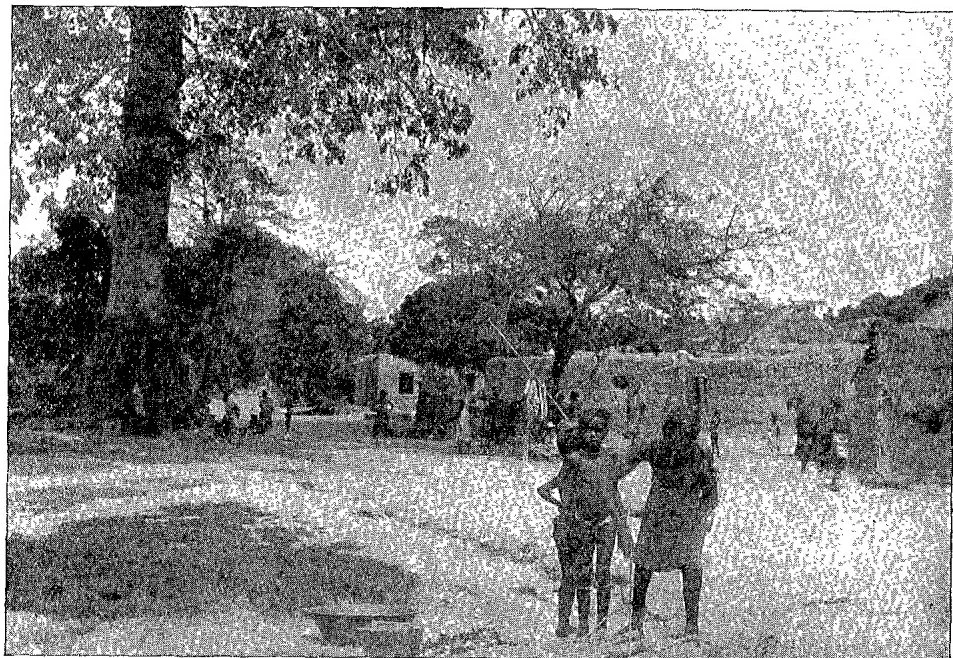
About seven weeks ago a native worker and I came to Waterloo, a village having a population of three thousand, twenty-one miles southeast of Freetown. As its inhabitants are the most intelligent among the people of the villages in this vicinity, we immediately began to canvass for our literature. Sales were slow, but a lively interest was manifested by all, many requesting that the truths found in the books be explained to the public.
Before the first week closed, we visited the district commissioner, who purchased “Great Controversy.” In course of conversation, he suggested that we should ask the Church Missionary Society for permission to use an old church building which they have vacated, in which we could give our lectures, and then promised to be responsible for the obtaining of the same. He was so sure that we could have it, that he advised us to write our placards to that effect. Knowing the antipathy that other denominations have for our work, I hinted that his plan did not seem feasible; but he reassured us that it was a settled matter, because his word was authority.
On returning to Waterloo the following week with our placards, we learned that the Society had positively refused to grant our request. In order that we should not be disappointed, he consented for us to use the public market, a building twenty-five by sixty feet, which was erected about five years ago, but was used only a few months, and then vacated. It was thought that it would be useless to invite the people to come here, inasmuch as they had sworn never to return to it for vending purposes, and had even declined to attend a social entertainment held in it some time ago, at which music and dancing were prominent. But the Lord’s ways are not the ways of man, and he overrules all prejudices when his truth has to be proclaimed.
At our first meeting, about two hundred were present. Since then we have had an average attendance of two hundred fifty. The commissioner came to the opening meeting, and at its close highly commended the people for the interest they had exhibited, also exhorted them to attend regularly, so that no opportunity might be lost by which they might be benefited.
There lived in this village, two years ago, a man who preached on the prophecies to some extent. As he was not well informed, he told the people that he could not tell them much, but the time was not far distant when God’s true messengers would come to clearly expound these things to them. Many believe that we are the ones to whom he referred.
Among the obstacles Satan has placed in the way of the truth of God we might mention necromancy in all its forms—transmigration of souls, ancestral worship, spiritism in a crude form, and witchcraft—the outgrowth of their superstitious fears. For example, when a child is born, it is conspicuously marked on its face, the marks remaining through life, and even after death, in the spirit world, they believe. And when that child reappears in the flesh, as they claim it invariably does, if it should visit the neighborhood through birth, it can be readily recognized; but generally it is born some distance away. Witnesses are abundant on every hand to prove the truthfulness of these statements, claiming to have seen and handled such transmigrated children.
A WEST AFRICAN VILLAGE
Ministers and lay members of Christian denominations frequent the homes of Mohammedans, in order to solicit their aid in times of distress and financial failure, and the heathen so cunningly bewitch them that large sums of money are continually spent in this manner. Note the result: When the Mohammedans are invited to become Christians, they refuse, on the ground that their religion is superior to the Christian faith; for were it not so, Christians would not seek their help in time of trouble.
As might be expected, our views concerning the immortality of the soul met with great opposition, the ministers being in the vanguard. We visited the pastors of the Anglican and Methodist denominations, and presented the truth to both. The Methodist pastor quite stubbornly resisted our position on the nature of man, stating that he could not agree with us, because it was one of the essential doctrines of Methodism. Having discussed with him “hades,” “Abraham’s bosom,” etc., we left him, promising to lend him “Here and Hereafter,” which he consented to read. This minister has been attending regularly, but so far has not accepted the light.
Last Friday evening we extended a cordial invitation to all to come to our home for Sabbath services. Six responded. On Sunday as we visited among the people, we discovered that others were on the point of decision, so the next Sabbath we expect a larger number.
The experience of a Methodist class-leader is very remarkable, as related by himself yesterday. He states that after listening to the presentation of the Sabbath question for the first time, he went home, and retired, but not to sleep; for he could not. “The seventh day is the Sabbath,” kept ringing in his ears, and before morning dawned he had decided to obey. His pastor has threatened to take his class from him, but he is fixed in his purpose. Pray that the Lord may help him and the others who are now venturing out.
Day after day the merits of our literature are being discussed. This morning a justice of the peace came to purchase “Thoughts on Daniel and the Revelation;” but as we have no more at present, we could not sell it to him. To scatter our publications as the leaves of autumn, is an injunction that it will pay us in a twofold sense to carry out: first, with respect to the people; for they become acquainted with the solemn truths for this time; and, secondly, with regard to the workers, as we are thus brought into close contact with the people for whom we labor, and they become friendly, and learn to place confidence in us and the truth we represent, when they see our straightforward, business principles in obtaining sales. Canvassing is really an entering wedge, and15should be neglected by no one who aspires to be a successful worker.
The “great awakening” is being felt in Africa; and as a child awakening from sleep cries for food, so is there a general demand here for spiritual bread. Who will voluntarily join the ranks, and assist in feeding these starving, benighted souls, with the pure, unadulterated word of truth?
The fever still troubles me, there seldom being a week when I am not affected. But my motto is, “Faint, yet pursuing.”