Your ShelfYour Projects

Review and Herald, Vol. 85, No. 4.

This I Know
Earlier text: The Outcome of Its Present Struggle

Guatemala

E. L. CARDEY
It has been with great interest that we all, workers and lay members, have looked forward to the opening of our work in this country. I do not wish to infer in this report that we have opened work there, but the first steps have been taken toward such a move.
The night of November 4 found me on board the steamship “Mobila,” on my way from Belize to Puerto Barrios. I had some misgivings for a time about going so far in a strange country, and among a strange people and language; but there was no alternative. However, I met with very little trouble.
The next morning our boat pulled up to the large wharf at Puerto Barrios where a train was waiting to carry us on toward the city. We arrived at the half-way place, Zacapa, in the evening at seven.
The ride during the day was very interesting as well as enjoyable. I was surprised at the service and accommodation of this railroad. The roadbed is very good; and the trains run smoothly, and make good time, all things considered.
The country is very thinly settled for the first hundred miles, or as far as Zacapa. Nevertheless the ground is good, and where plantations are made crops grow well.
The United Fruit Company has a number of banana plantations here; however, the country is open to any one, and land can be obtained very reasonably. For the most part of the way our road lay along a beautiful river, at times going within a few feet of the water; then, with the river, rushing between two mountains barely wide enough to pass through. Zacapa is but 650 feet above sea-level. Here our train stopped for the night, and the next morning at an early hour we were on our way again. The country around and west of this city is very beautiful; and especially along the river bottom the country is well cultivated. The road rises gradually until one gets to the capital, it being five thousand feet above the sea.
At one o’clock we arrived at Agua Calliente, the end of the present railroad. The road will be finished on to the city in a few weeks. Here we took a carriage drawn by four mules; from this point to the city it is twenty-five miles. In this distance we had to climb three thousand feet; thus it will be seen that we must go up-hill most of the way. This part of the journey proved to be the most interesting by far in a number of ways. Our driver seemed to be in a great hurry, especially on going down hill, when he would put the mules on the run; over the rocks, around the curves, we would go at a break-neck speed, at times going within a few inches of the edge of the precipice, two or three hundred feet straight down.
I can’t say that it just struck my fancy as to what a carriage ride should be, yet one feels like putting a great deal of confidence in the driver at such places and times.
The scenery was extremely beautiful as we climbed the mountainside. The well-cultivated valleys with their many shades of green (caused by the variation of crops grown) lying one thousand feet or more below us, was truly a scene of beauty. Twelve miles from the city we came to the end of the railroad coming out from it, where another train was waiting to take us on. What was my surprise to step into an apartment car as fine as any I was ever in. In another hour we were in the city. The contractor of the railroad, who was on the train, kindly showed me to a hotel where I stayed while there.
Already I had been forcibly impressed with the change in the atmosphere; my tropical clothing was altogether too light for such an altitude, and I was glad to stir around to keep warm. The city is well lighted with electricity, and the streets are well paved. On either side of the street is a good sidewalk—a luxury rarely found in Spanish towns.
I tried to study the country, its people, and the conditions from every side, that we might know how best to enter it. It seemed to me that the population of the city was nearly half German, but all speak Spanish, and many speak English. In the city and on the west coast I found a very fine class of people as a whole. In this section the country is in a high state of cultivation. All kinds of tropical plants, as well as plants grown in the temperate zone, are grown in abundance. Living is thus very cheap, as very little is imported to eat. The larger cities on the west side are connected by rail with the capital, thus it will be easy to work these cities from the standpoint of travel. Despite these natural advantages it will mean some hard work to get a foothold in this country.
The power of Catholicism has complete sway in religious matters. Guatemala City—which is a sample of all the cities—has twenty large churches and cathedrals. One I measured, roughly, to be 500 feet long and 250 feet wide. The walls of the larger ones are from twelve to eighteen feet thick, solid stone. I was told that some of them are over three hundred years old. I visited a number of the cathedrals, and watched the almost continuous train of worshipers coming to bow before the many images. It was enough to impress one with the need of the people, and with our duty to carry to them the light of the gospel which says, “Now the just shall live by faith.”
I stayed one Sabbath in the city, spending the day largely in the beautiful parks, with which the city abounds, as well as making a few calls on some American families.
Conditions are fair for opening medical work in the city. The government is very free toward schools, and I was told by the American minister that we would be welcomed in such an enterprise. There are two small Protestant missions in the country. Some priests told me, through the American consul, that no more missionaries would be allowed to enter the country, and the governor at Barrios said we could pass no more of our books through the customs. But I was told to go ahead and try it at any rate. This we shall do. There were three earthquake shocks while I was there. I am sure the time has come for us to enter this needy field with the message for this generation. This gospel must be heard by all these people that now sit in darkness and the shadow of death. Pray that the way may speedily be opened for such a step.

How the Truth Made its Way in Russia

Reminiscences of the Days of Our Imprisonment—No. 4

How the Truth Made its Way in Russia

H. J. LOEBSACK
WHILE imprisoned in Bessarabia, new accusations were brought against us,—in Crimea, on account of the baptism of a family, and also in Volhynia we were accused. In 1898, Brother Jurickson, one of our Bible workers in Estland, was in prison three times for holding services, and at Lodz, in Russian Poland, the prison furnished a means of introducing the truth. Three of our ministers, who had worked in the Caucasus among the Russians, were in prison about six months; but having soon gained the confidence of their guards, they were placed by them as wardens over the prisoners of the different divisions. All members of the parishes of Holstein and Warenburg, “took joyfully the spoiling of their goods,” being compelled to pay fines for attending meetings. Brother John Perk and others have often escaped death only through the use of the rustic costume of the Russians.
Under such circumstances the Lord has blessed his work, and spread the truth throughout the whole of European Russia. Now, even in Siberia and in Tashkent, on the Chinese frontier, parishes have been organized by Elder H. K. Loebsack. In six fields, our number of members reaches three thousand, with about seventy parishes and nearly sixty preachers, Bible workers, nurses, and canvassers. This fall, a Russian union conference, including three conferences and three mission fields, has been organized. The religious freedom, assured us by law, is to be used for the propagation of this last message of warning.We do not want to regard lightly those days of small beginnings, but remember that in the future as well, any mountain can become a plain before God in the onward progress of his truth and work.
All our brethren and sisters, who suffered with the bound ones, or who “took joyfully the spoiling of their goods,” know, “that they have in heaven a better and an enduring substance.” Some have already passed away, but many are still living. All these experiences will make up a part of the song of Moses and the Lamb. Those who wrote the Scriptures, those who printed them, those who sent them out, and those who also taught them, all these will have a reward, and all will shine as bright stars in our Father’s kingdom forever and ever.
Brethren and sisters, “Cast not away therefore your confidence, which hath great recompense of reward. . . . For yet a little while, and he that shall come will come, and will not tarry. Now the just shall live by faith: but if any man draw back, my soul shall have no pleasure in him. But we are not of them who draw back unto perdition; but of them that believe to the saving of the soul.” Heb. 10: 35-39.
Caucasus.

The Argentine Annual Conference

N. Z. TOWN
Two years ago at the close of our general meeting there came a very heavy rain which washed out the railway in some places, and compelled several of our workers to remain for some time in the vicinity where the meeting was held. Three young ladies who were to go to Buenos Ayres to canvass during vacation with La Verdad Presente went to Gualeguay, the only town to be reached on account of the floods. They met with remarkable success selling the paper and taking subscriptions, and were these also able to interest several persons in the truth.
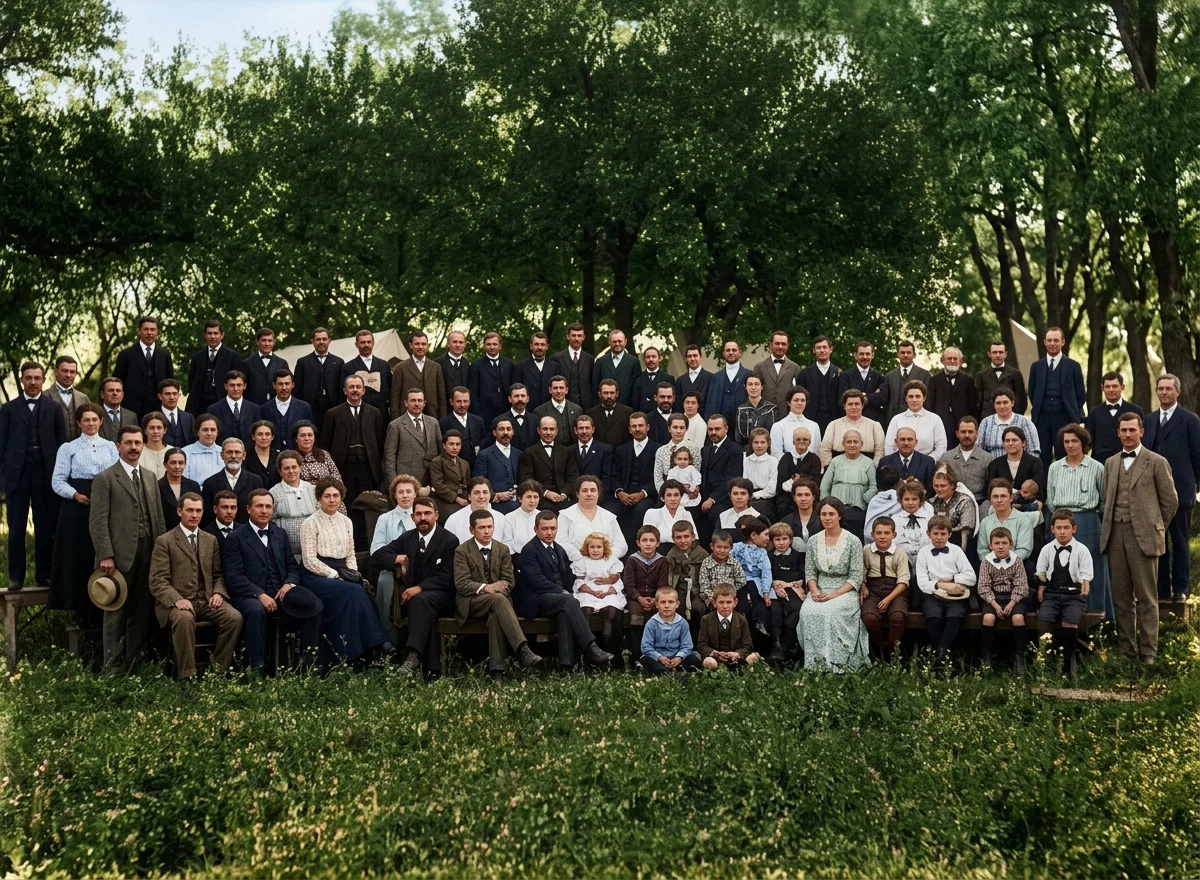
Later, other workers were sent there, and a few began to keep the Sabbath. As there still seemed to be considerable interest to hear, this year we held the annual meeting in that place. An Italian brother who recently began to keep the Sabbath gave us the free use of a beautiful place for the tents just on the outskirts of the town. We pitched our tents in a nice grove of tala trees, the shade of which added much to the comfort of the meeting. Not only did this grove serve as a protection from the sun and winds, but it also served as a sanctuary where those assembled could go and pour out their souls to God and seek his blessing upon the meeting. The Lord heard these supplications. From the very beginning of the meeting there came in a spirit of heart searching and consecration which brought rich blessings to us, and we had one of the best meetings ever held in Argentina.
GROUP OF BELIEVERS ATTENDING ARGENTINE CONFERENCE
The attendance from the town was slightly good. Some evenings our large forty-by-sixty foot tent was filled to overflowing with orderly, attentive listeners. The cash book sales during the meeting amounted to about two hundred dollars paper.
Aside from the regular laborers of the Argentine Conference, Brother J. V. Maas and Brother Schimpf from the Uruguay Mission, and Brother Luis Ernst, from Alta Parana, were present throughout the meeting.
Recommendations were unanimously passed in favor of increasing our tent fund, of finishing at once the new school building which is already begun, and also the building in which are the offices of the conference, and the printing office. It was also voted that steps be taken toward the erection of a small sanitarium in connection with our school in Entre Rios. The brethren supported these measures not only with words, but with liberal donations and pledges. The pledges made to help the sanitarium enterprise amounted to about four thousand dollars paper. Neither was the $150,000 fund forgotten. About fifty dollars gold were given and promised for this fund.
The following recommendation was freely discussed and heartily indorsed by all present:—
“In view of the present movement in the different parts of the world, against our organized work and against the Testimonies,—
“We recommend, That we as a conference, as workers, and as individuals, declare our loyalty to the General Conference and to the Testimonies, and that we pledge ourselves to uphold the General Conference by our prayers, and to put in practise the precious light that the Lord gives us by means of the Testimonies.”
In the discussion of this and other recommendations it was cheering to see the loyalty of the brethren to the message.
The increase in members in Argentina during the past year has not been large, but there has been a substantial increase in the tithe. During the first nine months of this year the tithe received has been three thousand dollars paper more than during the entire year of 1906.
We have now entered upon another year’s campaign. What its record will be we do not know, but we ask the readers of the REVIEW to unite their prayers with ours to the end that it may be a year of progress.
Buenos Ayres.

Mission Notes

A PATIENT at the Wahroonga Sanitarium, Australia, recently paid for seven hundred twenty copies of the Smoker’s Number of the Australasian Good Health, the sanitarium workers promising to place these in the hands of smokers. A good temperance work, surely.
RECENTLY a missionary in South China, who labored earnestly for women, wrote a touching article entitled “Is It Worth While?” Soon after this she died. A colaborer, in relating the circumstances of her sudden death, writes: “Perhaps some would even now still ask, ‘Is it worth while?’ and add, ‘When you have to lay down your life in so short a time;’ but let us remember that all the great wonders that have been accomplished in missions have been through God’s using of these broken bits, it may seem, of many consecrated lives. It is estimated that the average missionary life is only six years. Some live on for forty, fifty, and sixty years, but many die after only a few years’ service, and some even with a few months’ service. But God uses it all, and it is this united missionary effort that has brought about such wonders for the salvation of the lost all over the heathen world.”

Canadian Union Conference

In closing the work for the past year and making up the reports, we find that some progress has been made in all departments, and we enter upon the new year with hope and courage.
In reviewing the work of the year, we are pleased to note the blessing of the Lord in the efforts to spread the truth and to warn the people of the judgment-hour. The blessing of the Lord has been with the ministry, and while we have not realized all we had hoped for, yet we are thankful for what has been accomplished by the preaching of the Word.
Near the close of the year we made some changes in our laborers which we believe for the good of the work in general. Elder J. G. Hanna of the Maritime Conference was transferred to the Quebec Conference and located in Montreal. Elder F. A. Tracy of New Brunswick was transferred to the Ontario Conference and stationed in Ottawa. These brethren need the prayers of our people as they take up the work in these important cities. A few young men and women have entered the various departments of the work during the year, and they give promise of success.
Our educational work is making gradual progress, and our schools are being better equipped for successful work. There are thirty students in the Williamsdale Academy this year, and the most of them show evidence that they are there for the purpose of better knowing the Lord and his will concerning them, and of receiving a preparation to labor in the Master's vineyard. The new building at Lornedale was not quite finished when school opened January 6, but will soon be ready for occupancy. It is gratifying to see so many of our young people attending and planning to attend these schools to fit themselves for a part in this closing work.
A good record was made in the publishing work, compared with past years. Brother I. S. Jones has labored faithfully, encouraging the canvassing work and getting others to enter the field with our books. Over seven thousand dollars' worth of books were put out by these workers, not including the large number of “Christ's Object Lessons” that were sold. Time only will tell the full result of the faithful labors of our young men and women in placing these books, laden with present truth, in the hands of so many people. We expect a larger number will enter the field this year with our publications, and that a greater work will be done.
The medical work is moving on with very good results and those who are engaged directly in this work feel much encouraged. Since Dr. R. M. Clarke took the work at the Knowlton Sanitarium, the patronage has gradually increased. There being no doctor there for so long, the patronage had fallen off. There is a good work started, and had we a doctor qualified in Quebec who could take full charge of the work, there would be no question as to the success of the institution. Our treatment rooms conducted in Ottawa by Brother and Sister W. J. Hurdon, and in Lindsay, Ontario, by Brother and Sister Henderson, are doing successful work with good results. Our people as a whole throughout the conference are, as far as we know, of good courage, and are helping on the work as far as they are able, being anxious to see the message advance at home and abroad.
Some general meetings are being held, and our ministers are laboring mostly in the cities during the winter season. The Lord has preserved the health and lives of our workers, and we all have much to be thankful for. We reconsecrate ourselves to the Lord as we take up the work of the new year, and hope and pray for more of the Holy Spirit and for greater results in spreading the message. Our tithes and offerings have gradually increased, and we hope the time is not far distant when every one professing this truth will feel it a duty, as well as a privilege, to return to the Lord his own,—one tenth of all. It is the finishing of the work in which we are engaged, and as we all take hold, under God, we shall see of his salvation. Some of our people are doing good work with our papers, and it is hoped that many more will take up this work. Our papers grow better every year, and the message for this time is being proclaimed to thousands through their instrumentality.
“The night is far spent, the day is at hand: let us therefore cast off the works of darkness, and let us put on the armor of light.” As we do this we shall triumph with the message and finally receive crowns of righteousness.
W. H. THURSTON.

Ecuador

MONTECRISTI.—Since writing my last letter from Chone we have had some interesting experiences. We stayed a little longer than we expected at Chone to attend the yearly church festival which came on October 30. For two days we had a stand on the street with our books and papers on exhibition. This was a new thing for us both, but it worked very well. As the crowd passed by, we were calling their attention from morning until night to our literature, and were able to sell a good number of small books and papers, besides taking a number of yearly subscriptions for our Spanish paper, Las Señales de los Tiempos.
From there we secured four mules to take us to Portoviejo, the capital of the province of Manavi. The trip occupied two days and part of a night. The first day I took twenty orders for “Patriarchs and Prophets,” besides selling small books and papers.
At Portoviejo I was able to secure some very good orders, such as the governor’s and his secretary’s. I also secured a number of orders from the leading officers of the army, and the director of the high school.
At Portoviejo we met the first Protestant missionary (a native), who has a small congregation. Here in Montecristi, the birthplace of Alfaro, the present president, I took fifteen orders and sold ten copies of “His Glorious Appearing,” the first day. I was surprised to see the advancement along educational lines here in Montecristi. Young men come from different parts of the provinces to be educated. At Mr. Chrisman’s gospel meeting, one evening, I saw the hall filled with young people, among them a great many students. There is an excellent opening for us here in Manavi just now. This is one of the richest provinces of Ecuador, producing a great quantity of cocoa, coffee, rubber, and more ivorynuts than any other part of the world.
Elder Casebeer left me at Portoviejo, going to Ambato. I can see the hand of the Lord manifested in my behalf, so am of good courage. May the Lord of the harvest send a worker for this wide-open province, is my prayer.
THOS. H. DAVIS,
Ambato, Ecuador.

Report from Elder Loughborough

THE whole month of January, 1907, I suffered with the grip, and this was followed by soreness in my left lung, lasting until August 10. After the death of Mrs. Loughborough (May 31), I decided to sell my home in Mountain View, and reside with the family of my daughter, in Healdsburg, believing that it was the Lord’s will that I should again do some work in the gospel field, and that if so, he would strengthen me for the work.
On August 7 we completed our sale of the place and furniture. On the eighth a letter came from Colorado, inviting me to attend their yearly conference camp-meeting at Denver, from August 22 to September 2. My daughter was certain that my condition would prevent my going. I said, “We will make this a subject of prayer. If the Lord wants me to go, he can cure the lung difficulty. I will not send a reply until evening after the Sabbath, the tenth.” We sought the Lord earnestly for light. I awoke at three o’clock on the morning of the tenth. The rich blessing of the Lord was resting upon me, and I was praising the Lord. The soreness was all gone from the lung, and I said, “Lord, in thy name I will go.” While I slept, the Lord had healed me.
I went to Colorado, and for nine days spoke to crowds of people once a day in their great pavilion, and returned to California in much better health than when I left for Colorado. Then I was able to take part in the dedication services of the new Pacific Press building, the St. Helena hospital, and the Oakland church.
I have just returned from spending the whole month of December in the States of Oregon and Washington. First I was in the ministers’ institute at Salem, Ore. Then I visited the Laurelwood Intermediate School, near Gaston, Ore. Next I was with the church at Portland, and the Mt. Tabor Sanitarium. For one day I was with the intermediate school at Meadowglade, Wash., some sixteen miles from Vancouver. Then for nine days I spoke to the church and college students at College Place, Wash. OnSabbath, December 28, I gave two discourses to a crowded house at Seattle, thus completing twenty-eight discourses in the month. The Lord gave much of his blessing to both speaker and hearers in all of these places, while we were considering his dealings with his people in the rise and progress of the great second advent movement.
After the Sabbath, the twenty-eighth, I made a three days’ trip to Healdsburg, arriving at home on the evening of the last day of the year, in much better health and strength than when I left home. To the Lord be all the praise.
J. N. LOUGHBOROUGH.

Italy

In a town not far from Sicily, Brother Fant met a colporteur of the Bible Society, not long ago, to whom he taught our truth. The man embraced it with joy, and is ready to spread our literature, by engaging directly in selling our papers and tracts. I have heard that he is one of the best canvassers in Italy, and has done excellent work in raising up Protestant churches and groups of believers while in the employ of the Bible Society. It is said that he and an evangelist of the Methodist Church have been instrumental in raising up about thirty churches in the province where he lives. Under Brother Fant's preaching and the reading of our literature, this evangelist has come out very strongly in favor of the truth. He is an ex-priest. He has been in England, and knows English very well, so I can send him our literature in that language.
The school work at Rome is making good progress. We have now over eighty students, and new ones are coming every day, so that I am sure we shall have one hundred students by the end of this month [December]. Our school is becoming well known, and is acquiring a good reputation, which is quite essential for both moral and financial success. I am endeavoring to push this work that it may come to the place where it will be self-supporting, and we thus have a strong center of influence for our work here, without its being a drag on the conference. Things move slowly in these old nations. However, we have reason to be thankful to God for the progress made thus far.
Of the first edition of forty-five hundred copies printed of our Italian paper, we have already sent out nearly three thousand. We are getting subscriptions, and words of favorable comment. I am now working on the next number. Brother Fant helps greatly in writing and translating. CHAS. T. EVERSON.

The Week of Prayer at Walla Walla College

THE week of prayer at Walla Walla College is now in the past, but it will not soon be forgotten because of the very manifest presence of the Lord in the school at different times. Last year's season of seeking the Lord was a great benefit to the school, and seemed the best we had ever enjoyed, but the season we have just spent has been even richer with the blessings of God than that of last year.
The readings were given in the evening, the church and the school uniting in the services. Usually the reading was followed by an earnest testimony and prayer-meeting, which showed a willing response to the instruction contained in the readings.
On two occasions when all the students were assembled in the chapel, the Spirit of the Lord came in in a marked manner, and nearly every heart was yielded to God. The presence and power of the Lord, so manifest on these occasions, indicated plainly that our regular work should be laid aside, and that the Great Teacher had lessons of instruction for us which would be more profitable than the carrying on of the regular class work. A deep interest was manifest in the meetings from the very beginning. On the last Sabbath of the week of prayer twenty-five went forward in baptism. Most of these were persons who are attending school. There are a number of others who expect to go forward in the ordinance at the first opportunity.
The conviction seemed almost universal among the teachers and students as well as the members of the College Place church, that the time has come for the people of the Lord to have a deeper experience in the things of God, and to walk upon a higher plane of Christian activity than ever before. I have never seen a deeper spirit of consecration and earnestness manifested on the part of the students, and their highest aim seems to be to prepare themselves quickly for efficient service in this closing message.
Elders W. B. White and A. J. Breed were with us during the week of prayer, and gave much valuable instruction. Elder J. N. Loughborough came the last half of the week, and spoke each evening. The Lord greatly blessed and sustained his aged servant, and the instruction was very much appreciated by all. It seemed to blend with the spirit of consecration that came in during the week of prayer, and resulted in settling and establishing the hearts of the youth more firmly in the faith than ever before. Despite the rainy weather and muddy roads the chapel was filled every evening.
A new feature of the week-of-prayer service was the holding of cottage meetings in the homes of our people here in the village. Several of the older students gained a blessed experience as they assisted in these meetings. They were well attended, and the Lord blessed greatly. It was felt by all that the holding of these small division meetings was a great blessing to the College Place church.
We believe that this special prayer season has enabled the brethren and sisters in the church, and the teachers and students in the school, to take a firmer stand for truth and place themselves on vantage-ground where they can be of greater service in their work for the Master.
M. E. CADY.

New Jersey

BRIDGETON.—Great interest has been aroused in this place since the tent effort held there this past summer, by an article which appeared in the Bridgeton Evening News, from the pen of the pastor of the First Baptist church, about the time of the Atlantic Union Conference in Philadelphia. It contained the usual arguments concerning the abolition of the law. Evidently the plan was to present this article to the people while those who had publicly represented the truth here were out of the way. My attention was called to the article, and I immediately replied to it, and out of this beginning has grown a newspaper discussion, stretching over a period of several weeks, and even now it shows no signs of closing.
No sooner had my reply appeared, than a great number of articles came to the editor upon the Sabbath question, and the remarkable part of it is that the majority have been in favor of the seventh-day Sabbath, though who the writers are no one seems to know.
One or two of these articles appeared daily in the News up to the time of the holidays, when suddenly they ceased, without apparent cause. The reason was forthcoming a day or two later, however, when the following editorial appeared:—
“Our correspondents and others will appreciate our position when we say that we have now on hand no less than fourteen letters pertaining to the Sabbath question, and this notwithstanding that we have published many on the subject. The abundance of letters received and the diversity of points from which they come is an evidence of the deep and wide-spread interest in this question. During the holiday season we have been hindered to some extent in publishing them. We will do the best we can. No one can do more.”
There is indeed a “wide-spread interest in this question.” The News has quite an extensive circulation not only in Bridgeton, but also in Millville, and a large number of smaller towns and villages in Cumberland County, and we hear continually that many of the inhabitants of these places are inquiring about the Sabbath.
During the past year we have baptized twenty-nine persons here, and there are a number more to follow in the rite. And still others are taking hold of the truth right along. Only last week a woman came to me, saying she was keeping the Sabbath and was paying tithe, and wished to unite with the church. On inquiry I found that she was a member of the First Baptist Church, the pastor of which had started the above newspaper discussion by writingagainst the Sabbath. She had been led to accept the truth by reading her own pastor’s opposition to it. May there be many others like her.
And so we see many evidences that God is working mightily for his truth here. As the time approaches for us to separate from the work here and go to another field of labor (Baltimore), our earnest prayers ascend to God that he may continue to prosper his work in this place, and that many more precious souls may be born into the kingdom.
CARL B. HAYNES.

Maryland

BALTIMORE.—Sabbath, December 21, the two churches in Baltimore met at the Christian church, where, through the courtesy of the pastor, the writer had the privilege of baptizing nine precious souls. Four of these united with church No. 1, and five with church No. 2.
Others are keeping the Sabbath, making about forty that have accepted the message as a result of the work carried on in this city last summer.
Since the tent was taken down in September, Brother Prener and the writer have held Sunday night meetings; but when we consider the fact that the greater part of those who have accepted the truth, did so as a result of the readings held around the fireside, the importance and blessed results of personal work are seen. Brother Prener has done excellent work along this line. We trust the number of new believers may soon reach fifty.
MORRIS LUKENS.

The Canvassers’ Institute in Atlanta, Ga.

A CANVASSERS’ institute is now being planned for the State of Georgia, to be held in Atlanta, beginning Feb. 26, 1908, and continuing two weeks. Long ago the Lord said the canvassing work was to be revived, and we believe the time has fully come when this work that has been so “strangely neglected,” is being revived in this State. The rapid fulfilment of prophecy clearly indicates to us that the end of all things earthly still is fast approaching, and what we do in the way of getting our literature before the public must be done quickly. We have every reason to believe a good, strong, and aggressive company of canvassers should be continually working in Georgia. The past few months the few agents we have have fully demonstrated that books can be sold here. The records they have made compare favorably with those of other fields.
A mighty work is before us,—a work that calls for consecrated men and women, those with an unconquerable determination to succeed. I most earnestly appeal to our brethren and sisters to look with favor on this important work, and see if you can not arrange your work so as to attend this institute, and give your lives to the spreading of this great advent message.
The institute will be held in the church at 507 East Fair Street, and we are expecting to care for all free, who arrange to spend some months with us in the field canvassing. We fully expect great blessings and a better fitting up to do valiant service during the year 1908. We expect the best help obtainable in this field, and we shall carefully study the various books to be used, and instruction both by precept and example will be given. Those planning to come may inform our field missionary agent, A. L. Manous, 602 Capitol Ave., Atlanta, Ga., or the writer, 77 Beecher St., Atlanta, Ga.
If there are those who are interested in this glorious work, and can not enter it at the present time, they may feel it a privilege to render some financial aid. Such should send contributions to our conference treasurer, M. L. Woodall, 16 White Hall Terrace, Atlanta, Ga.
Keep the matter in mind, and pray for the success of the work.
GEO. W. WELLS, President.

British Guiana Conference Meeting

THE second annual session of the British Guiana Conference convened at Georgetown, from Nov. 29, 1907, to December 3. Owing to unusually hard times in the colony, the attendance from the different churches and companies was small, but a deep interest was manifested in the deliberations by all the members present. The evening meetings were well attended by the people of the city. The president's address giving the conditions and the progress of the work showed a general improvement throughout the colony. The reports of the workers were noted with interest as all showed success and prosperity during the past year and bright prospects for greater success the year to come.
The work for the native Indians was presented by Brother T. J. Kennedy, who has charge of the mission and school. This report shows an increase in church-membership, and a fair attendance at school. Since Elder J. B. Beckner came to the colony, land has been purchased, and this work placed on a permanent basis. A mission house is now being constructed, and it is hoped that soon the work will be fully established.
The work among the East Indian people was presented by Brother R. Hyder, our native worker, and while the present results are not all we could hope for, still we believe the seed is being sown that will bring forth a harvest of souls from among this people.
The school for the children is prospering, and the roll shows an increase of scholars. Many of these are bright and quick to learn, and we hope, if time should last, that some may become efficient workers in God's cause. This gives us a school for both classes of Indians, but we have no school for the colored children; these must all, as yet, attend the schools of other churches or the public schools. We hope soon to have a school in the city for our Sabbath-keeping children.
The financial report showed an increase in the tithe, and notwithstanding the hard times the value of books sold by the canvassers has far surpassed that of the preceding year.
The Sabbath-school, educational, and Missionary Volunteer work received special attention, and good results are anticipated.
The visiting brethren who attended the meetings were Elders U. Bender, president of the West Indian Union Conference; Elder W. G. Kneeland, president of the Jamaica Conference; Elder W. Jay Tanner, superintendent of the Hayti Mission Field; and Brother H. H. Cobban. These brethren rendered valuable assistance and instruction in placing the work in this new conference on a more thorough and systematic basis.
Officers for the ensuing year were elected as follows: President, to be supplied by the West Indian Union Conference; vice-president and treasurer, O. E. Davis; secretary of tract society and Sabbath-school work, Mrs. A. Sampson. Owing to long service in the tropics, and to repeated attacks of fever in this colony, Elder Beckner was obliged to leave this field. All regret the loss of his fatherly counsel. His ardent labors for the time he was with us have been an inspiration to us all, and we earnestly pray God's blessing of health on him in his future labors. As the meetings closed, all felt it was good to have been present as the Spirit of the Lord was in our midst, and unity prevailed in the deliberations. Resolutions were passed expressing gratitude to God for his blessings on the work in this conference.
O. E. DAVIS.
Continue reading: General Meeting of the Alta Parana Mission