Your ShelfYour Projects

Signs of the Times, Vol. 25, No. 13.

Healthful

Signs of the Times

Mar 29, 1899

Pacific Press Publishing Company · Oakland, California · Mar 29, 1899

Healthful

Delicious

Nut

Foods

EASILY and cheaply made in any household by the use of our complete equipment for grinding and emulsifying nuts. The production of our mills is unsurpassed. Full directions and a booklet containing many valuable nut food recipes, free with each mill.

NUTS

Shelled and unshelled, of all kinds at reasonable prices. For further information, catalog, price-list, etc., write to JOSEPH LAMBERT Battle Creek, Michigan When you write, please mention the Signs of the Times.

General Progress Number

This number will bear date of May 10, and will contain an article by Eld. G. A. Irwin, President of the General Conference of America, outlining the progress of the work of the gospel as carried forward by Seventh-day Adventists, in educational and publishing lines. Missions and medical and health work will also be treated in carefully prepared articles.

Thanksgiving Number

Our Fall Special will probably bear this name, and will treat of the second coming of Christ and the harvest of the world.

Independence Number

Will be dated June 28. This number will be devoted to the present status of this country in its relation to religious movements and to the world, in the light of prophecy. This will include a discussion of the policy of this government looking toward expansion and imperialism.

Holiday Number....

This will be the last number in the year, and will contain a review of the prominent features of the year's history, and their special relation to the gospel message.

Special Numbers of the Signs

Each of these Special Numbers will have a Cover with Original Illustration and Design on the first page. Prices will be announced from time to time. In addition, we call attention to the Regular Issues of the Paper, which contain equally as important matter bearing upon the eventful times in which we are living. Write us for further information.
Signs of the Times, Oakland, California.

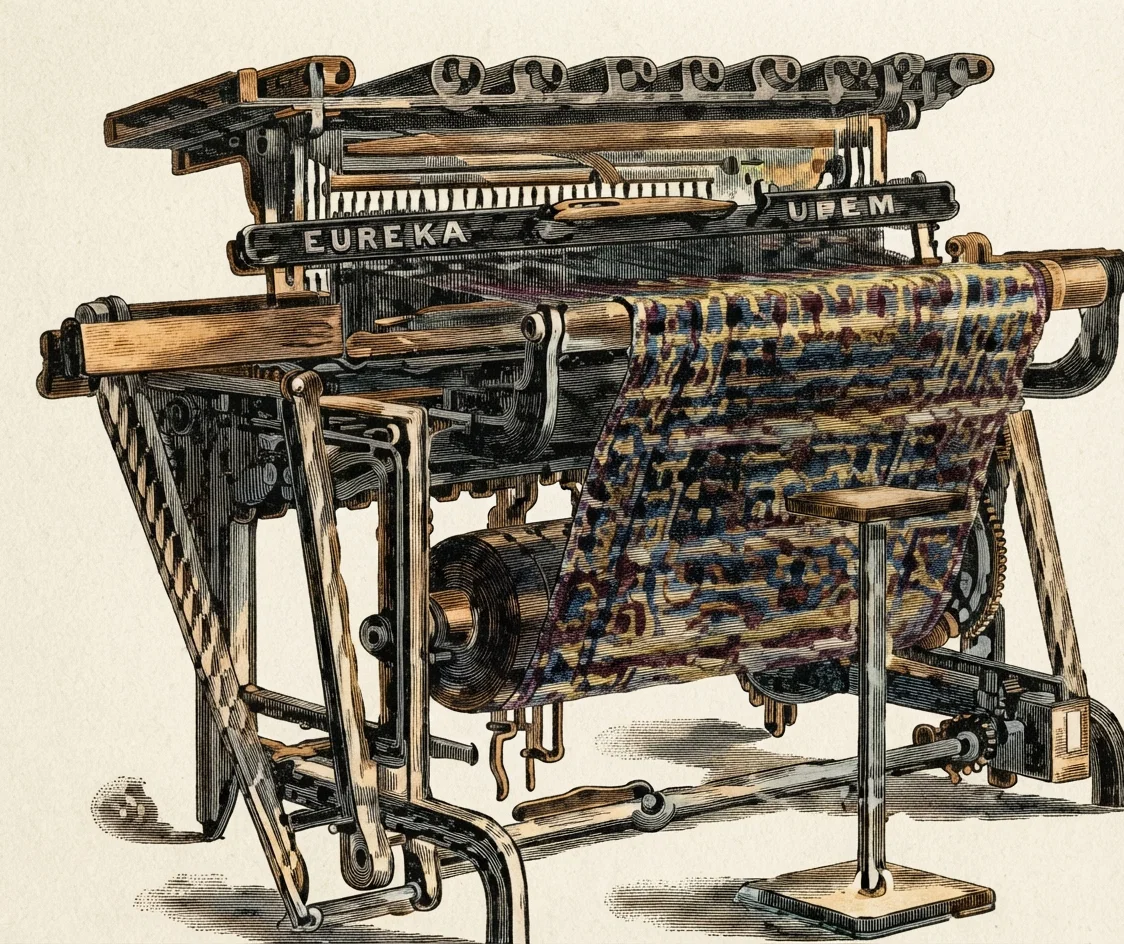
FLY SHUTTLE CARPET LOOM

The best, handiest, easiest running, cheapest, and most durable

FLY SHUTTLE CARPET LOOM

In the world,—100 yards a day. Catalogue free.
EUREKA LOOM CO. 5018 Main St., Battle Creek, Mich.
When you write, please mention the SIGNS OF THE TIMES.

Forecast of Other Special Issues

Of the ...Signs of the Times... for 1899

You Have Been Wanting

A College Education

Do You Want One Still?

Then Read Our Offer

We will give you a free scholarship of one year, including board, room, and tuition, in any one of the following colleges or academies:—
Union College, Lincoln, Nebraska Walla Walla College, College Place, Wash. Healdsburg College, Healdsburg, Cal. South Lancaster Academy, S. Lancaster, Mass. Mt. Vernon Academy, Mt. Vernon, Ohio Keene Industrial Academy, Keene, Texas Southern Industrial School, Graysville, Tenn.
Upon the condition that you secure for us a certain number of yearly subscriptions for THE SIGNS OF THE TIMES, at one dollar ($1.00) each.
The number of subscriptions required to entitle you to a scholarship in Union College, Healdsburg College, Walla Walla College, South Lancaster Academy, Mt. Vernon Academy, and Keene Industrial Academy, is 140. One hundred subscriptions will entitle you to a scholarship in the Southern Industrial School, at Graysville, Tennessee. These subscriptions must be accompanied by the cash, $1.00 for each subscription, and must be sent to us direct.
If you are interested in securing an education without financial expense to yourself, write us for particulars and instructions. We are making you an offer of great intrinsic value,—an offer whose acceptance will mean much in your future usefulness, whatever your field of labor. Send for catalogues to the schools named above, and write us at once in order that you may begin work without delay.
Address, SIGNS OF THE TIMES, Subscription Dept. Oakland, Cal.

ALL KINDS, PRICES REASONABLE

Nut Mills, Nuts, Nut Foods,
Malt Extract, Malted Foods,
Health Foods

ALL KINDS, PRICES REASONABLE

For descriptive price-list write
Knapp Brothers
407 E. Burnside St. East Portland, Ore.

Lessons by Mail on Medical Electricity or How to Use the Battery

By Prof. G. L. Abell
Member of the Board of Directors of the Electro-Medical Society of San Francisco.
Learn how to use the battery and treat yourself. Many diseases are quickly cured by the proper application of electricity. The course embraces the treatment of every organ and part of the body. The lessons are written in plain language and are illustrated. Course, five dollars. Send for circular. Address,
PROF. G. L. ABELL, School of Chemistry and Electro-Therapeutics. 22½ Geary St., San Francisco, Cal.

WE WISH YOU TO KNOW

that we have arranged with BATTLE CREEK COLLEGE to give you a...

Free Scholarship of one year, including board, room and tuition

Read the statement below

THE BATTLE CREEK COLLEGE

A Training School for Christian Workers Battle Creek, Mich.
"Come thou with us, and we will do thee good."
This institution is devoted exclusively to the spiritual, physical, mental and moral training of young men and women, that they may be prepared to go out to service for God. Practical courses are given in every line of study necessary for this work. Special attention is given to training for the ministry, missionary teaching, house-to-house Bible work, colporter work, and for foreign mission service. Students have abundant opportunity each day to put into practice what they have learned.
A prominent feature in the educational work of this College is the instruction and practice given in manual training, including farming, carpentry, broom making, shoe making, tailoring, dressmaking, cooking and nursing.
Board is offered in the College boarding hall on the European plan, which enables the student to control and greatly curtail his expense on this item.
To those who solicit subscriptions for the "SIGNS," Special inducements are offered at rates far below the regular fees.
For further particulars on this offer, write to "SIGNS OF THE TIMES," Oakland, Cal.
For further information concerning the School, address BATTLE CREEK COLLEGE, Battle Creek, Mich.

CHRIST OUR PASSOVER.

THERE is something inexpressibly sweet about the spiritual atmosphere in which the Christian word "Passover" is embedded. The very fountain-head, the very well-spring of those traits and attributes of character which appeal to our better natures as being divine, and which cause us to long for a pure and untainted experience, free from every defilement of self and sin, dwell in the sacred thought and idea which nestles in the bosom of the holy Passover.
When some poor trembling soul, guilty of a scarlet sin, standing in the presence of One who has the power to forgive, hears the welcome words, "I will pass over your offense and say no more about it," instantly he is filled with intense joy and feelings of deep relief. But the results of this act of "pass over" and mercy end not here; in widening circles upon the bosom of life's vast ocean of humanity, it touches springs of sympathy in the heart of many a man and woman, and extends through the finite to the infinite, till those waves of joy which started in the heart of the pardoned one terminate in throbs of pleasure, in the great heart of Eternal Majesty,—in the soul of God the Father, where the great thought of the Passover was born before ever sin and sorrow were.
Dark hung the pall of slavery over the land of Egypt. The beloved of God were bondmen. The seed of Abraham the faithful, of Isaac, the child of promise, and of Jacob, whose name an angel changed to Israel,—a prince with God,—for full four hundred years had suffered stern sorrows in the grim grasp of bitter bondage.
The condition of slavehood breeds wreck and ruin. The finer sensibilities of the souls of men are necessarily blunted by its blighting influences. This has been so in all climes and in all ages. And the effects of servitude upon the descendants of Joseph's brethren were no exception to the common rule.
It was sin which had fastened the shackles of slavery upon Israel. In a spiritual sense every son and daughter of Adam has been bound in slavery by sin. And degradation has followed in the train of enslavement, till the image of God, in which we were created, is now so faintly visible that these poor eyes of ours, bedimmed by sin, scarce recognize it in our fellow-beings.
But "Christ our Passover is risen for us," and through His tender ministry, with eyes undimmed by the lapse of years, and with spiritual vision untainted by the first contact with sin, God, the loving Father, still passeth by our iniquity and transgression, still sees in men and women, no matter how fallen and degraded, His own blest image in which we were created. And 'tis a blessed thought that day by day as we draw closer to God we see less of sin in others, and more and more is the divine, which still dwells in the souls of those with whom we have to do, revealed to us.
Steeped in sin and slavery as Israel was, God claimed him as His own—yes, claimed relationship to him. "Thou shalt say unto Pharaoh, Thus saith the Lord, Israel is My son, even my first-born; and I say unto thee, Let My son go, that he may serve Me; and if thou refuse to let him go, behold, I will slay thy son, even thy first-born."
Is there a soul bound in sin, sorrow, and sadness, let him look up and take courage, for, no matter how sinful, how degraded, how firmly bound in the slavery of sin, God still claims us as His own, still speaks those all-powerful words, "Let My son go."
Then came that memorable night when God delivered Israel, and on which the Passover feast was instituted and celebrated for the first time. "Speak ye unto all the congregation of Israel, saying, In the tenth day of this month they shall take to them every man a lamb, according to the house of their fathers, a lamb for an house." No priest officiated at this ordinance. It concerned too sacredly the welfare of every individual son and daughter of Israel to permit of this. It was not solemnized in any temple or sacred edifice consecrated to religious service. Each father gathered loved wife and precious children around him in the family dwelling, and in later times the Saviour ate His last Passover in an upper chamber in a private dwelling.
It is even so to-day. Christ, who is our Passover may be found and spiritually partaken of in the quiet little upper chambers of our homes. No temple walls confine Him; no priest is necessary to give Him to us. The partaking of Christ our Passover is an individual work for every soul.
"In the evening" shall ye kill the lamb. It is when the shades of night draw over our souls, when dreary sin presses its lengthening shadows over us,—when it is that we must look up, for in the evening the lamb was slain; at midnight deliverance came. When bondage and thralldom in sin seems to be the most complete, and when deliverance is least expected, then it is that God bursts through darkest clouds, and shines, dispelling deepest night. As Israel was delivered when earth was enshrouded in the sable mantle of night, so it is at midnight that the history of this earth closes, Christ comes, and the saints are gathered home. For long ago it was written: "In a moment shall they die, and the people shall be troubled at midnight, and pass away; and the mighty shall be taken away without hand." "And it shall come to pass in that day, that the light shall not be clear, nor dark; but it shall be one day which shall be known to the Lord, not day, nor night; but it shall come to pass, that at evening-time it shall be light. And it shall be in that day, that living waters shall go out from Jerusalem."
To many a soul in the midnight of sin the Saviour has come and burst the fetters in the hour when, to all human appearances, they seem to be the strongest. Even the conversion of Saul took place when he was on his road to Damascus to persecute the church of God. How true are the words of Elihu in the book of Job: "Now men see not the bright light which is in the clouds."
For every household a lamb was to be slain, and says the record: "And if the household be too little for the lamb, let him and his neighbor next unto his house take it according to the number of the souls; every man according to his eating shall make your count for the lamb." Christ Jesus is the paschal lamb. The household may be too little for the Lamb, but the Scriptures do not intimate that there could ever be a possible chance that the lamb would not be sufficiently ample for the household.
Christ Jesus is a sufficient Saviour for every soul. Every man to-day, as then, may call his neighbor next unto him to share in the feast, and still there is salvation in plenteous degree for all.
"And they shall take of the blood, and strike it on the two side-posts and on the upper door-post of the houses, wherein they shall eat it." "And the blood shall be to you for a token upon the houses where ye are; and when I see the blood, I will pass over you, and the plague shall not be upon you to destroy you, when I smite the land of Egypt." It is not enough to have a theoretical knowledge of the saving power of the blood of Christ—it must be applied, it must be stricken upon the very portals of the heart. How precious are the words, "And when I see the blood, I will pass over you"! It is for the mark of the blood of Christ upon us that God watches. He calls not for our own righteousness, but for that one stain on the soul, the only stain which is desirable, the crimson stain of Christ's own blood.
A very touching story is told of that first Passover night. The lamb had been slain, and ready for the feast; the family were assembled in the humble dwelling, the door was shut, and all were waiting for the dread hour when the angel should smite the first-born of every house whose portal bore not the saving token of the blood. From her fitful slumber the young daughter of the house, the eldest born, awoke with the cry, "O father, is the blood upon the door?" The father assured his tender child that all was well, for their faithful servant had been intrusted with the service; but the daughter could not be satisfied, and again, in deepest anxiety, she asked, "Are you sure the blood's upon the door?" Finally the father yielded to the entreaty of his child, and carried her in his arms to see the sprinkled door. To his consternation, he found no sign which should turn aside the destroying angel, and then in haste he grasped the hyssop and himself applied the blood. With how much anxiety should every Christian ask himself the question, "Has the blood been stricken upon my soul?" "Has it been applied to wash away the stain of sin?"
"And thus shall ye eat it; with your loins girded, your shoes on your feet, and your staff in your hand; and ye shall eat it in haste; it is the Lord's Passover." How beautiful is the imagery in this verse! There must be no delay in partaking of Christ, who is our Passover. The blessed Lamb has been slain, and is offered to us, and while mercy's door is open, we must take the proffered Gift in haste, lest it be withdrawn. We must do it with our loins girded, as men who expect to go forth on the Christian's march, battling with temptation and with trial. Moreover, it was also said to Israel: "And they shall eat the flesh in that night, roast with fire, and unleavened bread; and with bitter herbs they shall eat it. Eat not of it raw, nor sodden at all with water, but roast with fire; his head with his legs, and with the purtenance thereof. And ye shall let nothing of it remain until the morning; and that which remaineth of it until the morning ye shall burn with fire." We can not be Christians in part. Christ must be accepted wholly, or He can not be accepted at all. The whole of the Lamb must be eaten, and nothing must be allowed to remain till the morning. For when the morning of life's long night shall ultimately break, Jesus will then have been sealed in all of His saints. He must be taken now, ere the morning dawns, for then there are only the burnings with fire for those who are out of Christ.
We are living in the great antitypical Passover time. Soon will the cases of all of us come into review before the great Judge above."When I see the blood, I will pass over you, and the plague shall not be upon you to destroy you." The cases of men are being settled, settled for time and eternity. Christian, is the blood applied, and when the Master reaches your name upon the books above, will He see the crimson stain, not of sin, but of the blood of Christ, which washes all sin away?

WATCHING.

HARK! the warning word is spoken, Teaching us to watch and pray For the Master's soon returning, When all night will turn to day.
Dear one, do you heed the warning? For His coming do you long— For the resurrection morning, When we'll join the blood-washed throng?
Then we'll see our Lord, our Saviour, See the Master as He is— We'll be like Him, yes, forever, Like Him, with Him, ever His.
C. F. LADD. Jersey City, N. J.

A RISEN SAVIOUR.

"Why seek ye the living among the dead? He is not here, but is risen." This question was asked the women who came to the sepulcher to anoint the body of Jesus. The mighty angel from the heavenly courts had, a short time prior to this, rolled away the stone from the sepulcher. Now, in company with another angel, he converses with the women. These angels are come on a mission of peace and good cheer. When they appeared to the shepherds on the hills around Bethlehem, some thirty-one years before this, they announced "good tidings of great joy, which shall be to all people," "a multitude of the heavenly host praising God, and saying, Glory to God in the highest, and on earth peace, good-will toward men." Now they come to announce that Jesus is not in the tomb, but "is risen, as He said. Come, see the place where the Lord lay. And go quickly, and tell his disciples that He is risen from the dead; and, behold, He goeth before you into Galilee; there shall ye see Him." This announcement filled their hearts with gladness, for it is said, "They departed quickly from the sepulcher with fear and great joy."
What a comforting message there is in these words to every trembling, troubled heart that is yearning for such comfort as only Christ can give! What soul satisfaction to hear the glad announcement that they have a risen Saviour, not one who is shut up in Joseph's new tomb, with a Roman seal upon it! He is not dead, but lives. He does not call us to weep and mourn over Him, for He is the mighty Helper who dispels all our grief and sorrow. He does not call us to the grave to find comfort in desolation, for He is the mighty Conqueror over death and the grave.
No message ever carried with it so much assurance of hope and good cheer to the sorrowing disciples as did this one that gave conviction that they had a living Saviour. The same is true in all the world. Jesus lives to make intercession for every one. The One who has conquered death and the grave, is able to conquer every temptation and trial that comes to any one; so that it matters not what the temptation is, He will with the temptation make a way of escape.
Christ took on Himself the seed of Abraham. "Wherefore in all things it behooved Him to be made like unto His brethren, that He might be a merciful and faithful high priest in things pertaining to God, to make reconciliation for the sins of the people. For in that He Himself hath suffered being tempted, He is able to succor them that are tempted." Heb. 2:17, 18.
A risen Saviour was the key of the prophet's visions (Hosea 6:1, 2) and the shepherd's psalms (Ps. 16:10; 23:1-6). David would have us know that the grave could not hold the Son of God, and that when He came to pass through the dark valley, He had a Companion who was acquainted with the road. Hosea would point us to the "third day," when He should be raised up, and heal that which is torn, and bind up that which is smitten.
Daniel, the beloved of Heaven, sees in prophetic vision the Messiah the Prince, the Anointed of God. He is the one who ratifies the everlasting covenant with His own blood, and yet lives, "the great Prince who stands up" for the people of God when there is "the time of trouble such as never was since there was a nation."
It is the time when the dead are raised from their graves and delivered. The prophet does not base his hope on the fact that the Messiah was to be cut off, but that He lives, as Michael, the Prince of the covenant, the "One like the Son of man." He sees Him coming to the Ancient of Days to receive "dominion, and glory, and a kingdom, that all people, nations, and languages, should serve Him: His dominion is an everlasting dominion, which shall not pass away, and His kingdom that which shall not be destroyed."
Jesus, while conversing with the two disciples on the day of His resurrection, exclaimed: "O fools, and slow of heart to believe all that the prophets have spoken; ought not Christ to have suffered these things, and to enter into His glory? And beginning at Moses and all the prophets, He expounded unto them in all the Scriptures the things concerning Himself." Luke 24:25-27.
Again, as He meets with the disciples in the upper chamber, He brings to them the comforting message, "Peace be unto you." The disciples were not prepared to receive it as a communication of peace. They must be convinced that it is their risen Lord. "And as they thus spoke, Jesus Himself stood in the midst of them, and saith unto them, Peace be unto you. But they were terrified and affrighted, and supposed that they had seen a spirit. And He said unto them, Why are ye troubled? and why do thoughts arise in your hearts? Behold My hands and My feet, that it is I Myself; handle Me, and see; for a spirit hath not flesh and bones, as ye see Me have. And when He had thus spoken, He showed them His hands and His feet. And while they yet believed not for joy, and wondered, He said unto them, Have ye here any meat? And they gave Him a piece of a broiled fish, and of an honeycomb. And He took it, and did eat before them. And He said unto them, Those are the words which I spake unto you, while I was yet with you, that all things must be fulfilled, which were written in the law of Moses, and in the prophets, and in the psalms, concerning Me."
"Then opened He their understanding, that they might understand the Scriptures, and said unto them, Thus it is written, and thus it behooved Christ to suffer, and to rise from the dead the third day; and that repentance and remission of sins should be preached in His name among all nations, beginning at Jerusalem. And ye are witnesses of these things." This last sentence is specifically for every one who is a new creature in Christ Jesus. On the day of Pentecost Peter said, "We all are witnesses." Again, He attributes the healing of the lame man at the Beautiful Gate, to faith in the name of a risen Saviour, "whereof we are witnesses." "Neither is there salvation in any other; for there is none other name under heaven given among men, whereby we must be saved." This is the work of salvation that is brought to every soul. "But the righteousness which is of faith speaketh on this wise, Say not in thine heart, Who shall ascend into heaven? (that is, to bring Christ down from above) or, Who shall descend into the deep? (that is, to bring up Christ again from the dead.) But what saith it? The Word is nigh thee, even in thy mouth, and in thy heart: that is, the Word of faith, which we preach; that if thou shalt confess with thy mouth the Lord Jesus, and shalt believe in thine heart that God hath raised Him from the dead, thou shalt be saved."
We must be ready with the apostle to say, "I am crucified with Christ; nevertheless I live; yet not I, but Christ liveth in me; and the life which I now live in the flesh I live by the faith of the Son of God, who loved me, and gave Himself for me." Paul believed in a risen Saviour. So must we. We must come to the point where we can say, "But Christ liveth in me." He is not dead, but alive, hence we must "reckon ourselves to be dead indeed unto sin, but alive unto God through Jesus Christ our Lord." This is the mainspring of Christianity. It is the secret of a successful experience in the things of God. This knowledge must be inwrought into our very souls. No other knowledge brings with it such satisfaction as does this. To the child of God it is the distinction of the Spirit of God from the spirit of anti-christ. 1 John 4:3. To both Christian and infidel it is the mystery of godliness that is working mightily to present every man perfect in Christ Jesus. It is "Christ in you, the hope of glory." It is the power of God unto salvation to every one that believeth; to the Jew first, and also to the Greek.
What power, what peace, what rest, what comfort, what assurance, is couched in these words! Truly we can say, with Adam, Christ is the seed of the woman that is to bruise the head of the serpent. No power can stand against Him. Like Abraham, we may find in Him the King of Salem, King of Peace. His peace comes, not as the world gives, but like the calm, deep moving of a mighty river. Trouble may come to us, but He bears it all.
He is the Shiloh to our souls. We may be weary and heavy-laden, but He lives, and bids us to come unto Him and find rest. With Isaiah, we may say, Immanuel, "Wonderful, Counselor, The mighty God, The everlasting Father, The Prince of Peace;" or, with Jeremiah, "The Lord our righteousness."
L. A. Hoopes.

THE POWER OF THE RESURRECTION.

THE power of the resurrection is the complete victory over death. This must be true in every nature of the case. Says the apostle: "Forasmuch then as the children are partakers of flesh and blood, He also Himself likewise took part of the same; that through death He might destroy him that had the power of death, that is, the devil." If the one who has the power of death is to be destroyed, then death also must share in the same defeat. This is more emphatically stated in the Second Epistle to Timothy, where it says that "our Saviour Jesus Christ, . . . hath abolished death, and hath brought life and immortality to light through the Gospel."
But does resurrection power embrace more than deliverance of Christ from the thraldom of death? If it does not, the human family would still be lost and undone. But, O blessed consolation, the deliverance of Christ through His resurrection wrought deliverance for every soul in Christ! Heb. 2:15; Rom. 4:24, 25. The Life-giver entered the prison-house of the strong man, and, defeating him in his own stronghold, brought away with Him the keys of his dominion. He says: "I am He that liveth, and was dead; and, behold, I am alive forevermore, Amen; and have the keys of hell and of death." As Christ brought with Him the keys of death and of the grave, so there is lodged with Him the power to unlock every grave at will. "The hour is coming, in the which all that are in the graves shallhear His voice, and shall come forth: they that have done good, unto the resurrection of life; and they that have done evil, unto the resurrection of damnation." "For the Lord Himself shall descend from heaven with a shout, with the voice of the archangel, and with the trump of God; and the dead in Christ shall rise first." This is the comfort of the sleeping saints. Their enemy does not hold the key to the tomb, but the keys of death and of the grave are in the control of One who is their Friend, and who, in their experience, both in life and death, has become fully identified with them.

The Power of the Resurrection Is Victory over Sin.

That this likewise is true in the very nature of the case must be self-evident. The fullest development of sin is death. "When lust hath conceived, it bringeth forth sin; and sin, when it is finished, bringeth forth death." Death is the final fruition of sin, as sin is of lust. "For the wages of sin is death." Hence to obtain victory over the strength and power of sin,—that is, death,—is to obtain the victory over sin in its detail and fulness. Rom. 5:8-10, 17.

Where There Is No Sin There Can Be No Death.

It follows logically that if death is the result of sin, then where there is no sin, there can be no death. While the end of sin is death, the end of righteousness is declared to be life eternal. Rom. 6:20-23. Christ "did no sin, neither was guile found in His mouth." He was the spotless One from God. He Himself declares, "Satan cometh unto Me and hath nothing in Me." But Christ came under the power of death. How was this possible, if there can be no death where there is no sin?
In entering under the dominion of death Christ fell not as the lawful prey to the grim destroyer, but, standing in the sinner's place, He met the penalty of a broken law, suffering in man's stead, that, by the power thus attained, He might recover man from the thraldom of sin and death, and raise him up to sit with Himself in righteousness and glory. Eph. 2:4-7. "He was wounded for our transgressions, He was bruised for our iniquities." "The Lord hath laid on Him the iniquity of us all." Christ voluntarily entered the dominion of the enemy. His soul was made an "offering for sin." He "poured out His soul unto death." He Himself declared, "I have power to lay it [My life] down, and I have power to take it again." But as Christ, on account of His righteousness, voluntarily submitted to the power of death, it could have no authority to retain Him under its dominion. He could not be holden of it. Acts 2:24.

Death Can Not Hold the Children of God.

As death could not hold Christ under its dominion, when He was manifested in this world in the person of Jesus, neither can death hold Christ under its dominion when He is manifested in this world in the lives and characters of His followers.
There is an antithesis between righteousness and death. Life is the fruit of righteousness, as death is the fruit of unrighteousness, and these are two great opposing principles; but righteousness and life through Christ have triumphed, and triumphed most gloriously; hence in every conflict righteousness and life must come out triumphant. "If the Spirit of Him that raised up Jesus from the dead dwell in you, He that raised up Christ from the dead shall also quicken your mortal bodies by His Spirit that dwelleth in you." Rom. 8:11. See, also, 1 Cor. 6:14.

Resurrection Power in Christian Experience.

While the resurrection of the literal body is an oft-emphasized doctrine, a figure is drawn from this display of God's power at the last day to indicate the change which must take place in the life of His children in this world. Col. 2:12, 13. This, for convenience, might be termed the spiritual resurrection as distinguished from the literal resurrection at the coming of the Lord. The apostle Paul refers to this when he says that we may "know Him, and the power of His resurrection, and the fellowship of His sufferings, being made conformable unto His death." Phil. 3:10.
As the fellowship of Christ's sufferings will be known to His children in this life, so must the power of His resurrection be likewise experienced; and in knowing the power of His resurrection, and the fellowship of His sufferings, and in being made conformable unto His death, we really come to know God. See Eph. 1:18-20. This resurrection is the resurrection "from dead works to serve the living God." Heb. 9:14. It is the change whereby the "old man is crucified with him, that the body of sin might be destroyed, that henceforth we should not serve sin." He that is thus dead to sin is freed from its power. He rises to a new plane of existence; he comes to know the power of the resurrection. Rom. 6:3-11. "He is a new creature" in Christ Jesus. 2 Cor. 5:14-17. He has then risen with Christ, and his affections twine around the things of God instead of the things of this earth. Col. 3:1, 2. He has heard the call, "Awake, thou that sleepest, and arise from the dead, and Christ shall give thee light;" and, heeding this call, he has come into the light and liberty of the sons of God. Rom. 8:14-16. He believes on the Son; hence there has been given to him the precious boon of eternal life. John 3:16; 6:47; 5:11, 12. His life may be surrendered to the Master's service. There may be a short interim of sleep; but in God's purpose it exists, and, like the life and righteousness of Christ, can not be holden by the power of the tomb. The mortal body may die, but the life will be hid "with Christ in God;" and when Christ, who is the life, shall appear, then shall every individual of his children appear with Him in glory. Col. 3:3, 4.
May this be the attainment of our victory in Him. May we know the power of the spiritual resurrection in our lives here, that we may experience the transforming power of God in our mortal bodies when Jesus comes. 1 Cor. 15:51-55; Phil. 3:20, 21.
FRANCIS M. WILCOX.
Continue reading: WITHERED CHRISTIANS