Your ShelfYour Projects

Signs of the Times, Vol. 24, No. 13.

FAITH IN THE TREATMENT OF DISEASE

Signs of the Times

Mar 31, 1898

Pacific Press Publishing Company · Oakland, California · Mar 31, 1898

FAITH IN THE TREATMENT OF DISEASE.
The question of healing by faith is one that in these days of increasing disease and sickness is occasioning much discussion. So ready are the sick to avail themselves of any means which promises relief from suffering, that, like the drowning man catching at straws, they follow up every avenue in the hope of gaining much-sought health.
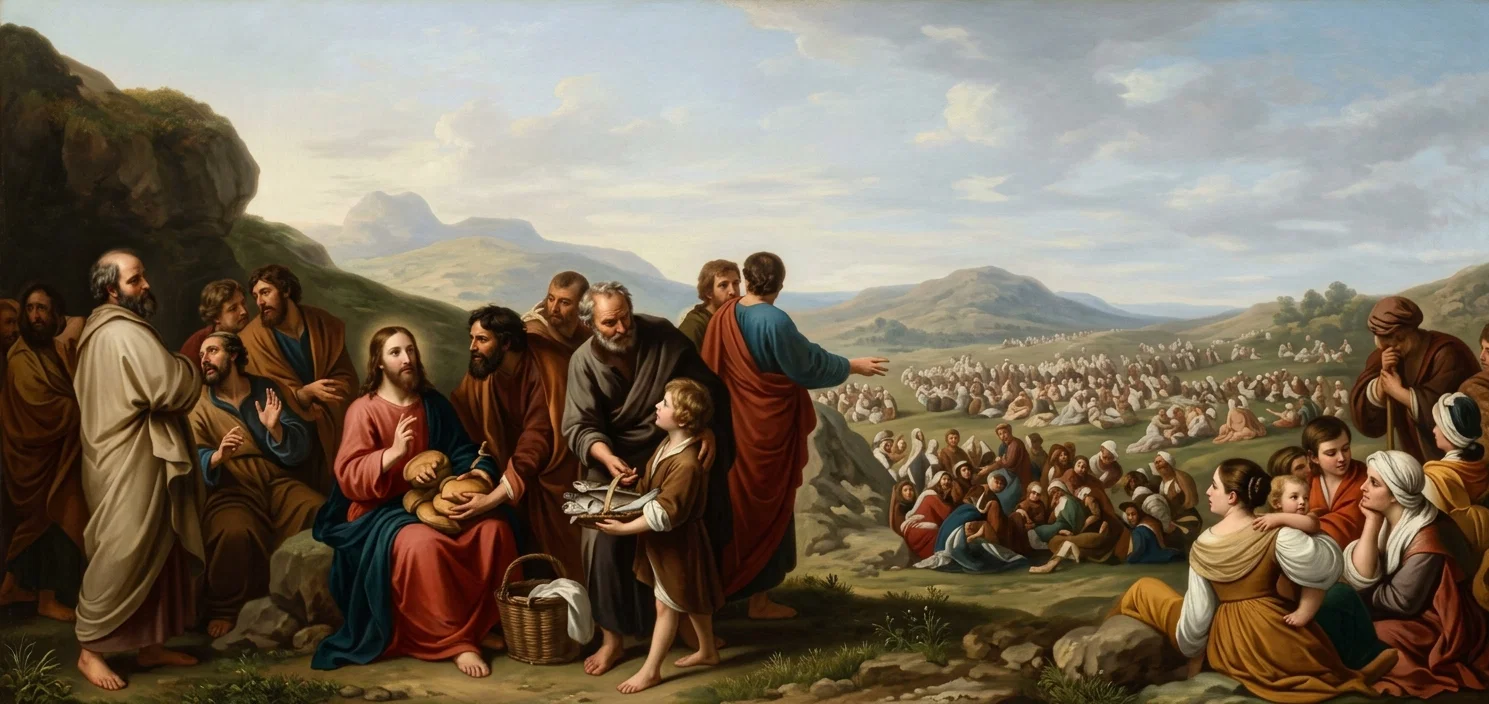
FEEDING THE FIVE THOUSAND.
“Jesus said unto them, They need not depart; give ye them to eat. And they say unto Him, We have here but five loaves, and two fishes. He said, Bring them hither to Me. And He commanded the multitude to sit down on the grass, and took the five loaves, and the two fishes, and looking up to heaven, He blessed, and brake, and gave the loaves to His disciples, and the disciples to the multitude. And they did all eat, and were filled.” Matt. 14: 16-20
FEEDING THE FIVE THOUSAND. “Jesus said unto them, They need not depart; give ye them to eat. And they say unto Him, We have here but five loaves, and two fishes. He said, Bring them hither to Me. And He commanded the multitude to sit down on the grass, and took the five loaves, and the two fishes, and looking up to heaven, He blessed, and brake, and gave the loaves to His disciples, and the disciples to the multitude. And they did all eat, and were filled.” Matt. 14: 16-20
It is desire rather than faith which leads to the large patronage of patent medicines and nostrums. And the power of such men as Schlatter over the masses is a power achieved through a hope on their part that possibly in some way there may be in the man power to heal disease. The quackery and charlatanism practised by such deceivers lead many of the disappointed sufferers to feel that there is no power which can alleviate their distress, and has an effect to cause the more conservative to regard with contempt everything under the name of divine healing. But entirely aside from all of these delusive movements, considering the question alone from the teaching of the divine Word, and from the standpoint of unbiased reason, is it consistent to believe that the Lord now, as in days of old, will manifest His divine power in the healing of disease? All admit that the first century witnessed the working of miracles. Was it the design of the great Miracle-worker that this power should continue with His church? That it was, is evident from the great Gospel commission, as recorded in the Gospel by Mark: “And these signs shall follow them that believe: In My name shall they cast out devils; they shall speak with new tongues; they shall take up serpents; and if they drink any deadly thing, it shall not hurt them; they shall lay hands on the sick, and they shall recover.” In the twelfth chapter of I Corinthians, one of the gifts of the Spirit is set forth as the healing of disease and the working of miracles; and the gift of the Holy Spirit, and all that follows in its train, is promised to as many as the Lord our God shall call, throughout the extent of the Gospel work. Acts 2:38, 39. Hence we must conclude that there has been no lessening of the power and willingness of God to heal to-day even as of yore. The Lord God changes not. With Him is no variableness, neither shadow of turning. He is the same yesterday, to-day, and forever. Therefore, if we do not see the same divine manifestations, the fault is with us, and is because our faith is too weak to claim the fulness of the promise.
The world to-day is so prone to subject every question and proposition to the test of so-called reason that faith is made difficult to exercise. And yet if we would but open our eyes and recognize the workings of God in nature, it would be more easy by faith to lay hold of the unseen. Paul inquires of Festus, “Why should it be thought a thing incredible that God should raise the dead?” Not alone by divine revelation, but also from the great book of nature, may we learn of God’s power to raise the dead and to heal disease . In the accomplishment of His work, either in a general way or for the special help of His people, God works by what we might term direct and indirect methods.
In the great book of nature we have the indirect method illustrated, while in the written Word we have a record more particularly of the employment of direct methods of working. We will illustrate. The husbandman plants in the bosom of mother earth the seeds of wheat. By a slow and gradual process it comes up through the various stages of development until it reaches maturity. It is warmed by the sun; it is watered by the rain; it draws strength and nourishment from the soil; and when it has reached its full development, it is taken and by another and more mechanical process is converted into bread. This is God’s indirect method of bread-making. Take now the record of His direct method. Nearly two thousand years ago, when the great Teacher was on earth, occasion found Him instructing a great multitude of five thousand men besides women and children, in a desert place in the vicinity of Galilee. All day long had the people listened to His word, forgetful of their own physical necessities, in the delight they felt at the gracious truths which fell from the Master’s lips. The day was far spent, and before the people could reach the neighboring towns to supply themselves with food, extreme fatigue and exhaustion must have overcome them. The Master supplies their needs, not by the indirect process of bread-making, but by a more direct method. Five barley loaves and twosmall fishes were brought forward, and these by the power of God were multiplied to that extent that after the large multitude had eaten their fill, more remained of the fragments than had been contained in the original quantity of bread. Is there any more of a manifestation of the divine power in the multiplication of the five loaves in the wilderness of Galilee than may be daily witnessed in the multiplication of the bread product growing in our fields? It must be admitted that in both instances it was the same power, only manifested in different ways. The turning of the water into wine serves another illustration of where God worked by a direct method instead of the indirect, and yet in that miracle there was no more of the power of God shown than in the converting of water into wine to-day through the growing of the grape, and the process of wine-making.
In the relation the Lord has sustained to the sick and suffering, as brought to view in His Word, we see the employment of the same two methods. The direct method is shown in the cleansing of the leper, the healing of the woman with an issue of blood, the raising of Jairus’ daughter, the resurrection of Lazarus; and many other miracles that might be noted. In the indirect method the healing was accomplished usually through the employment of natural agencies. An example of this kind is shown in the case of Hezekiah, king of Israel. He was afflicted with a terrible boil that in its natural course would have brought him to the grave. In answer to his prayer God sends assurance that he will live, and as a means for the recovery of health, directs that a plaster of figs should be placed upon the boil. As the result, Hezekiah recovered. In the case of the blind man, Christ covered his eyes with an ointment of clay. The question naturally arises, Did the figs in the case of Hezekiah, or the clay in the case of the blind man, possess any medicinal value or restorative virtue? To claim that they did not would be to impute to the Lord the performance of senseless service. Is it as truly a manifestation of divine power where cures are wrought by the employment of agencies as where they are wrought directly? It was certainly so regarded by Hezekiah, and by the blind man who received healing at the hands of Christ. These examples must forever settle the question whether it is right in combating disease to employ means and agencies. From the action of Isaiah, and also of our Saviour, we must conclude that it is.
Where the cure of disease is wrought by the employment of means, the great danger is that the credit will be given to the means, and that the power of God operating through the means will be left out of mind. A physician may employ electricity in the accomplishment of a desired result, and the patient, ignorant of the power of this influence, may look at the metal electrode through which the power is conveyed, and feel that the metal itself imparts to him the sensations which he experiences, not realizing that the metal is only the agent by which the electricity is conveyed.
If in dealing with the afflicted to-day every physician would realize that he must prescribe in faith, every nurse that he must administer the treatment in faith, and every patient that the treatment must be received in faith, the power of God working through the means would be much more effective and efficient. It is for none to direct his mind to the means as the power in the accomplishment of the work, but to the power of God back of the means and working through the means for the recovery of health.
We would not contend that the employment of rational means would not benefit a man who failed to recognize the power of God behind it. The world in its wickedness, even though it recognizes not God, is still blessed by Him. But as it is certainly true that in the application of the power of God in the spiritual way, that power works effectually in the believer, so it is just as evident that the power of God in a physical sense will be more effectual in the case of him who recognizes its divine source and authority. If the power of God is indeed manifested in the indirect methods in the healing of disease, it is but a step to recognize that same power working in a direct manner to-day as in the times of Christ. Whether the method of healing is direct or indirect, it is the power of God that accomplishes the work. And if that power is recognized and appropriated, and received in faith, it becomes healing by faith. God will honor the faith that recognizes Him. F. M. W.

THE TIME OF THE ATONEMENT.

REGARDING, as we must from the evidence presented in former papers, the atonement as Christ’s closing work for the world, the time when that service is being performed becomes the most solemn period in the history of the fallen race. To those who are alive when it closes, the time will be one of infinite consequence, as marking the end of their probationary career. Will God bring such an event suddenly upon men, and that without ample warning? To do this would not be in line with all His recorded dealings with men; for surely, when He designed to bring a flood of water upon the earth, to destroy it, He gave adequate notice of His intention, telling Noah that the world should have a hundred and twenty years of probation, in which to prepare for that event. Gen. 6:3.
Everything permitted to come upon the world, which would affect the destiny of His people, or any part of them, has been faithfully heralded beforehand, that all might be fully prepared to meet the issue. Moreover, He has said, “Surely the Lord God will do nothing, but He revealeth His secret unto His servants the prophets.” Amos 3:7. It must be, therefore, that the prophets have somewhere revealed whatever is good for man to know of this most important matter.
Turning to the book of Daniel, we will find the record of a conversation between two heavenly beings upon this very subject. Said the prophet: “I heard one saint speaking, and another saint said unto that certain saint which spake, How long shall be the vision concerning the daily sacrifice, and the transgression of desolation, to give both the sanctuary and the host to be trodden underfoot? And He said unto me, Unto two thousand and three hundred days; then shall the sanctuary be cleansed.” Dan. 8:13, 14.
The occasion of this vision was a peculiar one to the prophet. He and his people were captives in Babylon, and the earthly sanctuary at Jerusalem, the sacred place of the Jews, was left desolate. This was a matter of great concern to all those captives, and while this calamity weighed upon their minds, it was fitting that the design of that earthly tabernacle should be pointed out through a prophetic vision, not only for the satisfaction of the prophet while in trial of mind, but for the benefit of those who should live when the fulfilment of the vision was to be accomplished.
It will be readily seen that the cleansing here predicted could not refer to the annual cleansing of the earthly sanctuary, since the two thousand three hundred days, if taken literally, would cover a period of nearly seven years. These days could not refer to the time when the Jewish captives in Babylon would return to Jerusalem to renew the services in the tabernacle there; for we well know that their return from that seventy years’ captivity could not begin to take place until 536 B.C., since their bondage began in the year 606 B.C., as shown by the chronological date in the margin of Oxford Bibles, opposite Dan. 1:2.
We must therefore conclude that these days can not be literal measurements of twenty-four hours. An additional reason for this conclusion is that, had the days been literal, the fulfilment of the vision they covered would have been met, not only in the days of Daniel and his people, but while they remained in their Babylonian captivity. But the prophet was told that, while the vision was true, he should shut it up, that is, not reveal it, because it was yet for “many days.” Dan. 8:26. He was also told by the heavenly messenger, in the same conversation, that the vision would be fulfilled at the “time of the end.” Verse 17. The days of the vision must therefore be recognized as symbolic, covering the many events reaching to the closing scenes of earth’s history.
While the rule for measuring time-symbols of prophecy is plainly given, and fully confirmed in various parts of the Bible, it is not necessary, for the present purpose, to look for it beyond the limits of the subject now under consideration. From a study of the first part of the ninth chapter of Daniel’s prophecy, we learn that he supposed the vision to refer entirely to the desolation of the tabernacle at Jerusalem, and that the time mentioned in the prophecy covered the period of the captivity. He therefore began a most earnest prayer to God, for Him to let his face shine upon that downtrodden and desolate sanctuary. Dan. 9:3–19.
While the prophet was thus engaged, the angel who had first talked with him came, and said: “O Daniel, I am now come forth to give thee skill and understanding. At the beginning of thy supplications the commandment came forth, and I am come to show thee; for thou art greatly beloved; therefore understand the matter, and consider the vision.” Verses 22, 23.
The object of this angelic visit was, therefore, to make Daniel understand the matter which was resting so heavily on his mind, namely, the fulfilment of the vision about which he was just then praying. This was to be accomplished by a consideration of the vision again, which the angel began to explain in detail: “Seventy weeks are determined upon thy people and upon thy holy city.” The Hebrew word here rendered “determined” is defined by Gesenius to mean, literally, to cut off; tropically, to divide, and so to determine. The seventy weeks here mentioned by the angel were, therefore, to be “cut off” upon the Jews and their sacred city. But cut off from what?—Why, from that which was under consideration, to be sure. The vision concerning the 2,300 days was the subject receiving attention. So, then, the seventy weeks, or 490 days which composed them, were to be cut off from the 2,300 days, and assigned to the Jews and their city, in the history of the sanctuary work. The remainder of the time, 1,810 days, are devoted to that history after the Jews have fulfilled their part in connection with the sanctuary service.
This division of the 2,300 days is, therefore, clearly settled. But to make the matter doubly sure to all concerned, the angel proceeded to divide the seventy weeks, establishing positive waymarks by which to follow intelligently to their close, and so to ratify the prophecy. He therefore said: “Know therefore and understand, that from the going forth of the commandment to restore and to build Jerusalem unto the Messiah the Prince shall be seven weeks, and threescore and two weeks.”
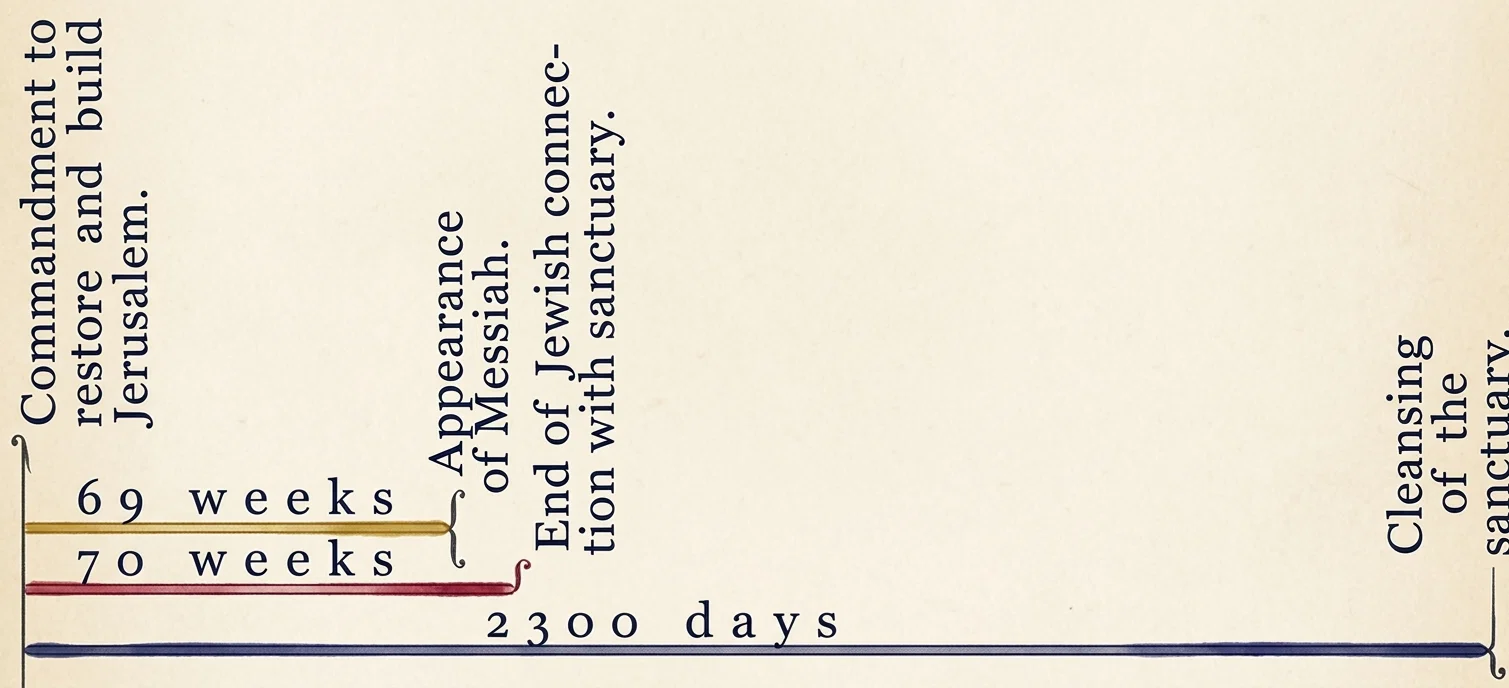
Here, then, is furnished a data from which toreckon the 2,300 days, at the close of which the cleansing of the heavenly sanctuary was to be undertaken. It is very evident from what the angel told Daniel that, the seventy weeks being cut off from the full number of days given in the vision, the beginning of the seventy weeks must be identical with the beginning of the 2,300 days. This being true, the sixty-nine weeks must also begin at the same place, since they are a part of the seventy. This point may be fixed in the mind by a simple diagram, as follows:—
The three horizontal lines shown in the diagram all began at the time when, after the Babylonian captivity, a commandment was going into effect for the restoration of Jerusalem. The shortest of these lines,—the sixty-nine weeks, or 483 days,—reaches to the appearance of the Messiah. The name Messiah means “anointed.” John 1:41, margin. By comparing Acts 10:37, 38 with Luke 3:21, 22, we learn that the anointing of Christ to His work as Messiah, was by the descent of the Holy Spirit upon Him, at His baptism. Looking at the margin of an Oxford Bible opposite the last reference, we find that this anointing occurred in the year 27 of the Christian era.
Tracing these 483 days back to their starting-point, we look for the date of the commandment calling for the restoration of Jerusalem. Immediately upon the close of the seventy years of Babylonian captivity, Cyrus issued a command for such as were interested, to return to Jerusalem to rebuild the house of the Lord. Ezra 1:1–3. Only a little over 42,000 responded to this call. Ezra 2:64. These being too few to carry on the work successfully, matters were left in abeyance for seventeen years, till the reign of Darius, who issued another call for the work to proceed, and that with haste. Chapter 6:12. The people failing to execute the work under these two calls, the third and successful command was issued by Artaxerxes, sixty-two years later. The record of this command is found in the seventh chapter of Ezra, verses 11–26. Verses 7, 8, however, give the date of this command as the seventh year of that king, and the chronological table in the margin shows it to have been some time in the year 457 B.C.
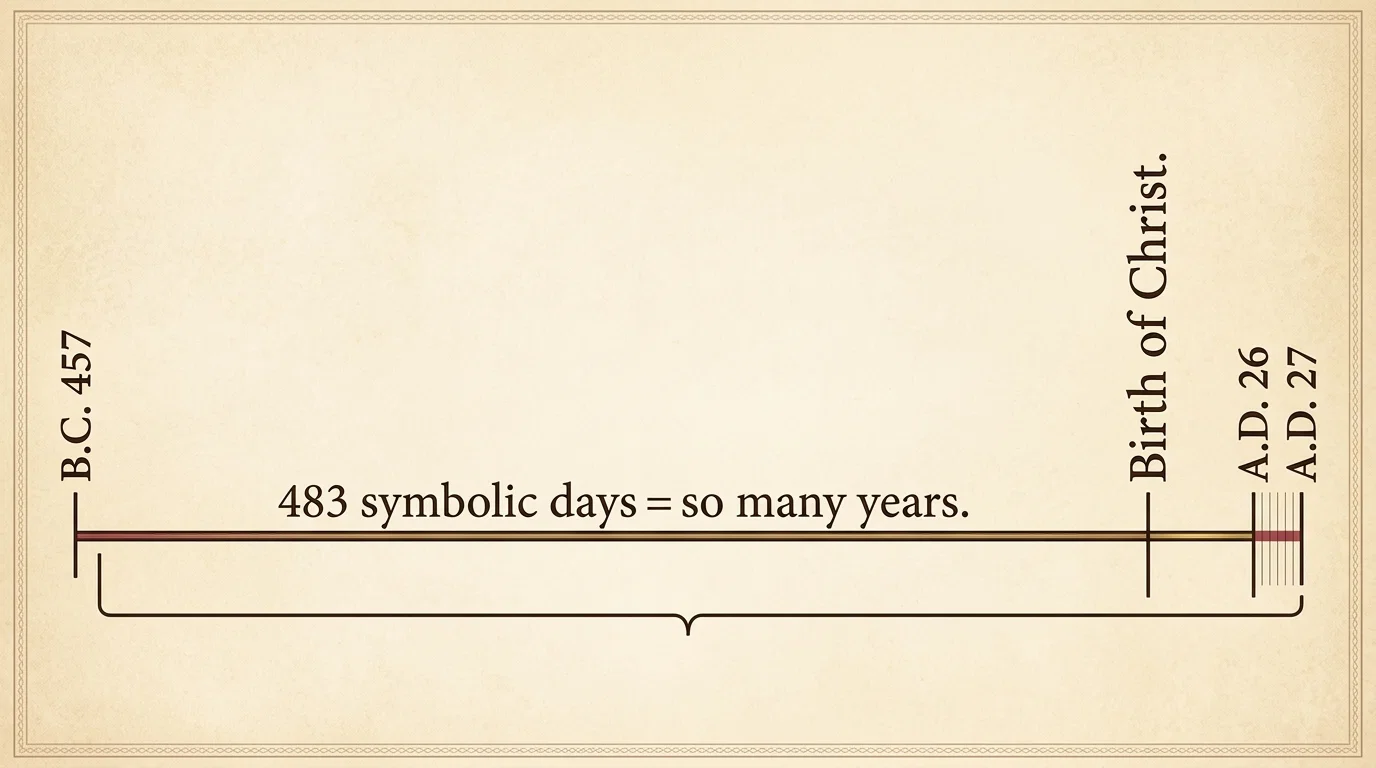
Taking this date and that of the anointing of the Messiah, and adding them together, we have a series of years, corresponding to the number of days the prophecy assigned to the interval between these dates. This matter will be clearer by a glance at another simple diagram:—
Adding the full number of 457 years before the birth of Christ to the entire time of 26 years after His birth, we have 483 years. But this result is secured only by beginning to reckon the time from the very first day of 457 B.C., and letting it include the very last day of A.D. 26. But we find that the work of restoring Jerusalem did not begin till that year was somewhat advanced. Ezra and his companions did not arrive in Jerusalem before the fifth month (Ezra 7:8), and then he attended to the autumn, or seventh-month ceremonies, before entering upon his regular work of rebuilding the city (chapter 8:35). It will be seen, therefore, that whatever time is lost from the first part of the year 457 B.C. must be added to the close of the year A.D. 26, which would bring the ending of the 483 years in the autumn of A.D. 27, as we find set forth in the chronological table opposite the record of Christ’s baptismal anointing. Luke 3:21, 22; Mark 1:10.
This ends the sixty-nine weeks, or 483 symbolic days, which were to extend to the Messiah. A consideration of the other time symbols in this prophecy must be reserved for the paper to follow. JOHN ORR.

THE SABBATH OF THE LORD.

“BLESSED is the man that walketh not in the counsel of the ungodly, Nor standeth in the way of sinners, Nor sitteth in the seat of the scornful. But his delight is in the law of the Lord; And in His law doth he meditate day and night. And he shall be like a tree planted by the rivers of water, That bringeth forth his fruit in his season; His leaf also shall not wither; And whatsoever he doeth shall prosper. The ungodly are not so; But are like the chaff which the wind driveth away. Therefore the ungodly shall not stand in the judgment, Nor sinners in the congregation of the righteous. For the Lord knoweth the way of the righteous; But the way of the ungodly shall perish.”
The Hebrews were held in bondage by the Egyptians, but the Lord delivered them from their bondage with a strong arm. Enshrouded in the pillar of cloud by day and the pillar of fire by night, Christ, their invisible Leader, guided them through the wilderness. Through Moses, their visible leader, he educated and instructed them, that they might love and serve the only true and living God. For their food the Lord gave them manna from heaven. Day by day this food was given, and on the sixth day enough fell for the Sabbath. This miracle testified constantly to the Sabbath commandment, which was given in Eden.
The Lord brought the children of Israel to Mount Sinai, and there He spoke the Ten Commandments, and enjoined upon His people the observance of the Sabbath. “The Lord spake unto Moses, saying, Speak thou also unto the children of Israel, saying, Verily My Sabbaths ye shall keep; for it is a sign between Me and you throughout your generations; that ye may know that I am the Lord that doth sanctify you. Ye shall keep the Sabbath therefore; for it is holy unto you; every one that defileth it shall surely be put to death; for whosoever doeth any work therein, that soul shall be cut off from among his people. Six days may work be done; but in the seventh is the Sabbath of rest, holy to the Lord; whosoever doeth any work in the Sabbath day, he shall surely be put to death. Wherefore the children of Israel shall keep the Sabbath, to observe the Sabbath throughout their generations, for a perpetual covenant.”
To Adam and Eve in Eden the Lord gave the use of every tree in the garden save one. So the Lord has given to men six days in which they are to engage in common labor; but He has put His sanctity upon the seventh day, declaring it to be holy. That day is to be sacredly observed as a memorial of creation. “God blessed the seventh day, and sanctified it; because that in it He had rested from all His work.”
God has declared in His Word that the seventh day is a sign between Him and His chosen people,—a sign of their loyalty. “I am the Lord your God,” He says; “walk in My statutes, and keep My judgments, and do them; and hallow My Sabbaths; and they shall be a sign between Me and you, that ye may know that I am the Lord your God.” The day God set apart to be kept free from secular labor He designed should be respected in commemoration of His wisdom, power, and goodness in creating the world and man. The Sabbath was instituted before the Jews were distinguished as a people, and was given to all mankind to keep holy, “that ye may know.” God declares, “that I am the Lord which do sanctify you.” If the Sabbath is accepted, the rest of the commands in the Decalogue will be obeyed; for no one can truly keep the Sabbath and disregard one precept of the law.
From the pillar of cloud Christ constantly set before His church in the wilderness the requirements of God. “Moses called all Israel, and said unto them, Hear, O Israel, the statutes and judgments which I speak in your ears this day, that ye may learn them, and keep, and do them. . . . Keep the Sabbath day to sanctify it, as the Lord thy God hath commanded thee. Six days shalt thou labor, and do all thy work; but the seventh day is the Sabbath of the Lord thy God; in it thou shalt not do any work, thou, nor thy son, nor thy daughter, nor thy man servant, nor thy maid servant, nor thine ox, nor thine ass, nor any of thy cattle, nor thy stranger that is within thy gates; that thy man servant and thy maid servant may rest as well as thou. And remember that thou wast a servant in the land of Egypt, and that the Lord thy God brought thee out thence through a mighty hand and by a stretched-out arm; therefore the Lord thy God commanded thee to keep the Sabbath day.”
The seventh day is God’s chosen day. He has not left this matter to be remodeled by priest or ruler. It is of too great importance to be left to human judgment. God saw that men would study their own conveniences, and choose a day best suited to their inclinations, a day bearing no divine authority; and He has stated plainly that the seventh day is the Sabbath of the Lord.
Every man in God’s world is under the laws of His government. God has placed the Sabbath in the bosom of the Decalogue, and has made it the criterion of obedience. Through it we may learn of His power, as displayed in His works and His Word. But to-day the world is following the example of those that lived before the flood. Now, as then, men choose to follow their own inclinations, rather than to obey the commandments of God. The inhabitants of the antediluvian world glorified themselves instead of commemorating the glorious works of creation. They did not obey the law of God; they did not honor the Sabbath. Had they done this, they would have recognized their duty to their Creator. This was the original and supreme object of the command, “Remember the Sabbath day to keep it holy.”
Men could not place themselves more decidedly in opposition to God’s work and to His law than by upholding a day that is without one evidence of sanctity, and professing to worship Him on that day. Those who have corrupted the law by substituting a false sabbath for the holy Sabbath of God, and who compel the observance of this false sabbath, exalt themselves above God, and honor the spurious above the genuine.
Sanctification is claimed by professed Christians who ignore God’s holy rest day for a spurious sabbath. But God declares that the sanctification coming from Him is bestowed on those only who honor Him by obeying His commands. The sanctification claimed bythose who continue in transgression is a spurious sanctification. Thus the religious world is deceived by the enemy of God and man.
In the temple service the Lord gave special directions that the priests were to use on their censers only the sacred fire of God’s own kindling, which was kept burning day and night. But Nadab and Abihu perverted their senses by the use of wine, so that they could not distinguish between the sacred and the common. They “took either of them his censer, and put fire therein, and put incense thereon, and offered strange fire before the Lord, which He commanded them not.”
Those who ignore the Lord’s Sabbath to keep holy the first day of the week, offer strange fire to God. It is a strange sabbath, which He has commanded them not. Will He accept it at their hands? Men have sought out many inventions. They have taken a common day, upon which God has placed no sanctity, and have clothed it with sacred prerogatives. They have declared it to be a holy day, but this does not give it a vestige of sanctity. They dishonor God by accepting human institutions and presenting to the world as the Christian Sabbath a day which has no “Thus saith the Lord” for its authority. As did Nadab and Abihu, they offer the common in place of the sacred.
MRS. E. G. WHITE.

GOSPEL LIBERTY.

The Gospel of Jesus Christ promises liberty. “If the Son therefore shall make you free, ye shall be free indeed.” John 8:36. By disobedience man fell into bondage,—into a bondage that has always subjected him to persecution upon his making any earnest attempt to serve God. Having overcome the human race once, Satan claims their undivided allegiance forever. Nor has the subjugated victim any power within himself to free himself. On account of his helpless condition, God provided a way for his liberation from the thraldom of sin and Satan. “This is a faithful saying, and worthy of all acceptation, that Christ Jesus came into the world to save sinners.” 1 Tim. 1:15.
Then the liberty which the sacrifice of Christ vouchsafes to the believer is the liberty to serve God. To serve any master means to obey him. “Know ye not, that to whom ye yield yourselves servants to obey, his servants ye are to whom ye obey; whether of sin unto death, or of obedience unto righteousness?” Rom. 6:16. But God’s Word always gives us illustration as well as precept; so we have the subject under consideration illustrated in history.
The people of Israel were once subjected to Egyptian bondage. For many years their servitude was very rigorous, and their treatment cruel in the extreme. But, in His own good time, the Lord took in hand the matter of their deliverance. He appeared to Moses (a type of Christ), whose life He had spared in infancy for the purpose, and sent him as the deliverer of His people. “And the Lord said, I have surely seen the affliction of My people which are in Egypt, and have heard their cry by reason of their taskmasters; for I know their sorrows.” Ex. 3:7.
Moses went, as directed by the Lord, to demand of Pharaoh: “Let My people go, that they may hold a feast unto Me in the wilderness.” “Let My people go, that they may serve Me.” Ex. 5:1; 8:1. And here we see the real hardship of their bondage,—they were hindered from serving God. Pharaoh replied to the demand, “Who is the Lord, that I should obey His voice to let Israel go? I know not the Lord, neither will I let Israel go.” Ex. 5:2. Then the king commanded that their labor should be increased—in effect they were punished for desiring to serve God.
But the Lord brought them out of their condition of slavery, and overthrew the power of their enemy. And we learn the meaning of their liberty by what immediately followed their deliverance. First, they were reminded of the Sabbath day, which their long and cruel bondage under idolatrous masters had well-nigh obliterated from the minds of the masses. See Exodus 16. Soon afterward they came to Sinai, and here the Lord repeated the whole of His moral law to them. Chapter 20:1–17. The meaning, then, of their liberty was liberty to keep the commandments of God. This meant not only a knowledge of His law, but the opportunity and the power to keep it. The obligation to obey carries with it the power to obey, if there be the honest desire, and the humble trust in Him who alone can give the power.
The earnest desire of the Lord that they should enjoy this liberty to the full is thus expressed: “O that there were such an heart in them, that they would fear Me, and keep all My commandments always, that it might be well with them, and with their children forever!” Deut. 5:29.
The deliverance from Egyptian bondage was a type of the great salvation from sin and death. The antitype has the same significance as the type—liberty and power to obey the commandments of God, and to enjoy the fruits of obedience forever. Christ was the real leader in the deliverance from Egypt (1 Cor. 10:1–4), altho Moses was the visible executive and type of the real Deliverer (Deut. 18:18; John 1:9).
Then the meaning of Gospel liberty is deliverance from the power of sin through faith in Jesus Christ. As “sin is the transgression of the law,” a deliverance from the power of sin can only be manifested in obedience to the law. Christ has set the example, and He alone can give the power. “As by one man’s disobedience many were made sinners, so by the obedience of One shall many be made righteous.” Rom. 5:19.
Christ kept His Father’s commandments (John 15:10), and by that means abode in His love. His counsel to His disciples is, “Follow Me;” and again, “Ye believe in God, believe also in Me.” The result of so doing is thus stated by the apostle Paul: “Therefore being justified [forgiven of past transgression of the law] by faith, we have peace with God through our Lord Jesus Christ; by whom also we have access by faith into this grace wherein we stand, and rejoice in hope of the glory of God.” The same principle was set forth to the typical Israel, as we learn from Deut. 4:5–13.
The apostle Paul, having shown to the Galatian brethren the principle of deliverance from the bondage which comes of transgressing the law and being under its condemnation, urges upon them this important injunction, which is pertinent for all time: “Stand fast therefore in the liberty wherewith Christ hath made us free, and be not entangled again with the yoke of bondage.” Gal. 5:1. Now, how could a justified person, one whose sin (transgression of the law) has been forgiven, become “entangled again with the yoke of bondage”? There is only one way, and that is by again transgressing the law, which is arrant apostasy. “How shall we, that are dead to sin, live any longer therein?” Rom. 6:2. “Forasmuch then as Christ hath suffered for us in the flesh [to set us free from sin], arm yourselves likewise with the same mind; for he that hath suffered in the flesh hath ceased from sin; that he no longer should live the rest of his time in the flesh to the lusts of men, but to the will of God. For the time past of our life may suffice us to have wrought the will of the Gentiles, when we walked in lasciviousness, lusts, excess of wine, revelings, banquetings, and abominable idolatries.” 1 Peter 4:1–3.
How, then, shall we stand fast in the liberty wherewith Christ has made us free?—By abiding in Christ, who is not only the Author but the Finisher of our faith. How did He stand fast?—By His obedience, as before shown. His own words through inspiration were, “I delight to do Thy will, O My God; yea, Thy law is within My heart.” Ps. 40:8. It is God’s universal principle that liberty is the reward of obedience, and the highest ideal of liberty is freedom from sin, and power to continue therein. W. N. G.
Continue reading: Uzzah Smitten