The time would fail me to review the multitude of object lessons which the Bible gives to demonstrate to the children of men, that “the Lord is true and righteous altogether,” and ever means what He says; so, with the citation of one or two more examples, we will leave the reader to the impressions of the Spirit of God, that each may decide for himself in regard to the importance of rendering unquestioning obedience to all of His commandments.
Uzzah Smitten.
At a certain period in the history of the children of Israel, because of their failure to honor God, and to depend upon Him as their source of strength, God permitted the sacred ark, which contained His holy law, to be taken in war by a heathen nation, the Philistines. But the Lord wrought in a mysterious way for the return of the ark to the land of Israel. He had distinctly told the people that none but certain of the priests were to touch this sacred receptacle of the law, and whenever necessity required that it should be transported from place to place, it was to be borne upon the shoulders of chosen men, by the means of staves, which were passed through rings in the sides of the ark. However, when the Lord had miraculously returned the ark to the borders of the land of Israel, the people, entirely disregarding the instructions of the Lord, pursued their own course in the handling of it, and, devising a more “modern” method of transportation, placed the ark upon a new cart, and with much demonstration set out for Jerusalem. But, en route, they came to a rough place in the roadway, the ark shook, and Uzzah put forth his hand to hold the ark, and the anger of the Lord was kindled against Uzzah, and He smote him, because he put his hand to the ark; and there he died before the Lord.”
Lesson: If the Lord would thus pass sentence, and execute judgment, upon the one who ventured to disregard the plain instruction He had given with reference to the touching of the ark, what will be His sentence, and what the execution of that final decision, upon the one who dares to lay vandal hands upon, or live in open violation of, the thrice sacred law, of which the ark was simply the repository.
The Disobedient Prophet.
Sometimes even a prophet of God has been deceived into thinking that the Lord does not5always speak the same thing, and remain steadfast in regard to what He has spoken. For an example of one who was thus deluded note the results of the disobedience of the “man of God,” as recorded in 1 Kings 13, and let us each apply the lesson to our own life.
Each of these examples should teach us one and the same truth,—that our heavenly Father never talks at random; that He always means exactly what He says; that He requires unquestioning obedience of His people to-day, as of old. In fact, we are distinctly told that “all these things happened unto them for ensamples; and they are written for our admonition, upon whom the ends of the world are come.” Will we be admonished before final sentence is passed? In view of all that has gone before, we, the last generation, have greater responsibility resting upon us than any members of the race of Adam who have ever been upon the stage of action; even as Christ said to the Jews who rejected Him, “The blood of all the prophets, which was shed from the foundation of the world, . . . shall be required of this generation.”
We can not rely on priest or minister to distinguish for us between the sacred and the profane, for the Lord says concerning those who occupy these sacred offices, “Her priests have violated My law, and have profaned Mine holy things; they have put no difference between the holy and profane, neither have they showed difference between the unclean and the clean, and have hid their eyes from My Sabbaths, and I am profaned among them.” Eze. 22:26. God’s people are sanctified through obedience, and our Father gives His Holy Spirit to them that obey Him. (See 1 Peter 1:2 and Acts 5:32.)
Now, in conclusion, let me ask, Has not the Lord spoken as distinctly in regard to Sabbath observance as He has concerning any other Christian duty? Hear Him say, “Six days shalt thou labor, and do all thy work; but the seventh day is the Sabbath of the Lord thy God; in it thou shalt not do any work.” In the former dispensation, Sabbath-breakers were stoned to death. Why does not the Lord manifest His displeasure now by executing the death penalty upon all of those who violate His law?—Simply because of the many object lessons that He has already given, and from the fact that He “is long-suffering to usward, not willing that any should perish, but that all should come to repentance” and obedience. But when sentence shall be passed, and judgment executed, how will the Sabbath-breaker fare? Will not the Lord’s decisions be uniform, or parallel with the precedents already established? Reader, are you willing to take the awful risk of being a violator of God’s holy law?
Knowing that the natural tendency of the human heart is to evade duty if possible, and that the deception of Satan would be to make mankind think that God is not particular, the Lord forewarns us in these words, “Ye shall not add unto the Word which I command you, neither shall ye diminish aught from it, that ye may keep the commandments of the Lord your God which I command you.” Deut. 4:2. If we do not follow the Word of the Lord, where will we draw the line?
In view of the fact that the great message of Sabbath reform in the last days is proclaimed to the world as an essential part of the “everlasting Gospel” (see Rev. 14:6–12), the Lord said through the prophet Joel, “Multitudes, multitudes in the valley of decision; for the day of the Lord is near in the valley of decision;” and every one to whom this message comes is shut up to a decision of the question, Will I obey the voice of the Lord and keep His holy Sabbath, or will I follow the multitude to do evil, and join in keeping a day that God has never sanctified? To escape the decision is impossible. How will you decide? The judgment of this world is now in session in the courts above. God the Father is Judge. Legal questions are involved. His eternal and unchangeable law forms the basis of that judgment. Dear reader, are you willing that your name should be passed upon by that great tribunal, from whose decisions there is no appeal, and you be found keeping a rival day to God’s holy Sabbath, and trampling His day underfoot? The highest form of worship is obedience.
“The solemn moment is at hand
When we who have His name confessed,
Each in his lot, must singly stand,
And pass the final searching test.”
“See that ye refuse not Him that speaketh. For if they escaped not who refused Him that spake on earth, much more shall not we escape, if we turn away from Him that speaketh from heaven: whose voice then shook the earth; but now He hath promised, saying, Yet once more I shake not the earth only, but also heaven. And this word, Yet once more, signifieth the removing of those things that are shaken, . . . that those things that can not be shaken may remain.” At that time every man-made institution will be removed, but the Sabbath of the Lord will still remain. Having withstood all the assaults of the enemies of God, and the ravages of time, it will endure to all eternity (Isa. 66:22, 23); and likewise those who prove their loyalty to God, will be given lives running parallel with the life of the eternal Father, and, having kept His commandments, will be given an abundant entrance into His everlasting kingdom.
May the reader and writer be found there, with all the blood-washed throng, and join glad hearts and voices in the universal tribute of praise, which shall fill the souls of the redeemed hosts to overflowing, and burst forth from their immortal lips in that triumphant “ALLELUIA: Salvation, and glory, and honor, and power, unto the Lord our God; for true and righteous are His judgments;” and “just and true are Thy ways, Thou King of saints.”
G. W. REASER.
THE MINISTER AND HIS TEMPTATIONS.
By Charles E. Jefferson
A MINISTER on a pedestal has little influence over men. Unless he is in all points tempted like his brethren, he can not be touched with the feeling of their infirmities. It is important, therefore, for laymen to remember that the battle of life is for all. Men may fight at different levels, but no matter where they stand, they are on a battle-field. Some sins are coarse and carnal, and others fine and subtle, but all alike separate the soul from God. There is no hedge around the minister. He has all the temptations of other men and some additional of his own. The devil has access to his study. He was in Luther’s study when the reformer threw his inkstand at him. He can ascend the pulpit stairs. He often does. What a host of demons the clergyman is obliged to meet and conquer! What opportunities for him to be a demagog, a coward, a mischief-maker! How easy to pose as a defender of the faith and cast insinuations on his brother minister who reads the Gospel with a different emphasis! How easy to be vain of a fine voice or a superb presence! How easy to be envious of men just a little ahead of him in power and fame! How easy to be lazy, uncharitable, deceitful, domineering, autocratic, or peevish! How easy to wilt under discouragement! How easy to commit any of the sins to which our frail humanity is prone!
The fact that the minister deals constantly with spiritual things is proof to the unthinking that saintship to him comes easy, whereas the constant handling of high ideals and moral truths is a source of constant danger. Familiarity has a tendency to deaden sensibility, and just as soldiers often become blasphemous on the battle-field, and undertakers sometimes come to look on death without a trace of awe, so a minister, unless he prays and watches, will have at last a heart unresponsive to the very truth which he is sent to teach. It is something to be remembered always that the scribes and Pharisees fell into a deeper ditch than did the publicans and harlots.—Rev. Dr. Charles E. Jefferson, in the Congregationalist.
For this and many other inquiries of like nature we recommend Bible Students’ Library No. 149, entitled, “From Glory to Glory;” price, one and one-half cents. Address, Pacific Press, Oakland, Cal.
740. Apocrypha.
IS IT right that the books of the Apocrypha are left out in our new Bible and the historical writings of man are put in front of the inspired Word of God? A. F.
It is certainly right that the Apocrypha should not appear as a part of the Inspired Word. If it went into the Bible as the other books, it would carry that impression. The historical writing which appears in our Bibles is not presented as a part of the Word of God. The idolatrous address to King James could well be dispensed with in our common version. The matter in the Revised Version is valuable in explaining the methods of the translators.
741. The Foolish Virgins.
DO the foolish virgins of Matt. 25:8-14 represent lukewarm Christians who are eternally lost? E. H. J.
They are at least lukewarm professors. They were once converted, tho they could hardly be called Christians in their backsliding and sleeping. The time of the special application of the parable is in the last days.
KINDLY explain the parable of the talents. Was the servant with the one talent a true disciple? Was he eternally lost?
He was doubtless once reckoned among the Lord’s “own servants.” Matt. 25:14. But when the test of service came, he failed. Verse 30 would show he was lost. For a fuller explanation of the parable, see No. 77 Bible Students’ Library, “The Talents;” price, one cent.
WHAT does “replenish the earth” mean in Gen. 1:28? M. J. W.
To completely fill it. Strong defines the Hebrew word (maw-law’) to fill, be full of. It is translated “fill” in Ps. 110:6; Prov. 1:13; Gen. 6:11, and many other places.
744. Taking Life.
CAN a man be a Christian and take the life of his fellow-man for any perishable thing, according to the Gospel plan of salvation by Jesus Christ? W. McB.
We do not know just what our querist means by “perishable thing.” Would it be right to kill him for an imperishable thing? The Word of God is: “Thou shalt not kill;” “Avenge not yourselves; . . . vengeance is mine; I will repay, saith the Lord. Therefore if thine enemy hunger, feed him.” Read also I Peter 2:19-23.
MAN’S DUTY TO MAN.
In Luke 10:27 is recorded an eternal truth: “Thou shalt love the Lord thy God with all thy heart, and with all thy soul, and with all thy strength, and with all thy mind; and thy neighbor as thyself.”
These are the words of one versed in the law. He came to our Lord with this question, asked ever since man began to die, “What shall I do to inherit eternal life?” Christ’s reply was a question implying this thought: You are versed in the Word of God; God has therein given directions. “What is written in the law? how readest thou?” And the lawyer replied by stating the eternal principles of life, supreme love to God and equal love to our neighbor, quoting the former from Deut. 6:5, and the latter from Lev. 19:18.
Our Lord came not to present new principles or to reveal new laws. He replied: “Thou hast answered right; this do, and thou shalt live.” We may take the words, therefore, as the conditions of salvation, as expressed by the Master Himself. (See Matt. 22:37–40.)
These words must be true of all those who live forever. They express the only stamp of character which will endure forever; and such character is the most precious thing in God’s sight. God is love; it is the stamp of His character; and, just as God endures forever and is from everlasting to everlasting, so every one who is stamped with God’s character will endure forever.
“Thou shalt love the Lord thy God with all thy heart, and with all thy soul, and with all thy strength, and with all thy mind.” Our affections, our spiritual powers, our very life, the physical man, our mental faculties, are pre-eminently to be yielded to God. Love to God takes in the whole man. There is to be no reserve.
“Thou shalt love.” Love is not an abstract principle. It is a principle which always issues in doing. If it remains quiescent, it dies. Love must do. God loves man; he tells us so over and over again; but it is not in the words alone; God does for man, and thereby He demonstrates His love. If man is to love God, he must do for God. “If ye love Me, keep My commandments.” That is the proof of our love to God. “This is the love of God, that we keep His commandments.” Our love is shown in obedience to God. Love to God must be undivided love. We can not love God somewhat, and love something else somewhat also. He demands everything.
Why Should We Love God in That Way?
1. He is our Creator. All we have comes from Him; and because God is our Creator, and has given us this very existence which we enjoy, we ought to love Him for that reason if for nothing else.
2. He is our Redeemer. When man—and we are man—sold himself in sin, and forfeited even life itself by choosing sin and death rather than righteousness and life, God made an eternal sacrifice for man, that He might win him to eternal life. The sacrifice of Jesus Christ was not simply for the few years that He dwelt upon the earth, ending with His crucifixion—it was an eternal sacrifice.
He who was the very image of the invisible God, who was in glory with the Father before the world was, came down to this earth and took upon Himself the form of the creature man. He will never be what He was before. In form He will always be one with humanity throughout the endless ages of eternity. He became God and man, Immanu-El, “God-with-us,” always to remain God-with-us. He stepped clear down to lowest humanity in order that he might lift humanity up to God; and throughout eternity there will be those marks of humanity upon Him, showing God’s wonderful love in the eternal sacrifice that was made for mankind. Surely, then, we ought to love God with all our heart, might, mind, and strength, when He redeemed us by such an infinite sacrifice as that. And that same wonderful love has kept us all the way.
How Can We Love?
You may say that it is impossible for you to love God in this way; that you love other things, sin, and your own self. But you can love God. Every command that God has given in His holy Word is an enabling act to help us to do, to enable us to do, what He has commanded us to do; and every heart that will by faith yield itself up to do what God sets before it to do, is enabled to do it. But how can love come into our heart?—By giving up our heart to God, and letting His Holy Spirit, His mighty presence, come in and take possession of our heart, and then “the love of God is shed abroad in our hearts by the Holy Ghost which is given unto us.” Rom. 5:5.
You say, “I have not His Spirit.” All you have to do is to ask for it. God has it for you. He holds out the water of life and says, “Come ye to the waters, I will give you drink!” That is the water of life, the Spirit of life, flowing right out of the great Fountain of life through all God’s universe. He asks those to whom it comes to yield themselves to “the law of the Spirit of life in Christ Jesus,” and they will receive it. Ask for it. “I say unto you, Ask, and it shall be given you; . . . for every one that asketh receiveth. . . . If a son shall ask bread of any of you that is a father, will he give him a stone? . . . If ye then, being evil, know how to give good gifts unto your children; how much more shall your heavenly Father give the Holy Spirit to them that ask Him?” “The love of God is shed abroad in your hearts by the Holy Ghost which is given unto you.” Then you can love God with all your heart, might, mind, and strength. Then you can do the next thing which is demanded—
“Thou Shalt Love Thy Neighbor As Thyself.”
The Golden Rule is the interpretation of the last clause of my text to-day: “Whatsoever ye would that men should do to you, do ye even so to them.” This is the carrying out of the principle, “Love thy neighbor as thyself.” What would you want if you were in like circumstances to the men that are seeking aid in your great cities night after night? Whatever you would feel that you would like your neighbor to do for you, that is what you should do for him.
But you ask, “Who is my neighbor?” The Lord answers that in the immediate context—in an indirect way, yet the most forcible way by which it can be answered—by telling us to whom we are neighbors. He relates the parable of the good Samaritan which tells the lawyer to whom he is neighbor; and that tells us also. Read that parable in Luke 10:30–37, of the man who had fallen among thieves, naked, wounded, half dead. The priest said, I have more important work. And he passed by on the other side. The Levite looked upon him and concluded, He is not worthy of charity, and he passed by on the other side. But the Samaritan, one who was despised by the Jews, came along, looked upon the fallen and friendless man, who was probably a Jew, and bound up his wounds, placed him upon his own beast, carried him to an inn, told the keeper to take care of him until he came again, and whatever was necessary he would pay it. Then the Saviour asks the question, Who was neighbor to him that fell among thieves? It was the Samaritan; but who was the Samaritan’s neighbor?—The man in need. Every one on this earth who is in need is our neighbor; and it is these that we should love as ourselves, do unto them as we would have them do unto us. What a forcible lesson the Lord teaches us in this parable!
Why Should We Love Our Neighbor?
For just the same reason as that for which we are to love God. First of all, that neighbor is our brother by creation. “Have we not all one Father? Hath not one God created us?” God “hath made of one blood all nations of men for to dwell on all the face of the earth,” whether American, English, French, Chinese, Japanese, Zulu, Spanish—they are all precious in His sight. God looks upon them from the great standpoint of infinite knowledge and wisdom; and there is very little difference between the high and mighty of earth and those who are the very lowest. We measure it in our finite minds, and there seems such a vast difference, but how small the very best of mankind are when compared with the angels of God!
“As the child to the child of four
Is the sage to the fool,
And the best of our lore
Is the lore of the babe that begins to grow.”
The very greatest of earth are truly in the sight of God
“On the lowest benches of Truth’s great college
To guess at what grown-up angels know.”
God looks upon us differently from what man does. He knows that by His own creative power He can take the very lowest and lift them up to the perfection of His own character. We have all one Father; and our hearts ought to go out to our brethren in need in every nation, and land, and country, and clime.
2. We have one Redeemer. When Jesus Christ made that eternal sacrifice, He gave it for all. He did not ask whether the man was a Chinese, or whether he was an Englishman; whether he was white or black, or of what nationality he was; but what was his need. He looked upon this great earth in need, and He7gave all, that He might ransom them and bring them home, and remake poor, fallen man to the praise of the glory of His grace. O, what a wonderful thing God can do for man, if only man will let Him! He bought each one just the same as He bought us, and it is for that very reason that the apostle Paul tells us in Rom. 1:14, “I am debtor both to the Greeks, and to the Barbarians; both to the wise, and to the unwise.” Paul owed all men—the nations that he never saw—the purchase of his life through Jesus Christ. Christ purchased Paul. Paul accepted of that wonderful love. He found himself a redeemed child of God. He became connected in partnership with our Lord Jesus Christ; and because of that he owed himself to all the different nations of the earth. They needed him. And so it is with every child of God. Every one who has been redeemed by the blood of the Lord Jesus Christ owes himself to all men, to give himself as Christ gave Himself for them, that He might help them and redeem them.
What shall be the motive to prompt us in our work for mankind? There are many in the world who are working for humanity’s sake. We praise God for that, and never for one moment will we do anything but praise God for every effort that is being put forth by whomsoever it may be to lift up fallen humanity. But to work for humanity’s sake alone, does not meet the issue. If you are working for humanity’s sake alone, if you are measuring it by humanity, you will always stop short of God’s great plan for the salvation of men. You will get to measuring the worth of men according to your own human judgment.
It is probable that if you had asked that priest or Levite that went down from Jerusalem to Jericho as to what their motives were for working, they would tell you that they were working for humanity’s sake; but when they looked upon that poor man, they did not think that he was worth working for. And so if we get to working for humanity alone, we will get to judging. If we saw a poor bloated drunkard, or a morphine fiend upon whom one could not lay two fingers without touching abscesses caused by hypodermic injections, in human judgment we would say, He is not worth working for; let him go to some hospital. But God has given us a deeper motive than that, and that is
Working for Them for Christ’s Sake.
And working for them for Christ’s sake, we will never ask for one moment whether the soul is worthy or not; but is he needy? That is the spirit in which Christ worked, and that is the spirit in which He demands that we shall work. Working in that spirit we will never stop to measure the worth of men. God is able and willing to put eternal worth into men if they will only yield themselves to Christ, and therefore we labor for that man, for His sake, in His name. God in His goodness who saved us, is able to take man in the lowest depths of iniquity to-day and lift him up, and make him to the praise of the glory of His grace. “For the love of Christ constraineth us.”
Some of us came over to these buildings before there was any work done upon them. What wretched things they were! We look them over to-day, and view them to the praise of the men who have been working so hard upon them for the last few days. This is an example of their work. Well, that is only the weakest sort of an illustration of what the Lord Jesus Christ can do; for He can go clear down into the lowest depths and take the sin leper, who is poisoned all through and through with the virus of the worst forms of iniquity, and by His own mighty power He can cleanse him and make him a child of God, so that throughout all eternity he will be to the praise of the glory of God’s grace. Will we not give ourselves to God to engage in such a work as that? Here are some of the promises:—
“Is not this the fast that I have chosen? to loose the bands of wickedness, to undo the heavy burdens, and to let the oppressed go free, and that ye break every yoke? Is it not to deal thy bread to the hungry, and that thou bring the poor that are cast out to thy house? when thou seest the naked, that thou cover him; and that thou hide not thyself from thine own flesh? Then shall thy light break forth as the morning, and thine health shall spring forth speedily; and thy righteousness shall go before thee; the glory of the Lord shall be thy rereward. Then shalt thou call, and the Lord shall answer. . . . And if thou draw out thy soul to the hungry, and satisfy the afflicted soul; then shall thy light rise in obscurity, and thy darkness be as the noonday. And the Lord shall guide thee continually, and satisfy thy soul in drought, and make fat thy bones; and thou shalt be like a watered garden, and like a spring of water, whose waters fail not.” Isa. 58:6–14.
How many there are that are clear down in ill health, sickness, and discouraged! There is no such remedy to take away discouragement as glad-heartedness in helping others. “Then shall . . . thine health spring forth speedily; and thy righteousness shall go before thee.” Men will hear of it before you get there. “The glory of the Lord shall be thy rereward.” God will be behind and before. Prayers will be answered. Criticism will cease. Faces will shine in the light of God. The darkness of despair will flee; hope’s sun will light your pathway, for the assurance abides that God is guiding continually. There is a time of drought coming in this sinful world, but the child of God shall be like a well-watered garden, like a spring of water whose waters fail not (margin, “lie not”); men will come to you for refreshing help, and not be deceived. What precious promises are these in the work God has given us to do! Go out into the highways and hedges.
There is coming a time when that work will be finished. And then shall it be said: “Come, ye blessed of my Father, inherit the kingdom prepared for you from the foundation of the world; for I was an hungered, and ye gave Me meat; I was thirsty, and ye gave Me drink; I was a stranger, and ye took Me in; naked, and ye clothed Me; I was sick, and ye visited Me; I was in prison, and ye came unto Me.” But God’s love is so much greater than anything that man can do, that the righteous forget all their deeds in the light of the wonderful glory of God. Not one will then be worth mentioning. They will ask, “When, Lord, did we do any of these things unto Thee?” And then comes the answer, “Inasmuch as ye have done it unto one of the least of these My brethren, ye have done it unto Me.” But the “least of these” may have been when he came to us a poor, wretched drunkard, or the lame, the blind, the needy; but they were the purchase of Jesus Christ’s blood, and the Lord regards them as identified with Himself.
O friends, let us engage in this blessed work here, and have a part in the glory which shall be hereafter!
Music in Every Heart
“THE very gnarliest and hardest of hearts has some musical strings in it; but they are tuned differently in every one of us.”
EXCUSING MOBS AND LYNCHINGS.
By T.
THE earnest seriousness with which mob violence and lynchings are defended by many intelligent people to-day is a striking sign of our times. In speaking of the mob who killed the colored postmaster in South Carolina recently, the Columbia Register says:—
That deeds similar to that of last Monday night are not sporadic outbursts of savagery or outlawry, but are really a reflex of the prevailing sentiment among the people of this locality, is demonstrated beyond a peradventure by the impossibility of inducing juries to inflict punishment upon the participants in such affairs.
And in a similar strain the Indianapolis News talks about the lynching of robbers in Indiana a few months since. An effort is being made to bring the mob that did the lynching to justice. And the News says of the affair:—
“You cannot try a whole community. . . . The people approve the act, believe it was a good thing for the community, that the mob deserves their thanks for ridding them of a gang of robbers and ruffians, and they propose to defend the members of the mob by all means within their power. If perjury is necessary, they will “perjure themselves like gentlemen.”
It is a fact that mob executions are becoming much more numerous. And it is also a fact that there is an increasing number of persons who lay claim to intelligence and respectability, that are openly advocating the idea that mobs and lynchings under existing circumstances are necessary and proper.
No matter from what standpoint you view the subject, the presentation is appalling. If you look at it in the light that defiant and unpunished robbery, murder, and general criminality is so flagrant that the mob and lynching in reality, as these gentlemen say, is excusable, what a dark picture of the world it presents! And, on the other hand, if the element that is looked upon as the better class in society is severe and lawless in these mobbing and lynching expeditions, the picture is darker still. And if there is a combination of both of these elements, so that the base and bold lawlessness of the criminal class is driving the better element of society to the lawlessness of mobs and lynchings, what worse state of affairs could be conceived?
“Coming events cast their shadows before.” And the “shadows” have appeared in very clear though dark outlines, showing that a reign of universal violence is right upon us. The infallible Book tells us that Noah’s time was made conspicuous by the fact that “the earth also was corrupt before God, and the earth was filled with violence.” Gen. 6:11. And the same Book also tells us that “as it was in the days of Noah, so shall it be also in the days of the Son of man.” Luke 17:26.
In the light that these Scriptures throw upon the situation about us to-day, who can doubt that “the days of the Son of man” are here? For surely the earth is being “filled with violence,” and everything is pointing us to the necessity of preparing to meet the Saviour at His coming. The thought of the second coming of the Master is the one bright gleam above the dark horizon. Let none be discouraged, but pass the good news along that Jesus is coming soon. T.
Gracious Words and Sympathizing Attentions
“GRACIOUS words, sympathizing attentions, watchfulness against wounding men’s sensitiveness—these cost very little, but are priceless in value.”
MODERN HIGH EXPLOSIVES AND THEIR DESTRUCTIVE WORK.
By T.
Nothing in the field of military or mechanical invention has received more attention during the last fifteen or twenty years than the development of high explosives. And the results of this activity are most marvelous indeed. These high explosives are much used and with great effect in mining and other industrial fields. But nowhere are they being studied more closely and experimented with more carefully and earnestly than in the line of the military profession.
The Battle-ship Maine at Full Speed on Her Last Trip. (Reproduced from the "Scientific American.")
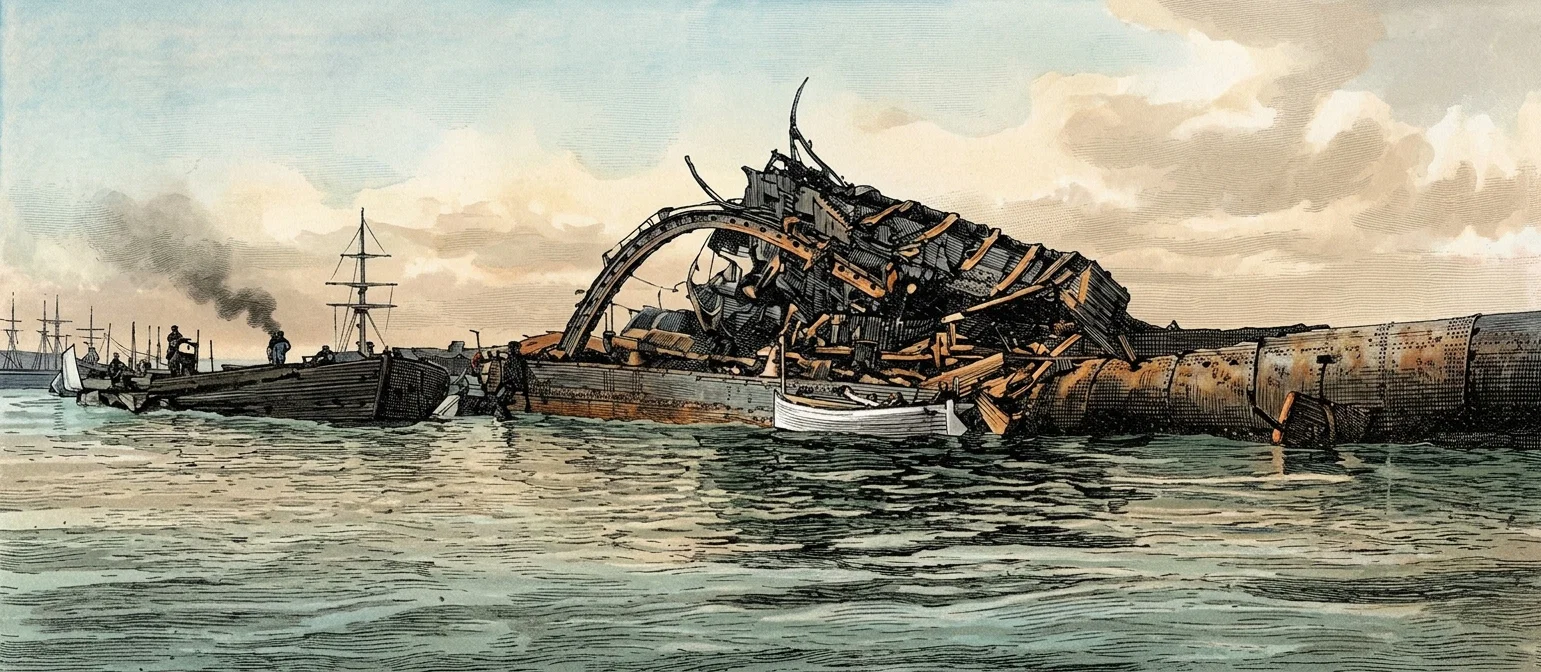
Port Side of the Wreck of the Maine, Showing Superstructure, Deck Ruins, and Overturned Smoke-stack. (Reproduced from the Scientific American.)
The gunpowder used in the time of the late war in this country would be as much out of date now as the old-fashioned stage-coach. Fortifications and naval armor that would have successfully withstood any projectile that the best explosives and cannon of those times could hurl, would hardly be sufficient to resist the attack of a battery of the one-pounders of to-day. Much of this development is due, of course, to the improved construction of the cannon itself. But far more is due to the great advance that has been made in the power of the explosives used.
The terrific effect of the explosives used to-day is very forcibly illustrated by the cuts on this page. The destruction of the Maine in Havana harbor has been the theme of discussion everywhere for a number of weeks. But it is difficult to imagine the great force that had to be exerted to so completely destroy such a stoutly-built vessel. The hull of the modern battle-ship is built as strongly as the inventive genius of man, with the best of steel and other materials at his command, can make her. And above the water-line the Maine was covered with an armor of steel twelve inches thick.
In our first cut a view is given of the Maine as she appeared under full steam on her last trip. Her great strength and power are apparent even in the picture. Our second cut gives a partial view of this same majestic ship after the explosive had done its work. The pictures tell what words can not express, so nothing further need be said upon this point.
But the fact should never be lost sight of that the infallible Word tells us that “the time of the dead, that they should be judged,” “the nations were angry.” Ingenuity and activity, the like of which has never been seen before, are manifested among all the nations of earth in their maddened preparation for war. And when we look at this in connection with the other signs that have appeared all about us, is it not evident that the judgment of the great day is even now impending?