From the London Mail of March 4 the following paragraphs are extracted:—
“A great sensation has been caused throughout Spain by a powerful pastoral just issued to his people by Cardinal Cascajares, the archbishop of Valladolid. It is really a fierce attack on the conduct of affairs in Cuba, and a searching exposition of the alarming internal condition of Spain. The authorities have attached so much importance to the document that the censor has stopped outgoing telegrams dealing with it. . . .
“The pastoral states that every one recognizes that the present situation of Spain is the most critical that our country has traversed in the present generation, and is only comparable to that which preceded the French invasion at the beginning of the century; every one recognizes that outside our own country, tempests threaten us, and that within, the volcano rages under our feet.
“The cardinal then goes on to bitterly denounce the manner in which, notwithstanding the situation, the Spanish public is giving itself up to the celebration of the carnival, and the enjoyment of all possible pleasures and festivities; indeed, the prelate compares it with the condition of the Roman people, who, in the last days of the empire, and amid all their calamities, demanded ‘panem et circenses’ [food and amusement].”
The corruption and debasement of the people in Spain are certainly described by the cardinal in no uncertain language. And because Spain is politically weak, she is perhaps denounced more by other nations than otherwise would be the case. But it is a fact that the political corruption in Spain, as well as the evils in private life, can hardly be much worse than they are in any or all of the other countries of the world. The wickedness—the base corruption of the times of Sodom—is reproduced all the world over to-day. And as God had no alternative then, but to destroy the cities of the plain because of their gross immoralities, tho He bore long with them, even so now the world is becoming so corrupt that its destruction is the only merciful thing that can be done. And the Bible plainly tells us that wickedness such as was in the days of Sodom shall reappear to make the “last days,” “perilous.”
Do not become discouraged by the great wickedness in the world, no, not even if that wickedness is in your own heart. Remember that there is hope in our Saviour, and that He is longing to cleanse you from all your sins, so that He may preserve you when He comes. His coming will be very soon. Haste to get ready to meet Him. He wants to save you.
The Rising Tide of War Preparations
A few days ago the newspapers were having much to say about the $50,000,000 so enthusiastically voted for war purposes in this country, the $65,000,000 set apart by the czar to increase and improve the Russian navy, and the $127,750,000 reported to the English Parliament as needed for the increase of the British navy. And now the papers are speculating on how much the other nations will have to appropriate in order to successfully meet the increased navies of these powers. Much is said about the disarming of the nations, but the tide in the opposite direction is rising higher and higher. One nation spends millions to increase her armies and navies, and immediately the other nations think that more millions must be spent by them also, so that they may not be left behind in the eager race of preparing for war. If men would only believe God when He tells them in His Word that it is the “spirit of devils” that is stirring up this war fever, and that they are preparing the world for the “battle of the great day,” how quickly would they turn from these war-like feelings and sentiments! Every one who knows the Master and the power and truth of His Word should be most intensely active now in winning men from the impending destruction.
THE MODERN RIFLE.
By T.
The battle-ship Oregon steamed out of the Golden Gate about a week ago for a cruise down the Pacific Coast. Just before she started she is reported to have exchanged her old rifles for a more modern gun. Her new rifles are constructed on the magazine principle, and are sighted for 2,000 yards. Up to 800 yards the range is point blank, so that for such a distance the sights do not have to be elevated at all. The bullet from this rifle will penetrate three feet of timber.
The infantry in all the armies of the world is being supplied with these or similar guns. Much attention is also being given in military circles to target practise, so that the soldier may be able not only to shoot, but “shoot to kill.” And with the smokeless powder now coming into general use, the battlefield will be clear, and usually a perfect aim may be taken.
With these destructive weapons in the hands of the infantry, and with the machine gun, the quick-fire and other types of modern cannon in operation, taking into account of course the accuracy of aim that recent devices make possible, what frightful slaughtering of human beings will take place! And may it not yet be seen that the twentieth verse of the fourteenth chapter of Revelation, instead of being a figure, as many have supposed, is after all a most literal truth? The prophet, in describing that great day when the “harvest of the earth” is to be “reaped,” states that “blood came out of the wine-press, even unto the horse bridles, by the space of a thousand and six hundred furlongs.” Rev. 14:20. The same prophet also tells us that “the spirits of devils, working miracles, go forth unto the kings of the earth and of the whole world, to gather them to the battle of that great day of God Almighty.” Rev. 16:14. Now when wicked spirits have gathered “the kings of the earth and of the whole world” to the “battle of that great day,” and when the fight actually begins with these weapons of modern invention, it can hardly be called an incredible thing that blood will flow, even as the Bible says, “unto the horse bridles.”
But why does the Lord not intervene to stop this most awful carnage? It is a great pleasure to inform you that He has. He has told you and me, yes, even the whole world, that it is the “spirit of devils” that is stirring up this murderous spirit of war. And He has warned us not to be found connected with it.
While the “spirits of devils” are enraging men for war, the Prince of Peace is beseeching and tenderly, tho loudly, calling every one to forsake the camps of evil and cruel war and come over to the side of the God of love. Now what will you do? The Bible makes the matter perfectly plain, and it is for each one to decide for himself which camp he will be in. T.
THE MUSICIAN AND THE OLD SOLDIER.
Once upon a time, on a beautiful summer day, you might have seen thousands of people streaming out of Vienna into the green country. It was a feast day, and happy smiles seemed on everybody’s face. They walked about, or played games, or rested on the grass under the shade of the trees.
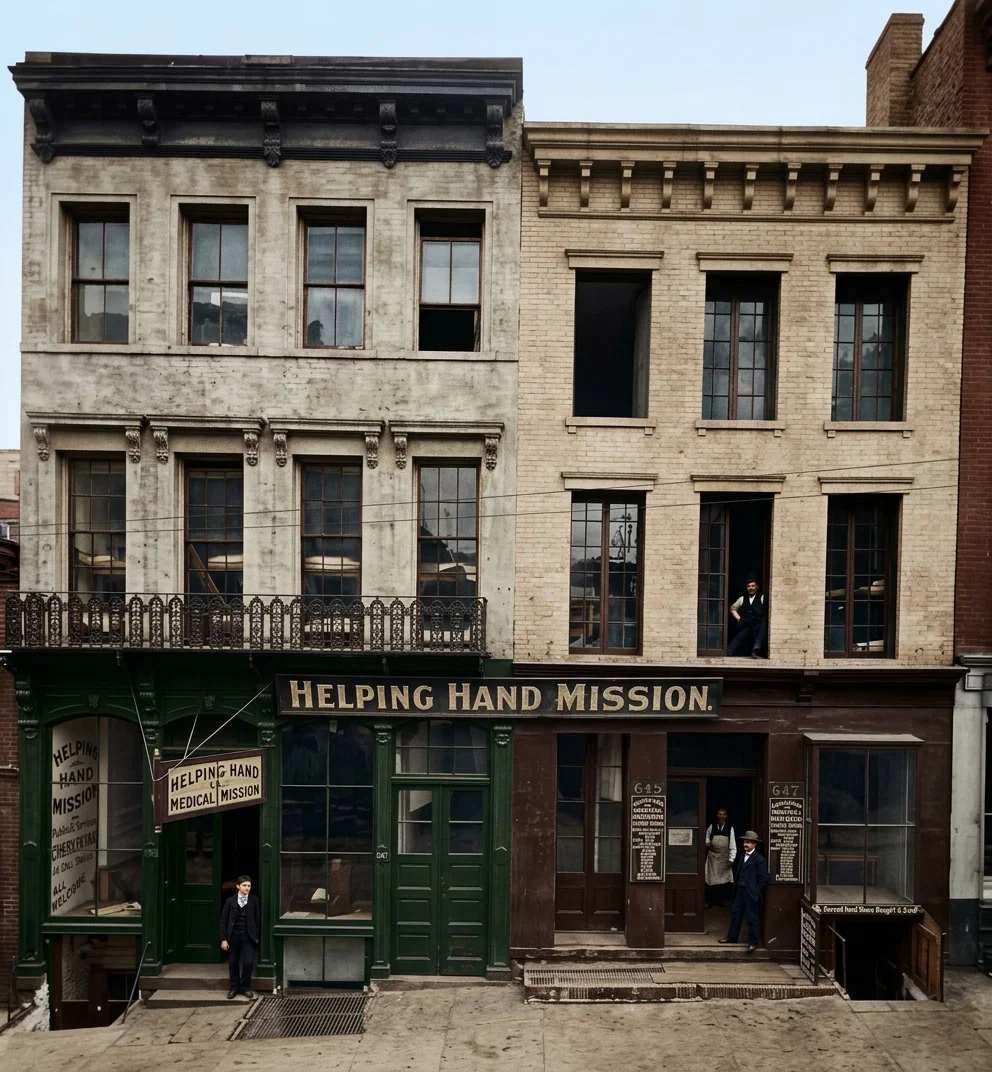
The Mission buildings as they appear at present. The upper stories of both are occupied with sleeping apartments. The basement at the left is used for baths and laundry purposes; at the right, for a shoeshop, over the door of which is the legend, “Second Hand Shoes Bought and Sold”—and sold as well. The first floor at the left is a chapel and reading-room; the first floor at the right is a restaurant, where one can get a good, clean, hearty meal for from three to five cents.
In the crowd was a poor, one-legged old man. He had been a soldier and had fought bravely for his country; but in a great battle a cannon-ball had taken off one of his legs. So, to make a living, he took to playing the violin, of which he had been fond as a boy.
He was not a good player, but he did his best to give pleasure to those who heard him. “If they do not give for my music,” thought he, “they may take pity on my snow-white hair, my one leg, and my old patched coat.”
So he sat down under a tree by the wayside, and began to play his little pieces. Close by him sat his old poodle, which he had taught to go round with his hat, into which many a penny had been cast by kind-hearted folk.
But to-day the people passed by, laughing and chatting gaily, and the hat remained empty. Had they but given one look at the old soldier, his sad face might have touched their hearts. His last penny had been spent in buying new strings to his fiddle, and he was very hungry and weak, and did not know where his next meal was coming from.
As the old man played, he glanced sadly at the happy crowd, and the sting of pain entered into his heart. To-morrow he must starve upon a straw mattress in his little attic room. The poodle was really better off than he; he could always pick up a bone for an evening meal.
It was now late in the afternoon. Many of the crowd were returning home, but still no penny had fallen into the hat. His hope was as near setting as the great sun in the sky.
He had no idea that there stood not far from him a gentleman who for some time past had been listening to his playing, and who was now looking at him with deep pity in his eyes.
The old man, weary and hopeless, at last sat down on a stone and covered his face with his hands. The gentleman standing under the linden tree saw him wipe the tears away with his rough hand. He then hurried across and handed the player a gold piece, and said:—
“Lend me your fiddle for a short time.”
The aged man looked up, full of wonder and thanks, and then handed the fiddle to the stranger. It was not such a bad fiddle. The gentleman tuned it as clear as a bell.
“Friend,” said he, “you take the hat round whilst I play.”
Then he began to play in such a wonderful manner that the old man looked up at his fiddle, as if to ask where it had got its beautiful tones, and why it lent them to the stranger and not to him.
Yes, the old fiddle was played now as it never had been played before. It was all song, and every note found its way to the heart. Sometimes it sang with joy, sometimes with deep sorrow that moved to tears.
The people no longer thought of going home. They stood still and listened breathlessly to the wonderful things the stranger played. The circle of listeners increased; even the carriages of great people stopped and swelled the throng.
The old soldier took round his hat. The coins rained into it—gold, silver, copper. All gave something, even the hardest-hearted, being touched with pity. The poodle snarled, perhaps with pleasure or perhaps he thought it his work to hold the hat.
At length the hat was full and the old man had to empty it. But the stranger played on, and moved the hearts of the people so greatly that it was again filled to overflowing.
The eyes of the stranger beamed with delight, and he played so that the crowd became still as death, and then burst out into a storm of cheering. Again he played, and the stillness deepened until one could hear the beating of one’s own heart.
By degrees it grew cold, and the stranger began the song, “God Save the Emperor,” which every Austrian knows and loves. Every hat and cap flew off, and the delight of the people became so great that soon thousands of voices joined in the song.
Then suddenly the player put the violin in the hands of the old soldier, and, taking his hat, went away before the old man could say, “God bless you, sir.”
“Who was that?” cried the people, as they crowded round the soldier.
“I do not know,” answered he, “but God has sent him to help me. Without him I should have had to starve.”
Then a gentleman stepped forward and said: “I know him well; it was the great violinist Alexander Boucher, who has been in Vienna for some days and has used his art here in the service of charity. Let us not forget his example.” He then raised his hat, and went on: “Boucher played to-day for this poor soldier whom we all forgot.”
Once more the coins poured into the hat, and then the gentleman cried, “Long life to Boucher!” and the people sent up cheer after cheer.
Hot tears rolled down the cheeks of the old soldier, and he prayed silently to himself, “Master, do Thou reward him.” And so the crowd broke up and each went to his home, happier for having helped a poor neighbor. But the happiest of all was the one-legged soldier and the great violinist.—From the German.
THE MEN WANTED.
By F. E. Clark, D.D.
In a railroad depot in a small Minnesota town, we recently saw, posted up, amid railroad time-tables and flaming advertisements of highly colored routes, the following placard: “A prominent railway official of many years’ experience has reached the conclusion that it is not the most brilliant men in the railway service that are the most successful, but rather those who make the fewest mistakes.” There is a world of truth for other people than railroad men condensed in those few lines. The world has comparatively little use for exceptionally brilliant men; but there is plenty of room at the top, and all the way down, for men of sound common-sense. Many a ‘bright’ man’s blunders dim the radiance of his good things. No, the world is not hankering for more brilliant men; but it is greatly in need everywhere of level-headed men who make few mistakes.—F. E. Clark, D.D.
DAY BY DAY.
“I LEAVE it all with Jesus day by day;
Faith can firmly trust Him, come what may;
Hope has dropped her anchor, found her rest,
In the calm, sure haven of His breast;
Love esteems it heaven to abide
At His side.”
Trusting Divine Purpose
By R. M. Offord
LET us be quiet. Passing years shall prove
Purpose divine upon our welfare bent;
True wisdom, hand in hand with deepest love,
Works out for us the will omnipotent.
—R. M. Offord.