DEDICATION SERVICES of the HELPING HAND and MEDICAL MISSION in SAN FRANCISCO.
By Charles Miles Snow
In the heart of San Francisco, the city by the sea, God has set His seal upon a sacred work. Where for more than half a century the wretchedness that recompenses wrong and the misery that thousands suffer from the wickedness of others have pressed their ragged ranks in hourly review before the Maker of the heavens and the earth, God’s ministering agents are now gathering out the bruised and broken and binding up their wounds.
Out of the heart proceedeth all manner of evil. This is true of a city as well as a soul, and has been true of the heart of this city from the day when the Golden Gate swung open to the commerce of the world. At the very fountain-head of the wickedness of this western metropolis the shaft is sunk and the well of salvation is gushing forth to-day. “Ho, every one that thirsteth, come ye to the waters, and he that hath no money,” is the gracious invitation which the Lord through His servants is giving there.
The Helping Hand and Medical Mission, at 641–647 Commercial Street, San Francisco, was dedicated on March 13, 1898, to the work which brought a Saviour from heaven to earth,—the work of rescuing perishing souls. For days previous to its formal opening many a hungry man was fed, and many a sin-sick soul found healing in the touch of the great Physician.
At 10:30 the dedicatory exercises were opened by song, led by a double quartet.
Following the song, “Bringing in the Sheaves,” Mr. C. H. Jones, president of the Pacific Press Publishing Company, of Oakland, delivered the introductory address, and told of the various steps which led up to the establishment of the Helping Hand Mission.
He said: “Last spring, at a meeting of the stockholders of the Pacific Press Publishing Company, publishers of the SIGNS OF THE TIMES, the editor of that paper introduced the following resolution:—
“WHEREAS, There is great demand and plenty of room for mission work among the submerged and needy classes in our large cities; therefore,
“Resolved, That we would approve of work of this kind being inaugurated and carried on under the auspices and name of the SIGNS OF THE TIMES MISSION, if the incoming directors on fuller consideration consider it to be in the order of the Lord.”
“In harmony with this the question was considered by our board of directors, and it seemed to them that it would be in harmony with the mind of the Spirit of God to have a work of this kind inaugurated in this city. We realized that this would require men as well as means, earnest, devoted men, men who were willing to sacrifice and who had had experience in dealing with the particular class of individuals who would come to a mission of this kind.”
“We found no such man until last December we learned that Brother B. F. Richards, who had had connection with mission work in Chicago and elsewhere, could be secured. The board immediately telegraphed to him to come to California, and within two weeks from that time he was with us ready to begin work.”
“It was the design of the founders that the work should be based upon as broad and liberal lines as possible, that this should be a helping hand mission for the needy, irrespective of race, color, or religion, and that it should be complete in all its details.”
“Arrangements were made with the California Conference to furnish evangelistic help, and with the St. Helena Sanitarium to furnish the physicians and skilled nurses, and to take special charge of the medical work connected with the Mission. The SIGNS OF THE TIMES was to be looked to for the financial part, and to have the general management of the institution.”
“In harmony with this plan a board of managers was appointed, consisting of President W. T. Knox and E. E. Andross, representing the California Conference; J. A. Burden and Dr. F. B. Moran, representing the St. Helena Sanitarium; M. C. Wilcox and C. H. Jones, representing the SIGNS OF THE TIMES. B. F. Richards was elected as the seventh member of this board, and S. N. Curtiss, secretary and treasurer. B. F. Richards was appointed manager and chaplain.”
“In looking for a suitable location, the section south of Market Street presented many poor families needing assistance; but this Mission was intended for homeless men, men with no place to lay their heads. So we went to the chief of police, and he directed us to this section as the worst locality in the city. We therefore secured the lease of this building in which the chapel is located, for three years, and of the adjoining building for one year, giving us a frontage of 45 feet. The buildings are 60 feet deep and four stories high, including the basement.”
“These buildings have a history. Commercial Street, between Montgomery and Kearny, was at one time in the very heart of the city; but as the city grew to the west and south, this vicinity became the resort of the very worst characters, and we may say it is such at the present time. In this locality there are nearly one hundred saloons, and we know that these are the devil’s workshop. The last thing that occupied this room before we took it was a saloon. This little room in the rear was used as a gambling-den, and many a poor fellow has been taken in there and fleeced of his hard-earned means, and then thrown out to take care of himself the best way he could. The basement of the building was a training ground for a noted local pugilist, ‘Yankee’ Sullivan. So we have come right upon the enemy’s battleground, and here we have erected the blood-stained banner of Prince Emmanuel.”
Mr. Jones then rehearsed how these buildings had been brought into their present neat and tidy condition from the dilapidated state in which they were found, by the work of willing hands from the churches on both sides of the bay, and also expressed the appreciation of the board of managers to Mr. Geiselman, the owner of one of the buildings, for his assistance in fitting up the buildings. The hearty thanks of the board were also extended to those who had so generously donated means for the support of the Mission that now, at the time of its dedication, it was absolutely free from debt.
Elder E. E. Andross offered the invocation, which was followed by a solo and chorus, “Throw Out the Life-line.”
Dr. Moran, of the St. Helena Sanitarium, gave a short explanation of that part of the Mission work which fell to the lot of the physician, and made a concise statement of the various conveniences which the Mission affords for those who, through various misfortunes, have fallen to the lower walks of life.
Following Dr. Moran, Chaplain B. F. Richards continued the same theme, The Work of the Mission. He said:—
“I praise the Lord, dear friends, for this day and for this gathering; for this day especially, when this Mission, with all its departments, will be given entirely over into the hands of the Lord. When we first looked over these buildings, it was asked by those who were along, ‘Do you think you can do anything with this dingy old place?’ As we looked through each floor, each room, we could simply look to and through to the completion, when we could present the building for God’s work as you see it to-day.”
“It has been my privilege, through the goodness of God, to visit all prominent missions in nearly all of the large cities of the United States. It was my privilege to visit missions in London, in Berlin, and other large cities in thirteen different countries on the other side of the water, and we believed that the time would come when we could have a mission here, which in all its departments would give glory to God and would do the work that God had planned that His servants should do here upon this earth.”
“Missions all over the country have been established and are being established to help the poor, but I do not know of one that has all the facilities that this has for carrying on the work along the lines that God has directed of going out into the streets and the highways and hedges, and bringing in the poor, the maimed, the halt, and the blind. But we can care only for men in this mission.”
“How do we do it?—Here is a man who is filthy, infected with vermin, discouraged, down-hearted, without a friend in the world, and without a penny in his pocket. Surely that poor soul needs a helping hand. When we extend a helping hand to that man, we want in the first place to cleanse him from the dirt that covers his body. When we can cleanse him from this filth and give him a good, clean bath, and invite him to a good, clean bed, and permit him to sit down to a clean table and partake of wholesome food, we have done three things that wonderfully help to put that man on his feet again. Then as we bring him into this room and his eyes are permitted to look upon God’s holy Word and hear it spoken to him, the tendency is for him to stop and think, and hear God talk to him; and God says, ‘Come, let us reason together.’ The man’s adversity and necessity are God’s opportunity for saving him.”
“About the first thing we do when a man comes to us who wants something to eat is to ask him if he will work. If he will, we will be only too glad to give him something to eat. We can not say to any man we meet, ‘You are unworthy,’ for we have no right to judge. But sometimes a man will come to us and say, ‘I am willing to work,’ and after you have fed him, and have given him a bed, have started him to work, and gone about your own duties, you will find on returning to see how he is getting along, that he has gotten along so rapidly that he has entirely disappeared. Then again we get a man who will promise to work, and he does work, completing the job he started on, and anxious for more. He shows that he has in his heart an interest, a desire, to show that he appreciates what we have done for him. It is a privilege to work for that man. When night comes on, he steps to the little office to secure a ticket for a bed. A bath ticket is given him in connection with the ticket for a bed. A key to one of the lockers is also given him, in which he can lock his ‘valuables’ or clothing for the night. Then he is taken to the bathroom. His clothing is taken entirely from his person and placed in a sack arranged for that purpose. When his bath is completed, the sack containing his clothing is taken to the disinfecting room, and there each garment that he has is hung up to a hook; and when the work is all done for the night, the large pans are set burning in the disinfecting-room, and the disinfectants go on doing their work till morning.”
“In the morning one faithful man brings the clothing to the man, cleansed from all vermin. He can then put his clothing on and go down to breakfast. After that he can go into the washroom and have the privilege of using the tubs, washboards, and soap to wash his clothing. This work is carried on every day except the Sabbath.”
“This chapel is also a reading-room, to be used by any one who desires. Here also they can hear the Gospel. We have morning worship with the men, especially the helpers, and all who are interested in the worship of God are at liberty to attend. Between eleven and half past eleven we have a meeting for the workers, for looking over each department. The head of each department will come to that meeting, and will tell how his department is getting along and what he needs. At three o’clock in the afternoon Bible study will begin, and every worker and person in the house will be permitted to take part in the study of God’s Word. At half past six is a prayer service, continuing one hour. Then a brief song and praise service begins, followed by the regular Gospel service, which lasts till a quarter past nine. After this, labor for individual souls often continues till eleven or twelve o’clock.”
“From the time our work began here, on the 27th of February, up to the present time—two weeks—we have given beds, and baths, and fumigation of clothing, in the aggregate, to eight hundred men. We have distributed among the men who have come in here, 3,838 penny lunches. Every night in the week Gospel services are conducted in this room, and at each service we ask every man who wants to leave the old master whom he has been serving so long and accept the Lord Jesus Christ, to raise the hand or come forward. We have found, by keeping strict account of the number of men who have raised the hand and have come forward here and knelt with us in prayer, showing that they desired to be better men and live for God in the future, that sixty-four men have already made a start in this direction. We have therefore every reason to-day to praise God for His wonderful goodness.”
Chaplain Richards then gave an interesting account of two typical cases, one a drunkard and one an attempted suicide, whom the Lord had sent to the mission. (These we omit for want of space; they may be given in a future number.)
He continued: “Every night we have some experience11of this kind, and every night at the close of our meeting we have to praise God for the privilege of helping our erring and fallen brother.”
“When God said, Go out into the highways and hedges and bring in hither those who are there, He saw the streets of this city at night, among others, where the devil, seemingly, with all his angels, is turned loose, and men are battered and bruised and torn. And most frequently they have no kind hand held out to them to help and care for them and make them realize that some one loves them.”
“Well, the medical work part of this Mission is to simply carry in the maimed, the blind, and the poor man that has met with accident, or has been knocked down by a slung-shot or a sand-bag, and take them to the treatment-room, and there the nurses will minister to them. We found that, in order to obey the Lord’s command to bring in the poor, the maimed, and the blind, it was absolutely necessary to have physicians in charge and skilled nurses, men who had the love of souls at heart, and who would labor for that man because Jesus died for him; and in the Mission here as well as in the Mission in Chicago, this line of work is being carried on.”
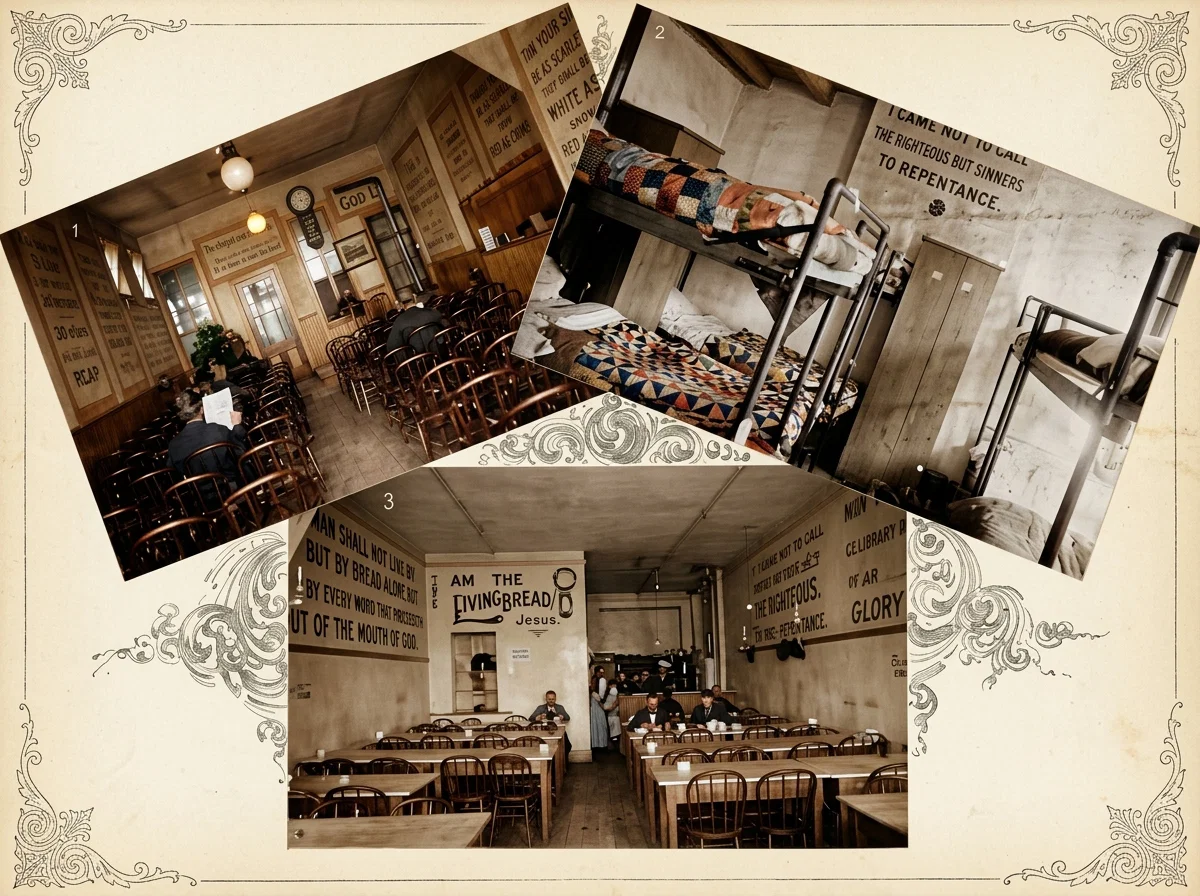
INTERIOR VIEWS OF HELPING HAND AND MEDICAL MISSION. Directly over the little pulpit or rostrum is a clock, given to the mission, on the face of which are the suggestive and appropriate words, “It is time to seek the Lord.” No 1, the chapel and reading-room. No. 2, one of the bedrooms, showing double-deck, iron bedsteads. No. 3, the Restaurant.
“Now, in place of pressing the button and calling for the hospital ambulance and surgeon to come and carry off the victim, we bring that man into the Mission, and we care for him here. While we are pouring in the oil and wine and soothing his aches and pains, we are telling him that Jesus Christ came into this world to save sinners.”
“God has been teaching men and women so that they will become skilled in this line of work. Through the goodness of God the St. Helena Sanitarium furnishes us with two skilled nurses, and thus these men can learn that God still loves the bodies as well as the souls of men. I know that God in His goodness has established this Mission, and many souls will be guided here by His angels, and through the Word of His grace saved to all eternity.”
This address was followed by the song, “Christ Receiveth Sinful Men,” which was joined in by the congregation.
The address was by the editor of this paper. A summary will be found in the editorial columns.
The touching verses and music found on the last page of this paper of two weeks ago were sung by the choir, and were a fitting recessional for the preceding services.
After the dedicatory prayer by Elder W. T. Knox, the congregation joined in singing the old familiar hymn, “O, Where Are the Reapers?” and the benediction by Elder A. O. Tait closed the program of the day.
By invitation of the chaplain, the congregation went on a tour of inspection through the buildings, and the workings of the different departments were explained.
When a man enters the door of the Mission and passes up the aisle of the chapel between the rows of chairs, his attention is at once attracted by the multicolored scriptures on the wall. Perhaps the first sentence he reads is over the speaker’s stand at the right, “God is Love.” Love is something which many a poor man who enters this chapel has experienced but rarely in his life. He looks again. Over the stand at the right he reads:—
“This Man receiveth sinners.”
“Sing it o’er and o’er again,
Christ receiveth sinful men.”
That is what he is, and he knows it. He has come to a place where there is One who will receive him. How he has longed for a direct invitation from some one who was willing to receive him; but there it is in great colored letters: “Come unto Me, all ye that labor and are heavy-laden, and I will give you rest.” “The wages of sin is death”—he knows that is true, for it is working in him now, and mayhap his own sins have many times prompted him to seek death at his own hands—but “The gift of God is eternal life through Jesus Christ our Lord;” “Jesus Christ came into the world to save sinners, of whom I am chief.” In such darkness he has groped that he does not know even how to accept of this free gift, but—“Thy Word is a lamp unto my feet, and a light unto my path.” And so, whichever way he turns, God is speaking to him, and inviting him from his sin and wretchedness to righteousness and peace in His own blessed service.
The poor man steps to the little office on the right, and inquires for a bed. His name is placed on the register; but perhaps he has nothing with which to pay for his accommodations. He is asked if he will work to pay for his lodging and breakfast. He agrees to do so, and the clerk hands him the following ticket for a bed:—
And with this he is also given this ticket:—
A towel and soap, and is directed to the bathroom; and while he stands under the shower-bath, tempered to his liking, he reads: “Purge me with hyssop, and I shall be clean; wash me, and I shall be whiter than snow.” As he is taken to his bed, his eyes are still reading the Word of God, and his heart is being touched by the finger of love—God’s love, manifest in the ministerings of faithful men.
On the two floors there are in all eighty beds, furnished with springs and comfortable mattresses, clean linen, and plenty of covers. Five times a week these sleeping-rooms are scrubbed and thoroughly cleansed. Each bed is a double bed—not in width, but in height; so that while two men sleep in one bed frame, one is directly over the other, and each has a bed to himself.
When the lodger has received his clothing in the morning, he goes down to the office, and there receives a certain number of tickets like the following:—
204With these he goes to the counter of the lunch-room, and for each dish that he orders he lays down one ticket. The dishes are handed to him over the counter; he takes them, sits down to a clean table, and while he is partaking of his food he is reading from the walls the following scriptures:—
“Man shall not live by bread alone, but by every word that proceedeth out of the mouth of God.”
“I am the living bread.”
“Blessed are they which do hunger and thirst after righteousness; for they shall be filled.”
“Whether therefore ye eat, or drink, or whatsoever ye do, do all to the glory of God.”
“Whosoever will, let him take the water of life freely.”
“Wine is a mocker, strong drink is raging; and whosoever is deceived thereby is not wise.”
Books of tickets like the following, one hundred in a book, good for either lodging or food, are sold at $1.00 each:—
Books of these tickets are bought by those who are disposed to feed the hungry, and are either left at the Mission, to be furnished to those who are unable to buy them, or are dealt out a portion at a time by the purchaser to those who apply to them for assistance.
In the basement of the restaurant building is located the shoe-shop and second-hand-clothing room. Here partially worn shoes and clothing are fitted up and sold at a nominal figure, or are paid for in work by those who are in need of such things. Some of those who are willing to work in payment for their accommodations and can do work of this kind, are set to help in these departments. Thus, while being kept from the evil influences of the streets, they are at work in a useful employment, under a God-fearing overseer, who is working for the salvation of their souls.
CHARLES MILES SNOW.
GOD IS LOVE.
By Sir John Bowring
God is love; His mercy brightens
All the path in which we rove;
Bliss He wakes, and woe He lightens;
God is wisdom, God is love.
Chance and change are busy ever,
Man decays, and ages move;
But His mercy waneth never;
God is wisdom, God is love.
—Sir John Bowring.
OUR WORK AND WORKERS.
A NEW house of worship is being erected by the church at Jefferson, Mont.
AT Walla Walla (Wash.) College, on the 6th inst., nine candidates were baptized by Brother Oscar Hill.
AT the close of the general meeting held at Livingston, Mont., the present month, seven candidates were baptized.
AT Davis City, Iowa, where Brother L. F. Starr has been laboring, eight recently united with the church. On the 6th inst. the new house of worship was dedicated.
THE brethren in Butte, Mont., are laying plans to open their contemplated workingmen’s home and mission in that city April 15. Preparations are being made to start with fifty beds.
BROTHER D. T. SHIREMAN, Hildebran, N. C., writes: “I am working this year on a methodic plan, in an entirely new field, visiting from house to house, and have regular appointments for every day at stated times.”
A NEW church building has been erected and dedicated at Cape Town, South Africa. The Sanitarium and orphanage that have been instituted in that colony are both full, and more room is necessary to meet the demands.
BROTHER O. E. JONES is holding a series of meetings in the Baptist Church at Guide Rock, Neb., with a good attendance. Brother Victor Thompson has the use of the court-house in Alma, same State, for meeting purposes.
THE Reaper says: “The interest continues good at the mission in Walla Walla. A large audience assembles every evening. The patronage in the restaurant is increasing. The beds are filled and applicants have to be turned away.” This report is all good but the last phrase, “applicants have to be turned away.” But that is characteristic of the human arm—it is always too short.
A REPORT of the work of the mission opened in Buffalo, N. Y., in January last, says that the prospects for the future are bright. The work has been growing continually. Many families have been helped to clothing and provisions, and this has opened the way for cottage meetings in several parts of the city. Other lines of missionary work are also being taken up.
THE Review of the 15th inst. contains the following sad intelligence:—
“Just after going to press last week, we were pained to receive, by telegram from London, the sad intelligence of the death of Elder George B. Tripp and Dr. A. S. Carmichael, of the Matabeleland Mission in Africa. Of the cause or the circumstances of their decease we have no knowledge. For information on these points we shall be obliged to wait the comparatively slow movements of the mails.”
PROFESSOR R. S. OWEN, of Healdsburg (Cal.) College, says: “A special feature of the work here this year is the organization of a company of young men for the purpose of making special preparation for the ministry. This company meets on Saturday evening; and under the direction of the president of the college, its members arrange and deliver discourses on various Bible themes. A number of these young men hold services each Sabbath in our churches in neighboring towns, and some of them hold meetings in district schoolhouses on Sunday.”
FROM a private letter from Brother C. L. Boyd, dated Asheville, N. C., March 3, 1895, we are permitted to take the following extract:—
“I have bought a piece of land, 111 acres, on which to establish an orphanage and industrial school for colored children. The lumber for cottage No. 1 is ordered, and is to be shipped to-day. If you and any of your friends would like to donate toward the support of some one or more of these orphan children, I shall be very glad of your co-operation. We will board, teach, and clothe at $50 per year per child. You understand that we propose to do it as far as we are able without the $50, but my means are limited.”
THE HELPING HAND AND MEDICAL MISSION.
By S. N. Curtiss
The following is the amount of cash donations received up to March 22:—
Amount reported before . . . . $1,364 75
Cash received for two weeks . . 64 35
Total . . . . . . . . . . . . . . . . . . . . . . . $1,429 10
S. N. CURTISS,
Secretary and Treasurer.
PERIODICALS WANTED.
Signs, Instructor, Our Little Friend, and tracts for missionary work. Send post-paid to R. J., Bryant, St. Catherines, Ont.
MRS. C. B. WEBB, Holliday, Mo. (Box 63), writes: “I have all the papers I can use at present. Thanks for the good work of the SIGNS.”
CLEAN late copies of the SIGNS, Sentinel, and Instructor for missionary work. Address, post-paid, Lottie Mullin, Morganshill, Santa Clara County, Cal.
COPIES of the SIGNS, indeed, any reading matter issued by our publishing houses, for missionary work. Address, post-paid, D. T. Shireman, Hildebran, N. C.
CLEAN copies of any of our denominational papers, in any language. The present need is especially for German and English papers. Address, post-paid, Elizabeth W. Harris, 2012 Brightwood Avenue, Washington, D. C.
How to See the Point and Place It.
Punctuation without Rules of Grammar.
A book of forty pages which teaches punctuating rapidly by example. Many people who have studied English, Latin, and Greek Grammar are very careless and slovenly punctuators. This book is indispensable to all writers. Memorizing rules and exceptions wastes time and they are soon forgotten. By mail, 20 cents. Cloth, 40 cents.
Laconia Pub. Co., 123 Liberty St., N. Y.
When you write, please mention the SIGNS OF THE TIMES.
“Christian” Demand for War
Bible Students’ Library No. 151, “Christian” Demand for War.
A striking object lesson. By Dr. E. J. Waggoner, illustrated. 16 pages; 1 cent.
“In God’s name let us raise an army and . . . sweep the old murderer and all his tribe into the sea,” says one correspondent in a leading religious journal, referring to the Turks. Dr. Waggoner quotes such utterances because they indicate the “Christian” sentiment which is really consecrating the spirit of war. He asks those holding such sentiments, “When the name of Christ, the Prince of peace, is used as a war cry, where shall we look for peace on the earth?” It contains some of the most powerful arguments against the use of force by Christians that we have ever read, and if widely distributed will awaken people to the iniquity of the principle involved. One of the illustrations is found on the cover page, and shows the mosque of Omar, where thousands of the Saracens met death at the hands of the “Christian” crusaders.
OUR GENERAL AGENTS.
General Eastern Agency.—Pacific Press Pub. Co., 39 Bond St., N. Y. City, N. Y.
General Central Agency—Pacific Press Pub. Co., 14-18 W. 5th St., Kansas City, Mo.
Argentina—Señor N. Z. Town, Casilla del Correa, 481 Buenos Ayres, Argentine Republic, S. A.
Arkansas Tract Society—Fayetteville, Ark.
Atlantic Tract Society—39 Bond St. New York City, N. Y.
Australia—Echo Publishing House North Fitzroy, Victoria.
Australian Tract Society—251 St. George's Road, North Fitzroy. Australia.
California Tract Society—1059 Castro St. Oakland, Cal.
Texas Tract Society—626 and 628 Elm St., Dallas, Tex.
Upper Columbia Tract Society—College Place, Wash.
Utah Tract Society—Box 1058, Salt Lake City, Utah.
Vancouver Island—B. Robb, 231 Pandora St., Victoria, B. C.
Vermont Tract Society—190 N. Winooski Ave. Burlington, Vt.
Virginia Tract Society—2504 E. Clay St., Richmond, Va.
West Virginia Tract Society—Newburg, W. Va.
Wisconsin Tract Society—Milton Junction, Wis.
LITERARY NOTICES.
“THE COMING KING,” by James Edson White. Review and Herald Publishing Co., Battle Creek, Mich., Atlanta, Ga., Chicago, Ill. Neatly bound in cloth with back and side stamp. Price, $1.00; presentation edition, $1.50.
This is a volume of 290 octavo pages, 38 chapters, and more than 150 illustrations, covering a wide range of subjects, the illustrations in monotint. The object of the book is to set forth in simple language and striking illustration Christ as Creator and Redeemer, with special reference to His second coming, with a fuller consideration of the special signs which precede His coming. The writer presents as evidences of Christ’s soon coming, the increasing earthquakes, storms, pestilences, preparations for war, the distress of nations, the money question, capital-and-labor troubles, etc. The book is sold by subscription, or may be obtained through the mails by addressing the publisher.