Pacific Press Publishing Company · Oakland, California · Sep 19, 1900
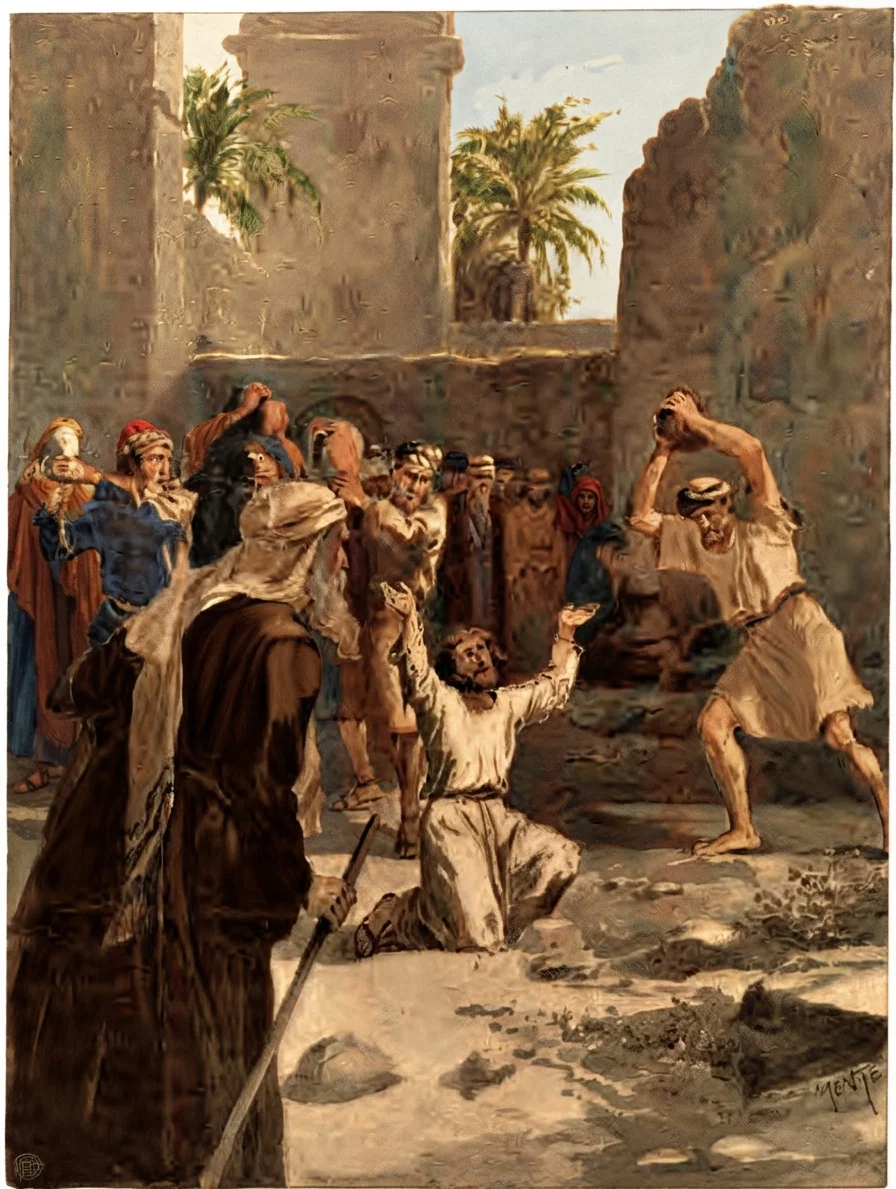
STEPHEN, THE MARTYR.
WHEN the apostles counseled the church at Jerusalem to choose seven deacons, the qualification was that they should be "men of honest report, full of the Holy Ghost and wisdom." The first on the list of those chosen was Stephen, and of him it is especially stated that he was "full of faith and of the Holy Ghost." Again it is noted that he was "full of faith and power," and that he "did great wonders and miracles among the people."
ALTHO he was set apart especially to "serve tables," that is, to see to the proper distribution of food among the people who "had all things common," in order that the apostles might give themselves to the "ministry of the Word," Stephen soon became a power in spiritual work. So mightily did the Lord work through him that erelong he became the special object of bitter opposition on the part of the enemies of the Gospel. The learned ones of various schools undertook by their wisdom to overthrow his arguments, and to counteract his influence among the people.
"THERE arose certain of the synagogue, which is called the synagogue of the Libertines, and Cyrenians, and Alexandrians, and of them of Cilicia and of Asia, disputing with Stephen."
There was a combination of the world's leading wise men (after the flesh) pitted against one of the humble tho learned followers of Christ. It was a notable effort on the part of the enemy of souls, by a display of learning, to draw away disciples and to hinder others from becoming convinced of the truth. But the adversaries of Christ "were not able to resist the wisdom and the Spirit" by which Stephen spake.
The Stoning of Stephen.
THEN followed the characteristic course of the enemies of truth. They are usually quite good natured as long as they can hold their influence with the masses by force of shrewd argument; but when that fails, there is almost certain to be a loss of temper, and, if possible, a resort to harsher measures. The enemies of truth are always unscrupulous, and are always ready to go as far as they dare in order to carry out their opposition. So in the case before us, the opponents of the Gospel began to persecute Stephen when they could not withstand him by fair means.
THEY began by bringing false charges against him. Then they "suborned men" to substantiate their charges. These hired falsifiers said, "We have heard him speak blasphemous words against Moses, and against God." This was designed to arouse the people, who were superstitiously bound to the traditional law of Moses as taught them by their leaders, and professedly zealous for God. The scheme was successful, "and they stirred up the people, and the elders, and the scribes, and came upon him, and caught him, and brought him to the council."
BEFORE the council Stephen was formally charged with speaking blasphemous words against the temple and the law. And the false witnesses declared that they had heard2him say that "this Jesus of Nazareth shall destroy this place, and shall change the customs which Moses delivered us." In refutation of these charges, before the accused man had been given opportunity to reply, the approval of Heaven rested upon him in a visible manner. "And all that sat in the council, looking steadfastly on him, saw his face as it had been the face of an angel." Had those who professed such zeal for the teaching of Moses really believed Moses, they would have recognized in Stephen's face the same glory that shone in the face of the patriarch as he came down from communion with God on Mount Sinai. But prejudice and jealousy are always blind to evidence, and Satanic hatred refuses to yield either to the Word of God or to manifestations of His power and glory. "If they hear not Moses and the prophets, neither will they be persuaded, tho one rose from the dead."
WHEN the high priest asked Stephen himself if the things charged against him were true, the prisoner entered upon an eloquent defense of the truth—not of his own person. He was earnest in his desire for the salvation of his persecutors. He rehearsed the history of God's dealings with His people from Abraham down to the building of the temple by Solomon, and his auditors were deeply interested in his theme and attracted by his eloquence. But when he said, "The Most High dwelleth not in temples made with hands," he was construed as speaking against the temple. Their disapproval was evidently so manifest that Stephen knew that further appeal was useless. So he boldly charged them with always resisting the Holy Ghost, with persecuting the prophets, and, finally, with betraying and murdering Christ. They had "received the law by the disposition of angels," and had not kept it.
HUMAN nature, backed by a determined unbelief, never can stand being confronted with personal sin. The utmost limit of power to resent it will surely be employed in whatever way is deemed most expedient. The truth had "cut to the heart" the persecutors of Stephen, and, in their rage, they "gnashed on him with their teeth." But the man of God was calm, "being full of the Holy Ghost." Looking up to heaven, he "saw the glory of God, and Jesus standing on the right hand of God," and faithfully bore witness to the fact.
THIS vision gave added strength to the hero of the cross, as he faced his doom; but his testimony and his fearlessness were too much for the enemies of Christ to bear. "They cried out with a loud voice, and stopped their ears, and ran upon him with one accord, and cast him out of the city, and stoned him." But Stephen committed himself to his Saviour, used his last words in prayer for his enemies, and "fell asleep." But the trying of his faith on this terrible occasion, his heroic defense of the Gospel, and his tragic death were not without fruit. One of his bitterest opponents, one who consented unto his death, afterward became the fearless apostle Paul. He faithfully served his Master through a long ministry of great persecution and suffering, and finally yielded up his own life in defense of the faith.
"AND devout men carried Stephen to his burial, and made great lamentation over him." For the full scriptural record of Stephen's call, trial, and death, see Acts 6:1 to 8:2. G.
THE NEED OF UNITY.
By Ellen G. White
GOD has given His children different talents and capabilities, but all are to work under one great Head. Those who claim to serve God are under obligation to work for Him with faithfulness and unselfishness. They are not to watch for an opportunity to build themselves up to the injury of some one else.
Different gifts are imparted to different ones, that we may feel our need of one another. God bestows these gifts, and they are to be employed in His service; not to glorify the possessor, but to uplift the world's Redeemer. They are to be used for the good of all mankind. God desires His people to help one another in the discharge of their various duties, and in the faithful accomplishment of the work He has given them to do.
The Lord wishes His people to reach a higher standard. He desires them to overcome all self-exaltation. No jealousy or envy is to be manifested, no evil surmisings entertained. The power of Satanic agencies is great, and the Lord calls upon His people to unite their forces to strengthen one another, "building up yourselves on your most holy faith." "Love as brethren, be pitiful, be courteous."
We are laborers together with God. One laborer plants, another waters or cultivates, and God gives the increase. The progress of the work in each individual soul determines the strength of the church. When those who claim to believe the truth are sanctified through the truth, when they learn of Christ, His meekness, and lowliness, there will be complete and perfect unity in the church. The members will answer Christ's prayer, "Sanctify them through Thy truth; Thy Word is truth; . . . that they all may be one; as Thou, Father, art in Me, and I in Thee, that they also may be one in Us; that the world may believe that Thou hast sent Me. And the glory which Thou gavest Me I have given them; that they may be one, even as3We are One; I in them, and Thou in Me, that they may be made perfect in One; and that the world may know that Thou hast sent Me, and hast loved them, as Thou hast loved Me."
When Christ abides in the hearts of believers, all quarrels, all selfish actions, all discourteous words, will be put away. Each one will ask earnestly, "Lord, what wilt Thou have me to do?"
Let us strive with earnestness for the victory over sin. Let us be determined not to give place to the enemy by criticizing, by picking flaws, by disparaging others, and seeking to be first. Let us study the prayer made in our behalf, and work for its fulfilment. Let us keep our eyes fixed upon the perfect Pattern. The only way to avoid dissension and strife is to keep looking to Him who came to the world to save sinners, learning of Him, His meekness and lowliness. He says to us, "Lo, I am with you alway, even unto the end of the world." How, then, can there be strife among us? If we live in Christ's presence, there will be no contention.
Read the instruction given in the eighteenth chapter of Matthew. In all the oracles of God there is nothing more positive than this, and yet God is dishonored and His cause marred by the doing of the wrongs pointed out in this chapter. These words are for you and for me, and for all who claim to be followers of the meek and lowly Jesus. He shows us the principles upon which we are to act in all cases and under all circumstances. There is to be no striving for the supremacy. Christ teaches that in His spiritual kingdom it is not position, not outward splendor or authority, but inward excellence that constitutes greatness.
The disciples came to Jesus with the question, "Who is the greatest in the kingdom of heaven? And Jesus called a little child unto Him, and set him in the midst of them, and said, Verily I say unto you, Except ye be converted, and become as little children, ye shall not enter into the kingdom of heaven. Whosoever therefore shall humble himself as this little child, the same is greatest in the kingdom of heaven."
This is Christ's lesson for those He has ransomed by His own blood. He takes a deep interest in the least and feeblest of His children, and regards that which is done for them as done for Himself. The angels, who are in constant communion with the Father, are not ashamed, but glad and willing to minister to those most in need of their help. Then should not we, as servants of Christ, be willing to minister to those whom we suppose to be inferior to ourselves?
The greatest in the kingdom of God are those who know and love Him. These are they who are chosen of Him and precious. To do justly, to love mercy, and to walk humbly before God, this is an unfailing evidence of true sanctification of heart and life.
Christ's teachings are to be to us as the leaves of the tree of life. As we receive and assimilate His words, we shall reveal a symmetrical character. By our unity, by esteeming others better than ourselves, we bear to the world a living testimony of the power of the truth. We are not to fear that unless we seek to be first, we shall not be properly estimated. If men had higher and clearer views of Christ, if they had greater confidence in Him and less confidence in themselves, their characters would be molded and fashioned according to the divine likeness. When self is hid in Christ, the Saviour will appear as the chiefest among ten thousand, and the One altogether lovely.
Christ's presence in the church is its life, its health, and its growth. Let God's children remember that to be esteemed by men is nothing, but to be commended by God is everything. Christians must give up seeking to be first if they obtain the favor and recognition of God. Those who have correct views of what constitutes true greatness will never contend for the supremacy.
Let us put far from us every feeling of self-exaltation. Let us prepare to be good soldiers of the cross by learning the lesson Christ gave when He said, "Take My yoke upon you, and learn of Me; for I am meek and lowly in heart; and ye shall find rest unto your souls." He who has crushed down all desire for self-recognition will surely be recognized by the unselfishness of His life. In order to help and encourage others, he is willing to put self aside, to forego his own plans and desires. Such a man is a noble leader in Christ's army.
Look at the Saviour's patient endurance in suffering and trial, and remember that we too are engaged in a severe and trying warfare. Let us yoke up with Him in unselfish service. "Let nothing be done through strife or vainglory; but in lowliness of mind let each esteem other better than themselves. . . . Let this mind be in you, which was also in Christ Jesus; who, being in the form of God, thought it not robbery to be equal with God; but made Himself of no reputation, and took upon Him the form of a servant, and was made in the likeness of men. . . . Do all things without murmurings and disputings; that ye may be blameless and harmless, the sons of God, without rebuke, in the midst of a crooked and perverse nation, among whom ye shine as lights in the world."
MRS. E. G. WHITE.
BECAUSE THOU KNOWEST.
By Mary D. Brine
BECAUSE Thou knowest, O dear Lord, because Thou knowest well,
The secret troubles of our hearts, those thoughts we can not tell
E'en to our friends, however dear and pitying they may be—
Because Thou knowest all, my Lord, our comfort lies in Thee!
At Thy dear feet our griefs are poured, on Thee our burdens laid;
In Thee we find the sunshine, tho our way lies deep in shade;
From Thine all-searching sight, O Christ, we would not try to hide
Those secrets which from friends around are hidden 'neath our pride!
Ah, no! but as a grieving child leans on its mother's knee,
We put our trembling hands in Thine, and tell our griefs to Thee,
Because Thou knowest, gracious One, the reason of them all,
Because Thine aid alone can lift and cheer us when we fall!
O loving Lord, who madest us, and who so long ago
Dwelt with Thy children here on earth, learned human joy and woe,
Bend down, and put Thine arms about Thy children as they pray,
Because Thou knowest all their hearts, their need of Thee each day!
And whatsoe'er our trials be, tho they be great or small,
"E'en as a mother comforteth," wilt Thou, who knowest all.
—Mary D. Brine, in Christian Endeavor World.
THE END DRAWETH NEAR.
By Clarence Santee
SEVENTH-DAY ADVENTISTS have no faith in setting times, such as days, months, or years, for the Lord to come. In fact, a person can not be a real Seventh-day Adventist and do this. There is a class of persons who have set various times for the Lord to come the second time, and they are correctly known as "Adventists," as the name simply means one who believes in the coming of the Lord, and especially it is applied to those who believe that His coming is near. But the class who have been calling attention to certain times, stating that the Lord would come at those times, while being Adventists, are not Seventh-day Adventists, and have few points of faith in common with them. Yet, while disclaiming emphatically all knowledge of the day, month, or year when the Lord will come in glory—believing that this is not revealed—we do believe that the generation who will be living when this shall take place, will know that His coming is near, so near that it is "even at the door," so that the next great event will be the ushering in of that solemn and momentous day.
Some one will be looking for Him and expecting Him. We do not look for an event that we have no evidence will come. In Titus 2:12, 13 God says, "We should live soberly, righteously, and godly, in this present world; looking for that blessed hope, and the glorious appearing of the great God and our Saviour Jesus Christ." Again He says, "Unto them that look for Him shall He appear the second time without sin unto salvation." Heb. 9:28.
They will not only be looking for that event, but they will be ready and waiting for it. "And it shall be said in that day, Lo, this is our God; we have waited for Him, and He will save us; this is the Lord; we have waited for Him." Isa. 25:9. So then some one will be expecting, looking for, and waiting for the coming of the Saviour when He does appear. And their action will be based upon the evidence of the inspired Word.
After speaking of the glory of the coming of the Saviour "with a shout, with the voice of the archangel, and with the trump of God" (1 Thess. 4:16, 17), the apostle adds: "But of the times and the seasons, brethren, ye have no need that I write unto you. For yourselves know perfectly that the day of the Lord so cometh as a thief in the night. For when they shall say, Peace and safety; then sudden destruction cometh upon them. . . . But ye, brethren, are not in darkness, that that day should overtake you as a thief. . . . Therefore let us not sleep, as do others; but let us watch and be sober." Chapter 5:1-6. In this it is stated that the signs about us will be a sure index of the "times and seasons" when "the Lord Himself shall descend from heaven." Then our duty is to watch "when they shall say, Peace and safety."
From this we learn that we are not only to "look for Him," but to watch the doings of men and nations in this world as signs when we should look for Him. There will be the two classes, those who "watch" and those who "sleep." We will all be found in one class or the other when He appears. Has there been the "Peace and safety" cry heard? Let me quote another text: "And it shall come to pass in the last days, that the mountain of the Lord's house shall be established in the top of the mountains; . . . and all nations shall flow into it. And many people shall go and say, Come ye, and let us go up to the mountain of the Lord, to the house of the God of Jacob; and He will teach us of His ways. . . . And He shall judge among the nations, and shall rebuke many people." Isa. 2:2-4. Who are the "many people" whom it is claimed will be rebuked? In quoting the same prophecy in Micah 4:1-3, he states that they are the "strong nations afar off."
To-day there is almost a religious war against China, in which, strange as it may seem, professed Christians are clamoring the most loudly for unsparing vengeance. One minister, speaking of the East, says that "every bullet sent, every cannon shot, and every flag waved, means righteousness." It is anticipated that, as a result of war and bloodshed, we shall have a world's peace.
The prophet has also recorded, in the same scripture, following the alleged rebuke of God, these words of many people: "And they shall beat their swords into plowshares, and their spears into pruning-hooks; nation shall not lift up sword against nation, neither shall they learn war any more." It must be remembered that the Lord says the people will be making these statements "in the last days," not that the Lord says it. The people will say, "The mouth of the Lord of hosts hath spoken it." Verse 4.
Do these things greet our ears to-day? Are they a sign of the end, given as such by the Lord Himself? Is there aught said of "Peace Congresses" and "National Arbitration Committees" to attain these ends? The "people" have spoken as the Lord said they would, and we will yet hear more from them.
Now listen to the words of God as He sees the same nations, at the same time: "Behold, evil shall go forth from nation to nation, and a great whirlwind shall be raised up from the coasts of the earth. And the slain of the Lord shall be at that day from one end of the earth even unto the other end of the earth." Jer. 25:32, 33. The people will say, "Peace and safety," and, "Nation shall not lift up sword against nation." But God says, "Evil shall go forth from nation to nation." He also says: "Prepare war, wake up the mighty men, let all the men of war draw near; . . . let the weak say, I am strong. . . . Let the heathen be wakened." Joel 3:9-12. Then "when they [the people] shall say, Peace and safety," at that time God wants us to know that "sudden destruction cometh upon them." Where, then, are we? We are in the time when we can say with confidence, "The end draweth near." Soon Jesus will come to this sin-burdened, war-shaken world. There is safety to every one who will put all into the hands of God, by implicit obedience, and let His truth be his "shield and buckler." Ps. 91:4.
THE CYNIC. IS IT I?
By M. H. Brown
THE cynic is always a critic. He sees and talks of the defects and weaknesses of men and things, and, what is worse, he becomes so habituated to viewing faults and wrongs that he suspects they exist even where they are not visible. And ever when a person's act is apparently good, he will insinuate that the motive that prompted it was a selfish one. Nothing is right, and nothing escapes his sharp and withering criticism. Unconsciously to himself, he virtually declares his great discernment, his profound wisdom, and his immaculate goodness. The man who talks of the faults of others proclaims that he is good, that he would not be guilty of such things; so that really the habit of faultfinding and criticizing is a manifestation of selfishness and a form of self-exaltation.
But the question may be asked, "Are we not to discern and call attention to the signs of the times and the increasing wickedness of these last days?"—Most assuredly. But we are also to heed what God's Word enjoins upon us, in regard to our words and thoughts. It says, "Whatsoever things are true, whatsoever things are honest, whatsoever things are just, whatsoever things are pure, whatsoever things are lovely, whatsoever things are of good report; if there be any virtue, and if there be any praise, think on these things." Phil. 4:8. Again it instructs us "to speak evil of no man, to be no brawlers, but gentle, showing all meekness unto all men." Titus 3:2. See also Eph. 4:30-32; 1 Peter 2:1; Matt. 7:12. How can we obey the instruction of the Lord in these scriptures, and give the message for our time as recorded in Isa. 58:1; Rev. 14:8, and 18:2-4? Surely there is no lack of harmony in God's requirements. Obedience to one of God's commands does not make it necessary to disobey another.
Truth may be preached and the message proclaimed without denouncing men, or sects, or parties. Error and false systems of religion may be exposed without denouncing their adherents. Our aim should be to save men, by preaching Christ, and showing the beauty and harmony of truth and righteousness in contrast with error and sin. Men are not won to Christ and His cause by denunciation and criticism. Love is the conquering power of the Gospel. Love is merciful, pitiful, and compassionate. It "covers a multitude of sins." It "suffers long and is kind." It abhors sin and wrong, but it loves the sinner, and seeks in every right way to win his confidence and his heart. "Every one of us should weed out of our conversation everything that is harsh and severe. We should not indulge in condemning4others, and we will not do so if we are one with Christ."
There is great danger that we shall fix our eyes and our minds upon the dark picture of sin and crime in our world, and dwell upon it and talk about it until we become changed into the same image. It is too late in the day to become molded into the image of the world by beholding its wickedness, talking of its doings, practising its ways, and partaking of its spirit. If others are referred to unfavorably in social intercourse, the Christian will not enjoy such remarks. He will never sanction or encourage evil-speaking and backbiting; on the contrary, he will seek to turn the conversation into other channels, or he will speak of some good trait, something to commend in the one who is the subject of criticism. Perhaps the one who is criticised has as few faults as those who censure him, and may be a true, sincere Christian. It would have a salutary effect on the true Christian to remember always the words of the Saviour, "Inasmuch as ye have done it unto one of the least of these My brethren, ye have done it unto Me." Matt. 25:40.
Yes, Christ identifies Himself with His people so closely that He counts every unkind word, every harsh remark, and every censuring statement uttered against one of His children, or any one else, as really against Himself. This is because all men belong to God, both by creation and redemption. He loves them with an infinite love; He gave His Son to die for them, and He graciously invites them all to accept the great salvation. He wants them won by love, the only potent force in saving people from sin, and the only one which God employs, or authorizes any one to employ in His work. Therefore when we indulge in evil-speaking, censuring, and fault-finding, we speak evil of the law and judge the law, because the law requires that we love our neighbor as ourselves. James 4:11. Satan is the great accuser, and accusing is one form of his violation of the divine law of love; and all who indulge in this terrible sin of evil-speaking manifest the spirit of Satan and not the Spirit of Christ. A careful reading of James 3 will show how God regards the use of the tongue. See also Prov. 10:11; 11:13; 15:26; 16:24, 27, 28; 17:9; 18:8, 21; 20:19; 21:23; 25:23; 26:20, 21, 28.
The Saviour says, "Out of the abundance of the heart the mouth speaketh." Matt. 12:34. The person who is constantly indulging in criticism of the acts and motives of others, shows that his own heart is devoid of that love and sympathy which God has for poor, fallen humanity, and that it is controlled by the spirit which inspires Satan in his work of accusing the brethren, and opposing the work of God. Love "thinketh no evil; rejoiceth not in iniquity, but rejoiceth in the truth." 1 Cor. 13:5, 6. Love produces kindness, sympathy, and tender compassion for all, especially the erring and the fallen. "Let brotherly love continue."
M. H. BROWN.
HOW MUCH REDEMPTION INCLUDES.
By Mrs. H. Hurd Haskell
"THE Son of man is come to seek and to save that which was lost." His work is to restore what was lost through sin. The body made in the image of God; the right to the tree of life; communion with God, without any obscuring vail between, and the dominion of the earth, were all lost through the sin of our first parents. The decree also went forth, "Cursed is the ground for thy sake."
The Son of man, the "second Adam," came to restore to humanity all that they would have enjoyed if sin had never entered. This means more than many suppose; for "so long as they remained loyal to the divine law, their capacity to know, to enjoy, and to love, would continually increase. They would be constantly gaining new treasures of knowledge, discovering fresh springs of happiness, and obtaining clearer and yet clearer conceptions of the immeasurable, unfolding love of God."
If man had never sinned, but continued to gain new treasures of knowledge, would he not have been at the present time immeasurably beyond what Adam was at the beginning? Have not all those vast opportunities been lost to humanity? It has been the work of the devil to cheat man out of these blessings. But "the Son of man was manifested that He might destroy the works of the devil." And the promise reads, "I will restore to you the years that the locust hath eaten," etc. Man redeemed will be what he would have been at the end of the thousands of years that have passed since his fall, if he had never sinned. He will not simply be what Adam was at the beginning. "All that it was possible for him to gain by a sinless life, will be given him through Christ." Man in the beginning was made a little lower than the angels; but man redeemed will be highly exalted. "The work of redemption involves consequences of which it is difficult for man to have any conception. There was to be imparted to the human being, striving for conformity to the divine image, an outlay of heaven's treasures, an excellence of power, which would place him higher than the angels who had not fallen."
Every trace of the slimy trail of the serpent will be removed. The earth, which was to be subdued and replenished by man, will be restored to the perfect state to which it would have been brought in the same period of time, by man, if sin had never entered. Thus, instead of having the garden only, we will have the city, and the garden, with the tree of life in the "midst of the street of it." What man would have built about the garden to beautify it, Christ has prepared in heaven, and brings it down with the garden upon the new earth.
"The redemption of our body" will be complete; for He will "change our vile body, that it may be fashioned like unto His glorious body." The robe of light which enshrouded our first parents before they sinned will again clothe humanity, and they will "shine forth as the sun in the kingdom of their Father."
"The Spirit of Christ" through Hosea gives the pledge, "I will redeem them from death." The flaming sword will no longer separate humanity from the tree of life, but they will have a right to eat and live forever throughout the ceaseless ages of eternity. What rapturous joy will fill the heart of Adam as "the Saviour leads him to the tree of life, and plucks the glorious fruit, and bids him eat"!
No longer will the Father be to His people an "invisible God;" for "they shall see His face; and His name shall be in their foreheads." The "first dominion" will come to the "tower of the flock, the stronghold of the daughter of Zion." Micah 4:8. He who conquered Satan in every conflict receives "dominion, and glory, and a kingdom, that all people, nations, and languages, should serve Him: His dominion is an everlasting dominion, which shall not pass away." The curse of sin that now rests so heavily upon the earth will forever pass away. "And there shall be no more curse; but the throne of God and of the Lamb shall be in it; and His servants shall serve Him."
"The cross of Christ will be the science and the song of the redeemed through all eternity. In Christ glorified they will behold Christ crucified. Never will it be forgotten that He whose power created and upheld the unnumbered worlds through the vast realms of space, the Beloved of God, the Majesty of heaven, He whom cherub and shining seraph delighted to adore, humbled Himself to uplift fallen man; that He bare the guilt and shame of sin, and the hiding of His Father's face, till the woes of a lost world broke His heart, and crushed out His life on Calvary's cross. That the Maker of all worlds, the Arbiter of all destinies, should lay aside His glory, and humiliate Himself, from love to man, will ever excite the wonder and adoration of the universe. As the nations of the saved look upon their Redeemer, and behold the eternal glory of the Father shining in His countenance, as they behold His throne, which is from everlasting, and know that His kingdom is to have no end, they break forth in rapturous song, 'Worthy, worthy is the Lamb that was slain, and hath redeemed us to God by His own precious blood!'"
NO MORE CURSE.
By G. B. Thompson
EVER since the fall of man the earth has been groaning beneath the curse of sin.
Every created thing on this planet,—the lost sheep in the family of worlds,—shows the marks of the terrible malady of sin. Death and decay are stamped upon everything. Man is born, but fleeth as a shadow. He continueth not. The grim reaper steps across the threshold and summons to the narrow home the father, mother, husband, wife, or child. The chair is vacant. They exist only in the memory, and the record made by the heavenly penman. Pain, sorrow, disappointment, weeping, death, mourning, misery, wretchedness, and poverty begging description, greet the eye at every turn. Man, made in the image of God, curses and swears and blasphemies the name of eternal God.
As we look upon the awful wreck sin has made, it is comforting to read of a time when the curse will be no more. "And there shall be no more curse; but the throne of God and of the Lamb shall be in it; and His servants shall serve Him." Rev. 22 : 3.
On reading this blessed promise it occurs to the writer that if such a glorious time ever comes, when the curse is no more, there must of necessity come a time when men will stop cursing. It is impossible to conceive of such a thing as the curse being done away while sinners remain to curse. To this every person who thinks must assent.
Then if this is so, what becomes of the doctrine that those who are finally lost will curse and blaspheme God through all eternity? Surely if unnumbered myriads of the damned should be cursing and blaspheming and denouncing God with terrible oaths as long as God Himself should exist, there never could be a time when there would be "no more curse."5
This horrible and God-dishonoring doctrine, so inseparably connected with the unscriptural idea of the natural immortality of man, has strengthened unbelief and hatred of God in the heart of many a poor struggling soul. I can remember when but a boy attending revival effort with my parents, and my young heart was moved as I saw the love of God manifested in the gift of Jesus, and the offer of a free pardon for all offenses. But frequently before the preacher closed he would give his audience what he termed a "peep into the bottomless pit." Then I was told that if I failed to repent, the God of love about whom I had been hearing would hurl me at last into hell fire, with millions of other lost souls, where, in a lurid flame, in agony no mortal tongue could portray, I would burn and curse in terrible torment as long as God should exist. I was told that when I had been weeping and wailing in this unspeakable torment as many million years as there are blades of grass and leaves of the forest, I would have just as long to burn and curse as ever. But my boyish mind revolted at the horrible thought, and it seemed to me that God must be a fiend to do this. As I grew to manhood with the thought of this awful doctrine before me, I could not see a God of love in it, and I was driven almost into infidelity and atheism. The preacher said it was in the Bible, and I, supposing he knew, took it for granted. So I had about concluded to discard the Bible. I shudder now at the thought.
But later on I learned that the Bible did not uphold such an awful dogma, but that God had said there would come a time when there would be "no more curse;" that sinners would be burned up, root and branch (Mal. 4 : 1), and cease to exist (Ps. 37 : 9, 10); that they would be devoured from off the earth (Rev. 20 : 9), until not a coal would finally be left at which to warm (Isa. 47 : 14); that the entire universe would be free from the curse of sin, and every creature be found praising God through the never-ending cycle of eternity. In this I can see the love and justice of God, and my soul longs for that glad time to come when there will be "no more curse."
G. B. THOMPSON.
Christ’s Service Requires Diligence
CHRIST'S service is no service for an idler. There is no place in all the kingdom of heaven for an idle man, either in this world or the next. Indeed, no man can follow Christ without becoming a busy man, as his Master was before him. Work is one of the world's great blessings. It is work that wins wages. And yet there is no easy task that may not be made hard by leaving Christ out of it. So there is no hard task but may be made easy if we put Christ and His helpfulness in it.—Christian Work.
SOME SOUND REASONS CITED.
By T. E. Bowen
JESUS CHRIST brought into the world principles so wise and pure that the world could not fully appreciate them. They were and still are as foreign to the spirit and ways of the world as heaven is higher than earth. They never can be united. In name the church may think to possess them while being actuated by worldly policies; and some in the world may honestly believe they belong to Christ, but He does not recognize them as His. If the church would remain faithful to these exalted truths, and let alone the worldly idea of civil force, she would not have so much to complain about. If the Lord’s instruction, which says, “Therefore all things whatsoever ye would that men should do to you, do ye even so to them,” were really practised by the church, there would never appear in the papers of the world such pertinent remarks as the following:—
THE DECLINE IN CHURCH ATTENDANCE.—While the ministers are discussing the reasons for the diminishing attendance at church services, it may be worth while to call their attention to the recent revival in Baltimore of an obsolete and neglected blue law of 177 years ago, and the raid last Sunday on the ordinary and necessary and harmless Sunday traffic. Is it to be expected that honest and reputable citizens who are made the victims of such a raid, and who are held up as law-breakers and malefactors under it, will show much enthusiasm for the mistaken zeal which prompted it?
The foregoing is an editorial from a journal published in the year 1900. People who go to church desire to hear from men in whom they can have confidence as Christians. If they do not have such confidence, and do not hear the Word when they do go to church, they will prefer to stay at home and enjoy their favorite reading rather than listen to some tirade or political speech. People love the taste of the fruit from the Spirit of God, altho they may not understand its Source, or how it is produced upon the human branch. The spirit of Sunday laws is far from being that Spirit of love which “worketh no ill to his neighbor.” A tree is known by its fruit.
T. E. BOWEN.