Your ShelfYour Projects

Signs of the Times, Vol. 25, No. 7.

THE BARREN FIG TREE

Signs of the Times

Feb 15, 1899

Pacific Press Publishing Company · Oakland, California · Feb 15, 1899

THE BARREN FIG TREE.
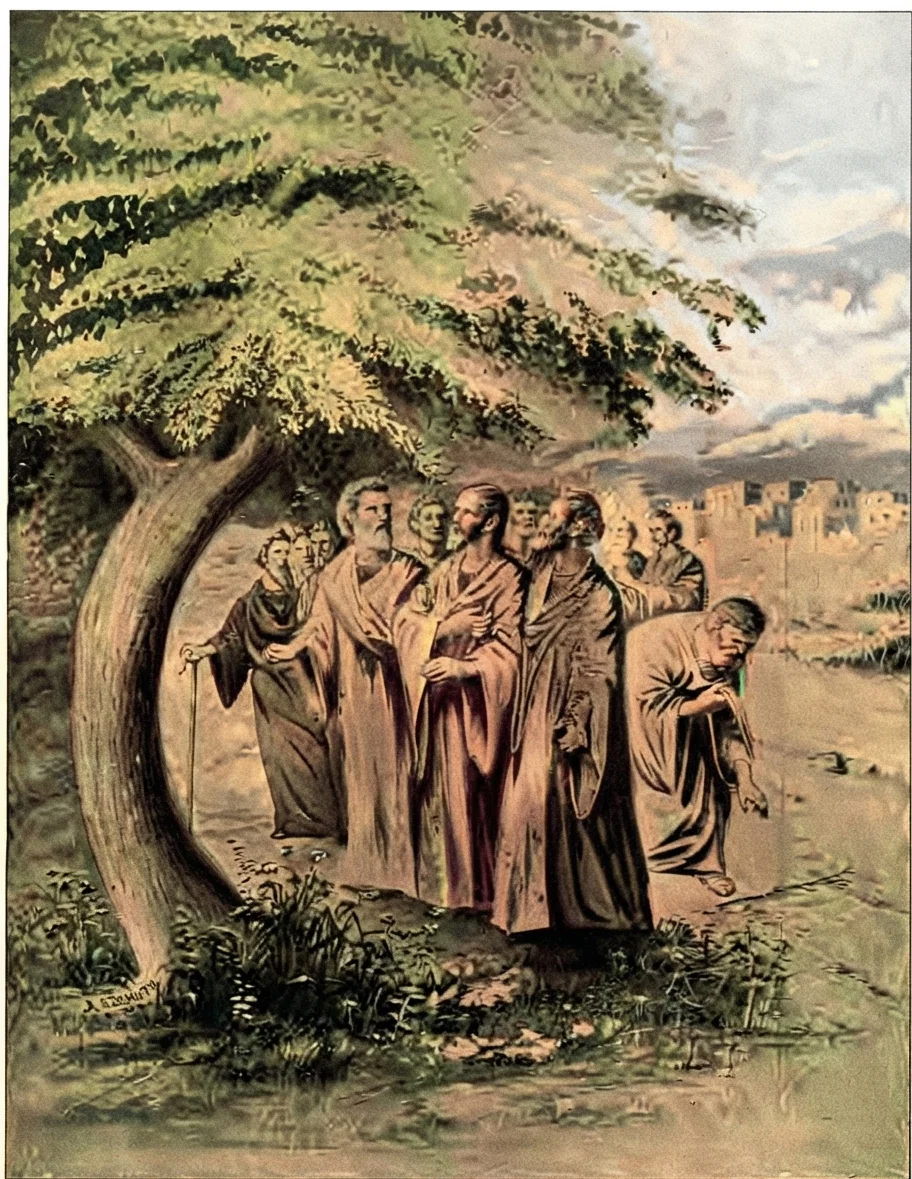
"AND on the morrow, when they were come from Bethany, He was hungry; and seeing a fig tree afar off having leaves, He came, if haply He might find anything thereon; and when He came to it, He found nothing but leaves; for the time of figs was not yet."
It was not a common thing in the East for a fig tree to present full foliage so early in the season. It is the nature of the fig tree for the fruit to make its appearance before the leaves. Therefore upon a tree covered with leaves one might expect to find well-developed figs. Christ approached the tree, expecting to find fruit upon it; but after searching from the lowest bough to the top-most twig, He found nothing but leaves. And Christ uttered against it a withering curse.
The next morning as the Saviour and His disciples were again wending their way to the city, the blasted branches and drooping leaves attracted their attention. "Master," said Peter, "behold the fig tree which Thou cursedst is withered away."
This instance in the ministry of Christ was a singular one. It was unlike His ways and works. We trace His life, and see that His acts were ever performed to restore, not to destroy. He scattered mercy wherever He went, in words of counsel and deeds of goodness.
He came not to condemn the world, but that the world through Him might be saved. The disciples could not understand this act in punishing a tree for its barrenness, and they said, "Declare unto us the parable of the fig tree."
It was the purpose of Christ that this fig tree should teach His disciples a lesson. He desired to impress upon them the true state of Jerusalem, and her final doom; and to do this He invested the tree with moral qualities, and made it the expositor of divine truth. Just before this Christ had made His triumphal entry
into Jerusalem. For the second time He had cleansed the temple, driving out from its courts the traffickers, saying: "Take these things hence." "It is written, My house shall be called the house of prayer; but ye have made it a den of thieves." Dishonest dealing was practised by the men who brought cattle to sell in the temple courts; but the word of command was given; divinity flashed through humanity, and no trafficker or priest in his gorgeous dress looking on that countenance dared to remain. In haste all fled from the temple courts. Now under the symbol of the blighted tree Christ presents before His disciples the righteous anger of God in the destruction of Jerusalem. That tree flaunting its pretentious foliage in the very face of Christ was a symbol of the Jewish nation, who had been separating from God until, in their pride and apostasy, they had lost their power of discernment, and knew not their Redeemer.
THE BARREN FIG TREE.
The Jewish nation had indeed been the favored people of God. The Majesty of heaven had been their leader in the wilderness. He had brought them water out of the flinty rock; He had given them bread from heaven to satisfy their hunger. He had turned from them the wrath of God when their iniquities had called
forth His anger. And after more than a thousand years of blessings bestowed and blessings withdrawn, He fulfilled His purpose of coming to the world in person. He veiled His divinity with humanity. Had Christ come in His divine form, humanity could not have endured the sight. The contrast would have been too painful, the glory too overwhelming. Humanity could not have endured the presence of one of the pure, bright angels from glory; therefore Christ took not on Him the nature of angels; He came in the likeness of men.
But thirty years was all that the world could endure of its Redeemer. For thirty years He dwelt in a world all seared and marred with sin, doing the work that no other one ever had done or ever could do. And for three years He waited, and prayed, and worked, and wept, crying, "Return, ye backsliding children, and I will heal your backsliding." "Seek ye the Lord while He may be found, call ye upon Him while He is near; let the wicked forsake his way, and the unrighteous man his thoughts; and let him
return unto the Lord, and He will have mercy upon him; and to our God, for He will abundantly pardon." But the Jewish nation would not receive their Messiah. Throughout the years of His public ministry they sought to put Him to death; and this act was to prove their ruin.
The Gentile world was represented by the leafless, fruitless fig trees. The Gentiles were destitute, as were the Jews, of godliness, but they had not claimed to be in favor with God. They made no boast of exalted spirituality. They were blind in every sense to the waysand works of God. With them the time for figs was not yet. They were still looking forward to a day which would bring them light and hope.
The Jews as a nation had laid claim to righteousness above every other people, while they stood out in proud defiance of God. As a people they were self-confident, exalted, selfish, and boastful. The barren tree was a fit representation of them. Ambition, and erroneous views in regard to Christ's advent, had deceived the Jewish nation, and when Christ came as the meek and lowly One, they would not receive Him. Israel had perverted the Scriptures, and had taught for doctrine the commandments of men. They made void the law of God through their traditions. That law which they claimed to observe so strictly, they made a yoke of bondage. Satan had put his leaven into the most precious, everlasting truth, to make of none effect God's sacred institution.
The law of God, if observed with heart obedience, would have produced altogether a different influence; but vainglory, selfishness, and oppression marked the character of the Jews. They were proudly displaying their ceremonies before the very face of Christ, who was the foundation and center of the whole Jewish economy, while they rejected the Antitype of all their types, the Substance of all their shadows. They were so blinded by Satan that they knew not the time of their visitation. And God declared, "O Israel, thou hast destroyed thyself."
Christ had often sought the Father in anguish of spirit, as He beheld the situation of the inhabitants of Jerusalem. Often in the lonely mountains He had prayed with strong crying and tears, because that of all the people on the face of the earth, none were so filled with bitterness and hatred against Him as were those who had been favored with every temporal and spiritual advantage. This was the people for whom the Son of God had done so much, in order that they might become a treasure-house of rich truth, to impart the same to the world. Those who claimed to know God were opening their hearts to the attributes of Satan. In the blighted fig tree Christ sees the ruin of the nation, and the sight draws tears to His eyes.
The bright future of prosperity and glory which Jerusalem might have enjoyed rises before Him. Had Jerusalem but known the time of her visitation, had she accepted the world's Redeemer, she would have been healed of her grievous malady; she would have been exalted as the world's metropolis. No Roman army would have stood at her gates. No Roman yoke would have rested upon her shoulders. As the favored citadel of truth, the dove of peace would have gone forth from her to all the nations of the earth. She would have been as a diadem of glory to her God.
But instead of this, Christ sees Jerusalem surrounded with the besieging army. He sees the inhabitants suffering from starvation, delicate mothers slaying and eating their own children, fathers, mothers, and children contending for a morsel of food, and forcing the fragments from the mouths of their starving relatives. He sees the gates open to the invaders, and those who have defied them and refused to surrender. He sees suffering beneath the scourge, the rack, and the cross. He sees Jerusalem in ruins, the beautiful, costly temple, the pride of the nation, torn down until not one stone is left upon another. Its site is plowed as a field. Terrible picture. The sight calls forth deep emotion from the Son of God.
The explanation of this strange act of Christ in the cursing of the fig tree was to stand as a living, warning appeal to all Christian churches. The blighted tree was to repeat its lesson in every age to the close of earth's history. God is looking for piety, self-denial, self-sacrifice, compassion for man, and zeal for God. He longs to see in man a deep yearning of soul to save his fellow-man from unbelief and ruin. But the present condition of the Christian churches is similar to the condition of the Jews in Christ's day. The Lord and all heaven behold the fruitless fig tree. They see men trampling upon the law of Jehovah, making the covenant between Him and His commandment-keeping people a thing of naught. But to the people who trample upon that law which God has ordained, Christ says, as He said to the Jewish nation, "Thou hast destroyed thyself."
MRS. E. G. WHITE.

ABOUNDING LOVE.

O, TELL me not that love and might Are both enthroned above; There grace and majesty unite, For God is only love!
On every hand, both sea and land, His dazzling brightness prove Whose glory is His goodness, and Whose pleasure is His love.
There's beauty for the charmed eye, The eye to beauty given, And for the ear sweet harmony, The harmony of heaven.
For every sense His grace supplies Beatitude divine; And ever, with His love-lit eyes, He seeks to kindle thine.
Ah, He it is who piles yon clouds, Of wondrous form and hue, In temple, and in pyramid, And gorgeous palace, too,
That through these fairy gateways we As glows the sun of even, May gaze with raptured eye, to see The battlements of heaven!
There lies the city of our dreams Depicted on the skies, And every aspiration seems Not far to realize.
So, in the setting in of night, The night of woe and pain, God watches with thee till the light Of day returns again.
'Tis of His love the robins sing; And from the wind-swept tree Breaks not upon thy listening ear His sighing sympathy?
The ceaseless throbbing of the sea Upon the rock-bound strand,— What is it but those arms of love Enfolding every land?
E'en in His wrath, which through long years Burns hot against thy sin, The flame shall both dry up thy tears And purge away thy tin.
Nor deem that Wisdom could devise What is not for thy good; At each new step some glad surprise Attests His Fatherhood,
Whose bow of boundless grace appears High overarching all, Who stoops from sweeping stars and spheres To mark the sparrow's fall.
And tho each blooming hope be crushed, Love can not be unjust; The seed shall bear an hundred-fold, Now trampled in the dust.
I see not what insidious snare Lurks in approaching doom; But God has placed His rainbow there To gild the cloud of gloom.
The secret of His dark designs As yet I can not tell, Nor read the meaning of those signs I have not learned to spell.
Yet in this faith I calmly trust, That what lies now concealed, When His own breath allays the dust Shall plainly be revealed.
I know not what reserves of wrath Earth's final plagues contain, Nor in their desolating path What deathly horrors reign.
Yet in the mystery of His ways Methinks I can discern Why God in sov'reign love delays The sons of men to spurn.
Unmeasured mercy seeks to dwell In all His plans severe; With justice, pity mingles well, And hope consorts with fear.
His gentleness shall make them great Who in that grace confide. Love's trophies crowd his car of state And 'neath love's banner ride.
And when I join the blissful choir Of ransomed souls above, My hymn shall be, eternally, His all-embracing love. THORO HARRIS. Washington, D. C.

THE GOSPEL IN THE DIET QUESTION.

WHEN we see a streak of lightning we think of the thunder, because we have always associated it in our minds with the lightning. "Train up a child in the way he shall go," for he will unconsciously associate his training with every act of his life. Yet parents say, "I prayed with Johnny day after day, but it did not seem to do any good."
Children may not have been trained to lie or steal, but are they trained to know that every act of their life should be done to the glory of God? For just as soon as they learn this lesson on one plane, God will lift them up to another, and then they will have it again, only in a broader way. "Whether therefore ye eat, or drink, or whatsoever ye do, do all to the glory of God." 1 Cor. 10:31. So there is such a thing as eating and drinking from principle. In Eccl. 10:17 we may get the principle more in detail: "Blessed art thou, O land, when thy king is the son of nobles, and thy princes eat in due season," for strength, and not for drunkenness! that is, do not eat at irregular times, and God has left it with us to find out how that is. Then we are to eat for strength; but the world has perverted that so as to eat for drunkenness; and since we are to eat for strength and not for drunkenness, it is our duty to learn what kind of food will give us strength. We get our strength from God, but we get it largely through the food, air, and water, and the Bible is the means whereby we learn how to use this strength. How appropriate that we should ask God to bless the food before we partake of it, for His power is in it! But it is only by the miracle of digestion that we can get His strength out of it. The Bible does not tell us in detail what kind of food to eat, but it does bid us to eat for strength, and the responsibility is laid upon us to discover what kind of food contains nourishment and what does not.
If we eat for strength the food will taste good, but if we eat it simply because it tastes good we are eating for drunkenness. It is an important principle that if we simply aim to have a good time we will get misery; but if the purpose be to make others happy we will be sure to reap a good time for ourselves also. We throw a rubber ball on the floor and it rebounds; so with happiness; by making someone else happy we will be happy ourselves. If we eat a thing just because it tastes good, we eat for drunkenness. But if we eat for the glory of God, so out of this food we may get strength to help others, we are eating from principle.
Prov. 23:1: "When thou sittest to eat with a ruler, consider diligently what is before thee." If we sit to eat with a man that is not a ruler, does not the same admonition hold good, even if it be the humble meal in our own home?
But suppose we long for his "savory meals," for they are deceitful food? There are thousands of natural flavors that God has put into the foods that He has bidden us to eat. But to multitudes the sense of taste has become so blunted that they fail to recognize these natural flavors, and the perverted taste is only stimulated by the agents, such as mustard, pepper, ginger, etc., that tend to destroy the natural taste of food. What a substitute for God's own delicate flavors in natural food! How appropriate that the Bible should warn us not to long for such savory meats, for how deceitful they are! Little by little the sense of taste, instead of being educated to enjoy the wonderful gifts God has stored up in foods, becomes so chloroformed, so to speak, that nothing short of the most irritating things can arouse it. Yet these very substances contain none of the nutritive properties of foods.
We can not be too diligent in considering the food question. Many would probably look at the piece of bread and think of some better method of slicing it, or perhaps wonder how the frosting on the top of the cake is made. They will wish they could make it as pretty as that at home. And this is about as deeply as many consider the diet question.
People may know a great many things about Pike's Peak, the depth of the Dead Sea, etc., and yet know practically nothing about the very things God told them to learn about.
"Thou puttest a knife to thy throat if thou be a man given to craving desire." Prov. 23:2, Jewish translation. If a man eats for drunkenness he is committing suicide. But possibly such a man may say, "I haven't any faith at all in this truth." But suppose he says he does not believe in the law of gravitation, it does not alter the law at all. God says if a man eats for drunkenness he is committing suicide, and that settles the question.
Many eat a thing largely because it has enough bulk to fill the stomach, but with little regard as to whether it is garbage or not. He who treats his digestive organs in this way insults God, and must reap in his own organism the sure result; for God is not mocked. "Whatsoever a man soweth, that shall he also reap. He that soweth to the flesh shall of the flesh reap corruption."
DAVID PAULSON, M.D.
STUDIES IN GALATIANS

THE PROMISE AND THE LAW.

SINCE we considered only certain features in the text studied last week, we shall include it in the portion for this week, so that the intimate connection may be preserved. We have therefore the following as

The Scripture Lesson.

"Brethren, I speak after the manner of men: Tho it be but a man's covenant, yet if it be confirmed, no man disannulleth, or addeth thereto. Now to Abraham and his seed were the promises made. He saith not, And to seeds, as of many; but as of one, And to thy Seed, which is Christ. And this I say, that the covenant, that was confirmed before of God in Christ, the law, which was four hundred and thirty years after, can not disannul, that it should make the promise of none effect. For if the inheritance be of the law, it is no more of promise; but God gave it to Abraham by promise. Wherefore then serveth the law? It was added because of transgressions, till the Seed should come to whom the promise was made; and it was ordained by angels in the hand of a mediator. Now a mediator is not a mediator of one, but God is one. Is the law then against the promises of God? God forbid; for if there had been a law given which could have given life, verily righteousness should have been by the law. But the Scripture hath concluded all under sin, that the promise by faith of Jesus Christ might be given to them that believe." Gal. 3: 15-22.
The things in this text that were considered last week were the following: The promise was made to Abraham; the promise concerns an inheritance; that inheritance is the whole world—the earth made new; an inheritance without a curse is the promise of the Spirit; the Lord redeems men from the curse in order that they may dwell forever in an earth redeemed from the curse; the covenant and the promise are the same thing; that covenant has been confirmed; it was confirmed in Christ, to Abraham, by the oath of God, and that oath is our hope and comfort till the present day. With this outline of what has already been passed over, we can proceed with our study.
An Unchangeable Covenant.—God is not a man, but it is sometimes allowable to use human things in illustrating the divine. God is not a man, that He should lie or change. Man is changeable, yet even a man's covenant, if it once be confirmed, can not be disannulled or added to. No change whatever can be made in it. How much more, then, must this be the case with God's covenant? "Whatsoever God doeth, it shall be forever; nothing can be put to it, nor anything taken from it; and God doeth it, that men should fear before Him." Eccl. 3: 14. "When God made promise to Abraham, because He could swear by no greater, He sware by Himself. . . . For men verily swear by the greater; and an oath for confirmation is to them an end of all strife. Wherein God, willing more abundantly to show unto the heirs of promise the immutability of His counsel, confirmed it by an oath; that by two immutable things, in which it was impossible for God to lie, we might have a strong consolation." Heb. 6: 13-18. The covenant, we have already seen, is the promise to Abraham, and that was confirmed by God's oath, and made as unchangeable as His character.
Abraham and Christ.—"Now to Abraham and his seed were the promises made. He saith not, And to seeds, as of many; but as of one, And to thy Seed, which is Christ." It can not be too strongly impressed upon the minds of men that Christ is the Seed of Abraham, and that the covenant was confirmed in Him. There would be no difficulty whatever about the question of Israel if this one fact were remembered. Christ is the Seed of Abraham, and there is no other; for "He saith not, And to seeds, as of many; but as of one, And to thy Seed, which is Christ." Abraham and Christ are inseparably linked together. "To Abraham and his seed were the promises made," how many soever they were. Nothing was made to Abraham that could be obtained in any other way than through Christ; and Christ never comes into the possession of anything that does not belong to Abraham. This is plainly stated in the text.
We will not stop to parley over the matter of "literal seed" and the "spiritual seed." Christ is spiritual, that we know, for no one can call Him Lord, except by the Spirit; but He is also very literal: "Behold My hands and My feet, that it is I Myself; handle Me, and see." We are glad to know that the literal can also be spiritual; were it not so, then we would be yet in our sins. But to Abraham and his Seed were the promises made. The Seed must be as literal as Abraham, even tho He be spiritual; and Christ "took on Him the seed of Abraham." It is enough for us at present to hold to the fact that Abraham and Christ are equally concerned in this promised inheritance, which is spiritual because the Spirit is the first-fruits of it. If we are of faith, then we are the children of Abraham and sharers in the blessing.
The Law Can Not Make Void the Covenant.—Do not forget as we proceed that the covenant and the promise are the same thing, and that it conveys land, even the whole earth made new, to Abraham and his seed; and remember also that, since only righteousness is to dwell in the new heavens and the new earth promised to Abraham and his seed, the promise includes the making righteous of all who believe. This is done in Christ, in whom the promise is confirmed. The argument of verses 17 and 18 is therefore this: Since perfect righteousness was assured by the covenant made with Abraham, which was also confirmed in Christ, it is impossible that the law, which was spoken 430 years later, could introduce any new feature. The inheritance was given to Abraham by promise, but if after 430 years it should transpire that now the inheritance must be gained in some other way, then the promise would be of no effect, and the covenant would be made void. But that would involve the overthrow of God's government, and the ending of His existence; for He pledged His own existence to give Abraham and his seed the inheritance and the righteousness necessary for it. "For the promise, that he should be the heir of the world, was not to Abraham, or to his seed, through the law, but through the righteousness of faith." Rom. 4: 13.
What Is the Use of the Law?—This is the question that the apostle Paul asks in verse 19, both for the purpose of anticipating the objections of the antinomians, and also that he may the more emphatically show the place of the law in the Gospel. The question is a very natural one. Since the inheritance is whollyby promise, and a covenant confirmed can not be changed, nothing can be taken from it, and nothing added to it, why did the law come in 430 years afterward? "Wherefore then serveth the law?" "Why then the law?" What business has it here? What part does it act?
The Question Answered.—"It was added because of transgressions." Let it be understood that "the entering of the law" at Sinai was not the beginning of its existence. The law of God existed in the days of Abraham, and was kept by him. Gen. 26: 5. God proved the children of Israel as to whether they would keep His law or not more than a month before the law was spoken upon Sinai. Ex. 16: 1-4, 27, 28.
"It Was Added."—The word here rendered "added" is the same as that rendered "spoken" in Heb. 12: 19: "They that heard entreated that the word should not be spoken to them any more." It is the same word that occurs in the Septuagint rendering of Deut. 5: 22, where we read that God spoke the Ten Commandments with a great voice; "and He added no more." So we may read the answer to the question, "Wherefore then the law?" thus: "It was spoken because of transgressions."
Because of Transgressions.—"Moreover the law entered, that the offense might abound." Rom. 5: 20. In other words, "that sin by the commandment might become exceeding sinful." Rom. 7: 13. It was given under circumstances of the most awful majesty, as a warning to the children of Israel that by their unbelief they were in danger of losing the promised inheritance. They did not, like Abraham, believe the Lord; and "whatsoever is not of faith is sin." But the inheritance was promised "through the righteousness of faith," so that the unbelieving Jews could not receive it. The law was therefore spoken to them to convince them that they had not the righteousness that was necessary for the possession of the inheritance; for, altho righteousness does not come by the law, it must be witnessed by the law. Rom. 3: 21. In short, the law was given to show them that they had not faith, and so were not children of Abraham, and were therefore in a fair way to lose the inheritance. God would have put His law into their hearts, even as He put it into Abraham's heart, if they had believed; but when they disbelieved, yet still professed to be heirs of the promise, it was necessary to show them in the most marked manner that their unbelief was sin. The law was spoken because of transgression, or, what is the same thing, because of the unbelief of the people.
In the Hand of a Mediator.—For the present we may pass by the question of time involved in the phrase, "till the Seed should come, to whom the promise was made," since our present study is the relation of the law to the promise. The law was given to the people from Sinai "in the hand of a Mediator." Who was this Mediator?—There can be only one answer: "There is one God, and one Mediator between God and men, the Man Christ Jesus." 1 Tim. 2: 5. "Now a mediator is not a mediator of one, but God is one." God is one, the people are the other, and Christ Jesus is the Mediator. Just as surely as God is one party to the transaction, Christ must be the Mediator, for there is no other Mediator between God and men. "Neither is there salvation in any other; for there is none other name under heaven given among men, whereby we must be saved." Acts 4: 12.
Christ's Work as Mediator.—Man has wandered from God and rebelled against Him. "All we like sheep have gone astray." Our iniquities have separated between us and Him. Isa. 59: 1, 2. "The carnal mind is enmity against God; for it is not subject to the law of God, neither indeed can be." Rom. 8: 7. Christ came that He might destroy the enmity and reconcile us to God; for He is our peace. Eph. 2: 14-16. Through Him we have access to God. Rom. 5: 1, 2; Eph. 2: 18. In Him the carnal mind, the rebellious mind, is taken away, and the mind of the Spirit given in its stead, "that the righteousness of the law might be fulfilled in us, who walk not after the flesh, but after the Spirit." Rom. 8: 3, 4. Christ's work is to save that which was lost, to restore that which was broken, to reunite that which was separated. His name is "God with us;" and so with Him dwelling in us we are made "partakers of the divine nature." 2 Peter 1: 4.
The Law Not against the Promise.—"Is the law then against the promises of God?"—Not by any means. Far from it. If it were, it would not be in the hands of a Mediator, Christ; for all the promises of God are in Him. 2 Cor. 1: 20. So we find the law and the promise combined in Christ. We may know that the law was not and is not against the promises of God, from the fact that God gave both the promise and the law. We know also that the giving of the law introduced no new element into the covenant, since, having been confirmed, nothing could be added to or taken from the covenant. But the law is not useless, else God would not have given it. It is not a matter of indifference whether we keep it or not, for God commands it. But, all the same, it is not against the promise, and brings no new element in. Why?—Simply because the law is in the promise. The promise of the Spirit includes this: "I will put My laws into their mind, and write them in their hearts." Heb. 8: 10. And this is what God indicated had been done for Abraham, when "He gave him the covenant of circumcision." Read Rom. 4: 11; 2: 25-29; Phil. 3: 3.
The Law Magnifies the Promise.—The law, as already seen, is not against the promise, because it is in the promise. The promise that Abraham and his seed should inherit the world, was "through the righteousness of faith." But the law is righteousness, as God says: "Harken unto Me, ye that know righteousness, the people in whose heart is My law." Isa. 51: 7. So, then, the righteousness which the law demands is the only righteousness that can inherit the promised land, but it is obtained, not by the works of the law, but by faith. The righteousness of the law is not attained by human efforts to do the law, but by faith. See Rom. 9: 30-32. Therefore the greater the righteousness which the law demands, the greater is seen to be the promise of God; for He has promised to give it to all who believe. Yea, He has sworn it. When, therefore, the law was spoken from Sinai, "out of the midst of the fire, of the cloud, and of the thick darkness, with a great voice," accompanied by the sounding of the trump of God, and with the whole earth quaking at the presence of the Lord and all His holy angels, thus indicating the inconceivable greatness and majesty of the law of God, it was, to every one who remembered the oath of God, but a revelation of the wondrous greatness of God's promise; for all the righteousness which the law demands, He has sworn to give to every one who trusts Him.
Conviction of Sin and of Righteousness.—Jesus said of the Comforter, "When He is come, He will reprove the world of sin, and of righteousness, and of judgment." John 14: 8. Of Himself He said, "I came not to call the righteous, but sinners to repentance." Mark 2: 17. "They that are whole have no need of the physician, but they that are sick." A man must feel his need before he will accept help; he must know his disease before he can apply the remedy. Even so the promise of righteousness will be utterly unheeded by one who does not realize that he is a sinner. The first part of the comforting work of the Holy Spirit, therefore, is to convince men of sin. So "the Scripture hath concluded all under sin, that the promise by faith of Jesus Christ might be given to them that believe." "By the law is the knowledge of sin." Rom. 3: 20. He who knows that he is a sinner is in the way to acknowledge it; and "if we confess our sins, He is faithful and just to forgive us our sins, and to cleanse us from all unrighteousness." 1 John 1: 9. Thus the law is in the hands of the Spirit an active agent in inducing men to accept the fulness of the promise. No one hates the man who has saved his life by pointing out to him an unknown peril; on the contrary, such an one is regarded as a friend, and is always remembered with gratitude. Even so will the law be regarded by the one who has been prompted by its warning voice to flee from the wrath to come. He will ever say, with the psalmist, "I hate vain thoughts, but Thy law do I love." E. J. WAGGONER.

Making Our Lives Like Songs

"LET us try to make our lives like songs, brave, cheery, tender, and true, that shall sing themselves into other lives, and so help to lighten burdens and cares."

Preachers Are Pitchers, Not Fountains

PREACHERS are pitchers, not fountains. Don't expect them to pour out always if you give them no time to fill up occasionally.—Bible Reader.

Faith, Life, Conscience, Honesty, and Temperance

"A FIRM faith is the best divinity, a good life the best philosophy, a clear conscience the best law, honesty the best policy, temperance the best physic."

Kindness Is the Music of Goodwill

KINDNESS is the music of good-will to men, and on this harp the smallest fingers may play heaven's sweetest tunes on earth.—Elihu Burritt.

"WHAT IS MAN?"

To the Bible question, "What is man?" the Bible returns the Bible answer in many texts, all testifying one thing, namely, that man is mortal, that is, subject to corruption and death. Indeed, natural, inherent immortality is, in the Scriptures, set forth as one of the divine attributes, distinguishing not only the true God from all false gods, but distinguishing also God from man. Says the psalmist: "Put not your trust in princes, nor in the son of man, in whom there is no help. His breath goeth forth, he returneth to his earth; in that very day his thoughts perish." Ps. 146:3, 4.
In Job 4:17 Eliphaz appeals to the well-known fact of man's mortality to overwhelm the afflicted patriarch, putting into the mouth of a spirit the words, "Shall mortal man be more just than God? shall a man be more pure than his Maker?" But tho thus reminded of his dying nature, Job's faith was unshaken, for his trust was not in himself but in God. He knew that he must die, but he knew also that there was One who was superior to death, and through Him he believed that he would one day receive as a gift immortal life. In the language of the most sublime faith the world had ever seen, the patriarch, with the evidence of his mortality most painfully manifest in his own body, exclaimed: "I know that my Redeemer liveth, and that He shall stand at the latter day upon the earth; and tho after my skin worms destroy this body, yet in my flesh shall I see God." Job 19:25, 26.
Another important Bible evidence of the nature of man is found in the marginal reading of 2 Chron. 14:11. Good King Asa, when confronted by "Zerah the Ethiopian with an host of a thousand thousand, and three hundred chariots, . . . cried unto the Lord his God, and said, Lord, it is nothing with Thee to help, whether with many, or with them that have no power; help us, O Lord our God; for we rest on Thee, and in Thy name we go against this multitude. O Lord Thou art our God; let not mortal man prevail against Thee."
In this text the contrast to which reference was made in the outset of this article is mostsharply drawn. On the one side is the immortal Jehovah; on the other, one million mortal men. But the issue was not doubtful; mortality, even tho multiplied by "a thousand thousand" and re-enforced by "three hundred chariots," could never be aught but mortality—simply corruption and death, tho piled mountain high—while, on the other hand, immortality, tho belonging by nature only to the Supreme Being, could never be less than eternal incorruption, unending life.
Nor is it alone in the Old Testament that this solemn and all-important truth of man's mortality is taught. The New Testament abounds in texts illustrating and emphasizing man's dependence upon God, not only for present existence but for all future life. As shown in a former article, the apostle Paul makes all hope of a future life dependent upon the resurrection of the dead through Christ (1 Cor. 15:12-18); and again in verse 53 he testifies most pointedly to the mortal, corruptible nature of man, when, in referring to the resurrection, he plainly says, "For this corruptible must put on incorruption, and this mortal must put on immortality." How different is all this from the popular idea that man is by nature an immortal being, incapable of death, and destined to live, either in happiness or misery, a life that measures with the life of God. C. P. B.
Continue reading: WHAT MUST I DO TO BE SAVED?
