Your ShelfYour Projects

Signs of the Times, Vol. 31, No. 21.

THE MIRACLE AT NAIN

Signs of the Times

May 24, 1905

Pacific Press Publishing Company · Mountain View, California · May 24, 1905

THE MIRACLE AT NAIN

W. MORLEY PUNSHON
FORTH through the solemn street The sad procession swept, Pacing its mournful way with measured feet, While inly wept One mourner, in a grief Stern as the silent years, Which seemed to mock the common weak relief Of outward tears.
Keen was her sense of loss, An agony untold; For death had seized amid a world of dross, Her piece of gold. They bore her only son, Star of her evening, fled; Whose lesser light recalled that vanished one Now long since dead.
For her best loved had died; And, stunned from former bruise The widow's oil of life had dried Within her cruse. Desert her heart, and bare; Like lone house on a wild; No voice to make blithe music on the stair— No laughing child.
No solace from the past, No hope in days to come, She cowered as if sorrow's second blast Had struck her dumb. But, near the city's verge, A sudden silence came; The hired mourners swift forebore their dirge, As if in shame
To mourn a lifeless clod With such despairing cry, While the Redeemer, "the strong Son of God," Was passing by. He came and touched the bier. They wait in curious pause: Has He the power and will to interfere With nature's laws?
He walked upon the waves! His word the thousands fed!— Is He imperial in the place of graves Over the dead? Then spake the royal word; And quick with rushing throes, The red life in the clay obedient heard; The dead arose!
And so—just as before— Unconscious of eclipse; Like babe who only knows that night is o'er From mother's lips; Or one who, free from harm, From the engulfing sea, Comes home and finds all on his father's farm Which used to be;
The same through endless time, Thus Jesus healeth now, With "many crowns" for victories sublime, Upon His brow— Conqueror in each stern fight O'er mortal sin and dread, And mighty, from corruption's foulest night, To raise the dead.

A NOVELTY IN TRACTS

Now Ready
Now Ready

Signs of the Times Leaflet Series

A SERIES of sixteen leaflets covering vital phases of Bible truth for this time, just out. Writers who have made a special study of the various subjects, have prepared matter, have read their manuscripts to the committee as a whole, have invited suggestions, and criticism, and have revised and re-arranged accordingly. As a result, we believe they have presented the truths on the subjects covered in a way that will be generally appreciated, and that will prove satisfactory and convincing to the reader.
After the matter was prepared, an artist met with the committee and planned appropriate headings for each leaflet. These headings add materially to the attractive appearance of the series. These leaflets contain only two pages each. The general title is, "Signs of the Times Leaflet, No. 1," "No. 2," etc. The price is so low that no one can excuse himself from using them liberally, and we confidently expect that millions will be circulated in a very short time. Let us, indeed, scatter them "like the autumn leaves." The titles are as follows:—
  1. THE SURE WORD OF PROPHECY
  2. PROPHETIC HISTORY OF THE WORLD
  3. SECOND COMING OF CHRIST
  4. SIGNS OF OUR TIMES
  5. THE SANCTUARY
  6. THE 2300 DAYS
  7. THE LAW OF GOD
  8. THE SABBATH OF THE BIBLE
  9. THE FIRST DAY IN THE BIBLE
  10. WHO CHANGED THE SABBATH?
  11. THE GREAT THREEFOLD MESSAGE
  12. THE SEAL OF GOD AND MARK OF THE BEAST
  13. CHURCH AND STATE
  14. LIFE AND IMMORTALITY
  15. THE GREAT JUDGMENT DAY
  16. THE HOME OF THE SAVED
Note the following low prices:—
Not post-paid Post-paid Not post-paid Post-paid
100 $0.15 $0.15 1600 (1 pkg. each) $1.50 $1.95
1000 1.00 1.30 1 lb. (about 20 of each) .42 .50
No orders filled for broken packages, except in pound lots as above. They may be ordered of any Tract Society or Publishing House, or of

PACIFIC PRESS PUBLISHING CO

MOUNTAIN VIEW, CALIFORNIA 1109 East Twelfth St., Kansas City, Mo. 285 Salmon Street, Portland, Ore.

Who Was Melchizedek?

Brother Reaser has helped me much in the study of "Who Was Melchizedek?" and I hope others are being benefited.

W. H. CAMPBELL

Brethren:
I wish to thank you very much for the help derived from the regular visits of the dear SIGNS to our school.

W. H. CAMPBELL

Request for Signs Articles

I see in the Review and Herald a list of articles, written by Prof. Geo. W. Rine, to be printed in the Signs. If you will let me have the papers at club rate, I will take fifty a week during this series. Yours in the love of the cause, G. H. EASTERBROOK.

The Sabbath and the Law

The Sabbath and the Law.—A treatise on the Sabbath, giving its Biblical and secular history for six thousand years. 190 pages. Price, 15 cents.

The Lord's Day the Test of the Ages

The Lord's Day the Test of the Ages.—This pamphlet deals with the Sabbath institution from Eden to Eden, treating the subject in the light of three dispensations, viz.: Patriarchal, Levitical, and Christian, showing its binding obligation in all. It is illustrated, and also contains several valuable charts. 124 pages. Price, 10 cents.

Sunday in History

Sunday in History.—A vast array of historical facts regarding its development, and startling admissions of eminent clergymen relative to its sacredness. A mine of information in a nutshell. 232 pages. Price, 30 cents.

Address to Publishers

Address publishers of this paper.

VII. THE GIVER OF LIFE.

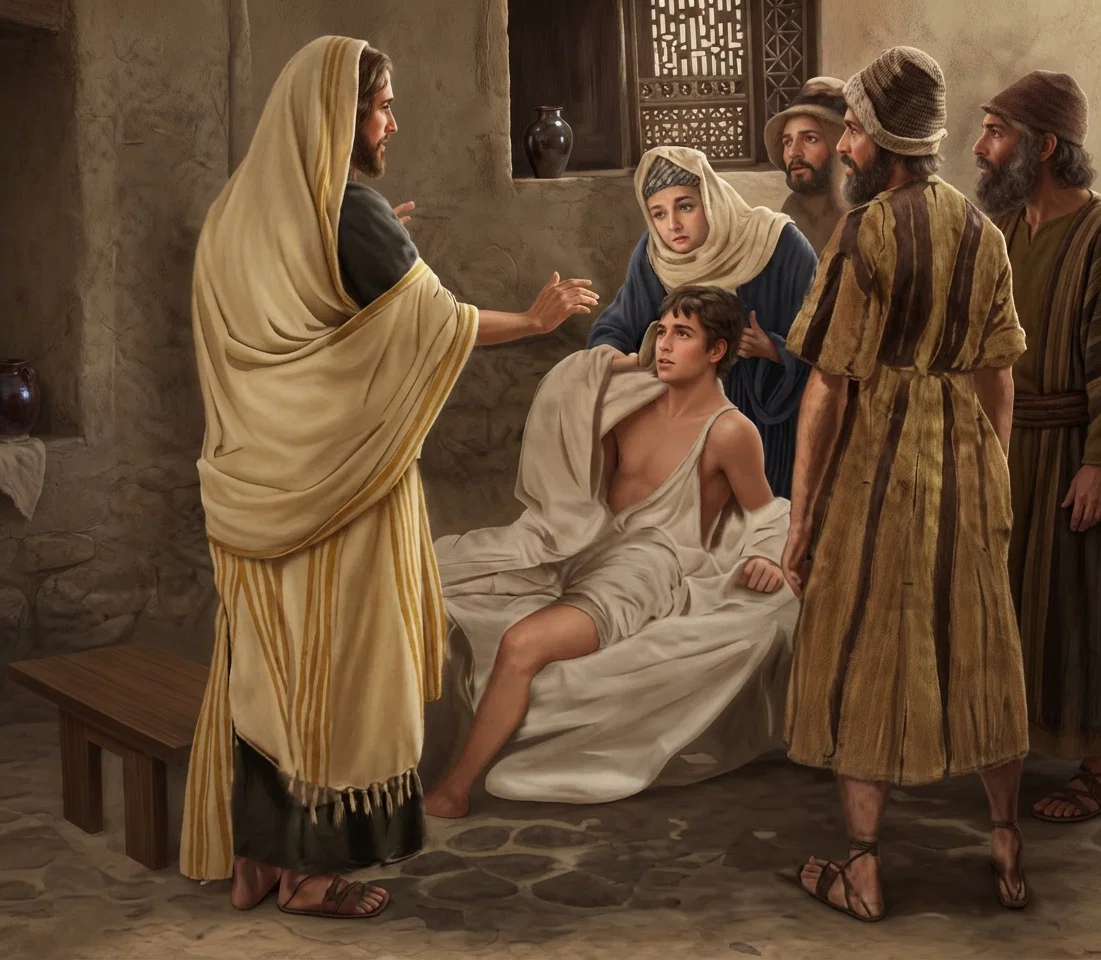
O THIS is a sad, sad world, despite its veneer of folly and fun. There is no city, town, or village but has its silent city close by, the inhabitants of which often number more than those of the living, throbbing town. Ever and anon the slow, mournful procession leaves the city of the dying for the city of the dead, bearing one or more silent sleepers to that bourne whence no traveler returns, the curtains of whose tents never outward swing. And so many of those who enter the dark portals of the tomb do so with no ray of hope to lighten or cheer their dying moments. What hope is there beyond? Is the silent city of the dead the last long home? Is the low bed beneath the cypress and the willow, under the green sod, the last resting-place? "If a man die, shall he live again?" asked the old Idumean emir, in his affliction. And men are asking it to-day. There is an answer.
“I say unto thee, Arise. And he that was dead sat up, and began to speak.”
THIS is a world of pain and death and sorrow. There is scarcely a home of a score of years where Disease and Death have not entered, and in departing have left blanched faces, tearful eyes, breaking hearts, and crape upon the door. Sometimes Death's dread messenger robs the home of wife and mother, of father and husband, or of son and daughter. To some homes the awful messenger comes again and again, till the last earthly prop, the last hope, is gone, and heart and home are enshrouded in the pall-cloth of despair.
SUCH a sad heart and home, typical of many others, there was in the little city of Nain, nearly nineteen centuries ago. A home had been broken by death. The husband and father had been taken away, leaving the wife, with but one son, to meet life's battles alone. How she must have watched over her boy. How happy she must have been to see his development into manhood. How she solaced her heart that in her old age she would have a strong son on whom to lean. But Disease enters her humble home, and chills her very heart with his presence. Death soon follows him, and her only son, her hope, her joy, her pride, her earthly hope and stay, falls into the sleep which knows no human waking. She calls in his ear the terms of endearment she is wont to call him, but he heeds her not. She weeps and wails her grief, but he so quick to comfort before, remains silent.
KIND neighbors come in and dress the corpse for its last resting-place. Former companions of the boy are found, perhaps, to bear the bier, on which the body rests, to the sepulcher. The procession passed along the streets with a great company of people mourning with the bereaved widow. They reach the city gate, and meet a company of men, dusty and travel-worn, about to enter the city. According to the custom of the people, they should have turned back and accompanied the procession, out of respect to the dead and in sympathy with the mourning ones.
BUT this Man did nothing of the kind. His great heart is moved with compassion as He looked upon the bereaved mother. He saw in her the mourning mothers of centuries. With infinite tenderness He speaks, "Weep not," and then passes on to the bier, and touches it. The bearers stood still. And then occurred a marvelous thing; He speaks to the ears the mother had called to in vain: "Young man, I say unto thee, Arise. And he that was dead sat up, and began to speak. And He delivered him to his mother. And there came a fear on all; and they glorified God, saying, That a great prophet is risen up among us; and, That God hath visited His people."
"If a man die, shall he live again?"—Yea, he shall live. "As in Adam all die, even so in Christ shall all be made alive. But every man in his own order: Christ the first-fruits; afterward they that are Christ's at His coming." 1 Cor. 15:23. And they that are not Christ's shall wait till the close of the day of God, and then come forth to condemnation and death forevermore. Rev. 20:5; Acts 24:15. But the dead shall live in Christ Jesus. The Son of the eternal God became sin for us, that we might be made the righteousness of God in Him. 2 Cor. 5:21. He having no sin in Himself, it was not possible for the grave to hold Him. Acts 2:24. And every soul who goes down into the grave clothed in the righteousness of Christ Jesus, shall come forth at the Master's call, clothed with immortality. 1 Cor. 15:51-54. He has broken the bars of death. He has cleft the gloom-cloud which hangs over this world of sin, and lighted the pathway of life through all its dark valleys, even through the Valley of the Shadow of Death to the glorious Beyond. He who wept at the tomb of Lazarus and spoke him to life again; He who halted at the bier of the widow's son and gave him back to her alive; He has Himself passed that way and won for us the key of the grave. O sorrowing mothers, weep not, there is hope, all hope, in Christ Jesus our Lord, the same yesterday, to-day, and forever.

THE WORD OF GOD VERSUS DECEPTION.

IT is only when men turn away from God that they are persuaded of things contrary to His Word. In looking away from the Source of truth, the perceptive faculties become so dull that the truth is obscured from them. Looking away from the Light of the world, they must necessarily walk in darkness.
It was when Eve neglected the counsel of God, and gave ear to the words of the adversary, that she "saw" that the fruit of the forbidden tree "was good for food, and that it was pleasant to the eyes, and a tree to be desired to make one wise." In the darkness of falsehood, this delusion seemed to be truth; but it was a sad delusion, nevertheless, and opened the way for sin and death to become dominant throughout the earth.
The witch at Endor, whom Saul consulted when the Lord would no longer have communion with him, "neither by dreams, nor by Urim, nor by prophets," was possessed by a "familiar [or evil] spirit." Therefore she could be made to believe that she "saw gods ascending out of the earth." And when she told Saul that she saw an old man coming up covered with a mantle, he, in his spiritual blindness, "perceived that it was Samuel."
"Now Samuel was dead," and buried at Ramah, several miles from Endor (1 Sam. 28:3); and "the dead know not anything. . . . neither have they any more a portion forever in anything that is done under the sun." Eccl. 9:5, 6. Yet there are people to-day so blinded by the idea that men are conscious after death, that they actually believe that Samuel came out of his tomb at Ramah and appeared to a witch at the distant town of Endor. This, too, in face of the fact that the Lord had forbidden His people to have anything to do with such characters. They had express command to "regard not them that had familiar spirits, neither seek after wizards, to be defiled by them." Lev. 19:31. The further command was, "Thou shalt not suffer a witch to live." Ex. 22:18.
Yet the Spiritists would have us believe that the Lord permitted the dead Samuel to do two things which He had forbidden the living Samuel to do—namely, to obey the call of a woman controlled by the devil, and to hold communion with Saul. To believe this we must believe one of two impossible things—either that God changes, or that the devil is sufficiently powerful to raise the dead at will. And a persistent believer in the conscious state of the dead will eventually become susceptible to either or both of these delusions. It is a logical and inevitable conclusion.
But the superior power of God was manifest in that the fictitious "Samuel" could only emphasize the Lord's condemnation of Saul. As in the case of Baalam, when he was desired to speak contrary to God's decree, he was obliged to repeat that decree. Satanic agency was not permitted to give Saul the momentary comfort of even a delusive consolation. And it was a mercy that it should not be allowed.
All the way down from the deception in Eden, men have been persuaded to say and do things contrary to God's Word just because they first turn away from that Word. "The carnal mind is enmity against God; for it is not subject to the law of God, neither indeed can be." Rom. 8:7. So "the Spirit speaketh expressly, that in the latter times some shall depart from the faith, giving heed to seducing spirits, and doctrines of devils." 1 Tim. 4:1. This is but a natural consequence of departing from the faith, and the first doctrine the devil ever announced to the human race was, "Ye shall not surely die." Through this doctrine (the natural immortality of man) has evolved the delusion of Spiritism in all its deceptive and destructive forms.
Therefore we are warned of "the working of Satan with all power and signs and lying wonders, and with all deceivableness of unrighteousness in them that perish; because they received not the love of the truth, that they might be saved." 2 Thess. 2:9, 10. This accounts for all the deception and consequent delusion that ever has come upon mankind. Rejecting the Word of God, which is the truth, there is nothing left for them but lying deception, the end of which is to perish.
Before every human being lies the choice between belief of God's Word, or the fatal delusions of the adversary. Jesus says, "I am the way, the truth, and the life." "The words that I speak unto you, they are spirit, and they are life." And here are the consequences plainly set before each one: "He that believeth on the Son hath everlasting life; and he that believeth not the Son shall not see life; but the wrath of God abideth on him."

SOLVING THE SOCIAL PROBLEM.

THE church has a purpose in the world, a well-defined one. God is the author of that purpose, and the church is a part of His plan; but that purpose and that plan has been, and is to-day, sadly misunderstood.
Writers and speakers on the “social problem” are demanding of the church that she take a position in the social world, and direct her energies in the line of bettering social conditions, forgetting or overlooking the fact that to the true Christian the “social problem” presents no insurmountable difficulties.
The true Christian sees, as the social philosopher sees, that the condition of the world is deplorable; but God, in His wisdom, has given to the Christian—to the church as a company of Christians—the true and the only solution of the problem. That solution is the salvation of souls through the atonement of Christ. If the world were not lost in sin, there would be no “social problem;” but it is; and to be seeking for any solution of that problem which does not recognize the true cause of the condition and the only remedy provided—to be seeking a solution which leaves salvation out of the question—is to turn completely away from the plan and purpose of God. It is like bringing to the man sinking in the quicksands a basket of delicacies, and forgetting that his greatest need is a rope and strong arms to pull him out of the clutch of the grave. To make men happy and contented with their lot while still unsaved and in constant danger of their soul's eternal loss, is not the business of the church nor of any in the church. Their work is to make men dissatisfied with sin; to bring to them God's message for their time; to rescue perishing souls.
This done, the “social problem” dissolves like burned limestone at the touch of water, and thus dissolved, enters at once into the building of God.
The members of Christ's body on earth will go about doing good as He set them the example to do, uniting His teachings with works of charity and mercy; but as He refused to be turned from His work by sophistry, flattery, or misapplied scripture, so will they. Christ came into the world to save it and its inhabitants; but there was only one way to accomplish it. Satan offered it to Him for a simple act of worship. Satan would have been well pleased had he been permitted to map out a plan of his own for Christ to use in inaugurating His work in the earth; and he is well pleased when he can induce Christians to accept other plans of work than those which Christ established. Christ spurned the suggestion, and they who are His will do likewise. Had Christ attempted to do His work along Satan's lines, He would have been lost with the angels that are doomed. Neither can the church carry on His work on plans contrary to His instruction.
One prominent educator declares: “If we feel a need which a church supplies, we use the church to supply that want, just as we would use a museum, or a bank, or a hotel. We need worship. Since men were born, we have never succeeded in getting along without it.” Therefore, the business of the church is presumed to be to satisfy a desire which men feel for something to worship. Men are to join the church to satisfy that craving. Thus the church becomes a means simply of gratification to its members, instead of a strong, positive force in the earth, carrying forward God's message of salvation, and preparing the bride of Christ for her heavenly Spouse. Christians will worship God—they can not do otherwise and be Christians; but if Satan can induce the church to believe that its chief or only mission in the earth is to satisfy man's craving for something to worship, he has succeeded in turning her from the work that was given her to do. The tendency of much of the teaching of the present time is in the way of influencing men to look to the church itself for that which can only come to men by personal, living connection with God. It belittles the work of the Gospel, and tends toward shallowness in Christian experience. It makes of the church a means of gratification to its members, instead of an aggressive instrument in the work of saving souls. The reality of God and His work is lost sight of in the haze of generalities accompanying such teachings.
The “social problem” will not be solved by the church setting itself at work to solve that problem and forgetting her mission in the earth. It will not be solved by her taking up any line of work which God has not commissioned her to do. But for every individual won to Christ, that much of the “social problem” is already solved in his conversion.
In the time when God is closing up His work of soul-saving it is the plan of the adversary of souls to blind the eyes of men so that they can not see what is coming upon the earth, or what God demands of men right now. If he can blind the church to her mission in the world, or throw her forces off on a tangent away from the true path of her duty,he is doubly successful. Such teachings as those above referred to are his instruments in accomplishing that work. There was never a greater need for a living, working church; there was never a time of greater danger from the soothing teachings of the world. S.

A PERTINENT QUESTION.

THE question is asked, "Does Christianity need restoration to the New Testament model?" That such a question could be asked shows that much now passing as Christianity finds no warrant in the Word of God. There is less of true Christianity in the pompous services of the gorgeous temples of wealthy congregations than in the simple deed of kindness performed out of sight and hearing of the multitude in some dreary alley, some lonely cellar home, or some lofty garrett where the suffering sick wait wearily for the help that seldom comes. "All is not gold that glitters," nor all Christianity that calls itself by that name.
There is no Christianity outside of Christ; there is nothing Christian that is unlike Christ; nothing Christian that Christ did not establish. Realizing this truth, the inconsistency of clinging to human forms and ceremonies as part of the saving Gospel of Christ is clearly apparent. Christ's own testimony on this question should settle the matter for all time. He declared, "Every plant which My heavenly Father hath not planted, shall be rooted up." Matt. 15: 13.
Paul, as if in answer to the very question asked above, declares: "Other foundation can no man lay than that is laid, which is Jesus Christ. Now if any man build upon this foundation gold, silver, precious stones, wood, hay, stubble; every man's work shall be made manifest; for the day shall declare it, because it shall be revealed by fire; and the fire shall try every man's work of what sort it is." 1 Cor. 3: 11-13.
In reference to this same point we quote the words of Christ Himself, "If a man abide not in Me, he is cast forth as a branch, and is withered; and men gather them, and cast them into the fire, and they are burned." John 15: 6. Thus does Inspiration answer the question, declaring that God will eradicate every institution which He has not established. There is but one true foundation, and the fires of God's great testing day will consume all that is not builded thereon. So he who is following and teaching others to follow human ceremonies and human institutions, is not perfectly abiding in Christ, is not building a perfect structure upon the true foundation; and his work, instead of abiding to eternity in the garden of God, will be uprooted and consumed with all things that displease and dishonor Him.
The work of God in the earth is a work of restoration to the divine pattern. Wherever the observance of God's ordinances has been neglected, or wherever His institutions have been trodden underfoot, there is the need for a restoration; and no matter what day men may set up here in the place of God's holy Sabbath, the fact remains that those who enter "through the gates into the city" will keep there the only Sabbath ever recognized by the Creator and Redeemer. See Isa. 58: 12-14; 66: 23. The Sabbath of the Lord is one of those plants which our heavenly Father did plant, and which shall endure throughout eternity. The majority of professed Christians are not keeping it now. In this matter, then, there is certainly need of a restoration, a turning again, to that institution which the Lord Himself has established, to the ways that He Himself has planned for our feet. S.

1667.—The Christian Life.

It must be joy to serve God with gladness, knowing that one's life is cleansed from sin. But how such a condition can be obtained I can not understand.
What if you can not understand; must you wait for that? You sow the seed in the ground; do you understand how soil and sunshine and moisture is transmuted into wheat and corn? Yet it is done. Do you wish to know the doctrine, the teachings of Christ in yourself? Here is God's answer through His Son: "If any man willeth to do His will, He shall know of the teaching." John 7:17. You can do that. You may choose God's way, the self-denial, the humility of Christ, the giving-up of all things to God, to be what He will make you, to do what He commands you to do; if you do that, believing Him to be in you all He has promised, you shall know the joy, the peace, the blessing of life. Prove John 7:17, and believe Jesus Christ to be the Way, the Truth, the Life, in you, your Wisdom, Righteousness, Sanctification, Redemption. John 14:6; 1 Cor. 1:30. Believe, simply believe.

Question Corner

FROM time to time under this head, we will answer pertinent questions, the answers to which we believe will be generally helpful to our readers. Some questions we can not answer here. They are of special interest only to the person who asks them. We will not answer what seem to be mere quibbles or cavils. We do not propose, for instance, to explain, more than once a year, where Cain got his wife. In all cases we must have the name of the questioner. We may wish to write them. To the questions we sign only the initials, or another term, if preferred by the questioner. But we have neither time nor space to bother with unsigned letters or questions. One more thought: "Foolish and unlearned questions avoid."

1664.—Flesh and Blood. 1 Cor. 15 : 50.

What is the meaning of the text that says, "Flesh and blood can not inherit the kingdom of God"? Yet we know that Christ had an immortal body, and that He had flesh and blood, and entered into the kingdom of heaven; also, Elijah arose to heaven bodily. A. A.
The last part of the above verse explains the first part: "Neither doth corruption inherit incorruption." The blood of all mortals is more or less corrupt. The life-current in humanity has been poisoned with the virus of sin. However ineffectual their efforts, the theory of the promoters of panaceas is correct, "the blood is impure," "the blood needs purifying." The corruption is there. When the mortal body becomes immortal, the life-current will be no longer blood, but spirit. Nowhere do we read that Christ's body after the resurrection possessed blood. Elijah was changed; blood-life gave way to spirit-life. The bodies are real; the life is no less so.

1665.—Difference in Accounts. Exodus 20, Deuteronomy 5.

How do you account for the difference in the wording of the law of God as given in Exodus 20 and Deuteronomy 5?
Exodus 20 gives us the law as God spoke it from heaven; Deuteronomy 5 is Moses' repetition of the law at the end of forty years, with certain additional reasons as to why that redeemed people were under special obligations to observe it.

1666.—The Last Days. Joel 2:28, 29.

Please inform me why Peter quoted Joel 2:28, 29? He was not living in the "last days."
But Peter did live in the beginning of the "last days." The last great year of Gospel husbandry, speaking figuratively, began at the first advent of Christ. At the beginning came the sowing with the falling of the early rain, of which Peter speaks. Joel seemed to cover the whole period, including the latter rain, which develops the world for its harvest.
There is now no pamphlet in print on Revelation 17. It will be treated in this paper, the Lord willing, the latter part of the year.

1668.—The Permission of Deut. 12:15.

Kindly explain the meaning of Deut. 12:15, concerning permission to use clean and unclean animal foods.
There is no such permission given here. The "whatsoever" is limited by the definite instruction given in chapter 14 and Leviticus 11. See how the "every day" of Ex. 16:4 and "every morning" of verse 21, are limited to six days in the week, and do not include the seventh. Verse 26. So at the great feast of Deut. 14:26 the "whatsoever" is limited by the prohibitions of Leviticus 11. "The unclean and the clean" there mentioned refer, not to the eaten, but to the eaters, both Israelites and strangers.

1669.—There Remaineth a Rest. Heb. 4:3-10.

Will you explain Heb. 4:3-10, especially verses 7-9. Does it in any way refer to the change of the Sabbath? I. C.
No; the passage in no way refers to the Sabbath day; only as the Sabbath is a pledge of God's eternal rest, which begins here with rest in the soul. We enter that rest by faith. The inheritance of God's children was finished from creation, and God's rest upon the seventh day was proof of that; but the race sinned, and did not share its blessings. Again, when He called His people out of Egypt, He did it that He might bring them into the promised inheritance, and give them rest. But unbelief kept them back from the work of God. Joshua could not give them rest. After that, God calls to His children in the ever-present "to-day" to give up their own works of sin, accept the righteousness of God in Christ, and enter into His rest. "Jesus," in verse 8, is the Greek form of Joshua in the Hebrew, and refers to Joshua. The promised, eternal, finished rest of the people of God, of which the Sabbath is a pledge, is still future, and the apostle exhorts us to enter that rest through the rest of faith which He now gives. "There remaineth therefore a keeping of a Sabbath to the people of God," a rest from all sin and its consequences forever.

1670.—A Special Resurrection. Matt. 27:52, 53.

Will you please explain Matt. 27:52, 53 in the "Question Corner," and oblige. E. E. A.
The time and the event is the crucifixion of Jesus. Then the graves were opened, but the last part of verse 52 should be read with the next verse: "And many bodies of the saints which slept arose, and came out of the graves after His resurrection, and went into the holy city, and appeared unto many." These were the trophies of Christ's triumph over death, the multitude of captives which went with Him when He ascended up on high (Eph. 4:8, margin), the redeemed ones of whom came the four and twenty elders around the throne (Rev. 4:4).

1671.—John the Baptist a Type. Mark 1:6.

Is John the Baptist a type of the people living in the last days? Mark 1:6. "He did eat locusts and wild honey." Was this locust an animal or vegetable food?
Elijah is a type of both John the Baptist and God's remnant people. John the Baptist is a type of the remnant people. But neither of them is a type as respecting his parentage, his birth, the manner of his labor, his dress, or his food; but in the character of the men, and the nature and object of the work of reform each did. The locust John ate was, in all probability, an animal food, to eat which the law gave him permission. Lev. 11:22. That, doubtless, was the best he could do.

1672.—Where Is It? Deut. 35: 3?

Will you please explain through the SIGNS OF THE TIMES Deut. 35:3?
Deuteronomy has but thirty-four chapters. If Ex. 35:3 is meant, see question No. 1656, in the issue of May 10.

1673.—Earthquakes and Murders. J. C. S.

We do not now recall any list of earthquakes since 1868, tho there may be several. Perhaps some of our readers can furnish it. We presume that, according to custom, the Chicago Tribune printed the number of murders, suicides, etc., in 1904.

CHRIST'S COMING IS NEAR.

[John S. Wightman, in New York Indicator.]
SHOULD we not consider the present "peace-and-safety" cry a portentous sign of His immediate coming? The universality of the "peace-and-safety" cry and temporal millennium dream can not be questioned. The application of the prophecy of the coming of Christ and the sudden destruction of the wicked (1 Thess. 5:3) to this condition is unmistakable.
At the very time that Secretary Hay was addressing the Boston Peace Parliament declaring the time had come when the war drums should throb no longer, Lord Lansdowne was telling the British people the same thing. The Czar, King Christian, the Pope of Rome, President Roosevelt, and Count Tolstoi, are united in the cries for peace. The nations and the creeds are as one in the vast movement for international arbitration and the abolition of war. Senator Depew says that "a court of arbitration will throttle war, and be a step forward toward the millennium."
We have arbitration societies, annual peace conferences, and a constant stream of literature upon the subject. The United States Government has taken the initial step, and concluded a peace treaty with the French. Press and pulpit are thundering forth the cry of "peace and a universal good time coming," while legislative halls are not silent upon the subject; but statesmen and diplomats vie with one another to declare that "to-morrow shall be as this day, and much more abundant."
Emily Crawford, in her Everybody's Magazine, article, "The United States of Europe," states that "a universal impulse in favor of peace may be felt everywhere on this [the European] continent." The Buffalo Express says: "At no time in history has there been such an intelligent striving for universal peace as at present." Thus we see a complete unanimity of opinion, universality of idea. So Isa. 2:3, 4 is literally fulfilled; and Joel 3:9-14 must be as literally fulfilled, and the destruction seen by Jeremiah, and the reappearing portrayed in Paul's pertinent letter to the Thessalonians must surely come to pass.
The "peace which passeth understanding" is not, and never has been, a matter of legislation or international treaty. It depends upon the transformation of the individual, and its best advocates and exemplars, instead of holding conventions and seeking the aid of the secular arm, have addressed themselves to the character and conscience of man, satisfied that the era of peace was conditioned upon the conversion of the individual.
The proposition to eradicate war by agreement is about as impracticable and futile an abstraction as ever occupied the mind of well-meaning men. Czar Nicholas proposes the Tribunal of the Hague, and the same Czar Nicholas refuses to submit the consideration of the Russo-Japan War to the tribunal. Hence the futility of the whole movement.
Then what does it all mean?—Simply a fulfilment of prophecy! "Peace, peace, when there is no peace." The universal-peace cry is simply a sign of the nearness of the end. "As it was in the days of Noah." Do we accept the sign with faith? Can we see, with the eye of faith, that the sudden destruction is nigh at hand? We see the prophecy fulfilled here and now; will not the destruction swiftly follow as declared?—Verily, it will!
Reader, seeing that this startlingly significant sign is appearing upon a grand scale, believing that the whirlwind of destruction must swiftly come, what is the duty of the hour? What about the "multitudes, multitudes in the valley of decision," and who shall warn them of the approaching storm? In view of all these things, are you ready for the crisis of all the ages? In a word, have you made the righteousness of Christ your very own by living faith, that you may be able to stand in that solemn hour when all the world will be tried? Rev. 3:10. God forbid that we should now number ourselves among those who shall say, "My Lord delayeth His coming," for "when they shall say, Peace and safety; then sudden destruction cometh."
"Behold, He cometh?"
Continue reading: THE LARGE GIFTS OF THE RICH