Your ShelfYour Projects

Signs of the Times, Vol. 39, No. 44.

According to His Will
Earlier text: The Tabernacle and the Ark

The Wicked Cities and Their Doom

LAST week we had something to say in this department of the paper in regard to the wickedness of Chicago and New York City. The prophecy of Jeremiah was quoted to show that because of the wickedness that is centering in the great cities, they are doomed to destruction.
While New York and Chicago were used as examples, yet it was stated, on authority, that those cities are in no wise worse than the average city of the nation, or for that matter, of the world. We promised that this week we might give some of the details of conditions as found in Portland and elsewhere, in order to show that the degradation of the cities is becoming universal.
Toward the close of last year, leading citizens of Portland, Oregon, organized a Vice Commission, on a plan similar to the commission of Chicago, spoken of last week. This commission employed a number of "operatives," or detectives, to investigate conditions carefully. No one of these investigators knew of the existence or work of any other one. They were kept under the direction of the commission, and worked apart, in different sections of the city, as they were ordered. When there was any doubt in regard to a case after one investigator had made his or her report, another one would be sent, without the knowledge that the other had worked there; and their reports on the case were compared. This is an indication of the painstaking work that the commission did in order to arrive at accurate results. They sought carefully neither to minimize nor to exaggerate, but to get the exact facts.
Their investigations covered certain central sections of the city where there were the most rooming houses, apartments, hotels, and the like. Five hundred forty-seven places were investigated. Of these, only 98 were moral, while 18 were of a doubtful character, and the remaining 431 were pronounced immoral under the following classification:
Wholly given up to prostitution or assignation, 113; immoral tenants desired or preferred, 124; immorality countenanced or ignored, 194.
Two paragraphs from the report of the commission read:
"A person might stand on the roof of one of the principal churches of the city and throw a stone into any one of fourteen immoral places, ten of which are wholly immoral.
"Nine places were investigated, immediately surrounding one of the principal department stores of the city, and only one of them was found to be moral. Four were wholly given up to prostitution or assignation, and the remaining four were of the intermediate grades of immorality."
Several leading ministers of Portland were members of the commission, hence it can not be said that the foregoing reference to the meeting-house is made with a view to casting slurs at religion. It is simply a statement of a condition over which that particular church has no power.

Vice Monopoly

It was found, in the investigations of Chicago and New York, that a regular "vice trust" or "vice monopoly" existed. The gain was so great that individuals and also small combinations of individuals formed "trusts" or "combines" on the same general plan that is followed in legitimate trade. The commission in Portland gives quite an extended report on this subject, from which we subjoin a few paragraphs:
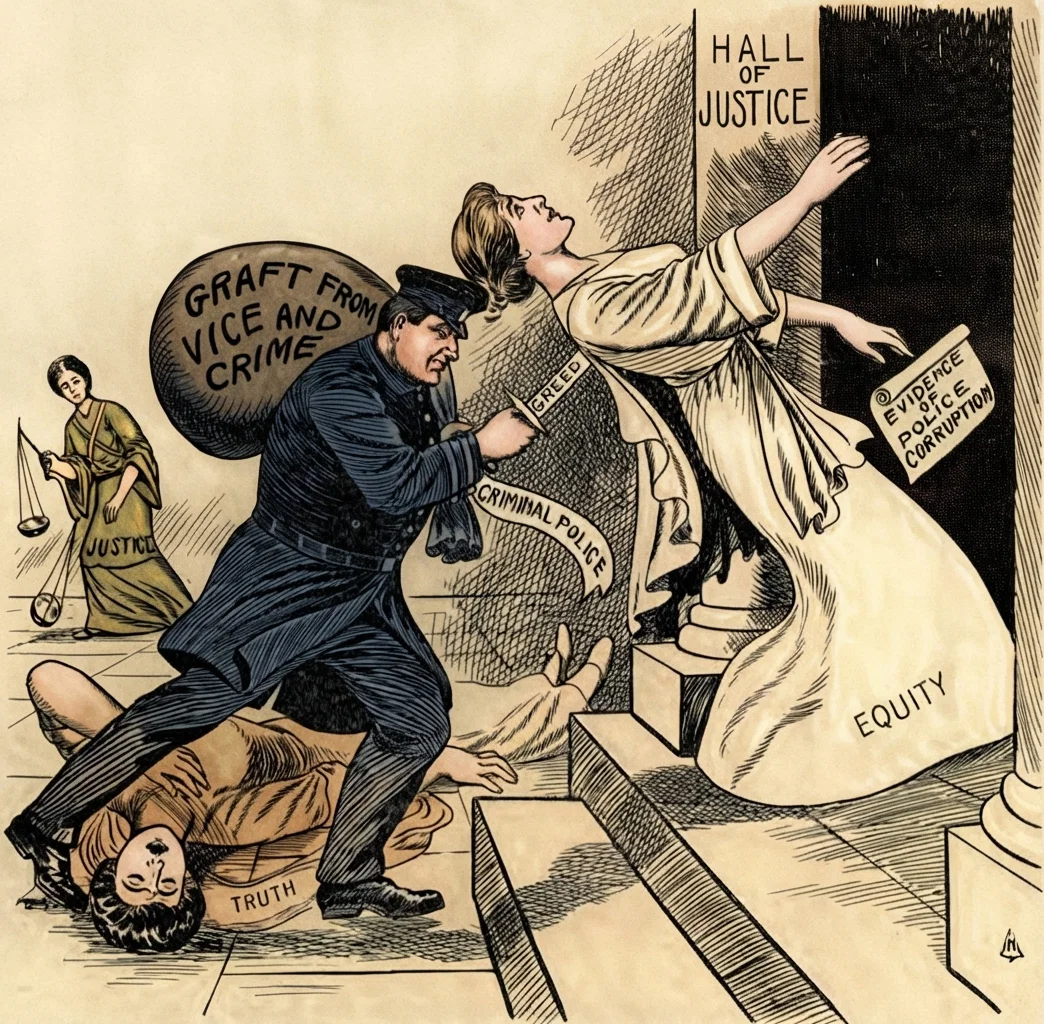
"Justice standeth afar off: for truth is fallen in the street, and equity can not enter." Isa. 59:14.
"Closely allied to the element of profit in commercialized vice in relation to the conduct of hotels and rooming houses is an observed tendency on the part of individuals and realty firms to acquire and either manage or control properties in which immorality contributes to the revenue. This tendency is manifested from instances where one person owns or controls two such properties, to that wherein a dozen or more such places are owned or controlled by one real estate firm.
"This tendency is illustrated in its incipient form by two cases, one of which concerns two respectable appearing hotels under the management of the same landlady, and the other involves four houses, a shade lower in the hotel classification, in all of which immorality is simply countenanced or ignored. In this latter case even the passive encouragement of immorality is found to be profitable, and the impulse is to reach out and make more money.
"As an intensification of this tendency, a startling example is afforded in the case of a group of fourteen apartment houses under one management."
Speaking of the assumed respectability of some of those who engage in this infamously degrading "business," the commission say of the proprietor of a certain resort, that he "is a business man of some means and social standing, evinced by the fact that he maintains a handsome and luxurious home on the Heights." The "Heights" is the name for the location of the exclusive aristocratic dwellers in Portland.
In regard to the owner of a group of four of these immoral places, the report states that—
"This landlord is a young man, single, clean-cut, well educated, and evidently of respectable antecedents. He engages in this business in a spirit of cold cynicism, giving to its direction his entire time and mental energy. His sole ambition seems to be to acquire other property of the same general character, and conduct it in the same manner."
Under the head of "General Observations," the commission says:
"First.—The general absence of a keen sense of personal responsibility on the part of owners of real estate for the proper conduct of their property. In this connection, this commission has on file an accurate list of all properties investigated, together with a list of the names of owners of such properties, as they appear on record. Among owners of land on which, or of buildings in which, immorality is carried on for commercial gain, are the names of men, women, and institutions that for probity, honor, and good repute, stand high in public esteem—lawyers, doctors, bankers, real estate firms, prominent business men, city officials, church corporations, publishers, members of the Vice Commission. It is a general condition. And it is this general inertia of ignorance or indifference or denial of responsibility on the part of good men that lies close to the couch of this ugly problem. . . ."
"Second.—The economic effect of commercialized immorality as it obtains in the various classes of houses reported on is a matter of simple deduction. Obviously, the ability to command higher prices for rooms rented to immoral people and for immoral purposes materially increases the rental price of rooms to respectable folk. Therefore a burden is imposed upon all classes of hotel and lodging house patrons, especially upon respectable girls and women who are working in this city without the protection of a home and are obliged to seek living accommodations in the cheap hotel, or in the lodging or rooming house. The spread of immorality among the more ostensibly respectable of these places raises the room rent to a figure which drives many of these girls and women into cheaper and manifestly disreputable houses. Contact and association deadens the sense of decency, and at the same time widens the area of demoralization. Almost by involuntary process the army of fallen women is thus recruited.
"Third.—The insidiousness of this evil is evident. As commercialized vice spreads through houses of public accommodation, its demoralizing influence is exerted in a most insidious way. It temptsthe cupidity of proprietors. It furnishes a convenient and comparatively safe field for the lecherous exploits of the libertine. It subjects the vanity of weak women to terrible temptation, which too often leads them, for the sake of gaiety and good clothes, to take the plunge into the underworld. It opens up new territory in which men and women who trade and barter in prostitution may conduct their business with greater profit and safety. It develops abnormal phases of viciousness and dangerous deceit, as this commission discovered and can show by its records cases wherein apparently respectable lodging houses and hotels have been converted into centers of activity for a wide circle of depraved people; where debauchery of almost unbelievable character is practised; where blackmail is hatched against those who have money and social position. Even beyond all this, the evil of commercialized vice has been found by this commission flourishing virulently in a house of refined and respectable surroundings, under the managerial control of a minister of the gospel who lives outside the city, and on the list of one of the city's benevolent institutions as an applicant for the patronage of young women who were seeking respectable rooming places."
The conditions set forth in the conservative report of this Vice Commission of Portland are certainly appalling. And the most appalling thing about it is that any well-informed person will tell you that what exists in Portland is characteristic of all the other cities. Men claiming respectability are making a business of trading in vice. The only excuse the proprietors of these resorts have to offer is that "it pays." They can make money fast and easy by giving their time and their properties to such work, and hence they go into it headlong. Is it any marvel, in view of these conditions, that the apostle Paul says, "In the last days grievous times shall come. For men shall be lovers of self, lovers of money"? 2 Tim. 3: 1, 2. Note particularly that it is in the "last days" when the apostle says these grievous times shall come, and it is all because men are "lovers of self" and also "lovers of money." Supreme love of self, manifested in part through the love of money, is loading these last days with grievousness. "Commercialized vice" is only one of the avenues through which this love of money is manifesting itself, but the "grievous times" ought to come as a penalty if there were nothing in addition to the "vice trust" to call for it.
What are men thinking about? How can any one give himself to such a work of degradation as is manifested in what is brought to light through the investigations carried on in so many of the cities?
God's Word says that He turned "the cities of Sodom and Gomorrah into ashes," condemning them "with an overthrow, having made them an example unto those that should live ungodly." 2 Peter 2: 6. God's Word plainly tells what He intends to do with the corruption that is spreading like a plague in our great cities. He has given examples of His displeasure with such wickedness. The day of His retribution can not be put off. The warning should be sounded with intense earnestness, that destruction lies just before all this wicked work, and that all who continue to pursue it, will be destroyed along with their evil deeds. The hour is vibrating right over the world now when the solemnly grand words will apply. "Seal not up the words of the prophecy of this book; for the time is at hand. He that is unrighteous, let him do unrighteousness still: and he that is filthy, let him be made filthy still: and he that is righteous, let him do righteousness still: and he that is holy, let him be made holy still. Behold, I come quickly; and My reward is with Me, to render to each man according as his work is. I am the Alpha and the Omega, the first and the last, the beginning and the end. Blessed are they that wash their robes, that they may have the right to come to the Tree of Life, and may enter in by the gates into the city. Without are the dogs, and the sorcerers, and the fornicators, and the murderers, and the idolaters, and every one that loveth and maketh a lie." Rev. 22: 10-15.
T.

Evolution’s Missing Evidence

Every little while we are treated to some new 'evidence' that man developed up from lower forms through the monkey. But why is it that there are not some stray fragments to be found in the woods somewhere of some of this development now? Why do we not find some animals that are somewhere between the monkey and the man? Why is it that illustrations found on the oldest Egyptian monuments show that there has been no development in race characteristics during the time of authentic history? If that evolutionist development theory had the least semblance of truth in it, there ought to be a regular series of creatures on earth in all the stages of development from the tadpole to the monkey, and from the monkey to the man. When men will quit dreaming about what might have happened millions of years ago, and think about actual fact, they will more likely arrive at the conclusion that the monkeys have descended from the man instead of the man coming up from the monkey.
There was a good reason on the part of the Jehovah of the Bible for putting those stringent laws into the Mosaic code against the cohabiting of men and beasts. God would not have made laws against such heathen customs unless the heathen were practising those things, and unless there was the further danger that the custom would be brought among the Hebrew nation. The argument that such crosses between men and beast could not propagate themselves is not sound, for the reason that the race is degenerating physically, and what is true of the weakened animal nature of to-day would not necessarily have been true of the stronger men and animals that existed just after the Flood. It is hard to think that the infinite Creator, who has shown His love for the beautiful in all that He has made, would have created man, His masterpiece, and then cartooned this man by creating the monkey in all its varieties. We know that God did not create sin, but sin is here just the same. And it does not seem difficult to grasp the thought that sin, and not evolution, is responsible for the monkey. T.

The Situation in Turkey

THE Balkan allies that are at war with Turkey have made unprecedented progress. It would appear without question that the Turk will soon be driven out of Europe unless the "powers" intervene. But the "powers" can not agree among themselves. They are as jealous of each other as they can possibly be.
One of the leading complications in connection with any action that the European nations might take is the bitter hatred that has existed for the past several years between England and Germany. These two nations are among the strongest, if not the very strongest, of the powers of Western Europe. Germany has one of the greatest, and best drilled, and best equipped of the armies of the world. Her army is the pride of the emperor and of the German nation. She has a navy that is struggling for supremacy, and is near the front rank.
Germany is not at the present time in a mood for concerted action. As an instance of her feeling, the despatches under date of October 27 told of a note that was sent to the German imperial chancellor Von Bethmann-Holweg, from Sir Edward Grey, England's prime minister. This note was looking toward some settlement of the Balkan question by the powers. Emperor William had been explaining to one of his grandchildren the use of miniature Krupp guns when the chancellor was announced. The note from England was handed to him, and after glancing his eye over it, he returned to the little prince and the toy gun. After firing the miniature cannon at a lot of toy soldiers, he turned again to his chancellor, upon which the chancellor said, concerning the note, "What shall I do with it?" "Light your pipe with it," said the kaiser. Following this, however, the emperor and the minister had quite a long chat over the situation, but no report is given of the conclusions that they reached.
Yet it is evident that Germany has her eye on the situation, and that she is not in a mood to make any agreements except such as would in the end result in her advantage. We know, from the program of prophecy, that this war can not last very long, for there are to be no long drawn out wars until we reach the very close of probation. We have frequently set these matters before our readers through our columns, together with the prophecies that told the story. But just how this matter may be terminated, at this writing it is difficult to conjecture, in fact conjectures are useless. There are a great many who think that the downfall of the Turk in Europe will really mean the close of probation and the end of the world, but there are others who believe that there is very strong evidence that the prophecy does not take into account any such overthrow of the Turk.
These are times not for speculation and conjecture, but for earnest, prayerful study and thought. Let us study carefully and faithfully the prophecies that give the program for the world in this time. They will be fulfilled literally, regardless of any human speculations or interpretations. T.

Mothers the Best Teachers

Mothers the Best Teachers.—We think there is a great deal of truth in what the Denver Republican says, in speaking of the teachings of eugenic societies and other organizations anxious to exploit the sex question. It declares that it should be left with mothers. In the first place, we feel there is no question at all but that children ought to be taught, and ought to be taught in a careful, proper way, the secret of life; but we believe, after all, that the one to do that, above every one else, is the good, pure mother. When it is taken into schools and into all sorts of circles, it is likely to do more harm than it does good. Mere knowledge of itself will not save. It needs a stronger, more sympathetic, more tender, more powerful hand than any society can exert, to hold the young from being led astray, and this generally is found in the mother. Let the efforts of the people who are so burdened be put forth to help the mother, and let the mother come in connection with her children. Of course it is sad that there are so many mothers who are ignorant, careless, seemingly unconcerned, regarding their daughters. It is these, doubtless, who have stirred up the reformers; but to enlighten children, and then turn them back to such uninstructed mothers, is likely to do more harm than good. Enlighten the mothers, and help them to help the children.
"Harper's Weekly" of October 19 well says that "the Cedar Grove, New Jersey, school board that wants its Canadian high school pupil to declare allegiance to the United States flag every morning, has misapprehended its duties." It has. It certainly does not foster respect for a country to command arbitrarily that outward homage shall be paid to its flag. And along a parallel line, it does not arouse respect for religion to enforce it. These are lessons taught through all the ages.
Guglielmo Ferrero, the historian, in a carefully prepared article for the press, says that the Balkan war now so strongly under way is the struggle between the barbarism that Turkey represents and the advance of civilization. He is not sure whether the present will be the deciding war or not, but he thinks that the time must soon come when a war will be waged, before which the old barbarism of the Ottoman must give way.
A striking cartoon in the Brooklyn "Eagle" makes the dime novel responsible for the reign of thievery and vice that is giving New York City so much notoriety at present. Pernicious reading-matter and strong drink are twin evils that are doing their full share in cursing the world.

Make Childhood Sweet

Wait not till the little hands are at rest Ere you fill them full of flowers; Wait not for the crowning tuberose To make sweet the last sad hours; But while in the busy household band Your darlings still need your guiding hand, O, fill their lives with sweetness!
Wait not till the little hearts are still For the loving look of praise; But while you gently chide a fault, The good deed kindly praise; The word you would speak beside the bier Falls sweeter far on the living ear. O, fill young lives with sweetness!
Ah, what are kisses on cold, icy lips To the rosy mouth we press When our wee one flees to her mother's arms For love's tenderest caress! Let never a worldly bauble keep Your heart from the joy each day should reap, Circling your lives with sweetness.
Give thanks, each morn, for the sturdy boys, Give thanks for the fairy girls; With a dower of wealth like this at home, Would you rifle the world for pearls? Wait not for death to gem love's crown, But daily shower life's blessings down, And fill young hearts with sweetness.
Remember the homes where the light has fled, Where the rose has faded away; And the love that glows in youthful hearts, O, cherish it while you may! And make your home a garden of flowers, Where joy shall bloom through childhood hours, And fill young hearts with sweetness.
—Selected.

The Parents in the Home

The Place Which They Occupy

By Mrs. L. D. Avery-Stuttle

SITTING in my window, one evening, I saw a very beautiful sight—one which set me thinking. A working man in soiled overalls, with dinner-pail in hand, came slowly down the street. One might easily imagine him to be very tired, and perhaps a little discouraged also, judging from the look of dejection upon his face, as well as from his shuffling gait.
Suddenly a change came over him. His lagging step quickened; his eyes brightened; the look of weariness vanished.
What magic power had so suddenly possessed this man, making him forget weariness and hunger?
Far down the sidewalk came the patter of little feet. Papa's baby had seen him coming, and hurried to meet him as fast as the toddling feet could fly.
A little blanket has been pinned on the baby head by loving hands, and the tiny apron is “spick and span,” even if the chubby face above it is a trifle dirty.
That man acts as fresh and unfatigued as he did in the early morning, as the chubby form is lifted to a seat on papa's shoulder.
Well, it was a pretty sight; and it made me certain of two things: first, that this man loved his little boy; and second, that he was kind to him. I felt quite sure, also, that in after-years, that baby boy, grown to manhood, would think of that father with veneration and love.
O, blessed be the man to whom baby feet fly as naturally as birds to their nests! and happy the woman toward whom the dimpled arms of babyhood are extended lovingly! O, commend me to that man or that woman whom little children love!
“But,” says one; “is it not the business of the father and mother, first of all, to command obedience?”
Most certainly; there can be no true love without obedience. God has laid a responsibility upon parents, which it is impossible to overestimate. But with the responsibility comes also a sacred joy, to which even the angels of heaven must be strangers.
What position do the parents occupy in the home?—Undeniably they are the head of the family. To them pertains the duty of caring for and ministering to the physical necessities of their children, first, last, and constantly. But while this must be done, of far greater importance is the duty of ministering to the spiritual nature of the child.
And to the mother, more than to any other, this sacred trust has fallen by common consent. But I sometimes question if, in the wide-spread anxiety for the mother to be faithful and true, it may not be possible that the father has in some degree been overlooked. And I question if God will not hold both parents equally responsible for the bringing up of their children.
“But suppose we do our best, and after all, our children later go astray?”
Ah, this is the cry from many a sad and loving heart! Look at that family. The children have grown up and left the old home. They each received the same parental training, and yet some of them are gone wofully astray, while the others are a credit to their parents and friends.
Yes, they all received the same training. Well, possibly here is where the trouble lies. Perhaps when Mary and John were children, they both ran away from school one day. The mother whipped them both. Result: Mary became obedient and docile; John, on the contrary, became reckless and self-willed, and more determined than ever to resist the will of both parents and teachers.
Now it seems to me that it is the province of the parents—both of them—to study the peculiar disposition and temperament of each child in the family circle,—study them carefully and prayerfully. That which would be stern discipline to one child, might not be sufficiently severe to bring good results in another case. A single glance of sad displeasure given by the mother, to little Mary, might be all the punishment needed; while for another, “the rod” which the wise man recommended is the only reasonable alternative.
A wise physician studies the physical make-up and the especial temperament of each of his patients. It would hardly be sensible to administer the same medicine, in the same amount, to a delicate and sensitive woman, which might, with perfect propriety, be given to a large, strong nerved and coarsely organized man,—simply because they are both “adults.”
But a thousand times more necessary is it for parents to use tact and judgment in dealing with their children. The boys and girls may wander from the right path in after-life; but I tell you—and I hope my words will sink deep into the heart—I tell you that if these wayward boys and girls have pleasant memories of their childhood home to look back upon, if they can remember nothing but loving and tender words and importunate prayers, then there is surely hope that they will some day return to the path of virtue and true happiness.
If not—but the other picture is too sad to dwell upon.
Yet the highest place in the home should be given—and is given by common consent, as well as by the command of God—to the parents.
Let no sacrilegious hand place any other upon that pedestal of honor.
It is with a feeling of real sorrow that we read the history of Eli, the aged priest of Israel. How plainly we can “read between the lines,” and get a general idea of his family, when young Hophni and Phinehas were but lads in the old home! Eli did not occupy the honored position which belonged to him, and which belongs to and should be accorded every father. His sons were headstrong and wilful, even in childhood. Without doubt, Eli remonstrated with them. But their faults were regarded as mere childish follies, and went unpunished. “Surely,” reasoned the father, “when my sons are grown, they will see for themselves the foolishness of sin, and will themselves turn to righteousness.”
Vain hope! The vicious habits of the wayward youth grew with their growth, and strengthened with their strength. They had never felt the restraining hand of parental authority. The parents had not insisted upon respectful obedience when it would have been comparatively easy to enforce it; and now the rebellious sons, priests of the Lord, shamed their holy office, disregarded the feeble protest of their aged father, perjured their own souls, broke their marriage vows, esteemed the virtue of woman as lighter than vanity, cast aside every consideration of decency and manhood, and offered insult to the holy law of the Most High.
Still, ever and anon the same old-time feeble protest of the white-haired priest sounded idly in their ears: “My sons, why do ye such things?”
We all remember too well the tragic ending of these three misguided lives.
But too many parents have lamentably failed to take warning from this sorrowful example. Consequently there are many Elis in the world to-day, and many parents who demand and receive no more respect than he did.
Let us be thankful that it is the privilege of parents to—
Sow the seed in the young heart's soil, And water the seed with tears. We shall reap the harvest of all our toil In the light of eternal years.

The Conceited Door-Knob

SAID the door-knob to the door: “Please let me go, I beg, implore. I'm tired of swinging here with you, from day to day, the decades through.
“I'm handled by the rich and great; for me all classes pause and wait; and when I turn, you open wide; but if I'm still, you still abide.
“To me it then is clearly plain, for me to travel would be gain. I'd see the world; I'd get me fame; I'd have renown, and honored name.”
The door replied, with patient smile: “You'd better bide with me a while. ’Tis here you are of greatest use. Away from me you'll find abuse.”
“Don't be alarmed,” the knob replied; “for me, all doors will open wide. The rich, the poor, the small, the great,—all on my motions meekly wait.”
“Well, be it so,” the door replied; “but when you've fallen from my side, you'll find your fancied greatness o'er, and wish to be with me once more.”
The knob fell off with rattling sound, and tumbled helpless to the ground. Nor rich, nor poor, nor high, nor low, cared where the poor door-knob should go. The door-knob soon with sorrow learned that door-knobs, out of place, are spurned. His pride and fancied greatness o'er, he wished himself back on the door.
’Tis only those who keep their place, and do their work by help of grace, who can be counted great at all. Pride always goes before a fall.—T. H. Jeys.

Special "Church and State" and "California Sunday Law" Number

Beginning with January 1, 1913, the subscription price will be 35 cents a year, or $2.00 for ten copies, 1 year, to one or more addresses.

PARTIAL CONTENTS

Cover — Entrance to White House, Washington, D. C.; Frontispiece — Photo of Senate Sunday Mail Report, printed upon silk, and displayed in office of postmaster-general; Establishing God's Kingdom by Law; Looking to the State for Morality; God's Religious Liberty Example; Putting the Church over the State in Ecuador; American Principles in the Balance; Religious Liberty in Puritan Times; Absurdity of Proposed California Sunday Law; The Question of the Century; Religious Liberty by Divine Authority; Un-American, Unequal, Unconstitutional — The California Sunday Law as Proposed; Survey of the Field; Temperance and Religious Liberty.

SPECIAL OFFER ON TEN, ONE YEAR

Good only until January 1, 1913. Ten copies, one year, to one address or to ten separate addresses, only $1.50, or 15 cents each. Sender may include his name as one of the ten. This number should be placed in the hands of every editor, attorney, clergyman, city and county official, and public school teacher in your county. We can furnish the names and addresses.
Order through our nearest agency or LIBERTY MAGAZINE Washington, D. C.

The Rapture of Truth

"ONCE loved deeply, all truths are so beautiful that they ravish us beyond ourselves, and the first rapture of life is to point them out to others. Nor does the rapture die, but grows in the using."

FOR SALE

A Desirable Home

In the best residence portion of Mountain View, a two-story, modern, 9-room house, with roomy basement, attic, commodious hall, large closets, bathroom, and pantry, toilet up-stairs and down, extensive porches, large windows, and beautiful outlook. The land consists of one acre, having a young family orchard of about 30 trees, nearly all of which are in bearing,—choice apple, peach, pear, apricot, nectarine, cherry, crab-apple, plum, prune, fig, quince, walnut, and almond,—besides a variety of choice small fruits, with plenty of land for gardening. The soil is excellent. There is a 3-room bungalow on the place, with bath, also a good well, tank house 30 feet high, 3,000 gallon tank, two horse-power gasoline engine, all in good condition. There are also two magnificent live-oaks in the right place, and other trees,—catalpa, eucalyptus, etc., etc.,—also chicken yards and houses. Reasons for selling: ill health and press of other duties. Will be sold at a reasonable price on reasonable terms. Address X, care editor SIGNS OF THE TIMES, Mountain View, California.

The "Bible on Romanism" and "Present Crisis" Number

Now a Monthly

$1.00 a Year 10 Cents a Copy

Special December Features

Rome the "Babylon" of Revelation — Bishop Wordsworth on Revelation 17; Catholic Authorities on "Antichrist;" The Present Crisis — Catholic and Protestant Remedies; President Taft's "Religious Garb" Decision; History Made to Order by Rome — Facts as to the Philippines; Mediation of Christ — Its Perversion by Rome Foretold in the Bible; The Growth of the Churches — Protestant and Catholic Church Statistics;

SPECIAL OFFER ON TEN, SIX MONTHS

Ten copies, six months, to one address or to ten separate addresses, only $3.00, or 30 cents each. Sender may include his own name. Or, send $3.00 for five copies, one year. This number should be placed in the hands of every editor, attorney, clergyman, city and county official, and public school teacher. We can furnish the names and addresses.
Address our nearest agency, or The Protestant Magazine, Washington, D.C.

"Christmas," "Headaches," and "Children's" Number

December Features

Headaches — How to Relieve Them; Secret of Athletic Success; Christmas in an Insane Asylum; The Christmas Dinner and Disease; Welfare Work for Children (Illustrated); How to Care for the Baby — Its Clothes, Bath, Food, etc.; What Is Alcohol? — Analysis by a British Physician; How to Cook Eggs (Illustrated); Report of International Hygiene Congress; Cotton versus Wool Undergarments; Bad Teeth and Bad Health; Use of Felt Shoes; Questions and Answers (Twelve Replies).
Earn your own subscription by sending us two yearly subscriptions at $1.00 each.
Selling this magazine is easy and profitable work. Many make from $2.00 to $5.00 a day. Apply for agency to-day. Send ten cents for sample copy. Address our nearest agency, or Life and Health, Washington, D. C.

STANDARD HOUSEHOLD LUBRICANT

Don't let your tools get rusty.

Standard Household Lubricant

In the Handy Oiling Can

Preserves tools from rust; keeps them sharp and clean.
Standard Household Lubricant never corrodes, gums or turns rancid. The best oil in the world for a sewing machine or a lawn mower, a go-cart or a gun—anything about the house that needs oiling.
Get the can with the patented nozzle attached. No risk of breaking. No dripping to soil the fingers.
Dealers Everywhere

STANDARD OIL COMPANY

(Incorporated) 461 Market Street San Francisco
Continue reading: Books for the Young People