THE tabernacle as pitched in the wilderness was a beautiful structure. Around it was a court enclosed with linen curtains suspended by silver hooks from pillars of brass trimmed with silver. Viewed from any side, the tabernacle was beautiful. The north, south, and west sides were upright boards, ten cubits high, covered with gold within and without, and kept in position by silver sockets underneath and golden rings and bars overlaid with gold extending around the building. The front or east end was a beautiful curtain "of blue, and purple, and scarlet, and fine twined linen, the work of an embroiderer." Ex. 36:37, margin. It was hung upon five pillars of acacia wood overlaid with gold, which added much to the beauty of the entrance. The rich rainbow tints of the curtain with cherubim wrought in it, which formed the door of the building in which God promised to dwell with His people, was a beautiful "shadow" of the entrance to the wondrous heavenly sanctuary, where, with a rainbow of glory encircling His throne, the Father sits, while ten thousand times ten thousand angels pass to and fro at His command. Rev. 4:2-4; 5:11.
The Covering
The roof or covering of the tabernacle consisted of four curtains of cloth and skins. The inside curtain was like the curtain at the entrance of the tabernacle, of blue, purple, and scarlet, and fine twined linen, with golden cherubim wrought in it by a cunning embroiderer. Ex. 26:1, margin. This formed the ceiling of the tabernacle, which was a faint representation of the canopy of glory above the throne of God, filled with myriads of angels ready to fulfil His command. Eze. 1:28. Over this was a curtain of goats' hair, above that a covering of rams' skins dyed red, and over all a covering of badgers' skins, which formed a good protection from the weather. The different colors of the coverings, blending with the golden wall and the beautiful entrance curtain, or veil, as it was called, added much to the beauty of the building.
The Pillar of Cloud and of Fire
Over the tabernacle rested the pillar of cloud by day and the pillar of fire by night which went with Israel in all their wanderings. Ex. 40:38. In the midst of the desert heat, there was a cool, refreshing shelter beneath the shade of the cloudy pillar, for those that served in the tabernacle or worshiped in its court, while without was the scorching heat of the desert. Isa. 32:2. What a beautiful type of the covering God spreads over His people in the midst of this wicked world, so that it is possible to dwell in the secret place of the Most High and abide under the shadow of the Almighty One (Ps. 91:1), while in the midst of the turmoil and strife of this wicked world! At night, when the intense heat abated, and darkness covered the desert, then above the beautiful tabernacle hung the cloud as a great pillar of fire "in the sight of all the house of Israel, throughout all their journeys." Ex. 40:38. God's immediate, visible presence lighted up the entire encampment, so that all could walk safely through the darkness. What a beautiful type was thus given of the Christian's walk! There may be no visible light; but when the light of God's presence surrounds one, his pathway is light. David knew of this when he wrote, "Blessed is the people that know the joyful sound: they shall walk, O Lord, in the light of Thy countenance." Ps. 89:15. The weakest trusting children of God can have the blessed light of God's countenance to guide them safe from the pitfalls of Satan if they will surrender their hearts to His service.
“And they shall make an ark of acacia wood.” Ex. 25:10.
Within the golden walls of the tabernacle, priests of divine appointment performed a work representing in types and symbols the wonderful plan of redemption. The work of Christ has two distinct phases, one performed in the first apartment of the heavenly sanctuary, the other in the second apartment. He offers salvation free to every one. Many accept, and start out on the Christian pathway. Christ reaches down His infinite arm to encircle and support every one that calls upon His name, and no power of earth or Satan can force a child of God out of His protecting care. John 10:28, 29. The only way any can be lost is by their letting go their hold upon the infinite hand. Like Peter, if they take their gaze from Christ, and fix it upon the sea of life, they sink, unless like him they cry out, "Lord, save me," and are rescued by the Saviour. Matt. 14:28-31.
The work of Christ is illustrated by the parable of the marriage of the king's son. All, both bad and good, are gathered as guests at the marriage; but there comes a time when the king comes in to examine the guests, and then all are excluded except those who are clothed with the wedding-garment of Christ's righteousness. "Many are called, but few are chosen." Matt. 22:1-14.
There were two apartments to the sanctuary, or tabernacle. In the first apartment a service was performed throughout the year, which typified the work of inviting and gathering the guests to the marriage. In one day, at the end of the year of service, a work was performed in the second apartment7of the sanctuary, which typified the work of choosing out from among the many that have accepted the call, those who are worthy of eternal life, as illustrated in the parable by the king examining the guests.
The Ark
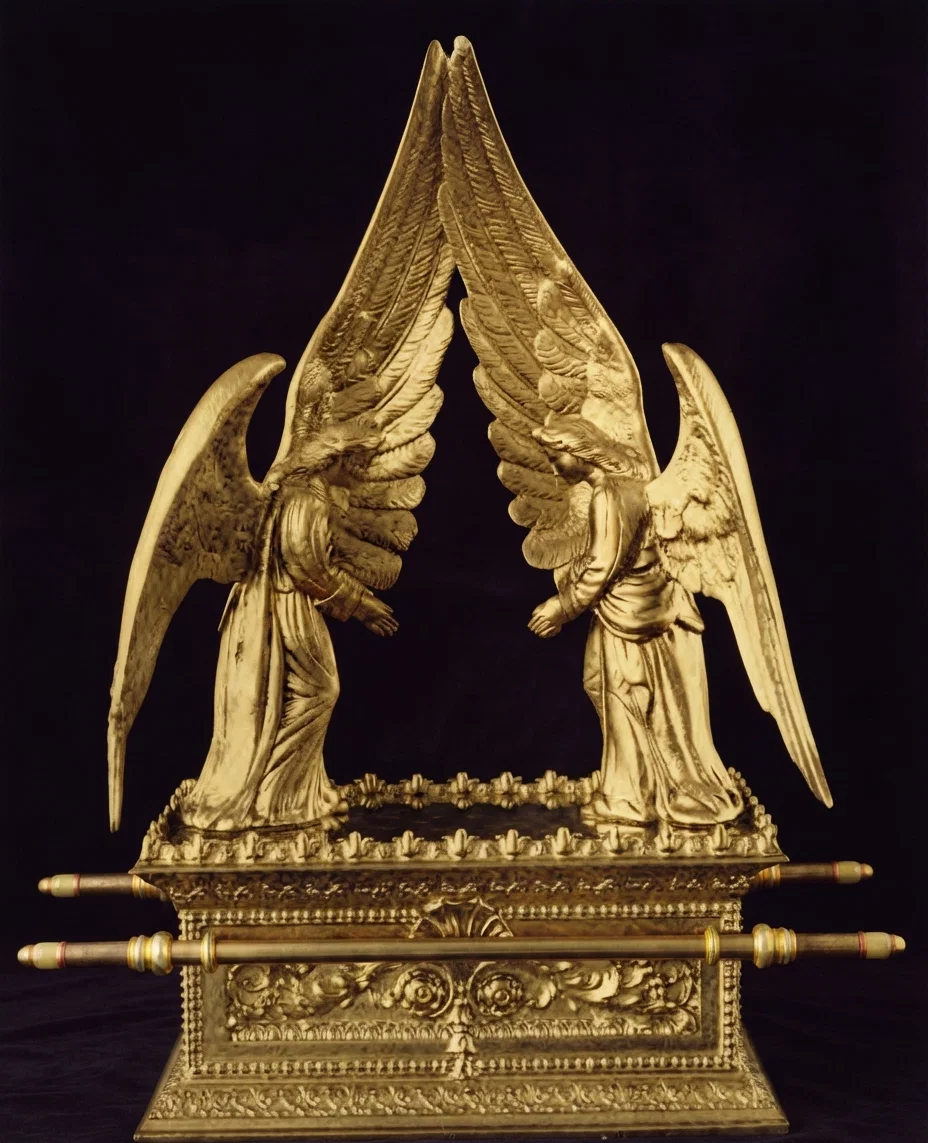
The ark was the central figure of the entire sanctuary. The broken law contained in the ark was the only reason for all the sacrificial service both typical and antitypical. When the Lord gave directions for making the sanctuary, His very first instruction was: "They shall make an ark of shittim [acacia] wood: two cubits and a half shall be the length thereof, and a cubit and a half the breadth thereof, and a cubit and a half the height thereof." Ex. 25:10-22. It was overlaid within and without with pure gold, with a crown of gold around the top. The cover of the ark was called the mercy-seat. This was of pure gold. On either end of the mercy-seat were cherubim of beaten gold, with their wings stretched forth covering the ark, and their faces looking reverently toward the law of God contained in the ark. There is great consolation in the fact that God Himself covered the broken law with a mercy-seat, and then He, the merciful God, took His position upon that seat, and every sinner that comes confessing his sins receives mercy and pardon. That mercy-seat, with the cloud of glory, the visible representation of God's presence, and its covering cherubim, is a wondrous "shadow" of the throne of the great God who proclaims His name as "Merciful and Gracious, Long-suffering, and abundant in goodness and truth." Ex. 34:5-7.
It Contained the Tables of Stone
Within the ark was the Lord's own copy of that holy law given to mankind in the beginning. "Where no law is, there is no transgression." Rom. 4:15. "Sin is not imputed when there is no law." Rom. 5:13. Therefore the Lord could never have driven our first parents from the Garden of Eden (Gen. 3:22-24) on account of their sin, if they had been ignorant of God's holy law. How God proclaimed His law to our first parents, He never revealed in His holy Book; but when it was necessary again to make His law known to His people after their long servitude in Egyptian bondage, He had the account of that wonderful event recorded, so that the generations to come might know that God came from heaven and spoke the Ten Commandments with an audible voice in the hearing of all Israel. Deut. 4:10-13. After God declared the Ten Commandments from the top of Mount Sinai in the hearing of all Israel, He wrote them upon two tables of stone, and gave them to Moses, with the instruction, "Thou shalt put them in the ark." Ex. 31:18; Deut. 10:1-5. The ark was placed in the most holy apartment of the sanctuary, where no mortal eye could gaze upon it except the high priest, and he only one day in the year, when he went in before the Lord to sprinkle the blood of the Lord's goat before and upon the mercy-seat to atone for the broken law within the ark. "The wages of sin is death" (Rom. 6:23), and the broken law demands the death of every sinner. In the typical service, the blood was sprinkled above the law, to show faith in the blood of Christ which would free the righteous from the demands or curse of the law. Gal. 3:13.
God communed with His people from the cloud of glory which rested above the mercy-seat between the cherubim. Ex. 25:21, 22. These golden cherubim with outstretched wings were but a shadow of the covering cherubim that surround the throne of God in heaven. Eze. 28:14, 16.
Government Requires Law
There can be no government without law. The very suggestion of a kingdom is always connected with law. There could be no judgment without a law as a standard of judgment. God declares that "as many as have sinned in the law shall be judged by the law." Rom. 2:12. All God's commandments are righteousness. Ps. 119:172. The establishment or foundation of His throne is righteousness and judgment. Ps. 97:2, margin. "There was nothing in the ark save the two tables of stone" (1 Kings 8:9), is the divine record. The pot of manna was laid up "before the Lord" (Ex. 16:33, 34), and Aaron's rod that budded was laid up "before the testimony" (Num. 17:10). Paul, enumerating all the contents of the most holy place in the order that he has, leads some to suppose that at some time the pot of manna and Aaron's rod might have been placed in the ark; but the ark was made for the one purpose of containing God's holy law. Deut. 10:1, 2.
No profane hands were allowed to touch the ark. Uzzah was smitten for reaching forth his hand to steady the ark when the oxen which were drawing it stumbled (2 Sam. 6:6, 7, margin), while thousands of "the men of Beth-shemesh" were smitten for looking into the ark (1 Sam. 6:19). None but priests were allowed to carry the sacred chest. Deut. 10:8.
Hidden by the Prophet Jeremiah
On account of the wickedness of the two sons of Eli the priest, the ark was carried onto the battle-field, and captured by the Philistines; but God impressed their hearts to return it to Israel with a golden trespass-offering. 1 Sam. 4:3-11; 5:1-12; 6:1-18. When Solomon's temple was built, the ark was placed in the holy of holies (1 Kings 8:1-6), where it remained until taken by the prophet Jeremiah and hid in the mountains, before the Babylonian captivity, lest it should fall into the hands of the Gentiles. 2 Maccabees 2:1-6.
The writer of the Apocrypha states that the ark will again be brought forth in the last times. 2 Maccabees 2:7, 8. Whether that copy of the law which God gave at Sinai will be brought out again or not, there will a copy of that same law be traced as with a pen of fire in the heavens, before the wondering gaze of the inhabitants of earth, in connection with the second coming of Christ to the earth. Ps. 50:6; 97:6; 98:2. That holy law is the standard by which all will be judged. That law will condemn the guilty; for "sin is the transgression of the law." 1 John 3:4; Rom. 7:7; James 1:23, 24; 2:8-12. The same law that condemns the sinner, will witness to the righteousness of those who through faith in Christ have tried to walk in harmony with its righteous precepts, humbly seeking forgiveness for every transgression. Rom. 3:21.
TYPE
Ex. 26:33. The ark was placed in the most holy place. Ex. 25:21, 22. God's visible presence was manifested above the mercy-seat.
ANTITYPE
Rev. 11:19. The ark was seen in the heavenly sanctuary. Ex. 34:5-7. The Lord gives His name as Merciful and Gracious and Long-suffering.
"Comprehended It Not"
By Mrs. E. G. White
The Lord Jesus, the Majesty of Heaven, laid aside His royal robe and relinquished His royal crown, gave up His high command, and came into the world, all seared and marred with the curse. "All things were made by Him; and without Him was not anything made that was made. In Him was life; and the life was the light of men." Did the world appreciate the light? —No; they refused to accept the bright beams of the Sun of Righteousness. "And the light shineth in darkness; and the darkness comprehended it not." Thus it will be until the close of time. The Son of God came personally into the world, and men did to Him as they listed. "He was in the world, and the world was made by Him, and the world knew Him not. He came unto His own, and His own received Him not. But as many as received Him, to them gave He power to become the sons of God, even to them that believe on His name: which were born, not of blood, nor of the will of the flesh, nor of the will of man, but of God. And the Word was made flesh, and dwelt among us, (and we beheld His glory, the glory as of the only-begotten of the Father,) full of grace and truth."
His Heart Overflowing with Love
The Son of God came to our world with His heart overflowing with love for fallen man. He was in the express image of God, and equal with God in character. He was the brightness of His Father's glory, the express image of His person. He came to meet and to conquer His adversary, Satan, the fallen angel, who had become exalted because of his brightness and wisdom, and who desired to place his throne above the throne of God. Satan desired to set aside the law of God, whose precepts could not be altered any more than could His character or His throne. Satan sought to be first among the ranks of heaven, to have the supremacy in the courts of God, and for this sin he was cast out of heaven, and became the lowest of all creatures. Christ came to controvert Satan's assertions, and to reveal his misrepresentations of the character of God. The Son of God clothed His divinity with humanity, and came to the world without parade or display, that He might be accepted, not because of outward attractions, but because of His heavenly attributes of character, as revealed in His words and works. He presented to men lessons whereby their souls were brought into8comparison with the law of God, not in a legal light, but in the light of the Sun of Righteousness, that man by beholding might be changed into the divine image.
Jesus taught that in no case is man to give up his mind to the guidance of his fellow man, or to follow his own vain imagination. This is what men will do if they drop eternity out of their reckoning, for they will fail to contemplate the things of heaven, and will make the world and the things of time their first consideration. When Christ came to the world, He found men engaged in pursuing phantoms as tho they were realities, and eternal realities were looked upon as unreal and unimportant. They were wholly given up to strife for worldly conveniences and for providing possessions for the future.
The Lord Jesus requires that those who would serve God shall make the world and its interests subordinate to the interests of pure and undefiled religion, and He gave to man in His own life an example of what it meant to be a loyal worshiper of God. If men follow the precepts and example of Christ, they will not become the sport of Satan's temptations. They will not let day after day go by without a thought of God, as they follow out their own devices and plans, as did the inhabitants of the world in the time of Noah. In Noah's day men carried out their plans with no reference whatever to God, upon whose power they were continually dependent. We should continually realize that God is at our right hand, saying, "This is the way, walk ye in it."
Jesus bids us learn of Him, for He was meek and lowly in heart. If He had thought that the best way to save perishing souls was to charm the senses and attract them to His standard through pomp and display, He could have surrounded Himself with worldly attractions, and presented to them maxims and sentiments that would have won the approval of the world.
The One Remedy
But there was but one remedy by which man could be saved,—man must believe God's Word, and follow the example of humility and meekness of heart. Jesus leads the minds of men from their worldly philosophy and self-exalting sentiments to the purity and virtue of the gospel. He leads them away from their false religions of fancy and human reason. There is a religion in the world that is apparently beautiful, but which leads men to turn with disgust from the representation given by Christ of the office work of the Holy Spirit. Of the Comforter which He was to send to His disciples, He says, "And when He is come, He will reprove the world of sin, and of righteousness, and of judgment." The natural heart does not enjoy this constant reproving of sin and continual exalting of righteousness. Men feel disgusted when they are represented as helpless to do good; yet Jesus declares, "Without Me ye can do nothing." The Word of God requires humility and practical godliness, and the picture of man's dependence upon God is mortifying to the selfish independence of man, to his grand ideas of eloquence and finery and parade, which he esteems as essential for the conversion of the world.
Enamored by the Fanciful
Those who are enamored of this religion of fancy do not relish the idea of destroying the old man with his deeds, and bringing into subjection every rebellious thought to the dominion of Christ. They do not desire to submit themselves to the control of the Spirit of God, which works in the human heart to expel every corruption and establish vital principles of virtue, temperance, godliness, brotherly kindness, and Christlike love. Yet those who receive the Spirit of God, tho they were dead in trespasses and sins, will experience the active working of that power which raised Jesus Christ from the dead. The vital power of the Holy Spirit will raise up those who realize their helplessness, and who come confessing their sins and believing in Jesus. All the faculties are to be brought under the control of the Spirit of God. Unaided humanity may struggle with all its power, may exercise reason, eloquence, and philosophy in seeking to repair the ruins of a fallen, disordered world; men may listen to the theories of men, but the question to ask is, What have been the results? Jesus answers, "Without Me ye can do nothing." When all the wisdom of the schools, all the accumulations of human ability, are brought to bear upon those who are dead in trespasses and sins, they avail nothing for the reformation of character. Human selfishness remains in all its depravity. The Spirit of God alone can make and keep men pure. Its work upon the soul is represented as bringing life to the dead, and freeing the soul from the slavery of sin, which has brought it under the condemnation of the law, where wrath and tribulation fall upon every evil-doer. It is the grace of Christ which brings salvation to every one who receives it. Those who are converted, experience peace and assurance forever. In place of being slaves, they are made free through Jesus Christ. Brought into the liberty of obedient children, they can say, "I delight in the law of God after the inward man."
Man is full of frailties and imperfections, and dependent upon God, and yet he stretches himself to enormous proportions of importance, and makes boast of his human wisdom and achievements. He forgets that he is in the world which God has made by His own wisdom. And shall man refuse to admit his obligation to the law of the Creator? The truly converted soul will stand true to the law of God, and be obedient to all His commandments.
God's Great Oneness
By Charles L. Taylor
ONENESS is divine. Unity is God's great concept of life. Before time began, even "before the foundation of the world," the great purpose of the Godhead was to "gather together in one all things in Christ, both which are in heaven, and which are on earth; even in Him." Eph. 1: 4, 10.
The unity of which the scripture speaks is one that embraces within its provisions God's great universe. All created intelligences, whether men, or angels, or unfallen beings of worlds afar, are invited to share its blessings. Jesus said, "And I, if I be lifted up from the earth, will draw all unto Me." John 12: 32. And when, at last, the redemption work of Jesus Christ shall have been completed, "every creature which is in heaven, and on the earth, . . . and such as are in the sea, and all that are in them," shall unite in saying, "Blessing, and honor, and glory, and power, be unto Him that sitteth upon the throne, and unto the Lamb forever and ever." Rev. 5: 13.
The Center of All Hopes
Our Lord Jesus Christ was the "universal Man," the "Desire of all nations." In Him centered the hopes of men of every age, every nation, every clime. Patriarch, priest and prophet, Jew and Gentile,—all have found or shall find salvation through His name. "Neither is there salvation in any other: for there is none other name under heaven given among men, whereby we must be saved." Acts 4: 12.
It requires no reasoning whatever to discover that God's plan in Christ contemplates but one great system of faith, one great unit of believers, one great truth, one great Teacher, one great result—this is a mighty and self-evident fact. The apostle, by inspiration, sums it up most beautifully and completely when he says, "One Lord, one faith, one baptism, one God and Father of all, who is above all, and through all, and in you all." Eph. 4: 5, 6.
Reflecting the Same Image
From whatever angle this truth is viewed, it reflects the same blessed image of unity in the Christ. Take the church, the body of true believers of all earth time. By what name is it known in the records above?—It is styled "the church of the First-born," "written in heaven." Heb. 12: 23. In that church are Abel, Enoch, Noah, Abraham, David, Paul,—all who by faith accepted the righteousness of the Messiah, and obtained title to everlasting possessions.
So absolutely true is it that the believers of all ages are counted as one in Christ, that Abraham, the man of faith who lived more than 1,800 years before Christ, is called "the father of all them that believe." Rom. 4: 11. "And if ye be Christ's," says Inspiration, "then are ye Abraham's seed, and heirs9according to the promise." The church of Christ is the church of all probationary time.
But One Church in Reality
If it be true—and it is—that there has been from earliest times but one church, and that "the church of the First-born," then in a most beautiful sense the children of God in all ages have been Christians. Abraham was a Christian, for he saw the day of Christ and was glad. John 8: 56. David was a Christian, for he spoke repeatedly of Him who was to come. This thought is tremendously emphasized in the words of the apostle, "For this cause I bow my knees unto the Father of our Lord Jesus Christ, of whom the whole family in heaven and earth is named." Eph. 3: 14, 15. Whatever men may have been called on earth, in heaven those who are His have been known by His name.
In various ways the blessed Word of God brings before us the unity which is found in the Lord Jesus. Under the figure of the body—that delicate organism which is declared to be "fearfully and wonderfully made"—the apostle sets forth the relationship existing between Christ and His church, and the relationship between the different members of that church. Christ is the great Head,—"He is the Head of the body, the church." Col. 1: 18. And as the Head of the whole body, He is the Head of each particular member and part. "The head of every man is Christ." 1 Cor. 11: 3.
Source of the One Life Current
From the great Head, Christ, there comes to the body and to all its parts one great current of life. Listen! "The Head," says the Word, is that "from which all the body by joints and bands having nourishment ministered, and knit together, increaseth with the increase of God." Col. 2: 19. And again the Lord admonishes His children to speak the truth in love, and to "grow up into Him in all things, which is the Head, even Christ: from whom the whole body fitly joined together and compacted by that which every joint supplieth, according to the effectual working in the measure of every part, maketh increase of the body unto the edifying of itself in love." Eph. 4: 15, 16.
Every one who enters fully and truly into God's great life plan, becomes intimately, yes, vitally connected with Christ. He bears within himself the divinity of the Head, he is controlled directly by the mind of the Head, and shows forth in his experience the glories of the Head.
Compared with the Human Body
In this great spiritual organism are found also those beautiful inter-relationships which are found in the human body. The individual parts "are members one of another." Eph. 4: 25. In every normal being, each part is dependent upon every other. "Whether one member suffer, all the members suffer with it; or one member be honored, all the members rejoice with it." 1 Cor. 12: 26. A great spiritual circuit is established, the Christ life flowing to all through all. That gift of life which blesses the one goes on through the one and becomes the blessed gift of all.
This is "the unity of the Spirit." Eph. 4: 3. It is a unity which has for its bond the invisible power of divine unction. It is that unity which existed between Jesus Christ and His Father. "That they all may be one; as Thou, Father, art in Me, and I in Thee." John 17: 21. It is the unity which at once makes the believer the bond-servant of Christ, and yet leaves him in a world of absolute freedom of belief and action.
It is, indeed, good and pleasant "for brethren to dwell together in unity." But whenever or wherever this blessing is realized, it is because the one mind governs each brother, each sister. Diversity will be present, but not unlikeness; difference of opinion, but not dissension. The great oak has no two leaves which exactly resemble each other; and yet, while all are dissimilar, each one loudly declares, I belong to the oak. In the church, among Christian brethren, there are diversified gifts and individuality of action; but all positively testify, We are Christians, parts of the same great tree. Oak life makes oak leaves; the Christ life produces Christian faith and action.
Were all men fully and completely to surrender to God, make His will their will, and His mind their mind, then should we see one great common faith. All would be taught of God (John 6: 45), and all, consequently, would see the same truth, and stand as a unit in belief. It is only man's unwillingness that debars the great Teacher from leading into that oneness for which Jesus prayed.
Is Unity by Federation?
To-day men are seeking to bring about unity by means of federation. The effort, however, will not succeed, for federation can be brought about only by compromise and suppression of much that is vital. Such unity is but a mild form of coercion, a visible cloak covering invisible disorder and spiritual chaos. Churches of different beliefs and practises may come together in a great spiritual trust, but, as a matter of fact, their union must smack of the same error that constitutes the pseudo forced oneness of the Papacy. There is no unity except that which is founded in oneness of mind, oneness of choice, oneness of faith, oneness of life, oneness of spirit, and all rooted and grounded and founded in Christ Jesus.
Jesus prayed for oneness. His prayer will be answered, but never perfectly on earth. No one visible church has ever known it completely. It is the privilege, tho, of each believer so to submit to the leadings of the divine that when God's great church of the ages, called out of every nation, kindred, tongue, and people, shall finally be gathered before the throne, he may be numbered among them, and unite in that wonderful united chorus of praise which shall then be offered.
Sweet Day of Rest
By Delwin Rees Buckner
By Delwin Rees Buckner
It is the hallowed day of peace and rest,
And yet wee, powdered, blossom-scented
bees
Buzz busily among the apple-trees;
The oriole, with sunset-painted breast,
Seeks flakes of fleece with which to line
her nest;
While, in the lawn, keen-scented antlets
seize
Stray cracker crums to cram their
granaries,
Lest winter come as an unwelcome guest.
Yea, even God Himself doth work, else
would
The worlds not whirl around in dizzy
space,
Thus disconcerting the Eternal's plan.
But O, how wonderfully wise and good
Is He, who through His boundless love
and grace
Hath set apart a Sabbath day for man!
Our Bible Reading
The Hope of the Ages
1. What was the hope of Enoch, who lived before the Flood?
“Enoch also, the seventh from Adam, prophesied of these, saying, Behold, the Lord cometh with ten thousands of His saints.” Jude 14.
2. In what language does the psalmist express his hope in the second coming of Christ?
“Sing unto the Lord with the harp; with the harp, and the voice of a psalm. With trumpets and sound of cornet make a joyful noise before the Lord, the King. Let the sea roar, and the fulness thereof; the world, and they that dwell therein. Let the floods clap their hands: let the hills be joyful together before the Lord; for He cometh to judge the earth: with righteousness shall He judge the world, and the people with equity.” Ps. 98: 5-9.
3. In what prophetic words does Isaiah express the hope of his time in the second coming of Christ?
“And it shall be said in that day, Lo, this is our God; we have waited for Him, and He will save us: this is the Lord; we have waited for Him, we will be glad and rejoice in His salvation.” Isa. 25: 9.
4. How did Job tell the story of his faith in seeing Christ in person on the earth?
“O that my words were now written! O that they were printed in a book! that they were graven with an iron pen and lead in the rock forever! For I know that my Redeemer liveth, and that He shall stand at the latter day upon the earth: and tho after my skin worms destroy this body, yet in my flesh shall I see God: whom I shall see for myself, and mine eyes shall behold, and not another.” Job 19: 23-27.
5. What is one among the many New Testament promises of His coming?
“For the Lord Himself shall descend from heaven with a shout, with the voice of the Archangel, and with the trump of God: and the dead in Christ shall rise first: then we which are alive and remain shall be caught up together with them in the clouds, to meet the Lord in the air: and so shall we ever be with the Lord. Wherefore comfort one another with these words.” 1 Thess. 4: 16-18.
6. What is one of the promises of the Apocalypse, the closing book of the Bible?
“And I looked, and behold a white cloud, and upon the cloud One sat like unto the Son of Man, having on His head a golden crown, and in His hand a sharp sickle. And another angel came out of the temple, crying with a loud voice to Him that sat on the cloud, Thrust in Thy sickle, and reap: for the time is come for Thee to reap; for the harvest of the earth is ripe. And He that sat on the cloud thrust in His sickle on the earth; and the earth was reaped.” Rev. 14: 14-16.
Tempted as We
O, WHEN we are journeying through the murky night and the dark woods of affliction and sorrow, it is something to find here and there a spray broken, or a leafy stem bent down, with the tread of His foot and the brush of His hand as He passed, and to remember that the path that He trod He has hallowed, and thus to find lingering fragrance and hidden strength in the remembrance of Him as “in all points tempted like as we are,” bearing grief for us, bearing grief with us, bearing grief like us.—Selected.
The Beautifying Power of Kindness
By Ralph Waldo Emerson
THERE is no beautifier of complexion, or form, or behavior, like the wish to scatter joy and not pain around us.—Emerson.