Your ShelfYour Projects

Signs of the Times, Vol. 39, No. 44.

According to His Will

Signs of the Times

Nov 12, 1912

Pacific Press Publishing Association · Mountain View, California · Nov 12, 1912

According to His Will

By Eliza H. Morton
The Most High rules here on earth According to His will, And none can stay His hand, or say, "What doest Thou? Be still!"
'Tis not God's will that men shall sin, Or evil dwell below; And yet He lets the wicked live, That all His love may know.
The universe must justice see; And sin shall show to all, Its awful character at length, The measure of the fall.
God's will on earth will surely be Exemplified at last, When all the wo that sin has wrought Is ever in the past.
'Tis working now, that perfect will. We pray it may be done In all its fulness, till at length The controversy's won.
Then let Thy will, O God, in us Our lives transform each day, Until our feet with gladness tread The holy city's way.

OUR BIBLE BAND

Schedule for the Week Ending November 23, 1912

Sunday November 17 1 Thessalonians 3, 4; Psalm 114
Monday " 18 1 Thessalonians 5; Psalm 115
Tuesday " 19 2 Thessalonians 1-3
Wednesday " 20 Ephesians 1
Thursday " 21 " 2
Friday " 22 " 3
Sabbath " 23 " 4; Psalm 116
— ★ —
Three epistles come into this week's reading,—the finishing of 1 Thessalonians, 2 Thessalonians, and Ephesians. As remarked last week, 2 Thessalonians was written a few months after 1 Thessalonians, both from Corinth. Ephesians was written probably in the year 53, and is thought by some to be a general epistle to various churches, partly because of its contents, and partly because of the fact that in the earlier manuscripts "at Ephesus" is wanting. However that may be, the instruction is good for the Ephesian church, as well as for others. Our chapters on 1 Thessalonians close with very definite, clear instruction concerning the manner of our Lord's coming, and practical teaching to those who are waiting for Him. Supplementary to this are Psalms 114 and 115, both inspiring and instructive, especially concerning idolatry.
2 Thessalonians was written to correct some errors that had been imbibed because of the first epistle. It clearly shows us that the apostle did not believe that the Lord was coming in his day, and that the Lord would not come until the great apostasy had taken place. It also deals with the coming of the Lord.
The remainder of the week is filled with the first four chapters of Ephesians. Wonderfully deep are they in their instruction, the strong meat of spiritual Christianity, the first one dealing with God's election in eternity, in time, the sanctification in the Spirit, the exaltation and power of Jesus, the work that He does for those who are without Christ, but who receive Him, and the mystery of God and the oneness of His church and gifts, with excellent practical instruction which grows out of these things. Psalm 116 supplements Ephesians 4.

"IF YE WILL INQUIRE, INQUIRE YE."

This Inquirers' Department is conducted for the purpose of helping those who are studying the Bible. The answers are oftentimes only suggestive. They are never to be considered infallible, only as they agree with the infallible Word. The writer who may answer them does not consider that his opinion is infallible. He will simply give the best that he has, and plead with the inquirer to search the Word. Such questions only will be answered as, to the editors, seem to minister to the good of the readers and to the mission of the paper. We can not answer repeatedly in the same volume questions upon the same scripture. The name and address must accompany question, not for publication, but as an evidence of good faith, and that answer may be made by letter if deemed advisable. No letters are answered which do not contain the name of the writer. It is well always to enclose stamp for reply.

3907 — Drawing All Men to Him

Will you explain the meaning of John 12:32? Will the time come when all men will be drawn to Him? It seems that Christ has been lifted up, and He says that He will draw all men to Him, and we know that all men have not as yet been drawn to Him. U. S. M.
How do we know that that is the case, that all men have not been drawn to Him? The text does not imply that all would accept Him. It does not imply that all would become Christians, but it does mean that there would be that attractive power in the Lord Jesus Christ that would turn the hearts of men toward Him; and for aught we know, every soul that has ever heard of Him has had longing for Him. But the sins of the world have crushed out the longing, and Christ has been allowed to pass, while men have hardened their hearts against Him. The very fact of His death, His lifting up upon the cross, has drawn the attention of the world to the Lord Jesus; and even beyond this God draws men. Those who have not heard His name at all have been moved and affected by Him. So we read in John 1:9, "That was the true Light, which lighteth every man that cometh into the world." Not one single soul in this world but has light enough to light him to God, if he will but follow it; and yet it lies in his power, and in the power of every one, to snuff out the candle that God lights, and harden the heart against the appeals of His Spirit.

3908 — When Was Christ Glorified?

Will you please tell us through the "Question Corner" when Christ was glorified? E. W. P.
It depends upon what we mean by the term "glorified." Certainly glory is due to him who finishes his work and finishes it in harmony with the will of God. Just before our Lord died upon the cross, He said, "I have glorified Thee on the earth: I have finished the work which Thou gavest Me to do." On the cross He declared, "It is finished." Character met its consummation in dying for the right. Preeminently, therefore, He was glorified when He ascended up on high, as recorded in Acts 1:9-11 and in the 24th Psalm, foreshadowed on the mount of transfiguration. It is to this which Eph. 1:20-23 refers,—"Which He wrought in Christ, when He raised Him from the dead, and made Him to sit at His right hand in the heavenly places, far above all rule, and authority, and power, and dominion, and every name that is named, not only in this world, but also in that which is to come: and He put all things in subjection under His feet, and gave Him to be head over all things to the church." Then was Christ glorified. The same is taught in Philippians 2, speaking of the humiliation of our Lord Himself, giving Himself even to the death of the cross: "Wherefore also God highly exalted Him, and gave unto Him the name which is above every name." See Phil. 2:9-11. But when He comes the second time, He will be glorified in His saints. In them the fulness of the glory will come home to Him, when "He shall see of the travail of His soul, and shall be satisfied," and sin shall be banished forever from God's universe.

3909 — The Seventh Day

Can you prove that Sunday is not the seventh day of the week, instead of the first, as the majority seem to believe? I take it that Sunday was the seventh, because of the scripture that as Jonah was three days and three nights in the belly of the whale, so was the Son of Man to be three days and three nights in the heart of the earth. Now Jesus was crucified on Friday. Hence He would only have spent two nights and a small part of one day, provided He were resurrected on Sunday morning, as every one seems to believe He was. I do not believe that any one could have authority to actually change God's holy day, but I do believe that the world is keeping the actual seventh day, believing it to be the first. H. P.
Now in the first place, God knew which day the seventh was when the manna fell. There can be no question regarding this by a believer in the Word. He pointed out by a threefold weekly miracle, for forty long years, just which day was the seventh day. There could be no doubt about it. (See Exodus 16.) No manna fell upon that day. However ignorant the Jews were, however much they might wish to pervert or tamper with God's commandment, there could be to them no question regarding the day of the week. The Sabbath was the seventh day of the weekly cycle, and God marked it Himself miraculously. A few days after the fall of the manna began, He spoke His own law from heaven, in which He declared that "the seventh day is the Sabbath of the Lord thy God." Ex. 20:8-11. Then at the time of the commandment, there could be no question whatever regarding it, for the miracle of the manna was still current.
When Jesus died upon the cross, and was placed temporarily in the sepulcher, it is stated that the holy women who followed Him returned from the sepulcher, and kept the Sabbath "according to the commandment." Luke 23:56. There certainly could be no question at that time, for Inspiration declares that the day which they kept was the Sabbath day "according to the commandment." The next day was the first day of the week. Now the day which the Jews kept at that time was the same seventh day which we have now. They have been scattered to all parts of the earth, but wherever they have gone they have carried with them the seventh day. And that seventh day corresponds to our seventh day at the present time. Nobody disputes it who has regard for history and fact and astronomical data.
We have before us a chart of the week prepared by the late Pastor William Jones, of Millyard Church, London, assisted by his imperial highness, Prince Louis Lucien Bonaparte, the great European linguist. This chart has nine columns. The first column gives the language, and where spoken; the second column, the name of the week, or cluster, or cycle, of seven days; the next seven columns give the names of the days of the week.
This chart gives the name of the week and the days of the week in 107 ancient languages and dialects, mostly of the Eastern or Oriental world. In addition to that, it gives us the same thing in 53 languages of Europe. Of these 107 languages and dialects, 71 name the seventh day as a sacred day, most of which call it "the Sabbath" itself; 37 of the 53 European authorities also call it "the Sabbath." Not one of them calls the first day of the week by the term "the Sabbath." Some of them indicate that it is a holy day, but the Sabbath day is the seventh day always. Take for instance the Georgian language in the Caucasus. The week is called "seven;" the week is also called "Sabbath." The first day is called "Lordly day;" the second, "day two to the Sabbath;" the third, "three to the Sabbath;" the fourth, "four to the Sabbath;" the fifth, "five to the Sabbath;" the sixth, or our Friday, "preparation day;" and the last day, "Sabbath." Now many of these languages were spoken and used by nations entirely separate, having had no international communication at all with each other. It certainly is a remarkable fact, which can not be set aside, that all have the same cycle of days, and so many of them, heathen tho they are, recognize the seventh day as the sacred day of the week.
The Scripture record and history of nations; the observation and record of eclipses; the Jews scattered among all the nations of the earth and still retaining the same day, which they have always held in theory and sometimes in practise; the uniform testimony of Christianity that Sunday is the first day of the week, kept in honor of the resurrection,—all prove beyond the shadow of a doubt that our seventh day, or Saturday, corresponds as nearly as Roman reckoning can make it to the seventh day of the Scriptures and of the commandment, while Sunday corresponds to the first day of the week. The day of the death or the resurrection of Christ does not affect the Sabbath, nor does the Bible anywhere define the heart of the earth as the grave. That expression seems to have reference to the powers of darkness into which Jesus was delivered when arrested. See Luke 22:53.

3910 — Prayer by Catholics

Is it true that the great political conventions which nominated Taft and Wilson were opened by prayer by Catholics? M.
Yes, so far as we know, Catholics may have prayed in all the political conventions. The convention was opened by ministers of other denominations also. So far as the political régime is concerned, it was simply to meet with popular favor that this was done; and first a minister of one denomination was asked and then another, and the compliment was passed around to various ones, in order that in a political way all might be won if possible. It meant nothing more than this.

3911 — Hardening the Heart

I would like an explanation of John 12:37-40. It seems they could not believe if they had wanted to. U. S. M.
Compare verse 40 with Matt. 13:14, 15, etc. We there learn that they hardened their own hearts and shut their own eyes. It is not until men reject the Word of God that the Lord withdraws His Spirit from them, and the withdrawing of His Spirit is bound to harden the heart. But He does not do that until men show that they do not desire His presence. The language used of God is simply allowing the heart to be hardened. Men harden their own hearts always, by rejecting the truth; and so while Christ is lifted up in order that all men may be drawn to Him, and all men are affected by that drawing power, yet they may harden their own hearts as did the Jews, and not receive Him.

3912 — Inquirer.—Regarding the statement that Martin Luther told his mother, when she was dying, that the Catholic Church was the safe one to die in, we know nothing about it at all. Such statements as that are to be received with a grain of salt. We do not recall now just the time of the death of the mother of Martin Luther. It took Martin Luther quite a long time to get out of the Catholic Church; and if his mother died during this time, he may have told her that. He didn't see the truth of the matter all at once; it came to him gradually. Such a statement as that proves nothing one way or the other.

EDITORIAL

Fishers of Men
IN these lessons, we follow the Gospel by Mark. It is not a study of the book,—simply sundry lessons gleaned therefrom of the Master's life and work and teaching. In our last, it was His message and its time. In this, it is the call of His first disciples.
THUS reads the passage: "Now as He walked by the Sea of Galilee, He saw Simon and Andrew his brother casting a net into the sea: for they were fishers. And Jesus said unto them, Come ye after Me, and I will make you to become fishers of men. And straightway they forsook their nets, and followed Him. And when He had gone a little farther thence, He saw James the son of Zebedee, and John his brother, who also were in the ship mending their nets. And straightway He called them: and they left their father Zebedee in the ship with the hired servants, and went after Him."
THE first thing we note is the place where Jesus sought His disciples. Why did He not go to Judea? It was not because He was timid. While He was not bold, or boastful, or self-assertive, He was always brave to do His duty. It was not because He was ignorant, that He did not go to Jerusalem; for at twelve years of age He surprised the great doctors in the temple by His mental acumen and intelligence, and in every after-encounter His superior knowledge and wisdom were more than a match for the casuistry and sophistry of Pharisee and Sadducee, of doctor and priest and scribe. It was not because He did not know that there were men at Jerusalem,—able, devoted, well-balanced men. Surely it would seem that He could have better supplied His cause with directing material from the groups of men revolving around Gamaliel, Annas, Caiaphas, and Nicodemus. But all these He passed by, and came first to the Sea of Galilee. Knowing Him, the reason is obvious. He preferred to gather His disciples from those who were not bound about by truth-perverting or truth-chaining traditions, to gather from those who were not educated to believe that truth could come only through the traditions of the elders, to gather disciples from those who were not wise in their own conceits, from those who were not self-satisfied. Therefore He went to freer Galilee, to the hardy peasants who had seen God's power and wisdom in the stars at night, as their boat rocked on the quiet sea, who had felt their helplessness in the mighty storms which frequently swept down from the mountain gorges and lashed the beautiful lake into a fury, who had learned that God was above men and cared for them all, and whose honest, hungry hearts longed for God and the Deliverer from sin whom God had promised. Therefore Jesus sought the region of Galilee.
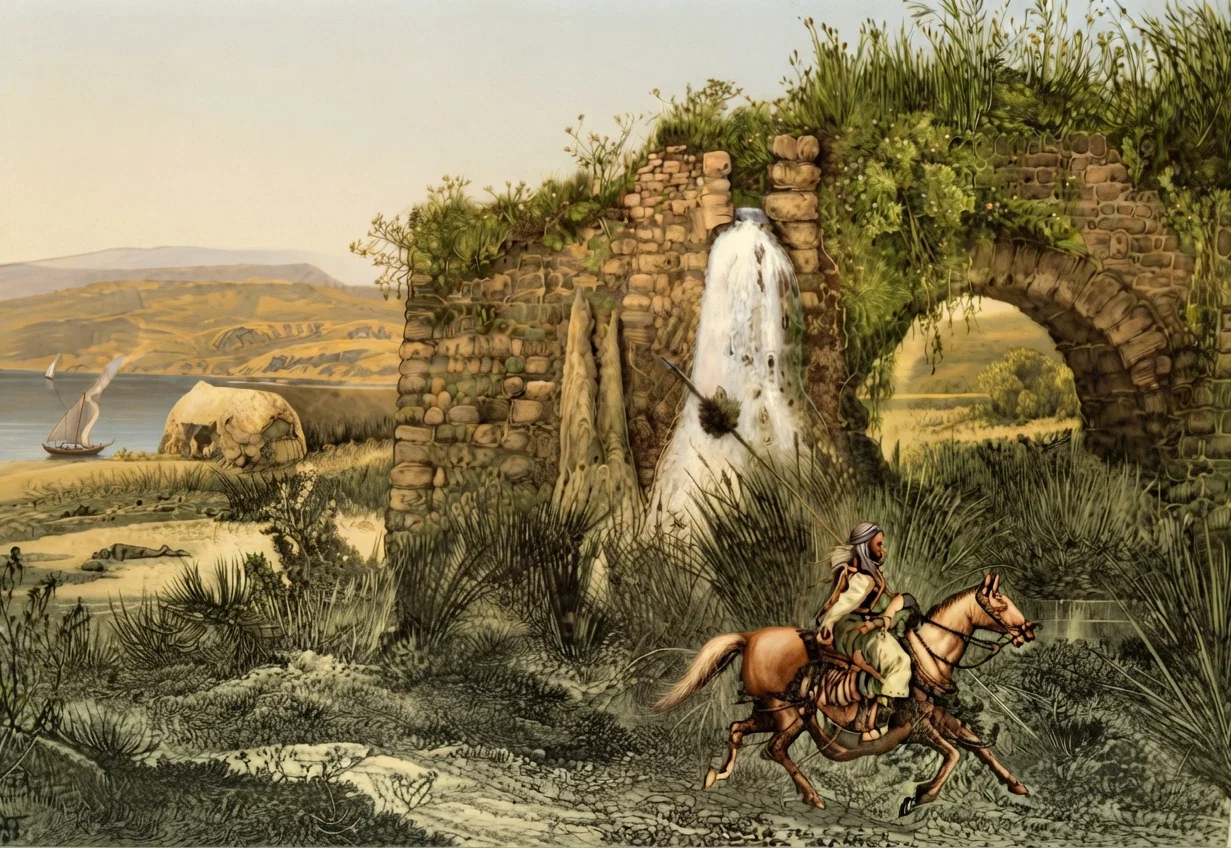
The present site of Bethsaida, "the city of Andrew and Peter," now in ruins. At the time of the calling of the disciples it was a prosperous fishing village. A little bit of the sea may be seen in the left of the picture. Sin never beautifies a land.
THE men He wished to choose were found in Galilee of the Gentiles, where the Jews were mingled with other peoples, until many of them had come to believe that there was salvation for other men. It was among these people that a Roman centurion could find hope, and the Jews say of him, "He loveth our nation, and he hath built us a synagog." Jesus went down among the lowly fishermen by the sea, the men who toiled on the deep under the stars of God. He would choose His disciples, His teachers, His missionaries, from such a class, that the world would not give glory to the missionaries, or to the men chosen. It is God's plan that no flesh shall glory in His presence, and therefore He has not followed the wisdom of the world in His work for souls, because "the foolishness of God is wiser than men; and the weakness of God is stronger than men. For ye see your calling, brethren, how that not many wise men after the flesh, not many mighty, not many noble, are called: but God hath chosen the foolish things of the world to confound the wise; and God hath chosen the weak things of the world to confound the things which are mighty; and base things of the world, and things which are despised, hath God chosen, yea, and things which are not, to bring to naught things that are: that no flesh should glory in His presence." 1 Cor. 1: 25-29. So God chose the Galilean fishermen, bearing with them even to the very close of His ministry the brogue of the Galilean district. But these men were educated by the greatest Teacher that the world ever knew; they learned the great principles of the plan of salvation from the lips of the Master.
"FISHERS of men"—that is what Jesus would make those who would follow Him. He calls, and the call reaches other souls. They had been fishing for fish. They knew all its uncertainties and all its hardships, all its disappointments, all its constitution-breaking experiences. They must have reasoned among themselves that it would be harder to fish for men. They knew the uncertainty and insincerity of men.
THERE are fishers for men. Satan and his agents have fished for them from the time that sin entered this old earth, and he has gathered them in, with all the various nets and hooks and wiles of which he is master,—one in the net of drunkenness, and another in that of lust, and another in that of power,—by all the various ways and means by which men can be attracted from the path of godliness and righteousness to a life of selfishness and ease and dissoluteness. Christ wanted those who would fish for men, and gather them into the great net of God, not for destruction or despoliation, but for salvation eternal. He has had His fishers in all days and in all generations; He has them to-day. But they must fish men out by the straight, clear devices indicated in our Lord's message in our last number. Men are not to be caught by the wiles of evil, they are not to be deceived. They themselves must yield to the fishermen, "repent, and believe." God has declared that in the last days "I will send for many fishers, saith the Lord, and they shall fish them; and after will I send for many hunters, and they shall hunt them from every mountain, and from every hill, and out of the holes of the rocks." Jer. 16: 16. But He does it by the same everlasting gospel that our Lord Jesus Christ died to give to the world. Rev. 14: 6.
THE fishermen responded. Simon and Andrew were just casting their net into the sea for a haul, but "straightway they forsook their nets, and followed Him." James and John were mending their nets preparatory to casting them into the sea, and they left their nets and followed Him. There was instant response to the call of the Master. Straightway He called, and straightway they left their earthly things to respond to the call. There is always blessing in promptness in doing the right thing; there is always weakness and disappointment in delay. There are many souls who would have been stronger had they followed their Lord without hesitation when He first called them. Said the writer of the 119th Psalm, presumably the prophet Daniel: "I thought on my ways, and turned my feet unto Thy testimonies. I made haste, and delayed not to keep Thy commandments." There are many souls in God's cause who would have been far stronger men, far stronger workers, if they had yielded themselves fully, promptly, in the beginning. That full and prompt yielding would have brought such blessing that it would have been the foundation of a habit of just such promptness in all time to come. God does not want rashness, but He does want the soul to decide regarding the thing that is right; and when the right comes, He wishes quick, prompt decision. Why not? Why should we dally and parley when we know what duty is? Why not yield to the duty, do it at once, and stand on the right side of the question forevermore? These four disciples, Peter and James and John and Andrew, whom Jesus met down there by the Sea of Galilee, were among the strongest of the twelve. They were among the first who were really called to the Master's service, and the record indicates that they were among the most prompt to respond to that call. Promptness in yielding to the call of Christ opens the heart to His presence. It forms open channel between the soul and its Saviour. That soul feels free communion with Christ its Lord, and to that prompt response Christ the Lord souls abundant blessings to fortify the soul against the deceptions of the enemy. That prompt response does not mean loitering behind, becoming a straggler in God's army; it means that that soul is at the forefront where the Master leads, prompt to do duty, growing stronger continually in the duties done, learning to bear burdens by bearing them, until life closes. The narrative is a very simple one, but the lessons it contains are of vital importance to success in Christian life.

Two Sabbath Reforms—Which?

THE first part of the thirteenth chapter of the book of Revelation describes the great "beast" power that has been the strong persecutor of righteousness all down the ages. This "beast" has appeared at different times under various guises or "heads," and in this chapter under consideration, it is said that the prophet saw one of his heads apparently doomed to destruction. His words are:
"And I saw one of his heads as tho it had been smitten unto death; and his death stroke was healed; and the whole earth wondered after the beast; and they worshiped the dragon, because he gave his authority unto the beast; and they worshiped the beast, saying, Who is like unto the beast? and who is able to war with him? . . . And it was given unto him to make war with the saints, and to overcome them; and there was given to him authority over every tribe and people and tongue and nation. And all that dwell on the earth shall worship him, every one whose name hath not been written from the foundation of the world in the Book of Life of the Lamb that hath been slain. If any man hath an ear, let him hear." Rev. 13:3-9.
All agree in saying that the great beast power of the Apocalypse is the persecuting force that Satan has exercised against the true church of God. The sixteenth century Reformation that swept Europe carried with it a spirit of freedom and liberty that every one said would destroy the "beast" power of persecution from the face of the earth. Our "civilization of the twentieth century" is one of the outgrowths of that mighty Reformation. And men are saying that we can never have persecution and its horrors as in the days of old. Those who are saying this the most strongly are the evolutionists, who believe that the race is developing irresistibly toward a higher plane. But God has spoken right into the face of this strong evolutionist sentiment, that the "death stroke" of the beast is to be healed, and all the world is to wonder after him; all will worship him who are not standing with the Lamb that has been slain. We will see erelong who knows best—the infinite God who sees the end from the beginning, or finite, erring, mortal man.
Such, in brief, is one of the prophecies that tell of the restoration of the beast, or the persecuting power. And that restoration is to be right at the end of time; for the most solemn warning in all the Bible is directed against it, and that warning prepares a people to stand ready for translation at the coming of Christ. The words of the warning are these:
"And another angel, a third, followed them, saying with a great voice, If any man worshipeth the beast and his image, and receiveth a mark on his forehead, or upon his hand, he also shall drink of the wine of the wrath of God, which is prepared unmixed in the cup of His anger; and he shall be tormented with fire and brimstone in the presence of the holy angels, and in the presence of the Lamb: and the smoke of their torment goeth up forever and ever; and they have no rest day and night, they that worship the beast and his image, and whoso receiveth the mark of his name. Here is the patience of the saints, they that keep the commandments of God, and the faith of Jesus." Rev. 14:9-12.
Three leading things are warned against in this text. There is the "beast," his "image," and his "mark." The last part of the thirteenth chapter of Revelation tells the story of the "image" and the "mark." There is another beast introduced there which helps on the beast that had the death stroke, and causes all the world to worship the wounded beast and to receive his mark.
Now we have the issue fairly before us in the language of the prophetic Scriptures. A beast power comes forward demanding homage. All the world are told that they must worship him and receive his mark. If they do not do this they will have to suffer death, as is shown by the latter part of the thirteenth of Revelation, which we have not taken the space to quote. And while these combined beast powers are demanding worshipful allegiance (which, by the way, shows that they will be religious powers), the mighty God is sending a strong message against this destructive apostasy. It is not necessary to say that no combination can be formed that will finally win against the infinite Jehovah.
But you ask, What is this "mark" that the beast power is demanding shall be received, and against which God sends such a strong warning? A little thought will enable one to see how to avoid receiving it. It is said of those who are developed under the message that God sends, "Here is the patience of the saints, they that keep the commandments of God, and the faith of Jesus"—three great distinguishing characteristics, "the patience of the saints," keeping "the commandments of God," and "the faith of Jesus." They are Christians, for they have the faith of the Christ. But they also keep the commandments of God, and they have the patience of the saints. They seem to have a well rounded out Christian character.
Until very recent years, there was not much controversy in the Christian world concerning the commandments of God. All agreed that they should be kept. But while all are still agreed concerning nine of the Ten Commandments, yet it has been pointed out clearly in recent years that the Sabbath commandment does not call for Sunday keeping. There is no evading the fact that it calls for the observance of the day the world calls Saturday. And while this commandment calls so plainly and explicitly for the observance of the seventh day, which the world names Saturday, there is not to be found in all the Bible a single whisper of evidence that God had ever transferred the Sabbath from Saturday to Sunday. God is not the author of this apparent change of the Sabbath. In recent issues of this paper, we have shown, however, that a power was pointed to in prophecy that would think to change God’s law.
The issue, then, is over the commandments of God, because the ones who triumph with God are found keeping His commandments. And the mark of apostasy would have to be, from the very nature of the controversy, an institution that would set up a rivalry to God’s commandments. And see how strikingly the facts harmonize with the prophecy. The prophecy foretells a controversy that was to involve God’s commandments. And we have right before us in the world to-day two rival sabbaths. One is plainly required by the commandment of God, and the other has only the authority of man.
A world-wide movement is gaining ground and momentum, which seeks to make the observance of Sunday universal by the enactment of human law. They tell us that man’s physical and spiritual natures both require it, and that we can not advance to the highest civilization till we have Sunday laws everywhere, and have them rigidly enforced. All through the past, when men have sought to compel the consciences of their fellows by demanding something of them that was contrary to the plain teaching of the God of the Bible, they have found that men who really believe God will not yield. They stand ready for any persecution or any suffering, but to yield a conscience that remains truly connected with God is an impossibility. This unyielding spirit over purely matters of conscience and religion is taken by men to be nothing more than stubbornness, and all the governmental machinery is set to work to break the stubborn will.
Is it possible that such a bitter struggle confronts the men of this generation? We have these two rival sabbaths. One of them rests on a divine command, and the other on human law only. And we have the prophecy which tells of the fierce conflict that will be waged with the commandments of God and the faith of Jesus as the issue. Where do we stand? Are we with God and His plain Word, or will we take the awful risk of trusting to the sheer force of numbers that depends on human enactment for a divine institution?

Salvation Through Jesus Christ

THE false religions of the world are so many varied efforts of man to save himself. They are all acknowledgments on the part of the devotees that they are in a lost condition. There is almost a universal acknowledgment that man needs a Saviour, that he is out of harmony with his God. The matter of which he is really ignorant is how to find a way out of his trouble, how to find a Saviour that can give him peace. There is just one way of salvation, one Saviour that can make peace between the sinner and his Creator. That one way, that one Saviour, is Jesus Christ. "Neither is there salvation in any other: for there is none other name under heaven given among men, whereby we must be saved." Acts 4: 12.

Invisible Power Made Visible

“For the invisible things of Him since the creation of the world are clearly seen, being perceived through the things that are made, even His everlasting power and divinity; so that they are without excuse.” Rom. 1:20, A.R.V., margin.
THE unseen may be clearly seen. The invisible is made visible. “From the creation of the world [they] are clearly seen, being understood by the things that are made.”
Electricity, which is itself invisible, by making the carbon incandescent enters into the realm of the visible. We still do not see the power; but we do see what it does, and this is all that is essential.
Or electricity may operate a motor, and thus move a mass of machinery. We do not see the power; but we hear the whir of the quickly moving wheels, and we see the machinery in operation. We do not see the electric energy; but we do see what it does, and thus learn of the power through its workings.
No man has seen the force of gravitation at any time; but its effects, its work, all men have seen and felt. We can not climb a hill, without feeling its downward pull. We can not leave anything unsupported except gravity drags it to the earth. Our globe swings out like a mighty pendulum in its magnificent orbit, and sun and moon and sister planets all swing in sympathy with its majestic movement.
Gravity is not seen; but what it does is clearly seen, else we would never know of its existence. We do not see gravitation, but we do see its mighty work in the earth and heavens. Altho unseen, through its visible effects men know of its existence and confess its wondrous potency.
Gravity has a part in giving us our snow and rain. All water-power is merely this selfsame energy exerted on the particles of water in seeking to draw them to the lowest possible level. Gravitation causes the daily tides of the ocean, which are such a factor on our seacoasts. Gravitation is the power that holds all the heavenly bodies in their places, and that, as God’s finger, keeps them forever in the paths appointed to them.
Unseen, nevertheless by its works it is made known. If you should tell a scientist that you do not believe in such a thing as gravity, because it is invisible, he would think you a simpleton. And yet men sometimes declare, by no better argument, that they do not believe in the existence of God, because He is invisible.
All forms of energy are made manifest by their effects upon material things. The presence of heat is revealed through its effects upon the nerves of the skin; excessive heat, by its causing many objects to expand, burn, or melt.
And in a still more marked degree, light is revealed to the eye by its illumination of the objects upon which it falls. The X-ray was discovered because of its effects upon the photographic plate and other substances. And the chemical rays, tho invisible to the eye, are known by their mysterious effects upon many things. All these different forces are known, not by being visible, but by affecting those things which are visible.
Thus the invisible is brought within the realm of the visible. And thus these invisible things are “clearly seen, being understood by the things that are made.”
R.

Who Wrote Shakespeare’s Plays?

Still another author adds his evidence to the mass, that Shakespeare never wrote one of his plays, but that they were written by Sir Francis Bacon. This author, Sir Edwin Durning-Lawrence, in analyzing old book-plates and first-folio spelling, shows that Shakespeare was a poor, ignorant attaché of the theater, too ignorant to write, whose name Bacon borrowed and used in order to save himself from prosecution, and yet has left evidence in his writings that would prove to future generations that it was Bacon who wrote what was supposed to have been written by Shakespeare. And he seems to have fairly good arguments for it. Thus it is that the world’s idols crumble.

Caring for God’s Work

Governor Woodrow Wilson, of New Jersey, said an excellent thing in an address delivered in the First Presbyterian Church of Seagirt, October 20: “Always be afraid of the man who is indifferent to his own success, and certain of the success of the thing that he represents. Stand out of his way, for he has behind him the thoughts of the Almighty.” That certainly is worthy of study in Christianity. One of the great difficulties has always been that men are careful for themselves, and not of the things of God.

Christianity Is a Life

There is no comparison between Christianity as a whole and any other religion whatsoever. Christianity is more than a theory, more than a system of ethics; it is a life. It has ethics far superior to all other religions, but it has what no other religion possesses, the power, the life, to cleanse, to regenerate mankind. Said Jesus, “The words that I speak unto you, they are spirit, and they are life,” and faith is that which grasps the life.
Continue reading: The Tabernacle and the Ark
