Almost everyone can, with ordinary care, preserve his teeth as long as he lives, and preservation may mean a longer life, surely better health and an immense amount of comfort, also a saving from a financial standpoint.
To accomplish this two things are necessary; first visit a skillful, competent dentist, at least twice a year and oftener if necessary. Keep the mouth clean, by removing all foreign deposits.
The mouth is a neglected spot by most people. Organic matter left in the mouth, is surrounded by the most favorable conditions for decomposition. Remember, if the mouth is not clean, food put into such a mouth is contaminated by the decomposing matter, and, with its germs, is not fit to be introduced into the stomach.
In my estimation, there are more deranged stomachs from this one cause than any other.
The cavities of the teeth are perhaps the chief breeding place of disease germs, and should be given great care. Pyorrhea alveolaris is the name applied to a disease of the gums. In this disease the gums become swollen and of a bluish color, with engorged11capillaries, and ready to bleed at the slightest touch. These are primary symptoms. The secondary symptoms are recession of the gum and a loosening of the tooth in its socket.
To wait for the toothache before consulting the dentist is a common mistake. It is often too late then to save the tooth without some suffering and considerable expense.
Do not use a pin or wooden toothpick to clean the teeth. Use only a common quill, waxed silk dental floss, or a good brush. It is far more important to clean the teeth after eating than at any other time. Clean them invariably, however, after breakfast or supper.
No doubt it was the intention of our Creator that the two sets of teeth He has given us would be sufficient to last us our lifetime, and if properly treated they certainly will.
It is a mistake to have a tooth extracted just because it has a little cavity in it. What would you think of a surgeon who would amputate a finger or hand, just because there was a felon or a little sore of some kind on it? I am sure you would think it very unwise. When a permanent tooth is extracted, it is gone forever, therefore we should be more careful about our teeth. If we carefully follow out these directions, there is no reason why we should resort to artificial teeth.—F. E. McKinnon, D. D. S.
SUNSET AND SUNRISE.
By Geo. H. Snyder
I AM sitting at the window
While the sun is sinking low,
Filling mountain, hill, and meadow
With a soft and golden glow.
Fleecy clouds are slowly drifting
From the azure-tinted west,
Settling like a jeweled chaplet
On Mt. Shasta’s hoary crest.
Such a scene portrayed on canvas
Ne’er did mortal eyes behold;
Ever-changing cloud-built chariots,
Liveried in sun-lit gold,
Roll their muffled wheels in splendor
T’ward yon citadel of snow,
Like some ancient warlike legion
Pressing a beleaguered foe.
Now I see a shadow creeping
Slowly up the mountainside,
Mounting higher and still higher,
Like the rising of the tide;
Steadily the gloom advances,
Veiling valley, hill, and town,
Till at last it has enveloped
Even Shasta’s jeweled crown.
’Tis the somber, creeping shadow
Of the western mountain range;
See the light retreat before it,
Till, with movement swift and strange,
Darkness wraps his sable mantle
Round the mountain tall and white,
While I sit in meditation
’Mid the gathering gloom of night.
As I watch the deep’ning shadows
Settling down o’er hill and dale,
As I listen to the sighing
Of the wintry western gale,
Then I think how moral darkness
With its awful, sinful gloom,
Settles o’er the teeming millions
Sweeping onward to their doom.
Once again I’m at the window;
Clouds and darkness all are gone;
Shasta, like an unveiled statue,
Greets the golden light of dawn,
While the sunbeams’ Orient splendor,
Mingled with the snowy white,
Weaves the mantle of the morning
Round the form once robed in night.
As I sit and watch the sunbeams
Slanting toward the vale below,
Mingling with the light reflected
From the monuments of snow,
Then I think of how the Master
Sheds forth rays of light divine
O’er time’s dark and shaded valley,
Lighting up your path and mine.
Many bright prophetic sunbeams
Shining from the Sacred Page,
Herald forth the coming glory
Of a brighter, better age;
E’en now o’er the dark horizon
Shine some beams of glory bright,
Like the fingers of the morning
Pointing to the land of light.
GEO. H. SNYDER.
EXPLORING PATAGONIA.
PROF. J. B. HATCHER of Princeton University has newly returned from a remarkable trip of exploration in a hitherto unknown region of South America, namely, the wild interior of Patagonia. He visited Washington this week for the purpose of depositing with the Bureau of Ethnology a rich collection of objects illustrating the mode of life of the various tribes of aborigines in that part of the world. These natives are among the strangest and most picturesque savages in existence, some of them being described as representing almost the lowest stage in the scale of human development. Their country, too, is more than ordinarily interesting, being associated, since the earliest times, with rumors of gigantic human inhabitants and an astonishing fauna. Quite recently some skeletons of birds that had heads as big as those of horses have actually been dug up. They stood at least nine feet high, and had short wings, claws like an eagle’s, and a beak like a condor’s. It is likely that they attacked with success the largest mammals contemporary with them, being the biggest fowls of prey that ever lived; but they became extinct long ago, and so there was no opportunity for Professor Hatcher to secure a living specimen.
The Professor made several trips, during one of which—through the desert interior—he did not see a human being for over four months, except Mr. O. A. Peterson of Princeton, who accompanied him. He discovered a river never before heard of, which is one of the largest in Patagonia, very swift and deep. But his most interesting observations related to the aboriginal tribes, respecting some of which almost nothing was known. Of these not the least notable were the savages of the west coast, who are an aquatic people, living almost entirely in small, open boats, which they construct with much skill out of large pieces of bark sewn together with sinew and flexible whalebone. Of the latter considerable quantities are thrown up along shore.
These natives feed almost exclusively on shellfish, which they pick up along shore, while the remains of an occasional seal or sea-otter, cast up by the waves or killed with spears, serve to vary the monotony of the diet. Probably among no other people in the world are the actual necessities of life so few. With no constant habitation—no place of residence that can properly be called a home—they move about from one sheltered cove to another. Their occupation of any particular locality is entirely dependent upon the abundance of edible mollusks and upon the weather, which, during inclement periods, may render a well-sheltered spot desirable as a temporary village site. On a few earthen sods in the bottom of the family canoe is kept constantly burning a small fire, which always seems just on the point of going out. About this fire they huddle when not engaged in collecting food.
The climate is extremely cold, and fierce storms are constantly raging; yet these strange people, instead of wrapping themselves in furs, go almost naked. Some of them are clad in scraps of cheap calico, obtained by barter from the whites, which are fashioned into rude garments, the costume of the women being a loose skirt suspended from the shoulders and falling below the knees. Others, through choice or necessity cling to the primitive style of costume, which consists merely of a narrow girth about the loins. To this is sometimes added a piece of sealskin held by thongs in such a way as to be readily shifted to any desired position as a protection against the wind.
For shelter on land, notwithstanding the severe weather that prevails most of the time, these aborigines erect structures hardly worthy to be called huts, consisting of a few branches of trees, the lower ends of which are stuck in the ground in a circle, while the upper ends are bent over toward the middle and carelessly thatched together. Such a house, together with a canoe, a couple of paddles, one or two spears or harpoons of bone for the capture of seals, and one or more baskets made of rushes for use in gathering mollusks, fulfil all the domestic requirements of a family. From the great accumulations of shell heaps in many places periodically occupied, it is evident that the people described have inhabited the region for a long period, during which their habits and customs have undergone little change.—Boston Transcript.
TO-MORROW
By W. R. Fitch
How many hearts with longing hopes
Are waiting for to-morrow;
To some ’twill bring its wealth of joy,
To some its cup of sorrow.
We bear the burdens of to-day,
And often find them lighter
In thinking that to-morrow’s sky
Will be a little brighter.
Our hearts would oftentimes grow faint,
And we be still more weary,
The world would have less charms for us,
And life seem dark and dreary,
If it were not for hopes that cling
To something yet before us;
To-morrow’s hand of promise holds
Its silken curtain o’er us.
The grief that rends our hearts when death
Earth’s tenderest ties doth sever,
E’en tho upheld by unseen hands,
We could not bear forever.
Our loving Father hath ordained
For us surcease of sorrow,
And so hath put within our hearts
Hopes of a blest to-morrow.
—Rev. W. R. Fitch.
TO DISINFECT A SINK.
In hot summertide very strict attention should be given to the sink, so that no ill odors from it may be able to permeate the house. After washing dishes, etc., at the sink, a bucket of water mixed with powdered charcoal should be thrown down the waste pipe, as charcoal is a renowned purifier and disinfecting agent. Cabbage water should never be thrown down a sink, as it smells for days; but thrown upon the garden-beds, out of doors, it may do the plants real service.
The World Did Not Come by Chance
SIR ISAAC NEWTON was once examining a new and fine globe when a gentleman came into his study who did not believe in God, and declared the world we live in came by chance. He was much pleased with the handsome globe, and asked, “Who made it?” “Nobody,” answered Sir Isaac, “it happened here.” The gentleman looked up in amazement at the answer, but he soon understood what it meant. Who can say that this beautiful and wonderful world came by chance when he knows that there is not a house or ship or picture or anything in it but has had a maker?—Selected.
New Hampshire Joins Anti-Cigarette States
NEW HAMPSHIRE has entered the list of anti-cigaret States. There is more or less agitation going on in all the States over the cigaret question, its harmfulness being so great and so continually in evidence that those generally indifferent to debasing practices are forced to acknowledge the terrible danger in this. Eleven States have now passed laws against this enemy of health, and happiness, and usefulness.
LITERARY NOTICES.
“THE LEIPER PHOTOGRAPHS IN BIBLE AND CLASSIC LANDS.” General agent, Mr. Edward F. Biddle, 169 Ewing Street, Fort Wayne, Ind.
The above comprises a collection of natural scenes, taken by J. L. Leiper, D. D., in a tour of 20,000 miles in twenty different countries, reproduced by special process from actual photographs. Mr. Leiper, by letters of State, visited many places, and secured photographs of many scenes hitherto uncaptured by the camera. These pictures are as near actual, fine photographs as it is possible for reproductions to be, and the description accompanying each one renders it more valuable than a mere photograph could be. Series 1 includes 100 pictures in art form, with portfolio. The subscription price is 5 cents for each picture, and 25 cents for the cloth portfolio. These will be delivered at once, as far as published (1-48), or not fewer than eight every two months for 40 cents. These are the latest and finest issued.
“THE WAY TO JESUS AND HOW TO FIND IT.” By Edward Payson Hammond, M. A. And “THE BLOOD OF JESUS.” By William Reid, M. A. Both pamphlets, 216 pages, 10 cents. J. S. Ogilvie Publishing Company, 57 Rose Street, New York.
Both of these little evangelical pamphlets are bound together in one. Both have done good service in the past in winning souls. Both are simple, plain, direct. May they yet win many souls to Christ.
“TARRY THOU TILL I COME.” By George Croly. Beautifully illustrated by T. de Thulstrup. Nicely printed. 12 mo., cloth, beautiful cover design, 622 pages. Price, $1.40, net. Postage, 19 cents. Funk & Wagnalls Co., New York.
This book is a reprint with a new setting of the Rev. George Croly’s “Salathiel, a Story of the Past, the Present, and the ‘Future.” The design of Croly was to portray in romance the Jewish people, and proclaim the second coming of Christ. The present publishers have added an introduction by General Lew Wallace, and an appendix containing the opinions of many learned Jews respecting Jesus and His work. It has been beautifully illustrated by Mr. Thulstrup. Dr. Funk’s preface has taken all the heart out of the main Scriptural truth which the story contains, in his endeavor to make Christ’s second coming mean what, according to the entire Word, it is not.
“WHAT A MAN OF FORTY-FIVE OUGHT TO KNOW.” By Sylvanus Stall, D. D. 284 pp., price $1.00. The Vir Publishing Company, 1601 Real Estate Trust Building, Philadelphia, Pa.
This is Dr. Stall’s fourth book for men in that excellent “Self and Sex Series” published by this company. This book deals with the constitutional changes which take place in men at about the age named. It is full of information and good instruction to the ignorant, warning for the transgressor, and hope for the pure-minded and noble.
“VAIN REPETITION, OR THE PROTESTANT MEANING OF BATTA.” By Rev. Joseph F. Sheahan. The Cathedral Library Association, 123 East 50th Street, New York.
This brochure, by a Roman Catholic priest, is aimed to show that the translations and comments of certain Protestants on Matt. 6:7 are wrong, and that the text should read, “Speak not ‘much,’ rather than ‘use not vain repetitions.’” Murdock’s Syriac renders “garrulous.” An illustration of heathen worship is given in 1 Kings 18:26. But it seems to us that using nearly 100 pages on so unimportant a matter is certainly not “speaking ‘not much.’”
“THE BATTLE OF THE CENTURY.” By Percy Tilson Magan. Berean Library, No. 8, Review and Herald Publishing Co., Battle Creek, Mich.
This pamphlet of 80 pages is a discussion of the great conflict over the principles of liberty, their birth and growth in France and America, opposition to them by the Papacy, the death of these principles, and the coming end. Interesting and instructive.
“THE LADY OF THE NATIONS.” By Richard Hays McCartney. Fleming H. Revell Co., Chicago, New York, Toronto.
The author believes in the literal restoration of ancient Babylon, the reign of Lucifer there as the personal antichrist, the restoration of Jerusalem and the temple, and other things, which will hide from his eyes, and those who follow him, the true fulfilment of prophecy. He fails to catch the root-meanings of the great revelations of ancient Babylon. His pamphlet is written in verse.
“COSMONICS OF WORLDS AND FORCES.” Illustrated. By Oliver M. Babcock. Paper covers, 144 pages. Morell Bailey, Philadelphia, publisher.
The author of this book says a great deal, but tells us very little. He does not believe in the Newtonian theory of gravitation, or the internally-fused earth. In fact, he believes in a hollow sphere, and makes no distinction between stars and planets.
EGGS
By C. H. Tyrrell
EACH VARIETY $1.00 AND $2.00 PER 15
Fancy Black Langshans, White Wyandotte and Barred Plymouth Rocks
Illustrated Price-list and Valuable Information free for stamp
C. H. TYRRELL
SIOUX RAPIDS, IOWA
The Situation in China.
It has been the lot of China to pass through a serious crisis. It is to be hoped that the storm has now spent its fury; but its effects continue, and will continue for many a day. In fact, the causes that led to the Boxer uprising remain; and the feelings that incited it have been embittered and intensified by the struggle through which the country has passed.
What are the characteristics of the people that led to this uprising? One of their number, a Christian missionary named Hu Ging Ung, says of them:—
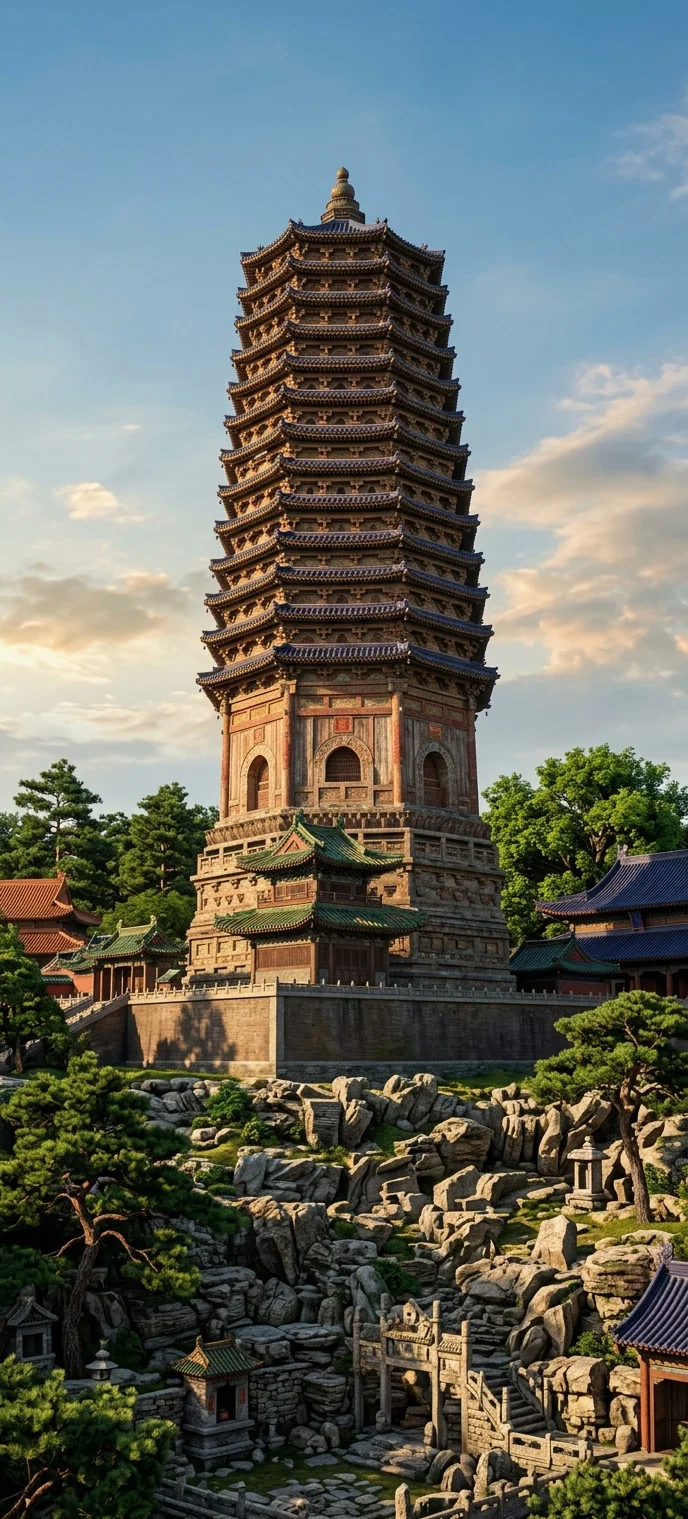
A Chinese Temple.
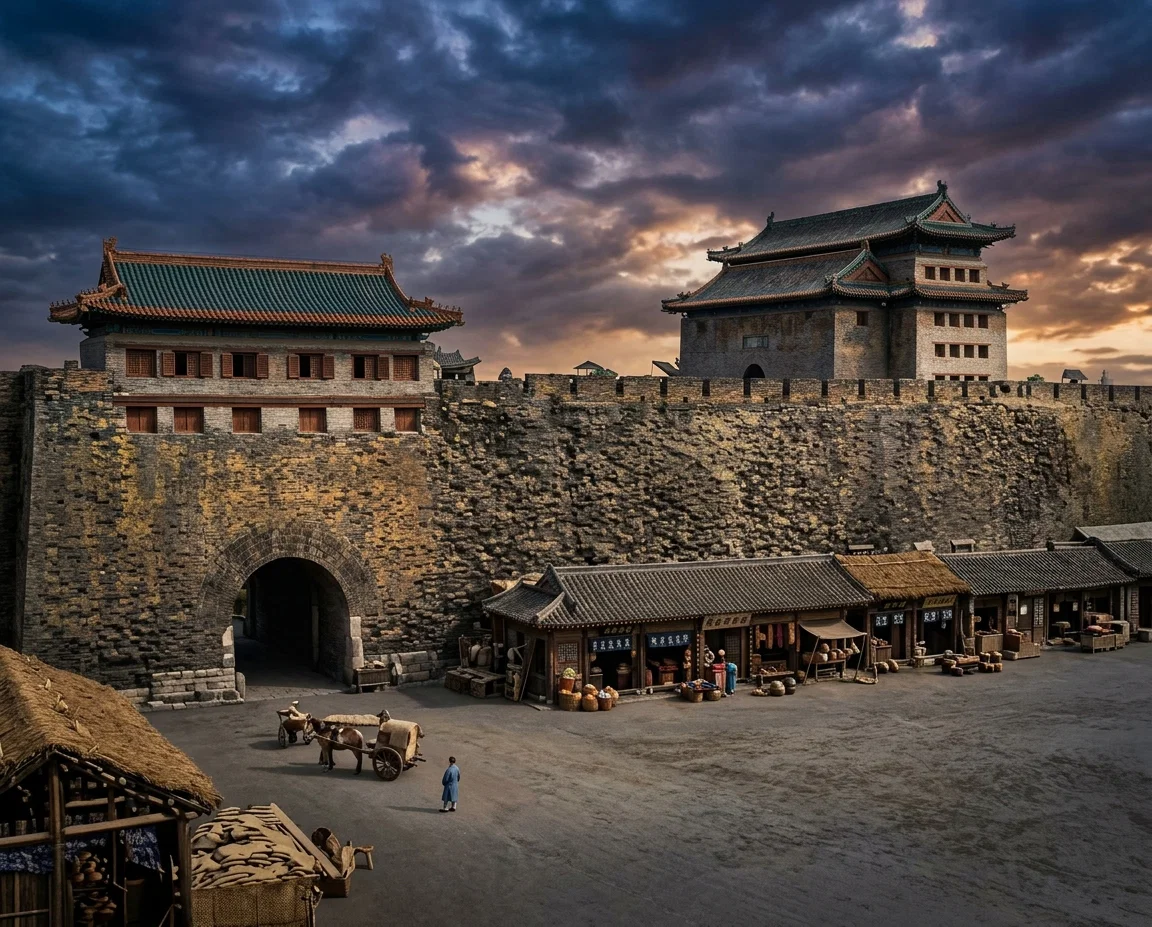
A Glimpse of City Wall, Peking.
They are so proud of the antiquity of their nation that they have no desire for improvement over preceding generations nor of receiving any newer civilization; they are so faithful to the national traditions that they even do not inquire into their origin, but exactly imitate their heathen ancestors; they are so content with their knowledge that no new ideas will be welcomed, but will be strongly resisted. . . . This is the real cause of the weakness of China, and her gradual decline for several hundred years. Here, also, we find the most difficult work of reform which no mere teaching nor direct legislation can reach to much effect.
There are many superstitious customs in our country which have been handed down from our ancestors. Geomancy, or selecting a lucky site, is considered a most important business for the legacy of the succeeding generations. The funeral rites are very seriously kept. The employment of Buddhist and Taoist priests and the extravagant burials are regarded, not only for the sake of the dead, but as the glory and pride of the living. Women are not in the same rank with men, and poor girls are sold as slaves. Higher class girls prefer to suffer with “golden lilies” rather than to have broad feet “in disgrace,” as they call it. Suicide is practised, and sometimes is commended as virtuous. On festival occasions, as birthday or marriage, the people are very particular in their manner of entertainment to follow the speech and ceremony of gross superstition. Besides images in temples, there are domestic spirits, such as ancestral tablets, the two guardian kings of ghosts, the kitchen god, the goddess of mercy, and many others which involve selfishness and fear. Many of the higher class of people set most selfish examples, so that injustice and dishonesty are treated as common matters. It is impossible to name all the degrading wickedness and superstition that bind the hearts of the people, but we can imagine their great influence over them.
In the same line, M. Piton says in Le Missionnaire, as condensed in the Missionary Review:—
There are three parties now to be met with in the Chinese empire. First, that of the literati. This is the most intensely Chinese of all; it is also the most consistent with the principles on which the whole history of China has rested until this day. Hatred of the stranger, absolute, fierce, and implacable—this is its word of command, or, still more exactly, it is its ground of being. . . .
Then there is a middle class—the class of business men, of working-men, and petty annuitants. These, it is true, do not in the least love the foreigner, but then they do love money. To gain this, they think it will not do to bring the Europeans and Americans down upon them too hard. Discoveries and civilization, they believe, procure indisputable advantages to those who know how to avail themselves of them. Let us then, they reason, take care not to break openly with them; let them settle among us, and let us turn their energies to our account.
Unhappily, these foreigners reason the same way, in reverse order. They detest the Chinese; they despise them with all their heart; but they ask nothing better than to make use of them and of the riches of their country in order to heap up handsome profits. For this they find railroads indispensable, and these involve two inevitable consequences—among themselves, competitions which sometimes result in scandal; among the people, profanations which lead to the worst excesses.
Then, too, the railway lines can not but cross and overthrow many tombs. These are encountered everywhere. There are no burying grounds in the Celestial empire—at least, in the parts occupied by our missionaries. Take any landscape whatever, toward whatever quarter you may look you are very probably surrounded by tombs. The reverence felt in every country toward these is, in China, multiplied tenfold by the force of ancestor-worship. To destroy a tomb, is to attack a whole family, to violate the reverence due to ancestors, to commit a sacrilege, and to render one’s self guilty of a blasphemy. Moreover, the lay of the land brings out the well-known sign of the green dragon or of the red tiger. This, also, is sacred. Would you drive a railroad through these venerated lines, behind which there lie entrenched whole ages of superstitions?
Here the third class, the common people, take the field, and stretch out the hand to the literati. Little do they care for the progress of civilization. Ignorant and violent, they are easily influenced by the higher class, and willingly lend them their arms in hunting down the foreigner, or else, confounding all the rich in a common hatred, they form themselves into rebel bands, into corporations of bandits. Among them the secret societies find their most dangerous and sometimes their most numerous members. We find them, for instance, in their famous Trias, an association of the partisans of the Tong dynasty, a body whose emblem consists of three points, mysteriously disposed in the letter expressing the dynasty. They are genuine Chinese Free Masons! Sometimes these partisans fight with one another; often they will fire upon the regular soldiers; but above all are they ready to turn their blows against the strangers, and are wild with eagerness to burn their possessions. Assassins ready for everything, they may become terrible instruments in the hands of the literati. Officially they are disavowed when their murders become a little too compromising; but underhand they are encouraged, and their work is thought worthy of every Chinese that loves his country.
When the character of the people is considered, in connection with the encroachments of foreigners on their territory and the open discussions relative to the partition of China, and “spheres of influence,” together with the interference of foreign ministers in the internal affairs of the country, and the greed of foreign syndicates, it is not strange that the crisis occurred; nor is it strange that China, utterly unable to cope with the powers that were arrayed against her, should come out of the melee crushed and humiliated. It is natural to sympathize with the weaker and wronged party; but to the Christian the first consideration is, How will these things affect missionary work in this great heathen empire?
The Christian converts in China have shown that they were sincere and faithful. J. R. Hykes, D.D., in the American Bible Society’s Report for 1904, says of them:—
Chinese Christians have proved that they have the martyr spirit, and all the qualities of heroes. Proclamations were posted, offering them their lives if they would recant; but tens of thousands preferred death to dishonoring their Saviour, and even children fearlessly faced the executioner rather than deny their faith in God. The Christian church has been tried and not found wanting. It has passed through the fire, and has come out as gold tried in a furnace.
Preachers and colporters have sown the land with Bibles; and the seeds of truth are immortal, and can not be killed out by fire and sword, and they will no doubt bring forth a rich harvest of souls in the land of Sinim. But it will not be done through political aid. As Mr. Hykes justly remarks, “The ‘weapons of our warfare are spiritual, not carnal,’ and they are sufficiently powerful to meet all the ‘opposing forces of the powers of darkness.’”
THE LIVING VOICE.
By Emma Herrick Weed
It seemed like the gardener’s footstep—
His dress like the gardener’s dress;
For her eyes were filled with weeping,
And her heart with heaviness.
But O! at that sweet word “Mary!”
Doth the soul within her rejoice;
It may be the gardener’s semblance—
But the voice—it is Jesus’ voice.
Forgotten the nights of vigil,
Forgotten the dawns of tears;
Her Lord is standing beside her,
His greeting in her ears!
Could mine be a bygone rapture,
The moment—the place—my choice,
I would be the maid in the garden,
When she knows it is Jesus’ voice!
—Emma Herrick Weed.
OUR WORK AND WORKERS.
FOUR converts are reported at Princeton, Texas, by Brother J. B. Beckner.
THREE candidates were recently baptized at South Bend, Ind., by Brother I. G. Bigelow.
SUCCESSFUL canvassing work at Juneau, Alaska, is reported by Brother Walter Harper.
IOWA Conference has returned $6,000 to Union College from the sale of “Christ’s Object Lessons.”
A NEW church was dedicated at Elwood, Ind., July 21. Brother E. S. Huntington conducted the services.
THE publication of the Pacific Union Recorder is announced to take the place of the various State conference organs in the Union conference. The address will be 1059 Castro Street, Oakland, Cal.
THE time of holding the camp-meeting at Greenfield, Ind., has been postponed till August 29 to September 8.
AT the last quarterly meeting at Ogdensburg, Wis., three candidates were baptized by Brother Swin Swinson.
NEBRASKA Conference Committee has decided to change the State camp-meeting from Seward to Lincoln, September 3-16.
THE Dakota Conference has voted to continue the support of Brother L. M. Crowther as a missionary in the island of Trinidad.
DURING the month of August twenty-two camp-meetings are being held and to be held in the United States by Seventh-day Adventists.
ANOTHER of our ministers, Brother J. S. Iles, has fallen at his post. He died at his home near Chesterville, Ohio, June 16, aged 60 years.
WITHIN the two years ending with the recent session of the General Conference, 473 persons were baptized in the West Indian Mission field.
THE executive committee of the Ohio Conference are asking the brethren of that field for contributions to assist in starting a medical missionary work in Cincinnati.
THE brethren at Connersville, Ind., are erecting a new house of worship. The Reporter says they are “straining every nerve to have a creditable building ‘fully paid for.’”
BROTHER E. T. RUSSELL has resigned the presidency of the Texas Conference, on account of ill health, and has removed to Topeka, Kansas, for a change of climate.
MEETINGS are being held among the Oneida Indians, on their reservation in Wisconsin, by Brother H. W. Reed. He reports a fair attendance and good interest.
AT a recent meeting of the Lake Union Conference, Brother W. H. Thurston, who has spent some time as a missionary in Brazil, was elected vice-president and business manager of the conference.
THE missionary spirit is nearly always a prominent characteristic of converts in what we call heathen lands. “Some of the children at our Matabele Mission, not having money to make missionary donations, go without their breakfast every Sabbath and give the cost of the breakfast as their offering.”
THE office of the Gospel Farmer, heretofore published at Harvey, Ill., has been moved to Woodbridge, Va., where it is to be established on a broader basis. The June and July numbers were omitted on account of the change, and it may not appear again until September. Those who have read the paper in the past have appreciated its contents, and will be glad to see it prosper. Price, 25 cents a year; address as above.
IN THE Wisconsin Reporter of July 17, we find the following from Brother A. D. Westcott, who has been laboring at Fennimore: “There are six new subscribers to the SIGNS OF THE TIMES, besides one old subscriber reclaimed. I can not resist the impression that the SIGNS OF THE TIMES is one of the most effective preachers that ever visited any community. Brethren, you who have long prayed that some good missionary would visit your neighborhood with the truth for these last days, please show your neighbors the SIGNS OF THE TIMES, asking them to subscribe, and you may soon be able to thank God that He has answered your prayers.”
DR. J. E. FROOM reports good progress in his efforts to establish the rational treatment of disease in the tri-cities of Rock Island, Moline, and Davenport. He and his wife and son started private treatment rooms in Moline about fourteen months ago. He now says: “It taxes us to secure enough rooms for rent in the neighborhood to accommodate those who must room near by. We are often obliged to refuse board and treatment to those who would gladly come to us for relief. Even our medical office has had to be utilized for two surgical beds. Citizens are urging the establishment of a first-class sanitarium, and are soliciting for this purpose with very good prospects of success. Already building sites have been tendered, and $2,000 donated.”
JAPAN’S EXPERIENCE WITH “CHRISTIAN NATIONS.”
So long as the sun shall warm the earth, let no Christian be so bold as to come to Japan.
For about two hundred years previous to 1854 this is the sign that was posted up throughout Japan by order of the Mikado. And why this interdiction? When Christianity was first introduced into Japan by St. Francis Xavier (Roman Catholic Jesuit), it was favorably received, and there was almost at once a large number of converts, 12,000 or more. But Spain and Portugal entered into a conspiracy with these native Christians to overthrow the government. There was terrible bloodshed and persecution, 31,000 Christians at one time being put to the sword. In the end all missionaries were banished, and the edict just quoted was everywhere put up, and Japan became a hermit nation.
In 1852 some American sailors were wrecked on the coast of Japan, and being harshly treated by Japanese authority, the United States despatched an expedition under Commodore Perry for the protection of American seamen; also to establish a treaty with Japan which would open up one or more ports. That expedition was most successful, and other nations followed a similar course. Soon that obnoxious edict had to come down, for missionary effort always speedily follows commercial opening. But it was not done without a struggle. The cry was raised throughout the empire: “Honor the Mikado and expel the barbarian.”
For the first thirteen years that missionaries worked in Japan, in this second attempt, there were not thirteen converts—a sad contrast to the results of the first introduction under St. Francis Xavier. Alas! the Japanese had learned the bitter lesson of distrust in Christianity! But nearly fifty years of missionary work have wrought a great change in Japan. It would be difficult to tell just how many Japanese have become Christians; but this we do know, there are over 8,000 children in Japanese Sunday-schools. Let us not rejoice too much in this, however, for where one child is in the Christian Sunday-school there are a thousand children who are taught to worship idols. In the city of Tokyo alone there are nearly five thousand temples and shrines.
Has Japan Anything to Fear from a Christian Nation?
Alas! yes, for close behind the missionaries has followed the demon drink traffic. The missionaries tell us that throughout the length and breadth of Japan, American wines and liquors are used, and that American breweries are in full blast, and more are constantly being erected. The Japanese can not be said to be temperate people, since one-seventh of all the rice raised in their country is made into an intoxicating drink called saki, containing about 14 per cent. of alcohol. This makes it all the more deplorable that a so-called Christian nation should do anything to increase the drink evil. Word comes to us from Japan that the next morning after treaty revision came into force in Japan—in July, 1899,—by which Japanese laws are made to apply to all European residents, America had the disgrace of seeing one of her citizens arrested for murder which took place in an American rumshop. The offender afterward met his own death on the gallows at the hands of the Japanese Government.
Japan Prohibits Opium.
Japan prohibits the sale of tobacco to minors and all students, and its use by them.
Japan can and should prohibit the importation and manufacture of liquors.
In regard to the prohibition of opium, Japan undoubtedly learned the necessity of this from the sad condition of her near neighbor, China. As to the prohibition of tobacco, this law was gained through the Hon. Sho Nemoto, M. P. The law became operative only so late as April 1, 1900.
May the time soon come when Japan is as free from the liquor curse as it now is from opium and tobacco.
Japan would probably have prohibited the importation of liquor as well as opium, but for hindering provisions in the treaties of “Christian nations.”
—Corr. Union Signal.
Kingship and Tyranny
A king ruleth as he ought, a tyrant as he lists; a king to the profit of all, a tyrant only to please a few. —Aristotle.
The Growth of Catholicism in France
A WRITER in the New York Independent gives these facts relative to the growth of Catholicism in France: “One hundred years ago the French Revolutionists had closed the convents, dispersed the monks and nuns, and confiscated the possessions of the church. There were then about 60,000 monks and nuns in France, and the ecclesiastical wealth was about $800,000,000. To-day, altho the population of France has not doubled, there are more than 180,000 monks and nuns connected with 1,468 orders. Their known wealth amounts to $2,000,000,000, to say nothing of unregistered property. The influence of these religious orders over the masses of the people is immense, as they hold in their power the parochial clergy, public instruction, an important part of industry, almost all the press, and absolutely all the command of the army and navy.”
MISSION TO LEPERS.
There is an organization which has been in existence for twenty-six years, devoting its efforts in behalf of the lepers who abound in all eastern countries. A report of this mission says:—
Year by year, as the work grew, God has provided the funds, and not once has He allowed us to close a year in debt. From very humble beginnings the work has grown, till now, at the beginning of the new century, the mission is at work in fifty-nine centers, in India, Burma, Ceylon, China, Japan, and Sumatra, in connection with the missionaries of twenty-one different missionary societies. The Lord has not only been faithful to His promises in giving us the funds necessary to carry on and extend the work, but in the great blessing that He has continually poured out upon the spiritual work in the various asylums. Not only have we been permitted to relieve a vast amount of terrible suffering, and to comfort many a breaking heart, but we have been allowed to see many hundreds of the lepers turning to the Lord.