Your ShelfYour Projects

The Signs of the Times, Vol. 25, No. 19

DEPARTURE FROM GOD
Earlier text: THE CROWNING ACT OF CREATION

THE ENGLISH DUMDUM BULLETS.

The Scientific American Supplement has the following to say in regard to the English dumdum bullets:—
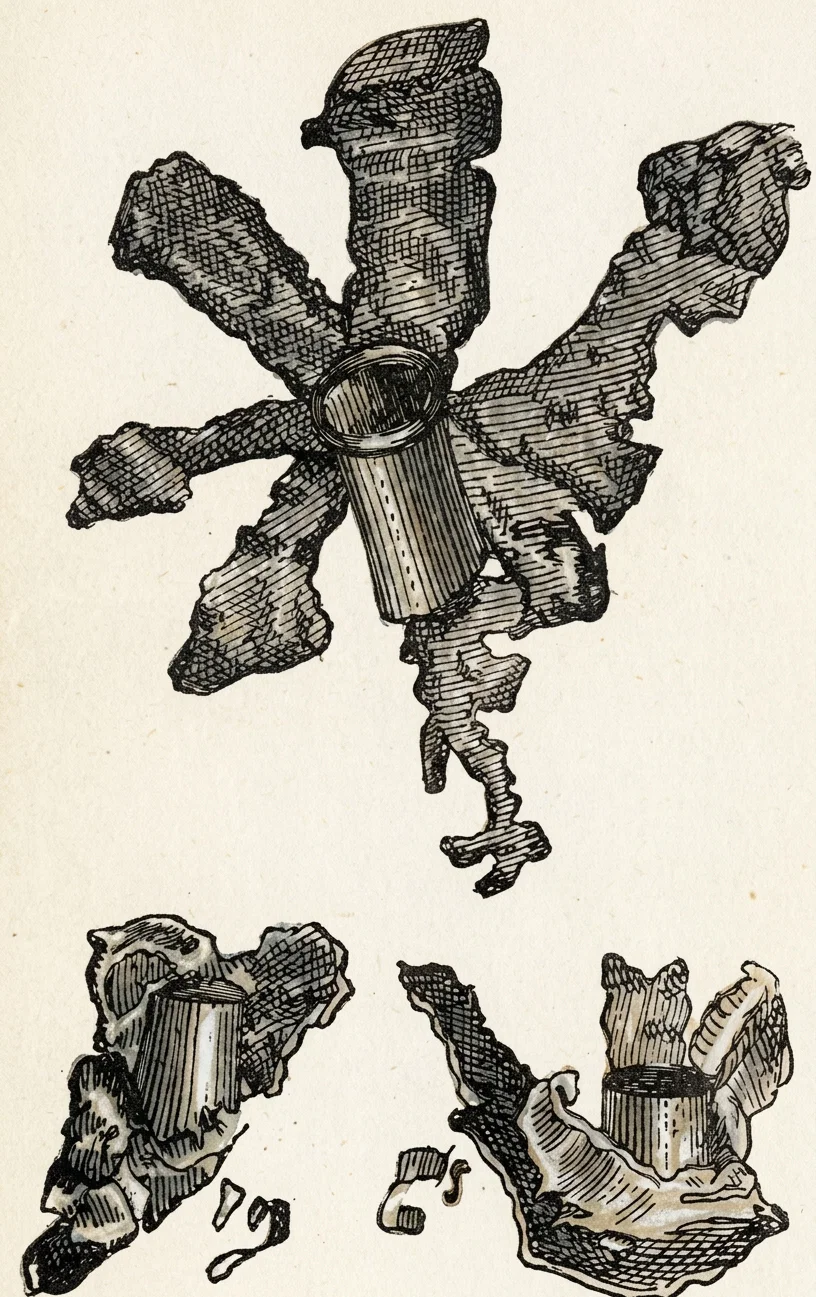
“During the Chitral campaign of 1895, the Indian troops found that the nickel-covered leaden bullets of their Lee-Metford rifles were ineffective against living targets. The soldiers overcame this difficulty by stripping the bullet partially of its nickel jacket and exposing the ogival point of the head. These dumdum bullets, so named after the Dumdum Ammunition Works, at Calcutta, became distorted on striking a soft body and were torn apart, as shown in figure 1. The wounds produced by these half-covered bullets were found to be very serious. . . . The Geneva Convention, it is true, only prohibited the use of explosive bullets in small arms, but had the convention known of the terrible effect which could be produced by a bullet of the form described, mankind would undoubtedly have been protected from this new and fearful type of shot.”
Fig. 1.
Fig. 1.
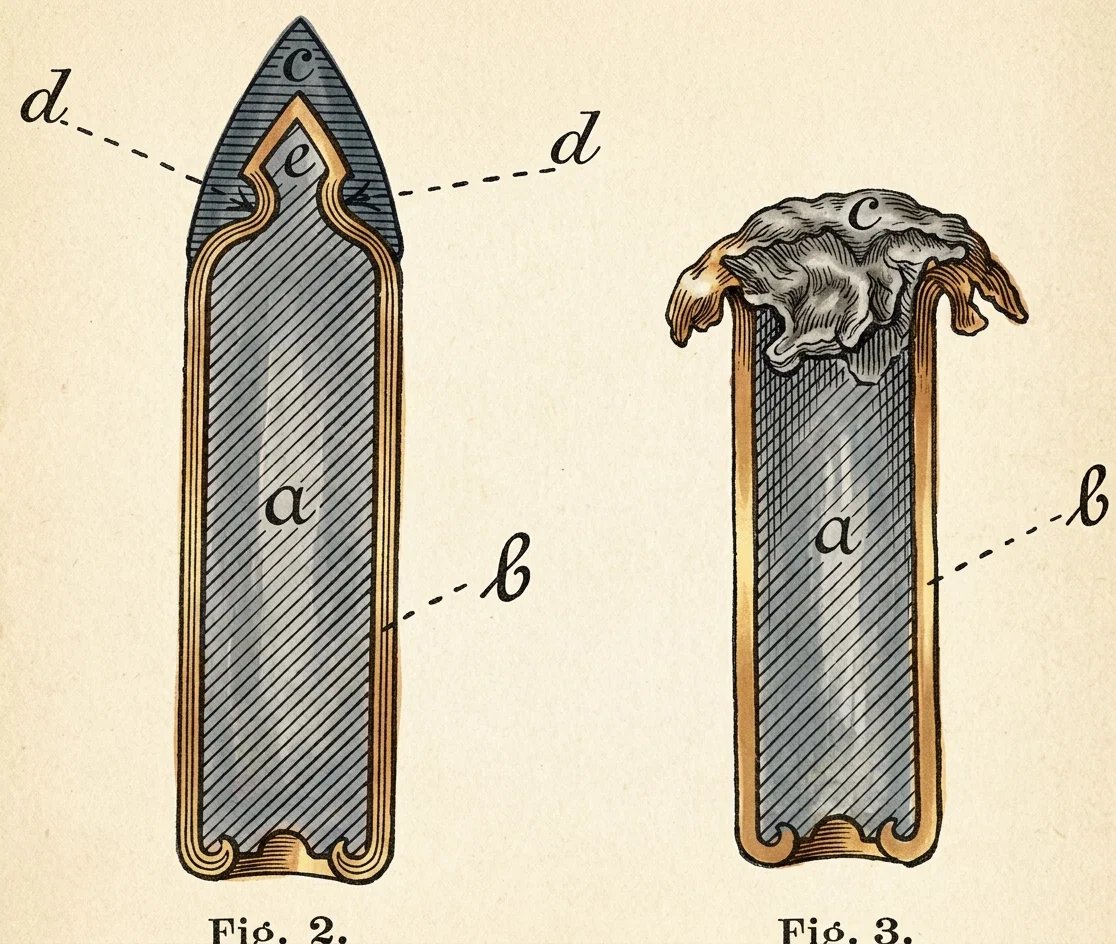
“True it is, that completely jacketed bullets are comparatively harmless against living targets, since they merely pass through the body with but little injury. But it is not on that account necessary to employ these highly destructive, half-covered bullets with their expansible soft cores. Experiments should be made either with fully-covered shot having flattened heads or with an entirely new form of bullet, since a flatheaded projectile has too small an initial velocity for use in modern warfare. In the Kriegstechnische Zeitschrift, to which we are indebted for our illustrations and particulars, a writer proposes a construction similar to that shown in figure 2. In this proposed form, a core, a, a jacket, b, and a leaden cap, c, are used. The jacket, b, is formed with a contraction, d, which offers a firm hold for the leaden cap, c. The inventor of this bullet is of the opinion that a projectile of this type will lose nothing in velocity, and that upon striking a human body it will not be distorted to so great a degree as the half-covered dumdum bullet. By reason of the tapered head, e, a mushroom-like formation will result on impact, as shown in figure 3, and a rather large passageway will be produced without tearing apart the surrounding muscles so terribly as in the case of the half-jacketed bullet. A further advantage claimed for this shot is its high penetrating power, since the easily-demolished leaden cap readily permits the hardened head to protrude.”
It is painfully amusing to note the discussions in regard to just how barbarous a bullet can be without being put under the ban of belonging to “uncivilized warfare.” A bullet that explodes and tears the victim all to pieces will not do, for it is too barbarous, so the “civilized” warrior seems to think. And then a plain steel bullet will not do, for it merely cuts a clean hole through a man, and unless it strikes a vital part of his body it does him but very little injury. Hence a bullet must be invented that is not open to either of these objections.
Fig. 2. Fig. 3.
Fig. 2. Fig. 3.
Why can not men see the absurdity of such sophistical reasonings, and recognize the fact that every form of war, and every form of bullet used in war, is uncivilized and barbarous. But so long as men want to fight, it is supposed that they will try to devise various means to make themselves think that they are civilized, while still doing uncivilized things. War belongs to savagery, and a mere change in the style of bullets used does not strip it of its barbarities.

THE SIGNIFICANCE OF THE POLITICAL BOSS.

THE “boss” has come to be a recognized factor in politics everywhere. He seems to hold the balance of power in his hands, and he either rules or else exerts all his influence to ruin what and whom he can not bring under his control.
Several of the States have been made to feel the power of the political boss in a very marked manner. There have been dead-locks and a prolonged contest in at least five States over the election of their United States senators. And the California and Pennsylvania Legislatures did not succeed in electing their senators at all.
In all these States the work of the boss was very apparent, and in some of them the charges of bribery and fraud seemed to rest upon evidence that could not be set aside as untrue. But the boss is not confined in his work to senatorial contests. He is at work everywhere. His hand is seen in the ward caucus, in the local elections, and also in national affairs.
One peculiar fact about the political boss is that no one can be found who will openly express a love for him. Every one will declare that he holds him in contempt. But still if you have a boss, you must have those who are bossed. In the very nature of things, when a man stands alone, and no one recognizes his authority, he can not be called a boss. But as soon as men begin to seek his favors and gifts, and prostrate their manhood before him in order to get them, then they create the boss. The boss does not create himself, but is made such by those who are willing to cater to some mere man in order to win his influence or his money.
Then if the country is filled with political bosses and wire-pullers—and everybody seems to affirm that it is so—what does it indicate? Does it not show conclusively that men are becoming subservient, and that they are trucking to those that they themselves denominate as bosses? This is another link in the great chain of imperialism that is so rapidly turning this country on the backward movement. And how long can the present corrupt and corrupting work of the boss continue before the whole country is ruined? And if the torch of freedom that has been planted in America is snuffed out, what will be the fate of the rest of the world. These are questions that are at least worthy of most serious reflection.
T.

THE FACE OF CHRIST.

Dannecker, the yeoman sculptor, In a vision the Christ face caught; Then he seized his faithful chisel, And year by year he wrought, And to fashion that face ideal Gave all his time and skill, That a work of God so hallowed Might his loving hands fulfil; For he would that all the people Might behold that wondrous face, So “altogether lovely,” So full of matchless grace.
At last—yet still reluctant— He called a little maid, “Whom have I here?” he questioned. “O, some great man!” she said. He knew by the maiden’s answer That holier touch than yet His skill must find, and a tenderer Christ; Then, with weeping and regret, Dannecker took his chisel And patiently wrought on Until in awe he whispered Exultingly, “It is done.” And again he called the maiden; She answered reverently, “It is, ‘Suffer the little children,’ It is Jesus that I see.”
With such sorrow and compassion That wondrous face was sealed That each man saw his Saviour, Each read God’s heart revealed. The suffering saw His pity; The burdened found release; The sinful felt His pardoning love, And the troubled, rest and peace.
Then Dannecker, the artist, Did his faithful chisel stay, No longer of mind to sculpture From models of earthly clay; Nor image the most enchanting Could tempt his matchless skill, Since a work of God so hallowed Did his faithful hands fulfil.
MARTHA WINTERMUTE.
Newark, Ohio.

THE GOSPEL OF INDUSTRY.

THE Gospel of an earnest Christian industry, from a physical as well as a mental standpoint, is beginning to receive considerable attention as an important element in the education of the youth of to-day. It is being more clearly seen that no influence is so potent in the development of a courageous, well-balanced character as the infusion of a spirit of earnest physical labor, performed under the inspiration of a worshipful service to the Creator, who demands not only the loving service of mind and soul, but of the strength as well.
It is through the medium of an earnest physical service that the inspiration of the divine mind that works upon mind and soul is assimilated and becomes interwoven in the texture of human character. It is through this medium that love instead of selfishness becomes the actuating motive of the life, and human lives are most securely bound together.
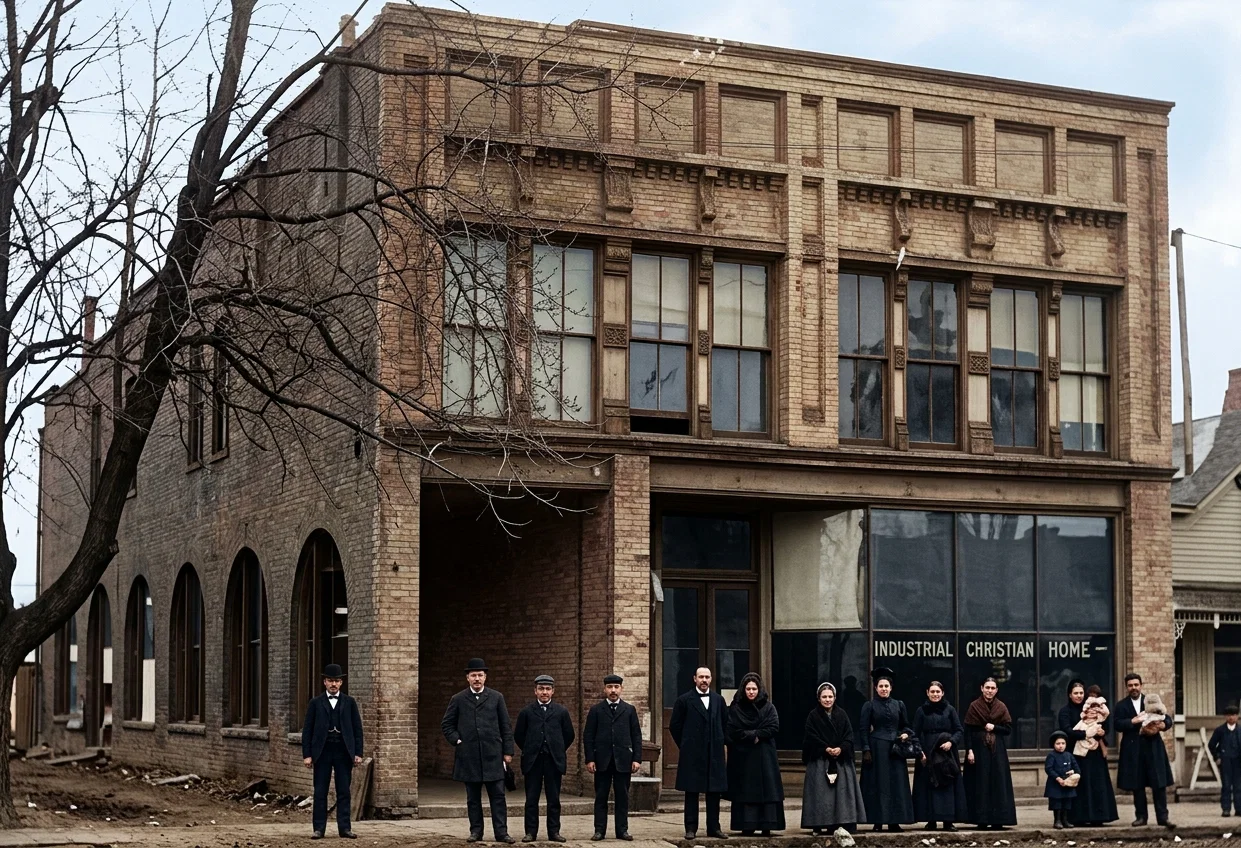
The Industrial Christian Home, Ogden, Utah.—Front View.
May there not be a cause for the prevailing lack of parental respect and obedience that characterizes the childhood and youth of our present age? May not the secret lie in the fact that the parents of to-day do not lay down their lives and strength in the service of love, as they did in former days?
The Industrial Christian Home, Ogden, Utah.—Rear View.
The sound of the ax and the rhythmic music of the scythe are heard no more; they live only in poetry. The pegging hammer is silent; the card, spindle, and loom have all been left behind, or are seen only in the home of poverty; busy fingers ply no more the knitting needles of yore. There is no vision of a faithful mother toiling into the small hours of morning that she may have the coveted pleasure of laying the completed trousers and coat before her sleeping boy where his first conscious thought will be gladdened by this product of a mother's loving service. All this is gone, and now, while mother has so many social engagements of club and call, some servant-girl, who is considered good for nothing else, cooks the food, scrubs the floors, and does all this “awfully distasteful” work; and the unifying influence of a service of love is destroyed.
And then, to patch over this domestic rent, we hold before the children the self-developing fact that we carry, for their benefit, a heavy life-insurance policy. And as that seems to them the highest parental devotion, they naturally begin to count the gray hairs and note the faltering step that seem to give promise of the early realization of this prospective service.
These, with many other influences, have conspired to produce a class of dependent ones who, without courage or hope, are fast being driven to despair. Back of these are a multitude of children who, unless rescued by energetic effort, will soon swell the ranks of this parasitic army.
What shall be the help extended to these neglected ones? Shall it be the doling out of a paltry sum of money, or of clothing ready-made, or food already prepared, which serves only to crush out all lingering feelings of self-respect and independence, and confirm them in a course of vagrancy and pauperism? Is this all?—Certainly our responsibility does not end here. It is the gospel of industry that is needed to-day; the infusion of a spirit of heroic toil into the aimless life. It is the emancipation of labor, not from its tax upon bone, brain, and sinew, but from the contempt of drudgery with which it has so long been branded.
The mighty influence of diligent, helpful physical employment upon life and character must be emphasized by voice and pen; and not by precept only, but also by example.
Strong, earnest, intelligent hands must grasp the trailing banner of industry, and by sacrifice and toil raise it to its heaven-appointed place in the education and reformation of mankind.
Greed and mammon have well-nigh crushed life and love and hope out of common toil; it will take sacrifice and tears to win back the heritage.
It is with the hope of emphasizing these great principles of industry, economy, and temperance, as taught in the greatest of all books—the Bible—and especially of bringing the uplifting influence of these truths into close touch with the daily life of the neglected classes, that the Industrial Christian Home has been established in Ogden, Utah. The blessing of the Lord has attended the work of the home from the beginning. Almost all kinds of physical labor have been consecrated to its establishment.
Brother and Sister M. T. Johnson, of Minnesota, and Sister Libbie Bronwer, of Logan, Utah, were moved by the Spirit of the Lord to consecrate their services free of charge to the work of the institution, and the Lord will abundantly reward these faithful laborers.
The industrial departments of the home consist of a kindling-wood yard, shown in the rear view of building, carpet weaving, a sewing room, and a farm of twenty acres. The home also conducts a free employment agency. The institution has become known throughout the city as the center of practical aid for the poor, whether in the person of the homeless man or the deserted mother and children. The great need at present is means to equip the farm with agricultural implements, team, etc. If any of the readers of the SIGNS feel in sympathy with the purpose of the home, and would like to aid in a substantial way, we can assure them that any such aid will be most gratefully received and faithfully used.
Address all communications to M. T. Johnson, 260 Twenty-fourth Street, Ogden, Utah.
W. A. ALWAY.

In God Is My Salvation and My Glory

“In God is my salvation and my glory.”

PACIFIC PRESS PUBLISHING COMPANY.

The twenty-fourth annual meeting of the stockholders of the Pacific Press Publishing Company was held according to appointment at the main office of the company, corner Twelfth and Castro Streets, Oakland, Cal., on Monday, April 24, 1899.
The past year has been one of marked prosperity, and the outlook for the future is quite encouraging. The following is a brief summary of the work for the fiscal year ending March 31, 1899.

Manufacturing Department.

This department includes a well-equipped book-binding, book and job printing office, and electrotype and stereotype foundry. Twenty-one steam-power presses are in operation, and the plant is one of the largest and most complete on the Pacific Coast. From 2 to 4 tons of paper are used every day, and from 125 to 150 persons find employment in the various departments. Notwithstanding the prevailing hard times, this department makes quite a satisfactory showing. The total amount of business charged out for the fiscal year just closed, amounts to $122,536.35, against $118,726.20 last year.

Book Department.

Aggressive work has been carried on in this department during the past year, and as the result, the volume of business has largely increased.
Beside the regular work of the department, three new subscription books have been placed upon the market, as follows:—
1. “The Story of Redemption,” by Wm. Covert. This is a small book of about 240 pages, and is selling fairly well.
2. “The Desire of Ages,” by Mrs. E. G. White. This is by far the largest and most important volume we have ever issued. It contains nearly 900 large octavo pages, and is illustrated with nearly 300 original half-tone engravings, made especially for this book, at a cost of over $6,000. For over two years a corps of artists were at work upon these illustrations. The book was placed upon the market November 1, 1898, and already the first edition of 10,000 copies is nearly exhausted, and we are now printing a second edition. Two editions have also been printed by the Review and Herald Office at Battle Creek.
Great care has been taken with the mechanical execution of this book, and it is acknowledged by all to be the finest and best-gotten-up volume ever issued by our publishing houses, and it is destined to have a large sale.
We now contemplate getting out a trade- or workers’ edition of this book, without illustrations, uniform in size and style with the “Testimonies,” printed on thin paper, to sell for about $1.50, bound in cloth.
3. “Heralds of the Morning,” by Elder A. O. Tait. This is a book of nearly 300 pages, treating upon the signs of the times, and the near coming of our Saviour. It is beautifully illustrated with original half-tone engravings made especially for this book, and has met with a hearty reception by our canvassers. Altho placed upon the market only two months ago, the first edition of 10,000 copies is nearly exhausted, and we are now rushing through a second edition.
The subscription book sales the past year show a gain over the previous year of $31,075.20, and this does not include $2,471.25 worth of “Gospel Primers,” which are not considered strictly subscription books.
Our tracts and pamphlets have had an unprecedented sale during the past year, there having been about eleven and one-half million pages distributed, or about eight and one-half tons. During the months of October and November about 50,000 pages per day were sent out.
The net business in this department for the year amounts to $62,253.64, as against $41,289.59 last year, showing an increase in volume of $20,964.05.

Periodical Department.

The same increased activity has been manifested in this department that has characterized other branches of our work. Beginning with the year
(Continued on page 14.)

ANNUAL MEETINGS.

THE twenty-eighth annual meeting of the California Conference of the Seventh-day Adventists, and the third annual meeting of the California Conference Association of the Seventh-day Adventists, a corporation, will convene at 9 A.M. Wednesday, May 31, 1899, at Stockton, Cal., for the purpose of electing the officers of the conference, a board of seven directors of the California Conference Association of the Seventh-day Adventists, and the transacting of such other business as may properly come before the meeting. Each organized church will be entitled to one delegate and an additional delegate for every twenty members.
W. T. KNOX, President.
J. J. IRELAND, Secretary.

LESSON IX.—SABBATH, MAY 27, 1899

CENTURION'S SERVANT HEALED, AND WIDOW'S SON RAISED.

Capernaum and Nain.

1 “After He had ended all His sayings in the ears of the people, He entered into Capernaum. 2 “And a certain centurion’s servant, who was dear unto him, was sick and at the point of death. And when he had heard concerning Jesus, he sent unto Him elders of the Jews, asking Him that He would come and save his servant. And they, when they came to Jesus, besought Him earnestly, saying, He is worthy that thou shouldest do this for him; for he loveth our nation, and himself built us our synagogue. And Jesus went with them. And when He was now not far from the house, the centurion sent friends to Him, saying unto Him, Lord, trouble not Thyself; for I am not worthy that Thou shouldest come under my roof; wherefore neither thought I myself worthy to come unto Thee; but say the word, and my servant shall be healed. For I also am a man set under authority, having under myself soldiers; and I say to this one, Go, and he goeth; and to another, Come, and he cometh; and to my servant, Do this, and he doeth it. And when Jesus heard these things, He marvelled at him, and turned and said unto the multitude that followed Him, I say unto you, I have not found so great faith, no, not in Israel. And they that were sent, returning to the house, found the servant whole. 11 “And it came to pass soon afterwards, that He went to a city called Nain; and His disciples went with Him, and a great multitude. Now when He drew near to the gate of the city, behold, there was carried out one that was dead, the only son of his mother, and she was a widow; and much people of the city was with her. And when the Lord saw her, He had compassion on her, and said unto her, Weep not. And He came nigh and touched the bier; and the bearers stood still. And He said, Young man, I say unto thee, Arise. And he that was dead sat up, and began to speak. And He gave him to his mother. And fear took hold on all; and they glorified God, saying, A great prophet is arisen among us; and, God hath visited His people. And this report went forth concerning Him in the whole of Judea, and all the region round about. 18 “And the disciples of John told him of all these things. 19 And John calling unto him two of his disciples sent them to the Lord, saying, Art Thou He that cometh, or look we for another? And when the men were come unto Him, they said, John the Baptist hath sent us unto Thee, saying, Art Thou He that cometh, or look we for another? 21 In that hour He cured many of diseases and plagues and evil spirits; and on many that were blind He bestowed sight. And He answered and said unto them, Go your way, and tell John what things ye have seen and heard; the blind receive their sight, the lame walk, the lepers are cleansed, and the deaf hear, the dead are raised up, the poor have good tidings preached to them. And blessed is he, whosoever shall find none occasion of stumbling in Me. 24 “And when the messengers of John were departed, He began to say unto the multitudes concerning John, What went ye out into the wilderness to behold? A reed shaken with the wind? But what went ye out to see? A man clothed in soft raiment? Behold, they which are gorgeously apparelled, and live delicately, are in kings’ courts. But what went ye out to see? A prophet? Yea, I say unto you, and much more than a prophet. 27 This is he, of whom it is written,
Behold, I send My messenger before Thy face, Who shall prepare Thy way before Thee.
28 I say unto you, Among them that are born of women there is none greater than John; yet he that is but little in the kingdom of God is greater than he. 29 And all the people when they heard, and the publicans, justified God, being baptised with the baptism of John. 30 But the Pharisees and the lawyers rejected for themselves the counsel of God, being not baptised of him. 31 Whereunto then shall I liken the men of this generation, and to what are they like? 32 They are like unto children that sit in the market-place, and call one to another; which say, We piped unto you, and ye did not dance; we wailed, and ye did not weep. 33 For John the Baptist is come eating no bread nor drinking wine; and ye say, He hath a devil. 34 The Son of man is come eating and drinking; and ye say, Behold, a gluttonous man, and a wine-bibber, a friend of publicans and sinners! 35 And wisdom is justified of all her children.”
Side Lights.—Matt. 8:5-13; 11:1-19; “Desire of Ages,” pp. 315-320.
NOTE.—The texts inclosed in marks of parentheses, while not essential to the lesson study, will be found to throw much light upon the lesson, and are suggested for those who wish to study further.

SUGGESTIVE QUESTIONS.

1. Going down from the “mount of blessing” to Capernaum, who met Christ there? For what purpose? Luke 7:1-5. (Matt. 8:5, 6.)
2. What strong plea was offered in behalf of the centurion? Verses 4, 5. See note 1.
3. When Jesus was on His way to the centurion’s house, who was sent to meet Him? With what message? Verses 6-8.
4. Hearing this, what did Jesus say to those following Him? Verse 9. See note 2.
5. When the centurion’s friends returned to his house, what did they find? Verse 10.
6. The day following, where was Christ leading a large company? Verse 11. See note 3.
7. Drawing near the city, what sort of procession did they see issuing from its gates? Verse 12. See note 4.
8. What moved the Saviour to speak to the woman? With what words did He comfort her? Verse 13.
9. What mighty work did He perform? Verses 14, 15. (Matt. 28:18; Eph. 5:14.)
10. At sight of this, how were the people moved? What did they say? Verse 16. See note 5. (1 Kings 17:21; 2 Kings 4:35.)
11. Hearing the general rumor of Christ’s wonderful works, what did John’s disciples do? Verses 17, 18. (Matt. 11:2.)
12. What message did the Baptist then send to Christ by two of his disciples? Verse 19. See note 6. (Num. 24:17; Dan. 9:25; John 1:25-31.)
13. While the men were in the presence of Christ, what did they behold? Verse 21.
14. After they had seen this, what gentle message did Christ send to John? Verses 22, 23. (Isa. 28:16; 1 Peter 2:6.)
15. As soon as John’s messengers were departed, what did Christ say of him? Verses 24-30. (Matt. 11:7-11.)
16. What consistent rebuke did Christ then administer to the people of His day? Verses 31-35. (Matt. 11:16-19.)
17. After pronouncing woe upon those cities wherein He had wrought, what prayer did He then offer? Matt. 11:25, 26. (Matt. 16:17.)
18. What gracious invitation did He then offer to all? Verses 28-30. See “Desire of Ages,” p. 331. (Jer. 6:16.)

NOTES.

1. He sent elders of the Jews.—Several items serve to make this an interesting account. The centurion was counted a heathen by the Jews, but while in command of the Roman post at Capernaum, he had been so favorably impressed with the Jewish religion as to build for them a synagogue at that place. No particular favor was asked for the centurion, but his anxiety was for a servant,—a slave, generally considered as a thing rather than a person. Mommsen says that all the miseries of negro slavery were a drop in the ocean compared to the slaves of those days. Yet this man’s tenderness for his slave prompted him to send to Jesus, whom he had never seen, for relief for his beloved slave. Matthew sets forth the centurion as making the appeal, on the principle that the Jewish elders represented him. Compare Matt. 20:20 with Mark 10:35 for a similar case.
2. “I have not found so great faith.”—Here was a strange saying. One regarded as a heathen was found to have more genuine faith than was in all Israel. And on what ground? Simply that of believing that the word alone was able to produce the desired result. In this artless faith was a confession that Christ had godlike power, and was, therefore, able to heal the sick by His word. This was greater faith than any one among the Jews possessed, even tho that people professed to be then expecting the Desire of Ages. It was indeed a marvelous faith.
3. Nain,—the fair, the beautiful,—was more than twenty miles from Capernaum, on the northwest slope of Little Hermon, in full view of Tabor and the heights of Zebulon.
4. The only son.—To die childless was counted a terrible calamity among the Jews, and to have their offspring entirely cut off was regarded a direct punishment for some sin. This woman was already a widow, and was following her only son to the grave,—a most wretched affliction.
5. A great prophet.—It may be well to remember that Shunem, the place where Elisha raised the “great” woman’s son, was a village on the opposite side of the very hill upon which Nain was situated, and that the plain of Jezreel, the scene of the greatest events of Elijah’s life, stretched out in full view of the place. It was perhaps the memory of these great prophets that called to the lips of the people that another great prophet had arisen among them.
6. Art Thou He?—John had been in prison for a long yet indefinite time. Herod had relaxed his severity enough to permit visitors to see the prisoner frequently, as if almost ashamed to keep the innocent one in confinement. Thus he could hear of Christ’s doings, which caused him much thought. John’s ideas of the Messiah were evidently those held in common with all the Jews,—that of establishment of pure theocracy on the earth. The thought was therefore most natural, If He is the Messiah, why does He not assume the throne of David? Why does He leave me to languish in prison, who went before Him to proclaim His coming? Why am I set aside, apparently forgotten, and my work permitted to drop? (On this point see “Desire of Ages,” p. 361.) These very thoughts were calculated to bring despondency, unless he remembered the lives of Moses and Elijah, who had been over the ground before him. No wonder, then, that he had, and even ourselves have, temporary seasons of depression, when looking at ourselves, and the seeming lack of appreciation which follows one’s pathway.

OUR WORK AND WORKERS.

ONE sister sold 2,000 copies of the Resurrection Number of the SIGNS in Omaha, Neb.
THE MAY number of the Life Boat is a special for use in jails and penitentiaries. The price is $1.00 per hundred. It ought to have a large circulation. Address 1926 Wabash Avenue, Chicago, Ill., or your State tract society.
AT the last quarterly meeting of the church at Deadwood, S. D., six were added to the membership. A good interest has been awakened by circulating the SIGNS prior to the special labors of Brethren J. H. Wheeler and L. E. Johnson.
A CHURCH of eleven members was organized at Cardiff, Ala., March 25, on which occasion five persons were baptized. This result was mainly through the labors of Brother W. Woodford. Brother E. L. Sanford was present at the organization. This company has also erected a house of worship.
THE workers in Honolulu are receiving occasional requests that some provision be made for the education of the Chinese girls. Who could contemplate a more noble work, uplifting these who have so long been degraded? Openings are multiplying, workers are volunteering, but the means has not yet been offered.
REFERRING to our church schools, the Training School Advocate says: “The standard must be held high, because it is God-given, and we shall put forth every effort to reach it. As the young people from all parts of the United States gather at Battle Creek this summer, we look forward to a greater flood of light on educational methods than we have had before. It is planned to have actual work with children, that the teachers may receive not only the theory, but may see the actual workings of lessons on the child mind.”
MRS. L. MONNING writes to the Review from Guadalajara, Mexico, that “the Guadalajara Sanitarium is two months old, and is certainly prospering beyond our most sanguine expectations. . . . We certainly have a neat building, with the most excellent facilities for fresh air and sunlight. At present we have about fifteen house patients, with six or eight from the city. A short time ago Dr. John had three severe cases of pneumonia in one family in the city, and the patients made remarkable recoveries. This at once made the doctor well known, and several cases have been brought to him since.”
THE Fort Worth, Texas, Register of recent date has this item of interest concerning our work in that city:—
“The interest and attendance continue to increase at the Haven of Rest Mission. This mission is doing a good work for fallen humanity, and many souls are being converted. The workers have been kept quite busy during the winter nursing the sick and clothing the poor. Thursday they started out with a new enterprise in the shape of a penny lunch counter. The object is to furnish food to those who are in need, for the actual cost of the raw material. The food is well cooked and everything is clean and neat. Some of the business men of Fort Worth took their dinner at the mission and were highly pleased with it. The superintendent of the mission and his wife, Mr. and Mrs. A. G. Rodwell, have been in Fort Worth since the first of last August, and have spent several hundred dollars from their own pockets besides spending their time and rescuing the fallen. They came here from Chicago, where they obtained a thorough experience in mission work.”

UPPER COLUMBIA CAMP-MEETING.

The Upper Columbia Conference will hold its nineteenth session in connection with the camp-meeting to be held May 11-21 at Milton, Oregon. A number of laborers from abroad will be present to render assistance in the meeting.
We expect this to be the most important conference ever held thus far in our territory. We trust that as many of our brethren and sisters as can consistently will attend this meeting, and bring hearts hungering for righteousness.
J. L. Kay, Secretary of Conference.
Continue reading: LESSON IX.—SUNDAY, MAY 28, 1899