God is One. Perfect unity is manifest in all that He does. There is coherence and growth and progress in all that is God's. His life permeates, infuses all; His Spirit controls all, moves all. This divine unity runs through all His plans. “There is one body, and one Spirit, even as ye are called in one hope of your calling; one Lord, one faith, one baptism, one God and Father of all, who is above all, and through all, and in you all.”
God is One, and the only One. It therefore follows that all that is not of God is division. And all the ages have ever demonstrated.
This is shown in the root meaning of the word “sin,” “missing the mark.” The mark is God and the glory and unity of His character. Missing it is turning from His way. Walking in God's way is righteousness and life. Turning from it is sin, confusion, and destruction.
We have an illustration of unity from the standpoint of the world in an army, moved according to the will of one man, often to complete defeat, disaster, or destruction. But the motive power in all is force, moving against some other body or bodies moved also by force.
In God there is the drawing power of love to unite in Him, the only One, for the salvation, conservation, and preservation of all of His creatures. “God is love.” Love only can truly unite souls. Other motives may unite for awhile; mutual self-interest may unite for a little time the minds of men; but such union is only for so long as self-interest is mutual.
A RESULT—OF WHAT? READ THE ARTICLE.
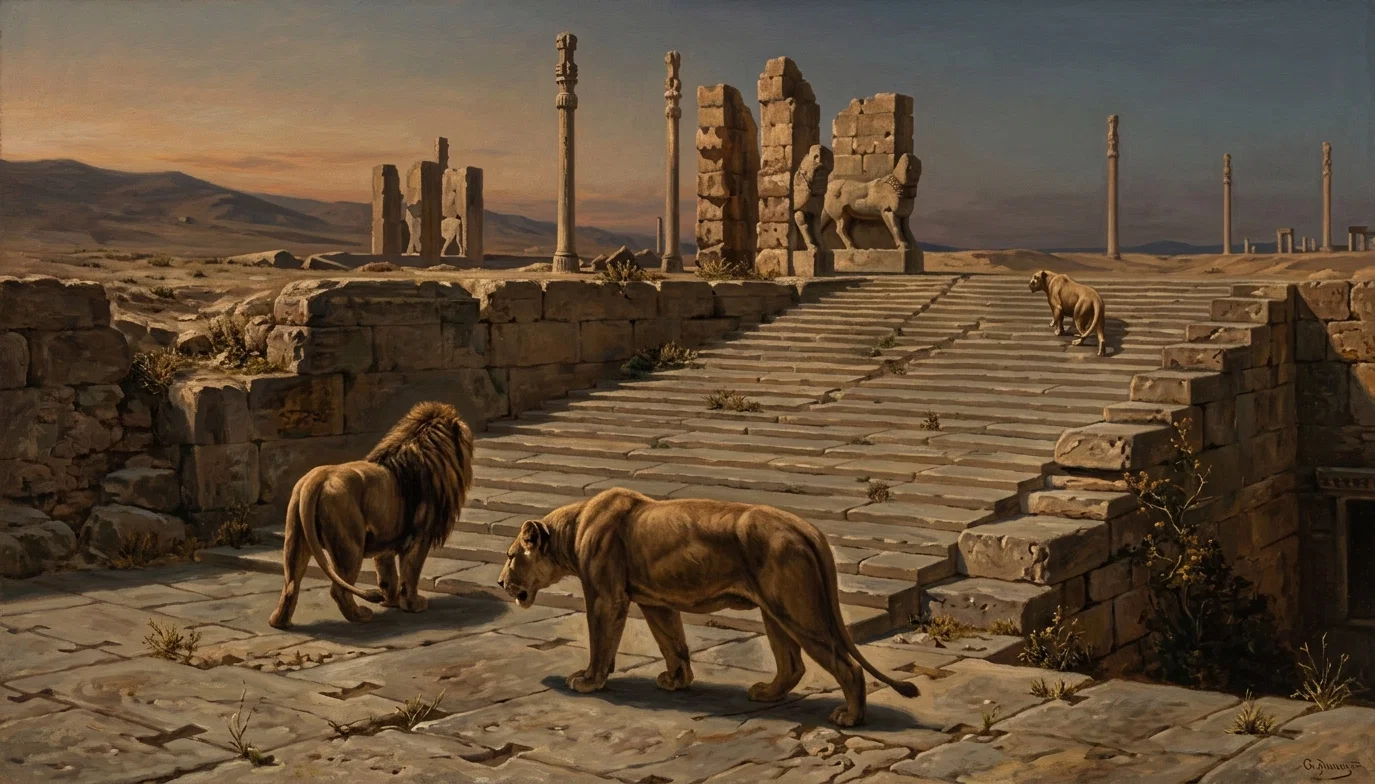
God has ever sought to bind all His creatures to Himself in the bonds of love. Satan has ever sought to deceive man into believing that God is cruel and arbitrary, and so to lead man to set up standards for himself and mark out ways diverse from the ways of God. And the latter has been the way of all the earth; “for all have sinned,” and sin has ever brought forth death, destruction, and desolation. This is manifest in all the ruined men, ruined nations, ruined cities of past time. A good illustration of the result of this departure from God is shown in our illustration, the ruins of Persepolis. Where once men roamed and ruled, ate and drank, ran hither and thither on business or pleasure bent, wild beasts of prey now prowl among its ruins, or lie in wait for victims. God's prophecy against Idumea of old is true of all who rebel against God. He shall stretch out upon it “the line of confusion and the stones of emptiness. They shall call the nobles thereof to the kingdom, but none shall be there, and all her princes shall be nothing. And thorns shall come up in her palaces, nettles and brambles in the fortresses thereof; and it shall be a habitation of dragons, and a court for owls.”
The hope of the world is to turn to God. He is One. One with God is existence to all eternity. Apart from God is utter non-existence, utter ruin, and utter desolation. Why not be one with God when it can be done simply by yielding to Him? X.
CHRIST GLORIFIED.
By Ellen G. White
“These words spake Jesus, and lifted up His eyes to heaven, and said, Father, the hour is come; glorify Thy Son, that Thy Son also may glorify Thee. As Thou hast given Him power over all flesh, that He should give eternal life to as many as Thou hast given Him. And this is life eternal, that they might know Thee, the only true God, and Jesus Christ, whom Thou hast sent. I have glorified Thee on the earth; I have finished the work which Thou gavest Me to do. And now, O Father, glorify Thou Me with Thine own self with the glory which I had with Thee before the world was.”
This is a plain statement of the pre-existence of Christ. Had He not had an existence before He assumed human nature, how could He possess glory with the Father before the world was? This is a grand theme for all to contemplate2who are searching for truth. The Holy Spirit will be beside all such, to present to them the glory of this wonderful truth. O, that the human mind might be strengthened that it might comprehend the glory of the Redeemer!
Christ is not praying for the manifestation of the glory of human nature; for that human nature never had an existence in His pre-existence. He is praying to His Father in regard to a glory possessed in His oneness with God. His prayer is that of a mediator; the favor He entreats is the manifestation of that divine glory which was possessed by Him when He was one with God. Let the vail be removed, He says, and let My glory shine forth,—the glory which I had with Thee before the world was.
Christ defines the manner in which He has glorified the Father: “I have manifested Thy name unto the men which Thou gavest Me out of the world; Thine they were, and Thou gavest them Me; and they have kept Thy Word. Now they have known that all things whatsoever Thou hast given Me are of Thee.”
How did the Father answer Christ’s prayer?—For a period of time Christ was on probation. He took humanity on Himself, to stand the test and trial which the first Adam failed to endure. Had He failed in His test and trial, He would have been disobedient to the voice of God, and the world would have been lost.
Satan has asserted that men could not keep the commandments of God. To prove that they could, Christ became a man, and lived a life of perfect obedience, an evidence to sinful human beings, to the worlds unfallen, and to the heavenly angels, that man could keep God’s law through the divine power that is abundantly provided for all that believe. In order to reveal God to the world, to demonstrate as true that which Satan has denied, Christ volunteered to take humanity, and in His power, humanity can obey God. “As many as received Him, to them gave He power to become the sons of God.” All heaven is Christ’s to give to the world.
Christ emptied Himself of His honored position in the heavenly courts. He became a man of sorrows and acquainted with grief. He was, as we are, subject to the enemy’s temptations. Satan exulted when Christ became a human being, and he compassed His path with every conceivable temptation. Human weakness and tears were His portion; but He sought unto God, praying with His whole soul, with strong crying and tears; and He was heard in that He feared. The subtlety of the enemy could not ensnare Him while He made God His trust, and was obedient to His words. “The prince of this world cometh,” He said, “and hath nothing in Me.” He can find nothing in Me which responds to his sophistry.
Amid impurity, Christ maintained His purity. Satan could not stain or corrupt it. His character revealed a perfect hatred for sin. It was His holiness that stirred against Him all the passion of a profligate world; for by His perfect life He threw upon the world a perpetual reproach, and made manifest the contrast between transgression and the pure, spotless righteousness of One that knew no sin. This heavenly purity annoyed the apostate foe as nothing else could do, and he followed Christ day by day, using in his work the people that claimed to have a superior purity and knowledge of God, putting into their hearts a spirit of hatred against Christ, and tempting His disciples to betray and forsake Him.
Christ was buffeted with temptations, and convulsed with agony. He was lacerated with stripes, crowned with thorns, and crucified. The fallen foe, once exalted to heaven, bruised Christ’s heel, but this was all he could do. While engaged in doing despite to Christ, his head was being bruised. While enduring the contradiction of sinners against Himself, Christ was filled with sorrow and anguish. This was represented as the bruising of His heel. A pain, heavier than ever oppressed another, was weighing down His humanity.
But although Christ’s divine glory was for a time vailed and eclipsed by His assuming humanity, yet He did not cease to be God when He became man. The human did not take the place of the divine, nor the divine of the human. This is the mystery of godliness. The two expressions human and divine were, in Christ, closely and inseparably one, and yet they had a distinct individuality. Though Christ humbled Himself to become man, the Godhead was still His own. His Deity could not be lost while He stood faithful and true to His loyalty. Surrounded with sorrow, suffering, and moral pollution, despised and rejected by the people to whom had been intrusted the oracles of heaven, Jesus could yet speak of Himself as the Son of man in heaven. He was ready to take once more His divine glory when His work on earth was done.
There were occasions when Jesus stood forth while in human flesh as the Son of God. Divinity flashed through humanity, and was seen by the scoffing priests and rulers. Was it acknowledged?—Some acknowledged that He was the Christ, but the larger portion of those who upon these special occasions were forced to see that He was the Son of God, refused to receive Him. Their blindness corresponded to their determined resistance of conviction.
When Christ’s indwelling glory flashed forth, it was too intense for His pure and perfect humanity entirely to conceal. The scribes and Pharisees did not speak in acknowledgment of Him, but their enmity and hatred were baffled as His majesty shone forth. The truth, obscured as it was by a vail of humiliation, spoke to every heart with unmistakable evidence. This led to the words of Christ, “Ye know who I am.” Men and devils were compelled, by the shining forth of His glory, to confess, “Truly, this is the Son of God.” Thus God was revealed; thus Christ was glorified.
By raising Christ from the dead, the Father glorified His Son before the Roman guard, before the Satanic host, and before the heavenly universe. A mighty angel, clothed with the panoply of heaven, descended, scattering the darkness from his track, and, breaking the Roman seal, rolled back the stone from the sepulcher as if it had been a pebble, undoing in a moment the work that the enemy had done. The voice of God was heard, calling Christ from His prison-house. The Roman guard saw heavenly angels falling in reverence before Him whom they had crucified, and He proclaimed above the rent sepulcher of Joseph, “I am the resurrection and the life.” Can we be surprised that the soldiers fell as dead men to the earth?
Christ’s ascension to heaven, amid a cloud of heavenly angels, glorified Him. His concealed glory shone forth with all the brightness that mortal man could endure and live. He came to our world as a man; He ascended to His heavenly home as God. His human life was full of sorrow and grief, because of His cruel rejection by those He came to save; but men were permitted to see Him strengthened, to behold Him ascending in glory and triumph, surrounded by a convoy of angels. The same holy beings that announced His advent to the world were permitted to attend Him at His ascension, and to demand a triumphal entrance for the royal and glorified Being. “Lift up your heads, O ye gates,” they cry as they near the heavenly portals; “and be ye lift up, ye everlasting doors; and the King of glory shall come in.” The angels at the gates respond in lofty strain, “Who is this King of glory?” And from thousands and ten thousands of voices the answer comes: “The Lord strong and mighty, the Lord mighty in battle. Lift up your heads, O ye gates; even lift them up, ye everlasting doors; and the King of glory shall come in.” Again the angels at the gates cry, “Who is this King of glory?” and again the response swells triumphantly upward, “The Lord of hosts, He is the King of glory.”
Thus the prayer of Christ was answered. He was glorified with the glory which He had with His Father before the world was. But amid this glory, Christ does not lose sight of His toiling, struggling ones upon earth. He has a request to make of His Father. He waves back the heavenly host until He is in the direct presence of Jehovah, and then He presents His petition in behalf of His chosen ones. “Father,” He says, “I will that they also, whom Thou hast given Me, be with Me where I am.” And then the Father declares, “Let all the angels of God worship Him.” The heavenly host prostrate themselves before Him, and raise their song of triumph and joy. Glory encircles the King of heaven, and was beheld by all the heavenly intelligences. No words can describe the scene which took place as the Son of God was publicly reinstated in the place of honor and glory which He voluntarily left when He became a man.
And to-day Christ, glorified, and yet our Brother, is our Advocate in the courts of heaven. “In all things it behooved Him to be made like unto His brethren, that He might be a merciful and faithful high priest in things pertaining to God, to make reconciliation for the sins of the people.” “We have not an high priest which can not be touched with the feeling of our infirmities; but was in all points tempted like as we are, yet without sin.” “For in that He Himself hath suffered being tempted, He is able to succor them that are tempted.” “Let us therefore come boldly unto the throne of grace, that we may obtain mercy, and find grace to help in time of need.”
Mrs. E. G. WHITE.
Christ's Training of Unlearned Fishermen
JESUS chose unlearned fishermen because they had not been schooled in the traditions and erroneous customs of their time. They were men of native ability, and they were humble and teachable,—men whom He could educate for His work. In the common walks of life there is many a man patiently treading the round of daily toil, unconscious that he possesses powers which, if called into action, would raise him to an equality with the world's most honored men. The touch of a skilful hand is needed to arouse those dormant faculties. It was such men that Jesus called to be His co-laborers; and He gave them the advantage of association with Himself. Never had the world's great men such a teacher. When the disciples came forth from the Saviour's training, they were no longer ignorant and uncultured. They had become like Him in mind and character, and men took knowledge of them that they had been with Jesus.—Desire of Ages.
Fire of God's Holiness Needs Time in Fellowship
By Rev. Andrew Murray
I MAY put a poker in the fire twenty times in the course of the day and leave it there two or three minutes each time and it never will be thoroughly heated. If you are to get the fire of God’s holiness and love and power burning in your heart, you must take more time in His fellowship.—Rev. Andrew Murray.
WIRELESS TELEGRAPHY.
By C. M. Snow
GALILEO, as early as 1632, discovered the principle of communication by electricity between widely-separated points. The action of the magnet upon a steel needle was the key to the discovery. In 1753 an Englishman suggested a method of conveying intelligence by electric currents through twenty-six wires, one for each letter of the alphabet. In 1837 Prof. S. F. B. Morse invented the telegraph instrument, and what is now known as the Morse alphabet. It was not until 1843, however, that he succeeded in obtaining from the government the aid necessary to enable him to construct and operate the first telegraph line in the world.
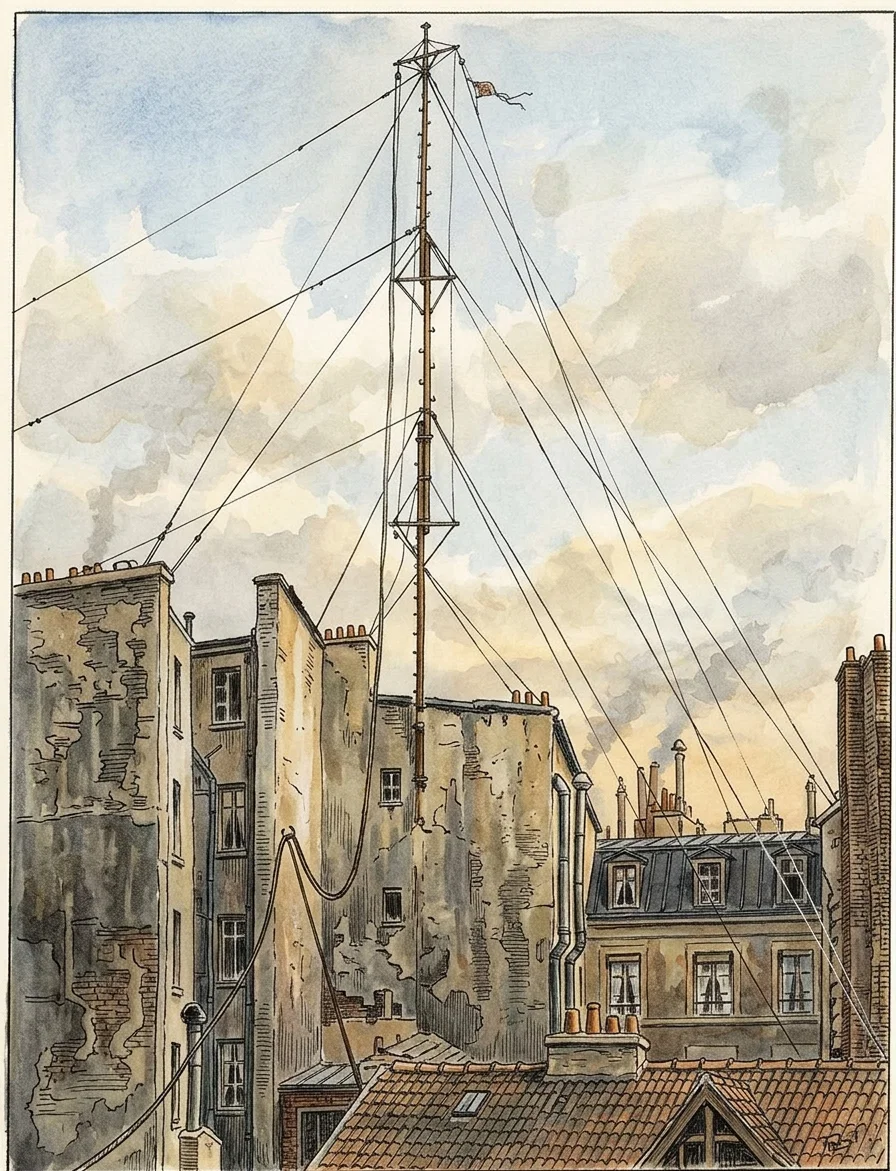
The Mast of a Wireless Telegraph Station Carrying the Wire Called the “Vertical Conductor,” from which the Messages Leap off into Space.
Since that time great advancement has been made in telegraphic communication, until the whole world is bound about or interwoven with a mesh of electric nerves. Let the finger of famine pinch Australia, and England knows it—feels it—without the lapse of time. Let the sword of the rioter fall in China, and the whole world is a-quiver with the sensation. It took the news of the battle of New Orleans three weeks to cover the distance between Louisiana and Maine. To-day we read of battles on the opposite side of the globe before the smell of the gunpowder has risen from the field, or the litters have dropped their bleeding burdens under the shelter of the hospital tent.
This is not all: where one message was formerly sent along one wire, now eight are being sent and received over the same wire at the same time. The carrying capacity of the electric wire is not limited to the transportation of dots and dashes, but has adapted itself to the faithful reproduction of the human voice, with its infinite variety of modulation; and, stranger than this, it is possible for the speaker and listener to see each other while they converse through hundreds of miles of wire stretched above the earth or under the sea. The hand-written telegram, produced at the rate of twenty-five or thirty words a minute, is being superseded by that produced upon the typewriter; that in turn gives place to a device which sends and receives over the wire, in printed form, two hundred words per minute. Scarcely has the latter been given a fair trial of its ability, before a device is patented and put in operation which will send matter over the wire at the rate of three thousand words per minute.
Now that the capacity of the copper wire has about been exhausted, the bold inventor discards it, and sends his messages quivering through the air. Perhaps the first step in wireless telegraphy was the invention of an apparatus by which messages could be sent and received from a moving railway train. The instrument would attract messages from the wires along the railroad or transmit messages to them; but the telegraph companies, fearing what this invention would enable one to do in the way of “wire tapping,” purchased the inventor’s patent rights for a large sum, and smothered the invention.
But the blocking of this step is a mere incident in the progress of long-distance communication. In 1842 Joseph Henry, of Washington, D. C., made the discovery that an electric spark in one room of his house could induce electrical activity in a wire circuit in another room without any connecting wires whatever. In 1888 the term “electric waves” was applied to this phenomenon by Hertz, a German inventor, who had spent much time in experiments along this line. Other scientists, foremost among whom is Dr. Bose, a Hindu, have been experimenting with this peculiar property of electricity; but Guglielmo Marconi, a young Italian of twenty-five years, has outstripped them all in turning the discovery to practical account.
The electric waves travel outward in widening circles from the instrument which produces them, as ripples on the water travel outward from the place where a stone strikes its surface. Young Marconi has invented a delicate instrument which picks up these waves and is agitated by them as the strings of a piano will pick up and reproduce a note struck on another instrument tuned to the same pitch. Thus the dots and dashes produced on the instrument which generates the waves are taken up and reproduced electrically in the delicate instrument constructed to receive them. As no wire connects the sender and receiver, this achievement is known as wireless telegraphy.
The Sending Instrument of a Wireless Telegraph Station. M is the Sending Key; I, the Motor Driving the Interrupter of the Coil, B₀; P₁, the Connection with the Mast; O, the Oscillator; and i, the Connection with the Earth.
Signor Marconi has had his system of wireless telegraphy in practical operation off the coast of England for several months, between the South Foreland lighthouse and the East Goodwin light-ship, a distance of twelve miles, while successful experiments were being conducted on land between stations eighteen miles apart. It is, however, within the past few weeks that the success has been attained which gives this system a real practical standing in the world. Marconi had been seeking for some time for permission to make the attempt to establish communication between the coasts of France and England, a distance of thirty-two miles across the English Channel. The permission was granted after much hesitancy, and stations were erected at Folkestone, England, and Boulogne, France. Messages were sent back and forth to the entire satisfaction of the experimenters, and apparently with as much ease as tho transmitted by wire under the channel instead of through the air above it.
The apparatus by which this wonderful achievement is accomplished is more simple in construction than would be expected of such a wonder-working instrument, and very little material is required for equipping a working station. Each station is provided with a sending instrument and a receiver, and from these a wire is carried to the top of a flag-staff, tower, tall building, or lighthouse. From this wire, or “vertical conductor,” the wave message leaps off into space, to be caught up by the receiver ten, twenty, or a hundred miles away.
The Receiving Instrument of a Wireless Telegraph Station. The Dots and Dashes Are Registered on the Tape as Shown in the Cut.
From a tower eighty feet high messages are sent and received eighteen miles away. In the recent successful test of the system across the English Channel a “vertical conductor” 114 feet high was used. Tho the stations in this experiment were thirty-two miles apart, Marconi claims that with this height of conductor he can send messages forty miles.
It requires no stretch of the imagination to realize what the perfection of this system means. It is claimed that messages will soon be sent from continent to continent and from island to island by means of wireless telegraphy; that it will enable vessels at sea to detect the approach or proximity of other vessels in a fog, and thus avoid collisions, as well as to communicate with vessels in passing; and military men of the different nations are already preparing to utilize it in the operation of their armies. The old telegraph system, with its thousands of miles of wire stretched over the earth and its thousands of leagues of cable lying in the slime of the ocean bed, will then be a thing of the past, and the news of the world will be transmitted on electric waves and picked up on delicate electrical receivers in every part of the earth. C. M. SNOW.
Self-Renunciation Before Divine Calling: Isaiah and Peter
“It was after Isaiah had beheld the holiness of God and his own unworthiness, that he was intrusted with the divine message. It was after Peter had been led to self-renunciation and dependence upon divine power, that he received the call to his work for Christ.”
Advertising Business Without Saying So
By A. J. Gordon, D.D.
SOME clocks strike the hours and some tell the time of day only with their hands. So some Christians advertise their business, and others do it and say nothing about it.—A. J. Gordon, D.D.
ALTHOUGH we have studied the first three verses of the sixth chapter of Galatians, we will for the sake of the connection include them in the text for this week, and without further review begin the study.
“Brethren, if a man be overtaken in a fault, ye which are spiritual, restore such an one in the spirit of meekness; considering thyself, lest thou also be tempted. Bear ye one another’s burdens, and so fulfil the law of Christ. For if a man think himself to be something, when he is nothing, he deceiveth himself. But let every man prove his own work, and then shall he have rejoicing in himself alone, and not in another. For every man shall bear his own burden. Let him that is taught in the Word communicate unto Him that teacheth in all good things. Be not deceived; God is not mocked; for whatsoever a man soweth, that shall he also reap. For he that soweth to his flesh shall of the flesh reap corruption; but he that soweth to the Spirit shall of the Spirit reap life everlasting. And let us not be weary in well-doing; for in due season we shall reap, if we faint not. As we have therefore opportunity, let us do good unto all men, especially unto them who are of the household of faith.” Gal. 6: 1–10.
Burden-Bearing.
It can well be said that there is much in this portion of Scripture, as well as in others, which no one as yet understands, especially in verses 2 and 5, which seem to be directly contrary to each other. One says that we should bear one another’s burdens, and the other says that every one shall bear his own burden. Without speculating upon what we do not know, we can find abundance of instruction in what is evident. Each one must have the Spirit of Christ, which is that of burden-bearing. He devoted His life to the service of others. But His own burdens He carried to God. He did not ask others to carry them for Him. Even so it should be with us. If every one in the house of God, to say nothing of the world, acted according to this plan, how easy it would be to get on! There would really be no burdens for any one to bear. Each one thoughtful only of others, studying their burdens, that he might help them, would find his own burdens carried in turn by others. The only burden that any one would then carry would be Christ’s burden, which He calls us to take, because it is light. Let us learn of Christ, who bore the burden of the world, and asked none to share it with Him; yet He found it easy and light. When we try to unload our burdens on others, we are always in trouble, always heavy-laden; but when we are wholly devoted to bearing the burdens of others, we find them light.
Communicating Good Things.
“Let him that is taught in the Word communicate unto him that teacheth in all good things.” There can be no doubt but that this refers primarily to temporal support. “The laborer is worthy of his hire.” If a man gives himself wholly to the ministry of the Word, it is evident that the things necessary for his sustenance must come from those who are taught. But this by no means exhausts the meaning of the injunction. The one who is taught in the Word must communicate to the teacher “in all good things.” Mutual help is the burden of this chapter. “Bear ye one another’s burdens.” Even the teacher who is supported by those who are taught, is to assist others pecuniarily. Christ and the apostles, who had nothing of their own—for Christ was the poorest of the poor, and the disciples had left all to follow Him—nevertheless distributed to the poor out of their little store. See John 13: 29. As the teachers contribute not only the Word but temporal support as well, so those who are taught in the Word should not confine their liberality merely to temporal things. It is a mistake to suppose that ministers of the Gospel never stand in need of spiritual refreshment, or that they can not receive it from the weakest in the flock. No one can ever tell how much the souls of teachers are encouraged by the testimonies of faith and joy in the Lord, which come from the mouths of those who have heard the Word. It is not simply that the teacher sees that his labor is not in vain; the testimony may have no reference whatever to anything that he has done; but a humble soul’s joyful testimony to what God has done for him, will often, through the refreshment it gives the teacher of the Word, be the means of strengthening the souls of hundreds.
Sowing and Reaping.
“Whatsoever a man soweth, that shall he also reap.” A simple statement of fact that can not be made plainer by any amount of talk. The harvest, which is the end of the world, will reveal what the sowing has been, whether wheat or tares. Verse 8 is so plain and striking a statement that comments only weaken its force. “He that soweth to his flesh shall of the flesh reap corruption; but he that soweth to the Spirit shall of the Spirit reap life everlasting.” “Sow to yourselves in righteousness, reap in mercy; break up your fallow ground; for it is time to seek the Lord, till He come and rain righteousness upon you.” Hosea 10: 12. “He that trusteth in his own heart is a fool,” and equally foolish is he who trusts in other men, as is seen from the next verse: “Ye have plowed wickedness, ye have reaped iniquity; ye have eaten the fruit of lies; because thou didst trust in thy way, in the multitude of thy mighty men.” “Cursed be the man that trusteth in man, and maketh flesh his arm,” whether it be his own flesh or that of some other man. “Blessed is the man that trusteth in the Lord, and whose hope the Lord is.” Jer. 17: 5, 7.
Faint Not.
“In the morning sow thy seed, and in the evening withhold not thine hand; for thou knowest not whether shall prosper, either this or that, or whether they both shall be alike good.” Eccl. 11: 6. This is the thing that is taught in verse 9. We can not tell how much we shall reap, nor from which of the seed that we sow. Some may fall by the wayside, and be snatched away before it has time to take root; and other may fall on stony ground, where it will wither; and still other may fall among thorns, and be choked; but one thing is certain, and that is that we shall reap. Notice the statement in Ecclesiastes: We do not know whether the morning sowing or the evening sowing will prosper, or whether both shall alike be good. There is no possibility that both can be bad. One or the other alone may prosper, or else both may be good. Isn’t that encouragement enough for us not to be weary in well-doing? The ground may seem poor, and the season may not be favorable, so that the prospect for a crop may be most unpromising, and we may be tempted to think that all our labor is wasted. Not so; “in due season we shall reap, if we faint not.” “Therefore, my beloved brethren, be ye steadfast, unmovable, always abounding in the work of the Lord, forasmuch as ye know that your labor is not in vain in the Lord.” 1 Cor. 15: 58.
Make No Difference.
“As we have therefore opportunity, let us do good unto all men, especially unto them who are of the household of faith.” In this we see that the apostle speaks of temporal help, for it needs no special exhortation to preach the Word to those who are not of the household of faith; they are the ones to whom it is specially to be preached; but there is a natural tendency—natural, I say, not spiritual—to limit charities to those who are called “deserving.” We hear much about “the worthy poor.” But we are all unworthy of the least of God’s blessings, yet He showers them upon us continually. “If ye do good to them which do good to you, what thank have ye? for sinners also do even the same. And if ye lend to them of whom ye hope to receive, what thank have ye? for sinners also lend to sinners, to receive as much again. But love ye your enemies, and do good, and lend, hoping for nothing again; and your reward shall be great, and ye shall be the children of the Highest; for He is kind unto the unthankful and to the evil.” Luke 6: 33–35. The most of Christ’s ministry on earth was among those who cared nothing for Him personally. In some instances they would not even take the trouble to say, “Thank you,” for the greatest favors bestowed; but that made no difference with Him. He gave just as freely of what He had to give. Let us learn more of Him, that we may “fulfil the law of Christ.”
Seek the Opportunity.
Note especially the beginning of the tenth verse. “As we have therefore opportunity,” let us do good unto all men. Doing good to others is to be considered a privilege to be enjoyed, and not an irksome duty to be discharged. Men do not speak of disagreeable things as opportunities. No one says that he had an opportunity to injure himself, or that he had an opportunity to lose some money. On the contrary, a man will speak of an opportunity to make some money, or to escape from some threatened danger. It is thus that we are to consider doing good to the needy. But opportunities are always sought for. Men are always on the lookout for an opportunity to get gain. So the apostle teaches us that we should be seeking opportunities to help some one. This Christ did. He “went about doing good.” He traveled about the country on foot, a tramp, if you please, but a glorious one. He was searching opportunities to do somebody some good, and He found them. He did good, “for God was with Him.” His name is Immanuel, which means “God with us.” Now as He is with us all the days, even to the end of the world, so God is with us, doing good to us, that we also may do good. “We then as workers together with Him, beseech you that ye receive not the grace of God in vain.” To this end, “receive ye the Holy Ghost.” E. J. WAGGONER.
Let the Wicked Forsake His Way
“LET the wicked forsake his way, and the unrighteous man his thoughts; and let him return unto the Lord, and He will have mercy upon him; and to our God, for He will abundantly pardon.”
Perfect Peace Through Trust in the Lord
“Thou wilt keep him in perfect peace, whose mind is stayed on Thee: because he trusteth in Thee. Trust ye in the Lord forever; for in the Lord JEHOVAH is everlasting strength.”