“From the going forth of the commandment to restore and to build Jerusalem.” Dan. 9:25.
This was to be the starting-point of the long prophetic measuring line of the 70 weeks (or 490 years) and of the 2300 years. Events of such eternal import are marked out by the time prophecies depending upon this date, that what otherwise might seem a tedious review of facts and figures becomes a study of deepest interest. Once the starting-point is fixed, the events foretold must be seen following one another, scheduled exactly to the great time-table of divine prophecy.
There were successive decrees concerning Jerusalem, issued by Cyrus, and Darius, and Artaxerxes Longimanus. Which one does the scripture contemplate as “the commandment”? The decree of Artaxerxes to Ezra (Ezra 7) is the one we would naturally look upon as the most comprehensive; for it authorized Ezra to restore the full ecclesiastical and civil administration of Jerusalem and Judah. And the scripture clearly indicates10this as “the commandment to restore and to build.”
In a single passage, Inspiration notes the decrees of Cyrus and Darius, and sums up both with this decree of Artaxerxes to Ezra, as constituting “the commandment”:—
“And they builded, and finished it [the temple], according to the commandment of the God of Israel, and according to the commandment of Cyrus, and Darius, and Artaxerxes king of Persia.” Ezra 6:14.
Thus it is spoken of as one threefold commandment, completed in the sweeping and inclusive commission to Ezra. Here, then, was the “going forth of the commandment to restore and to build.” And this decree to Ezra was put into execution in the seventh year of Artaxerxes. Ezra 7:7-9. This was in the year 457 B. C., as must now be shown.
Fig. 1 Alexander's Succession
This date of the seventh year—so important to ascertain—is fixed by the combined record of sacred and profane history with uncommon accuracy.
One witness is the canon of Ptolemy, the great authority on the chronology of ancient kings. Claudius Ptolemy, mathematician, astronomer, and geographer, dwelt in Alexandria, Egypt. He was born in the first century of our era, and died about the year 151 A. D. Alexandria was the great educational center, the home of wonderful library collections. From the records of ancient times Ptolemy compiled a chronological list of the kings of the great universal empires.
Thus his list of kings is a canon (rule, or standard) of ancient chronology, of the greatest value. He began with Nabonassar, of the Assyro-Babylonian line, 747 B. C., and continued the list of his successors to the fall of Babylon; then followed the Persian, Grecian, and Roman lists, to the second century after Christ, when Ptolemy died and his record ceased.
That line of kings in Ptolemy’s list—Babylon, Persia, Greece, Rome—is a striking comment, as a number of writers remark, on Nebuchadnezzar’s dream of the great metallic image, representing the four universal kingdoms.
When Ptolemy, in his quarters in the temple of Serapis, made up his list of empires and their kingly line, in the second century of our era, he unconsciously bore witness to the fulfilment of the prophecy uttered by Daniel, in Babylon, in the sixth century before Christ, when the prophet said to the king, “There is a God in heaven that revealeth secrets, and maketh known to the King Nebuchadnezzar what shall be in the latter days.” Dan. 2:28.
Along with his list of kings, Ptolemy compiled also a record of ancient astronomical observations, called the “Almagest” (an Arabic word meaning “great composition”). This “contains most of what is known of the astronomical observations and theories of the ancients.” —Webster’s Dictionary, “Almagest.” When it is recorded that in such and such a year of a certain king, at such a place, an eclipse of the sun or moon occurred, the modern astronomer and mathematician can verify the chronological record.
Thus the canon and the “Almagest” go together. Dr. Wm. Hales, the chronologist, said of the canon:—
From its great use as an astronomical era, confirmed by unerring characters of eclipses, this canon justly obtained the highest authority among historians also. It has most deservedly been esteemed an invaluable treasure, . . . and of the greatest use in chronology, without which, as Marsham observes, there could scarcely be any transition from sacred to profane history.—“Chronology,” Vol. I, page 280.
So we thank God for the work of Ptolemy, as a help in tracing the fulfilling word of prophecy. Speaking of the providences of God in the preservation of historical records, the late Dr. H. Grattan Guinness, of London, wrote of Ptolemy’s work as follows:—
In the existence of this invaluable work, and in its preservation as a precious remnant of antiquity, the hand of Providence can clearly be traced. The same divine care which raised up Herodotus and other Greek historians to carry on the records of the past from the point to which they had been brought by the writings of the prophets at the close of the Babylonish captivity,—the Providence which raised up Josephus, the Jewish historian, at the termination of the New Testament history, to record the fulfilment of prophecy in the destruction of Jerusalem,—raised up also Ptolemy in the important interval which extended from Titus to Hadrian, that of the completion of the Jewish desolation, to record the chronology of the previous nine centuries, and to associate it in such a way with the revolutions of the solar system as to permit of the most searching demonstration of its truth.—“Creation Centered in Christ,” Vol. I, page 292.
Now, what is the testimony of the canon to the seventh year of Artaxerxes Longimanus, when the decree to Ezra was issued. That day was the Egyptian thoth, or New-year. It begins the year one of Ptolemy’s Canon, which thenceforward numbers off the years, one, two, three, etc., straight on through history, telling in what year of Nabonassar’s era each king began to reign, always counting from New-year to New-year. The canon does not deal with parts of years. It is like a rigid measuring rule, just three hundred sixty-five days long, laid down over history, marking the years and numbering them from that first New-year. Knowing the starting-point, Feb. 26, 747 B. C., it is but a matter of computation, or measuring, to tell in what year of our reckoning a given year of the canon falls.
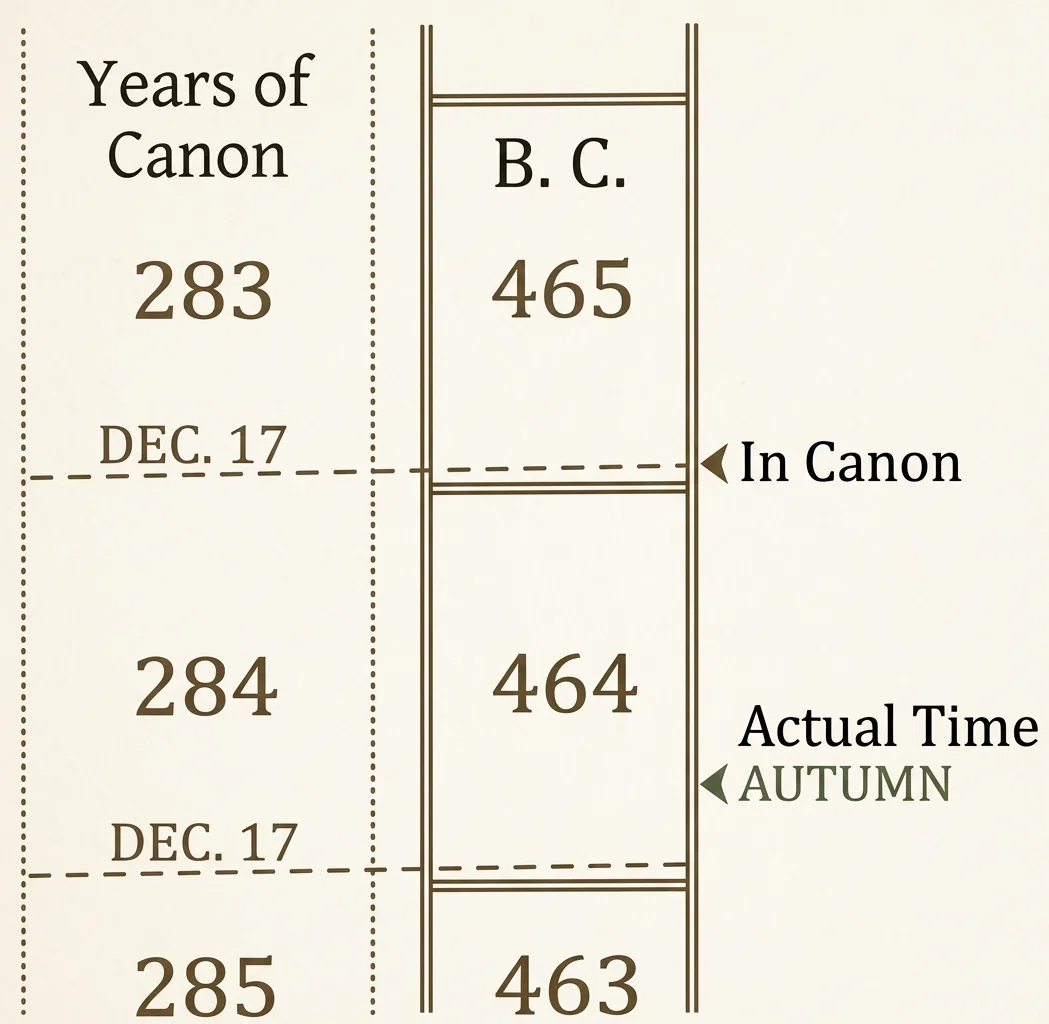
According to Ptolemy, the year in which Artaxerxes began to reign was the 284th year of the canon. This year 284, according to our calendar, began Dec. 17, 465 B. C.
But according to the rule of the canon, this means only that somewhere between Dec. 17, 465, and Dec. 17, 464, the king came to the throne. At whatever time in the year a king came to the throne, his reign was counted from the New-year preceding. To illustrate: If we were following that plan now of recording the reigns of kings,—by years only, not counting parts of years,—and a king should come to the throne in July, 1912, the year of his accession would be set down as beginning with the New-year, Jan. 1, 1912, for in the year then opening he began to reign.
That was Ptolemy’s method. Dr. Hales states the rule:—
Each king’s reign begins at the Thoth, or New-year’s day, before his accession, and all the odd months of his last year are included in the first year of his successor.—“Chronology,” Vol. I, page 285.
He cites the following proofs of the rule (which we will illustrate by diagrams):—
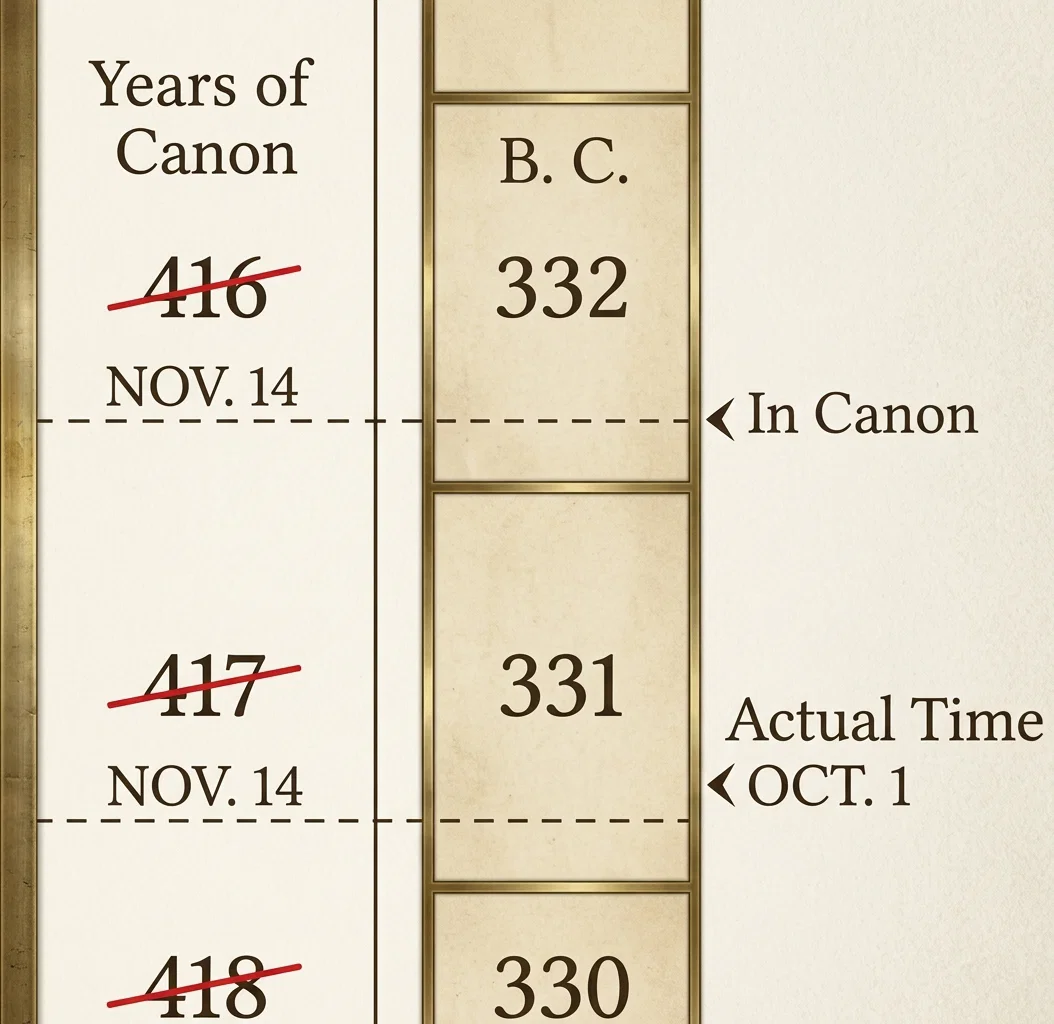
Thus, the actual accession of Alexander the Great was at the decisive victory of Arbela, Oct. 1, B. C. 331; but his reign in the canon began the preceding New-year’s day of the same current Nabonassean year, Nov. 14, B. C. 332. [See Fig. 1.]
The death of Alexander the Great was in the 114th Olympiad, according to Josephus, May 22, B. C. 323; but the era of his successor, Philip Arrhidæus, began in the canon the preceding New-year’s day, Nov. 12, B. C. 324. [See Fig. 2.]
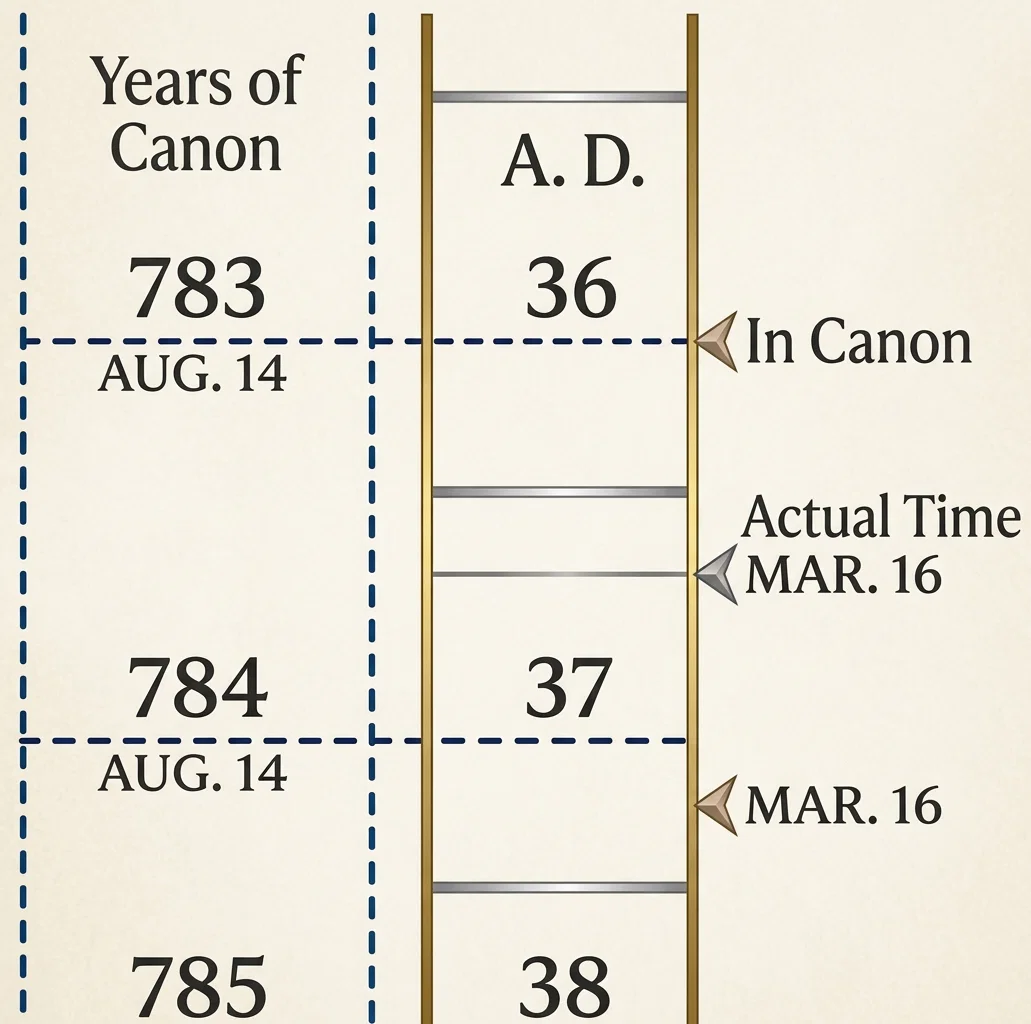
Tiberius died March 16, A. D. 37, but the reign of his successor, Caius Caligula, began in the canon from the preceding New-year’s day, Aug. 14, A. D. 36. [See Fig. 3.]
Therefore, inasmuch as the canon shows only that Artaxerxes began his reign sometime in the Nabonassean year beginning Dec. 17, 465 B. C., and ending Dec. 17, 464, the question is, At what time of the year did he come to the throne?
With this answered, we can readily determine the seventh year of Artaxerxes, as the scripture would reckon it from the time when he actually began to reign. And here Inspiration itself gives the answer.
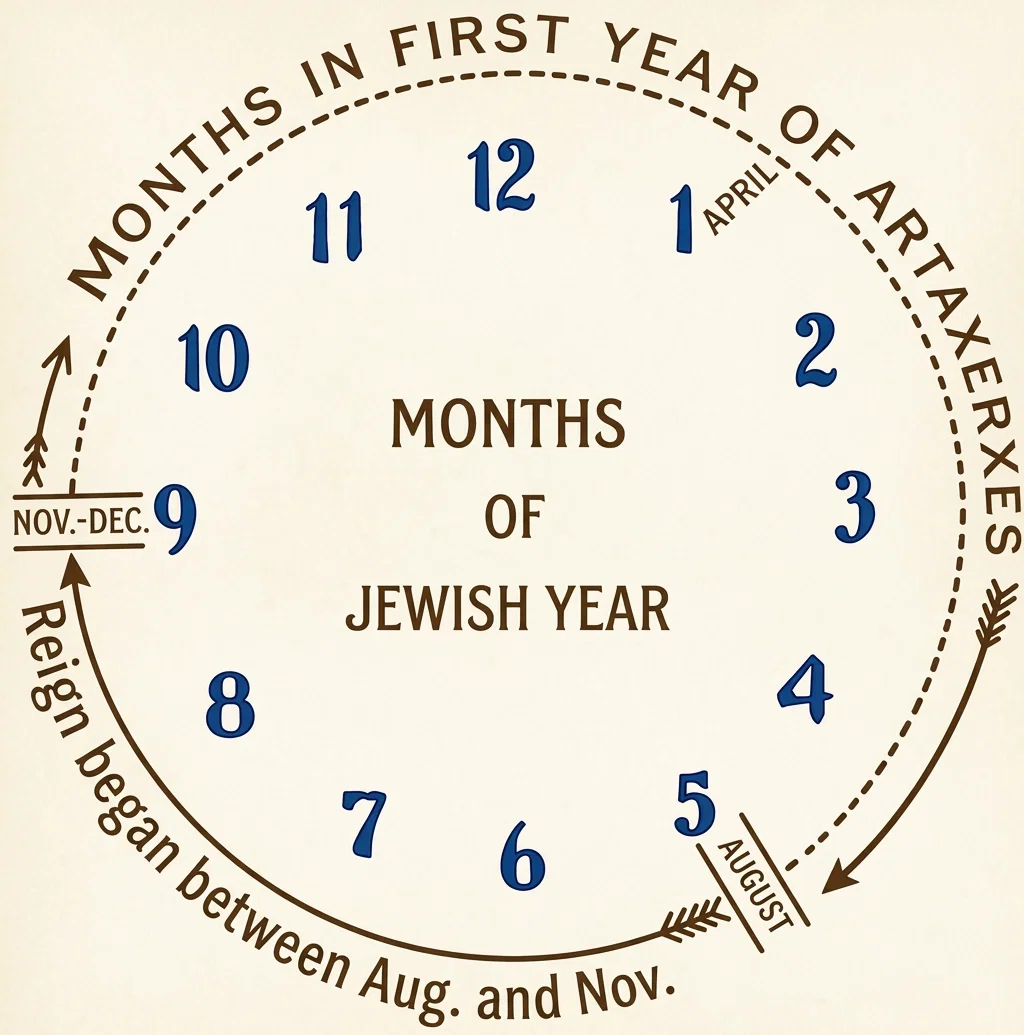
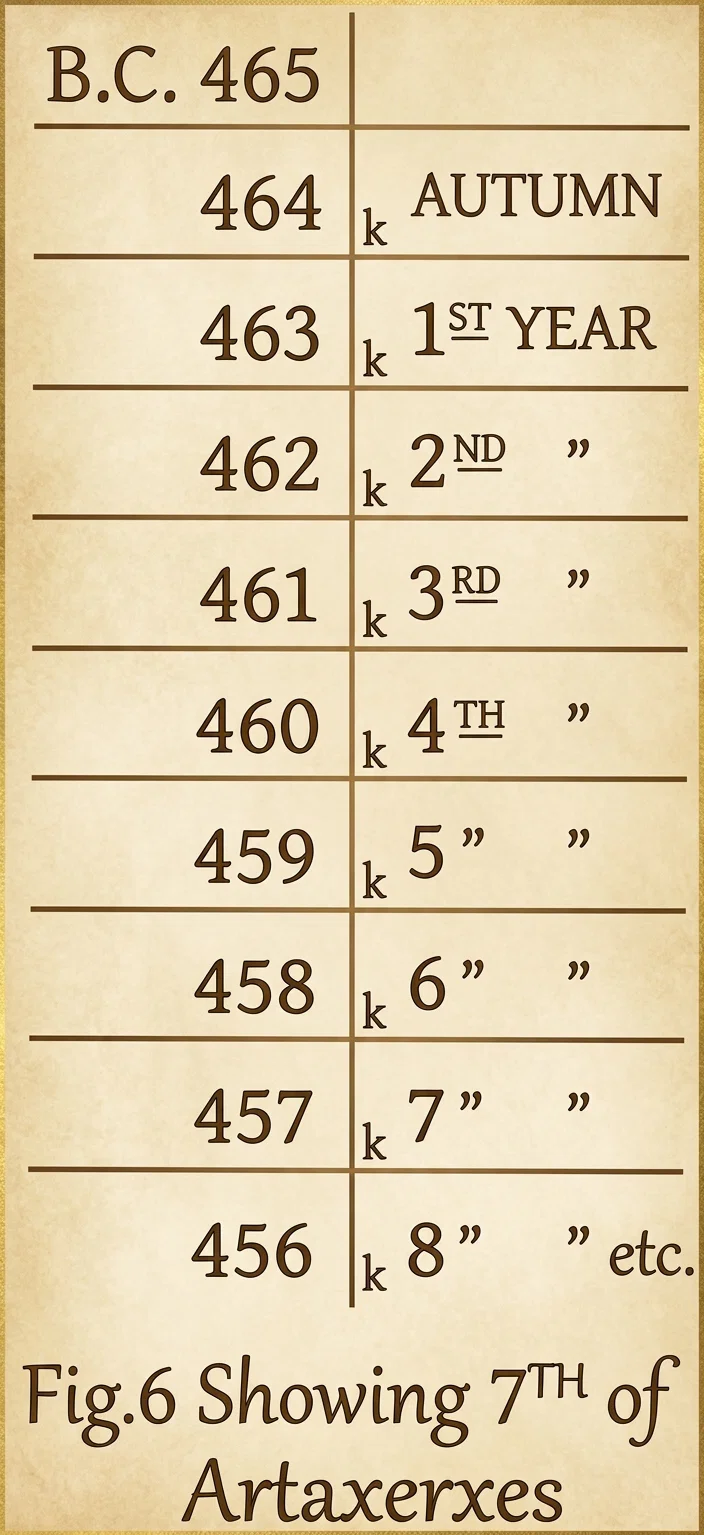
The record of Nehemiah and Ezra fully establishes the fact that Artaxerxes began his reign at the end of the summer, or in the autumn. Neh. 1:1; 2:1; Ezra 7:7-9. His first year, therefore, was from the autumn of 464 B. C. to the autumn of 463 B. C. (Fig. 4), and his seventh year was from the autumn of 458 B. C. to the autumn of 457 B. C. (Fig. 6.)
Under Ezra’s commission the people began to go up to Jerusalem in the spring of that year, 457 B. C. (in the first month, or April), and they “came to Jerusalem in the fifth month” (August). Ezra 7:8, 9. Ezra and his associates soon thereafter “delivered the king’s commissions unto the king’s lieutenants, and to the governors on this side the river: and they furthered the people, and the house of God.” Ezra 8:36.
With this delivery of the commissions to the king’s officers, the commandment to restore and to build had fully gone forth.
And from this date, 457 B. C., extends the 70 weeks, or 490 years, allotted to the Jewish people. “Seventy weeks are determined [cut off] upon thy people and upon thy holy city . . . from the going forth of the commandment to restore and to build Jerusalem.” Dan. 9:24, 25.
This 490-year period, measuring from 457 B. C. to A. D. 34, touches at its close the years of the public ministry and crucifixion of Christ, and the turning of the apostles to the Gentiles.
Fig. 3 Caligula's Succession
At the same date, 457 B. C., necessarily began the longer period of 2300 years, from which the shorter period was “determined,” or cut off. And this long prophetic period was to reach to “the time of the end,” to “the cleansing of the sanctuary,” the beginning of the closing ministry of Christ in the heavenly sanctuary, preparatory to his second coming in glory.
That year 457 B. C., therefore, is a date of profound importance. It stands like the golden mile-stone by the ancient arch of Severus at Rome, from which ran out all the measurements of distance to the ends of the empire. From this date, 457 B. C., run out the golden threads of time prophecy that touch the events in the earthly life and the heavenly ministry of Jesus that are of deepest eternal interest to all mankind to-day.
W. A. S.
Fig. 4 Artaxerxes's Succession
Fig. 5 Showing time of year of Artaxerxes's Accession
Fig. 6 Showing 7th of Artaxerxes
The Christian and the Law of God
By C. M. S.
Let us look for a moment at the attitude which the Word of God teaches us to maintain toward the law of God. Antagonism toward the will and the commands of God has been synchronous with the history of sin. Sin and that antagonism began together, children of the same parent, traveling the same road, destined to reach the same goal; and whether that antagonism toward God's law is manifested by human beings or by fallen angels, it stands for disloyalty toward God and opposition to his purpose.
The writer of that wonderful treatise on the law of God, the one hundred nineteenth psalm, seems almost at a loss for words to express the fulness of his heart as he pours out his love for that law. Again and again he declares his love: “O how love I thy law! It is my meditation12all the day” (verse 97); “I delight in thy law” (verse 70). Throughout the psalm the words law, ordinances, judgments, statutes, and precepts are used interchangeably, to save repetition.
We can not say, as some have said, that while such an attitude was proper and necessary under the old dispensation, this law which the psalmist extols was abolished in Christ; for this same writer declares (verse 172): “All thy commandments are righteousness;” and again (verse 142): “Thy righteousness is an everlasting righteousness, and thy law is truth.” As the commandments are righteousness, and that righteousness is everlasting, how we fly in the face of truth and contradict God when we declare that these same commandments are abolished in Christ, or in any other way. As if foreseeing that this charge would be brought against him, Christ declares: “Think not that I came to destroy the law or the prophets: I came not to destroy, but to fulfil. For verily I say unto you, Till heaven and earth pass away, one jot or one tittle shall in no wise pass away from the law, till all things be accomplished.” Matt. 5: 17, 18.
That declaration of our Saviour certainly puts an end to all argument in the matter of the abolition of the law of God. It stands surer than the “eternal hills,” stronger than all the powers of earth and fallen angels, true as God himself is true, and as perpetual and unchangeable as he is.
In view of that fact, we turn again to the inspired writings of the prophets. Because that law is true and every one of its righteous commandments perpetual in duration, it furnishes the psalmist a theme for exultant song. He says: “Let my lips utter praise; for thou teachest me thy statutes. Let my tongue sing of thy word; for all thy commandments are righteousness.” Ps. 119: 171, 172.
There was not in his heart the spirit of hatred, so often manifest to-day toward that law. He says: “I love thy commandment above gold, yea, above fine gold” (verse 127); “The law of thy mouth is better unto me than thousands of gold and silver” (verse 72); “Unless thy law had been my delight, I should then have perished in mine affliction” (verse 92); “I have longed for thy salvation, O Jehovah; and thy law is my delight” (verse 174).
This psalm writer was not pleased, as many individuals are, to see the law of God transgressed, and its abolition taught. He says: “Thou hast rebuked the proud. Cursed are they that wander from thy commandments” (verse 21, margin); “Hot indignation [“horror,” margin] hath taken hold upon me, because of the wicked that forsake thy law” (verse 53); “It is time for Jehovah to work; for they have made void thy law” (verse 126); “Streams of water run down mine eyes, because they observe not thy law” (verse 136); “They draw nigh that follow after wickedness; they are far from thy law” (verse 150).
He not only refuses the suggestion that the law of God could be abolished, but declares that he knew it never could be abolished. “Of old have I known from thy testimonies, that thou hast founded them forever” (verse 152); “The sum of thy word is truth; and every one of thy righteous ordinances endureth forever” (verse 160). It is impossible to read these scriptures and believe them and at the same time believe in the abolition of the law of God. It is not taught here nor anywhere else in the divine Word.
But how is it with the lives of those who adhere to the law of God? Are they not filled with hardship, and discouragement, and sorrow?—Far from it. Listen to the psalmist, and then let us make his experience and this fact ours: “Great peace have they that love thy law; and they have no occasion of stumbling.” Verse 165. Why will they have no occasion?—Because, loving that law, they have made its precepts a constituent part of their character; and they have peace, great peace. The world does not have peace. Why?—The people of this world have forsaken the law of their God; they have occasion for stumbling. They have not made the precepts of that law a part of their character; so they are at variance one with another, and fight against the very things that are for their best good. In such an attitude true peace is impossible. In so far as the law of God is being disregarded and abandoned, peace is departing from the earth. So the psalmist says, “Blessed are they that keep his testimonies, that seek him with the whole heart.” Verse 2. Then, too, he can say, “I shall walk at liberty; for I have sought thy precepts.” Verse 45.
This is the attitude of the true Christian, the truly converted man, toward the law of his God, and this is the happy condition of the man who maintains that attitude. C. M. S.
The Fifteen-Cent-a-Week Fund
By W. T. Knox
THE financial report appearing on pages 18 and 19 is a statement of the moneys received at the General Conference Treasury from all the conferences of North America on the Fifteen-cent-a-week Fund during the quarter ending March 31, 1912. It is of an encouraging nature, not only as to the amount of money it reveals as having been received, but also in that it shows that some of the conferences are evidently definitely at work in their endeavor to raise the full amount of mission offerings for the year 1912. W. T. Knox.
Baháʼí Peace Movement in Persia
The spirit of religious confederacy and universal peace and safety is stirring even in the dominion of the Mussulman and ancient Persia. The present leader of the Bahai movement in those countries is preaching that doctrine and winning many followers. He is now in New York in the interests of that movement. Already his followers in New York City are said to be no inconsiderable number. He will address the peace conference at Lake Mohonk, New York, the latter part of this month.
Note and Comment
A Radical Statement
THE Rochester (N. Y.) Evening Times of February 15 contains the following striking quotations and comments thereon:—
Judge E. H. Gary is chairman of the board of the United States Steel Corporation, a position more important than that of president. He is the directing head of this greatest corporation in the world. In a recent speech, Judge Gary made the following remarkable declaration:—
“Unless capitalists, corporations, rich men, powerful men themselves, take a leading part in trying to improve the conditions of humanity, great changes will come, and they will come mighty quickly, and the mob will bring them.”
Judge Gary’s statement was part of a speech delivered to the New York Lehigh Club. Judge Gary made it very plain that he thought the people generally are “evincing a readiness to take things into their own hands.” He also stated that the “spirit of unrest” was not confined to the United States, but was world-wide.
“Things are being said,” he declared, “very similar to things said just before the French Revolution. I tell you that the spark may yet make a flame, and that soon. I have an especial reason for saying this, a reason that affects you and me. Men of great power and influence in the affairs of the country, have all of us done the fair thing? It is imperative that something be done to improve the condition of mankind. Can not we ourselves do something to improve that condition?”
“I say that it is not only good morals, but good policy likewise, to improve those conditions. I appeal to you all in your dealings with men under you to do the square thing.”
Had these statements been made by some radical agitator, a cry of indignation would have gone up from certain quarters that he was trying to array class against class. But Judge Gary certainly is not trying to do anything of that sort. Neither would he make such radical statements lightly. There can be no question that he is impressed with the seriousness of the situation, and that he intended to sound a warning.
China Union Training-School
By O. A. Hall
O. A. HALL
THIS school, which opened for its first work at Chowkiakow, in October, 1910, is conducted for the China Union Mission. The blessing of God has rested upon the work since its beginning. The manifest result seen in the uplift of the young people, has been most gratifying. Students from four provinces have assembled at this central school, and the enrolment has reached seventy-two. Many applications for entrance were made that could not be accepted because of the limited accommodations. Many beg for the privilege of doing industrial work to support themselves while obtaining an education under a foreign teacher. We are hoping in the near future to be permanently located, and able to reach this class of students. The girl students have been able to do much toward paying their way through school by doing needlework, some of which has been purchased by our friends in America.
During the past year, eighteen students received baptism and united with the church. The object of true education is to restore the image of God in the soul. The Holy Spirit, the divine Teacher, has been accomplishing this in the lives of these Chinese students. One young girl returned to her home where she had unchristian parents, brothers, and sisters, and the testimony of the community was that as a result of her upright life a change was wrought in the other members of the family. Eleven students have gone out from the school as teachers, preachers, and colporteurs, carrying to as many communities that which they have found has lifted them to a better and happier life.
At the time of the outbreak of the revolution in China, Oct. 10, 1911, the fall term of school was getting nicely started, but on account of the workers' being requested by the American consul to remove from inland to places of safety on the coast, it was necessary to close the school. The students from other provinces found it very difficult to reach their homes. The Hupeh province was then a field of battle, it being the meeting-place of the northern and southern armies. It was therefore necessary for the Hupeh students to take a roundabout route, and travel overland a distance of over four hundred miles, requiring eighteen days to reach their homes. Upon meeting them later, they bore earnest testimony of the goodness of God to them, and of how in answer to prayer they were guided and kept on this dangerous journey. Our Chinese students are making good soldiers of the cross, and through the work of education we expect soon to see a trained army go out clothed with the Spirit of the Master, to lift up a standard against the enemy, who is responsible for untold misery, superstition, and death in this land.
Beirut, Syria
By W. C. Ising
W. C. ISING
You certainly have read the reports of the bombardment that occurred here last Sabbath, February 24. It was indeed a surprise to all. Early in the morning we heard a few cannon-shots, and did not quite understand the meaning, because there was no salute. Frequently foreign men-of-war call at Beirut so as to show themselves, because of the animosity between the different peoples.
About nine o’clock, some of the brethren came for worship, and brought the news that all shops had been suddenly closed, and that the streets were crowded with soldiers, and the Italian cruisers were out in front of the harbor. From our veranda we saw the one battle-ship taking position, and a few moments later a regular bombardment started. The guns could be seen flashing at every shot, and the cannon-balls came screaming through the air in real earnest.
The suddenness of the affair naturally caused much surprise. The brethren quickly made preparations to return to their families. Before we separated, however, we all knelt in prayer and called upon the Lord to hold his hand over us. We had a good season of prayer, and then dispersed. It was a vivid suggestion to us of the troubles of the last days, when there will be no opportunities for God’s people to meet together, when in such moments of alarm there will be no spirit of real rest, and when there will arise constantly reports of new troubles.
The people were relieved when, about eleven o’clock, the cruisers took their way out to sea. In the afternoon, my wife and I, in company with a gentleman, went out to see what was really going on, and what there was to do. We had been told that the public building, with all the foreign post-offices, had been struck and was on fire, and we thought we could perhaps procure our mail. We also thought of visiting a brother who was living in that portion of the city most affected by the shooting, and who had not come to the meeting. Meanwhile the cruisers returned, and the bombardment reopened. On our way we stopped at the house of another brother, where a number of families were crowding the place. Soon the cruisers left the port and steamed out to sea again.
Everywhere one could see the various foreign flags hoisted; double guards were placed at all the public buildings, to watch the entrances. There were rumors that the Moslems were seriously excited, and that attacks upon the foreigners and Christians were planned. So hundreds of families fled to Mt. Lebanon, while others crowded the grounds and buildings of foreign institutions and private homes. The government began to distribute arms to the people (Moslems), though it is said that the people broke into the storehouses, and everybody took what he pleased, the officials losing all power over them.
We were cautioned to return home and not to show ourselves. The following night, of course, was one of general unrest. While all day there was no traffic in the city, the street-cars were going all night, carrying soldiers all along the main lines. Reenforcements have come from Damascus to look after the order in the city. Martial law has been proclaimed. In consequence no papers are published, and therefore there is no information as to the exact condition of things. But the general version is that the Italians fired early in the morning to make their coming known. A deputation from the government went out to see what was wanted. The reply was that the Turks should deliver the Turkish cruiser and torpedo-boat which were in the harbor. The deputation said they would communicate with the authorities. However, the cruiser and the barracks opened fire on the Italians, when immediately the latter answered, with the result that these two vessels were destroyed and sunk in the harbor. About one hundred persons were killed, and a large number wounded. Pieces of shells were found in a number of places,14where they had caused more or less damage.
One big shell was found in our neighborhood, where it struck the sand; it has been dug out and brought to the college. Serious damage was done to some of the buildings near the harbor. The torpedo-boat was not entirely sunk in the forenoon, therefore the Italians returned in the afternoon to finish sinking it.
We hope that erelong quiet may reign again, though naturally there is great excitement on the part of the Moslems. It is openly stated that the lives of foreigners are still in danger.
UNDER THE LEFT CROSS WILL BE SEEN THE FUNNELS OF THE SUNKEN TORPEDO-BOAT IN BEIRUT HARBOR; IN THE REAR, UNDER THE OTHER CROSS, THE SUNKEN CRUISER
This experience has taught us that our lives are really in the hand of the Lord. How important it is that in the time accepted and in the day of salvation (2 Cor. 6:2) the heart be established in grace (Heb. 13:9), that we may obtain mercy and find grace to help in time of need, and that we may have that heavenly peace that nothing can destroy.
We must look for greater troubles in the future, and it is good to learn these lessons now. It is another suggestion also as to how earnestly we should labor and push the work, because very suddenly the opportunity to labor will be cut short.
We have to stop our public meetings for a little while, because the government will not assume any responsibility for people who expose themselves to danger in the evening. For this reason people will not attend the meetings until the shock is entirely over, which we believe will be soon, unless other difficulties arise.
On Furlough
LET me go back! I am homesick
For the land of my love and toil,
Though I thrill at the sight of my native
hills,
The touch of my native soil.
Thank God for the dear home country,
Unconquered and free and grand!
But the far-off shores of the isles for me,
And the shores of the promised land.
My brain is dazed and wearied
With the home land’s stress and strife,
With the race for money and place and
power,
And the whirl of the nation’s life.
Let me go back! Such pleasures
And pains are not for me;
But O, for a share in the harvest home
Of the field beyond the sea!
For there are my chosen people,
And there is my place to fill,
To spend the last of my life and strength
In doing my Master’s will.
Let me go back! ’Tis nothing
To suffer and do and dare,
For the Lord has faithfully kept his
word;
He is with me always there!
—Selected.