A FEW years ago there was much discussion in the public press, as well as among the officials of the various countries of the world, over the atrocities practised in the Kongo upon the natives by agents of the rubber companies doing business in that region. Those rubber companies were under the protection and under the control of the king of Belgium. Missionaries of unimpeachable veracity published to the world the details of the terrible conditions existing there, with photographs of the mutilated children and adults who had lost some member of their bodies or had suffered terrible floggings as punishment for failure to bring to the officials of the companies a stipulated amount of rubber. Figures were given, backed by evidence, showing the extent to which portions of the Kongo country had been depopulated by the inhuman soldiery employed by the rubber agents. The killing of thousands of the natives was openly charged to these rubber agents, who made the natives slaves, and took toll of life and limb when the natives could not bring in the requisite amount of rubber.
These charges were verified by many; and England urged the United States to join her in putting a stop to these atrocities. The American State Department had begun to look into the matter with a view to joining England in intervention in the Kongo in the interests of humanity when the Roman Church, through that powerful political organization known as the American Federation of Catholic Societies, sent a peremptory demand to the American government that it keep its hands off the Kongo matter. The demand was a threat backed by several million voters. The threat was effective, and the American government did nothing further to stop the inhuman butchery on the Kongo. The cry for something to be done, however, became so strong that the Belgian government took over the control of the Kongo, and appointed a commission to investigate. As a result of its investigation, conditions in the Kongo have been greatly altered for the better, according to published reports. But the record will always stand that the Catholic Church in both hemispheres stood solidly against any investigation of the Kongo atrocities.
During the past few weeks the public prints have been dealing with similar atrocities in the rubber country on the upper reaches of the Amazon in Peru. The agents of an English company have been doing in Peru what the Belgian concessionaires did in the Kongo country. It is reported that the ignorant natives have been made practical slaves by the agents of the English rubber company; that thousands of them have been put to death, and other thousands maimed and tortured and whipped for not bringing to the agents of the company the amount of native raw rubber demanded. Sir Roger Casement, British consul-general at Para, Brazil, has made an investigation into the conditions in the rubber district, and has made public his report, and great indignation is expressed on both sides of the Atlantic. England, recognizing the preponderating influence of the United States in Peru, has asked that the American government and the British government cooperate both in investigating the conditions and in taking action to remedy the conditions. The United States government has directed its consul at Iquitos, Peru, to make an investigation in connection with the representative of the British government. Through the activity of these two nations the government of Peru has been stirred up to make an investigation on its own behalf, but is pleading inability to do much to remedy the conditions, owing to the fact that the Putumayo District is on the eastern side of the Andes, and her communication with that district must be by way of the Panama peninsula, around the northern portion of South America, and through Brazil by way of the Amazon.8
Peru is a Catholic country. Its national religion is the Roman Catholic, and all other religions are excluded from active operation in that country, and the Roman Catholic Church is responsible for that prohibition. Now there is a movement on foot to send a Catholic mission into that portion of Peru in order to put an end to the atrocities. Not only so, but the Catholic Church, pleading a lack of funds, is asking that this mission be financed and supported by popular contributions in America and England. The situation, therefore, resolves itself into this: The Roman Church through its teachings and influence has caused the government of Peru to pass laws forbidding any religious activities in Peru save those of the Roman Catholic Church. Now the Roman Catholic Church pleads that the public pay the expenses of its mission to the rubber district in Peru because the Peruvian laws will not permit any other sect to go there. One word from the Vatican to the Peruvian government would make it possible for the missionaries of any sect to enter that district and do a work in the uplift and protection of the natives such as the Roman Church will never accomplish. Will that word be given? — No; but Rome, taking advantage of laws which she has inspired and of conditions which that obedient government has permitted, is petitioning England and America to send her into her own mission field and pay her expenses there while attempting to remedy conditions there such as she would not permit England and America to remedy in the Kongo country. No one can help asking the question, Why is Rome so anxious about conditions in the Peruvian rubber district, when she not only would not remedy similar conditions in the Kongo, but would not permit those to remedy them who were anxious to do so? The answer is that she desires to open up strong mission operations in that district without depleting her own treasury in financing those operations. Her desires in this respect might not be worthy of serious consideration were it not for the fact that she expects to involve both the British and the American government in the undertaking, and thus have those governments tacitly behind her operations there. Says the Washington Herald of July 28:—
Backing for this movement is to come from the highest possible official sources, it is now understood. . . . The start of the movement, for subscriptions waits only upon a decision as to how the money might best be collected, and what person or organizations shall be made receivers. The British embassy is ready to co-operate in such a movement in the United States, as soon as it is started. The project for the sending of a Catholic mission to the Putumayo originated in Great Britain, where the atrocities in this region have occupied the attention of the British government for nearly two years. The idea of a mission was hit upon as the best possible assurance that the torture and butchery of the Indians by rubber agents would cease. No sect other than the Roman Catholic Church is considered in a position to take up the matter, because of the fact that the constitution of Peru prohibits any activities in that country by any other church. It is believed that if the Putumayo can be covered by churchmen to work among the natives in even the most remote regions, the agents of the rubber company will not dare to continue their practises among the Indians, which have resulted in the killing of thirty thousand in the last twelve years. The missionaries, it is believed, would serve as so many watchful agents of humanity and civilization, and would be able to keep the light of publicity turned upon all the acts of the rubber-gathering firms. The proposal to send a Catholic mission to the Putumayo has been taken up with the Pope by the British government, and his heartiest co-operation is assured. Great Britain earnestly hopes that a similar movement will be started in the United States, and it has been stated recently by officers of that government that such help is not only hoped for, but expected from the American people.
Another press report states that “in the hope of alleviating conditions among the Peru Indians in the Putumayo rubber country, the British government has concluded to aid the extension of the Roman Catholic Church in that section.”
If the position of the Roman Church with reference to the atrocities in the Kongo country and in the Putumayo country is an anomalous one, the proposition to make that church the active agent of England and America in safeguarding the rights of the Peruvian Indians is an anomalous proposition, and the proposition of having England and America finance the missionary operations of the Roman Church in Peru is one of the most unique propositions of this century. The record of that church in the Philippines, as brought out by the Taft commission, the record of its operations in all the South American countries, and the record of its oppression of the people of Europe from Constantine’s time to the present, give no individual or people reason to consider her a safe custodian for their liberties or rights. In view of the records of the past, can the British people and the American people unite in the financial support of Roman Catholic missions in any country? That individual or that church that goes into Peru to put a stop to the atrocities there should be able to show that she has stopped atrocities in other countries, or at least has not prevented others from doing so when they were more than willing. If the American people seem apathetic when contributions are called for to finance the Putumayo Catholic mission enterprise, that church must find the reason in the history of her operations in other lands.
We are earnestly desirous of seeing an end put to all oppressions in every land, whether they are in the nature of oppressions of the physical man or oppressions of conscience; but Rome has unfitted herself to play the part of liberator in either of these particulars because of her participation in such oppressions in every country where she has been able to wield the power of the state in her own interests. Give us liberty of the body and liberty of the soul, but set not as the custodian of those liberties her who has deprived the people of them for centuries, and still holds it as a fundamental tenet that freedom of the press and freedom in religion are principles which are not to be tolerated.
C. M. S.
Editorial
By Editor
Day-Dreaming and Doing
PRECIOUS hours are often wasted in day-dreaming, and that, too, by most excellent persons. Many children of God spend hours in contemplating what they might do and in weakly purposing what they will do, but fail in the end of actually doing what they had in mind. The life of Christ was a life of active doing. So will be the lives of those who see him as he is, in whom his Spirit richly dwells, and who are walking in his footsteps.
The apostle Paul exhorts, "Be instant in season, out of season." And through Solomon comes this admonition, "Whatsoever thy hand findeth to do, do it with thy might." It is not enough to sit down and meekly contemplate the doing of work for God. Let us resolutely arise and be about our Father's business.
If the Spirit prompts a missionary visit to-day, let us not delay it until to-morrow. If the Spirit puts into our hearts some helpful thought, let us not refrain from utterance. Our lives are not measured by purposes alone, but above all by deeds. We shall be rewarded at last not by what we purpose to do, but by what we actually did and what we earnestly sought to accomplish. Let us not waste time in day-dreaming, but let us be doers. F. M. W.
The Book of Prophecy Unsealed
By W. A. S.
The Hand of God in History — No. 19
Notes on Important Eras of Fulfilling Prophecy
The Book of Prophecy Unsealed
FIRST, we may note that by the events of the last decade of the eighteenth century, when the period of papal supremacy was closing, Bible students were stirred up to give special study to the prophecies. This revival of study of the books of Daniel and the Revelation led to a great awakening, in the years following, on the subject of the second advent.
All through the centuries believers had recognized the Papacy as the apostasy, or falling away, of the prophetic Scriptures. They laid hold eagerly of the assurances of prophecy that the papal supremacy would some day be broken, and that soon thereafter the Lord would come. But their view of the time prophecies was necessarily obscure and indefinite in those far days.
Luther declared before his death:—
I persuade myself verily that the day of judgment will not be absent full three hundred years more. God will not, can not suffer this wicked world much longer.—"Table Talk."
Somewhat over a century later the French preacher and student of prophecy, Jurieu, wrote:—
We are not to look upon the prophecies as absolutely impenetrable. We must seek, that we may find; we must ask, that we may receive; we must humbly and devoutly knock at the gate of heaven, that it may be opened to us. . . . I may say that I did not out of choice apply myself to the study of the prophecies: I found myself forced to it by a kind of violence, which I could not resist.—"Accomplishment of Prophecies," part 1, page 3 (1687).9He explains that it was the "cruel and horrible persecution, which at this day makes such terrible ravage and desolation in the church,"—the persecutions in France following the revocation of the edict of Nantes,— that drove him to the study of the prophecies to find consolation and some assurance that the rule of the Papacy would soon be broken. As the end of the period of papal supremacy was drawing nearer, devout hearts were the more stirred up to look earnestly into the prophecies. The time was approaching when Daniel's book was to be unsealed.
Sir Isaac Newton, called "the greatest of philosophers," who died in 1727, wrote:—
Then, saith Daniel, "many shall run to and fro, and knowledge shall be increased." . . . An angel must fly through the midst of heaven with the everlasting gospel to preach to all nations, before Babylon falls and the Son of man reaps his harvest. . . . 'Tis therefore a part of this prophecy, that it should not be understood before the last age of the world; and therefore it makes for the credit of the prophecy that it is not yet understood. But if the last age, the age of opening these things, be now approaching, as by the great successes of late interpreters it seems to be, we have more encouragement than ever to look into these things. If the general preaching of the gospel be approaching, it is to us and to our posterity that those words mainly belong: In the time of the end the wise shall understand, but none of the wicked shall understand. . . . "Blessed is he that readeth, and they that hear the words of this prophecy, and keep those things which are written therein."—"Observations on the Apocalypse," chap. 1 (London, 1733).
John Wesley, who died in 1788, just before the outbreak of the French Revolution, urged the earnest study of prophecy, because he believed that important predictions were "on the point of being fulfilled." Commenting on the exhortation of the first chapter of Revelation, "Blessed is he that readeth," he said of many preachers in his day:—
They inquire after anything rather than this [the understanding of the prophecies], as if it were written, Happy is he that doth not read this prophecy. Nay, but happy is he that readeth, and they that hear and keep the words thereof: especially at this time when so considerable a part of them is on the point of being fulfilled.—"Notes on the New Testament."
Wesley's rebuke and exhortation were timely, as we can now see so clearly. Decisive events were at hand, marking the close of the prophetic period of the 1260 years and the opening of a new era. While many gave no heed to the "sure word of prophecy" in considering the meaning of these things, others recognized the fulfilment of what God had spoken. An English secular writer of that period, John Adolphus, bears testimony to this fact in the following comment:—
The downfall of the papal government [in 1798], by whatever means effected, excited perhaps less sympathy than that of any other in Europe: the errors, the oppressions, the tyranny of Rome over the whole Christian world, were remembered with bitterness; many rejoiced, through religious antipathy, in the overthrow of a church which they considered as idolatrous, though attended with the immediate triumph of infidelity; and many saw in these events the accomplishment of prophecies, and the exhibition of signs promised in the most mystical parts of the Holy Scriptures.—"History of France From 1790-1802," Vol. II, page 379 (London, 1803).
Thus with the coming of the "time of the end" there came an opening up of fulfilling prophecy to the view of earnest searchers after truth. From this time on the Bible doctrine of the premillennial second advent of Christ was more widely understood; and multitudes in Europe and America saw that the prophecies pointed to the near coming of the Lord. With the passing of a few decades, there came, in 1844, the ending of another great prophetic period of Daniel's prophecy, the 2300 years (of chapter 8). This time prophecy fixed the beginning of the investigative judgment in the heavenly sanctuary, and marked the rise of the definite advent movement of Rev. 14: 6-14, proclaiming this judgment hour come, and calling all men to turn from the traditions of the Papacy and to "keep the commandments of God, and the faith of Jesus." This is the movement and proclamation for which Seventh-day Adventists stand.
In the light of latter-day events, the great outlines of prophecy in the book of Daniel constitute a plain and thrilling message for the hour. They deal with problems that we face to-day. What was obscure in olden time is now an open book. The testimony of history to the fulfilment of prophecy is seen to be clear and unmistakable; and thus the little book that was sealed unto "the time of the end" now lifts its voice to bear witness to the living God in the heavens, who knew the end from the beginning, and who now, in this generation, is rapidly bringing to pass the events that are to usher in the day of God and the eternal triumph.
Romanism in the Protestant Press
By Editor
As we have stated before, the journals published by Seventh-day Adventists by no means stand alone in recognizing the peril of Romanism which threatens the religious world at the present time. A glance through the Protestant press of the country reveals that many earnest men see in part, if not fully, the menace of the active Roman propaganda which has recently been inaugurated. We append a few of the many quotations which might be made from representative church journals coming to this office.
Says the Herald and Presbyter of July 24, 1912, in speaking of the manner in which the Roman Church controls the Catholic vote for its own ends:—
While it may not be true that the hierarchy absolutely controls the votes of all Catholics, yet it is the policy of the leaders to make it appear that it does, and that whoever fails to conform his conduct of public affairs to the wishes of the church must expect to be defeated in the following election. And this is true in national as well as in State and county and municipal affairs. It enters into everything. Only very few officials, from the President to the policeman, dare go in the face of a demand made by a Roman Catholic priest or bishop.
Speaking of the same subject, namely, the Catholic vote, this same journal in its issue of July 31, 1912, says:—
The politicians of the country fear the Roman Catholic vote. Both of the great parties and all the other parties want it. It is usually thrown as by one man and at the behest of the hierarchy. The Roman Catholic is a man of "the people," but he is a man of the church, and of the priest, and of the bishop, and of the cardinal, and of the Pope. He rarely denies it. He is willing to confess the truth in the case. When a Roman Catholic priest or prelate goes to a public10officer for the accomplishment of an object, he does not fail to let the official know that he commands the vote of the faithful. He does not hesitate to intimate that the future of the official depends upon his favor or disfavor of the object in view. The issue is joined just there. True, the vote of the church is usually and traditionally with one of the great political parties, but the other always wants it, and the leaders believe that at least a part of it is essential to success. "We can not afford to offend the Catholics" is a prevailing argument in political councils.
The Literary Digest of July 27, 1912, quotes the Standard, a Baptist paper, regarding the efforts of the Catholic Church to Romanize America, as follows:—
Is free America to become Catholic America? Protestants do not always realize the tyranny of Catholicism in nations where ecclesiastical and temporal powers are united, and the representatives of "the church" are the acknowledged head of church and state. Yet that is the goal toward which, it is declared, Catholicism is bending every effort in the United States. Catholicism is losing ground in Europe. . . . If Rome is to continue a power, she must rule on this side of the Atlantic. With carefully laid plot Rome, according to those who profess to know, is seeking to bring within her control the government of the United States. Catholic organs openly exhort American Catholics to work together "to make of the United States, according to a dream that is no longer visionary, the first Catholic nation of the world."
This same journal in its issue of Aug. 3, 1912, in an article by J. W. Darby, discusses the pertinent question "Shall We Give America Away?" He argues that while Christianity is menaced by many evils, the greatest of these at the present time is Roman Catholic aggressiveness; that Rome is quite willing and even anxious that the Protestant churches of America shall pour their money into heathen mission funds while giving little attention to the thousands of immigrants from the Old World that almost daily land on our shores,—a class of people so constituted as to greatly augment the membership and power of Roman Catholicism in this country. He says:—
The Catholic control will be greater in the future unless we awaken to the fact that we have a mission right here at our doors that needs our care and attention. Our American issues can and should be controlled by Americans rather than by the prisoner of the Vatican. . . . Our liberties were bought by the blood of Protestants, and should still be defended and kept alive by them. The only way to hold on to the liberties we have is to prevent Roman Catholicism from gaining power in America. . . .
My appeal is not for the church to enter politics, but for it to teach the religion of Jesus Christ as he desired it to be taught. American missions should be supported to-day more liberally than any other cause before us. We must save ourselves from Rome for the sake of the world, or the cause of foreign missions is surrendered as well as our own cause here. If we are to unite Christendom, we must rise to this opportunity now. Narrow? It may be, but it is as God gives us to see it after much study of the present-day movements of Catholicism.
Speaking of the position of the Roman Catholic Church on the question of marriage, the Northwestern Christian Advocate of July 17, 1912, comments as follows:—
Now if the American people wish to stand for such a program, they may do so, but not with the consent of Protestantism. We are positive the sense of justice, the moral sense of the common American citizen, will certainly turn in revolt from such an utterly dogmatic and positively shameful and cruel attitude. Its strict enforcement would create more adulterers than it would restrain. To arrogate to herself the sole right to sanction marriage in the face of the opinion of the state and the deepest conviction of the greater body of Protestants, may be accounted just cause for deepest indignation.
The Advance of Chicago, the organ of the Congregational Church, in its issue of July 18, 1912, quotes Zion's Herald as setting forth two great dangers which confront the American school system at the present time. One of these is the danger of Romanizing influences. The quotation reads:—
There are various people in the community—many, but not all, of whom are Romanists—who would, if they could, lay hand upon public funds and devote them to the support of schools which teach particular tenets, and are associated with partisan interests. These intrigues, conducted for the most part with an unholy secrecy, must be detected by an alert patriotism, and combated by the composite Christian mind of the community.
The editor of the United Presbyterian, organ of the United Presbyterian Church, in his paper of July 25, 1912, devotes the leading editorial to "The Protestant Awakening." He presents plainly a general view of the Catholic situation as it exists. From this article we make the following somewhat lengthy, but valuable extract:—
In our opinion the awakening of the Protestants has largely been brought about by the fact that Rome has been very boldly aggressive of late. She has not been as careful to mask her movements as of yore. She has apparently been a little overconfident, and has ventured to press some of her claims that are most intolerable and repellent to a free people.
The arrogance of the new-made cardinals, particularly Cardinal O'Connell, of Boston, the insolent demand that cardinals of the church must be treated as princes of the blood, the grave argument that appeared in Cardinal O'Connell's paper, the Boston Pilot, insisting that in this free America the cardinals of the Church of Rome at state functions must have precedence of members of Congress, the members of the Supreme Court, the diplomatic representatives of other governments, even the Vice-President of the United States; the demand that a cardinal in one of our ports must receive the same salute from the ships of war that would be given for the son of the emperor of Germany,—all this sort of arrogance and insolence has served to stir the blood of the sons of the Reformers.
We have commented before in these columns on the unfortunate act of President Taft in setting aside Commissioner Valentine's order regarding the use of sectarian garb by teachers in certain of the government schools among the Indians. The President has said that this order was vacated only that time might be given for an investigation of all the facts in the case. But time has been slipping by, and so far as we have noted, no decision has yet been rendered, and presumably the nuns are still teaching in their distinctive garb in government schools, and are still being exempted from the civil service examinations which other government employees must take. There is a very strong suspicion that action is being held up until the political campaign is fairly well along, and the President has reaped the advantage of his reactionary order in votes.
Catholicism has also been making her accustomed assaults upon our public-school system, has been aiding secularism to put the Bible out of the schools, has been renewing her demands for a partition of school funds in the interests of the parochial schools, and otherwise has been showing an itching desire to get a hand on the levers of government.
It is these aggressions that have stirred Protestants up. And we feel that it is time for them to be fully awake. There is no need for any alarmist cries. There is no need for harshness or bitterness of feeling. But it is important that Protestants come right out into the open, and stand courageously for the principles that are vital to our religion and to our liberties. It is important that the issues at stake be kept in view. We believe that the thing Rome can least afford to meet is intelligent discussion of her principles and claims. Her strength is in ignorance and indifference. She is weak when the light of truth is shining brightly.
As we stated at the outset, these quotations are but a tithe of what might be given. They indicate in a small measure the wide-spread agitation which has been created. We should appreciate the opportunity which the present discussion of this question affords us in placing before our friends and neighbors literature that will show them the meaning of these efforts which are now being made by Rome. Before our eyes to-day the prophecies of Revelation 13 are rapidly meeting fulfilment. It behooves us to be on our guard lest we be found sleeping. God has made us his sentinels. Let us be faithful in sounding the warning message entrusted to us. Our purpose should be to save men, not to condemn them. The most effective way to meet error is to proclaim the truth.
Luncheon for Fashionable Dogs
"IN spite of the social discontents and the pointed rebuke administered to a luxury-loving world by the 'Titanic' disaster, vanity and folly still display themselves unabashed. In one of the most sumptuous hotels of New York a luncheon party was recently given in the name of a Pekingese spaniel to seven other dogs, each chaperoned by the lady of fashion who owned it. The repast was prepared by the chef of the hotel, served by waiters, and spread on a table adorned with elegant silver, cut glass, and hot-house flowers."
Note and Comment
By Editor
Get-Rich-Quick Advertisements
THAT the various schemes for rapidly amassing wealth and robbing the unsophisticated of their hard-earned money are not methods of the past is apparent from a recent statement of the Postmaster-General. More than one thousand persons and companies were charged during the past year with using the United States mails to defraud. Of these, four hundred fifty-two were convicted and sentenced, while five hundred seventy-one are still awaiting trial. But before the government could secure the arrest of these swindlers, more than one hundred twenty million dollars had been filched from unwary persons. Knowledge of these facts will not deter thousands of others who are easily persuaded, from becoming a prey to such fraudulent schemes in the future.
Shangani Mission
An Out-School of Somabula
Brother and Sister John N. de Beer have made a visit to the Shangani Station since returning to the Somabula Mission, and Brother de Beer speaks of it as follows:—
"In a former report I made mention of the idol tree, around which the poor natives would gather and worship. On this last visit we found that the grass had grown high and thick around the trunk of this tree, proving to us that the natives had kept their promise not to worship it any longer. When we went down to establish the mission, the ground around this tree was clean and bare, and one could see that visits there were frequent.
"The natives were delighted to see us again. Never had we received such a welcome as we did on this occasion. We stayed at the mission a week, and held meetings two Sabbaths. Over one hundred attended, besides the children. God gave me freedom to speak, and all present seemed deeply interested as I repeated to them the dear old story of Jesus and his love.
"While there I learned of a white man six miles away who was suffering from blackwater fever. We at once inspanned and went over to see what we could do for him. On our arrival we found him in a very dangerous condition, seemingly at the point of death. The best thing we could do was to put him on the wagon and take him to our mission. After a week's treatment he was much better, but very weak. As our food supply was running out, we had to come away before he was quite over his trouble, but we left him in the care of our boys, and with enough food to last until his own would arrive. He seemed much interested in what we told him about the truth, and promised to visit us in the near future at Somabula. As an expression of his gratitude, he promised to send or bring us a beautiful skin kaross that he had made, the inside of which is lined with furry spring-hare skins.
"Expecting him to die while on the wagon en route to the mission, I asked him his name,—which he could hardly utter,—so that we could communicate with his people in case of his death. You can imagine how surprised we were when he said, 'My name is John de Beer.'
"We are quite well, and can now feel the benefit of the change at the Cape. Brother Hutchinson, however, is very poorly on account of severe attacks of the fever. Delmar Gibson is also still having attacks of it."
Mexico
By G. W. Caviness
G. W. CAVINESS
PERHAPS a few words with reference to our work in Mexico will be of interest to our brethren. As all are aware, we have been passing through a revolution. Many things have been published in the United States, some of which were very much exaggerated if not entirely without foundation. However, there has been trouble in the north especially, and also in a lesser degree in the southern part of the country, but none of our workers or brethren have suffered because of it, unless it be the few believers who were in Santa Barbara, in the state of Chihuahua, and from whom we have as yet received no word.
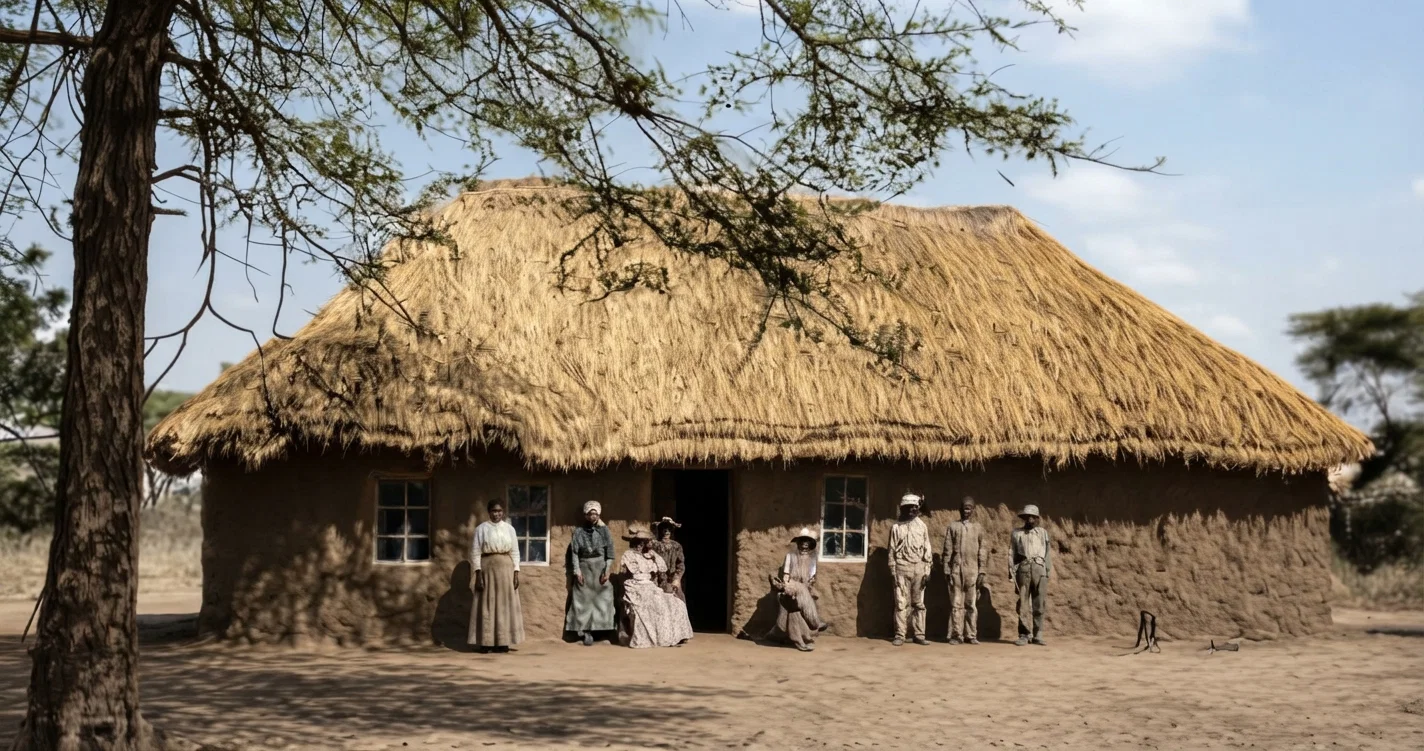
SHANGANI MISSION HOUSE, AN OUT-SCHOOL OF SOMABULA
The brethren of the company in Yxtaltepec were arrested one Sabbath morning at the close of their meeting, taken to jail, held for two hours, and then released. Some of the brethren left Gomez Palacio and Torreon when it looked as if they would be the seat of war for a time. But the work is moving on in that part, and six candidates are waiting baptism in Torreon.
Most of our canvassers were in Yucatan and Oaxaca, in the hot lands, when the unrest and excitement reached its highest point. Warm weather was coming on, and they expected to return to the table-lands anyway; so we wrote them to come into the city of Mexico.
On account of the unsettled condition, the canvassers found it somewhat difficult to sell the larger and more costly books, so it was decided to put them all on the papers. They went right into the Center, the business part of the city of Mexico, and began work with splendid success, considering the circumstances. Hundreds of subscriptions were taken for our three papers. At the present time the work is still going on, and the greater part of the city has been canvassed for them.
Last year the canvassers seemed to think it necessary, in order to avoid calling attention directly to religious matters, to have a health paper with which to introduce themselves; but this year the religious paper in its new form is the one that sells the most readily, and many of the subscribers choose it in preference to the others. It has been amply demonstrated that our religious papers, as well as books, can be sold to all classes.
Brother Otto Schulz had planned a trip up the west coast, and was starting on his journey. I wrote him that perhaps he would better come back and not venture into that part of the country. He replied that he felt that the Lord could and would protect him, and he thought it best to continue his journey as planned. He has been at work in the states of Sonora and Sinaloa and the territory of Lower California. He has experienced no difficulty except on one occasion. A drunken federal soldier was going to shoot him for a rebel, but, of course, did not when he found out who he was. He has had splendid success, and is still in that part of the country.
We told all the workers if they thought best to leave Mexico, we would furnish them the means; but none of them seemed desirous of leaving. There has been a great deal published about Americans arming themselves, but I am glad to say that so far as I know, none of our workers ever thought of resorting to firearms for defense.
In the midst of the difficulties a goodly company has been raised up in Monterey, and now await baptism. In other parts also the work is onward, so that perhaps the evangelistic work will show as much advance this year as in any previous year. If we had the workers which our field demands, we could report much greater advance. It is pitiful when we compare the few laborers we have with the great field of fifteen million people who must have the message—one ordained minister, and he tied down with publishing work; one Mexican, one Spanish, and two American licentiates to look after fifteen companies scattered from one end of the country to the other,12besides endeavoring to do something for new interests which are springing up.
On account of the conditions of the country, we have not ventured to press our claims for more workers to come to this field, but now that the revolution is losing out and conditions becoming more normal, we earnestly implore that help be sent us in the near future. We expect soon to visit some of our companies, and will then give additional reports, and perhaps make some definite requests. Meanwhile, we ask our brethren to remember Mexico and her needs with their resources and their prayers.