Your ShelfYour Projects

Signs of the Times, Vol. 36, No. 33.

The World's Harvest

Signs of the Times

Aug 25, 1909

Pacific Press Publishing Association · Mountain View, California · Aug 25, 1909

The World's Harvest

By Dinah Mulock Craik
In His fields the Master walketh, In His fair fields ripe for harvest, Where the golden sun smiles slantwise On the rich ears, heavy bending; Saith the Master: “It is time.” Tho no leaf wears brown decadence, And September’s nightly frost-blight Only reddens the horizon, “It is full time,” saith the Master— The good Master—“It is time.”
Lo! He looks. His look compelling, Brings the laborers to the harvest; Quick they gather, as in autumn, Wandering birds in silent eddies Drop upon the pasture-fields; White wings have they, and white raiment, White feet shod with swift obedience; Each lays down his golden palm-branch, And a shining sickle reareth; “Speak, O Master! is it time?”
O great Master! are Thy footsteps Even now upon the mountains? Art Thou walking in Thy wheat-field? Are the snowy-winged reapers Gathering in the purple air? Are Thy signs abroad?—the glowing Of the evening sky, blood-reddened; And the full ears trodden earthward, Choked by gaudy tares triumphant: Surely ’tis near harvest-time!
Who shall know the Master’s coming? Whether ’tis at morn or sunset, When night dews weigh down the wheat-ears, Or while noon rides high in heaven, Sleeping lies the yellow field? Only may Thy voice, O Master! Peal above the reapers’ chorus, And dull sound of sheaves slow falling; “Gather all into My garner, For it is My harvest-time!”

Schedule for the Week Ending Sept. 4, 1909.

Day Date Morning Evening
Su. Aug. 29 Ps. 126 to 128 1 Cor. 10:19-33
Mo. " 30 " 129 to 131 " 11:1-16
Tu. " 31 " 132 to 134 " 11:17-34
We. Sept. 1 " 135, 136 " 12
Th. " 2 " 137 to 139 " 13
Fr. " 3 " 140 to 142 " 14:1-20
Sa. " 4 " 143 to 145 " 14:21-40

Suggestive Notes.

Psalm 126 begins our morning readings for the week, closing with Psalm 145. These are largely psalms recounting God's wonderful goodness, His promises to Israel, His power to save and to keep; His goodness with all the dealings of the children of men.
Psalm 136 was one of the many responsive songs. We could understand something of what wonderful power would be manifest in it sung by Solomon's chorus of a thousand voices, with the continued response: “For His loving-kindness endureth forever;” the song itself recounting His goodness and His dealings with His people in the great chorus and the response in the refrain, “For His loving-kindness endureth forever.”
Psalm 137 shows it to have been written by the captive exiles by the River of Babylon. Psalm 138 shows how God has magnified His truth; in 139 His wonderful knowledge of us and our motives, is strongly presented. How every longing soul can adopt as his prayer Psalm 143! How full of majesty and food for thought is Psalm 145!
The lessons of the evening begin with 1 Cor. 10:19 and close with the 14th chapter. Much is said in this epistle regarding the matter of eating, of eating food offered to idols, with instruction as to how God's children should relate themselves to the prevalent customs. Over questions that arise now, one splendid rule is given us in the 31st verse of the 10th chapter, one which will guide the humble, truly teachable child of God at all times, under all circumstances: “Whether therefore ye eat, or drink, or whatsoever ye do, do all to the glory of God;” remembering always the instruction in the following verse: “Give no occasion of stumbling, either to Jews or to Greeks, or to the church of God.”
Chapter 11 is Paul's statement of the Lord's Supper as revealed to him and in harmony with that given in the Gospels. The question of spiritual gifts and Paul's wonderful panegyric on love occupy chapters 12 to 14 inclusive.

Question Corner

[To Our Inquirers.— (1) The name and address of all who ask questions must accompany questions, not necessarily for publication, in token of good faith, and that we may reply by letter if thought best. All communications will be considered confidential if so desired, and no name will be published unless requested. But we have no time to give to anonymous or unsigned epistles or articles. (2) Let the questions be to the point. Do not say, “Explain Josh. 7:1-8,” but state the thing upon which help is desired. (3) Questions can not be answered immediately in this department. Sometimes it will mean a month or more of waiting. We can not reply to the same question frequently. Read answers to other questions; you may find reply to yours. (4) Members of the Bible Band will kindly enclose stamp if answer is desired by letter. Others will please enclose ten cents. This does not begin to meet expenses oftentimes. (5) “Foolish . . . questions avoid.”]

2917.— Previous to the Law of Constantine.

Did the people of Rome at large keep the seventh-day Sabbath from the resurrection to the going forth of Constantine’s law setting forth Sunday as the Sabbath? How is the 321-years intervention between the resurrection of Christ and Constantine’s law explained away, or is it a part of the lost time question? A. L. B.
Christians in general kept the Sabbath day away down to the fifth and sixth centuries after Christ. Their first apostasy was the keeping of the two days together. Such the church was doing in the fourth century when the Abyssinians were converted, and the Abyssinians regard both days to the present time. Constantine’s law did not set up Sunday as the Sabbath. It made no reference to the Sabbath whatever. Constantine was not a Christian but a heathen when his mandate was given. It simply declared that Sunday ought to be kept. It helped to strengthen those who were endeavoring to introduce Sunday as a religious day, and helped in legislation. But at the same time nearly all the people kept the Sabbath, although apostasy was doing all that it could to wean people away from it. And yet no other than the seventh day was called the Sabbath for a thousand years after Christ, and there have been true Sabbath-keepers throughout all the ages. When men began to keep the first day, it was not kept at all as the Sabbath, and Constantine’s decree shows that men worked upon that day.

2918.— Why Proclaim the Lord’s Message?

If those who are living according to their best light and yet do not keep the Sabbath of the Decalogue, will not be condemned by the law, why should the great threefold message of Revelation 14 be proclaimed? Why call them out of their saved condition if they are saved and still keep the Sabbath not enjoined of the Lord; and what about the time from sunset to 12 o’clock? A. L. B.
Let this one great truth be settled forever, as God Himself has settled it: “The eyes of the Lord run to and fro throughout the whole earth, to show Himself strong in the behalf of them whose heart is perfect toward Him.” God wants the perfect heart. That is the very first essential in all true Christian living—a heart that is washed clean by the blood of Christ. Then begins the work of enlightenment. Step by step, little by little, God gives His lessons, daily, hourly, weekly, yearly. The Sabbath is not the only thing there is in God’s word. There are other things that we are to learn as well as that. A great part of the Christian world has lost sight of the Sabbath through the great apostasy.
When the Reformers found again the great truth which most of the world had lost, “The just shall live by faith,” God accepted and blessed them, but that was not all. He gave more and more light; and in His great purpose in the last great reformation, all of His light is to come forth from His treasure-house; all the down-trodden truths are to be restored; all the breaches made in His law by apostasy are to be repaired. This does not mean that God condemns those who have not seen the light, and who are living according to all the light they have, but in His plan He wishes to reveal to His children all His light. He will not come until His entire Holy law has been vindicated, until He has set before all the world that plan which would unite all discordant elements in Christianity and make them one, even as Jesus prayed. Therefore, at this time the prophet sees “multitudes, multitudes in the valley of decision.”
The light-lovers will follow the light; the light-haters will turn from the light, but the determination as to who is a lover of light or a hater of light rests with God. We may not take our place upon the judgment-seat and decide that this man is saved, or that one is lost. It is our business to follow the light wherever it may lead. It is our business to teach the light to others so that they may have the privilege of following the light; but the ultimate judgment of character rests with Him whose the light is.
Saying that one will be saved who follows the light even tho he may not be keeping all of God’s commandments according to His word, is an entirely different thing from saying that we should not enlighten that soul. God has given us His message to give to the world; that message restores His down-trodden truth, including the Sabbath. See Isa. 58:12, 13. It includes the Sabbath as God gave it, from sunset to sunset. In the light of that message men will see how Sunday is a usurper; how it has within it no intrinsic worth; that it is contrary to God’s law and plan. Yet God in His goodness waits, suffers long, and is merciful; but when probation is closed and God’s message is finished, all those who do not have on Christ’s righteousness and who have not yielded to the light will, according to His word, be cast out.

2919.— Sabbath Observance.

Referring to John 5:9-17 and Luke 6:2-4, had it not been lawful before this to heal the sick? Where is the incident regarding David and the showbread? F. J. S.
When the Jews said to the healed man: “It is the Sabbath day; it is not lawful for thee to carry thy bed,” and to Jesus: “Why do ye that which is not lawful to do on the Sabbath days?” they did not have reference to the Decalogue, but to their interpretations of the Decalogue. Or, to put it in other words, their criticism did not apply to the Decalogue, but to their traditions respecting the Decalogue. When the Jewish nation went into idolatry previous to the Babylonian captivity, they gave very little regard to the Sabbath, as shown by Ezekiel 20.
In the restoration from the Babylonian captivity, the Sabbath was strongly emphasized, and a decided reform took place upon it, as we learn from the last chapter of Nehemiah. The Jews, however, failed to learn the true lesson of Sabbath-keeping. Instead of making it a day of spiritual blessing, they made it a day of hard, burdensome observance. They piled up their traditions regarding it. They copied out precepts of the rabbis as tho those precepts were divine, until the day which God gave as a blessing for man became an awful burden and really a curse instead of a blessing. Jesus came to correct this, and He tells us emphatically in Matt. 12:12: “It is lawful to do well on the Sabbath day.” He was not breaking the Sabbath law, He was simply transgressing some of the foolish traditions of the Jews.
David’s eating of the showbread is recorded in 1 Sam. 21:1-6. The Jews excused this unlawful act because necessity demanded it. Surely they ought to have excused Jesus in the healing of poor, suffering humanity.

2920.— The Word “Quicken.”

Does the word “quicken” in both Rom. 8:15 and Ps. 71:20 refer to the future and embrace the resurrection and translation, as the tense indicates? H. M. L.
Romans 8:11 is evidently the verse intended, as “quicken” does not occur in verse 15. The Greek word is the same in Rom. 8:11 as in the Septuagint in Ps. 71:20. It seems certainly to include the resurrection in Ps. 71:20, and yet it may refer also to this life. God who had shown His children “many and sore troubles,” was bringing them down into the very pit of despair, and He would quicken them again and bring them up again from the depths of the earth and increase their greatness.
Certainly the passage in Romans has reference not only to this life, but also to the life to come; not only will God raise up our mortal bodies, but He gives life also in this world to our mortal bodies through “His Spirit that dwelleth in you.” That will be the earnest of the life which is to come. God wants to give just as many of His blessings now as it is possible for His children to receive.

2921.— Fools and Fools.

Please explain Prov. 26:4, 5. F. A. A.
The text is not a difficult one, if one will stop to think over it. “Answer not a fool according to his folly, lest thou also be like unto him.” That is, do not answer in his foolish way. If he speaks to you foolishly, do not reply foolishly. Do not be like him in any way. “Answer a fool according to his folly, lest he be wise in his own conceit,” is to show him his mistake and teach him the better way. One writer well remarks: “To answer a fool according to his folly, in verse 4, is to bandy words with him, to descend to his level of coarse anger and vile abuse, and in verse 5 it is to say the right word at the right time, to expose his folly and untruth to others, and even, it may be, to himself.” This is best done not by teaching beyond his reach, but by words that he is just able to comprehend.

Taught of God

By Mrs. E. G. White
“Multitudes flocked to the wilderness”
John the Baptist in his desert life was taught of God. He studied the revelations of God in nature. Under the guiding of the divine Spirit, he studied the scrolls of the prophets. By day and by night, Christ was his study, his meditation, until mind and heart and soul were filled with the glorious vision. He looked upon the King in His beauty, and self was lost sight of. He beheld the majesty of holiness, and knew himself to be inefficient and unworthy. It was God’s message that he was to declare. It was in God’s power and His righteousness that he was to stand. He was ready to go forth as Heaven’s messenger, unawed by the human, because he had looked upon the Divine. He could stand fearless in the presence of earthly monarchs, because with trembling he had bowed before the King of Kings.

Rebuking Unrighteousness

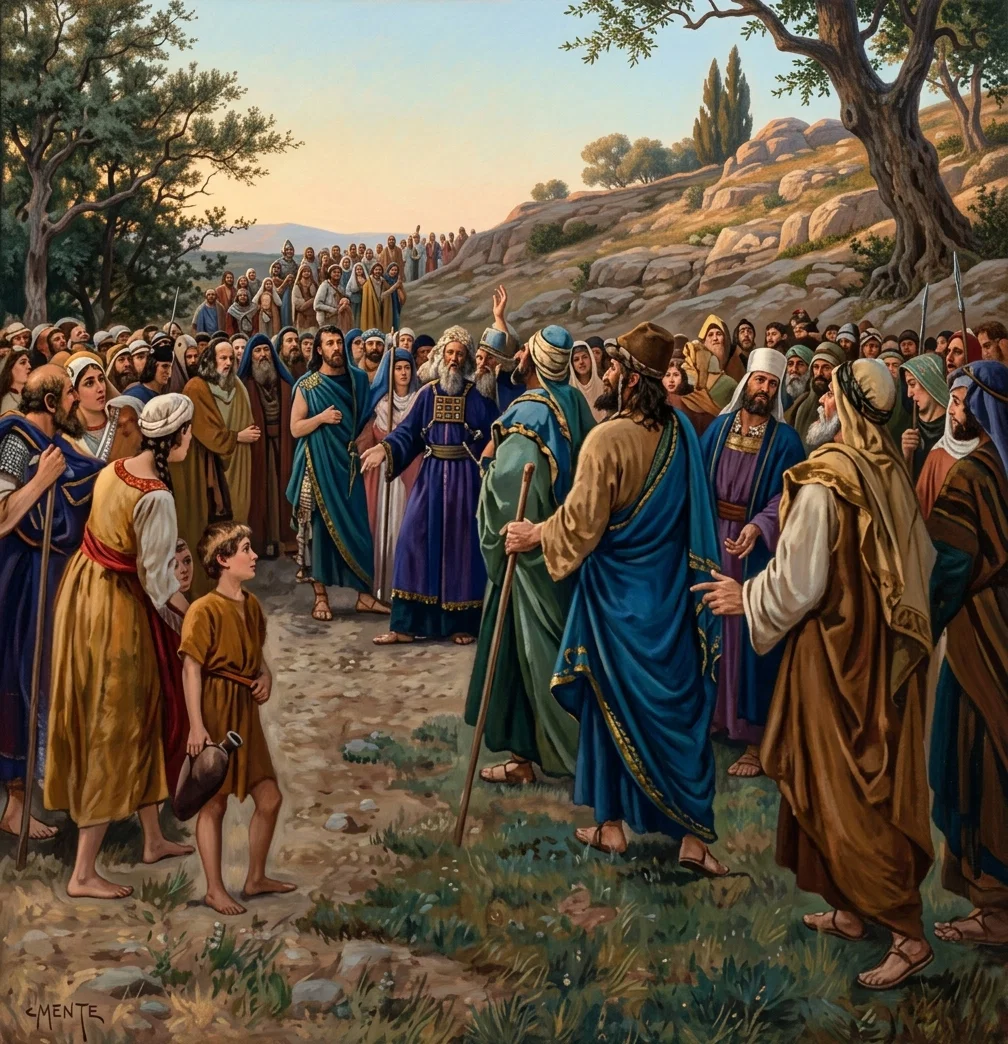
With no elaborate arguments or fine-spun theories did John declare his message. Startling and stern, yet full of hope, his voice was heard from the wilderness, “Repent ye, for the kingdom of heaven is at hand.” With a new, strange power it moved the people. The whole nation was stirred. Multitudes flocked to the wilderness. Unlearned peasants and fishermen from the surrounding country; the Roman soldiers from the barracks of Herod; chieftains with their swords at their sides, ready to put down anything that might savor of rebellion; the avaricious tax-gatherers from their tollbooths; and from the Sanhedrin the phylacteried priests,—all listened as if spellbound; and all, even the Pharisee and the Sadducee, the cold, unimpressible scoffer, went away with the sneer silenced, and cut to their heart with a sense of their sins. Herod in his palace heard the message, and the proud, sin-hardened ruler trembled at the call to repentance.
In this age, just prior to the second coming of Christ in the clouds of heaven, such a work as that of John is to be done. God calls for men who will prepare a people to stand in the great day of the Lord. The message preceding the public ministry of Christ was, “Repent, publicans and sinners; repent, Pharisees and Sadducees; ‘repent ye; for the kingdom of heaven is at hand.’” As a people who believe in Christ’s soon appearing, we have a message to bear,—“Prepare to meet thy God.” Our message must be as direct as was the message of John. He rebuked kings for their iniquity. Notwithstanding that his life was imperiled, he did not hesitate to declare God’s word. And our work in this age must be done as faithfully.
In order to give such a message as John gave, we must have a spiritual experience like his. The same work must be wrought in us. We must behold God, and in beholding Him lose sight of self.
John had by nature the faults and weaknesses common to humanity; but the touch of divine love had transformed him. When, after Christ’s ministry began, the disciples of John came to him with the complaint that all men were following the new Teacher, John showed how clearly he understood his relation to the Messiah, and how gladly he welcomed the One for whom he had prepared the way.

John’s Self-Abnegation

“A man can receive nothing,” he said, “except it be given him from heaven. Ye yourselves bear me witness, that I said, I am not the Christ, but that I am sent before Him. He that hath the bride is the bridegroom: but the friend of the bridegroom, which standeth and heareth him, rejoiceth greatly because of the bridegroom’s voice: this my joy therefore is fulfilled. He must increase, but I must decrease.”
Looking in faith to the Redeemer, John had risen to the height of self-abnegation. He sought not to attract men to himself, but to lift their thoughts higher and still higher, until they should rest upon the Lamb of God. He himself had been only a voice, a cry in the wilderness. Now with joy he accepted silence and obscurity, that the eyes of all might be turned to the Light of Life.

Not to Seek Honor

Those who are true to their calling as messengers for God, will not seek honor for themselves. Love for self will be swallowed up in love for Christ. They will recognize that it is their work to proclaim, as did John the Baptist, “Behold the Lamb of God, which taketh away the sin of the world.” They will lift up Jesus, and with Him humanity will be lifted up. “Thus saith the high and lofty One that inhabiteth eternity, whose name is Holy; I dwell in the high and holy place, with him also that is of a contrite and humble spirit, to revive the spirit of the humble, and to revive the heart of the contrite ones.”
The soul of the prophet, emptied of self, was filled with the light of the Divine. In words that were almost a counterpart of the words of Christ Himself, he bore witness to the Saviour’s glory. “He that cometh from above,” he said, “is above all: he that is of the earth is earthly, and speaketh of the earth: He that cometh from heaven is above all. . . . For He whom God hath sent speaketh the words of God; for God giveth not the Spirit by measure unto Him.” In this glory of Christ all His followers are to share. The Saviour could say, “I seek not Mine own will, but the will of the Father which hath sent Me.” “And,” declared John, “God giveth not the Spirit by measure unto Him.” So with the followers of Christ. We can receive of Heaven’s light only as we are willing to be emptied of self. We can discern the characterof God, and accept Christ by faith, only as we consent to the bringing into captivity of every thought to the obedience of Christ. To all who do this, the Holy Spirit is given without measure. In Christ “dwelleth all the fulness of the Godhead bodily. And ye are complete in Him.”

God’s Promises

To all who are willing for self to be humbled, are given God’s promises:
“I will make all My goodness pass before thee, and I will proclaim the name of the Lord before thee.”
“Call unto Me, and I will answer thee, and show thee great and mighty things, which thou knowest not.”
“Exceeding abundantly above all that we ask or think,” will be given unto us “the Spirit of wisdom and revelation in the knowledge of Him,” that we “may be able to comprehend with all saints what is the breadth, and length, and depth, and height; and to know the love of Christ, which passeth knowledge,” that we may be “filled with all the fulness of God.”
This is the knowledge that God is inviting us to receive, and beside which all else is vanity and nothingness.

The Sabbath Through the Ages

V. The Sabbath in the Decalogue

By Charles L. Taylor
SINAI! Ah, the simple word brings before the mind that day of sublime grandeur and awfulness when the Almighty, the King of the universe, the “One that inhabiteth eternity,” set foot upon earth and deigned to speak from the thunder-riven heights of a barren land to the creatures of His own making—to worms of the dust. “The Lord came from Sinai, and rose up from Seir unto them; He shined forth from Mount Paran, and He came with ten thousands of saints: from His right hand went a fiery law for them.”

The Law Given by God Himself

Not by prophet, nor yet by priest, did Jehovah make known to the nation of His choice the great and eternal words of His law. By His own voice the foundation principles of His kingdom and throne were thundered forth. And so divinely complete were those fundamentals, so perfect, so far-reaching, so infinite in all their meanings, that Inspiration has seen fit to record the word, “And He added no more.” Deut. 5:22.

The Law Eternal, Unchangeable

That wonderful law the apostle calls “holy, and just, and good.” Rom. 7:12. He also calls it “spiritual.” Verse 14. And because it is holy, just, good, and spiritual, it is to “stand fast forever and ever.” Ps. 111:7, 8. God’s government is moral, hence these moral precepts. Says the Baptist Church Manual, “We believe that the law of God is the eternal and unchangeable rule of His moral government.” Recognizing the law as spiritual and moral, we must recognize it as unchangeable, because no moral precept can know change. The unchangeableness of the commandments was clearly set forth in the striking fact that God, by His own finger, graved them in the granite of the mount from which He spoke.
In view of the truth set forth in the preceding paragraph, we may appreciate the word of Rev. Geo. Elliot in his “Abiding Sabbath:” “Long should pause the erring hand of man before it dares to chip away with the chisel of human reasoning one single word graven on the enduring tables by the hand of the infinite God. . . . Is the eternal tablet of His law to be defaced by a creature’s hand? He who proposes such an act should fortify himself by reasons as holy as God and as mighty as His power.” To this every candid heart will respond with a reverent, Amen.

The Sabbath in the Law

But in the very bosom of that wonderful, holy, unchangeable, moral code, Jehovah placed the word, “Remember the Sabbath day, to keep it holy.” In “The Lord’s Day the Test of the Ages,” there is found this striking word: “Note again the position of the Sabbath commandment-in the law. It is not at the beginning or at the close. Were it at the beginning, it might be declared to be no part of the law. Were it at the close, it might be declared to have been added. But divine wisdom placed it in the very heart of the moral law, so that three immutable precepts guarding man’s duty to God must be passed over, on the one hand, and six immutable precepts guarding man’s duty to his fellow, crushed out, on the other hand, before the impregnable fortress of the Sabbath can be reached in order to attack it. But not one of these massive walls which surround it can be successfully assaulted. The Sabbath law is a part of the Decalogue, and no sophistry can evade it.”

The Morality of the Sabbath

Without doubt the Sabbath commandment is a moral precept, and as such must continue, unchangeable and unchanged, throughout all ages and unto all generations.
The commandment is: “Remember the Sabbath day, to keep it holy. Six days shalt thou labor, and do all thy work: but the seventh day is the Sabbath of the Lord thy God: in it thou shalt not do any work, thou, nor thy son, nor thy daughter, thy man-servant, nor thy maidservant, nor thy cattle, nor thy stranger that is within thy gates: for in six days the Lord made heaven and earth, the sea and all that in them is, and rested the seventh day: wherefore the Lord blessed the Sabbath day and hallowed it.” Ex. 20:8-11.
It is necessary only to call attention to the fact to enable one to see that all through the commandment the matter of the day is emphasized. “Remember the Sabbath day;” “the seventh day is the Sabbath . . . in it thou shalt not do any work;” God “rested the seventh day;” and God “blessed the Sabbath day and hallowed it.” Man’s mind is directed toward the day, not toward an institution which may be moved from one day to another. It is the day which belongs to God.
And surely every candid mind will quickly see that divine ownership of the day is in itself a moral question. When God declares, The day is Mine, man may not set up a counter claim and remain innocent. He who takes for himself the property of a fellow man is regarded, even among men, as a criminal, even tho the value of what he takes be no greater than a pin. That he can see no valid reason why his neighbor should cherish the pin is no excuse whatever for his theft. The principle of ownership is sacred. And how true this is in the case of the Almighty. Well may the Lord ask, as He once did, “Will a man rob God?”
The Sabbath of the Decalogue is moral in that it involves God’s right to command. Has He decreed that the first six days are ours and the seventh His? That, in itself, is an everlasting and incontrovertible argument which man’s reasoning can not nullify. To question God’s right in any respect is the very height of presumption. Does He ask for sacred fire in the sanctuary ministrations? Then common fire is only sacrilege which calls for certain and swift punishment. Lev. 10:1-3. Does He give particular instruction concerning the apparently simple matter of the removal of the ark? Then man’s carelessness or forgetfulness brings down upon him the bolts of divine wrath, and he dies. 2 Sam. 6:6, 7. Human reasoning may have had some part in both these cases, but certainly it brought only ill to the reasoners.

Our Father’s Example

No greater reason why man should rest upon the seventh day is needed than that Jehovah Himself rested on that day and asks man to do likewise. But this is not all. The seventh day is, as it were, a weekly birthday of the completed creation. It alone, and it in its appointed place at the end of the week, can truly be the memorial of creative power manifested during the first week of time. This is the truth of the commandment. “In six days the Lord made heaven and earth, . . . and rested the seventh day: wherefore the Lord blessed the Sabbath day and hallowed it.”
Dear reader, let us not doubt our Father’s word: The seventh day is His. In that day and in none other He has placed His blessing—His hallowing, sanctifying presence. In keeping holy His day, we shall find within each and all its sacred hours the power of His own life. Read once again the commandment, feast once more upon the divine assurance of Isa. 58:13, 14, and then before God, with bowed heart, submit as never before to the word which says, “Remember the Sabbath day, to keep it holy.”

The Church

VIII. The Church Triumphant

By C. S. Longacre
By the terms “church militant” and “church triumphant,” we distinguish between the church on earth as engaged in actual warfare with the forces of evil, and the church in her future triumphant state, before God’s throne in heaven, clothed in garments of immortality and crowned with eternal life. In the church militant the members are often compared to good soldiers fighting the good fight of faith, putting on the whole armor, as in a military contest; but the church triumphant has fought all her battles and won all her victories, and has come off an absolute conqueror over the flesh, the world, and the devil, and over death and the grave, and is forever safe in the Father’s home.
The church militant numbers many more than the church triumphant, because many a poor soldier is taken captive by the enemy, or falls out by the way. Instead of being an overcomer, he is overcome. He may have his name written on a score of church rolls on earth; but that in itself is no evidence that his name is on the roll of “the general assembly and church of the first-born which are written in heaven.” “Not every one that saith unto Me, Lord, Lord, shall enter into the kingdom of heaven; but he that doeth the will of My Father which is in heaven.” Matt. 7: 21.
The church triumphant is composed of all the saved of all ages which will be gathered from the four quarters of the earth, and brought before the throne of God in heaven at the last day. A part of this church has already been taken to heaven, to assist Christ in His mediatorial work in the heavenly sanctuary. Matthew speaks of their resurrection thus: “And the graves were opened, and many bodies of the saints which slept arose, and came out of their graves after His resurrection, and went into the holy city and appeared unto many.” Matt. 27: 52, 53. Paul in writing to the Ephesians states that this company ascended with Christ to heaven. “Wherefore he saith, When He ascended up on high, He led a multitude of captives.” Eph. 4: 8 (margin). John when he was shown heaven in vision, saw this resurrected company there, and he heard them singing a new song and praising the Lamb of God: “Thou wast slain and hast redeemed us to God by Thy blood out of every kindred, and tongue, and people, and nation; and hast made us unto our God kings and priests.” Rev. 5: 9, 10. These resurrected saints, together with the resurrected Christ, constituted “the first-fruits of them that slept.” The harvest itself will be “in the end of the world.” “And then shall they see the Son of Man coming in the clouds with great power and glory; and then shall He send His angels and they shall gather together His elect from the four winds, from the uttermost part of the earth, to the uttermost part of heaven.” Mark 13: 26, 27. “And they lived and reigned with Christ a thousand years,” not on earth, but in heaven, where He had promised to take them when He should return again. Rev. 20: 4; John 14: 2, 3. At the end of the thousand years they descend in the holy city to this earth which, when purified, becomes their everlasting abode. Rev. 21: 10.
Long had the church been Satan’s “lawful captive,” but the days of her captivity are now ended, “and the ransomed of the Lord shall return, and come to Zion with songs and everlasting joy upon their heads: they shall obtain joy and gladness, and sorrow and sighing shall flee away.” Isa. 35: 10. Then the Lord “will swallow up death in victory; and the Lord God will wipe away tears from off all faces; and the rebuke of His people shall He take away from off all the earth; for the Lord hath spoken it. And it shall be said in that day, Lo, this is our God; we have waited for Him, and He will save us: this is the Lord; we have waited for Him, we will be glad and rejoice in His salvation.” Isa. 25: 8, 9.
In that day the church of the dead and living saints of all the ages will win her final victory over death and the grave, and from that day she will eternally be the church “triumphant.” At that time, “God shall wipe away all tears from their eyes; and there shall be no more death, neither sorrow nor crying, neither shall there be any more pain: for the former things are passed away.” Rev. 21: 4.
Dear reader, if you wish to belong to the triumphant church at last, you must triumph over your sins now. Only he “that overcometh will I give to eat of the Tree of Life, which is in the midst of the paradise of God.” Rev. 2: 7.
Can you say, at this moment, that if you should suddenly be cut off from life, you would be prepared to meet your God in peace at the last day of final reckoning? Do you know that the long and weary struggle of all of earth’s pilgrims is almost over, and that the journey from this dark world of sin to the everlasting realms of light is soon to take place? Have you obtained Heaven’s passport? Would you like to know what it is? Here it is: “Blessed are they that do His commandments that they may have right to the Tree of Life, and may enter in through the gates into the city.” Rev. 22: 14.
O Christless one! why will you delay and hesitate over the salvation of your soul? What will it profit you if you gain the whole world and lose your soul? What more can Christ do for you than that He has done? If such infinite love as He manifested on the cross will not win you, there is nothing left that can win you. It was for you that He died, that you might be redeemed from the curse. Why not make your peace with Him now, and become an heir of an inheritance that fadeth not away, and the possessor of a life that will never end? The long night of sin is almost spent, and the morning of the eternal day will soon dawn upon the faithful of all ages, and they will sing the new song of the triumphant church, and make heaven’s arches ring with resurrection melody. “The Spirit and the bride say, Come.”

Courage to Stand for Truth

They are slaves who will not choose Hatred, scoffing and abuse Rather than in silence shrink From the truth they needs must think. They are slaves who dare not be In the right with two or three. — Lowell.

The Christ the People Want

In apostolic days men advocated a gospel without the cross. But St. Paul would have none of it. In the fourth century Arius taught a Christianity without a perfectly divine saviour, and the church would not have it. In the fifteenth century the Renaissance, intoxicated by the discovery of Greek and Roman literature, despised the “jargon of St. Paul,” and would have paganized Christianity, but the Reformation brought northern Europe back to the Scriptures and to the Christ. To-day men are proclaiming a gospel without the supernatural. They are asking us to be content with a perfect human christ; with a Bethlehem where no miracle was wrought; with a Calvary which saw sublime self-sacrifice, but no atonement for sin; with a sepulcher from which no angel’s hand rolled away the stone. But we must have none of it. We will hold fast, we will transmit the faith once for all delivered to the saints. We will hand down to our children, we will proclaim to all tribes of the earth, Christ incarnate, atoning, risen, ascending, our intercessor at God’s right hand, waiting to come again to judge the quick and the dead.—Bishop of Liverpool.

Sinning Against Grace

THERE are some things which the grace of God can not do. It can not save those who deliberately continue in sin. It is only effective in the lives of men and women who have formed the single purpose to walk in the way of righteousness. There are many who make a sort of half-way covenant, secretly pledging themselves to the service of Satan while openly taking the vows of a Christian disciple. They have an idea that there is a positive virtue in being identified with the church. It costs little, they argue, in the way of personal effort or personal sacrifice, to be a nominal church-member, and the connection, moreover, may have some advantages. While they bear the Christian name, they may secretly engage in selfish and sinful pursuits, taking care to repent and reform when death threatens.—The Independent.

Scripture Given by Inspiration

“ALL Scripture is given by inspiration of God, and is profitable for doctrine, for reproof, for correction, for instruction in righteousness; that the man of God may be perfect, thoroly furnished unto all good works.” 2 Tim. 3:16, 17.
Continue reading: The Judgment