THE most natural thing to do to put out a fire is to pour on water. This principle holds good in reference to the vital fires, not, however, to quench them entirely, but to diminish their activity when burning too vigorously, as in the case of fever. There are quite a variety of water applications which may be usefully employed in combating a high temperature, more or less vigorous in character according to the necessities of the case. It should be borne in mind first of all that cold applications in this class of cases are to be made not alone for the reduction of temperature, but for their tonic and exhilarating effect upon the patient. Other symptoms besides the temperature are greatly modified by the cold applications.
As before mentioned, the character of the treatment varies according to the condition of the patient. Vigorous patients, that is, those with good physiques, having an abundance of reserve tissue in the form of fat, and, as a rule, persons in early adult or middle age of life, are best prepared to tolerate vigorous applications of cold. Such a patient with a fever in which the skin is hot and dry, the face flushed, and the temperature sufficiently high, say 103° to 105° or above, may be immersed in a full cold bath. It is in such cases that the famous Brand bath is applicable. This bath consists in immersing the patient in water having a temperature of from 68° to 70°, keeping him in the bath for fifteen minutes, observing the precaution to have the head thoroughly wet in cold water before entering the bath, and keeping a cloth upon the head, frequently wetting it in water at a temperature at least ten or fifteen degrees lower than the temperature of the bath. Vigorous friction should be administered to the patient while in the bath, especially to the extremities. It requires two attendants to administer such a bath, one to apply friction to the upper, the other to the lower, parts of the body. On removal from the bath, the patient is wrapped in a sheet, and again put to bed. This is an extremely vigorous treatment. It has, however, been resorted to in thousands of cases, often being practically the only hydropathic measure employed, and has resulted in the saving of the lives of many thousands of fever patients. It is customary to repeat this bath whenever the temperature of the patient rises above 102½°.
Less heroic measures may, however, be used, and with equally satisfactory results; for example, an excellent substitute for the Brand bath, and one which is applicable in by far a larger percentage of cases, is the so-called graduated bath. This method consists in immersing the patient in a bath at a temperature of 100°, and reducing the temperature at the rate of two degrees every five minutes until a temperature of 85° is reached, and the bath continued at this point until the desired results are secured, as indicated by the reduction of the patient's temperature at least to 101½° or 102°. As the bath becomes cooler, it is necessary to apply friction to relieve the patient from the sensation of chill. Such a bath does not produce any shock to the patient, as does the cold immersion bath; and the results are equally satisfactory, and in many cases superior to more vigorous treatments.
Another very excellent method of combating high temperature, and one which is applicable at all ages of life, is the neutral immersion bath. In health, immersion of the body in water at a temperature of 92° to 95°, even though continued for several hours, does not produce any lowering of temperature; but with patients suffering from fever, the neutral bath is an excellent means of securing a lowering of temperature. The bath may be continued, if desired, for one or two hours, or even longer. It is only necessary to make the patient comfortable in the bath by having him suspended in a hammock in the water or lying upon an air cushion.
It is very essential that friction should be applied during any form of bath previously mentioned, as the friction diminishes the sensation of chill, and thus prevents the tendency toward increased heat production, while at the same time it helps to maintain dilatation of the blood vessels of the skin, thus bringing a larger quantity of blood in close proximity to the cold water, and heat is thereby much more rapidly eliminated from the body.
Temperature may be lowered very successfully by wrapping the patient in a sheet wrung from cold water, applying in addition a single blanket, or more if necessary, to prevent too rapid cooling of the body. Friction may be applied outside the sheet to prevent chill. As soon as the sheet becomes warm, it may be renewed, or cold water may be sprinkled upon it while it is left in position. The wetting of the sheet should be repeated a sufficient number of times to secure the desired reduction in temperature.
In cases where the patients are very susceptible to cold, and in which there is pallor of the skin, tendency to chill, or in which the patients are very weak, the sheet may be wrung from very hot water and placed about them. The sheet, while hot, will relieve the chill and dilate the surface vessels, and by becoming quickly cool, will secure the lowering of temperature. Cooling by evaporation may be hastened by fanning the patient.
Various forms of cold friction are of great value in dealing with this class of cases, and may be applied, alternating with the more vigorous measures. For example, the body may be rubbed with the hand dipped frequently in cold water. The application should be made to first one portion of the body, as, for example, the arms, then proceeding systematically from one part to another. For this purpose, water should be used at a temperature of 55° to 65°. A mitt made of coarse cloth, such as haircloth or alpaca, may be placed upon the hand, and dipped frequently in cold water. This furnishes an excellent means of lowering the temperature.
In addition to being used as alternating treatments, the more mild forms of applications should be used for very young or very old persons, also for feeble patients in which the tendency to chill is marked, or where there is a marked inability to react. In the majority of such cases, it is advisable to give a short hot application of some sort as a preliminary measure; as, for example, fomentations to the spine or abdomen, the graduated bath, the hot sheet, or other means already suggested.
An enema at 65° or 70° three times a day, repeating the injection two or three times at each application, is a most excellent means of reducing temperature.
Cold water drinking is another efficient measure. Fever patients should be given at least half a glass of cold water every half hour. The patient should be urged to drink. To encourage drinking it may be necessary to acidulate the water with lemon or other fruit juice.
The outline here given is merely suggestive. It would be impossible in the space of one article exhaustively to outline suggestions for the entire care of cases of fever. The attention of the reader is called to the suggestion made in the footnote accompanying this article.
Leave God to Order All Thy Ways
“LEAVE God to order all thy ways,
And hope in him whate’er betide:
Thou’lt find him in the evil days
An all-sufficient strength and guide.
Who trusts in God’s unchanging love,
Builds on the rock that naught can
move.”
In India
By J. L. SHAW
J. L. SHAW
During the winter months the climate of India on the plains is delightful,—not too cold nor too hot; but just cool enough to make work a pleasure,—similar to our early autumn. One who has not been in India cannot imagine how the cool months of November, December, January, and February are appreciated. After eight months of incessant heat, with the thermometer fluctuating between 90° and 125° above zero, the cool zephyrs are refreshing, and work becomes a pleasure.
Notwithstanding the fact that the heat is trying, among the natives of India there is far less sickness in the hot weather than in the cool season. The bubonic plague and smallpox number their victims by thousands in the winter. When the sun strikes India with its most direct rays, the native has his best health, and the plague makes least headway. This is accounted for easily, when we remember the effect of the sun’s rays upon disease germs. In the cool season the filth that exists about native houses forms a good medium for germ culture, and various diseases multiply and spread; but when the mighty Indian sun returns in all his power, he checks these agents of destruction. So it is that, although we fear this fiery monster as it beats upon our heads, and do our utmost to protect ourselves from its direct rays, yet at the very time it is most intense, it is our greatest benefactor, and destroys the enemies that seek our lives.
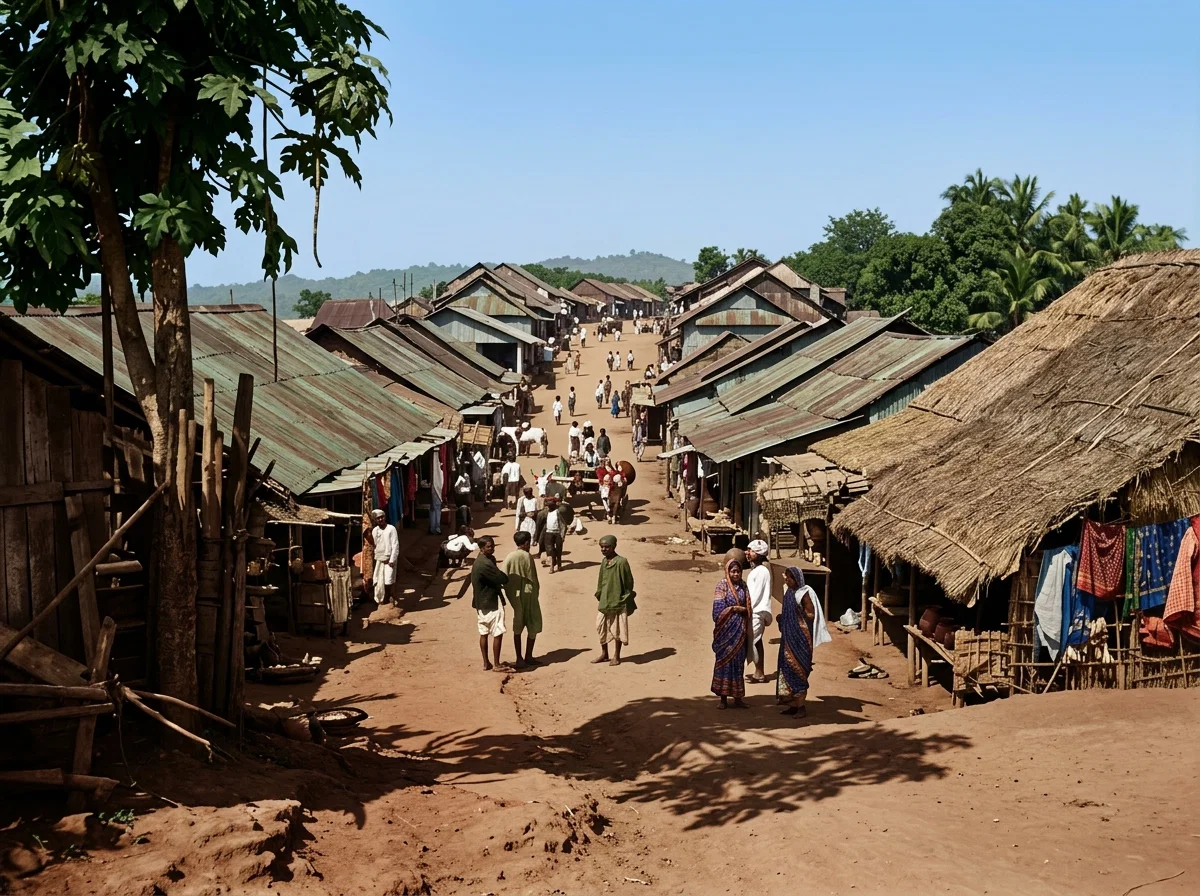
A VILLAGE IN INDIA
We thank God for India’s mighty sun, whose brightest beams give its people health; and we long to see the Maker of this sun, the Sun of Righteousness, shine forth with greater power, and pierce through this awful pall of caste and superstition that hides the millions of this land from the light of life. Some are beginning to see the gleams, and the name of Jesus is wending its way among the multitudes; a spirit of inquiry prevails, and many are waiting to hear the news of salvation; and most naturally, they look to the agent who carries this message of good news to see if his life conforms to his teaching. Unfortunately, self has too often had the mastery, and the Christian religion has been judged by the character of its professors.
Just now I am at Karmatar, where our orphanage is located. The orphans are all doing well, save one who has the fever. We are opening a small school in connection with the orphanage, to afford an opportunity for our people and others to give their children a Christian education. Education among the English and Eurasians is calling loudly for reform. The system of cramming, which now prevails, is one of the curses of the country. The mind is made to comprehend a large number of subjects at one time, many of which are impractical. A boy of fourteen gives the following list of studies which he is carrying: Latin, English grammar, English prose, geography, Urdu, English poetry, drawing, Indian history, map drawing, and arithmetic. With all these studies that read like a college curriculum, he is learning but little that will be of practical help to him in life. His Scripture study has been the memorizing of a few texts. As regards this wonderful house in which we live, he knows nothing. He has had no practical training, and has not learned to wait on himself. In nearly all the schools, servants are employed, and in some of them they dress and undress the pupils. Lads of fifteen have servants who dress them as if they were dolls. They become so dependent that they are unable to wait upon themselves. A day or two ago, while I was on the train, a forcible illustration of this occurred. A young man boarded the train, who had a basket weighing perhaps fifteen pounds, which a servant brought and placed in the car. After riding some distance, we came to the place where he wished to stop. As the train drew up to the platform, he began calling for a cooly to assist him, but when he saw no one coming, he rushed out, shouting, “Cooly, cooly,” and after many oaths and some much searching he found a man to remove his fifteen-pound parcel from the train just as the guard’s whistle blew for “all aboard.”17
Sisters Black and Orr are conducting the school, orphanage, and medical work, and have their hands well filled. Our medical dispensary is for the natives. Dr. Ingersoll comes up from Calcutta twice a month for special work, and people come from miles around to get help. At other times Sister Black prescribes for the patients, and the older students help her in giving treatments. This affords them a good opportunity to learn how to treat the sick, which in this country is very important. People know little or nothing about their bodies, and they have very peculiar ideas about diseases and their cure.
Our work at Karmatar has been much crippled since Brother Brown died, as no one has been able to speak the language to any extent. Although the medical work is gaining the confidence of the people, yet in order to reach their hearts, the workers must be well acquainted with the language, and be able to tell them about the love of God.
While speaking with some natives, I told them that God loved them, and that we had come to tell them of his love. With astonishment one of them said that he did not know that God loved them. What a pity! These people do not know that God is a God of love, and that he loves them. No doubt this man’s acknowledgment is only a revelation of the feelings of millions of men and women in India. Their religion is a religion of fear, and all their worship is to appease the wrath of the gods. May God put it into the hearts of many in the home land to come to this land and tell the people that our God is a God of love, that these feelings of fear may all be expelled from the heart, because “perfect love casteth out fear.”
W. H. THURSTON
By W. H. THURSTON
Brazil
W. H. THURSTON
Brazil, with its lofty mountains, rushing rivers, beautiful valleys, fruits, plants, flowers, and diversity of climate, is a delightsome land. The people are genial and courteous,—good and bad, of course, the same as elsewhere,—and many of them are waiting and longing for the good news of salvation.
BOTANICAL GARDENS, RIO DE JANEIRO
The message of truth is now established in seven states. There are eight hundred Sabbath keepers in all. They have an industrial school and several church schools in operation, and workers are being trained for the great harvest field.
They are now arranging to establish a printing plant in connection with the industrial school. This will enable them to print their own papers (O Arauto da Verdade and Missions Arbeiter) and tracts. A large portion of the work can be done by the students.
The laborers there are earnest, devoted men and women, and are laboring hard to carry the message to that people. They appreciate the financial help which the work in their country has received, and the prayers of the faithful are recognized as giving strength and courage to one and all.
There is still something else, however, that they are looking for and expecting. Please note the following:—
“If families would locate in the dark places of the earth, places where the people are enshrouded in spiritual gloom, and let the light of Christ’s life shine out through them, a great work might be accomplished. Let them begin their work in a quiet, unobtrusive way, not drawing on the funds of the conference until the interest becomes so extensive that they cannot manage it without ministerial help.”—Testimonies for the Church, Vol. VI, page 442.
Here is a work, a special work, for families. The call is for families to settle in the dark places of the earth as self-supporting missionaries. Our brethren in Brazil are looking for a response to this call. Who will go? There are many places in that country where families could settle and live the truth before the people, and thus be the means in the hands of God of saving many souls. All cannot go. All are not expected to go, but some, yes, many, can go, and should feel it a privilege to have a part in this grand work. There will be difficulties to contend with, some of which are not found in the United States; but on the other hand, we have unpleasant things here that are not found there.
Although the long, cold winters are unknown there, the climate is no hotter in summer in central and southern Brazil than it is in the United States. The only difference is that the summer continues longer than it does here.
It should not be a question of hot or cold climate, but to know and to do the Lord’s will, and thus help in hastening the day when this long reign of sin shall cease.
There are large German colonies all through Brazil, and our German brethren could move to some of these places where the truth is unknown, and do a noble work for the Lord.
The Portuguese language would have to be learned, in order to work for the Brazilians; but by locating among the Germans or the Americans, there is plenty of work to do while studying the language. I hope to see many of our young and middle-aged people move to these needy places.
“The return of Christ to our world will not be long delayed.”—Testimonies for the Church, Vol. VI, page 406.
MRS. S. JESPERSSON
By Mrs. S. Jespersson
From Jaffa to Jerusalem
MRS. S. JESPERSSON
On reaching Jaffa from Basel, Switzerland, we shared the hospitality of Brother and Sister Horner, also nurses who had been sent out from the Institut Sanitaire. They are doing a prosperous work, with treatment rooms well equipped for the locality, and many people, some of quite high standing, take treatments daily.
Four hours on the Ottoman train covered the distance between Jaffa and Jerusalem. The first part lay through a beautiful landscape, abounding in orange groves, olive, and fig trees; but as we neared Jerusalem, the aspect of the country changed. Desolate mountains bare of trees and without water, reared themselves, and we wondered almost anxiously if the holy city itself would produce as sad an impression.
At the station Brother Krum awaited us, and half an hour's drive brought us to the house, a massive building of Oriental style, entered by a small door, which led into immense rooms, each one like a chapel with high vaulted roof.
From the roof a fine view is had of a great part of the city and the Mount of Olives. On every side may be seen by scores the rounded towers of temples and synagogues.
The city is not beautiful, the streets are narrow, tortuous, and filthy, and it is difficult to pick one's way among the people of all sorts and the throng of camels and asses. To take a walk for pleasure one must go beyond the walls.
This we have done the last two Sabbaths. After the morning service we have taken our dinner and gone to the Mount of Olives to hold Sabbath school. The view from the mountain is impressive, not because of the beauty of the landscape, but because each village, each point we see, recalls some scene in the life of the Saviour. One better understands the histories of the New Testament when he is acquainted with the places where they occurred and the manners of the people.
Our hearts are heavily oppressed as we contrast the Jerusalem described in the Bible, so glorious and resplendent,18with this poor people crushed to the lowest depths; for here the Jews are hated of all other people. They can scarcely traverse the street with the dead body of one of their fellow Jews because of the insults of the populace. So they bury their dead in the night, without coffin or any ceremonies. One or two persons take the body as they would carry any other burden, and place it in a hole prepared beforehand, only too happy if they can pass unnoticed from the house of death to the grave. They do not always succeed in this, and we have already been awakened during the night by cries which sounded like the howling of beasts. This was occasioned by the attempt of some poor Jew to bury the body of a dead friend, followed by the curses and threatenings of the people.
It is pitiful to see all these poor people weeping every Friday over the ruins of their temple, men and women beating the breast and praying the God of heaven to come and restore the temple, and deliver them from their present misery. These are the Jews which are such at heart as well as in name. Others more prosperous have built themselves beautiful residences in the suburbs, and live in luxury, not even observing the Sabbath, expecting Christ to come and establish a kingdom on earth. What a disappointment awaits them!
Seven miles from the Mount of Olives is the village of Emmaus, where the risen Christ appeared to two of his disciples; also, in the other direction is Bethany, where is shown the house of Mary and Martha and the tomb of Lazarus, now in ruins. The villages about Jerusalem now are composed of huts of one room, without chimneys, where the whole family lives, and often the ass, the faithful servant of the family.
On the summit of the mountain a church has been erected by the Roman Catholics. At the entrance is a stone surrounded by a grating, pointed out as the place where Christ ascended into heaven. Pilgrims attach great importance to it.
At the foot of the mountain surrounded by a thick wall pierced only by a small door is the garden of Gethsemane. An immense olive tree occupies a part of it, at the foot of which we are told Jesus prayed. Farther on is pointed out the place where the disciples slept. The place is picturesque and imposing, but it is a pity that fanaticism has left its marks; for here and there images and crosses indicate a blind worship.
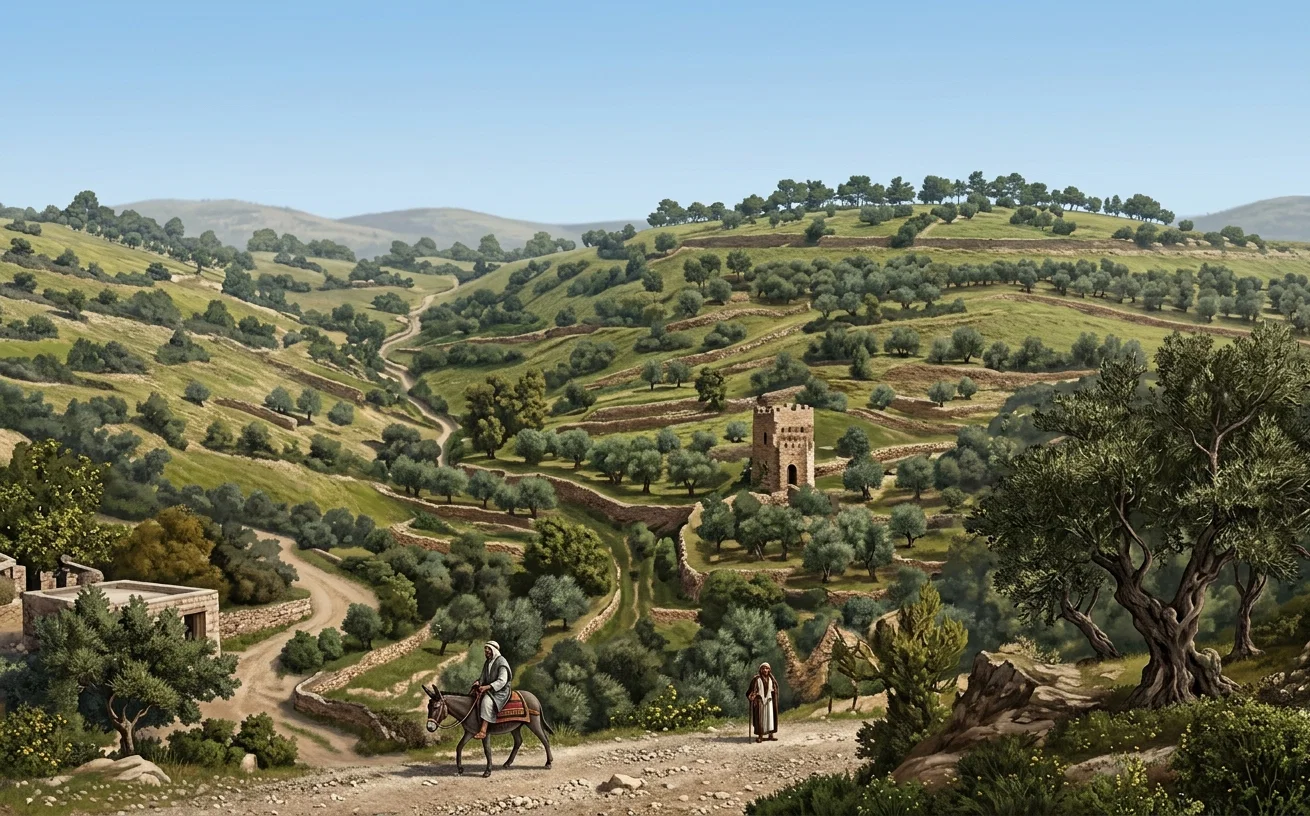
THE MOUNT OF OLIVES
Nearly a mile from the city is a heap of stones, the place where Stephen drew his last breath. Farther on a grotto of immense stones is presented to us as the spot where Jeremiah wrote his Lamentations. Along the valley of the Kidron, not far from the city walls, are sepulchers hewn in the rocks. These are still inhabited by lepers and poor Arabs, whom one sees during the day near the city gates, begging of the passers-by.
Calvary is upon a little elevation; not a tree nor a blade of grass grows there. The great stones scattered about indicate only tombs. The scenes of the crucifixion come crowding upon the mind as one treads the spot, and it is sweet to contemplate, by faith, Christ our Saviour in glory, surrounded with his Father and the angels.
After visiting all these sacred cities, after the view from the Mount of Olives, of the desolated city, the ruined temple, the Dead Sea stretching in the distance, one can but long for the heavenly city.
O, pray with us for this city! Pray for this people, that the light of the gospel may reach their hearts. Pray for us also, for we are so weak for a task so great.
The time is short, the hour draws nigh. Let us pray, watch, and work. The Master will soon come.
War in Colombia
By F. J. Hutchins
F. J. HUTCHINS
THE first of this month it was reported that the Liberals were in Chiriqui Grande, a point in the lagoon about forty miles from us. We were just ready to go to Port Limon, to visit our company there, but this report hindered us. The report was confirmed, and so we were not safe to leave our property.
One week later the Liberals landed at this spot, and took possession of it. Old Bank, the place of their September battle. They sent word, under a flag of truce, that they would give the government four hours to surrender. We were warned to escape from the town, and to go to the American man-of-war, which had come in the day before. We were informed by the commander of the battle ship that the situation was a grave one, and that we were not safe at home, and we, with all other Americans, should come to his ship for safety. We hastily packed a few small effects that we could store in our mission launch, the “Messenger,” locked up the house, committed the property to God, and acted on his advice, as we knew of no good reason for staying.
Two days later, just about sunrise, the battle began, and bullets whistled overhead on the right and on the left, some striking in the water close to us, although we were perfectly safe. Late in the afternoon, after some negotiations between the two parties, the representative of the government agreed to surrender the next morning. This was done, and so the war ended with the Liberals in charge again. There were twelve killed and twelve wounded on the government side, and twenty killed and about the same number wounded on the Liberal side. This occurred Friday about ten o’clock.
On Sabbath the Colombian battle ship came in, also a sixty-ton steamer, loaded with recruits. As the result, we spent Sabbath at our own home. Again, on Sunday, we packed up everything in haste, and left with the full expectation that the place would be bombarded; and if so, most likely the mission would suffer. Before going we asked the Lord to let it be as it pleased him; to spare his property only if he could use it still for the salvation of souls. After thus dedicating it anew to him, we left to seek safer quarters for ourselves.
Just as we came in sight of the harbor, we saw a small steamer coming up with flags of truce, which brought the terms of peace that saved the place from bombardment. The Liberals surrendered to the government, without force of arms. In about one hour we were back to the mission, glad for another deliverance from disaster. We do not know what to expect from one day to another, but we are thankful for the kind, loving watchcare of our Heavenly Father.
Amid all the shooting, not one bullet struck the mission home, as far as we were able to see. Some houses were almost destroyed, among them the Catholic church, the Methodist church, and some dwellings near them. One of our sisters and her daughter and granddaughter were in the midst of the whole battle, and their lives were spared, although many balls passed close to them through the house. The daughter was burned on the shoulder with one bullet.
We are of good courage, although everything is at a standstill. Pray for us and the prosperity of the work in this stricken country.
Notes from the Regions Beyond
THE week of prayer offerings from the little church at Bonacca, Bay Islands, amounted to $17.35.