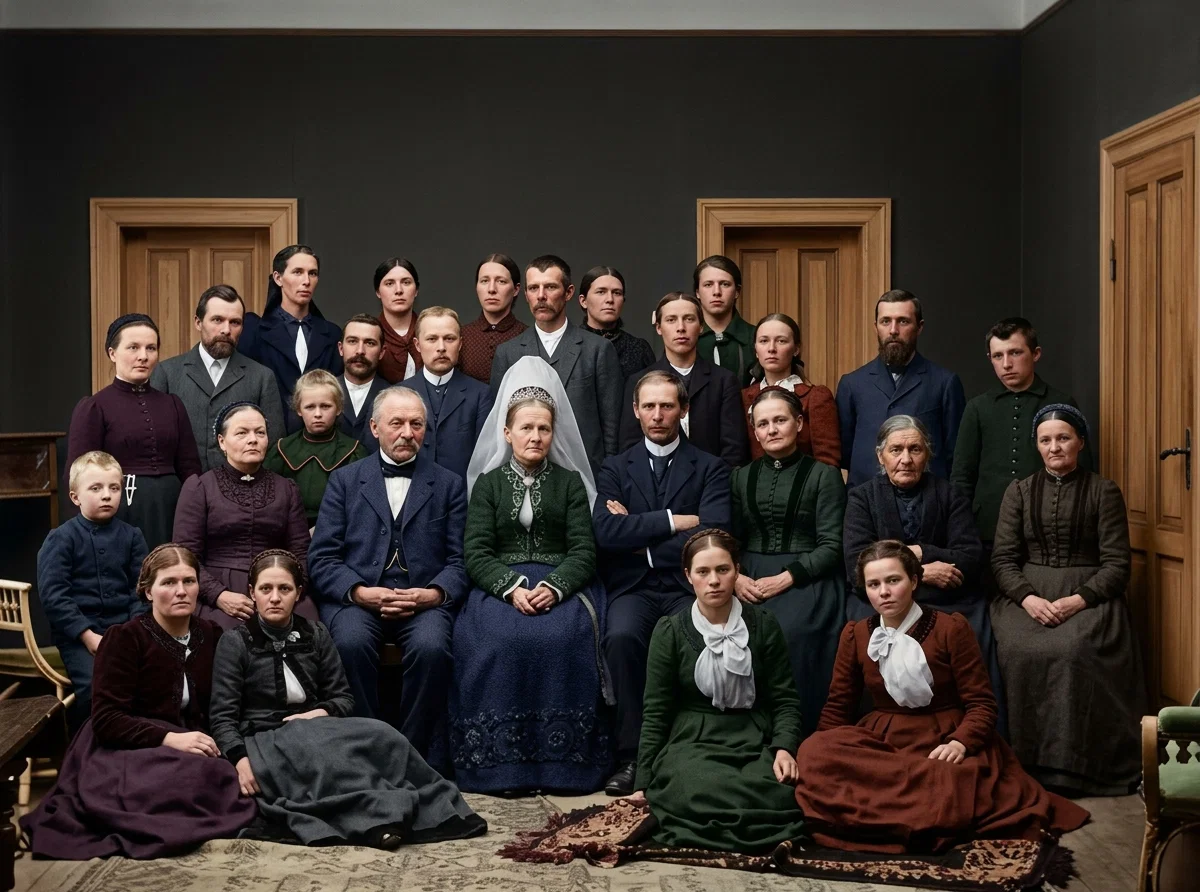
God is love; therefore love is born of God. Many, however, who enter into the marriage relation are ignorant of the love that is born of God. They mistake lust for love. True love is unselfish and enduring. It stands by through “better or worse,” in sickness as in health, and is faithful unto death.
Marriage is sacred. It was instituted by God himself, and all who enter wedlock take upon themselves most solemn obligations, and assume the most tender relations one to the other. But too often the husband and wife drift apart when the tests of married life come, and their vows at the marriage altar become a dead letter. Instead of faithfulness “until death doth us part,” a separation takes place on the merest pretense. Indeed, divorces are so frequent nowadays that it is no wonder many are asking, “Is marriage a failure?”
Duties of the Husband
When God presented the woman to Adam, he laid upon him obligations that reach every man who enters the married state, though many who repeat these vows are ignorant of their true meaning, and therefore fail to realize the solemn responsibility they are assuming.
In the Bible the husband's duty is clearly outlined, love being the starting-point. We read:— “Husbands, love your wives, even as Christ also loved the church, and gave himself for it. . . . So ought men to love their wives as their own bodies. He that loveth his wife loveth himself. For no man ever yet hated his own flesh; but nourisheth and cherisheth it, even as the Lord the church.” Eph. 5: 25-29.
How many there are who know nothing of the pure, true love here defined! Mark the degree of love,—as Christ “loved the church.” He gave up all, even life.
Men ought to love their wives how much?—“As their own bodies.” Bone of his bones, and flesh of his flesh, you see. Self love is strong in a man's heart, but his wife is to be loved as himself. How is it, husbands who may read this article, are you providing amply for your wife, nourishing her as your own body? Are you mindful of the needs, not only of the body, but those of the heart and mind? Are you “encouraging, comforting” her daily? Do you “cherish” with “tenderness and affection” the wife by your side? If not, you are failing in the duty God has enjoined upon you as a husband. Remember, “No man ever yet hated his own flesh, but nourisheth and cherisheth it, even as the Lord the church.”
Again we read, “Husbands, love your wives, and be not bitter against them.” Col. 3: 19. “Bitter” is a little word, but means much. A few of Webster's definitions are: “sharp; causing pain; cruel; severe; reproachful; sarcastic.” Is it any wonder God warns you against so dark a list? Have you ever spoken sharp words to the wife, or been severe, sarcastic, cruel? Have you ever reproached, when she failed in any line of duty, the one who should be loved as yourself? Remember, “No man ever yet hated his own flesh, but nourisheth and cherisheth it, even as the Lord the church.” A man who would blush with shame to strike his wife with his hand, will often smite her with his tongue, which causes her deeper pain than would a blow from his strong right arm. O husbands, be careful of your words!
Perhaps you say, “God forbid that I should be such a monster.” Well, there is danger of failure on this point, or God would not have inspired such an admonition; for “all Scripture is given by inspiration of God.” Be careful that you study well this portion of his Word, and be sure you fail not in all the duty you owe your wife.—Mrs. M. C. Du Bois.
The Love That Will Not Let Us Go
NIGHT was upon the city, and the children of darkness were in the streets. A mother moved slowly along in the crowd, looking eagerly and anxiously into the faces of those who passed, and whenever the swinging door of a saloon flashed a glare across the pavement, she turned quickly to look within the place where she thought perhaps her son might be.
She was searching for him, searching with motherly disregard of her surroundings, intent upon taking him home. That was her one mission in the crowd, to find and to take home her son. She found him at last, a pitiable figure; and he had no desire to go home. He had broken with his ideals, he had cast love to the winds, and the bestial in him held the reins and the whip.
But in that mother's heart was a passion stronger than the beast in the boy, a love so determined in its purpose, so compelling in its steady pull upon the boy's better self, that he did go home in spite of the clamor and tug of his lusts. Then, as before, and afterward, the cry of that mother in prayer and in any voicing of her love for him was ever the same: “I can not, can not, let him go!” Nor did she let him go until from a clean life, moving quietly on day by day, the Lord took him out of the fight.
What that mother did for her son, is done for every one of us day by day.—Sunday School Times.
A Lesson from the Plants
By MRS. L. M. MOREHOUSE
MRS. L. M. MOREHOUSE
When I found my plants in the cool dark cellar showing signs of life, I brought them out and placed them in the light, but not in the sun. As the plants received new life, and the new leaves developed, the dead leaves began to drop. As I was tempted to break off the unsightly leaves, I was suddenly impressed with the lesson for me to handle my fellow men with care. As the plant gains strength, it can be set in the sunlight; then as the new life flows through the plant, the old dead leaves will drop off of themselves, and the stem will not be injured, as it might be by our hand.
So, I thought, when the Spirit of God enters the human heart, and we see little tokens of a new life, let us remember that that person is but a “babe in Christ,” and can not yet bear the strong rays that we older ones can. Let us deal gently with such ones, and not be in a hurry to strip off the defects that mar their Christian character, but kindly lead them to the greater light, and let the Sun of Righteousness do the rest as they become filled with his new life.
I am sure that we often take too much upon ourselves, and God would be better pleased if we kept “hands off,” and pleaded more with him to do the pruning in his all-wise way.
Ceresco, Mich.
Happiness and Contentment
“HAPPINESS does not consist in doing what we like, but in liking what we do.”
The Opening of Our Work in Western South America
By F. H. WESTPHAL
F. H. WESTPHAL
The West Coast field is composed of the following four republics: Chile, Bolivia, Peru, and Ecuador. It contains an area of 1,397,926 square miles, and a population of 10,000,000. The official language of the four republics is Spanish, yet there are tribes of aborigines,—the Mapuchi, the Aymara, the Cedma, and others,—and each tribe has its own language. There are a large number of foreigners, also; for nearly all the nationalities of the world are represented.
Near the close of the eighteenth century, a Jesuit, called Lacunza, moved by the evidences of the prophecies of the Bible, wrote a book, which was entitled, “The Coming of the Messiah in Majesty and Glory.” The publishing of this was prohibited by the ecclesiastical authorities; nevertheless the book is still known of by some. This was at least one voice that proclaimed something of the three angels’ messages in Chile.
The Presbyterians began their work in Chile about fifty years ago. They say that two of their laborers were killed in the beginning of their efforts. Little by little a large number of copies of the Scriptures were circulated. The Methodists entered the field with Bibles, and finally the Baptists, and all together these prepared the way somewhat for the last message.
In Peru, where the law prohibited the preaching of the gospel, various laborers had to seal their faith with their lives. A daughter of a Methodist minister was burned, and others met a similar fate. This caused the work to progress, and souls are now hungering for the truth in that country.
Bolivia has been in great darkness. But the missionaries who went there were treated cruelly, some being condemned to death, for the only offense of preaching the gospel. But the Lord did not want the people to be left always in darkness, and he was preparing the way for the proclamation of the third angel’s message. A short time ago Congress proclaimed liberty to preach the gospel. This should be hailed with gladness by all lovers of the truth, to whom the Lord has committed the giving of the news of his coming kingdom to every nation, tribe, and people on the earth.
In Ecuador the doors were closed against the gospel. But finally the Lord directed the government to establish religious liberty, and at present, the rights of all are recognized in all parts of the country.
The third angel’s message came to Chile first, and that by means of the canvassers Nowlen, Bishop, and Davis. Through the work of these, quite a number of persons accepted the truth. After the colporteurs had been there one year, Elder G. H. Baber went to take the superintendency of the field, in 1896.
In a short time believers were gathered in Iquique, Santiago, and other parts, and soon workers were selected from among them. The Baptist evangelist, Henry Balada, who labored as a Bible colporteur; Eduardo Thomann, a deacon of the Presbyterians; Brother Escobar, an exhorter of the Methodists; Victor Thomann, and others began to dedicate their time entirely or in part to work, and in this way the message extended more and more.
Notwithstanding the resistance made by the enemy of the truth, there were gathered from among the freethinkers, Catholics, Spiritualists, and from among the different Protestant denominations, believers, until they now number about two hundred in Chile.
Assisted by donations gathered in Germany in the year 1898, several brethren from Santiago and Arequipa visited Lima, Peru. Here they began to bear testimony of the light which they had. Those in Arequipa who believed were cast into prison; but these brethren, being Chilenos, were sent back to Valparaiso, through the services of the Chilean consul. In this way they were liberated from staying longer in the prisons, jails, and calabooses of Peru.
A little later, Pastor Balada served one year in that country as a witness for the truth, a short while before Elder Baber and Brother Eduardo Thomann visited the brethren.
Brother Pereira had served as a Bible colporteur in the north of Chile, but after receiving the truth had passed two years in Bolivia. There he was cast into prison, and was condemned to death. But by the blessing of God, he was set at liberty, through the services of a lawyer who defended his cause, and who through this means was afterward converted to the gospel.
In 1900 our missionary paper, Senales de los Tiempos (Signs of the Times), was first published. Through it the faithful were more enlightened on the truth, and many others were brought to a knowledge of it. The next year a second paper—La Revista Adventista—was published. This was dedicated especially to aid the members of the churches.
In 1901 the force of workers was strengthened by the coming of Brethren A. R. Ogden and H. F. Ketring from the United States. The burden of the superintendency was placed on Brother Ogden. But because of the failing health of his wife, he returned to the States. Brother Ketring succeeded him as superintendent. The next year the writer was placed in charge of the field.
The message of the third angel was carried to Ecuador in 1904, by Brother Davis, who from that time to the present has been working there as a colporteur. A year later he was reinforced by the coming of Elder Casebeer. Peru also received reinforcement in Elder Perry from the United States.
The Brethren Thomann and Brother Escobar visited Bolivia five years ago. During the four months spent there they visited five of the principal cities, and took five hundred subscriptions for the Senales.
In 1905 we opened a school among the Mapuchi Indians. This name signifies “countrymen.” Brother Victor Thomann has charge of this school, which is carried on during the winter months. During the summer the teacher works as a preacher among the colonists in the south.
A school for training workers has been opened at Pua. Brother Krieghoff and wife have been in charge of it.
Pray for the work and the workers here.
The Work in Europe During 1906
By L. R. CONRADI
L. R. CONRADI
As we have closed up our accounts for 1906 throughout the European field, we have every reason to be grateful to God for his protecting care. Never before since the opening of the work in Europe have we had an increase either in our membership or in our means that equals the growth of the past year, so that 1906 stands out as our banner year in every way.
Not less than 2,781 new members were added during the year (which nearly comes up to the apostolic 3,000), bringing our membership up to 13,768.
If we view the increase of our finances, we see that the tithe sprung from $101,000 in 1905 to $132,000 in 1906, a growth of about $31,000 in the twelve months; our Sabbath-school offerings to missions rose from $7,689 to $9,485; our First-day offerings from $3,075 to $5,095; and our annual offerings from $6,350 to $6,802: thus the total income from these sources was $153,525 last year, against $118,421 in 1905, a net increase of $35,000.
As to increase in the number of organizations, we would say that we organized two new conferences in the German Union, and have perfected an arrangement making Siberia an organized mission field from Jan. 1, 1907; and the Northlands Mission also starts out as a separate field from the beginning of 1907, in the Scandinavian Union. Thus we add four new organizations. At the same time, we were able in 1906 to have our first baptisms in Portugal, while the British Union established a new mission in British East Africa, on Victoria Nyanza, and the German Union has added another station and two out-stations in German East Africa during the year, increasing its working force in that field to eight persons.
So far as our working force is concerned,14we find that our ordained ministers increased from 74 to 79; licentiates, from 62 to 67; and Bible workers from 133 to 150, while our other workers increased from 62 to 67 on the conference pay-roll, bringing the total up from 284 to 330. Our canvassers increased from 402 to 406, the latter not including our periodical canvassers.
Last year we held four union camp-meetings, and twenty-four local meetings, nearly all of which I attended, besides my trip to the United States, Constantinople, and Asia Minor.
The Lord has signally blessed our institutions, and nearly all of them have shown quite an encouraging gain, and in the few cases where there were slight losses, we were able to make the loss good in some way.
One important step was the securing of suitable property for the British Union institutions, which we succeeded in doing by the purchase of a nice property near London, at Watford, where, everything considered, the property at last secured is the best located and adapted to our needs. Now the four leading union fields of Europe are well provided with suitable properties for their institutions, and if the proper care be taken in their management, there is no question but, by the blessing of the Lord, they will prove a great help to the cause of God in our extensive and important territory.
In the Levant we were just about opening the Constantinople Treatment Rooms when Dr. A. W. George was taken ill, near the end of the year. While the year 1906 records only the death of Sister Wakeham, among our gospel workers, yet the beginning of 1907 has taken from us three devoted workers—Dr. George, Sister Ehlers (one of our German East African workers), and Brother Kueller, an aged pioneer in the work in Germany. If we remember that our workers are so many in number, and that they are scattered over three continents and in all kinds of climates, we surely have reason to thank God for his prospering hand and protecting care over his servants in the past.
As to help from the States, we find, in closing up our audits, that the British Union calls for $2,076.95, the Scandinavian Union for $700, the Latin Union for $7,458.20, and the Levant Union for $4,765.52 from American appropriations, or, in all, $15,000.67. The money to Scandinavia is for the last payment on the Frydenstrand property, and hereafter that union will expect no appropriations from America. On the other hand, the General European Conference, which receives a tithe of the union receipts, was not only able to carry its own officers, and bear its other expenses, but also was able again to vote nine hundred dollars to help the British East African Mission. We surely feel very grateful to the brethren in the States for the $15,000 they granted us to support the work, and if they see that Europe has been able to raise $154,000, and that with the $169,000 it has thus spent we have been able to gain nearly 3,000 new souls for the truth, we believe that all will say that God's blessing has been with their means in a marked degree in developing the European field and the adjoining parts of Asia and Africa.
As we review the many meetings held, and the visits we have made to our institutions during the past year, and recall the unity that has characterized all our councils, we must indeed exclaim that this is God's doing, and it is marvelous in our eyes, especially in view of the fact that there are now about thirty nationalities represented in our various conferences and missions.
NEAR SUNSET ON GULF OF MEXICO
As the brethren in Europe are pressing into the heart of Africa and Asia, we feel certain that the brethren in the States will also in the future remember us not only with their gifts, but also in their prayers, that soon the glad day may come when the whole earth shall be lighted with the glory of this last message, and when we shall all together reap the everlasting rewards.
Hamburg, Germany.
Bonacca
By NETTIE TATUM
NETTIE TATUM
Bonacca is the name applied to our little isle, which is the most easterly of six small islands located off the coast of Central America and washed by the waters of the Caribbean Sea. Bonacca has beautiful harbors.
The first house, built by Mr. Haylock, or “Grandpa Haylock,” as he is familiarly called, is still standing, though its builder has long since passed away. Children and grandchildren have built around the old homestead, as also have many others, making quite a community at present. The other islands near us are also inhabited. The people are mostly of English descent.
We do not have railroads, electric lights, factories, and such things as are found in most other countries. Not even a wagon travels our roads, but occasionally a bicycle crosses our path. No bridges span our lagoons and streams, but God’s wonders are greatly displayed in the panorama of earth, sea, and sky. The scenery is picturesque. We have most gorgeous sunsets, the beauty of which is indescribable to those who have not witnessed it. When the sun is sinking low, the rays of light ascend high in the sky, resembling the aurora borealis, or northern lights, in their fire-like appearance—a faint glimpse of the glory which will attend the soon coming of our Saviour.
There is always summer here, with azure sky and fleecy clouds above us. The placid harbor, which resembles a lake with its tranquil waters, is beautiful. The reef has hardly a wave, and beyond the great ocean can be seen as far as the eye can measure. At other times pleasant, balmy breezes fan the cocoanut-palms, cool the heated land, and ruffle the surface of the water. But yet there are the tropical winds, which blow in March, and cold monsoons, or seasonal winds, from October till February, intermittently coming off the Gulf of Mexico, and crossing the Caribbean Sea.
Our little isle may well be called the land of sunshine and flowers. Birds and butterflies, with their brilliant colors, flit from leaf to leaf and flower to flower. Babbling brooks find their way to the ocean from the ever-green hills, watering the valleys. On cool, calm nights the stars shine with great brilliancy. There are many beautiful shells and coral to be found on our reefs and bars, which are sometimes washed upon the shore by the waves. When gliding over the water on a calm day, we can see many beautiful things beneath us.
Most of the people are industrious, having pleasant homes and large cocoanut gardens by the sea. We travel from island to island in sloop boats and dories. Steamers and schooners from abroad visit us frequently, to get loads of bananas and cocoanuts. The first gasolene launch made in all Honduras was built by Mr. S. Haylock, of Bonacca.
There are three schools found on the island at present. One, taught by a colored man, is a public school. Brother Evans has for eight years conducted a school high on the mountainside, which is just such a one as our Heavenly Father wants, away from the noise and evils of town. The buildings are located in a beautiful little valley, with tall pine-trees around them. Below them is heard the rumble of a waterfall. Besides these, there is our pleasant little church-school at Northeast Bight, which is taught by Brother Cary. Under his patient teaching, the children improve greatly, and are growing up with a love for the Bible and the things of God taught them daily.15
Many Indian relics have been found, showing that these people lived here before the Spaniards drove them from the island. While going to school on the mountain, I have passed an Indian graveyard, with large stones erected, which time and elements have left unmoved.
We have organs and one piano on the island, and nearly all the girls can play with skill, having talent for music.
We have three churches—two Methodist, the other Seventh-day Adventist. There is also another Seventh-day Adventist church at Northeast Bight.
An Egyptian Wedding
By Mrs. J. J. Nethery
MRS. J. J. NETHERY
I THINK I shall tell you about a real Egyptian wedding which we attended while at Luxor. We went to the house where the ceremony was to take place, and waited patiently for the arrival of the bride, who was finally brought in a procession headed by singers and players on cymbals. When the guests heard the music, they went out to meet the bride, and joined in the music, which sounded more like Indian yells than anything else. The bride was brought in, all covered from head to foot with a white cloth about the size of a sheet, and was seated on a sofa. Then the procession went after the groom and brought him in the same manner as the bride, with the exception of the covering. He was seated beside her. Then the two Coptic priests began to read in their turns, and to swing incense, and every few minutes the singers would break forth, and the women, who were sitting on the floor in the corner, would screech out; and if too much noise was made, one of the priests would command them to keep quiet. There was also a man with a whip in his hand, which he was not backward in using when he deemed it necessary.
The reading, which continued about an hour and a half, was composed of nearly every chapter in the Bible which speaks of man and wife or the training of families. Brother Awada interpreted for us. Meanwhile, two shirts, containing a ring in each, were tied together, and thrown between them. Then they were crowned with red handkerchiefs, after which the bride's hand was drawn from her covering, and given to her husband. He did not see her face at all, and perhaps had never seen it, and would not until he had taken her to his home.
The average age of a bride here is from twelve to fifteen years. The young man always pays to the father of the girl a certain sum of money before they are married, usually about one hundred dollars, according to her value, which the father is supposed to return in jewels for the bride at her marriage. Surely it is sad to think what custom and tradition has done for these poor people.
Another strange custom is the manner in which funerals are conducted. When one dies, a number of women go to mourn with the friends. Sometimes they sit out beside the house in the dust, and weep and wail. In the funeral procession several men carry the corpse in a wooden box above their heads, with just a cloth thrown over the box. They are preceded by a number of men shouting, "There is but one God, and Mohammed is his prophet." Then following is a company of women, weeping and wailing, and throwing dust on their heads. The Coptic funerals are much the same, with the exception of the praises to Mohammed.
The Work in Iceland
By David Ostlund
DAVID OSTLUND
Here in the far north the work is prospering, in spite of all difficulties.
Last year we had the privilege of organizing a church in the capital of Iceland. The members of this first church of Seventh-day Adventists in this country numbered twenty. Since the organization seven others have united with us, three of them on the nineteenth of January, this year. The little Icelandic church is an active, living one, so I believe that we shall be able to report good news in the future.
The work here is, as a whole, established upon the conversion of the people. We find them mostly unconverted, not knowing what the life of God is. But it is a precious thing, indeed, to do this first work by the grace of God.
Now and then a brother or sister comes in with us, or, rather, is born anew, and becomes our brother or sister. Our number of Sabbath-keepers is thirty or thirty-five. Some are now preparing for baptism.
Our meeting hall contains seats for about two hundred. The public meetings are very well attended. Our paper, Frækorn, has a weekly edition of four thousand copies. Brother Nils Anderson works with our literature, and especially with this paper. He is of good courage, and is always prosperous.
We have a Sunday-school with about forty members. The day-school, begun last year, has an enrolment of fifty, mostly children of outsiders. The people are not afraid to send their children to our school, for they know us to be in harmony with the Bible. One father said to me some time ago, when speaking about sending two of his children to our school: “I am not afraid of your making Seventh-day Adventists out of my children. Even though I am not one of your church, I know that you follow the Bible better than we do, and I will not hinder them from following the religion they choose.”
GROUP OF SABBATH-KEEPERS AT REYKJAVIK, ICELAND
One of our sisters is working in the school as a teacher. She is a well-educated and intelligent woman, and a whole-hearted Adventist, and uses every opportunity to spread the truth. She has now for a long time been giving Bible readings as well.
We enjoy freedom to teach the word of truth for our time, and we are glad in the hope of seeing many received into the little church here. One Icelandic sister went to the Skodsborg Sanitarium last summer to take a course in nursing, and now another is planning for the same work.
We are well, and happy in the Lord’s work. Iceland is a good land for a happy mission worker. This winter has been a harder one than the preceding two or three. But Reykjavik has the mildest climate of Iceland.
The Moravian Church and Missions
In 1898 the Moravian Church, with less than forty thousand members, gave an aggregate of eighty thousand dollars to missions.
A Washington Training College Educational Convention
By B. G. Wilkinson
One idea suggests another. While ministering to the churches of Baltimore the last Sabbath in March, I endeavored to persuade two or three of their young people to get an education for the work of the third angel's message. The proposition was then made that the Young People's Society of both churches unite in having an educational rally. This proposition suggested the idea of holding just such a rally in our churches of the District of Columbia. The College faculty was pleased with the idea, and a suitable program was prepared and presented to a large audience in the Takoma Park church, April 27.
Many interesting parts were arranged for the program rendered, enlivened by appropriate music under the direction of Professor John; but we will simply endeavor here to state some of the leading points which might benefit those who have a desire to promote similar interests.
Elder K. C. Russell, who was chairman of the day, introduced the program with a short talk upon the necessity of young people's securing a preparation with the definite aim of carrying the message of the Lord's soon coming to the world in this generation. A general education without any specific relation to our work, he said, was not the education that our young people should seek to obtain. In fact, the education of the present time, which would fit a man for a high position in other churches, would not be the preparation needed for a worker in our cause. He once heard a Seventh-day Adventist minister, who previously had been a Baptist minister, answer the question whether the work in which he was now engaged differed very greatly from his previous position. The minister replied that he found his change of work had demanded of him a complete “right about face” in his methods and ideas of labor. How necessary it is, then, for our young people to seek for an education in our own schools!
Professor Lawhead followed with an earnest talk on “The Responsibility of the Church.” He pointed out the necessity of church-members zealously laboring for the conversion of the youth. He recalled an incident in a church out West, where all the young people had practically left the truth and were on the point of being lost to the cause. In consequence, the church was dead. One member, however, resolved to labor earnestly to regain the youth. As a result, the whole church-membership was revived, and very soon quite a company of young people had been brought to Christ, and their faces turned toward a definite preparation for the Lord's work.
After this speech twenty minutes was divided among four students, who spoke upon the value of an education, and the great help they had received at the Washington Training College. Mr. Roggenkamp related his experience as a preacher in the New York Conference. Though the Lord had blessed him spiritually, he felt that he was shorn of the power he might have wielded had he been in possession of a better education. He related briefly two or three incidents, which made a deep impression upon the audience, carrying the conviction that more zeal should be put forth in educating our youth. Mr. Westbrook, as the second student, spoke forth his praises to the Lord for the material help that God had vouchsafed to him while he had been studying the past three years at college. He had mended shoes, had performed carpentry work; and while struggling to meet the financial demands of this period, he had found the Lord a present help and powerful to assist. His stirring words could not but sweep from the minds of the young people any fear which they might have of failing to secure the necessary financial help whenever they are determined to educate themselves for the Lord's work. Mr. Manuel occupied the next five minutes in testifying to the manner in which the Lord had helped him financially while attending school, and he also spoke very earnestly of the great value his studies had been to him in the College. The fourth student, Mr. Prener, testified by his own development to the great good he had received during the two years he had attended Washington Training College. Mr. Prener will labor in the ministry this summer, as in fact all these four students have been called to do.
Professor Derby presented to the audience the subject, “Proper Standards for Our Schools.” He quoted the authority of Dr. Harper to show that all the technical and specific lines of education, as found to-day in the great schools of the world, are wanting in one very necessary element,—religious education. Therefore, our schools should seek to emphasize permanently the religious side of education. He very pointedly called the attention of the audience to the fact that the four students who had spoken had not only gained an education in the College, but had actually gained it while learning to be independent. He therefore concluded that our schools should seek to make a man of an independent mold.
The writer then spoke on the topic, “The Debt of Our Schools to Missions.” In 1792 one little band in England sent forth William Carey, the founder of modern missions. Their donations were $65.50. A century later the one missionary had grown to fourteen thousand, while the $65.50 expanded to almost twenty million dollars. “The field is the world,” said Christ, and he gives to his church power enough to occupy the field. Zinzendorf, the founder of Moravian missions, the fruits of whose noble work are found in all lands, dedicated himself to this work at twenty-two; Judson, the heroic missionary to Burma, sailed from America when he was twenty-four; Robert Morrison took China as his field of labor at twenty-five; David Livingstone gave himself to Africa at twenty-seven; John Williams, the mighty apostle to the South Sea Islands, began work at twenty-one. How necessary it is that the youth be led to consecrate themselves to the missionary idea at an early age, before their growing powers become set in worldly lines.
The speaker here called attention to the great results produced in our own denomination by educational funds, which have been created to help worthy students obtain an education for the work in the German Union, in the British Union, and in the Latin Union, which proved how results had been produced for Europe by the creation of an educational fund. He made an appeal to the churches of the District to take up the matter, and do what they could for the Washington Training College.
The last speaker was Elder Lee Wellman, then on a visit to Takoma Park. He presented himself as an object-lesson of the possibility of educational funds. He had been associated with the writer in the missionary classes of Battle Creek College some ten years ago as a student, at which time he had been helped by an educational fund. To-day he is doing excellent work in the West Indian Islands.
The convention closed by a stirring appeal from Elder Russell. He asked that all those present who desired to secure more education to fit them for the work, should rise to their feet. It was encouraging to note the number of young people who responded to this appeal, testifying to their determination to secure an education that would make them efficient workers for God. All felt that the convention had produced good results. It contributed to arousing a greater enthusiasm on the subject of definitely educating our youth for the work.
How commendable it would be if all our churches and conferences would keep their eyes on the young people, helping them continuously both spiritually and financially, until they find their place in the vineyard of the Master!
On the Sabbath following this convention at the Takoma Park church a similar one was held in the Washington Memorial church. Following is the program as rendered there:—
The blessing of God attended the execution of the program. The hearts of many burned within them as the different speakers opened to their understanding the possibilities of true education, and the desire for knowledge and progress which seizes the newly converted youth. To co-operate with heaven in aiding youthful aspirants after a Christian education, several of the speakers presented the possibilities of our educational fund.17The audience responded with a splendid donation of $215 in cash and pledges. Why may not other of our churches awake and do likewise?