Your ShelfYour Projects

Signs of the Times, Vol. 36, No. 2.

What Statesmen and Wise Men Say

Signs of the Times

Jan 13, 1909

Pacific Press Publishing Association · Mountain View, California · Jan 13, 1909

What Statesmen and Wise Men Say.

The late Lord Salisbury declared shortly before his death, in speaking of threatened wars:
"These wars come upon us absolutely unannounced and with terrible rapidity. The war cloud rises in the horizon with a rapidity that obviates all calculation, and, it may be, a month or two months after the first warning you receive, you find you are engaged in or in prospect of a war on which your very existence is staked."
The late Bishop Newman said:
"This is the most unsettled condition of the world since the crucifixion of Christ. The stability of government is no longer a fact. . . . Statesmen are at their wit's end, philosophers speculate in vain."
Senor Crispi, for many years prime minister of Italy, said at the time of the Spanish-American War: "Europe resembles Spain from a certain point of view. Anarchy is dominant everywhere. . . . WE ARE MARCHING TOWARD THE UNKNOWN. WHO KNOWS WHAT TO-MORROW HAS IN STORE FOR US?"
A recent issue of the London "Daily Express" declares: "THE WHOLE WORLD IS FILLED WITH UNREST. NO MAN CAN KNOW WHAT TO-MORROW MAY BRING FORTH."

What Inspiration Says.

"We have also a more SURE WORD OF PROPHECY; whereunto YE DO WELL THAT YE TAKE HEED, as unto a LIGHT that shineth in a dark place, until the day dawn." 2 Peter 1:19.
QUESTION: Upon which of these shall we base our confidence and hope?

2696.—Jezebel. Rev. 2:20.

Tell us who or what that woman Jezebel refers to in Rev. 2:20. L. V. S.
The book of Revelation, ever and again, refers to the past as examples and types of the future; and among the types of the past which it brings over, is the woman Jezebel and her times. Note the conditions then. Ahab was a king of Israel, and ought to have been faithful to God; but he married outside of his own people, a sun-worshiping princess, named Jezebel. She led away the people of God by that unlawful union. The one voice which was raised against that was Elijah, a type of the true teacher of God. The Revelation uses a part of those conditions as typical of the conditions of the church of God during the Dark Ages, a time when superstition ran riot, when man-made rules took the place of the word of God; when saints and angels were worshiped instead of God, and when God's word was made void by tradition. That great apostasy is referred to as the woman Jezebel, who taught and seduced God's servants to commit fornication, and the antitype in the Christian church led the church away to unite unlawfully with the world, and so commit spiritual fornication, or unlawful union with the kings of earth. Jezebel is a type of the great apostasy.

2698.—Another Day.

Please explain Heb. 4:8, "If Jesus had given them rest, then would He not have spoken of another day." As the first part of the chapter speaks of the Sabbath, does this refer to the Sabbath also?
The subject of the scripture is the rest which God promised His children. Read from the third chapter through. When they left Egypt He promised them rest, and they would have come into that rest had they been faithful. That rest was finished from the foundation of the world. When God made the world, He made a home of rest for His people; and as proof of that, the Sabbath is mentioned. He rested the seventh day from all His works, showing that these works were finished for man from the foundation of the world. At the time of the deliverance from Egypt, they to whom it was preached did not enter in because they did not believe, consequently the Lord gave another time, as expressed in the 95th Psalm: "To-day if ye will hear His voice."
The word "Jesus" ought to be "Joshua" in verse 8. "Jesus" is the Greek form of the Hebrew word "Joshua." Read as in the Revised Version, "For if Joshua had given them rest, He [God] would not have spoken afterward of another day."
Joshua took them into the promised land, but the people were disobedient and unbelieving, consequently did not get the real rest of God there after all. The "another day" in which God gives that rest is to-day. To all those who will come to the Lord Jesus, and receive Him, He will give rest. Matt. 11:28-30. This spiritual rest which God gives here is the earnest, or pledge, of the glorious rest which He will give in the earth made new. Spiritual rest comes when we give up our own works and yield ourselves to God's works. The eternal rest will come when the Lord makes us immortal. The pledge of that eternal rest all through the ages has been His Sabbath.

2693.—Deeds of the Law. Rom. 3:20.

Please explain Rom. 3:20. What are the deeds of the law spoken of here?
The deeds of the law spoken of in Rom. 3:20 are efforts which man puts forth to save himself. Verse 19 declares that all the world is guilty before God, and verse 9, that Jews and Gentiles are all under sin; therefore, no deeds which they can do will meet the requirements of the law. For they are as imperfect as the mortal sinful man who does them. Therefore, man can not be justified by his imperfect deeds. He can only be justified by One who has wrought out for him perfect righteousness, and that is our Lord Jesus Christ. But the Lord places His righteousness upon us for all the sins of the past, and His righteousness within us to change us from sin, in order that we may, by the same grace, walk above sin in the future. Sin has dominion over us when we are transgressing God's law and committing sin, and so only. It is God's desire that His grace shall so fill our hearts, not simply for forgiveness of the past, but for strength to live for Him in the future, "that the righteousness of the law might be fulfilled in us who walk not after the flesh, but after the Spirit." Rom. 8:4.

2694.—The Law. Gal. 5:14.

Will you explain Gal. 5:14? This surely does not mean that the law is fulfilled by loving our neighbors. C. F. C.
Yes, loving our neighbor is the fulfilling of that part of the law which pertains to our neighbor. That is all that is implied in the statement, "Love is the fulfilling of the law." Rom. 13:10. If the law in question pertains to our neighbor, love is the fulfilling of that part; if it pertains to God, love is the fulfilling of that part. But that love always issues in deeds. Jesus says: "If ye love Me, keep My commandments." John 14:15. The apostle John declares, "This is the love of God, that we keep His commandments: and His commandments are not grievous." 1 John 5:3. And so loving our neighbor as ourselves, we will do all in our power to serve Him, as shown by 1 John 3:14-18. The man who loves will help his brother. John concludes his remarks in this respect: "My little children, let us not love in word, neither in tongue, but in deed, and in truth."
Does Ezekiel 40 to 48 refer to the New Jerusalem and the services in the sanctuary, or does it refer to the service of the return of the Jews from captivity?
R. R. T.
Ezekiel 40 to 48 is conditional. If, when the Jews returned from the Babylonian captivity, they had yielded themselves wholly to God, there would have been rebuilt the sanctuary which Ezekiel laid before them. They failed to do this. According to Jer. 18:7-10, God's promises and blessings are conditional. Ezekiel was told to lay before the children of Israel this sanctuary, in order "that they may be ashamed" (chapter 43:10), "and if they be ashamed of all that they have done, make known unto them the form of the house," etc.
There are other expressions in the same prophecy which imply the same conditions. God would have conquered for them all their enemies; Palestine and Jerusalem would have been at peace; the new sanctuary would have been builded, and God would have wrought wonderful things for His people. They would not allow Him to do this by their unbelief; and, therefore, they only obtained the much more inferior sanctuary described in Ezra.

2697.—The Children of Israel in Egypt.

1. Did God send the children of Israel into Egypt?
2. How many kept His commandments and were His children when they came out of Egypt? Please explain to the simple.
M. E. G.
1. Yes, God sent His children into Egypt. This you will learn by reading Gen. 15:13; Ps. 105:17-24; Genesis 45 and 46. While none of the Scriptures directly say that God sent His children into Egypt, yet they all very clearly show that His providence directed Israel in going. There was a twofold purpose that the Lord had in this. First, that His own people might be preserved from famine, and tried, and secondly, that Egypt might have before them constantly the representatives of the truth of God.
2. We do not know how many kept God’s commandments when they came out of Egypt. There are some that did, we know, like Moses and Joshua, and Caleb, and Aaron, and others. How many rebellious there were, we know not. This knowledge the Lord has reserved to Himself. We read in the first chapter of Deuteronomy of the two who left Egypt that went into the promised land; but that does not mean that others were not obedient when they left, nor does it include those who were under twenty years old. This is something which we will have to leave with God.

2699.—After Three Days.

Will you please harmonize for me, Matt. 20:17-20; Mark 10:33, 35, with Matt. 12:38-41, and Mark 8:34?
B. B. No. 745.
There is no inharmony in these scriptures if we will simply understand this, that "after three days," and "in three days," and "three days and three nights," are all expressions employed in a general way just as such expressions are to-day. It does not mean just seventy-two hours or just so many hours a day and a night. The term "day and night" was an expression used by the Jews simply for a day, and "a day and a night" meant what would be called a day, altho it might lack several hours of being a day. Again, "three days and three nights in the heart of the earth" may not mean in the grave, but in the power of Rome who then ruled the earth. If we will look at some of these simple things, it will help us quite materially to understand the Scriptures and this text in particular. The two men who went down to Emmaus and who met Jesus there, told Him, according to the 24th chapter of Luke, at the very close of the first day, that it was the third day since those things were done. The third day, including the three days which include His sufferings and betrayal as well as His crucifixion.

2700.—The Morning of the Resurrection.

When the disciples were assembled on the morning of the resurrection, were they there for worship and had the door locked because the Jews were opposed to their way of worshiping, or were they living there, and afraid the Jews would kill them?
There have no account whatever in the Scriptures that the disciples met on the morning of the resurrection. The record which speaks of their meeting together, with the doors closed for fear of the Jews, refers not to a morning meeting, but to an evening meeting; held toward the close of the first day, and continuing until the second day had well begun. See John 20:19, "The same day at evening." Note also that that expressly says that the doors were shut when the disciples met for fear of the Jews. This was not an assembly for meeting, for we read in Acts 1:13 that this upper room was the place where abode both Peter and James, John, etc., the whole eleven disciples. It was their common living abode.
During the whole of this first day they were in doubt, in trouble, in perplexity, many of them doubtless ashamed to appear in public, because the One in whom they had hoped was to them lying in the grave. So far from meeting to celebrate His resurrection, they did not even believe that He was raised from the dead. See Luke 24:36-41; Mark 16:11-14.

Every One Shall Be Salted with Fire

2701.—B. B. No. 745. Mark 9:49.—The fire referred to here, doubtless is the glory which will accompany God's presence when He comes. "Every one shall be salted with fire." When the Lord comes He will consume by His presence all that are not of Him. "Our God is a consuming fire," we read in the last verse of Hebrews 12; but His presence consumes only sin; and yet the glory of His presence will shine upon all. Those who are not of sin will live. They will endure the everlasting fire. While those who are half identified with sin, will perish before the glory of His presence. See Isa. 33:14, 15; 2 Thess. 2:8.

"Herein Is Love"

By Mrs. E. G. White
CHRIST was not only an expression of the Father's love, but a channel to convey the love of God to men. Christ loved us, and gave Himself for us. He gave His life that He might bring salvation to perishing sinners. Man could not satisfy the claims of justice; no human hand could apply the atoning blood and cleanse the heart from sin. Christ alone, by clothing His divinity with humanity, could reach mankind and bring it near to God.
And "God so loved the world that He gave His only-begotten Son, that whosoever believeth in Him should not perish, but have everlasting life." In the compassionate life of Christ we behold the character of the Father. "He that hath seen Me," Christ declares, "hath seen the Father."
God does not love us because Christ died for us, but it was because He loved us that He gave Christ as a ransom for our sins. Satan has represented God as selfish and oppressive, as claiming all, and giving nothing, as requiring the service of His creatures for His own glory, and making no sacrifice for their good. But the gift of Christ reveals the Father's heart. It testifies that the thoughts of God toward us are "thoughts of peace, and not of evil." It declares that while God's hatred of sin is strong as death, His love for the sinner is stronger than death. Having undertaken our redemption, He will spare nothing, however dear, which is necessary to the completion of His work.
No truth essential to our salvation is withheld, no miracle of mercy is neglected, no divine agency is left unemployed. Favor is heaped upon favor, gift upon gift. The whole treasury of heaven is open to those He seeks to save. Having collected the riches of the universe, and laid open the resources of infinite power, He gives them all into the hands of Christ, and says, All these are for man. Use these gifts to convince him that there is no love greater than Mine in earth or heaven. His greatest happiness will be found in loving Me.
When Christ came to the time of His great trial, His thoughts were not for Himself, but for the disciples whom He was to leave in the world to meet its trials and conflicts. "Little children," He said to them, "yet a little while I am with you. Ye shall seek Me: and as I said unto the Jews, Whither I go ye can not come: so now I say to you. A new commandment I give unto you, That ye love one another; as I have loved you, that ye also love one another. By this shall all men know that ye are My disciples, if ye have love one for another."
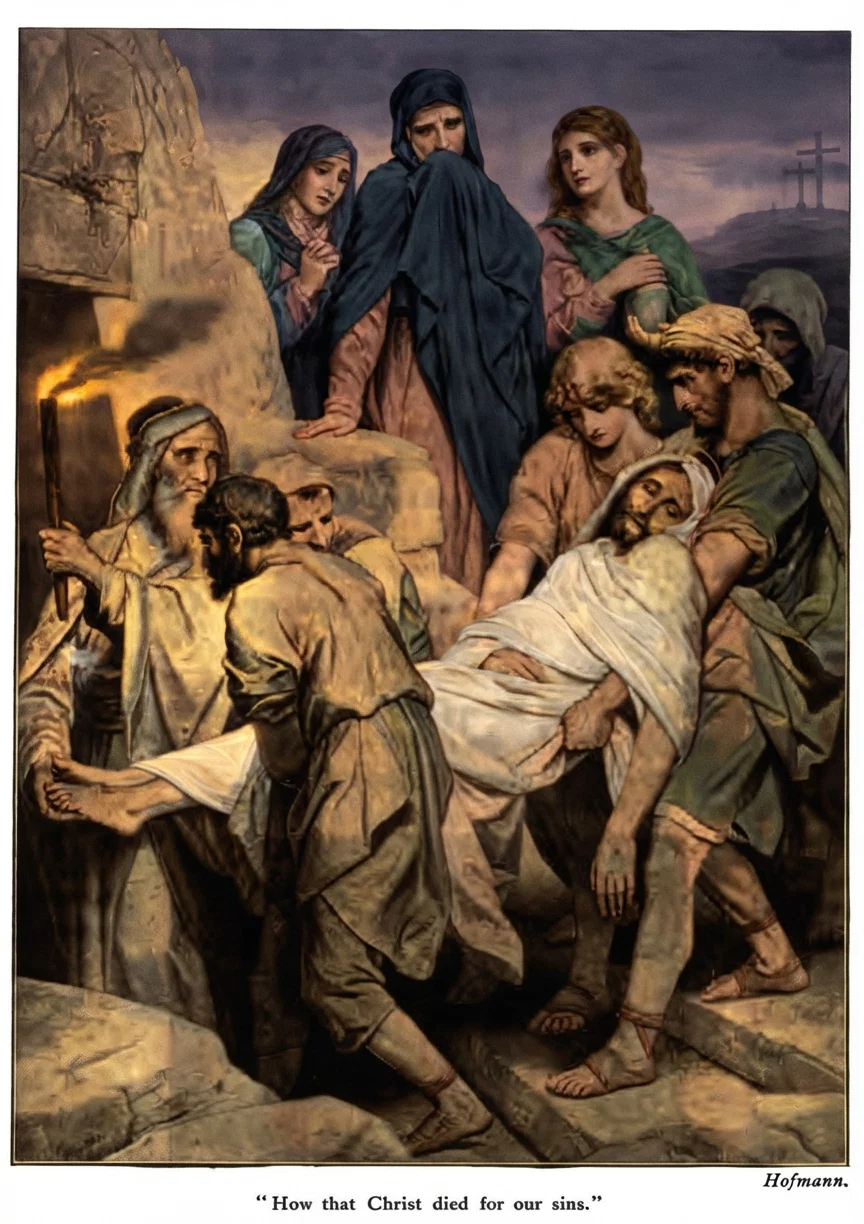
“How that Christ died for our sins.”

The Demonstration of His Love.

"As I have loved you," the Saviour said. The fulness of that love was yet to be more fully demonstrated in His sufferings and cruel death at the hands of men who hated Him because His piety and grace revealed their own great lack. To the disciples this commandment was new; for they had not loved one another as Christ had loved them. He saw that new ideas and impulses must control them; that new principles must be practised by them; through His life and death they were to receive a new conception of love. The command to love one another had a new meaning in the light of His self-sacrifice. The whole work of grace is one continual service of love, of self-denying, self-sacrificing effort. During every hour of Christ's sojourn upon the earth, the love of God was flowing from Him in irrepressible streams. All who are imbued with His Spirit will love as He loved. The very principle that actuated Christ will actuate them in all their dealings one with another.
This love is the evidence of their discipleship. "By this shall all men know that ye are My disciples," said Jesus, "if ye have love one to another." When men are bound together, not by force or self-interest, but by love, they show the working of an influence that is above every human influence. Where this oneness exists, it is evidence that the image of God is being restored in humanity, that a new principle of life has been implanted. It shows that there is power in the divine nature to withstand the supernatural agencies of evil, and that the grace of God subdues the selfishness inherent in the human heart.

Love Begets Love.

God and Christ alone know what the souls of men have cost. For our sakes the Son of God became poor, that we through His poverty might be made rich with eternal riches. His love has bought for us immeasurable grace. "His divine power hath given unto us all things that pertain unto life and godliness," that we "with open face, beholding as in a glass the glory of the Lord," may be "changed into the same image, from glory to glory."
It is not possible for the heart in which Christ abides to be destitute of love. If we love God because He first loved us, we shall love all for whom Christ died. We can not come in touch with divinity without coming in touch with humanity; for in Him who sits upon the throne of the universe, divinity and humanity are combined. Connected with Christ, we are connected with our fellow men by the golden links of the chain of love. Then the pity and compassion of Christ will be manifest in our life. We shall not wait to have the needy and unfortunate brought to us. We shallnot need to be entreated to feel for the woes of others. It will be as natural for us to minister to the needy and suffering as it was for Christ to go about doing good.
Tho now He has ascended to the presence of God, and shares the throne of the universe, Jesus has lost none of His compassionate nature. To-day the same tender, sympathizing heart is open to all the woes of humanity. To-day the hand that was pierced is reached forth to bless more abundantly His people that are in the world. “And they shall never perish; neither shall any man pluck them out of My hand.”
The soul that has given himself to Christ is more precious in His sight than the whole world. The Saviour would have passed through the agony of Calvary, that one might be saved in His kingdom. He will never abandon one for whom He has died. Unless His followers choose to leave Him, He will hold them fast.
Because we are the gift of His Father, and the reward of His work, Jesus loves us. He loves us as His children. Reader, He loves you. Heaven itself can bestow nothing greater, nothing better. Therefore trust.

The Prophetic Image of Daniel 2

By B. G. Wilkinson, A.M., Ph.D.
[The first part of this paper gave the king’s dream, and his efforts to secure an interpretation. This article continues the narrative.—EDITOR.]

The Dream Interpreted—The First Three Empires.

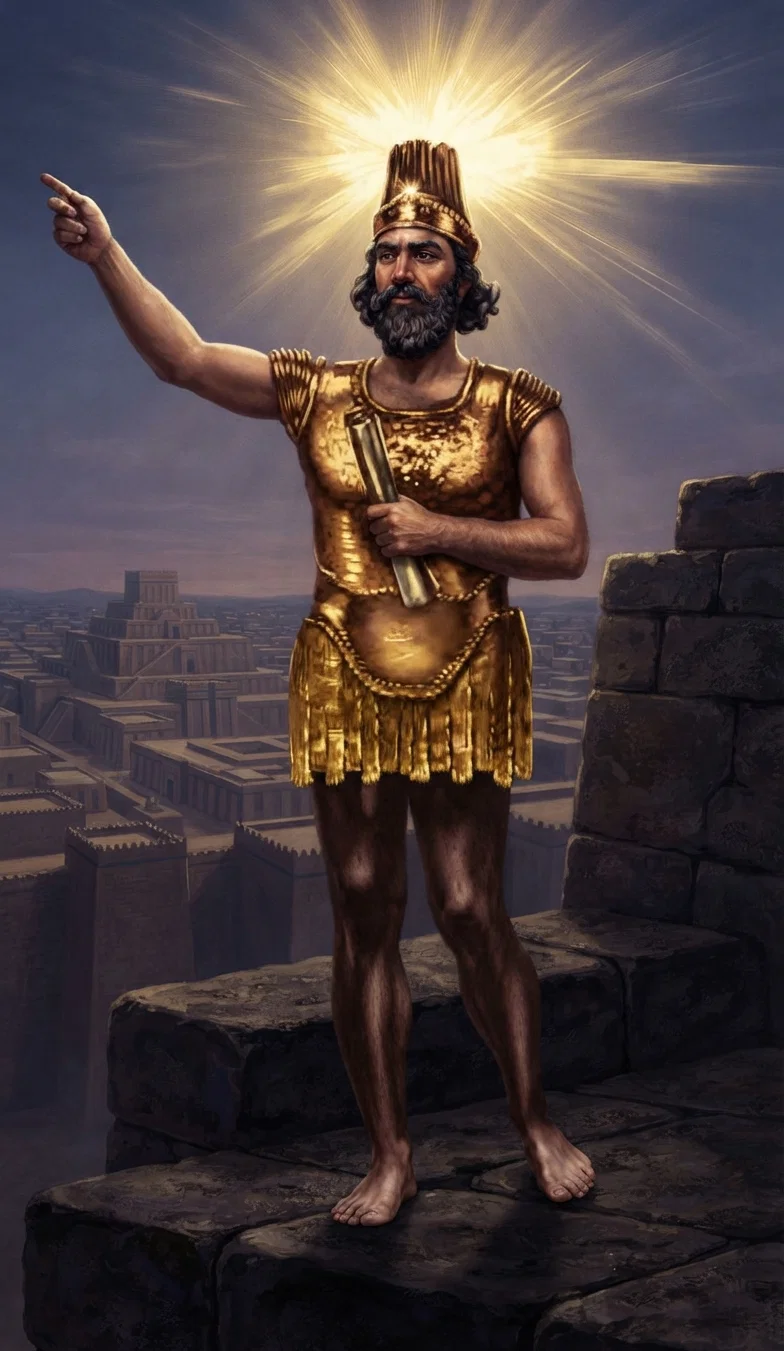
IN astonishment Nebuchadnezzar heard Daniel make the first practical application of the dream to himself and his empire. “Thou, O king,” said the prophet, “art a king of kings: for the God of heaven hath given thee a kingdom, power, and strength, and glory. And wheresoever the children of men dwell, the beasts of the field and the fowls of the heaven hath He given into thine hand, and hath made thee ruler over them all. Thou art this head of gold.” Dan. 2: 37, 38.
First in glory as well as in time was the universal empire of Babylon. To those who lived in the days of its greatness, it appeared as if built to endure permanently. Tho it did not attain its fullest glory until about 625-600 B.C., yet the foundations of the nation were laid immediately after the Flood. We hear much of the tower of Babylon, where God worked the confusion of tongues; but we hear little of the city which was built about the same time. “So the Lord scattered them abroad from thence upon the face of all the earth; and they left off to build the city. Therefore is the name of it called Babel; because the Lord did there confound the language of all the earth.” Gen. 11: 8, 9. The city seems originally to have been one of four which, according to Gen. 10: 9, 10, were built by Nimrod, a great grandson of Noah. The Babylon, therefore, mentioned in connection with the tower of Babel, and the Babylon built by Nimrod can be considered as one and the same city, for Nimrod has usually been reported by Jewish and Arabic literature as the mighty rebel who led on the revolt against God which resulted in the confusion of tongues.
Under Nebuchadnezzar, this city sprang into a commanding position. His nobleness of character and his great ability made this king a suitable instrument in the hand of God to carry out the divine purposes, especially when the Jews had sunk back into lifeless idolatry. “Nebuchadnezzar was the real founder of the Babylonian Empire. The attempt of Pharaoh Necho to win for Egypt the inheritance of Assyria was overthrown at the battle of Carchemish; and when Nebuchadnezzar succeeded his father in B.C. 604, he found himself the undisputed lord of Western Asia. Palestine was coerced in 602 B.C.; and the destruction of Jerusalem in 587 laid a way open for the invasion of Egypt, which took place twenty years later. Tyre also underwent a long siege of thirteen years. . . . Babylon was now enriched with the spoils of foreign conquest.”—A. H. Sayce, “Ancient Empires of the East,” p. 2.

Babylon the City.

With such riches flowing into the capital city through these vast conquests, Daniel declared before the king, “God . . . hath made thee ruler over them all. Thou art this head of gold.” The captive prophet had beheld the splendors of that city of which Nebuchadnezzar said later, “Is not this great Babylon, that I have built for the house of the kingdom by the might of my power, and for the honor of my majesty?” Dan. 4: 30.
Beneath the terraces of his palace, whose remaining walls and piers still rise in their ruins to the height of seventy-five feet, still shimmered in the sunlight the fine streets lined with houses, three and four stories high. Two other structures of unusual beauty and size stood out against the sky. The first was “the great temple of Marduk, or Bel, the head of the Babylonian pantheon. Altho the beginning of this structure goes back to a very ancient period, it was Nebuchadnezzar who restored and enlarged it beyond its former proportions, and within its sacred precinct, in which the temple stood, he erected numerous shrines to various gods and goddesses, who constituted, as it were, the court of the chief god. A feature of the precinct was a high tower eight stories in height, formed by a series of stages, one above another, with a balustrade running around the tower to the top.”—M. Javis, Ph.D., in Harper’s Magazine, April, 1902.
The second edifice standing within the city walls and so wonderful to the ancients, was the hanging gardens. The bride from Media, who shared the throne with Nebuchadnezzar, sighed for the mountains of her native land. To cheer her, the king caused to be constructed successive terraces, rising in stages one above another. Each one of these was covered with earth in which were planted beautiful trees and rare plants, the whole being so arranged as to give the appearance of a natural mountain.
The city walls themselves were of striking dimensions. “A space of more than 130 square miles was enclosed within walls eighty feet in breadth and 300 or 400 feet in height, if we may believe the record.” (George Grote in “Great Events by Famous Authors,” Vol. 2, p. 75). Other writers speak definitely of three massive walls, the outer one being broad enough on top to be made into a great street upon which a four-horsed chariot could be driven. Pierced by 100 gates and flanked by 250 towers, they must have struck with admiration the astonished beholder. To speak nothing of the numerous population within their circuits, nor of the notable bridges which crossed the Euphrates, the prophet could well call it, “Babylon, the glory of kingdoms, the beauty of the Chaldees’ excellency.” Isa. 13: 19.

Medo-Persia.

This glittering empire, however, was not to become permanent. Daniel had noticed that, beginning with the head of gold, the different divisions of the statue declined in worth until the head of gold rested upon the feet of clay. “After thee,” he declared to Nebuchadnezzar, “shall arise another kingdom inferior to thee.” Nebuchadnezzar had no successor able to maintain what he had built up. He reigned forty-three years; from the time of his death in 561 B.C. till the fall of his empire in 538 B.C. five successors reigned in this space of twenty-three years. Only one, Belshazzar, has become famous, or infamous, through his godless feast, the night when the shining hand traced on the palace wall the sentence of Babylon’s doom. The city fell before the skilful attack of the Medes and Persians. “Cyrus,” says George Grote, “caused another reservoir and another canal of communication to be dug, by means of which he drew off the water of the Euphrates to such a degree, it became not above the height of a man's thigh. The period chosen was that of a great Babylonian festival, when the whole population were engaged in revelry and amusement. The Persia troops, . . . watching their opportunity, entered from both sides along the bed of the river, and took it by surprise with scarcely any resistance.”
In this manner the second empire, that of Medo-Persia, took the kingdom. The head of gold was replaced by the breast and arms of silver. How rapidly had prophecy become history! Under the Medo-Persian empire, the reign of organized civilization pushed further westward and eastward. As God had used Nebuchadnezzar, so he used, as long as he was able, Cyrus and his successors. Under Cyrus took place the return of the Jews from Babylon to Jerusalem. Under Darius, 521-486 B.C., the empire still continued to aid in the restoration of Jerusalem. His son and successor, Xerxes, named Ahasuerus in the book of Esther, occupied his life with the dreadful campaign against Grecia, so disastrous for Persia. After him, the empire plunged rapidly forward toward its doom. Riches, luxury, selfishness, treason, plots, and revolts undermined confidence and public authority. Cyrus, as the anointed of the Lord, had been held in the hand of God as the Lord led him on to the execution of His designs. But when his successors departed from God, the hand of the Lord was withdrawn. “And now will I return to fight with the king of Persia,” said the angel to Daniel, “and when I am gone forth, lo, the prince of Grecia shall come.” Dan. 10: 20.

Greece.

“And another third kingdom of brass, which shall bear rule over all the earth.” No city or nation of previous time ever secured the prominent hold upon history as did Greece. Long before the days of Alexander the Great, the cities of Greece had given to the world men of imperishable fame. Solon, for his wisdom; Pausanias, for his bravery; Eurepides, for his dramas; and Demosthenes, for his oratory, had left behind immortal records. The heroic resistance of little Greece to the gigantic invasion of Persia molded a people of resistless daring, fit for the use of Alexander. Under the attacks of his commanding genius, the empires of antiquity fell to pieces, and the Grecian race, as foretold by Daniel, assumed the dominion of the earth. This youthful conqueror succeeded his father upon the throne of Macedonia and Greece in 336 B.C. By 333 B.C. Asia Minor, Palestine, and Egypt had yielded to invasions. Three great battles, Granicus, Issus, and Arbela, the last in 331 B.C., laid the Persian Empire at his feet. Then followed the subjection of Babylon, Susa, Persepolis, Ecbatana, and Persia.
His vast undertakings, however, came suddenly to an end. In 323 B.C., in Babylon, in the midst of great plans for the future, he suddenly died. The unity of his empire failed to survive him; the ultimate division of his dominions among his four leading generals, followed his death. Nevertheless God has accomplished His purpose in giving unlimited sway to Greece. The language and civilization of that energetic people were spread abroad throughout the known world. Not only was the Old Testament translated into the Grecian tongue, but the advantages of that speech were secured to the New Testament as well. Grecian arts became the handmaiden of the new truths proclaimed by Christ. And as Solomon employed the workmen of Tyre to build a temple to God, so the Christian church, vitalized by the Holy Spirit, continued its flight to Western worlds on the wings of Grecian knowledge. It remained for the thighs of brass to be replaced by the legs of iron,—only one step more, and then the setting up of the everlasting kingdom which should never be destroyed.

The Eighth Commandment

By J. O. Corliss
[By mistake the article on "The Ninth Commandment" preceded this. It is out of order, but it makes no difference in the merits of the article, as each is independent of the other.—Editor.]
THE more closely one examines the moral law, the more clearly he sees its breadth of purpose to guard the prerogatives of Jehovah and the rights of all men. The sanctity of God's name as creator, the life of the creature man, and the purity of his family, are by it required to be sustained inviolate under extreme penalty. Next to these, one's earthly possessions are remembered, and the command issues:
*************************
  • "THOU SHALT NOT STEAL." *
*************************
The original word here rendered "steal" means to take by stealth, or secretly. The commandment does not limit the value of the thing so taken in order to bring it within the prohibited act, but simply says: Take nothing by stealth from another that is his by right. The thing desired may be a trifle, and of little or no intrinsic worth, but it belongs to another, and so is guarded by the commandment which forbids stealing.

Stealing and Robbery.

According to the Scriptures, there is a difference recognized between stealing and outright robbery. As already noticed, to steal is to take another's goods surreptitiously. But to commit robbery, in a general sense, is to seize or snatch goods openly from another. While the latter is by far the worst sin because violence is added to the theft, it will be noticed that the commandment guards even the milder form of wrong, where no personal injury is contemplated.
The Hebrew word for robbery is not, however, confined to taking possession forcibly of another's goods, but covers the idea of "snatching away" a thing from another, even tho it rightfully belongs to the snatcher. This is because such an act involves personal violence, which the moral law forbids on the ground that it would not be doing to another as one would have another do to him.
But going still further, some acts are considered robbery which do not involve personal encounter. The question has been seriously asked: "Will a man rob God?" Mal. 3: 8. It is not possible for one to have a personal encounter with Jehovah, and yet He says: "Ye have robbed Me . . . in tithes and offerings." In this case God is robbed by a man's withholding from Him that which he has in his possession belonging to God, selfishly retained, because it is within his power to do so. After this same manner a man, or an organization of men, may commit robbery by withholding from others their rights, because it is in their power to do so. It matters not by what human rule or custom the act is done, according to the Golden Rule, such is robbery.
It was this sort of robbery which was practised by the hypocritical Pharisees, of whom the Saviour said: "Ye devour widows' houses, and for a pretense make long prayers; therefore ye shall receive greater damnation." Matt. 23: 14. As is emphasized by this statement, praying at any length by those who take from, or withhold from, others their just dues, only makes the sin more heinous, and therefore adds to the condemnation merited.

Outside of Material Property.

Coming back to the milder form of sin contemplated by the commandment under consideration, let us briefly consider its intent further, in harmony with the foregoing analysis of robbery. As before learned, stealing consists in getting things by some secret or sly method. One may refrain from taking material property from another, and yet be guilty of stealing. There are possessions of more value than real property or bank stocks. We learn from high authority that "a good name is rather to be chosen than great riches, and loving favor rather than silver and gold." Prov. 22: 1. To take away either of these by fraud is to steal that which may not easily be recovered, and for which the common law does not in all cases provide a remedy. Material property may be located in the possession of the thief, but the good name or loving favor of a neighbor taken from him can not thus be placed. The thief does not possess it, and therefore may not always be approached. It is this feature that makes reputation-stealing so aggravatingly odious.
It is not necessary to lie openly about one in order to take from him this most valued treasure. The "loving favor" enjoyed by him may be undermined by fawning suggestions that more benefits might accrue to interested ones than they have been receiving, if certainplans were adopted. In all this not a name need be mentioned, or any reference made to the part another has acted in the matter. By such persistent wheedlings, however, the one who has enjoyed the confidence and sympathy of the public finds in time that his social or religious standing has been impaired, and he has lost that which he valued more than money and land.

An Evil Custom of All.

This is not entirely a supposititious suggestion. The same course has been pursued for ages, both in and out of the church. Altho swift justice does not always follow an act of this kind, yet the embezzler has usually reaped the due reward of his labors. The case of Absalom and his untimely fate reveals how God permits justice to overtake this cruel violation of the divine law. Being very desirous of obtaining that favor of the king's subjects to which, as the king's son, he felt entitled, he prepared himself to win the coveted treasure. Securing a bodyguard, he stationed himself, early each morning, by the gate of the city, and as each traveler came by, he inquired of him from what city he came, and why he came thither. He next proceeded to ingratiate himself into favor by telling the stranger that his cause was just, but that the king had deputed no one to attend to such cases. Then, as tho in sympathy with the suitor, he would say: "O that I were made judge in the land, that every man which hath any suit or cause might come unto me, and I would do him justice!" Kissing then the hand of his auditor, he would let him go.
All this could not fail in time to have its effect. The king's subjects were gradually losing their kindly feeling for him, and the "loving favor" of his people was withdrawn, because "Absalom stole the hearts of the men of Israel." 2 Sam. 15: 1-6. But his booty was not long enjoyed. As soon as the king learned what had been done, and that Absalom had laid deep plans to take the kingdom as well, the royal soldiers pursued the reprobate to the woods, where he was hanged in the boughs of a heavily drooping oak.
How much better it would have been in this case to curb ambition, and live happily, than to steal the hearts of the king's subjects for so brief a period. It is just as reprehensible to steal another's good name and loving favor now as in the days of King David. "Thou shalt not steal." See thou do it not.

Efficacy of Prayer.

IN THE first of a series of articles on "The Salvation of Christianity" which appears in the August number of Appleton's Magazine, Rev. Charles F. Aked quotes a distinguished London medical man, Dr. Murray Hyslop, as bearing this testimony to the efficacy of prayer:
"As an alienist and one whose whole life has been concerned with the sufferings of the human mind, I would state that of all the hygienic measures to counteract disturbed sleep, depression of spirits and all the miserable sequels of a distressed mind, I would undoubtedly give the first place to the simple habit of prayer. . . . Let there but be a nightly communion, not as a mendicant nor repeater of words more adapted to the tongue of a sage, but as a humble individual who submerges or asserts his individuality as an integral part of a greater whole. Such a habit does more to clean the spirit and strengthen the soul to overcome more incidental emotionalism than any other therapeutic agent known to us."
Continue reading: Is the Sabbath Jewish?