Your ShelfYour Projects

Review and Herald, Vol. 89, No. 36.

He Watches Over Israel

Review and Herald

Sep 5, 1912

Review and Herald Publishing Association · Takoma Park Station, Washington, D.C. · Sep 5, 1912

He Watches Over Israel

He watches over Israel, and sweeps The fulness of His mercy into one Great ocean of eternal deeps; No helm need I, no guide, When at my side Is the Maker of a hundred suns.
He watches over Israel, nor sleeps, Lest I should stumble in the closing dark, Like some poor leper as he creeps By rugged rut or notch. Without His watch, My faltering feet would never reach the mark.
He watches over Israel, and keeps The greatness of His mercy to the close; He slumbers not, nor sleeps. In all my little flight, By noon or night, I know that He will lead me to repose.
— Pall Mall Magazine.

“Get Well,” “Questions,” and “Mothers’” Number

OTHER FEATURES: “Nerves,” “Healthful Cookery,” “Theaters,” “Cancer,” “Liquor,” and “Infant Feeding.”

BEAUTIFUL “DUTCH WINDMILL” COVER

September Edition Exhausted by August 31

PARTIAL OCTOBER CONTENTS

Aids to Health Restoration What to do for Exhausted Nerves Milk as a Health Food Simple Methods of Infant Feeding Are Theaters Innocent? Federal Children’s Bureau Mothers’ Congress Poison in Soda-Water Why I Am Against Liquor Stimulants and Narcotics Alcohol and Efficiency Is Cancer Preventable? There Shall Be No Grade Crossings Treatment of Intestinal Disorders Newspapers and Patent Medicines City Christian Help Work Many Other Important Articles and Items
Questions and Answers (11 questions answered).—In this new and popular department the editor replies to questions asked by subscribers. Subscribe now. Send $3.00 for five years; $2.00 for 3 years; $1.00 for one year. Single bound volumes, 1908-11, half leather, each, post-paid, $1.75.

ORDER THROUGH OUR NEAREST AGENCY

If you don’t know the address of our Agency, ask “Life and Health,” Washington, D. C.
Cover Design in Three Colors

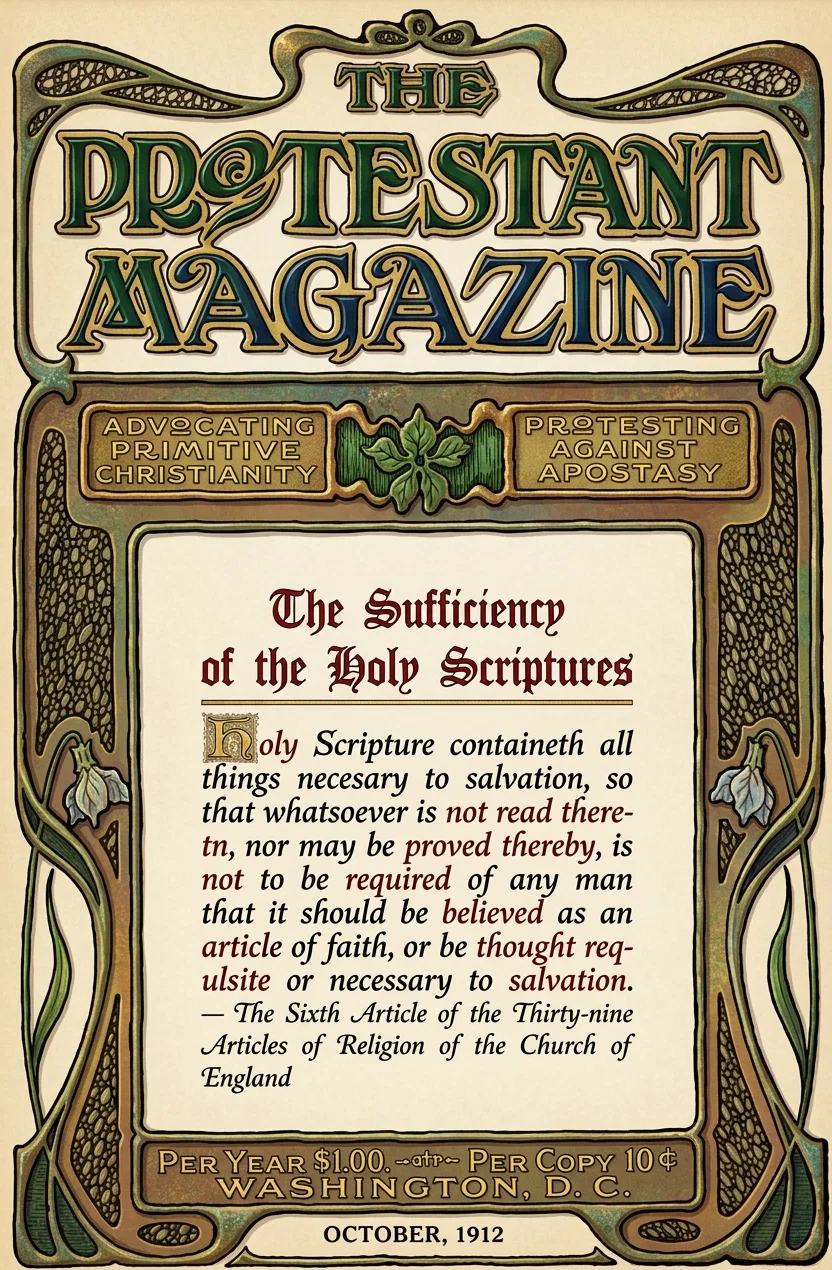
“Guardians of Liberty” and “Marriage Laws” Number

NOW A MONTHLY!
$1.00 A YEAR         10 CENTS A COPY

SPECIAL OCTOBER FEATURES

Double Frontispiece: Photographs of “Catholic Marriage Certificates,” and “Roman Catholic Idolatry in Boston”
Rome and Marriage Again—Rome’s defeat in Canada
Alexander Campbell on Romanism
“Guardians of Liberty”
The “Independent’s” Attack Upon the “Guardians of Liberty”
Reply to Attack of Catholic Truth Society
The Protestant Attitude
Report of Presbyterian Assembly on Romanism
Side-Lights on Religious Situation in France
The Seven Sins of the Roman Church
The Pope as “Ruler of the World”—Reply to attack of Catholic Standard and Times
Rome’s Substitution of Human Mediators for Christ
The Privilege of Peter

SPECIAL OFFER ON FIVE, ONE YEAR

Five copies, one year, to one address or to five separate addresses, only $3.00, or 60 cents each. Sender may include his own name. Or, send $1.50 for ten copies six months. This number should be placed in the hands of every editor, attorney, clergyman, city and county official, and public-school teacher. We can furnish the names and addresses.

ORDER THROUGH OUR NEAREST AGENCY

If you don’t know the address of our Agency, ask “Protestant Magazine,” Washington, D. C.
PRICES, POST-PAID

Yearly subscription - - - - $1.00
Six months - - - - .50
(Subscriptions for less than six months
not accepted)

Three years - - - - 2.00
Five Years - - - - 3.00
Five copies, one year, to one or more
addresses - - - - 3.00

NO EXTRA CHARGE ON FOREIGN
SUBSCRIPTIONS
PRICES, POST-PAID Yearly subscription - - - - $1.00 Six months - - - - .50 (Subscriptions for less than six months not accepted) Three years - - - - 2.00 Five Years - - - - 3.00 Five copies, one year, to one or more addresses - - - - 3.00 NO EXTRA CHARGE ON FOREIGN SUBSCRIPTIONS

MRS. E. G. WHITE

Patmos

MRS. E. G. WHITE

More than half a century had passed since the organization of the Christian church. During that time the gospel message had been constantly opposed. Its enemies had never relaxed their efforts, and had at last succeeded in enlisting the power of the Roman emperor against the Christians.
In the terrible persecution that followed, the apostle John did much to confirm and strengthen the faith of the believers. He bore a testimony which his adversaries could not controvert, and which helped his brethren to meet with courage and loyalty the trials that came upon them. When the faith of the Christians would seem to waver under the fierce opposition they were forced to meet, the old, tried servant of Jesus would repeat with power and eloquence the story of the crucified and risen Saviour. He steadfastly maintained his faith, and from his lips came ever the same glad message: “That which was from the beginning, which we have heard, which we have seen with our eyes, which we have looked upon, and our hands have handled, of the Word of life; . . . that which we have seen and heard declare we unto you.”
John lived to be very old. He witnessed the destruction of Jerusalem and the ruin of the stately temple. The last survivor of the disciples who had been intimately connected with the Saviour, his message had great influence in setting forth the fact that Jesus was the Messiah, the Redeemer of the world. No one could doubt his sincerity, and through his teachings many were continually turning from unbelief.
The rulers of the Jews were filled with bitter hatred against John for his unwavering fidelity to the cause of Christ. They declared that their efforts against the Christians would avail nothing so long as John's testimony kept ringing in the ears of the people. In order that the miracles and teachings of Jesus might be forgotten, the voice of the bold witness must be silenced.
John was accordingly summoned to Rome to be tried for his faith. Here before the authorities the apostle's doctrines were misstated. False witnesses accused him of teaching seditious heresies. By these accusations his enemies hoped to bring about the disciple's death.
John answered for himself in a clear and convincing manner, and with such simplicity and candor that his words had a powerful effect. His hearers were astonished at his wisdom and eloquence. But the more convincing his testimony, the deeper was the hatred of his opposers. The emperor Domitian was filled with rage. He could not dispute the reasoning of Christ's faithful advocate, nor match the power that attended his utterance of truth; yet he determined that he would silence his voice.
John was cast into a caldron of boiling oil; but the Lord preserved the life of his faithful servant, even as he preserved the three Hebrews in the fiery furnace. As the words were spoken, “Thus perish all who believe in that deceiver, Jesus Christ of Nazareth,” John declared, “My Master patiently submitted to all that Satan and his angels could devise to humiliate and torture him. He gave his life to save the world. I am honored in being permitted to suffer for his sake. I am a weak, sinful man. Christ was holy, harmless, undefiled. He did no sin, neither was guile found in his mouth.” These words had their influence, and John was removed from the caldron by the very men who had cast him in.
Again the hand of persecution fell heavily upon the apostle. By the emperor's decree, John was banished to the isle of Patmos, condemned, “for the word of God, and for the testimony of Jesus Christ.” Here, his enemies thought, his influence would no longer be felt, and he must finally die of hardship and distress.
To outward appearance, the enemies of truth were triumphing, but God's hand was moving unseen in the darkness. God permitted his faithful servant to be placed where Christ could give him a more wonderful revelation of himself, and of divine truth for the enlightenment of the churches. In exiling John the enemies of truth had hoped to silence forever the voice of the faithful disciple; but on Patmos he received a message, the influence of which his enemies could not destroy, and which was to continue to strengthen the church to the end of time. Though not released from the responsibility of their wrong act, those who exiled John became instruments in the hands of God to carry out his purpose; and the very effort to extinguish the light placed the truth in bold relief.
Patmos, a barren, rocky island in the Ægean Sea, had been chosen by the Roman government as a place of banishment for criminals; but to the servant of God this gloomy abode became the gate of heaven. Here, shut away from the busy scenes of life, and from the active labors of former years, he had the companionship of God and Christ and the heavenly angels, and from them he received instruction for the church for all future time. The events that would take place in the closing scenes of this earth's history were outlined before him;and there he wrote out the visions he received from God. When his voice could no longer testify to the One whom he loved and served, the messages given him on that barren coast were to go forth as a lamp that burneth, declaring the sure purpose of the Lord concerning every nation on the earth.
Among the cliffs and rocks of Patmos, John held communion with his Maker. He reviewed his past life, and at thought of the blessings he had received, peace filled his heart. He had lived the life of a Christian, and he could say in faith, “We know that we have passed from death unto life.” Not so the emperor who had banished him. He could look back only on fields of warfare and carnage, on desolated homes, on weeping widows and orphans, the fruit of his ambitious desire for pre-eminence.
In his isolated home John was able to study more closely than ever before the manifestations of divine power as recorded in the book of nature and in the pages of inspiration. To him it was a delight to meditate on the work of creation, and to adore the divine Architect. In former years his eyes had been greeted by the sight of forest-covered hills, green valleys, and fruitful plains; and in the beauties of nature it had ever been his delight to trace the wisdom and skill of the Creator. He was now surrounded by scenes that to many would appear gloomy and uninteresting; but to John it was otherwise. While his surroundings might be desolate and barren, the blue heavens that bent above him were as bright and beautiful as the skies above his loved Jerusalem. In the wild, rugged rocks, in the mysteries of the deep, in the glories of the firmament, he read important lessons. All bore the message of God's power and glory.
All around him the apostle beheld witnesses to the flood that had deluged the earth because the inhabitants ventured to transgress the law of God. The rocks thrown up from the great deep and from the earth, by the breaking forth of the waters, brought vividly to his mind the terrors of that awful outpouring of God's wrath. In the voice of many waters—deep calling unto deep—the prophet heard the voice of the Creator. The sea, lashed to fury by the merciless winds, represented to him the wrath of an offended God. The mighty waves, in their terrible commotion, restrained within limits appointed by an invisible hand, spoke of the control of an infinite Power. And in contrast he realized the weakness and folly of mortals, who, though but worms of the dust, glory in their supposed wisdom and strength, and set their hearts against the Ruler of the universe, as if God were altogether such a one as themselves. By the rocks he was reminded of Christ, the Rock of his strength, in whose shelter he could hide without fear. From the exiled apostle on rocky Patmos there went up the most ardent longing of soul after God, the most fervent prayers.
(To be concluded)

Little Voices

WORTHIE HARRIS HOLDEN
I AM glad that the brook can praise Him, As well as the boundless sea; That the tiny blade of the grasses May join with the forestry; That the wee lone flower by the wayside Unites with the garden fair To utter a fragrant message Of his infinite thought and care.
I joy in the summer's sunshine, In the winter's frost and snow, In the gales that bend low tree-monarchs, And the zephyrs that softly blow; But the sun pales before his glory, And no snow can his raiment meet, And the winds that blow are but symbols Of his power for those who seek.
I rejoice, though so small and feeble, I may sing of his power and might, That the God who will note the sparrow Is guardian through earth's night; And erelong in the day, beholding His excellent majesty, I shall kneel at his feet adoring, And proclaim his great love for me.

May Christians Dance?

E. E. EMENHEISER
THE question is often asked, Is it wrong to dance? Why not ask, Is it expedient? Is it better to dance than not to dance? I think all will agree that dancing is not an essential virtue; for many of the best people never danced. You can not add anything to the worth of your character by dancing. You can not add anything to your Christian life and influence (not even in the eyes of the world) by dancing. If it is not an essential virtue, if it adds nothing to our Christian character and influence, it is certainly not a good thing for Christians to engage in; for the aim of every Christian ought to be to live a virtuous life, to build up a strong Christian character, and live a life that will influence others for good.
A young woman gave the following reasons why she quit dancing:—
“1. I can make better use of my time. The young man or young woman whose highest aspiration is to have a good time, has a very low conception of life. God has endowed us with extraordinary powers of mind and heart, and placed within reach of each one of us the means by which we may develop these powers, and thus fit ourselves for life. The Christian religion means more than church-membership; it is more than a profession; it is a life,—a life that demands every power of mind, and every power at its best. We owe the world not only the best we have, but also the best we can acquire. Does not my time belong to God? If it belongs to him, then it ought to be given to him, and not to the pleasures of the world. Many young people spend more time training their feet than they give to the development of their minds? If I am God's child, and am a member of the Christian church, having pledged my allegiance to Christ and his cause, I can not consistently give my time to the pleasures of the world.
“2. Because I can not take Jesus with me to the dance. A young woman asked Mr. Moody the question, ‘May I dance as a Christian?’ Mr. Moody’s reply was: ‘Ask Jesus to go with you; if he goes with you, go; if not, you had better stay away.’ She never attended a dance after that; neither will any other Christian that makes it a matter of prayer, and then follows the leadings of the Holy Spirit. Christ said: ‘Let your light so shine before men, that they may see your good works, and glorify your Father which is in heaven.’ Think of a Christian shining in a modern ballroom! Every time Christians get ready to attend a dance, they ought to ask themselves Pilate’s question: ‘What shall I do then with Jesus?’ What will you do with him? Will you say, ‘Master, I am going to the dance; I know it is not a fit place to take you, but I am going for a good time; when I come back, I want your company and fellowship again’? I always have a great deal of sympathy for the Christian who has to go to the ballroom for enjoyment. I never yet knew a fully consecrated Christian who wanted to dance. A true Christian finds joy in the study of God's Word, in the prayer-meeting, in doing good. Think of a Christian preferring the ballroom, with its immoral atmosphere and degrading influence, to the Christian church, where God's name is recorded, where his honor dwells, and where he delights to meet with his people! Think of the Christian who would rather go to a dance than to prayer-meeting; rather dance than help to save lost souls! Do you want real enjoyment? Learn to sit at the feet of Jesus, and drink in the word of truth and life; go with him on the mount of transfiguration, and heaven will come to greet your waiting soul, and glory will crown the mercy-seat. If you have Jesus, he will be your all in all. He will give you joy unspeakable and full of glory; an inheritance that is incorruptible, undefiled, that fadeth not away, reserved in heaven for you. Go to the dance for joy and pleasure?—No; not while God is my Father, Christ my Saviour, and heaven my prospective home.
“3. Because dancing leads to immorality. Dancing is not only a waste of time that should be used for self-improvement and in Christ’s service, but it is demoralizing and degrading. Bishop Meade said: ‘Dancing is not among the neutral things which we may do at pleasure, not among the things lawful, but not expedient; but it is in itself wrong, improper, and of bad effect.’ An ex-dancing-master says, ‘Two thirds of the young girls that are ruined, fall through the influence of the dance.’ Two hundred girls, inmates of the brothel, were personally interviewed as to the cause of their downfall, and from their frank admissions the following figures were obtained: By dancing-school and ballroom, 163; through drink, 20; wilful choice, 10; poverty and abuse, 7. The modern dance, in its very nature, tendencies, and results, is dangerous to social purity. However much we may dislike to tell the truth on this point, we ought to tell it for the good of the young people who are in danger of the damaging influence of the dance. Men take liberties on the dancing-floor that are allowed nowhere else in reputable society. The very poise suggests impurity. The central source of attraction of the modern dance is sex; and I care not what the amusement is that depends upon sex for popularity, it is dangerous to society. Did you ever see man dance with man, woman with woman, for hours at a time?—No; there is no attraction, no fascination, in that kind of dancing. Why do so few young men who dance go to the ballroom for a wife? Why do young men who dance and who have respect for their sisters, want them not to go to the ballroom?
“ ‘But,’ says one, ‘they danced in Bible times; we read quite frequently about dancing.’ Those who appeal to the Bible in justification of the dance should take their Bible and look up every referenceon dancing. They will find that dancing was a religious act; that it was an expression of joy for God's mercies; that dances were always held in daytime; that men and women never danced together; that dancing for amusement was regarded fit only for the low classes; and that there are only three instances given in the Bible of dancing for amusement: The wicked families that Job speaks of, the daughter of the wicked Herod, and the lewd fellow.
“May I dance?—Yes, if a consciousness of my sins forgiven, and if communion with Christ my Saviour, and a hope of heaven and eternal glory, fill my heart with joy, then I may dance before the ark in the house of my God.”
— Religious Telescope.

Suffering Affliction

O. B. KUHN
“In all their affliction he was afflicted.”
In the church of Jesus Christ to-day almost every member is suffering affliction. Many are weakened and handicapped because of diseased bodies and racking pains; some are blind, deaf, lame, or crippled; others may be afflicted in business or social life; and in almost every case the affliction is considered a barrier to spiritual as well as temporal progress. It appears so to the natural eye, and the human heart is caused to cry out, “All these things are against me.”
Often in prayer- or social-meeting the church is requested to unite in prayer for the miraculous healing of some brother or sister. Ministers are appealed to, and the divine power of God invoked to remove the affliction. If it pleases God not to answer their prayers according to their desires, some are cast into discouragement. Satan besets them with unbelief, and causes them to doubt the love, mercy, and divine protection of our Heavenly Father. But God loves us too well and too wisely to answer our prayers always in the way we wish and designate.
In most cases of physical suffering, violation of natural law either ignorantly, deliberately, or indulgently, is the direct cause of the trouble; and should God heal us and we continue the same evil practices and sinful habits, it would be but a little while until we should be as bad as, if not worse than, we were before the healing.
There is a surer way. “My people are destroyed for lack of knowledge.” God therefore sends us light; and through the acquisition of knowledge and its intelligent use, we are able to live in harmony with the laws that govern our being. As we thus walk in the light and faithfully live the principles of health reform, our health improves, our strength increases, our powers develop, and our affliction is gradually removed. This process of healing, though slow, teaches us valuable lessons; we acquire knowledge of our physical being and its laws, and become intelligent in regard to disease,—our affliction,—its causes, and its relation to life and health.
“Would you live for Jesus, and be always pure and good? Would you walk with him within the narrow road? Would you have him bear your burden, carry all your load? Let him have his way with thee.
“Would you have him make you free, and follow at his call? Would you know the peace that comes by giving all? Would you have him save you, so that you need never fall? Let him have his way with thee.
“Would you in his kingdom find a place of perfect rest? Would you prove him true in providential test? Would you in his service labor always at your best? Let him have his way with thee.
“His power can make you what you ought to be; His blood can cleanse your heart, and make you free; His love can fill your soul, and you will see ’Twas best for him to have his way with thee.”
Those who think their lot is harder than others’, and believe that they have been especially singled out to be surrounded by evil circumstances and unfavorable conditions, may know “that the same afflictions are accomplished in your brethren that are in the world;” for “there hath no temptation taken you but such as is common to man: but God is faithful, who will not suffer you to be tempted above that ye are able; but will with the temptation also make a way of escape, that ye may be able to bear it.” “The Lord pitieth them that fear him. For he knoweth our frame; he remembereth that we are dust.” “For we have not an high priest which can not be touched with the feeling of our infirmities.” “Let us therefore come boldly unto the throne of grace, that we may obtain mercy, and find their own pleasure in times of prosperity, and it is only through adversity that they will seek the Lord. “When he slew them, then they sought him.” “In their affliction they will seek me early.”
Brethren, let us encourage ourselves in the Lord; “for our light affliction, which is but for a moment, worketh for us a far more exceeding and eternal weight of glory.” Soon Jesus will come and “change our vile body, that it may be fashioned like unto his glorious body.” Gleams of the golden morning are evidence that the glory of the eternal day is about to burst upon us. “Then the eyes of the blind shall be opened, and the ears of the deaf shall be unstopped. Then shall the lame man leap as an hart, and the tongue of the dumb sing.” “And the ransomed of the Lord shall return, and come to Zion with songs and everlasting joy upon their heads: they shall obtain joy and gladness, and sorrow and sighing shall flee away.” “And I will rejoice in Jerusalem, and joy in my people: and the voice of weeping shall be no more heard in her, nor the voice of crying.”
“And there shall be no more curse:” for “God shall wipe away all tears from their eyes; and there shall be no more death, neither sorrow, nor crying, neither shall there be any more pain.” “He will make an utter end: affliction shall not rise up the second time.” O, hasten, glad day! “Remember the word unto thy servant, upon which thou hast caused me to hope. This is my comfort in my affliction: for thy word hath quickened me.”

A Way to Help

GEO. E. HOLLISTER
WE may help in the foreign missionary work, and yet remain at home. The following is an extract from a letter received from one of our foreign missionaries by a member of the young people's society of Ontario, Cal.:—
“We feel exceedingly pleased to know that you are so interested in our isolated field away in the remotest part of the South Pacific Ocean, and we are glad for your promise to pray for us.”
“This year has been a hard one in some ways, but it has also been the most fruitful in results. Your prayers have been heard, I am sure. One man who surrendered to God and the message, said in his testimony that he felt that he was there in answer to the prayers of some one away from this island. I then read your letter in which you said you were praying for these people. We have just finished our week of prayer, and it has undoubtedly been the best we have ever had here. At every meeting victories were gained, and souls drawn to Christ. We have indeed had a great revival, and our people all feel stronger in the Lord.”
Surely all of us can take some of our workers and their work to God in earnest prayer, and then write them a good cheery letter, letting them know they are remembered at home.
Chino, Cal.

Beginning and Closing the Sabbath With Prayer

There was a time when in practically every Seventh-day Adventist home the holy hours of the Sabbath were welcomed by prayer, and the same season of spiritual refreshing was enjoyed at the closing Sabbath hour. With some of our people this excellent practise has fallen into disuse. In some families but little attention is paid to the early Sabbath hour. The labors of the week are permitted to encroach upon sacred time. If family worship is engaged in, it is in the late evening rather than at the going down of the sun. In the families of those who are careless in regard to the observance of the Sabbath of the Lord, there is a carelessness also in other things pertaining to Christian experience. The spirit of indifference has entered into their hearts. The family altar has been cast down; sacred prayer is neglected. They do not distinguish clearly between common things and the things of God.
We urge that these indifferent ones stop and consider where they are drifting. The spirit which now possesses them, if allowed to grow, will separate them from God and from his truth. It will affect the hearts of their children, and lead them to carelessness and indifference. On the other hand, the maintenance of the family altar through the week would foster in their hearts a careful regard for the Sabbath hours. From the going down of the sun Friday evening to the same hour Saturday evening, hedge in the Sabbath with prayer and Bible study. This will prove a safeguard in the experience of the entire family.
Do not violate the Sabbath of the Lord at any period of its existence. The first hour, the first minute, is as sacred as any time throughout the period. Honor God by showing reverence for his sacred institutions. In return he will honor you by the presence of his Holy Spirit, and the altar of prayer through the week and at the holy Sabbath hour will become a place where you will meet God face to face, as did Israel of old.

Notes on Important Eras of Fulfilling Prophecy

The Hand of God in History — No. 20

Notes on Important Eras of Fulfilling Prophecy

Increase of Knowledge in the “Time of the End”

(Concluded)
THE seeds of a new order of growth were planted in the soil of the New World in the days of settlement that followed the period of discovery. One writer says:—
Diverse and seemingly incongruous as were the nationalities represented in the colonies,—Dutch, French, German, Swedish, Scotch, Irish, English,—they had all imbibed, either by experience or inheritance, something of the spirit of personal independence, and especially of religious liberty. Gustavus Adolphus designed his colony of Swedes for the benefit of “all oppressed Christendom.” Penn, the Quaker, established Pennsylvania as “a free colony for all mankind,” where the settlers “should be governed by laws of their own making.” The first charter of the Jerseys—which were largely peopled by Quakers and Scotch and Irish Presbyterians—declared that “no person shall at any time, in any way, or on any pretense, be called in question, or in the least punished or hurt, for opinion in religion.” And Oglethorpe’s colony of Georgia was founded to be a refuge for “the distressed people of Britain, and the persecuted Protestants of Europe;” then the German Moravians settled side by side with the French Huguenot and the Scotch Presbyterian under the motto, “We toil not for ourselves, but for others.”—Thompson’s “United States as a Nation,” page 31.
By the end of the eighteenth century a new nation was springing into vigorous life across the sea, founded on the principles of civil and religious liberty, and exerting a powerful influence for a new order of things. All the time the forces of progress and reform in Europe were struggling toward the same ideals.
According to the prophecy, the time of the end began at the close of the period of papal supremacy, in the end of the eighteenth century. That was a turning-point in history. The minds of men were aroused to unwonted activity. The old autocratic order was broken, and the era of constitutionalism and liberty set in. The Papacy, with the closed Bible, stood for the old order. The open Bible and the spirit of genuine Protestantism stood for the new.
The great evangelical movement under Wesley, Whitefield, and others, in the latter half of that passing century, had awakened multitudes. It was a revival among the masses, that made for a new life, and stimulated the desire for education and social betterment. The open Bible had yet freer course; and wherever that agency of heaven goes, enlightenment and progress follow.
All influences conspired to make the opening of the nineteenth century the opening of an era of enlightenment. And back of all uplifting influences, and overruling all, was the Lord, true to his word, inspiring and leading, and ushering in the time of the prophecy, the era of increase of knowledge. As regards the marvelous increase of general knowledge, the late Dr. A. T. Pierson summed up the facts as follows:—
The nineteenth century is conceded to be a century of wonders. Judged by human progress along the highway of scientific discovery and invention, and by the general widening out of the horizon of human knowledge, it is not only unsurpassed, but it leaves all previous centuries far behind. Mr. Gladstone thought that a single decade of years might be found within its limits during which the race had advanced farther than during five hundred decades preceding. This estimate is probably not an exaggeration; but, if so, what must be true of the whole century!—“Modern Mission Century,” page 41.
Another writer says of the development that came with the nineteenth century:—It is something more than a merely normal growth or natural development. It has been a gigantic tidal wave of human ingenuity and resource, so stupendous in its magnitude, so complex in its diversity, so profound in its thought, so fruitful in its wealth, so beneficent in its results, that the mind is strained and embarrassed in its efforts to expand to a full appreciation of it. Indeed, the period seems a grand climax of discovery rather than an increment of growth. . . . The negative conditions of that period extend into such an appalling void that we stop short, shrinking from the thought of what it would mean to modern civilization to eliminate from its life those potent factors of its existence.—Edward M. Byon, M. A.
Two millenniums before, the prophecy had pointed to the closing years of the eighteenth century, and had said that then would be ushered in an age of increase of knowledge. Well we know, however, that it is not primarily increase in merely human knowledge that the prophecy foreshadowed. The wonderful increase in human knowledge, the progress in the arts and sciences, and the inventions that characterize the age are all providential factors; for every means of bringing to men light and information and for spreading knowledge through the world is laid under tribute of service in God’s one great purpose. That purpose is the salvation of men, and the ending of the course of sin and apostasy on earth.
When divine prophecy speaks of increasing knowledge, it means first of all increased knowledge of the Lord, the true wisdom, without which the compassing of all the range of learning is but loss. And in the opening up of all the world, and the spread of general education and enlightenment, we plainly see the providential working of the Lord in preparing the way for the gospel message to reach all nations and tribes and tongues in these last days.
The study of fulfilling prophecy in the time of the end leads us directly to a survey of the spreading abroad of the knowledge of God and of his Word by the wonderful achievements of the “century of modern missions.”
W. A. S.

Worldly Dress

Modern styles of dress are calling forth much comment to-day in the secular as well as in the religious press. Various church societies and clergymen in both Protestant and Catholic churches have spoken plainly against the evil influences attending the manner of dress employed by many women at the present time. Narrow skirts, peek-a-boo waists, short sleeves, and low necks are coming in for severe condemnation. And it must be admitted that the condemnation for the most part is just. True modesty and refinement will be manifested in the apparel quite as much as in the speech and general deportment. A modest, retiring nature, such as every true woman should possess, will seek to avoid that attire which makes her at once the cynosure of curious eyes and the subject of slighting remark.
There is an amazing lack of simplicity in the world to-day. The woman or the girl who seeks to avoid the extremes of modern fashion is counted old-fashioned, and her ideas considered far from being up to date. The determining principles in the question of proper dress are conversion and education. With an education as to what constitutes true womanly modesty and reserve, and consecration of heart to the service of God, young women will see little to appeal to them in the vagaries of modern dress. Let our sisters be all that is implied in the term of true Christian women.
Continue reading: A Testing Message