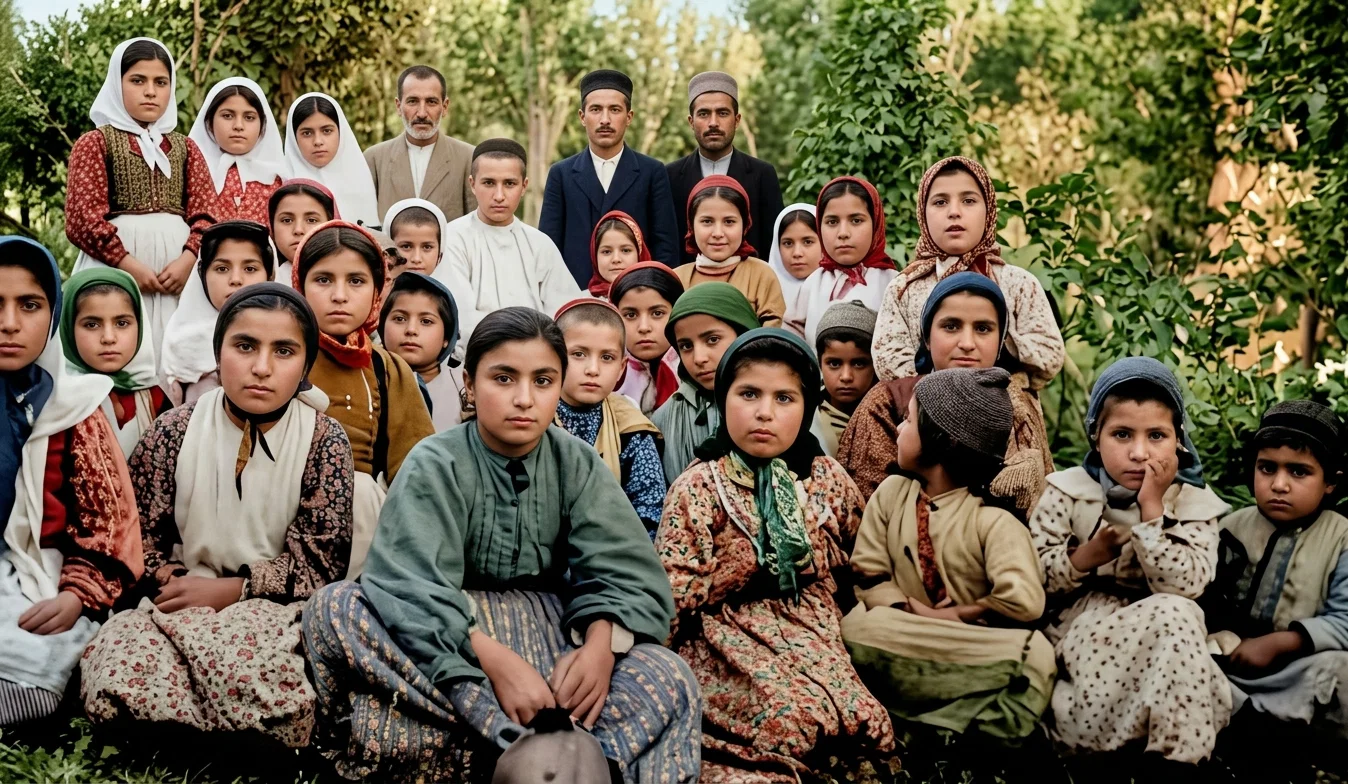
URUMIAH is a town of about forty thousand inhabitants. It lies only thirty miles from the Turkish border. There has been considerable dispute with reference to boundary lines. The Turks have advanced their border up into the mountains some thirty miles or more. As they were getting nearer and nearer to Urumiah, and in fact had already a number of soldiers stationed there, the Russians came in, thus creating a rather peculiar condition of affairs,—a Persian country, with a Persian government and police and a Russian force, and also a number of Turkish soldiers. For some time war seemed imminent between Turkey and Russia, but the matter has now been referred to The Hague Tribunal.
While the population of the country is mostly Mohammedan, there are many thousands of Nestorian Christians. One can see a marked difference in their dress. The people about Urumiah speak Turkish mostly, but Persian is their written language, while the Christians use modern Syriac. Since the occupation of the northern part of Persia by the Russians, the people are picking up a great many Russian expressions and phrases, and this is the only language in which we could converse with the driver, who lives at Tabriz.
Urumiah is a city of small compass. We drove almost around it before we entered the city gate. We arrived early in the forenoon, happily surprising Brethren Oster and Dirksen, as they did not expect us until the evening. We found our missionaries comfortably settled in a pleasant house, the Lord having especially favored them in enabling them to find good quarters with a Syrian Christian family in the city. After we had been boarding ourselves and sleeping in dirty khans, we felt happy indeed to find such a comfortable home.
ORPHANS IN THE GERMAN ORPHANAGE AT URUMIAH, PERSIA
We had but three days to spend in the city of Urumiah, and planned our work to make the best of every moment of our time. In this we were favored in many ways. The first day was mostly spent in planning and counseling with our brethren until late at night, and in calling on a few persons. The next morning the Presbyterian school for girls had its annual commencement exercises, at which twenty-two young women were to be graduated; we were kindly invited to be present. In the Presbyterian compound we found a nice brick church, also good school buildings. The exercises were held in a fine new American tent, which had been donated to the Presbyterian mission. This tent was crowded with about three hundred Syrian Christians. Dr. Sheed, who is in charge of the Presbyterian work here, courteously invited us to the front, that we might the better see and hear. A number of the young women recited in the English language, as well as in the Turkish and Parsee. There were also a number of songs rendered, some in English and one in German. After the doctor had addressed the graduates in their own language, they received their diplomas. Among them was one of the daughters of the lady with whom we were stopping. This occasion gave us the opportunity of meeting the leading Christians in the city, and as we were invited to dinner, we had quite an interview with the missionaries, when the question of our entering Persia was thoroughly discussed.
Our brethren have made many good friends, and have obtained a good speaking knowledge of the Turkish dialect spoken here. In harmony with the customs of the country, the afternoon of the second day was spent by us in the reception of visitors, many of whom came to our home, so that we had the opportunity of meeting a number of leading persons, both Mohammedans and Christians. The last day was indeed a very busy one, devoted to counsel, to the reception of callers, and to visiting. We drove out to the Presbyterian Boys’ College, located about two miles from town. The grounds are beautifully laid out. Dr. Sheed received us very cordially, and took us over to the hospital building. There are several American physicians here. The head physician kindly showed us many specimens of his successful operations. While we were there, a Kurd from the mountains was present, and his little boy, who had been afflicted with typhoid fever, was paralyzed in his arms and legs, and the father told the physicians that he would gladly give them one thousand dollars if they would only cure his child. Without question, medical missionary work in a country like this, if it is rightly carried on, acts as a great opening wedge of the gospel. The Presbyterians have medical missionaries in other parts of Persia also. They have been working in this land since 1835. We understand they have about eighty boys in the school here, and they charge about thirty-five dollars a year for board, tuition, and other school necessities. The plan is to carry the school on so simply that the expenses, aside from the teachers’ salaries, will be covered by the income. At first the Mohammedans were very shy, but now they have begun to attend the school. They will be charged a much higher rate than the Syrian Christians have paid, but the service will be correspondingly better. The American consul had just come in from Tabriz, but as he was weary from the journey, we contented ourselves with leaving our cards.
From the Presbyterian compound we went over to visit the German orphanage. This institution, as well as the American Mission, suffered from the inroads of the12Kurds. The orphanage is in a beautiful spot,—a large park,—one of the best compounds about the town. In the evening we visited another orphan home, opened by a Syrian physician, and now in charge of an American woman, assisted by a German missionary.
This visit with our missionaries aided us in many ways in obtaining a good understanding of the situation, and in giving them intelligent counsel. As there are so many different languages spoken, it was decided that Brother Oster should continue the study of the Parsee, and also give some attention to the Turkish dialect; while Brother Dirksen will continue the Turkish, and give special attention to modern Syriac. As matters are still so unsettled in the interior, and the province of Azerbaijan (where Urumiah is situated) is a good location for our work, we have considered it advisable to continue here for the present.
We now have churches along the Caucasian border, and a growing work. Some of the German colonists of southern Russia have visited Persia, and may settle at Asterabad, of the Central Asiatic Mission, where already a large Russian church exists. Then again on the other side of the line, in the Armenian field, there is a growing work in old Armenia. Therefore we thought it would be better for the brethren if they could get a foothold here, as this would help to consolidate our work. Then, too, this part of the country is best supplied with passable roads that are being patrolled by Russian soldiers, and consequently are comparatively safe for the traveler. We expect, however, that within a year or so these two brethren will separate, and we hope by that time some native help can be secured, so that each of our workers here may have a native helper. Considerable attention was also given to the question of the preparation of literature in these different tongues, and we hope that something can soon be done to supply the demands of the field in this respect. The task of printing this literature will probably fall to our Constantinople house.
When we consider the fact that Persia has nearly ten million people, among whom are some men of culture, we can at once realize the necessity of our securing a good start in such a field as this. We are glad indeed to see that God has helped our workers in the study of the language and in their efforts to become acquainted with the people and their customs, and we have every reason to believe that in another year we shall see the first-fruits of our work in this land. The seed is being sown. Careful plans have been laid for the extension of the work. Let us remember this new field in our prayers and in our gifts, so that our force of laborers may be strengthened, and the message be carried to every part of this great country.
Its Religious Opportunities
By J. O. Corliss
Home Life—No. 4
Its Religious Opportunities
J. O. CORLISS
HOME and family are God’s gifts to humanity for its elevation heavenward. Every child born into the world has given to it, first of all, the influence of home tuition, that under its leadings he may be qualified for the riper duties of advanced life, and in turn give character to those who may be committed to his care. This consideration adds dignity and responsibility to family and home cares, which should be duly recognized by the head of every household.
Parental authority, therefore, should ever be exercised as a God-given obligation, rather than one of impulse. Every precept issued should have the uplift of character in view, and when delivered, its object should be well set forth in gentle words, either by the relation of some incident or by an illustrative representation. To some this may seem a rather slow and troublesome process, but in the end it will be found to pay, because, when followed, less hasty and regrettable orders will be issued, which are likely to result in their careless observance, or what is worse, deliberate neglect, and consequent loss of respect for all parental direction.
It is not only the privilege, but the duty of parents to instil true principles in the child’s mind as early as he can comprehend them in their simple form. The same responsibility requires also that just behavior toward parents and all others be taught the child while in its infancy. As the child advances to the prattling age, where it picks up a vocabulary, it should be taught the impropriety of using low street words, which so easily find their way into many families. If anything in the use of words outside of positive profanity shows lack of refinement, such expressions as “you bet,” “you’re a peach,” “you kid,” are certainly in the list of inelegancies. A gentle parental rebuke should follow the use of such expressions before children by any one happening to come among them. Should the child pick up any of them from those outside the home, and repeat them in the home, he should be led to see how uncouth they make him appear in the presence of those whose friendship is desirable.
It is not best to let these things pass by unnoticed, or if noticed, simply call them “cute” sayings; for the retention of these will but court the presence of others as bad or worse, until the child will be on the way to manhood with these blemishes more prominent than his virtues. Having carried them so long, there is little hope of reform, and so these marks of cheap discipline follow on to become the standard of expression in the next generation. The time for reforming any of these bad habits is in childhood, when the mind is plastic and impressionable. Thus the instruction of the Lord is: “Train up a child in the way he should go: and when he is old, he will not depart from it.” Prov. 22: 6. The instruction here inculcated can not be misapplied if one teaches the way in harmony with the following exhortation: “Provoke not your children to wrath: but bring them up in the nurture and admonition of the Lord.” Eph. 6: 4.
By these injunctions parents are made responsible for the moral well-being of their children, and therefore should use every legitimate means to secure their salvation. It will be well, however, to13see that in doing a duty in this direction one does not make the mistake of provoking the child to wrath, or perverseness. Many children have been driven to desperation by overrigidity in moral discipline. Let this point be carefully studied, and earnestly plead with God to prevent the fatal mistake. Speaking of God’s leading, the psalmist says, “Thy gentleness hath made me great.”
The first point to be gained is to win the unswerving love of the child, and the second, to have the desired conduct properly set forth in daily parental example. For instance, let no burst of passion betray a spirit in contradiction to the oral teaching given. Be careful that no bickering over trifles occurs between parents. One can afford to yield his opinion or preserve quiet for the sake of example, and the good of observing children. Ideas of worship should be assiduously taught to the dawning intellect of the young brain, not only by oral precept, but by positive example as well. The parent who supposes that the small child takes no notice of passing events in the family circle, and therefore is careless of his conduct before him, sooner or later will doubtless be reminded of the true situation by some remark dropped by the child, in a confidential way, in dialogue with a companion.
In later years, many wonder why their children seem to have so little regard for Sabbath sanctity, and question the reason for it, when they have been so correctly taught the obligation of the weekly rest. It may be that in some of these cases the parents might discover the cause by reviewing their own Sabbath record. Perhaps while they were orally teaching the child the sacredness of the weekly rest, they themselves were violating the principles of their own instruction. Possibly some Sabbath necessities, which ought to have been attended to on a prior day, were left to be attended to on the Sabbath itself. Perchance business matters were talked over, and plans laid for the approaching week’s work.
In all this, the children are led to see that the Sabbath may be used in secular ways without detriment to a religious profession, and this impression follows on to become a part of their own experience. When due preparation has not been made for each approaching Sabbath, that day fails to accomplish for the family what it was designed to do. The mind needs to be gradually called away from worldly cares by previous preparation, so that when the Sabbath arrives, it may be hailed as a gift of heavenly peace, by which one is to be brought more nearly into holy communion with the mind of Jehovah. Let these preparation duties be the foreshadowing of the Sabbath itself, and then when the holy time arrives, labor will be mute, tumult and care will be hushed.
Stupid indeed must be the mind that will not feel a holy thrill of joy and peace upon entering the Sabbath time, if the proper preparatory program has been followed. The children will not be slow to perceive a radiant change in the family bearing, and by thus beholding, they, too, will be changed into the same image. So the entire family may be in the Spirit on the Lord’s day, and behold visions of ultimate glory in the loyal service of their Master.
Such Sabbath occasions would quickly dispel the notion obtained by some that the day was designed for physical rest alone, and to be used in sleepy, animal sluggishness. Idleness is not rest to the mind, any more than laziness is rest to the body. Genuine rest is that which comes from a change of occupation. Whereas the mind has been quite fully employed with secular things during the six working-days, on the Sabbath let it be entirely given to the things of God. Let worldly plans and pleasure-seeking be turned away, that the home may be wholly sanctified unto the Lord.
No child should be left to doubt or suspect his parents’ faith. The home should be a place where the very soul of the parents is laid bare to the child, where communion in eternal matters is free, that the soul of the child may be nourished, and built up to meet life’s conflicts in a Christian way. Many a man who has been able to pray for himself, and even for others, has failed of courage to pray with and for his children. Let this barrier of coldness be melted by the fire of God’s love, and then tender fellowship will be established between parent and child. The future good of the children depends on this. Let the family life be such that in the end it may be said to the Lord by every parent, Here am I, and the children whom thou hast given me.
Mountain View, Cal.
A Song of the King's Highway
By Arthur W. Spaulding
ARTHUR W. SPAULDING
Dark and devious are the ways
That thread the mist-hung hills,
And the luminous haze of the beacon's blaze
The wight's poor heart but chills;
For the high flames glare on the robber's lair
And the camp of the brigand bold,
Who steal the cheer of the hearthstone fair
To lure for the lust of gold.
O, what is the goal of the twisting trail?
And who shall find the track,
If storms prevail, and the senses fail
To trace the footsteps back?
For the clouds and the night have plotted the plight,
And the thickets hide but foes,
And the King's highway that holds in the light
Is a way that no one knows.
Ah, I have trodden those rocky steeps,
And hung on the chasm's brink,
Where the cataract leaps, and the traveler creeps,
And the shuddering senses shrink.
And I have spied on the furtive-eyed
Who watch to plunder the souls
That have wandered there for the lack of a guide,
And a strange confusion of goals.
And now I raise my voice on high
To pierce the dark defiles,
That far or nigh, they may hear my cry
With whom I walked the whiles.
For the joy that fills and the peace that stills
Have turned the night to day,
And my heart goes singing over the hills;
For I walk the King's highway.
Madison, Tenn.
The Problems of Today
“The problems of to-day are quite enough for our wisdom and energy. To-morrow shall take thought for the things of itself.”
The Noon-Hour Prayer
“Evening, and morning, and at noon, will I pray, and cry aloud: and he shall hear my voice.” “And the Lord turned the captivity of Job, when he prayed for his friends.”
NINE earnest requests for prayer have come in since last week. For the most part these are from those who are suffering severe physical affliction, or are burdened over conditions existing in their own homes.
33. A sister from Wisconsin writes of the great burden of heart she feels for the salvation of her father and husband, and asks for prayers that God may incline their hearts to him. Her husband is also in very poor health, and she greatly desires that he may be made well and strong for the duties that fall to him.
34. A mother in Iowa desires prayers in behalf of her afflicted son. Some seven years ago the Lord gave him partial healing, but he is still afflicted, and greatly incapacitated for labor. Pray that God may give him perfect soundness.
35. Another mother writes of the burden which she has carried for a long time in behalf of her children. One by one she has presented them by name to the throne of grace, but as yet no answer has come in their conversion. The father of the family also is very ill, and no hopes are entertained for his recovery. She desires prayer for her companion that God may work in his behalf.
36. An earnest appeal comes from a sorely afflicted sister in California. For a long time she has suffered with epilepsy. This affects her not only physically, but mentally, and almost wholly incapacitates her for active labor. She greatly desires healing, and urges her brethren and sisters to present her case before the throne of grace.
37. From the same State (California) a mother writes with much concern regarding her son, who works in one of our institutions. He has not yet given himself to the Lord. In consequence of his physical condition, he is becoming unsettled regarding his work. This, she feels, may lead him to seek other employment. She has long since dedicated him to the Lord, and now earnestly desires that God may bless him spiritually, mentally, and physically, and make him a useful worker in the giving of this closing message to the world.
38. The daughter of one of our sisters in the State of Washington has married outside of the truth. Her husband has little sympathy for the faith that she holds. In religious sentiment the family is divided, and it is a matter of much concern to the wife in the rearing of her little daughter. The mother of this sister writes earnestly requesting prayer in behalf of her son-in-law, that God may reveal himself to him and give him strength to take his stand with the remnant people of God.
39. A truly touching appeal comes from a sister in Colorado. Satan has been seeking to alienate her husband’s affections, and the integrity of the family relationship has been seriously threatened. The husband recognizes his danger, and desires strength to break away from the influences that are seeking to draw him off. Pray that the members of this family may be more strongly united to God and to each other, and that these parents may work together in the training of their children for God’s service.
40. From Michigan comes a request for prayer from a sister who has been a member of this church for thirty years. Her affliction is of a nervous and mental character, affecting both body and mind. She earnestly desires to be healed, and to have a mind to think clearly. Pray for her.
41. The last request we have to present this week is from the wife of one of our afflicted workers. Her husband has recently been obliged to give up the ministry on account of a serious throat difficulty, of such a character as to endanger his life. This sister believes that God is abundantly able and willing to hear prayers, and restore her husband to a place in this work. She pleads earnestly that God’s people will pray for his healing if that be in harmony with the divine will.
During the week to come let us carry on our hearts the burden of these afflicted ones.14Day by day as we engage in the noon-hour service, let us present their cases to the Lord; and as we pray, let us believe that God will hear our requests in their behalf and bless them as he sees in his infinite wisdom will be for the best.
Fireside Correspondence School
By W. E. Howell
Fourth Annual Opening
Three years’ experience in conducting study at home by correspondence has made it plain beyond question that this kind of work can be done efficiently. The results we get are gratifying even beyond what we expected when the school was started. Some of the reasons why study at home under our direction is successful, are:—
1. Every student does individual work; he is in a class of one; he really is taking private lessons.
2. No other student sees his recitation paper; he therefore feels free to “expose his ignorance” by reciting the very best he can, and asking all the questions he needs to.
3. Each student recites on the entire lesson; he does not merely answer one or two questions—possibly none—in a recitation, then spend the rest of his time listening to others or looking out of the window.
4. He has the teacher’s personal criticism on every essential point in the lesson; he therefore knows that he knows a lesson, or that he does not.
5. Before a student can set down an answer or an opinion in black and white, he must have very definite knowledge of what he is talking about; he is not coached along by the nod and beck of his teacher or the facial expression of his fellow students; he therefore strives continually to be independent in his thinking.
6. We do not require the lessons to be sent in on a fixed day; the student many times take extra time to work out the more difficult lessons or points in a lesson without feeling hurried or nervous over it; if a lesson has to be returned, he can take time to do it over without feeling that some one is getting ahead of him. On the other hand, we fix a limit of time to his scholarship in the school so he will not fall into plodding or indolent habits.
7. The student gets excellent practise in good expression, no matter what subject he is taking; for we criticize his writing in respect to spelling, punctuation, use of capital letters, sentence structure, choice of words, clearness and coherence of thought, and other qualities of good composition, including neatness, order, and legibility.
In these seven and various other helpful ways we are serving about two hundred students the year round. We now have our work thoroughly systematized, and are equipped to serve twice this number the coming year.
Who Our Students Are
Among our students the past year were:—
1. Thirty-eight teachers, from the elementary school to the college, seeking to advance in teaching efficiency.
2. Twenty-five farmers,—fathers and sons, sometimes in the same family.
3. Twenty-seven mothers and daughters at home, besides seventeen who classify themselves as housewives.
4. Students—those unable to go back to school, those in school but unable to take a certain subject there because of conflict, those who lack only one or two subjects of finishing a course.
5. Then come ministers, foreign missionaries, secretaries, canvassers, nurses, stenographers, and those employed in all kinds of occupations and professions.
Our Opening Date
We have chosen for our fourth autumn opening, October 7. It is the beginning of the best season for study. We do not need to urge our old students to continue,—some of them have been members of the school ever since it started,—but we do urge all who have not had the courage and determination to make a beginning in this interesting work, to attend to all the preliminaries for enrolment before our opening date, and start in promptly with the new year. For a calendar containing full information on the subjects we offer, the terms of tuition, and our methods of work, address Fireside Correspondence School, Takoma Park, D. C., or—
W. E. HOWELL, Principal.
Improve the Minutes
By N. W. Vincent
N. W. VINCENT
In the struggle of life amid our cares and our toils,
Many times lack of method our usefulness spoils.
Putting off till to-morrow the work of to-day;
Relying on self, neglecting to pray;
Only thinking of self, forgetting our brother;
Often attempting our conscience to smother;
Either drowsy and dull, or too nervous to try;
Thinking “time enough yet,” as the minutes go by;
Hoping special preferments to us will be given,
Expecting rich prizes for which we’ve not striven;
Making pauses for rest when we ought to be working,
Indulging in sloth, and our known duties shirking;
Not till sick rightly prizing our life or our health;
Underrating the true, overrating false wealth;
The counsels of Christians setting at naught;
Eternity slighting, God’s counsel forgot:
So minutes quite lost, our undoing may be.
God pardons our follies, in Christ makes us free.
Caney, Kans.
Good Manners Are Petty Sacrifices
Good manners are made up of petty sacrifices.—Emerson.
“My Faith Looks Up to Thee”
By Lora Clement
LORA CLEMENT
THE author of this matchless hymn did not pen the words for other eyes, but in the solitude of his chamber, “with a deep consciousness of his own needs, he transferred to paper, as faithfully as he could, what was passing within his heart.” At this time (1875) Dr. Palmer was teaching in New York. He copied the poem in a small morocco-covered pocket note-book which he usually carried. Several years later Dr. Lowell Mason met him on the streets of Boston, and asked for some contributions to a “Hymn and Tune Book,” which he was about to publish. The little book containing “My Faith Looks Up to Thee” was shown him, and he asked for a copy. They stepped into a stationer’s together, and the copy was made and given him. Without much notice, Dr. Mason put it into his pocket. On looking it over after his return home, he was very much impressed with the words, and wrote for them the tune “Olivet,” to which the hymn has been almost universally sung. Two or three days later he met Mr. Palmer and earnestly exclaimed: “You may live many years and do many good things, but I think you will be best known to posterity as the author of ‘My Faith Looks Up to Thee.’”
Among the many incidents given illustrating the helpfulness of this hymn, the following is of special interest:—
During a fearful storm at sea, in December, 1882, the propeller of the German steamship “Spree” broke, knocking a large hole through her bottom, and leaving her helpless. She was not only in danger of sinking, but was also being rapidly driven out of her course. The passengers were in a panic, and one leaped overboard to death. Dwight L. Moody was on the ship, and he “inspired all with courage by his splendid composure and oft-repeated assurances that God would answer their prayers and bring them safely to land.” They met in the saloon to implore divine help, and the comforting words of this song came unbidden to their lips. On board an apparently sinking ship in mid-ocean, seven hundred persons joined in singing:—
“My faith looks up to Thee,
Thou Lamb of Calvary,
Saviour divine!
Now hear me while I pray,
Take all my guilt away,
O, let me from this day
Be wholly thine!”
Their prayers were answered and their faith rewarded. Mr. Moody says, “God sent the ‘Lake Huron’ to our rescue, and made the storm a calm.”
A Tennessee Rally
By Arthur W. Spaulding
IT is the custom of the farm mission schools in Tennessee to hold quarterly conventions in their different groups, for consultation and for the study of the questions and conditions in which they are mutually interested. The last of July the usual gathering of the Summer County group was connected with an agricultural rally for the benefit of the farmers and neighbors.
The rally was held on the grounds of the Fountain Head school, where Brethren Mulford and West have for four years been building up a work whose value to the community has been recognized by many influential citizens. In these four years not only have a church and a flourishing Sabbath-school been established, and a prosperous day-school been in operation, but the material conditions of the people, physical and economic, have been fostered through the many forms of influence which the school has exercised.
The meeting was presided over by Prof. E. A. Sutherland, president of the Nashville Agricultural and Normal Institute. Several teachers and students from this school were also in attendance, as well as Prof. Chas. F. Alden and wife, from the Ridgetop school, representatives from the Sumner County schools, and about one hundred of the neighbors.
The exercises were held outdoors, under the great oaks and chestnuts, where also a hygienic dinner was served to the company. The visitors, after an inspection of the farm and buildings and the expanding canning industry of the school, expressed much surprise and gratification at the evidences they saw of a definite work being done by this school for its community, the importance of which the government, and they as its representatives have of recent years begun to see.
The question is often asked how the expenditure of such efforts for the material betterment of the people is of value in teaching them the last gospel message. The answer is that the higher the physical and material conditions of a man, the better opportunity is given him for comprehending and accepting spiritual truth. You may preach against tobacco, but so long as tobacco seems to the farmer to be his only profitable money crop, he is likely to persist in raising it and in using it. Right here our schools are striking at the foundation of the habit, by establishing canneries and advocating the raising of tomatoes, beans, and other vegetables, which make a better profit with less work than tobacco, while at the same time, in their schoolrooms, they are showing the physiological and economic evils of the weed. They tell of the danger, and they provide the way of escape.
This far-sighted policy, combined with care for the sick, and other phases of the self-supporting school work, has shown fruits already in the beginning of a change in public sentiment and customs. And in view of the favorable attitude of public-spirited officials toward a few of our schools with which they have become acquainted, we see in these schools a mighty lever for the truth, not only in their immediate communities, but to an extent that can not now be accurately measured.
The agricultural rally closed in the afternoon, and was followed, that evening and the next morning, by a most inspiring council relating to the spiritual efforts and the development of the self-supporting auxiliary work.
ARTHUR W. SPAULDING.
The Work in New Orleans
By W. P. McLENNAN
For a long time there has been realized the need of a church building in New Orleans. But how to secure the means with which to pay for such was the problem so hard to solve. Thanks be to God, the way has opened for us to secure a very suitable building at a most reasonable price.
SEVENTH-DAY ADVENTIST CHURCH BUILDING RECENTLY PURCHASED AT NEW ORLEANS, LA.
For several months our services were so overcrowded that we did not feel free to invite people to attend our meetings. We prayed earnestly that the Lord would open the way for us to obtain a church building. We had not been praying long when we heard that the Christian Scientist people had outgrown their church, and were planning to build a fine edifice. We called upon them, and found that they would accept $4,000 for their building. This amount our little church thought we could raise by soliciting help outside of our own people, hence we made the purchase.
The building is centrally located, being easily reached by streetcar from all parts of the city. It is in excellent condition, is well lighted, contains six electric fans, has five gas-heaters, and will seat over three hundred persons. The pews are plain, but comfortable. This church was formerly owned by the Christian denomination, who had a baptistery built, which will serve us in the future for our baptisms.
We are now meeting in our new Sabbath home, having paid ten per cent down, the remainder to be paid on or before Jan. 1, 1913. Our little company here responded liberally to the call for funds with which to buy this building, raising in cash and pledges the first time the matter was presented, the amount of $900. Other pledges have since been made, bringing the amount up to about $1,100. Our young people have been selling the Watchman the last few weeks to raise money to apply on the fund, and have been having good success.
Pray for the advancement of the work in this large city of the South.