WE have considered the danger to the state, and to the people who are not of the churches, that inheres in the Federation that has been accomplished. There is also to the churches themselves a danger that is no less real and no less ruinous. And this danger to the churches only increases the danger to the state and to those who are not of the churches.
This danger to the churches is that which will arise from the flood of hypocrisy and cant that will be poured into them by means of the hosts of unconverted and wholly unworthy persons who will flock to the ranks of the churches just as soon as it becomes manifest that political preference and civic control are in the hand of the church-power as represented in this Federation.
It is impossible to deny that political preference and civic control will be in the power of this Federation. And it is equally impossible to deny that it is intended that political preference and civic control shall be in the power of this Federation. This purpose was too plainly expressed in too many of the addresses in the conference to leave any room for any denial or even any doubt.
In addition there is number IV. of the objects of the Federation, as adopted in the "Plan of Federation," which runs as follows:
IV. To secure a larger combined influence for the churches of Christ in all matters affecting the moral and social conditions of the people, so as to promote the application of the law of Christ in every relation of human life.
To any one who attended the conference throughout and listened to the discussions, there can be no room for denial or doubt that this number IV. includes political and civic relations as really as any other, and in some respects even more so. To any who listened to the addresses and studied the conference throughout, the wording of this number IV. is most telling—it means literally all that the words say.
Therefore note that it is the "combined influence" of the churches that is to be exerted in "all matters affecting the moral and social conditions of the people." And it is to be noted that the word "moral" as here used, and as almost invariably used in the conference, is moral in the current sense of the outward—the strictly civic—relations of men to each other and to the state; and not moral in its deep, true, spiritual sense of man's relation to God only. Thus it is manifestly intended that the Federation shall exert the "combined influence" of the churches literally
"in every relation of human life," civil as well as religious, political as well as spiritual.
Every Relation of Life.
The further wording of this number IV. itself excludes all possibility of denial or doubt in this matter, for it says in their own words that this "combined influence" of the churches is to be exerted in "all matters affecting the moral and social conditions of the people" "in every relation of human life," expressly "so as"—in order to, in this way, by this means—"to promote the application of the law of Christ in every relation of human life."
Parallel with this number IV., now read the following from an address of Dr. Dickey, Presbyterian, of Philadelphia:
I trust that one of the practical results of this conference will be the organization of a force that law-breakers and law-makers will respect and heed when great questions of morals are involved. . . . It is our province in the name of our supreme King, and seeking the good of mankind, to ask rulers to respect the code of our kingdom. Rulers may ignore sects, but they will respect the church. This Federation will compel an audience, and it will speak with power, if it will put aside its differences and make its agreement its argument.
Further in this connection must not be forgotten the resolution that was passed, in which the conference positively committed itself to the repudiation of the idea that "corporations have no souls," and the specific inculcation of the view that the "corporation," and so the state, "is a moral person."
It is therefore unquestionable that political preference and civic control will be, and is intended to be, under the hand of this Federation, in all matters concerning which the Federation shall choose to exert, the "combined influence" which it represents. And since this "combined influence" in "all matters affecting the moral and social conditions of the people" is to be exerted "so as to promote the application of the law of Christ in every relation of human life," it is difficult to conceive of any matter which the Federation would consider as outside its realm.
Its Effect on the Politician.
This being so, it is as certain as that two and two make four that the men who are ambitious of political favor, or civil power, will as early as possible make themselves sure of the recognition and the favor of this church influence. And since the surest possible way to obtain this is by being a church member, it lies in the nature of the case that they will become church members just as soon as their interest shall require it. Thus has it been always before, and thus will it certainly be10again; for "human nature has not changed."
A Parallel.
For this Federation is not the first movement of its kind in history. The proposition that this Federation makes in number IV. of its objects, as herein cited, to exert its "combined influence" "in all matters affecting the moral and social conditions of the people" "in every relation of human life"—this is not the first effort of the kind in the history of the world and the church. This identical course of federation was gone over to this same goal in the great apostasy of the second to the fourth centuries that developed the Papacy in all that the Papacy has ever been. And when through federation and confederation at that time the point had been reached where the "combined influence" of the churches could be exerted "in all matters affecting the moral and social conditions of the people," "in every relation of human life," then, of the situation thus created, the following is recorded:
It was far more easy to define that which did belong to the province of the church than that which did not. Religion asserts its authority, and endeavors to extend its influence over the whole sphere of moral action, which is, in fact over the whole of human life, its habit, manners, conduct. . . . And as the acknowledged teachers of Christianity, the clergy continued to draw within their sphere every part of human life in which man is actuated by moral or religious motives. The moral authority, therefore, of the religion, and consequently of the clergy, might appear legitimately to extend over every transaction of life, from the legislation of the sovereign, which ought in a Christian king to be guided by Christian motive, to the domestic duties of the peasant, which ought to be fulfilled on the principle of Christian love.—Milman.
The Effects of That Federation.
The consequence that resulted from that situation then was that every limit was overstepped and every barrier was broken down that separated the civil and ecclesiastical powers. The state as a body distinct from the church vanished. As a distinct system of law and government the state was destroyed; and its machinery existed only as the means by which the church would accomplish her arbitrary will and enforce her despotic and meddling decrees "in every relation of human life." Such was the only consequence that resulted from the situation then, and the like of it is the only consequence that can result from the like situation that is now being created here.
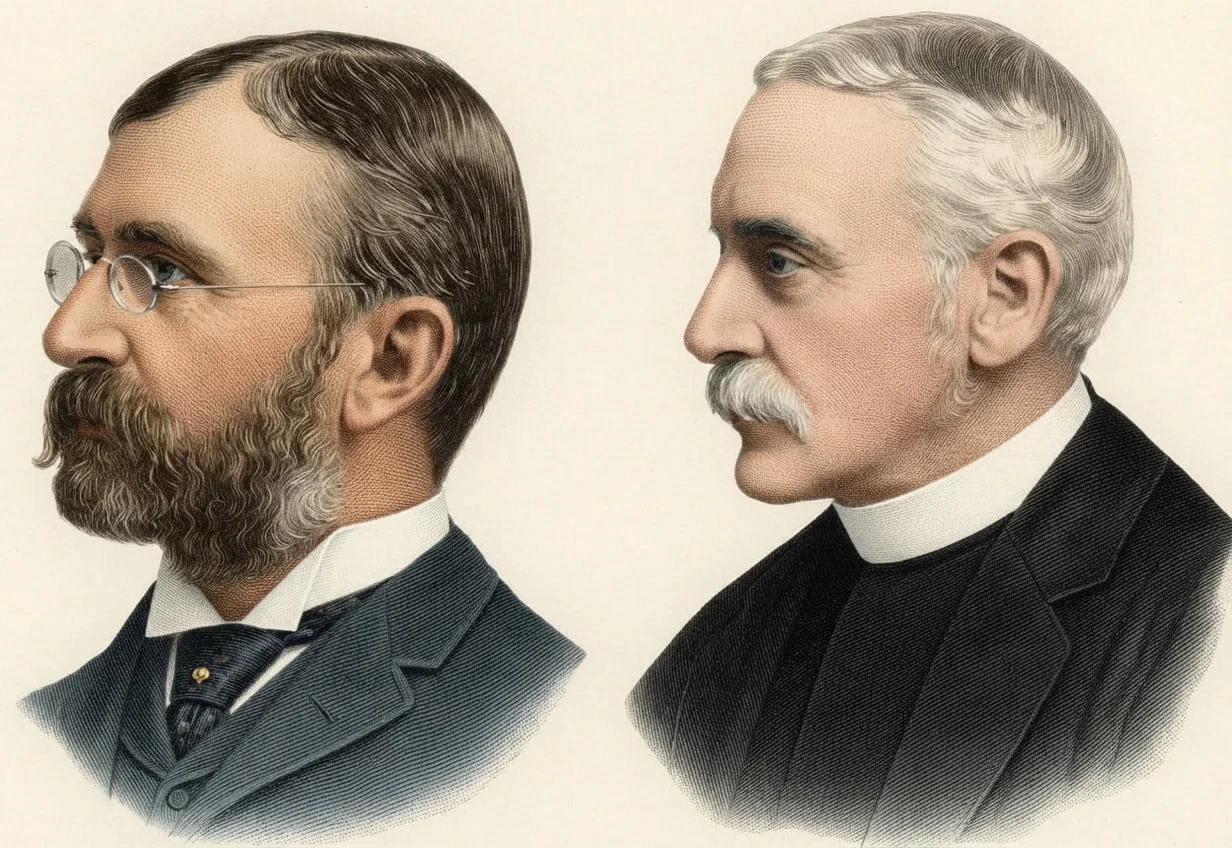
Hon. Charles A. Schieren. Rev. Henry A. Stimson, D.D.
But that which then most hastened the evil consequence to the state was the immediate effect upon the church, of her having attained the position of power and influence in state affairs that federation gave to her. For since at that time and in that federated situation, political preference and civic control were in the hand of the church-power; since the church was the recipient of imperial recognition and state favors; the result was that multitudes, with no change of either character or conviction, entered into church relations. And "the vast numbers who, from external considerations, without any inward call, joined themselves to the Christian communities, served to introduce into the church all the corruptions of the heathen world. Pagan vices, pagan delusions, pagan superstition, took the garb and name of Christianity, and were thus enabled to exert a more corrupting influence on the Christian life. Such were those who, without any real interest
whatever in the concerns of religion, living half in Paganism and half in an outward show of Christianity, composed the crowds that thronged the churches on the festivals of the Christians, and the theaters on the festivals of the pagans. Such were those who accounted themselves Christians, if they but attended church once or twice in a year, while, without a thought of any higher life, they abandoned themselves to every species of worldly pursuit and pleasure."—Neander.
And that thing will now be repeated here; for the identical course that was then taken by the "combined influence" of the church, is now being followed here. That thing at that time caused the church to become "Babylon the Great, the mother" of many and varied elements of confusion. And this thing now will cause this combined body in this Federation to become, first, Babylon the daughters, "a hold of every foul spirit, and a cage of every unclean and hateful bird," and finally one of the three principal elements of confusion in the great threefold combination of all apostasy, of which, as the ultimate "Babylon," is written: "A mighty angel took up a stone like a great millstone, and cast it into the sea, saying, Thus with violence shall that great city Babylon be thrown down, and shall be found no more at all."
The state can never afford what this Federation means; for it means the complete subversion of the state. The people can never afford it; for it means the despotism of a meddling, persecuting hierarchy. And most of all, the churches themselves can not afford it; for it means, first, that they will be made the "cage of every unclean and hateful bird," and lastly, that they will be sunk in everlasting ruin.
SIN AND ITS REMEDY.
By D. P. Zeigler
By one man sin entered into the world, and death by sin; and so death passed upon all men, for that all have sinned.” Rom. 5:12. That one man by whom sin and death entered was Adam. 1 Cor. 15:22. As “sin is the transgression of the law” (1 John 3:4)—the law of the Ten Commandments (Rom. 7:7)—Adam’s fall was the result of the violation of that law.
That we may be able to know that Adam brought sin and death upon himself and posterity by transgressing the ten-commandment law, let us briefly glance at their act of disobedience in the light of that law.
The first commandment says, “Thou shalt have no other gods.” In listening to the enticing voice of the serpent, his voice was placed above that of God; hence he became to man and woman what God should have been. And in their obedience to Satan, they violated also the second commandment against worshiping another god, as obedience is the essence of worship.
The third commandment says, “Thou shalt not take the name of the Lord thy God in vain.” This name was taken in vain when they presumed to take it upon their lips after ceasing to obey God.
The fifth commandment says, “Honor thy father and thy mother.” God being their Father, they ceased to honor Him when they listened to the insinuations of Satan.
God had said, “In the day thou eatest thereof thou shalt surely die.” Thus in eating11of the fruit, they took their own lives and the lives of their posterity; hence they violated the sixth commandment.
The seventh, “Thou shalt not commit adultery,” was violated in their illicit intercourse with the serpent. In this they ceased to be true to God.
In taking of the fruit that belonged only to God, they were guilty of theft, and thus violated the eighth commandment.
They bore false witness in listening to the malignings of Satan against God, and accepting them as truth to be afterward repeated. Believing Satan’s false witness, and acting upon it, was to endorse it, and hence to assume responsibility for it.
In seeing and longing for the fruit, they were covetous; and by coveting that which did not belong to them, they violated the tenth commandment.
In Gen. 5:5 we find that all the years of Adam were nine hundred and thirty, and he died. God had told him, after his transgression, “Dust thou art, and to dust shalt thou return.” Was there any way of salvation opened to these sinners?—Yes; for the loving Son of God, looking down and seeing that there was no man to save them, brought salvation Himself. Isa. 59:16.
So we find the Lord, in the Garden of Eden, opening the way of life before the guilty pair. He proclaimed the Gospel of salvation, as He said to the serpent, “I will put enmity between thee and the woman, and between thy seed and her seed; it shall bruise thy head, and thou shalt bruise his heel.” Gen. 3:15. It was decreed in the heavenly courts that the Son of God should take upon Himself “the likeness of sinful flesh,” and condemn, or overcome, sin in the flesh. This was not to set aside the violated law, but “that the righteousness of the law might be fulfilled in us, who walk not after the flesh, but after the Spirit.” Rom. 8:3, 4.
“But not as the offense, so also is the free gift. For if through the offense of one many be dead, much more the grace of God, and the gift by grace, which is by one Man, Jesus Christ, hath abounded unto many.” Rom. 5:15. “And ye know that he was manifested to take away our sins; and in Him is no sin.” 1 John 3:5. Thus for the violation of the law, and to save man from the wages—death, to save him, to restore him, Jesus Himself took upon Him the nature of the seed of Abraham (Heb. 2:16), and became the “Lamb slain from the foundation of the world” (Rev. 13:8).
But what must the sinner do to partake of the benefits of this blessed Gospel?—Let the Spirit answer: “The times of this ignorance God winked at; but now commandeth all men everywhere to repent.” Acts 17:30. The command of God to the sinner is to repent. “Testifying both to the Jews, and also to the Greeks, repentance toward God, and faith toward our Lord Jesus Christ.” Acts 20:21.
Why repent toward God?—Because sin is the violation of His law; hence repentance should be toward Him, and He therefore commands it. Repentance is a godly sorrow for sin, so much so that it causes the sinner to quit sinning, which is plainly stated as follows: “Repent, and turn yourselves from all your transgressions; so iniquity shall not be your ruin. Cast away from you all your transgressions, whereby ye have transgressed; and make you a new heart and a new spirit; for why will ye die?” Eze. 18:30, 31.
Let us now note Paul’s answer to the Philippian jailer, after repentance toward God: “Believe on the Lord Jesus Christ, and thou shalt be saved.” Acts 16:31. This, then, is our “faith toward our Lord Jesus Christ.” Why faith toward Him? What was His attitude toward the law that had been transgressed? “If ye keep My commandments, ye shall abide in My love; even as I have kept My Father’s commandments, and abide in His love.” John 15:10. Then, inasmuch as He has kept the law, He has maintained its righteous principles, which we have transgressed. Thus He sets us an example, that we should walk even as He walked. 1 John 1:6.
D. P. ZEIGLER.
THE EVER WARFARE.
THERE is a proper warfare of the spirit against the flesh. Paul was engaged in it, and his epistles are full of the record of it. It is the battle between the upward strivings and the downward drawings of the soul. So long as we are here in the world, this conflict will be waged. There are some who claim to have passed beyond it, but the claim raises suspicions. All the holiest men have been the men most keenly sensitive to their moral and spiritual peril, and most aware of the terrible reality of the warfare which they must wage until life is done. All earnest men are wrestlers, as Paul was, with spiritual foes, foes who find their footing in what he called the flesh, meaning thereby, as metaphor, the baser possibilities of the soul. —Sunday-School Times.
GOD’S PARTICIPATION IN SUFFERING.
By Ellen G. White
THE result of hastening or hindering the Gospel, we think of, if at all, in relation to ourselves and to the world. Few think of its relation to God. Few give thought to the suffering that sin has caused our Creator. All heaven suffered in Christ’s agony; but that suffering did not begin or end with His manifestation in humanity. The cross is a revelation to our dull senses of the pain that sin, from its very inception, has brought to the heart of God. Every departure from the right, every deed of cruelty, every failure of humanity to reach God’s ideal, brings grief to Heaven. When there came upon Israel the calamities that inevitably followed separation from God,—subjugation by their enemies, oppression, cruelty, and death,—it is said of God, that “His soul was grieved for the misery of Israel.” Judges 10:16. “In all their affliction He was afflicted; . . . and He bare them, and carried them all the days of old.” Isa. 63:9.
His Spirit “maketh intercession for us with groanings which can not be uttered.” As the “whole creation groaneth and travaileth in pain together” (Rom. 8:26, 22), the heart of the infinite Father is pained in sympathy. Our world is a vast lazar-house, a scene of misery that no pen can picture, misery that we dare not allow even our thoughts to dwell upon. Did we realize it as it is, the burden would be too terrible. Yet God feels it all. In order to destroy sin and its results He gave His best Beloved, and He has put it in our power, by co-operation with Him, to bring this scene of misery to an end. “This Gospel of the kingdom shall be preached in all the world for a witness unto all nations; and then shall the end come.” Matt. 24:14.
MRS. E. G. WHITE.
TITHING.
By Ruth E. Evans
THERE are some duties which the Bible seems to recognize as understood from the beginning. There is no mention of their origin and first announcement. Their violation, or their performance, is mentioned incidentally long before they are recorded as specifically enjoined. It appears to be taken for granted that they were known to be duties at man’s very start in the world.
There is no command to pray or praise—either public or private prayer—in any of the earlier books of the Bible; but most of the patriarchs whose histories are elaborated, are represented as being in the habit of prayer. Altho the duty of prayer is not specifically enjoined in the Ten Commandments, it was and is recognized as of universal obligation.
The duty of tithe-giving—giving one-tenth of one’s income to the Lord—is one of these duties which seem not to have needed the record of an original announcement, or injunction. Like prayer, tithe-giving was practised by the patriarchs long before the proclamation of the Mosaic law. While, as in the case of prayer, it finds no specific mention in the Decalogue, tithe-giving has had a wide-spread recognition in the world, a recognition that would be as nearly universal as that given to prayer, if it were not that it costs so much more.
The first Bible mention of tithes is in the fourteenth chapter of Genesis, where Abram, returning from the slaughter of the five kings, was met by Melchizedek, a “priest of the Most High God,” and he gave him tithes of all the spoils. It does not appear by the record that that act on Abram’s part was something unlike anything ever done before. On the contrary, it appears to have been the spontaneous performance of a recognized duty; for Abram did not count those spoils of the battle his own; he looked at them as belonging to the king of Sodom; but whosoever they were, Abram was the then steward of all, and knowing that one-tenth belonged to the Lord, he handed it over to the Lord’s representative.
The duty of tithe-giving would, therefore, seem to be the common law of God’s kingdom; yet there is no lack in the Bible of specific commands for this duty, or of denunciations of those who neglect it. We have found this duty recognized in the first book of the Old Testament.
Later we find specific and repeated commands for its continued exercise. In the last book of the Old Testament, we find its neglect denounced of God as nothing short of robbery.
“Will a man rob God?” He asks. Is there a man bad enough to deliberately steal from God? That is God’s question; and His answer to it is: “Yet ye have robbed Me. But ye say, Wherein have we robbed Thee?—In tithes and offerings.” Mal. 3:6–8. “Bring ye all the tithes into the storehouse, that there may be meat in Mine house.” In plain words, then, if any church-member, or any who profess to be the Lord’s children, have failed to pay over to the Lord the tenth of their income, such are thieves and robbers. That is the plain Bible teaching on this subject.
One can not properly make offerings out of the tithe, for the reason that the tithe does not belong to him. The giving to one’s own family, or giving to any one who is properly dependent on us for support, is not giving to the Lord. The Jews never counted the cost of their personal or family sacrifices at the temple as a part of their tithe-giving. Nor did they count their alms-giving tithe-paying, yet alms-giving was always a sacred duty with the Jews.
Their alms-giving could not begin until the tithes were first provided for. One’s charities must be given out of that which is his own, not out of that which belongs to another.
Who, then, can suppose that the New Testament commands to give systematically and freely are intended, or were understood, as meaning less than that required of the less favored people of former times? It is absurd to suggest such a thought. “Freely ye have received, freely give.” RUTH E. EVANS.
THE PATIENCE OF MY LORD.
By Max Hill
THE patience of my Lord has brought me low;
Before His throne my sinful self I throw
With penitence of heart to own His grace
Which promises to me a resting-place
Where His own saints eternally shall stand.
Unworthy tho I be, and long deferred
My coming home, I have His own true Word,
"Confess thy sins, in simple faith believe,
And thou a full salvation wilt receive,
And stand at last redeemed with Zion's band."
More faithful still than mother-love can be
His tender care is ever over me;
In danger, sickness, famine, pestilence,
My Rock and Shield, my safe and sure Defense
From every shaft the enemy can bring.
O make me grateful, Lord; Thy mercy still
Be ever with me; I would do Thy will.
I own Thy love, and on Thy pleasure wait;
In truth Thy gentleness hath made me great;
Teach Thou my lips a song of praise to sing.
Max Hill.
Earnest, Persistent Prayer
By Spurgeon
I FIND that in the original, the word for "helping together," implies very earnest work. Some people’s prayers have no work in them; but the only prayer that prevails with God is a real workingman’s prayer—where the petitioner, like a Samson, shakes the gates of mercy, and labors to pull them up rather than be denied an entrance. We do not want finger-end prayers, which only touch the burden, we need shoulder-prayers, which bear a load of earnestness and are not to be denied their desire. We do not want those dainty run-away knocks at the door of mercy, but we ask for the knocking of a man who means to have, and means to stop at mercy’s gate till it opens and all his need shall be supplied.—Spurgeon.
True and False Pleasure
"TRUE pleasure is like water; one can not take much of it without being satisfied. False pleasure is like intoxicating liquors, the more one takes the more he wants."
PROPHECY.
By George M. Brown
(Concluded.)
[The following is a paper read by Elder Geo. M. Brown, of Mexico, in a meeting of missionaries in that city, and sent to the SIGNS for publication.]
OFTEN in our own day when the faithful minister rebukes the sins which he sees are dragging the people down to eternal ruin, and believing the sure Word of prophecy warns the church and the world of that which will surely come unless decided reforms are made, he is accused of being a pessimist, a crank, and lacking in patriotism.
Such accusations are as false now as they were in the days of Jeremiah; for the student of prophecy, while cognizant of present evils and the inevitable result of persistence in them, can look beyond all these things and see the true Israel of God, from all ages and from every nation, dwelling peacefully in the promised land, where, through the ceaseless ages of eternity, they will dwell in the presence of God, and have ample opportunity to execute the grandest plans.
John the Baptist, the forerunner of Christ, appealed to the prophecies as authority for his work. Luke 3:2-4. The prophecies were explicit as to the place and manner of Christ's birth, and the priests at Jerusalem understood the matter so well that the wise men, following their instruction, found the infant Saviour. Matt. 2:1-12. Simeon, and Anna the prophetess, recognized Christ as He was brought to the temple because they were seeking to be led of God, and understood the prophecies.
Of the beginning of Christ's ministry Mark says: "Now after that John was put in prison, Jesus came into Galilee, preaching the Gospel of the kingdom of God, and saying, The time is fulfilled, and the kingdom of God is at hand; repent ye, and believe the Gospel." Mark 1:14, 15. Paul says that He came in the "fulness of time." Gal. 4:4. These expressions doubtless refer to the great prophetic period of time found in Dan. 9:24-27. This is one of the most remarkable prophecies in the Bible. The time of the Jewish return from captivity and the rebuilding of Jerusalem is the starting point. From this time, 457 B.C. as a basis, the prophecy foretold the exact year of Christ's baptism and crucifixion, also the time of the final rejection of the Gospel by the Jewish nation, and the beginning of the work for the Gentiles. This long prophetic period reaches down to A.D. 1844, and points to a solemn work in connection with the great plan of salvation, which began at that date.
In the founding of the apostolic church the apostles constantly appealed to the fulfilment of the prophecies concerning the Messiah, in the life and work of Jesus, as the strongest evidence of His divinity, and the truth of their claim that He was the Messiah. Note the words of Peter, "But those things which God before had showed by the mouth of all His prophets, that Christ should suffer, He hath so fulfilled." Acts 3:18. In Stephen's defense and in Paul's discourse before Agrippa, we find similar references to the relation of prophecy to the Gospel.
The example of the apostles demonstrates that they considered prophecy one of the pillars of the Christian church, and a most potent factor in successful Gospel work. Referring to the evidence of the prophecy in comparison with the evidence given the disciples on the Mount of Transfiguration, Peter calls it "a more sure Word of prophecy," and admonishes the brethren to heed it as a light that is set in a dark place. 2 Peter 1:19.
God hath set the prophets in the church (1 Cor. 12:28), and prophecy is one of the gifts of the Holy Spirit. 1 Cor. 12:10; Eph. 4:11-13. This gift is just as essential as any other spiritual gift, and the church that does not possess it can no more succeed in its Gospel work than it could if it lacked the pastoral or the evangelistic gift. The Jewish Church believed many grand truths, but, refusing the light sent through the prophets, it lost its spiritual life, and at last rejected Jesus the Christ. Thus we see that the rejection of the gift of prophecy led to the rejection of the Gospel, to the ruin of the nation, and the apostasy of the church.
Jesus, forseeing this, wept as from the brow of Olivet He looked upon the city and temple which both Jew and Roman had delighted to beautify and adorn, and said, "If thou hadst known, even thou, at least in this thy day, the things which belong unto thy peace! but now they are hid from thine eyes." Luke 19:42. He foretold the destruction of the city, and doubtless some who heard His words lived to see their fulfilment. In A.D. 70 the city was taken by Titus, a Roman general, the wall was broken down, and the beautiful temple became a heap of smoldering ruins, fit emblems of the spiritual ruin and blasted hopes that have been the heritage of the Jewish people from that day to the present.
Let us turn for a moment from the sad picture presented by those who rejected the light sent through the prophets, and contemplate the glorious work achieved by those who received it, and accepted the despised Jesus of Nazareth as their Teacher and Saviour. These men, tho lacking much of what is usually thought essential to success, were so inspired by the Holy Spirit, and filled with the wonderful truth which they had received, that they consecrated themselves wholly to the work of telling others. God sent them forth, clothed with His power, an invincible band of Christian warriors who carried the glad tidings of the Gospel through all the then known world in less than a hundred years, making the very foundations of the mighty Roman Empire tremble, and triumphing over every device of Paganism to exterminate the hated religion.
As there was then a special Gospel message to be given to the world, so in our day the prophecies reveal a special Gospel message which is to prepare the people for the coming of Christ the second time, without sin unto salvation. Heb. 9:28. The book of Daniel gives a prophetic outline of the world's history from the time of Babylonian supremacy to the setting up of the eternal kingdom of Christ. This is supplemented by the prophecies of Revelation which give us additional points, presenting more in detail the great apostasy in the church, and the events just before the coming of Christ. Jesus Himself gives the signs that are to herald the second advent. These are to be seen in the sun, moon, and stars, and among the nations of the earth. Already many of these signs have been fulfilled so that we know His coming is near. John saw a mighty Gospel movement which was to be universal in its scope, and which would prepare the world for the final judgment. He describes it thus: "And I saw another angel fly in the midst of heaven, having the everlasting Gospel to preach unto them that dwell on the earth, and to every nation, and kindred, and tongue, and people, saying with a loud voice, Fear God, and give glory to Him; for the hour of His judgment is come; and worship Him that made heaven, and earth, and the sea, and the fountains of waters." Rev. 14:6, 7.
Can we not see in the great missionary movement of the nineteenth century the beginning of the fulfilment of this prophecy?—Yea, verily. There is now going to the world a message which is based upon these and the following verses of Revelation 14, and thus the prophecy is again recognized, as in apostolic days, as the basis of a world-wide Gospel movement. Jesus said that the end would follow the preaching of the Gospel in all the world (Matt. 24:14), so it becomes evident that this world-wide missionary movement is in itself an incontrovertible evidence of the imminence of the second advent.
I believe, in view of the foregoing facts and many others that might be mentioned, that prophecy may rightly be considered an integral part of the Gospel, and that it is through the light of prophecy that the ministers of God learn the testing message for the time in which they live. This light will shine till the dawning of that perfect and eternal day when the redeemed of the Lord shall return and come with singing unto Zion (Isa. 51:11), and there shall they abide forever with the Lord.
This glorious hope brings courage to the weary worker, and lightens the hardest labor. Abraham, David, Paul, and an innumerable multitude of the faithful of all ages have looked forward with joyous hearts to that glad time when sin and sorrow shall be no more, and we shall be privileged to see the lovely face of Jesus, and hear the music of His voice as He says, "Come, ye blessed of My Father, inherit the kingdom prepared for you from the foundation of the world." Matt. 25:34.
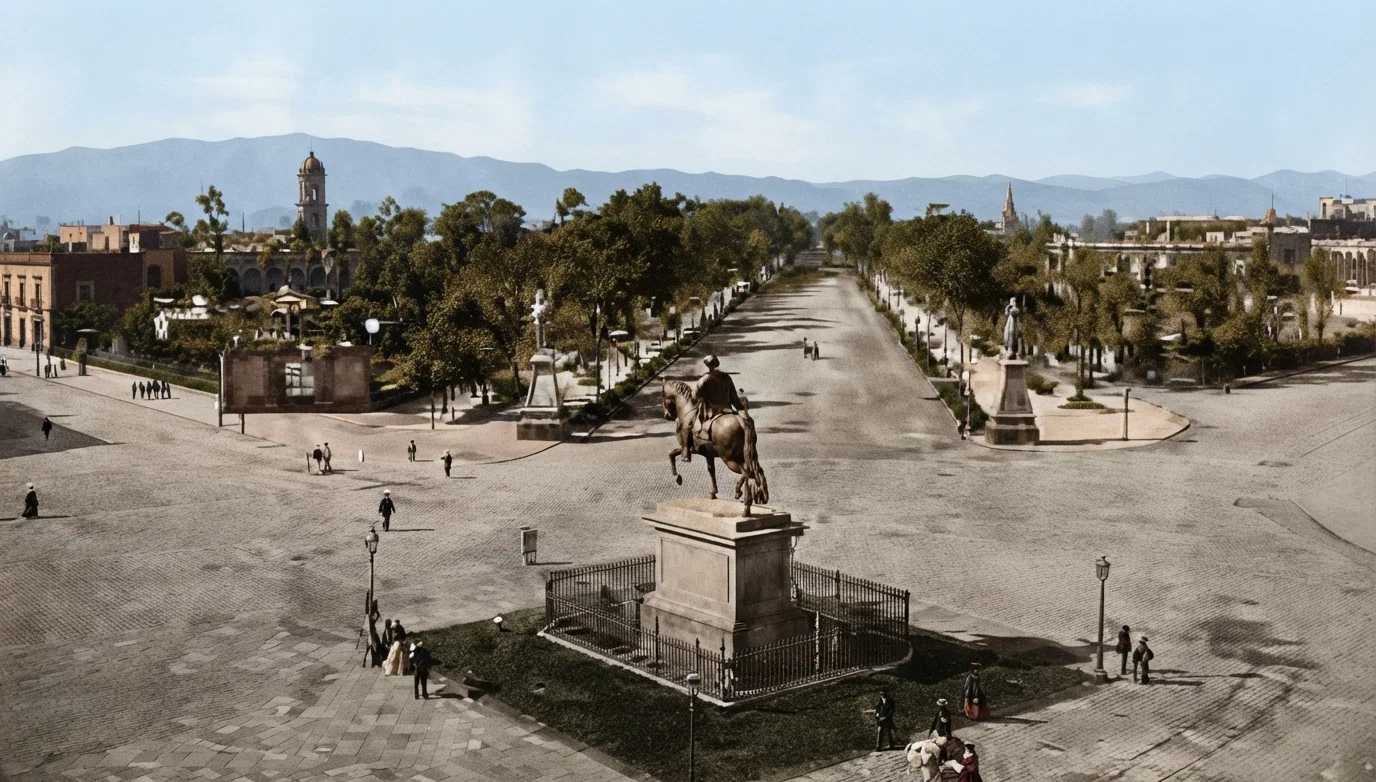
The Main Street of the City of Mexico.
As we contemplate this glorious vision, can we13not join with new fervor in singing the beautiful words written by Isaac Watts:
"The God of glory down to men
Removes His blest abode;
Men are the objects of His love,
And He their gracious God.
His own soft hand shall wipe the tears
From every weeping eye;
And pains, and groans, and griefs, and fears,
And death itself, shall die.
How bright the vision! O how long
Shall this glad hour delay?
Fly swiftly round, ye wheels of time,
And bring the welcome day."
YOUR PLACE.
By Helen M. Richardson
[This was handed us by a young lady, a Christian, as one of the helpful poems to her.]
Just where you stand in the conflict,
There is your place;
Just where you think you are useless,
Hide not your face;
God placed you there for a purpose,
Whate'er it be;
Think! He has chosen you for it;
Work loyally.
Gird on your armor! be faithful
At toil or rest,
Whiche'er it be, never doubting
God's way is best.
Out in the fight, or on picket,
Stand firm and true;
This is the work which your Master
Gives you to do.