We are glad to see that Christian sentiment is being aroused on the subject of vile literature, and that the pulpit and the Christian press are speaking out on this subject in a most fearless manner.
Rev. De Witt Talmage, when asked by letter whether it was right to read the New York Ledger, or the Weekly, expressed the sentiment of the more thoughtful men and women of the church, when he answered:
“The family altar is nothing; catechisms are nothing; religious instruction is nothing, so long as there is an unhealthy periodical in the house. From the two leprous lips of that one sheet there will be a poison breathed on the family Bible, on the piano, on the arm-chair, on the cradle, on the dining-table, and the whole house will be plague-smitten. The question amounts to this: ‘Shall my family be blest or blasted?’”
“I give an infallible rule. Seek some one who has been reading a paper for several years, and find out if her character is growing more symmetrical, is she a better daughter, a holier mother, a more consistent church-member? If, on the contrary, her talk is groveling, her imagination debased, her ideas of life twisted and sprung, then better decree that such a paper shall not come into your house by postman or messenger, or as wrapping paper around a dry goods’ bundle. ‘Every tree is known by its fruits.’”
“If there be one gulf in hell deeper than another, it shall be the doom of those newspaper men whose pen is stabbing to death the purity of American society. The newspaper stands are blotched with accursed pictorials, and I pray God that if these polluters of public morals may not be arrested by the voice of conscience, or silenced by the indignation of our sorrow-struck communities, that then they may be hurled out of this life speedily, that the plague may be stayed. God redeem our country from the damning influence of a corrupt newspaper literature.”
A mother recently complained to a friend of ours of the waywardness of her daughter. The friend, who was the girl’s Sabbath-school teacher, asked, “What does she read?” The mother had not guarded that point, and never thought to inquire.
They went to the young girl’s room, to find an abundant supply of sensational and vile literature, which had been furnished her gratuitously. The poison had been doing its deadly work for months, and the mother found out all too late that vile literature is as corrupting and seducing as vile company, and that the one leads to the other.
This poor, deluded girl is now an inmate of a brothel.
The feet of many thoughtless girls have been taken in this same snare.
We have found them in hospitals and almshouses and prisons; friendless outcasts; wrecked and ruined.
And girls are not the only sufferers. This is the shortest road a boy can take to perdition; every other evil follows in its train.
And this vice no longer hides itself in dark, secret places, but seeks some public resort for its vile traffic, where men and boys may be drawn together in crowds, and tempted by the display of immodest pictures to purchase.
We have seen boys blush with shame, and hide the newly-bought pictorial under their jackets, at the approach of respectable-looking people, and hurry away to enjoy in secret what they would not be seen reading in public.
Mothers will do well to inquire how many news depots there are where vile literature is exposed for sale on the streets their children travel when they go to the post-office or the school-house. Better expose them to small-pox or cholera than allow them to go near such places.—Golden Censer.
The Lord's Tenth.
THERE is a common opinion existing in the minds of Christians, that though their expenditures for the support of their families should be suitably proportioned to their incomes, that which is devoted to the Lord's service may well be left to accident, or the convenience or impulse of the moment when a call for benevolence is made.
Although it is true that, in the New Testament, we have no definite amount for God's treasury demanded, yet we are enjoined to give according to our income. “Upon the first day of the week let every one of you lay by him in store as God hath prospered him.” Here the duty of a definite appropriation is demanded. It does not, it is true, say whether a tenth or fifth or a hundredth is required; but let us look for a moment at a few of the records of those early days, and see if any light may be gathered from them. Zaccheus gave “one-half his goods to the poor.” The poor widow, whom Christ commended, gave in all her living to the treasury of the temple. We find the poor and afflicted church of Macedonia “abounding in riches of liberality” to those still poorer; giving even “beyond their power,” and entreating that the gift might be accepted. A whole church sold their houses and lands and gave away the proceeds.
Although we are not commanded to perform the same acts, yet the whole spirit of the gospel teaches us to make self-denials for the advancement of Christ's cause, and points toward a much larger liberality than was required in the old Jewish church.
And what was the proportion required then for the Lord's service? From the highest to the humblest, every one was required by God to give one-tenth of his increase to the tribe of Levi. Another tenth was required for the support of regular feasts; still another every three years for the poor, besides journeys to the temple, trespass offerings, and numerous other requirements, making in all not less than a fourth of their income.
How can any Christian, with the light of God's word illuminating his path of duty, be willing or even dare to give less than one-tenth of all he receives to the Lord? “Shall a man rob God?” Yet how many are daily robbing him by withholding the tithes, the mere interest money on the sum he has loaned them! Ah! a breath of his power can scatter the ill-gotten possessions which are secured by such robberies. “The blessing of the Lord maketh rich.” He who fails to honor God with the first-fruits of his increase, will find his gold corrupted, and its rust shall eat his flesh as it were fire.
The resolution of Jacob should be written on the door-post of every Christian's heart: “Of all that thou shalt give me I will surely give a tenth to thee.” Many have adopted and strictly followed this resolution; and one who has had a large acquaintance with the business, as well as religious, world, said he never knew an instance of one who did so, failing in business, however great the commercial pressure. “There is that scattereth and yet increaseth.” God never fails to give back “good measure, pressed down, and shaken together,” for all that is given to his cause. Dr. Harris has truly said that “the most marked interpositions and signal blessings of even earthly prosperity have attended the practice of Christian liberality in all ages.” Said Baxter, who was noted for his charities, “The little I now possess was nearly all acquired at the time when I gave away most.”
Let any one try the experiment, and watch the providences of God, and I doubt not that he will find his promises of prosperity to those who honor him with their substance fulfilled far beyond his largest expectations.—Christian Treasury.
LORD! I find David making a syllogism in mood and figure, two propositions he perfected.
Verse 18, “If I regard wickedness in my heart the Lord will not hear me.”
Verse 19, “But verily God hath heard me, he hath attended to the voice of my prayer.”
Now I expected that David should have concluded thus:
Therefore I regard not wickedness in my heart.
Verse 20, “Blessed be God, who hath not turned away my prayer, nor his mercy from me.”
Thus David hath deceived, but not wronged, me. I looked that he should have clapped the crown on his own, and he puts it on God’s head. I will learn this excellent logic; for I like David’s better than Aristotle’s syllogisms, that, whatsoever the premises be, I make God’s glory the conclusion.—Fuller.
Don't Fret.
By Mary Bolling
MARY BOLLING says: “Don't fret, whatever you do, and don't let your children fret. Fretfulness is a habit easily acquired, even when it is not naturally a part of one's disposition, by associating with fretful people.
“Everybody feels a tendency to it, at times, and if the desire is indulged, it gains strength very rapidly, and is a source of annoyance, even of unhappiness, not only to the fretful individual himself, but to all by whom he is surrounded. If mothers would not gratify their children when they fret for what they want, a good deal could be done toward preventing the little ones from acquiring a habit which will certainly contribute nothing toward the possessor's comfort, ease, or happiness, or toward that of any with whom he may come in contact.
“I know a lady who has a little boy, not yet three years old, who is inclined to be very fretful sometimes—though not at all sick—which might be an excuse. She never gives him anything that he asks for in a fretful tone. Before he was quite two-and-a-half years old, he had learned that when his mother said, ‘Can't give it to a fretful boy,’ that he was not to get it; and I have often heard his tone change in a few minutes, and he would reply, ‘I'm smilin’ now, mamma’—when his request, if a reasonable one, would always be promptly granted.
“Children of a fretful mother always fret, it might be safely asserted, and many indulge this bad habit whose mothers never gave way to it themselves, but, in many cases, did not take the trouble, or did not know how, to control it in their children.
“If anything were gained by it, there might be some little excuse for being uncomfortable one's self, and for making others so too—but we all know fretting accomplishes nothing, except making the one who indulges in it disagreeable to himself and to every one else. Therefore I conclude by saying, as I began—Don't fret yourself, and don't allow your children to fret.”
Faith Tested on Life's Rough Path
SOME can walk very well along the plank sidewalk of God's gentle providences, and over the smooth pavement of prosperity. But when their path is steep and stony, their feet stumble, and they faint by the way. Like Peter, they sink when they tread the boisterous sea of trouble or sorrow.
Seeking Truth Regardless of Majority or Minority
No man can be in a proper frame of mind for the discovery and reception of truth who is not utterly regardless of the question whether his being in a majority or minority will be the result of his investigations.
White Robes.
By James White
THE NATURE AND PERPETUITY OF THE DIVINE LAW.
The position taken in previous articles is that the law of the Father, and the gospel of the Son, constitute harmonious parts of the plan of salvation, covering the entire period of human probation.
The divine law, however, dates back before the gospel; hence, the period of its existence is longer than that of the gospel. It existed before the fall, or there could not have been in the justice of God any such thing as the fall. It existed as early as there were created intelligences subject to the government of the Creator, and extends to the future, running parallel with the eternity of God’s moral government. Angels fell; therefore, were on probation. They, being on probation, were consequently amenable to law. In the absence of law, they could not be on probation, therefore, could not fall. The same may be said of Adam and Eve in Eden.
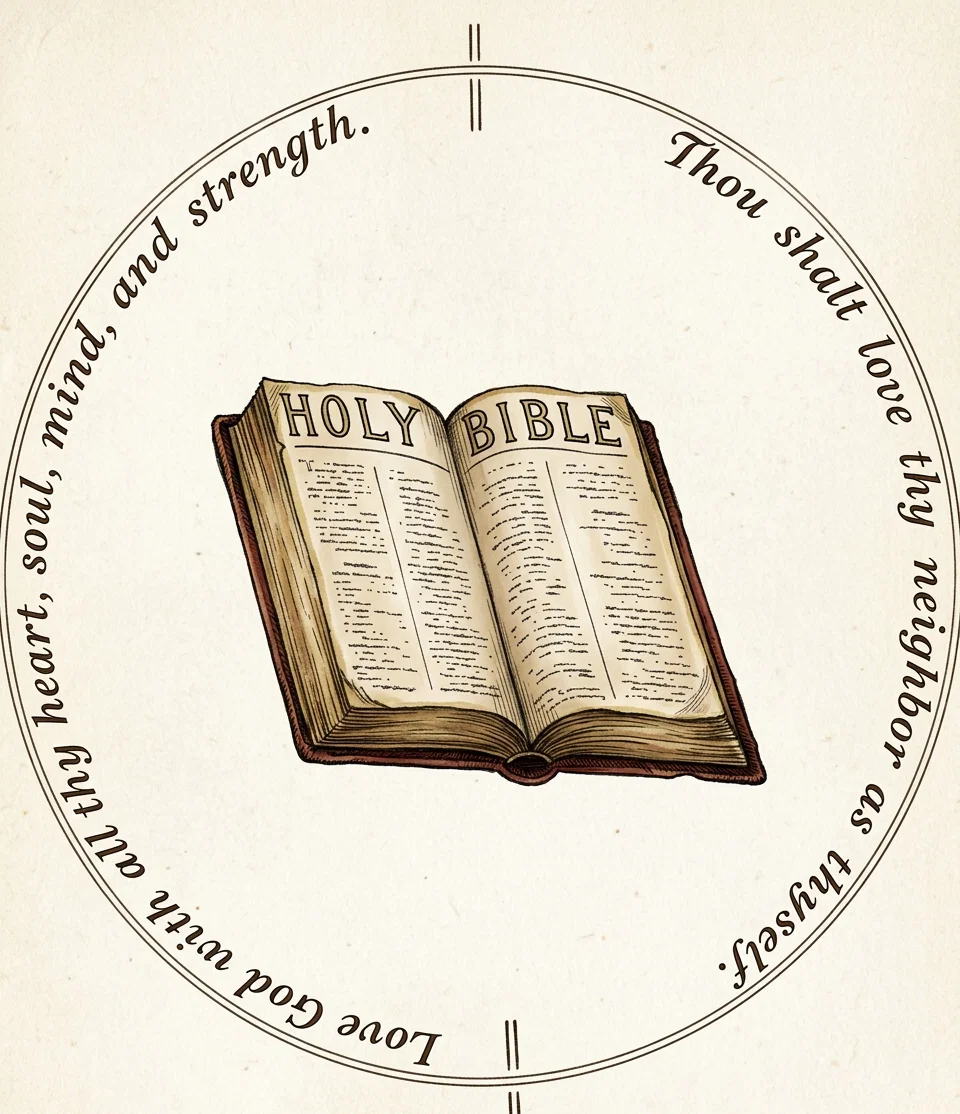
The ten commandments, as worded in the sacred Scriptures, are adapted to fallen beings. As thus worded, they are not adapted to the condition of holy angels, nor to man in his holy estate in Eden. The two grand principles of God’s moral government existed before the fall, in the form of law. These are given in the Old Testament, and are quoted by Christ in the New, as the two great commandments: “Thou shalt love the Lord thy God with all thy heart, and with all thy soul, and with all thy mind. This is the first and great commandment. And the second is like unto it, Thou shalt love thy neighbor as thyself. On these two commandments hang all the law and the prophets.” Matt. 22: 37–40; Deut. 6: 5; Lev. 19: 18.
These two commandments require supreme love to the Creator, and love to fellow-creatures equal to that bestowed upon one’s self. Angels could do no more than these require. Adam, before the fall, could do no more. We can do no more. The two great commandments embrace all that is required by the ten precepts of the decalogue. No precept and no principle of the book of God extends beyond this grand circle , inside of which is comprehended and summed up the will of God to man, concerning his Creator and his fellow-man.
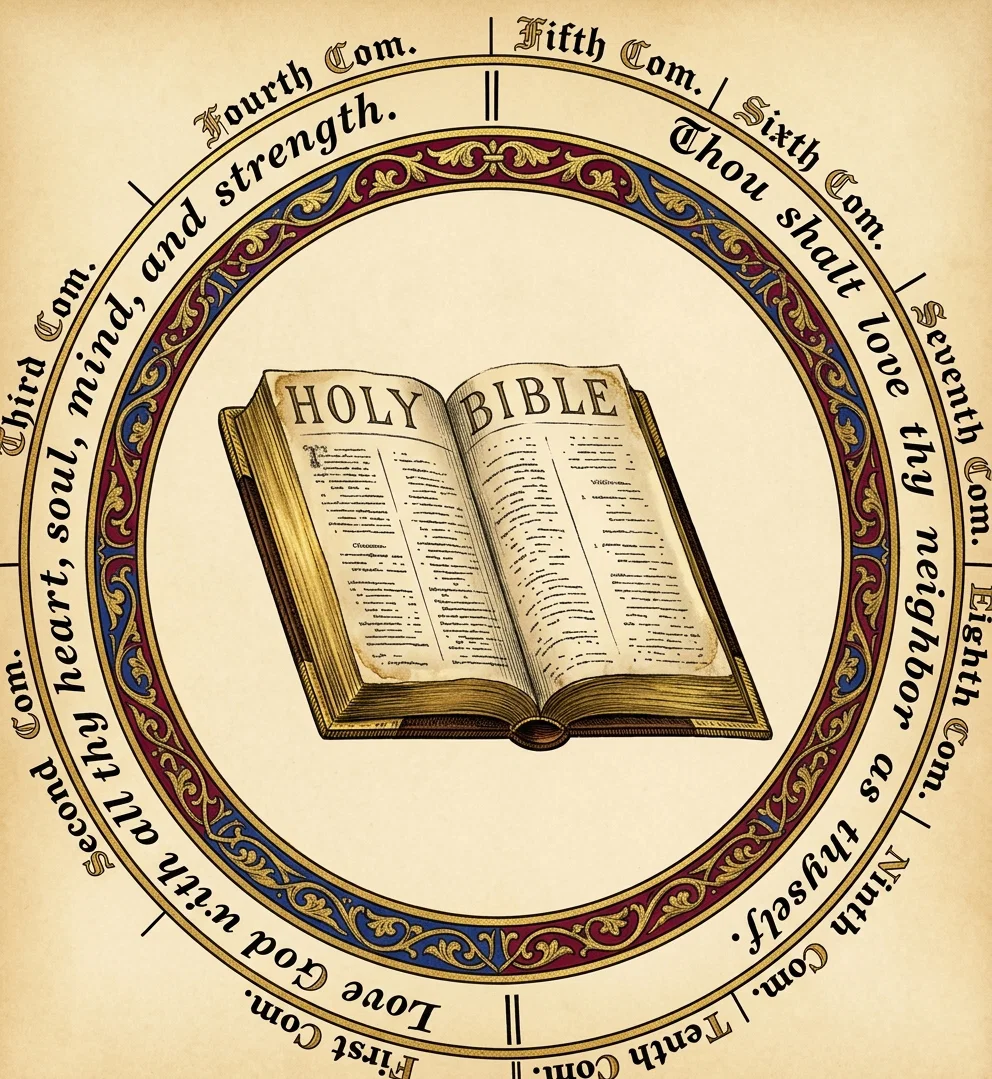
The foregoing circle in two parts is designed to illustrate the two principles of God’s moral government as expressed by the two great commandments; while the following circle represents the same as expressed and guarded by the ten precepts of the divine law.
Soon after the fall, we see the two principles of God’s moral government guarded by ten precepts, worded to meet man’s fallen condition.
Love to God is taught in the first four commandments, and love to our fellow-man is taught in the last six. The prophets of the Lord, the Son of God, and the apostles of Jesus, have all spoken in harmony with the ten precepts of the law of God. The whole duty of man, says Solomon, is to fear God and keep his commandments.
The ten precepts of the decalogue, so worded as to be adapted to man’s fallen condition, were enforced as early as the circumstances demanded them. The first three were applicable to Adam immediately after the fall. And although the Sabbath of the fourth precept was instituted at the close of the first week of time, before the fall, and we have evidence that Adam was directed to observe it as a memorial of creation, yet that portion of the precept adapted to the fallen state, relative to the man-servant, the maid-servant, and the stranger, could not exist till a later period, when such relations existed. The fifth commandment could not be enforced, until applicable to Adam’s children. The sixth, seventh, eighth, ninth, and tenth, were enforced as early as the parties existed to whom they could properly apply.
There is nothing in the moral condition of man in his fallen state, nor in the nature of the ten commandments themselves, to restrict them to any one dispensation more than another. Man’s moral wretchedness is the same, only more deplorable as he advances from the gates of Paradise toward the close of probation. And the law of God, adapted to his fallen state, is applicable and necessary throughout the entire period of his fallen condition, from Paradise lost to Paradise regained.
The reign of sin and that of death run parallel from Adam until sin and sinners shall cease to be. And parallel with them, stretching through all dispensations, there has been the knowledge of the principles of the ten commandments, consequently a knowledge of sin.
The means of this knowledge has been the law of God. “By the law,” says the apostle, “is the knowledge of sin.” Rom. 3: 20. “I had not known sin, but by the law.” Chap. 7: 7. As proof that this knowledge did exist immediately after the fall, see Gen. 4: 7, 23, 24; 6: 5, 11, 12. Also, Noah was righteous before God. Chap. 7: 1. He was a preacher of righteousness. 2 Pet. 2: 5. By his preaching right-doing, reproving the sins of the people of his time, he condemned the world. Heb. 11: 7. The men of Sodom and Gomorrah were great sinners, excepting one man. Abraham interceded, saying, Wilt thou destroy the righteous with the wicked? Gen. 13: 13; 18: 20, 23, 25; 19: 7. The blessing of God came upon Abraham, because he obeyed his voice and kept his commandments. Gen. 26: 5. Those who refused obedience, experienced his wrath for their transgressions. The cities of the plain were condemned for their unlawful deeds. 2 Pet. 2: 6–8.
As an illustration of this subject, we briefly notice the murder of righteous Abel. Cain killed his brother, and, as a sinner, received the mark of God’s displeasure. Sin, says the apostle, is the transgression of the law. 1 John 3: 4. Cain broke the sixth commandment; hence, that precept existed in the time of Cain. Otherwise he did not sin; for where no law is, there is no transgression. Rom. 4: 15.
The foregoing positions relative to the law of God would meet with but little opposition were it not for the Sabbath of the fourth commandment. The proper observance of the Bible Sabbath is not only crossing, but, with many, inconvenient, and not favorable to the successful prosecution of their worldly plans. The fearful and unbelieving shun its claims, brand it as a Jewish institution, and frequently assert that it was unknown to men until the Sabbath law was proclaimed from Sinai. Sacred history, however, proves this statement to be false. It is true that, though the record of setting apart the Sabbath to a holy use is given in Genesis, there is no distinct mention of its observance in that book. But this does not prove that it did not exist during the long period covered by that brief record. The facts connected with the giving of the manna show that the Israelites understood the obligations of the Sabbath, and that some of the people violated them, and were reproved by the Lord, thirty days before they saw Mount Sinai. See Ex. 16–19.
We call attention to three grand events which have taken place in connection with the sad history of fallen man, either one of which is sufficient to establish the perpetuity of the law of God.
First, the fall, with all its terrible consequences. If the law of God was of such a nature that it could, in any particular, be changed at any time, it would have been thus changed when there were but two fallen beings, Adam and Eve, just before leaving Eden. If the plan of God’s moral government could be changed, it would then have been changed, so as to set them free, and save the tide of human wretchedness and agony which has followed. But, no; it could not be changed. The curse must fall on man, and upon the earth for man’s sake. And the blight and mildew of sin must follow everywhere, and moral darkness, like a pall of death, must spread everywhere. Why? Because God’s law that had been transgressed could not be changed—could not be abolished. This is the result of sin and the terrible fall. And this has all come about because of the transgression of that law which is as changeless as the throne of Heaven. Every fading flower and falling leaf, since man left Eden, has proclaimed the law of God changeless.
If that law could ever be changed in any particular, it would have been changed when there were but two fallen beings. It would then have been changed in such a way as to free them from the sentence of death, and raise them from their degradation, and the race from continued sin, crime, and woe. Think of the recent American war, with all its terrible agony. And this is only an item in the vast catalogue. For six thousand years, the tide has been swelling, and creation has been adding groan to groan. Who can compute the amount of moral wretchedness and agony in consequence of the violation of God’s immutable law? The fall, then, with all its accumulated wretchedness, proclaims God’s law changeless.
Second, the announcement of the ten commandments from Sinai with imposing display. It was not left for Moses to proclaim this law. It was not left for an angel to assemble the tribes of Israel, and utter these ten holy precepts in their hearing. The Lord himself descends in awful grandeur, and proclaims the precepts in the hearing of all the people.
Do you say that that was the origin of the law of God? Do you say that God descended on Sinai, and there legislated? And do you say that he has since abolished that code? When did he do this? Where did he do it? Has any prophet foretold that such an event should take place? And has any apostle recorded that such a work was ever done? Certainly not. It is only by confounding the handwriting of ordinances with the royal law, that men infer that the divine law is abrogated.
Congress enacts laws which are published throughout the Union. The people understand them. Some of these laws are afterward repealed or changed. Is this done in secret, and the people permitted to know nothing about it? No; the same law-making body makes the changes, and the people are apprised of the fact. And has not God manifested as much wisdom and benevolence in the management of the affairs of his moral government in which man has so great an interest—affairs which affect his eternal welfare? He came down upon Sinai, and proclaimed his law under such circumstances as to impress the people with its grandeur, dignity, and perpetuity. Who can suppose that he would abolish or alter it, and say nothing about it?
Third, the crucifixion establishes the law of God. If that law was of such a nature that it could be abolished, or any of its precepts changed, why not have this done, and set man free, instead of the Son of God’s laying aside his glory, taking our nature, living the sad life he lived here upon the earth, suffering in Gethsemane, and finally expiring upon the cross? Oh! why should the divine Son of God do all this to save man, if that law which held him as a sinner could be changed, so that he could be set free? But no change could be made in the divine law. Man had sinned, had fallen, and was shut up in the prison-house of sin. His sins were of such a nature that no sacrifice was adequate but the sacrifice of Him to whom the Father had said, “Let us make man.” The death of an angel was not sufficient. He only who engaged with the Father in the formation of man, could constitute a sufficient sacrifice to open the door of hope by which he might find pardon, and be saved. In the language of the hymn we sing, “Come, O my soul, to Calvary,” and there behold love and agony mingled in the death of the Son of God.
Behold him groaning in Gethsemane. His divine soul was in agony as the sins of men were rolled upon him. “My soul,” said he, “is exceeding sorrowful, even unto death.” The weight of man’s sin in transgressing God’s immutable law was such as to press from his pores as it were great drops of blood.
He then bears his cross to Calvary. The nails are driven into his hands and feet. The cross is erected. There the bleeding Lamb hangs six terrible hours. The death of the cross was most agonizing. But there was in his case the additional weight of the sins of the whole world. In his last expiring agony he cries, “My God, my God, why hast thou forsaken me?” and bows his head in death.
The sun, the brightest luminary in heaven, can no longer view the scene, and is vailed as with sackcloth. The vail of the temple, the noblest work of man, is rent in twain. Christ, the noblest being in the universe, save One, is dying in agony. Creation feels the shock, and groaning and heaving, throws open the graves of many of the saints, who come out of their graves after his resurrection. The law must stand as firm as the throne of Heaven, although the earth shakes, and the whole creation trembles, as the Son of God dies in agony.
The law of God was given to man as his saviour. He broke it. Could it then redeem him? It is not in the power of law, either human or divine, to redeem the transgressor. Those who transgress the law of any commonwealth, must suffer the full penalty, unless the governor shall pardon the transgressor. Pardon is the transgressor’s only hope of escaping the full sentence of the law. Some, who do not fully understand our position, say that we trust in the law, and the keeping of the Sabbath, for salvation. No, friends, you may observe all the ten commandments, to the best of your ability, conscientiously; but if you look no farther than the law, you can never find pardon and salvation. Our only hope of eternal life hangs upon Christ. Adam placed his hope there. Abel, Enoch, Noah, Abraham, and the believing Jews, had no other hope. We can do no more. The hope of the next life depends upon Jesus Christ. Faith in his blood can alone free us from our transgressions. And a life of obedience to the commandments of God and the faith of Jesus will be a sufficient passport through the golden gates of the city of God. J. W.
Black Hawk, Colorado, Aug. 12, 1873.
Testimony of the Fathers.
By John Nevins Andrews
TESTIMONY OF JUSTIN MARTYR.—CONTINUED.
In chapter twenty-one, Justin asserts “that God enjoined you [the Jews] to keep the Sabbath, and imposed on you other precepts for a sign, as I have already said, on account of your unrighteousness, and that of your fathers,” &c., and quotes Ezekiel 20 to prove it. Yet that chapter declares that it was in order that they might know who was that being who sanctified them, i. e., that they might know that their God was the Creator, that the Sabbath was made to them a sign.
In chapter xxiii., he again asserts that, “in the times of Enoch,” no one “observed Sabbaths.” He then protests against Sabbatic observance as follows:—
“Do you see that the elements are not idle, and keep no Sabbaths? Remain as you were born. For if there was no need of circumcision before Abraham, or of the observance of Sabbaths, of feasts and sacrifices, before Moses; no more need is there of them now, after that, according to the will of God, Jesus Christ the Son of God has been born without sin, of a virgin sprung from the stock of Abraham.”
That is to say, there was no Sabbatic institution before Moses, and neither is there any since Christ. But in chapter xxiv., Justin undertakes to bring in an argument for Sunday, not as a Sabbath, but as having great mystery in it, and as being more honorable than the seventh day. Thus, alluding to circumcision on the eighth day of a child’s life as an argument for the first-day festival, he says:—
“It is possible for us to show how the eighth day possessed a certain mysterious import, which the seventh day did not possess, and which was promulgated by God through these rites.”
That is to say, because God commanded the Hebrews to circumcise their children when they were eight days old, therefore all men should now esteem the first day of the week more honorable than the seventh day, which he commanded in the moral law, and which Justin himself, in chapter xix., terms “the memorial of God.” In chapter xxvi., Justin says to Trypho that—77“The Gentiles, who have believed on him, and have repented of the sins which they have committed, they shall receive the inheritance along with the patriarchs and the prophets, and the just men who are descended from Jacob, even although they neither keep the Sabbath, nor are circumcised, nor observe the feasts.”
And in proof of this, he quotes from Isa. 42, and 62, and 63, respecting the call of the Gentiles. Upon this (chapter xxvii.), Trypho the Jew very pertinently asks:—
“Why do you select and quote whatever you wish from the prophetic writings, but do not refer to those which expressly command the Sabbath to be observed? For Isaiah thus speaks [chap. 58:13, 14], ‘If thou shalt turn away thy foot from the Sabbath.’” etc.
To which Justin made this uncandid answer:—
“I have passed them by, my friends, not because such prophecies were contrary to me, but because you have understood, and do understand, that although God commands you by all the prophets to do the same things which he also commanded by Moses, it was on account of the hardness of your hearts, and your ingratitude toward him, that he continually proclaims them, in order that, even in this way, if you repented, you might please him, and neither sacrifice your children to demons, nor be partakers with thieves,” etc. And he adds: “So that, as in the beginning, these things were enjoined you because of your wickedness, in like manner, because of your steadfastness in it, or rather your increased proneness to it, by means of the same precepts, he calls you [by the prophets] to a remembrance or knowledge of it.”
These are bitter words from a Gentile who had been a pagan philosopher, and they are in no sense a just answer, unless it can be shown that the law was given to the Jews because they were so wicked, and was withheld from the Gentiles because they were so righteous. The truth is just the reverse of this. Eph. 2. But to say something against the Sabbath, Justin asks:—
“Did God wish the priests to sin when they offer the sacrifices on the Sabbaths? or those to sin, who are circumcised and do circumcise on the Sabbaths; since he commands that on the eighth day—even though it happen to be a Sabbath—those who are born shall be always circumcised?” And he asks if the rite could not be one day earlier or later, and why those “who lived before Moses” “observed no Sabbaths?”
What Justin says concerning circumcision and sacrifices is absolutely without weight as an objection to the Sabbath, inasmuch as the command forbids, not the performance of religious duties, but our own work. Ex. 20:8-11. And his often repeated declaration that good men before the time of Moses did not keep the Sabbath, is mere assertion, inasmuch as God appointed it to a holy use in the time of Adam, and we do know of some in the patriarchal age who kept God’s commandments, and were perfect before him.
In chapter xxix., Justin sneers at Sabbatic observance by saying, “Think it not strange that we drink hot water on the Sabbaths.” And as arguments against the Sabbath he says that God “directs the government of the universe on this day equally as on all others,” as though this were inconsistent with the present sacredness of the Sabbath, when it was also true that God thus governed the world in the period when Justin acknowledges the Sabbath to have been obligatory. And he again refers to the sacrifices and to those who lived in the patriarchal age.
In chapter xii., Justin again brings forward his argument for Sunday from circumcision:
“The command of circumcision, again, bidding [them] always circumcise the children on the eighth day, was a type of the true circumcision, by which we are circumcised from deceit and iniquity through Him who rose from the dead on the first day after the Sabbath [namely, through], our Lord Jesus Christ. For the first day after the Sabbath, remaining the first of all the days, is called, however, the eighth, according to the number of all the days of the cycle, and [yet] remains the first.”
Sunday-keeping must be closely related to infant baptism, inasmuch as one of the chief arguments in modern times for the baptism of infants is drawn from the fact that God commanded the Hebrews to circumcise their male children; and Justin found his scriptural authority for first-day observance in the fact that this rite was to be performed when the child was eight days old! Yet this eighth day did not come on one day of the week, only, but on every day, and when it came on the seventh day it furnished Justin with an argument against the sacredness of the Sabbath! But let it come on what day of the week it might (and it came on all alike), it was an argument for Sunday! O wonderful eighth day, that can thrive on that which is positively fatal to the seventh, and that can come every week on the first day thereof, though there be only seven days in each week!
In chapters xliii., and xlvi., and xcii., Justin reiterates the assertion that those who lived in the patriarchal age did not hallow the Sabbath. But as he adds no new thought to what has been already quoted from him, these need not be copied.
But in chapter xlvii., we have something of interest. Trypho asks Justin whether those who believe in Christ, and obey him, but who wish to “observe these [institutions] will be saved?” Justin answers: “In my opinion, Trypho, such an one will be saved, if he does not strive in every way to persuade other men . . . to observe the same things as himself, telling them that they will not be saved unless they do so.” Trypho replied, “Why then have you said, ‘In my opinion, such an one will be saved,’ unless there are some who affirm that such will not be saved?”
In reply, Justin tells Trypho that there were those who would have no intercourse with, nor even extend hospitality to, such Christians as observed the law. And for himself he says:—
“But if some, through weak-mindedness, wish to observe such institutions as were given by Moses from which they expect some virtue, but which we believe were appointed by reason of the hardness of the people’s hearts, along with their hope in this Christ, and [wish to perform] the eternal and natural acts of righteousness and piety, yet choose to live with the Christians and the faithful, as I said before, not inducing them either to be circumcised like themselves, or to keep the Sabbath, or to observe any other such ceremonies, then I hold that we ought to join ourselves to such, and associate with them in all things as kinsmen and brethren.”
Justin’s language shows that there were Sabbath-keeping Christians in his time. Such of them as were of Jewish descent no doubt generally retained circumcision. But it is very unjust in him to represent the Gentile Sabbath-keepers as observing this rite. That there were many of these is evident from the so-called Apostolical Constitutions, and even from the Ignatian Epistles. One good thing, however, Justin does say. The keeping of the commandments he terms the performance “of the eternal and natural acts of righteousness.” He would consent to fellowship those who do these things provided they made them no test for others. He well knew in such case that the Sabbath would die out in a little time. Himself and the more popular party at Rome honored as their festival the day observed by heathen Romans, as he reminds the emperor in his apology, and he was willing to fellowship the Sabbath-keepers if they would not test him by the commandments, i. e., if they would fellowship him in violating them.
That Justin held to the abrogation of the ten commandments is also manifest. Trypho, in the tenth chapter of the Dialogue, having said to Justin, “You do not obey his commandments,” and again, “You do not observe the law,” Justin answers in chapter eleven as follows:—
“But we do not trust through Moses, or through the law; for then we would do the same as yourselves. But now—for I have read that there shall be a final law, and a covenant, the chiefest of all, which it is now incumbent on all men to observe, as many as are seeking after the inheritance of God. For the law promulgated on Horeb is now old, and belongs to yourselves alone; but this is for all universally. Now, law placed against law has abrogated that which is before it, and a covenant which comes after in like manner has put an end to the previous one.”
We must, therefore, pronounce Justin a man who held to the abrogation of the ten commandments, and that the Sabbath was a Jewish institution which was unknown before Moses, and of no authority since Christ. He held Sunday to be the most suitable day for public worship, but not upon the ground that the Sabbath had been changed to it, for he cuts up the Sabbatic institution by the roots; and so far is he from calling this day the Christian Sabbath that he gives to it the name which it bore as a heathen festival.