Seventh-day Adventist Publishing Association · Battle Creek, Mich. · Feb 17, 1903
From The Scientific American
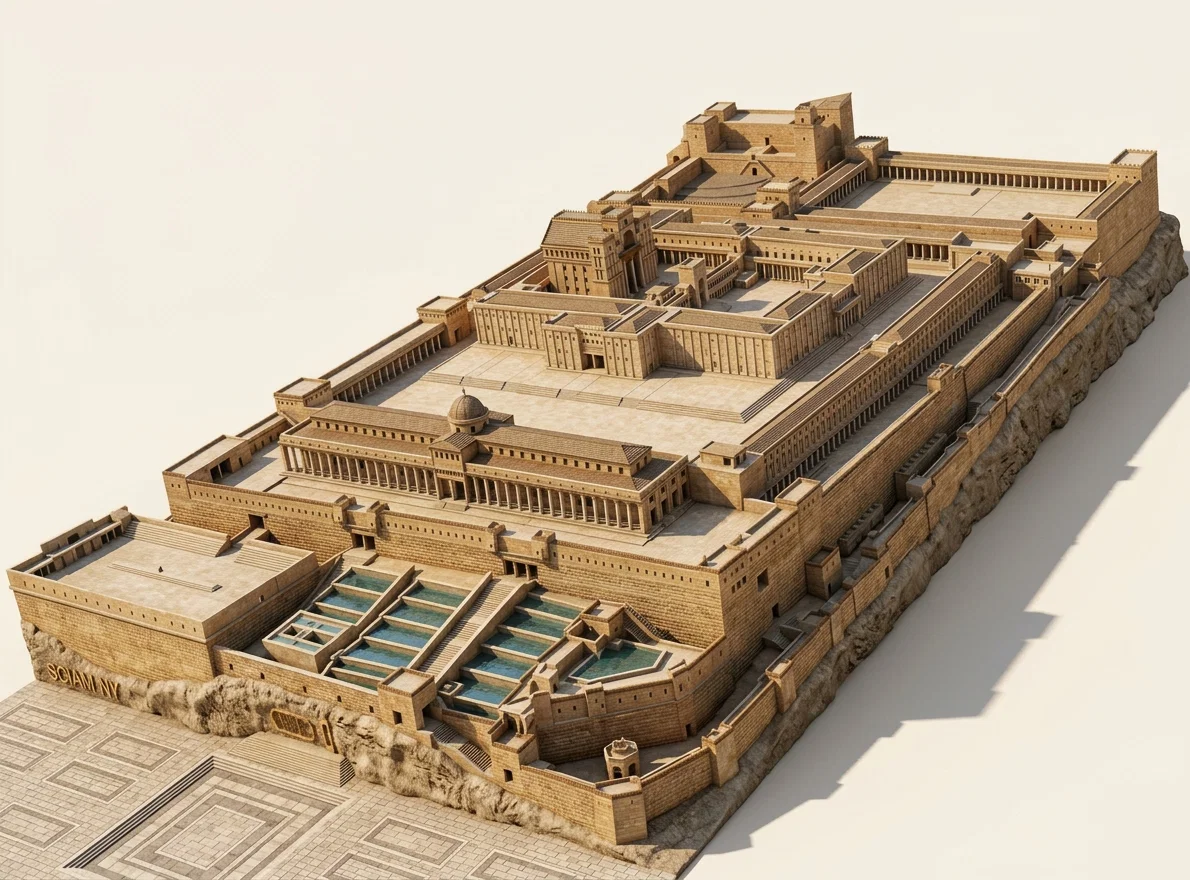
Herod's Temple, Built 30 B. C.
Last week we presented a picture of a model of Solomon's temple. This week we give a picture of the model of Herod's temple, which was built upon the same site. The following comparison of the two models is taken from The Scientific American:—
“The great temple of Solomon was destroyed by the Chaldeans, and after the captivity of the Jews a new one was built upon the same site by Herod, which is known as Herod's temple. It was finished about thirty years before the birth of Christ. An inspection of the two models reveals a considerable difference in the design of the various buildings. Herod enlarged the temple area, taking into the enclosure the ground space formerly covered by the palaces of the king, and extending the wall to the west. A great porch, called Solomon's Porch in John, was built where the line of palaces had been, but the inner temple, with the Chel, and its buildings were arranged much as in Solomon's time. The altar is larger and of stone. The marble pillars in the courts have taken the place of pillars of brass. The upper room has a greater roof, and the middle tower of the front is unfinished; Herod's fortress, Antonia, has taken the place of the old strong place on the northwest. This temple was destroyed by the Romans.”
Publishers' Page
By Editor
Conducted by the Department of Circulation of the Review and Herald Publishing Company
Special Sale of Slightly Damaged Books
In recent issues of the REVIEW, we have given quite a full description of the following slightly damaged books, and as these works are well known to the majority of our readers, we omit further descriptions of those heretofore presented, and quote only the regular and reduced prices:—
Desire of Ages
In the cloth binding, reduced from $3.50 to $2.60, postpaid.
Great Controversy
In the cloth binding, reduced from $2.75 to $2. Full morocco, from $4.50 to $3.30.
Patriarchs and Prophets
Cloth binding, reduced from $2.75 to $2.
Easy Steps in the Bible Story
Cloth binding, reduced from 50 cents to 35 cents.
Looking unto Jesus
The cloth binding, reduced from $1 to 75 cents.
Marvel of Nations
Cloth binding, reduced from $1.25 to 75 cents, postpaid.
Home Hand-Book
Cloth binding, reduced from $4.50 to $3.35; the library from $5.50 to $4.10, postpaid.
Ladies' Guide
Cloth binding, reduced from $3 to $2.25, postpaid.
Man, the Masterpiece
Cloth binding, reduced from $3 to $2.25, postpaid.
Prophecies of Jesus
Cloth binding, reduced from $1.75 to 85 cents; library, marble edges, from $3 to $1.40; Russia, $3.75 to $1.90.
Empire Series
Containing Empires of the Bible, Great Empires of Prophecy, and Ecclesiastical Empire
Reduced from $6 to $4, for the set.
Two Republics
Cloth binding, reduced from $2.50 to $1.25; the half morocco binding from $4 to $2; the full morocco binding from $4.75 to $2.35, postpaid.
The Abiding Spirit
By Mrs. S. M. I. Henry. Neatly bound in cloth, with plain edges; 316 pages. As good as new. Reduced from 40 cents to 30 cents, postpaid.
Here and Hereafter
Neatly bound in cloth; 357 pages. Reduced from $1 to 75 cents, postpaid. The damage is scarcely noticeable on this book.
Gospel Workers
Cloth binding; 480 pages. Reduced from $1 to 75 cents. As good as new.
The Nonsuch Professor
In a nice cloth binding, with 367 pages. Price reduced from $1 to 40 cents, postpaid.
Drummond's Addresses
Especially good for boys. Price reduced from 75 cents to 30 cents, postpaid.
The Master's Greatest Monosyllables
The faith-maker and the soul-winner. Reduced from 50 cents to 35 cents, postpaid.
Prophetic Charts in Series
Reduced from $4 to $2.50 per set.
Facts for the Times
A compendium of important facts in a simple form for ready reference; 329 pages; cloth binding. Price reduced from 75 cents to 50 cents.
Story of Daniel the Prophet
We have only 160 copies of this excellent book in stock. The average sale is 50 copies per month. At this rate our stock will last only a short time. Those who desire a copy of this book should order at once. It will soon be out of print. Neatly bound in cloth; 295 pages; 75 cents, postpaid.
Heralds of the Morning
Printed on extra fine paper; 280 large pages. Reduced from $1.25, marble edges, to 60 cents, and from $1.50, gilt edges, to 75 cents, postpaid.
Living Fountains or Broken Cisterns
By Prof. E. A. Sutherland. Contains 428 pages. Printed from new type. Substantially bound in cloth. Reduced from $1.25 to 65 cents, postpaid.
A Critical Harmony of the Gospels
75 cents each. Reduced from $1.25.
Mothers' and Teachers' Manual
Paper covers, 25 cents. Cloth binding, 35 cents. All as good as new. Reduced from 35 cents and 50 cents. Supply limited.
History of the Sabbath
In three volumes. Bound in paper covers, slightly damaged; 40 cents per set.
Other Damaged Books
The following books are only slightly damaged; the defect is scarcely noticeable on many volumes, yet the reduction in price is sufficient to cover larger damages.
The Gospel Reader
Companion volume to the “Gospel Primer.” The principles of the gospel are set forth in a clear, direct, and interesting manner. The more prominent events in Biblical history are noticed in chronological order. The story is told in such simple and direct language that even small children will have no difficulty in understanding it, while older readers will not fail to note the earnest manner and chaste elegance of the diction which distinguishes this book from the common story-book of the day.
Nicely illustrated, neatly bound in board and cloth. 192 pages. Reduced from 75 cents, cloth binding, to 35 cents; and from 50 cents, in the board binding, to 25 cents.
Peril of the Republic
Somewhat soiled; a little out of date in a few instances, but a splendid treatise upon the principles of liberty and good government. A book full of good things that never grow old; one that should be in the homes of all the people to warn them of the dangers that destroyed the Eastern nations, and to bind them to the principles upon which the safety of our government depends.
To close them out at once, we place the price at 30 cents, postpaid. The regular price is $1.
Mental Arithmetic
By Prof. E. A. Sutherland. A good chance for those who have children in our church schools to secure a text-book at greatly reduced rates.
Most of the readers of the REVIEW know that this book takes up the study of number in an entirely new manner, yet in harmony with sound and simplified arithmetical principles. It contains illustrations, examples, and drills, but eliminates the objectionable features found in other arithmetics that contain problems dealing in false weights and measures, and in liquor, tobacco, drugs, tea, coffee, candies, and other items of commercial value which have a tendency to poison the young mind.
Damage is not sufficient to hurt the durability of the book. It is substantially bound in cloth, 240 pages. Reduced from 65 cents to 40 cents, postpaid.
Good Form and Christian Etiquette
By Mrs. S. M. I. Henry. Circumstances have made it possible for some to secure this most helpful book at greatly reduced prices. What is loss to the publishers is gain to the people in this case.
The book is the product of a long, exemplary Christian life in which evil and its appearances were avoided, no offenses given, and the character of Christ revealed. Mrs. Henry was well qualified to teach how to avoid those things which give offense and lessen our influence for good among the best classes in the world, before whom we are to shine as lights. Every Christian needs to study the principles presented in this little work, and to make a daily application of them in his intercourse with humanity.
The book is neatly bound in cloth, with gilt edges. 144 pages. Reduced from 50 cents to 25 cents. Paper covers reduced from 25 cents to 15 cents, postpaid.
The Eastern Question
This book reveals the meaning of “the Eastern question,” “the sick man of the East,” draws back the historical and prophetic curtain, and brings to view the nations concerned in the solution of a situation impossible to be correctly solved by man without the aid of the revealed Word.
Substantially bound in cloth, 276 pages. Reduced from $1 to 50 cents, postpaid.
Life Sketches
The complete life of Elder James White, and the biography of Mrs. E. G. White, together with a thrilling history of the rise, early struggles, and progress of the work of Seventh-day Adventists. This book should be in the home of every person interested in religious reforms, especially those who are connected with the message founded by these faithful and sacrificing pioneers.
Books good as new; neatly bound in cloth, 435 pages. Price reduced from $1.25 to 75 cents, postpaid. Stock limited. Orders should be made immediately.
MAKE all orders for the books described above, on the Review and Herald Publishing Co., Battle Creek, Mich.
Fresh Courage
By Editor
Editorial
Why?
WHY will Jesus come again? “I go to prepare a place for you. And if I go and prepare a place for you, I will come again, and receive you unto myself; that where I am, there ye may be also.” “Father, I will that they also, whom thou hast given me, be with me where I am; that they may behold my glory, which thou hast given me.” “For the Lord himself shall descend from heaven with a shout, with the voice of the archangel, and with the trump of God: and the dead in Christ shall rise first: then we which are alive and remain shall be caught up together with them in the clouds, to meet the Lord in the air: and so shall we ever be with the Lord.” The purpose of our Lord’s coming is that his redeemed children may join him in the New Jerusalem, and share with him in the glory which he has won for them as the Son of man. Blessed prospect!
When?
WHEN will Jesus come again? “Now from the fig tree learn her parable: when her branch is now become tender, and putteth forth its leaves, ye know that the summer is nigh; even so ye also, when ye see all these things [definite signs mentioned by our Lord], know ye that he is nigh, even at the doors. Verily I say unto you, This generation shall not pass away, till all these things be accomplished.” “In the days of the voice of the seventh angel, when he is about to sound [the sixth trumpet closed Aug. 11, 1840], then is finished the mystery of God, according to the good tidings which he declared to his servants the prophets.” “And these good tidings of the kingdom shall be preached in the whole world for a testimony unto all the nations; and then shall the end come.” The signs mentioned by our Lord are all in the past. We are in the days of the voice of the seventh angel. As soon as this message of warning has accomplished its work in preparing the way, Jesus will come to take his people to be with him. Blessed prospect!
How?
How will Jesus come? “They shall see the Son of man coming on the clouds of heaven with power and great glory.” “If therefore they shall say unto you, Behold, he is in the wilderness; go not forth: Behold, he is in the inner chambers; believe them not. For as the lightning cometh forth from the east, and is seen even unto the west; so shall be the coming of the Son of man.” “This Jesus, who was received up from you into heaven, shall so come in like manner as ye beheld him going into heaven.” “Behold, he cometh with the clouds; and every eye shall see him.” The coming of Jesus, when he takes his people to be with him, is not at death. Death is not the friend who introduces us into the presence of our Saviour. Death is an enemy. This coming of Jesus is not hidden from the world. The world will know when Jesus comes; for “there shall be a time of trouble, such as never was since there was a nation even to that same time.” Sinners will know when Jesus comes; for they “shall suffer punishment, even eternal destruction from the face of the Lord and from the glory of his might, when he shall come to be glorified in his saints.” But at the revelation of his glory the righteous will “rejoice with exceeding joy.” Only a little time remains in which to prepare for the coming of the Lord. “Watch ye at every season, making supplication, that ye may prevail to escape all these things that shall come to pass, and to stand before the Son of man.” “Come, Lord Jesus.”
Fresh Courage
THE advent message is taking a new hold upon the hearts of the believers. A new hope is springing up in many hearts. The confidence that Jesus is really soon coming is being revived, and the work of preparing the way is now being pushed with renewed zeal. Fresh courage is filling the souls of many who had begun to faint in their minds. Let us praise the Lord for this, and push forward with earnestness. A great work is before us, but we have a mighty Leader, who “is able to do exceeding abundantly above all that we ask or think.” The very being of God is pledged that his word shall not fail, and what he has said will surely come to pass. We may remember with profit the experience of the children of Israel: “There failed not aught of any good thing which the Lord had spoken unto the house of Israel; all came to pass.” The same is true of the experience of God’s people in all the centuries, and as the basis of our confidence for the future, “we have the word of prophecy made more sure.”
“Then let my faith and hope grow
stronger;
My Father’s promise still is sure.
Jesus soon is coming; this is my song;
Cheers the heart when joys depart,
and foes are pressing strong.”
Former Things — Sixth Paper
By Uriah Smith
As we look back over the past, among the most satisfactory things that appear in our work is the harmony with which all the features of our faith fall into place, and adjust themselves one to the other, thus forming a solid and harmonious whole.
We were happy to acknowledge the mistake made in 1844; for the discovery of that mistake was the arising of light in the darkness. It showed us where we had made the blunder, and that to retrace our steps was simply to go straight ahead. It gave us a new lease of life. It showed us that our work was not yet done. As the disciples of Christ were begotten again to a lively hope (or a living hope) by the resurrection of Christ from the dead (1 Peter 1:3), so the Adventists discovered that they had a further work to do; for the current prophecy then declared, “Thou must prophesy again before many peoples, and nations, and tongues, and kings.” Rev. 10:11. This ought to put an everlasting quietus on the old slander persisted in even to this day by certain ones for a special purpose, that Adventists do not believe there have been any conversions of sinners since 1844.4“Thou must prophesy again.” If this refers to a further proclamation of the advent doctrine, then is not the way all open for us to set further times for the Lord to come, which are liable also to fail, and thus we repeat the same mistake we made in 1844?—It might be so but for the light which then barred the way against any further repetitions of the mistake of 1844. This light showed us that definite time for the coming of the Lord could never again be set by any intelligent student of prophecy. And why not?—Because we have entered upon the period designated in prophecy as “the patience of the saints;” and this is a time absolutely indefinite. Now if we ever reach a time when a definite day may be correctly set for the Lord to come, then this period called “the patience of the saints,” has come to an end. We are held fast to this conclusion by the light on the sanctuary question. “Unto two thousand and three hundred days; then shall the sanctuary be cleansed.” Those days ended at the time set, in 1844, and the cleansing of the sanctuary began. Then what follows?—Sufficient time for the work in the sanctuary to be finished.
This work of dealing with the sanctuary, in the type, began with the sinner, and was for the purpose of freeing him from his sins. It was carried on as follows: selecting a suitable offering for his propitiation, he brought it to the priest at the door of the sanctuary. He then laid his hand solemnly on the head of his victim, and confessed over it his sin and guilt before the Lord. Then, himself taking the sacrificial knife, he, with his own hand, shed the blood of the offering, saying to the priest, I present this my offering, whose blood I have shed, as my propitiation to the Lord. This was in accordance with the apostolic declaration, that “without shedding of blood is no remission.” Heb. 9:22; Lev. 17:11. This consecrated blood the priest then took in charge, letting some of it mingle with the earth at the foot of the altar, bearing the remainder of it into the sanctuary, and sprinkling it seven times before the dividing veil hanging in front of the ark of God in the most holy place. By this ceremony the life of the victim (Lev. 17:11), with the sin of him who had offered it as his propitiation, was removed from the sinner, and transferred to the sanctuary. There these sins remained till some further disposition was made of them. The round of service in the sanctuary was limited to one year, so as to give opportunity to the same high priest who began the year's service to finish it. All this was an object-lesson to keep before the minds of the people the way of life. Paul explains the limited term of service of the earthly priests, “because they were not suffered to continue by reason of death.” Heb. 7:23. Then he introduces a blessed contrast in favor of Christ, who continueth ever, and so has an unchangeable priesthood, and is thus able to save to the uttermost those who come unto God by him, for “he ever liveth to make intercession for them.” Heb. 7:25. Then it is said of Christ, that he “needeth not daily, as those high priests, to offer up sacrifice, first for his own sins, and then for the people's: for this he did once, when he offered up himself.” Heb. 7:27. Christ performs his round of service once for all. He ministers in the heavenly sanctuary, where he took his seat, at “the right hand of the throne of the Majesty in the heavens; a minister of the sanctuary, and of the true tabernacle, which the Lord pitched, and not man.” Heb. 8:1, 2. Following the type, when he had finished his work in the first apartment, or holy place, and the time came for the fulfillment of Dan. 8:14, he moved his position into the most holy place, and began the work of cleansing the sanctuary. “Ah,” says some one, “you do not know anything about what is going on in the heavens above.” Of course not, unless it is something that has been revealed. But what has been revealed belongs unto us and to our children forever (Deut. 29:29), and we have faith to believe it, all skepticism and unbelief to the contrary, notwithstanding.
Type and antitype answer to each other, as the die answers to the coin. We know that a shadow corresponds exactly with the substance that cast it; and we know that a sanctuary built according to a divine scale which had two apartments, in a shadow of itself, constructed on the corresponding scale, must have two apartments, devoted to the same general purpose. And we know that the high priest who officiated in the earthly tabernacle, and who, it is expressly affirmed, served unto “the example and shadow of heavenly things” (Heb. 8:5), must prefigure a corresponding work on the part of the antitype, our great High Priest, on high. And when we come to this antitypical work, we shall see why it is that there can be no definite time set any more for the Lord to come again in the clouds of heaven. He who will doubt, ignore, or disbelieve propositions so simple and plain as these, must be willfully and presumptuously blind.
We have found that “the everlasting gospel” is not a new gospel. It was preached to Abraham; it was preached by John the Baptist; it was preached by Jesus; it has been preached in every age. And yet in this last generation there is a special movement to proclaim this same gospel to all the world. What is the special significance of this particular call to teach “the everlasting gospel”? The answer to this inquiry is indicated in the form in which the message is to be proclaimed.
The angel who announces the gospel message “with a great voice” calls upon “them that dwell on the earth” to fear God and give him glory. The old-time gospel of complete salvation from sin is taught in this message of the angel, otherwise it would not be the genuine gospel of Christ; but in order that salvation from sin may be a reality and not a mere sham, there must be a recognition of God as God, and he must be glorified as God. Unless this is done, there can be no salvation from sin. The only other alternative is that self shall be exalted as God, and when this is done, there is neither deliverance from sin nor barrier against sin. This is the philosophy of heathenism, and it is clearly set forth by the apostle Paul thus: “Because that, knowing God, they glorified him not as God, neither gave thanks; but became vain in their reasonings, and their senseless heart was darkened. Professing themselves to be wise, they became fools, and changed the glory of the incorruptible God for the likeness of an image of corruptible man, and of birds, and four-footed beasts, and creeping things. . . . They exchanged the truth of God for a lie, and worshiped and served the creature rather than the Creator.”
The true God has made such a revelation of his character to every man that he is without excuse when he fails to glorify him as God. If a man will believe what God has said to him, and will accept the gift of the only begotten Son, “the effulgence of his glory, and the very image of his substance,” he must say with David, “Thine, O Jehovah, is the greatness, and the power, and the glory, and the victory, and the majesty: for all that is in the heavens and in the earth is thine; thine is the kingdom, O Jehovah, and thou art exalted as head above all.” To such a one, before whose vision the glory of Jehovah has been unveiled, the commandment has become the fulfilled promise, “Thou shalt have no other gods before me.”
But the heathen refused to accept the revelation which God had made of himself. In place of this revelation they substituted their own conception of God; and having thus formed a god after their own ideas, they put their imaginations into visible form, and thus they “changed the glory of the incorruptible God for the likeness of an image of corruptible man, and of birds, and four-footed beasts, and creeping things.” But in thus putting their own imaginations in the place of God’s revelation, they were putting themselves above God.5
In giving expression to this self-exaltation they “worshiped and served the creature [created things] rather than the Creator.” But redemption is creation, and the Creator is the only one who is able to save from sin through the new creation. In turning away from the Creator the heathen discarded the only barrier against sin.
In these last days much that passes for Christianity is simply ancient heathenism in a new guise. Professed defenders of the Christian faith have accepted the conclusions concerning God and Christ and the Bible which have been reached by a scientific treatment of the whole subject of God and revelation. A new and false conception of God is being put forward. The cross of Christ and his atoning work in behalf of sinners are being largely superseded by a kind of self-sacrifice which means self-purification, and a general humanitarianism. As the result of the work of the higher critics the infallible Word of God is regarded by many as the fallible word of men. The consequence of all this is that the imaginations of men have been substituted for the revelation which God has made of himself, and the true God of the Bible is not glorified as God. Men do not seem to realize that this is Satan’s final and supreme effort to hide the glory of God’s character from the human family, and to bring men back into the darkness and bondage of heathenism. “It is his purpose to cause the discoveries of men to be exalted above the wisdom of God. When the mind is engrossed with the conceptions and theories of men to the exclusion of the wisdom of God, it is stamped with idolatry. Science, falsely so called, has been exalted above God, nature above its Maker, and how can God look upon such wisdom?”
The image making of ancient heathenism resulted in a visible object of worship, the expression of man’s conception of God. Modern heathenism has constructed a mental image of God in harmony with the scientific spirit of the times, and presents this to the world as the God of the Bible. In neither case is the true God glorified as God. In neither case is there any barrier against sin. In both cases man is exalted above God.
It is in this generation and under these circumstances that God commissions an angelic messenger to lead those who remain faithful to him in a world-wide movement to reveal the true God in his true character. A great voice is to be heard throughout the earth, saying, “Behold, your God!” “Behold, the Lamb of God, that taketh away the sin of the world!” and restoring the knowledge of God in Christ as the Saviour from sin. Thus will the fear of God be made known, and God will be glorified as God. And in this message there is a barrier against sin. And this is the significance of the proclamation of “the everlasting gospel” in this threefold message.
An Ancient Example of Modern Criticism
CHRISTIANITY is suffering the most today at the hands of its professed friends. While claiming to be standing in defense of the truth of the gospel, these representatives of an advanced science and of “modern criticism” are granting all that the most outspoken enemies of the gospel could ask. The so-called Biblical critics who are turning aside the Word of God from its plain meaning ought to be reminded that this sort of “modern criticism” was in vogue at a very early date. The case has been well put by a prominent clergyman who preached a sermon more than forty years ago on this kind of Biblical criticism. He said: “The first one of these critics was Satan in the garden of Eden. He was treating the statement of God’s words to Adam about the fruit of a certain tree, ‘In the day that thou eatest thereof thou shalt surely die.’ The critic claimed that the word ‘not’ should be inserted, so that the statement would read, ‘Ye shall not surely die.’” And the clergyman’s comment was, “The amendment was accepted, and the world was lost.” He then added: “Beware of those men who philologically and exegetically know more than God knows.”
The very foundations of the gospel are assailed by the betrayers of Christianity. They deny the plenary inspiration of the Bible; they make the Bible merely the garnered wisdom of the ages; they deny the miracles of the Bible; they deny the reliability of the Biblical records; in fact, they deny almost everything except themselves. Their definite purpose seems to be to deprive us of every supernatural element in the gospel, and they will in the end leave us helpless and hopeless, without a divine Saviour from sin. We should take good heed not to permit these men to be our spiritual guides. They are headed straight for the Slough of Despond.
Here are some words of warning and instruction which ought to sink into our ears: “All who value their eternal interests should be on their guard against the inroads of skepticism. . . . It is impossible to keep beyond the reach of the sarcasms and sophisms, the insidious and pestilent teachings of modern infidelity. Satan adapts his temptations to all classes. He assails the illiterate with a jest or sneer, while he meets the educated with scientific objections and philosophical reasoning, alike calculated to excite distrust or contempt of the Scriptures. Even youth of little experience presume to insinuate doubts concerning the fundamental principles of Christianity. And this youthful infidelity, shallow as it is, has its influence. Many are thus led to jest at the faith of their fathers, and to do despite to the Spirit of grace. Many a life that promised to be an honor to God and a blessing to the world, has been blighted by the foul breath of infidelity. All who trust to the boastful decisions of human reason, and imagine that they can explain divine mysteries, and arrive at truth unaided by the wisdom of God, are entangled in the snares of Satan.”—“Great Controversy,” pages 600, 601.
All this modern criticism really aims at the same result as was sought in the amendment offered by the first great critic. Then, it was to bring man under sin. Now, it is to keep him under sin. It is a part of Satan’s final campaign to make of none effect the last message of mercy to the world. Its aim is to defeat the messengers of God in the work of giving the threefold message of Rev. 14:6-12. Our only hope is in an unreserved consecration to God and his service, that we may be kept by him from the evil that is in the world. “Because thou didst keep the word of my steadfastness, I also will keep thee from the hour of trial, that hour which is to come upon the whole world, to try them that dwell upon the earth.”
A Startling Exposure
By L. A. S.
“HOLDING UP A STATE” is the title of an article in The Outlook of February 7, in which George Kennan, the well-known traveler and writer, describes his personal investigations into the political methods which have for so long a time maintained a senatorial deadlock in the State of Delaware. For thirteen years this State, owing to the “rule-or-ruin” policy of a party which sought to create a one-man power, has had only one senator in Congress, and for two years past it has not been represented in the Senate at all. The facts which Mr. Kennan discovered are such as have long been believed to exist in many parts of the country, on the basis of evidence of a more or less tangible nature; but never before has the full proof of anything so completely exemplifying the term “political corruption” been brought into the public view, save in the revelations of municipal misrule that have recently cast the shadow of disgrace over some of the larger cities. Never before has an entire State been “held up” with such boldness and for such a period of time. Evidently we have reached a day when political corruption is far bolder, if not far greater, than in the times which have passed into history.
The story of this bold “hold-up” of the State of Delaware is the story of the efforts of J. Edward Addicks, of that State, to purchase a seat in the United States Senate. He is a wealthy man, and it is estimated that he has spent, in6all, more than a million dollars in the purchase of votes. The condition of things which has grown up in Delaware under the campaigns of corruption led by Mr. Addicks is thus described by Mr. Kennan:—
Women urge their husbands to sell their votes because they need the money, and because the act is no longer regarded as disgraceful; eight-year-old boys wish that they were grown up, so that they might get twenty dollars from Addicks; farmers sell not only their own votes, but the votes of their sons who have just come of age; Democrats go into the camp of the Addicks Republicans simply because the latter have “got the most money;” and intelligent young men frankly express the opinion that the bringing in and distribution of a huge corruption fund is a good thing for the poor farmers, and that a man who buys votes enough to elect him to the Senate of the United States is fully entitled to go there, and is unjustly treated, if not actually defrauded, when kept out of the position for which he has liberally paid.
“The buying of votes throughout southern Delaware in last fall’s election,” says Mr. Kennan, “was so open and so notorious that the local Addicks men did not think it worth while to make a secret of it.” Considering the readiness of the people to sell their votes, there was indeed no apparent necessity for secrecy. For example, it is mentioned that “there are said to be less than fifty unpurchasable votes in the whole of Dagsboro.” In Kent and Sussex Counties, where it is reported that $130,000 was spent to purchase votes in 1902, seven or eight thousand voters were willing to sell their votes. This is a very large proportion of the total voting population.
The “hold-up” of the State still continues, and seemingly with the indorsement of almost the highest authority in the Republican national party; for Mr. Kennan adds that “Senator Hanna, chairman of the National Republican committee, telegraphs State Representative Flinn at Dover that the anti-Addicks men ought not to combine with the Democrats to defeat the union Republicans, because ‘certainly the party is entitled to the fruits of its’ (purchased) ‘victory.’”
What politics is in Delaware, as revealed by these facts, it is in every State, to a greater or less extent. The “corruption fund” is a common thing on election days, and the election returns are largely influenced, and in many cases actually determined, by purchased votes. No proof of this assertion is needed beyond the knowledge which must have been gained by every intelligent observer of political affairs.
It is the constant endeavor of a large class of reformers in this country to purify politics by turning out the “rascals” who have bought their way into office. These reformers build up beautiful theories and paint beautiful pictures of the good time that is coming when politics shall have been made pure by law, or by some other earthly means. The very kingdom of heaven is, we are told, to be set up on the earth by the churches getting control of State and national politics. But these reformers do not look deep enough to see that the root of the whole difficulty is in the people themselves. There would be no corrupt use of money on election day if the people were not ready to sell their votes; and the selling of their votes is not the means of their corruption, but the evidence of it. The hold-ups of States and cities by men who have wealth without conscience, is the fruit upon the evil tree; and though the fruit may be plucked off by legal or political means, the tree will surely bear another and similar crop. Politics or the law may remove the figureheads to which public attention is turned by exposures like this made by Mr. Kennan, but Christianity alone can purify the individual heart in which lies the evil that makes political corruption possible. And this, and only this, is the proper work of the Christian church.