Your ShelfYour Projects

Review and Herald, Vol. 92, No. 5.

THE INSTRUCTOR

Review and Herald

Jan 28, 1915

Review and Herald Publishing Association · Washington, D. C. · Jan 28, 1915

THE INSTRUCTOR

1915 TEMPERANCE ANNUAL
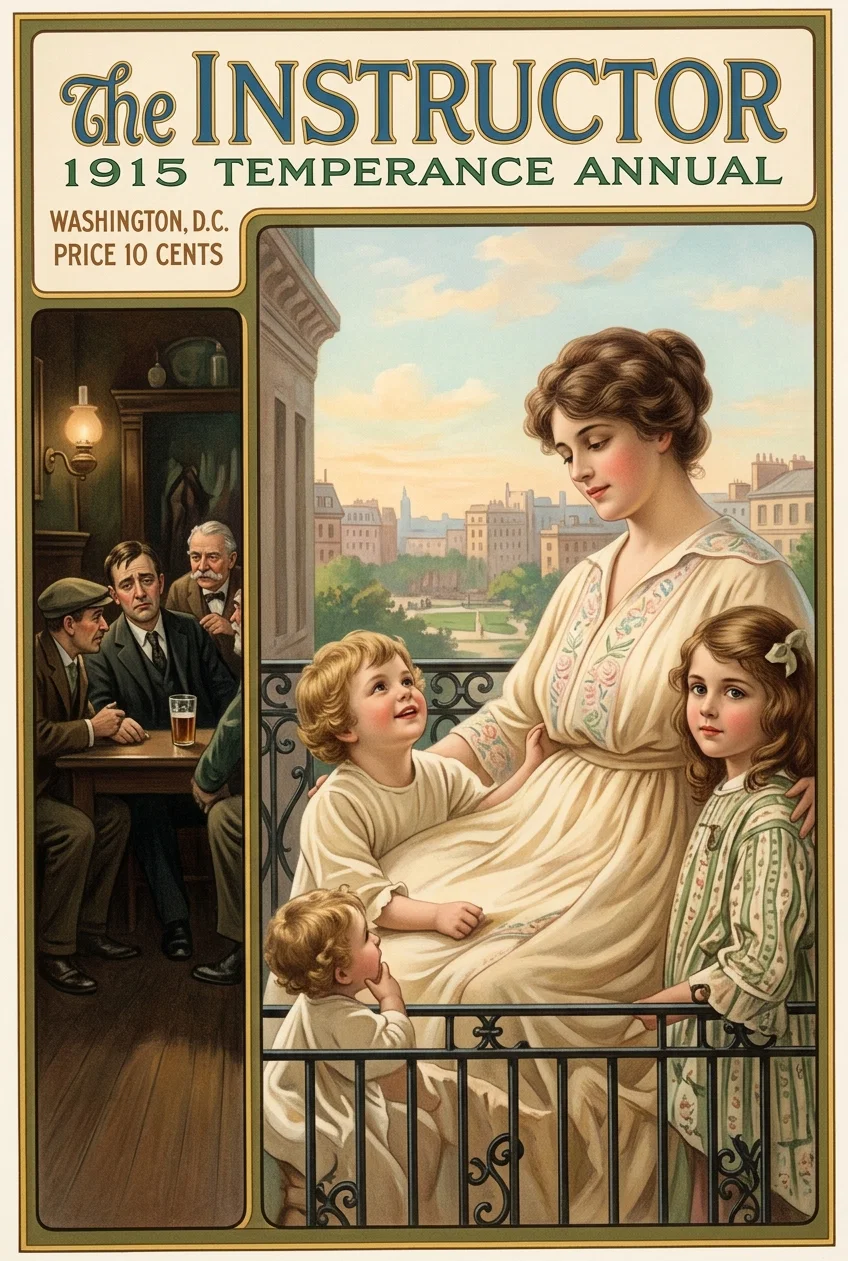
The Instructor Temperance Annual is a pronounced success in contending with intemperance, and in giving a bountiful remuneration for services in its circulation. Its future usefulness in the great war against the liquor traffic is assured. It has won the confidence and the support of the best temperance workers in all parts of the United States and Canada. The temperance-loving people like it, and work for and with it. It began its work in a modest way in 1907, the 1915 number being the eighth issue. The circulation has now reached nearly a half million copies annually.
Facsimile Front Cover in Three Colors

THE 1915 ISSUE

is the climax of all our Temperance numbers in appearance and contents. It will doubtless surpass any single issue of any temperance paper published. The original impressive cover drawings are printed in three harmonizing colors, and in themselves portray the sad story of the wreck and ruin by liquor, while the thirty-four pages of the strongest temperance matter obtainable, emphasized by seventy-two striking illustrations, present every phase of the liquor traffic, the curse of tobacco, and appeals to governments for prohibitory laws.
The 1915 Temperance Annual will be a strong factor in impressing the need of a temperance reform, and will follow its preceding Temperance issues in saving many lives, restoring peace in thousands of homes, and materially benefiting communities.
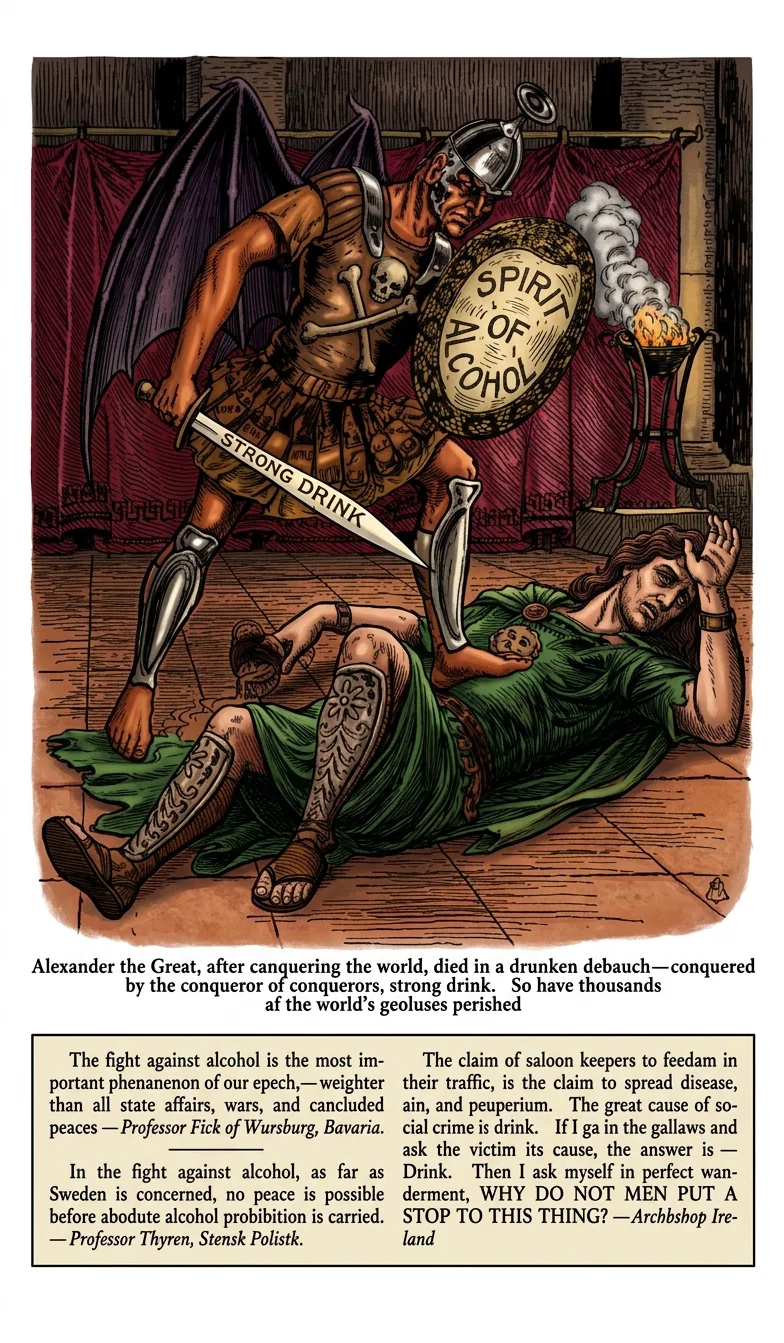
Alexander the Great, after conquering the world, died in a drunken debauch—conquered by the conqueror of conquerors, strong drink. So have thousands of the world's colleges perished
NOW READY TO MAIL AT REGULAR PRICES
ORDER ONLY THROUGH CONFERENCE TRACT SOCIETIES

The Papacy and the War

(Concluded)

Some of the Benefits Likely to Accrue to the Holy See as the Result of This Great Struggle

W. W. PRESCOTT
VERY SOON after the breaking out of the great war in Europe last summer, the Vatican began to loom up conspicuously on the horizon of peace discussions and peace plans. Among the first intimations that appeared in the Roman Catholic press was the suggestion that one of the results of the war might be the restoration of the temporal power in some form. An article signed “Ex-Diplomat” appeared and was discussed in various Roman Catholic papers. The opening paragraph of this article, as printed in the Catholic Citizen, Aug. 15, 1914, runs thus:—
“Might not one of the unexpected results of the present conflict be the restoration, in some form, of the Pope’s temporal power?”
The same writer suggested the possibility that Germany might punish Italy for not maintaining her union with the Triple Alliance, and then as a stroke of policy to hold the support of the Center party in the Reichstag, the kaiser might “give Rome and a small strip of seashore to the Holy See.”
In the discussion on both sides of the Atlantic of the possible means for terminating the war and bringing about an agreement upon terms of peace, it has been declared over and over again by Roman Catholic writers that the Pope was the only one who could act as arbiter and impartially determine the conditions of peace. The following quotations from various papers will show how fully this idea has been exploited:—
“The Pope numbers his faithful children in every land. His authority is a moral authority resting on truth and justice, and not on fear or force. . . . When Europe is once more clothed and in a sane mind, its people may turn to the see of Peter and its august occupant, and look to the Father of the faithful in the hope of finding in him a sure protector of all faith and justice among men. Where would such a natural hope be more likely of fulfillment?”—The Catholic Times (London), Sept. 4, 1914.
“The new occupant of the chair of St. Peter is very different in many respects from his predecessor, Pius X. He is a brilliant scholar, and is accredited with a statesman’s point of view. If this be so, the conviction of many will be strengthened, that the Papacy will have no mean influence upon European affairs when the present fierce conflict comes to an end. . . . The Pope is the only potentate who can claim to speak with an international voice, as he owns the allegiance of millions of those who are now at war with each other.”—Pall Mall Gazette (London), Sept. 4, 1914.
“When the warring nations pause for breath and hesitate to renew the strife out of sheer exhaustion, all eyes will be turned to the Vatican and its humble prisoner, and he will be called on to say the last word that will send the bloody sword back into its scabbard not to be unsheathed again perhaps forever.”—Western Watchman, Sept. 17, 1914.
“Benedict the Fifteenth will surely be called on, as no pope for centuries, to exert the enormous moral power of the Papacy in favor of that universal peace which recent decades have so eloquently and persistently sought, but which was never so near a final collapse as in these days. . . . Benedict the Fifteenth is the ideal peacemaker, and would bring to this holiest of priestly offices the spirit of his glorious predecessor, the last Benedict, whose moderate and conciliatory temper was the admiration of all Europe. May Almighty God so guide the counsels of the contending peoples that they will seek the good offices of him whose ancient line represents so worthily through the ages the Prince of Peace!”—Rt. Rev. Mgr. Thomas J. Shahan, D. D., Rector of the Catholic University of America, in the Columbiad, October, 1914.
“That the prestige of the Papacy will be enormously enhanced by the European war is beyond doubt; nations will see there is but one man on earth who can be trusted in all trials, crises, and wars to be perfectly impartial. His training in diplomacy and his knowledge attained in foreign courts give at home a feeling of strength and security. This is welcome, particularly to those who recognize the need a pontiff has for keenness and determination when dealing with Italian and French anticlerical statesmen.”—Rome Letter of Oct. 8, 1914, printed in the Western Watchman, Oct. 29, 1914.
“Not since the Middle Ages, when the Pope was regarded as the arbiter of Europe, has the prestige of the vicar of Christ been so widely acknowledged. Even the enemies of the Catholic religion are now alive to the fact that the Roman pontiff is the only power from whom strict impartiality and scrupulous fairness can be obtained.”—Rome Letter to the Baltimore Catholic Review, Nov. 14, 1914.
“The vigorous manner in which the holy Father conjures rulers and nations to cease drenching Europe with blood is characteristic of the fifteenth Benedict. Changed though the attitude of several European nations is since they recognized the Pope in the light of a universal peacemaker, it is evident Christ’s vicar alone can claim to be hearkened to amid the clang of warfare.”—Rome Letter of Nov. 16, 1914, printed in the Baltimore Catholic Review, December 12, 1914.
“It is a noteworthy fact that the holy Father receives dozens of letters daily from prominent non-Catholics as well as Catholics, imploring him to use his good offices in favor of peaceful mediation.”—The Catholic Bulletin, Dec. 19, 1914.
“A very serious claim can be made for papal influence in world councils today, however much it may seem to be in a decline as compared with thirteenth-century conditions. In so far as any external human power may be looked to to be of avail in pacifying Europe, the Vatican must be reckoned with.”—New York Post, Jan. 2, 1915.
One of the first indications of the benefits which are likely to accrue to the Papacy as the result of the war was the appointment by the English government of Sir Henry Howard, envoy extraordinary to the Vatican. The announcement of this appointment was made in dispatches from Rome, dated Nov. 25, 1914.
This reversal of a policy established at the time of the Reformation and strictly maintained for four hundred years, caused a widespread comment both in the Roman Catholic and in the Protestant press. Its large significance was admitted on all sides. Some of the views of Roman Catholic writers will be found in the following quotations:—
“It is plain that a great change has come over the sentiment of Europe with regard to the Papacy, when Great Britain has requested recognition of a representative at the Vatican, and even Mohammedan Turkey has made a move of a similar kind, in order that the interests of the Porte shall not suffer loss should Italy throw her sword into the scale on the side of the Allies of the Entente.”—Catholic Standard and Times, Dec. 12, 1914.
“The announcement that England has accredited Sir Henry Howard as envoy to the Holy See is a matter of more than ordinary interest to all Catholics. . . . Russia also has renewed her former relations with the Holy See by sending an ambassador in the person of Baron Nelidow, who has just presented his credentials to the Holy Father. Prussia and Austria are officially represented there. Other countries, too, are considering the advisability of sending envoys to the Vatican. This world-wide recognition of the important part which the Holy See plays in international affairs is a matter of deep interest to Catholics in all countries. It shows that the Holy See is gradually coming into its own.”—Catholic Bulletin, Dec. 19, 1914.
“The importance of the news that the British government intends to accredit an ambassador to the Holy See at least for the duration of the war cannot easily be overestimated. She is now one of the very few powers, even though Protestant, that have not got a representative at the Vatican. Catholics have long wished to see their ambassador in Rome, and there is every reason to hope that, once commenced, the envoy will not be withdrawn at the close of the present terrible struggle.”—London Letter to the Morning Star (New Orleans), Dec. 19, 1914.
The comments of the Protestant press upon England’s act of appointing a representative at the Vatican have been rather conservative. A London paper, Truth, declared:—
“It affects the whole attitude of the Protestant states toward the Papacy. It may be wise or unwise. On that point we express no opinion because no information is vouchsafed as to the purpose of the mission, but it is certainly important and raises various considerations which are only slightly and temporarily connected with the war.”
The Protestant Alliance of London made an official protest to the foreign office against opening up diplomatic relations with the Vatican, but this only served to call out a reply justifying the step taken.
In behalf of Canadian Protestants, the Sentinel (Toronto), of Dec. 10, 1914, expressed regret at England’s departure from her well-established policy:—
“It is unfortunate that the government of Great Britain should have considered it necessary to send a diplomatic representative to the Vatican. No doubt the situation is one so unusual that it calls for extraordinary measures. But to reestablish relations with the Vatican, which have been suspended for many years, constitutes a recognition of the Papacy as a civil entity at which the vast majority of the people of Britain will be greatly disappointed.”
These expressions of opinion all emphasize one thing; namely, that the appointment by England of a representative to the Vatican is a very significant step which may involve large consequences.
During recent weeks Pope Benedict XV has made various suggestions to the several belligerent nations, beginning with a request for a three weeks’ truce at Christmas time, which was followed later by recommendations concerning exchange of prisoners. One of the recent events which has served to bring the Papacy into prominence was the reported arrest of the primate of Belgium by the governor-general of the Belgian territory occupied by the Germans. According to one dispatch, the Vatican officially asked for an explanation and reparation from Germany, it being understood that the Pope would make a public protest if Germany refused to accede to these demands. This incident was the occasion for quite a number of articles in the daily press, with prominent headings.
In this connection mention should be made of a striking proposal put forward by Rev. R. J. Campbell, minister of the City Temple, who, in his paper, the Christian Commonwealth, recommended that a general council of the Christian churches of the world be summoned to discuss the war, and named the Pope as the only one who could successfully issue the call for such a council. To quote his own words:—
“Who is to summon such a council? There is only one person who could, with any chance of success, and perhaps he would not dream of attempting it. I mean the Roman pontiff. The archbishop of Canterbury could not do it. Rome would not listen. The metropolitan of the Eastern Church, or the largest portion of it, could not do it. Rome holds the key to the situation. Let her try, and Protestants will think better of her than has been the case for nearly four hundred years.”
The mere fact that such a proposal as this should be made by professed Protestant clergymen of influence, and that it should be cabled to America as a matter of important news, shows a decided drift toward bridging the gulf between Romanism and Protestantism by acknowledging the supremacy of the Pope.
Thus in various ways the Pope and his plans have been kept before the public, the impression being deepened all the time that the Papacy is one of the great powers of earth which must be reckoned with in every matter of importance relating to the war and its conclusion.
The lessons from this whole war situation should not be lightly disregarded. According to Roman Catholic interpretation, God is sending his judgments upon the nations as a penalty for their disregard of the claims of his one true church in the earth. According to the same authority the only way to restore permanent peace will be for these nations to return to the Roman Catholic fold, and to recognize the Pope as the true vicar of Christ, with supreme authority upon earth. The fact that all the great powers of the world, with the one exception of the United States, are involved in this fierce conflict, naturally brings the Papacy into prominence and affords a favorable opportunity to advertise the Pope as the only available arbiter of peace. The new Pope, Benedict XV, is a diplomat by training and by experience, and seems more than willing to thrust himself into the breach in repeated efforts to establish in some way a claim to power over the nations in bringing about an adjustment of present difficulties. It is plain enough that this means a long step toward the exaltation of the Papacy, and the prestige which is thus gained in Europe will be used to further the interests of the Roman Catholic Church in all parts of the world. Those who claim to have special light for the people concerning the great apostasy, the man of sin, and the impending compromise between Protestantism and Romanism, ought now to lift up their voices like a trumpet in a sane but positive interpretation of present events, and to make an earnest effort to save as many as possible from the snare that is being set for them. The warning and instruction of the threefold message of Revelation 14 should now be given to the world with clearness and power.
Washington, D. C.

Thoughts on Christian Finances

D. U. HALE
“ALL that is withheld of that which God claims, the tenth of the increase, is recorded in the books of heaven as robbery against him. Such defraud their Creator; and when this sin of neglect is brought before them, it is not enough for them to change their course and begin to work from that time upon the right principle. . . . Repentance for unfaithful dealing with God, and for base ingratitude, is required.”—“Testimonies for the Church,” Vol. III, page 394.
These are solemn words, but they are the counsel of God to us. We are now come to another year. What is our record in the books of heaven? Is the word robber placed against your account, or is it the word faithful?
It is not so much that God’s cause cannot go on without our tithe, but the fact that God has laid that plan to give us opportunity to join the Saviour in sacrificing with him in this world that we may join him in the joys of the world to come. “If we suffer, we shall also reign with him.” This is the principle. If we fail to share with him a proper part of our possessions in this world, we shall fail to share with Christ in his possessions in the world to come.
“Judge not, that ye be not judged. For with what judgment ye judge, ye shall be judged: and with what measureye mete, it shall be measured to you again.” Matt. 7:1, 2. “Forgive us our debts, as we forgive our debtors.” Matt. 6:12. “Therefore all things whatsoever ye would that men should do to you, do ye even so to them.” Matt. 7:12. These are some of the principles laid down in the Word. If we find fault with and criticize every little action of our brother, we may expect that the Lord will bring up every little sin we have committed. If we overlook our brother’s faults, God will overlook our faults. If we hold something against our brother that we cannot forgive, there is no promise of forgiveness for us in the judgment. Our actions toward our brother are the guide for the Lord in the judgment in dealing with our cases.
These same principles are true in regard to our finances. Our future possessions in heaven depend upon how we deal with what the Lord gives us in this world. “If therefore ye have not been faithful in the unrighteous mammon [or riches], who will commit to your trust the true riches?” Luke 16:11. The Lord includes both tithes and offerings in his sentence of robbery. Can you afford to risk the loss of your home in heaven for a few paltry dollars of tithe in this world? Can you afford to jeopardize your eternal existence for a few paltry dollars that you might squeeze out by skimping your offerings to the Lord’s cause? Every one would say No. But, brethren, are you doing it? “At the close of every year all [the Jews] were required to make solemn oath whether or not they had done according to the command of God.”—Id., Vol. IV, page 77. Study your finances for the past year, and then ask yourself the question, Could I take the oath? We are too near the end to take any chances on these things. May God help us to see our finances as he sees them, and be faithful with them.

The Ordinance of Humility

An Incident

H. H. VOTAW
DURING the time that we labored in the Indian Empire, we repeatedly noticed that when various doctrines were presented and arguments adduced in their favor, we were met with argument in return, but when we spoke of the rite of feet washing, we were almost invariably met with ridicule. At times we were disturbed by the fact that we were unable to offer any argument in support of this ceremony besides that found in the terse account given by the apostle John.
On one occasion our hearts were much cheered by an incident that occurred while we were celebrating the ordinance of humility. There was present a Burmese man who had never seen the service performed. He was new to our faith. His heart was aglow with the love of the message, and he was rejoicing in the new-found treasure of the knowledge of the Lord’s return. As he watched the brethren kneeling at one another’s feet, gravity amounting almost to solemnity, and holy joy, seemed to be seeking expression in his countenance. Suddenly he cried, “O, if my people could only see such love as this, they would all become Christians!”
We thanked the Lord for the lesson. We realized afresh that his ways are all good and always best. Ever since that day it has been easier to obey God and leave the consequences in his hands.
Marion, Ohio.

God’s Call to Us

(Concluded)
M. DORMAN
“WE are living in the time of the end. The fast fulfilling signs of the times declare that the coming of Christ is near at hand. The days in which we live are solemn and important. . . . The agencies of evil are combining their forces and consolidating. They are strengthening for the last great crisis. Great changes are soon to take place in our world, and the final movements will be rapid ones.”
“In a special sense Seventh-day Adventists have been set in the world as watchmen and light bearers. To them has been intrusted the last warning for a perishing world. On them is shining the wonderful light from the Word of God. They have been given a work of the most solemn import,—the proclamation of the first, second, and third angels’ messages. There is no other work of so great importance. They are to allow nothing else to absorb their attention. . . . The world is to be warned, and God’s people are to be true to the trust committed to them. . . . Christ says of his people, ‘Ye are the light of the world.’ Matt. 5:14. . . . So far as his opportunities extend, every one who has received the light of truth is under the same responsibility as was the prophet of Israel to whom came the word, ‘Son of man, I have set thee a watchman unto the house of Israel; therefore thou shalt hear the word at my mouth, and warn them from me. When I say unto the wicked, O wicked man, thou shalt surely die; if thou dost not speak to warn the wicked from his way, that wicked man shall die in his iniquity; but his blood will I require at thine hand. Nevertheless, if thou warn the wicked of his way to turn from it; if he do not turn from his way, he shall die in his iniquity; but thou hast delivered thy soul.’ Eze. 33:7-9.
“Are we to wait until the fulfillment of the prophecies of the end before we say anything concerning them? Of what value will our words be then? . . . In clear, distinct rays, light has come to us showing us that the great day of the Lord is near at hand, ‘even at the door.’”—“Testimonies for the Church,” Vol. IX, pages 11, 19, 20. The time has come when the message of Christ’s soon coming is to sound throughout the world.
Not only have we reached a crisis in the history of the world, but a crisis in our own lives as well. The way in which we relate ourselves to this message will determine largely our eternal destiny.
We are now in the shaking, the sifting time. In speaking of this time God’s servant says: “I asked the meaning of the shaking I had seen, and was shown that it would be caused by the straight testimony called forth by the counsel of the True Witness to the Laodiceans. This will have its effect upon the heart of the receiver, and will lead him to exalt the standard and pour forth the straight truth. Some will not bear this straight testimony. They will rise up against it, and this is what will cause a shaking among God’s people.”—“Early Writings,” page 270. The straight testimony of the True Witness to the Laodiceans is: “I know thy works, that thou art neither cold nor hot: I would thou wert cold or hot. So then because thou art lukewarm, and neither cold nor hot, I will spew thee out of my mouth.” “I saw that the testimony of the True Witness has not been half heeded. The solemn testimony upon which the destiny of the church hangs has been lightly esteemed, if not entirely disregarded. This testimony must work deep repentance; all who truly receive it will obey it, and be purified.”—Ib.
It is with God’s army today as it was with Gideon’s army of old. All whose hearts are not hot and burning for the fray will be sifted out. Thousands will disappear from the ranks, but with the tested remnant a mighty work is to be accomplished.
“We are on the very verge of the time of trouble, and perplexities that are scarcely dreamed of are before us. A power from beneath is leading men to war against Heaven. Human beings have confederated with satanic agencies to make void the law of God. . . . In the broad way that leads to eternal ruin there walks a long procession. The world, filled with violence, reveling, and drunkenness, is converting the church. . . . At this time, a time of overwhelming iniquity, a new life coming from the Source of all life is to take possession of those who have the love of God in their hearts, and they are to go forth to proclaim with power the message of a crucified and risen Saviour.” “In visions of the night representations passed before me of a great reformatory movement among God’s people. Many were praising God. The sick were healed, and other miracles were wrought. A spirit of intercession was seen, even as was manifested before the great day of Pentecost. Hundreds and thousands were seen visiting families and opening before them the Word of God. Hearts were convicted by the power of the Holy Spirit, and a spirit of genuine conversion was manifest. On every side doors were thrown open to the proclamation of the truth. The world seemed to be lightened with the heavenly influence. Great blessings were received by the true and humble people of God. I heard voices of thanksgiving and praise, and there seemed to be a reformation such as we witnessed in 1844.”—“Testimonies for the Church,” Vol. IX, pages 43, 44, 126. Will you be one of the sifted band who will be privileged to see the accomplishment of this work?
O careless, heedless, slumb’ring one, Arouse thee! Gird thine armor on! I charge thee: Stay not till the dawn Of heaven’s wondrous, perfect bloom Shall break the shadow of earth’s gloom. Arouse, a work awaits thee here! Thy Captain calls, “Take now thy spear.” Come! Angels wait; why tarry so? O, plunge into the thickest fray! The Master calls thee. Up, away!
The value of souls, the shortness of time, the greatness of the work before us, call, “Arise, shine; for thy light is come, and the glory of the Lord is risen upon thee.”

The Holy Spirit Awaits Our Demand and Reception

D. H. KRESS, M. D.
Anciently the Lord led a people out of Egypt toward the Land of Promise. Shortly after they began their journey, they came to a place where “there was no water for the people to drink.” Had they only been patient and trustful, all their needs would have been supplied. Here was a needed test; but they found fault with their surroundings, and murmured against Moses, and said, “Wherefore is this that thou hast brought us up out of Egypt, to kill us and our children and our cattle with thirst?”
“And Moses cried unto the Lord, saying, What shall I do unto this people? they be almost ready to stone me.” Then the Lord told Moses what to do. He said, “Go on before the people, and take with thee . . . thy rod. . . . Behold, I will stand before thee there upon the rock in Horeb; and thou shalt smite the rock, and there shall come water out of it, that the people may drink. And Moses did so in the sight of the elders of Israel.” Exodus 17.
It required a water supply equal to that of the city of New York to supply the millions of human beings and their cattle with drink, and with water for bathing purposes. The psalmist, in speaking of this says, “He clave the rocks in the wilderness, and gave them drink as out of the great depths. He brought streams also out of the rock, and caused waters to run down like rivers.” Ps. 78: 15, 16.
Twenty years later they were brought to a similar test. “There was no water for the congregation.” Num. 20: 2. And again the people chid with Moses and said, “Why have ye brought up the congregation of the Lord into this wilderness, that we and our cattle should die there?” This time the word came to Moses, “Take the rod, and gather thou the assembly together, thou, and Aaron thy brother, and speak ye unto the rock before their eyes; and it shall give forth his water.”
Only once was it necessary for the rock to be smitten to supply the famished people with drink; after this it was only needful to speak to the rock, and the water would gush forth.
“That rock,” we are told, “was Christ.” Christ said, “If any man thirst, let him come unto me, and drink. . . .” But this spake he of the Spirit, which they that believe on him should receive: for the Holy Ghost was not yet given; because that Jesus was not yet glorified.” John 7: 37-39. After his crucifixion (after the true Rock was smitten) Jesus ascended on high and gave gifts unto men. He had commanded his disciples that they should not depart from Jerusalem, but wait for the promise of the Father. He said, “Ye shall receive power, after that the Holy Ghost is come upon you: and ye shall be witnesses unto me.” Acts 1: 8. They tarried and prepared their hearts, by confession of their sins and faults, for this promised blessing. When their part was done, “and when the day of Pentecost was fully come, they were all with one accord in one place. And suddenly there came a sound from heaven as of a rushing mighty wind, and it filled all the house where they were sitting. . . . And they were all filled with the Holy Ghost.” Acts 2: 1-4. In a miraculous manner they were able to speak fluently in the tongues of the people who had gathered at Jerusalem. A mighty miracle had been wrought. And the people “were all amazed, and were in doubt, saying one to another, What meaneth this?” Verse 12. Then “Peter, standing up with the eleven, lifted up his voice, and said unto them, . . . This is that which was spoken by the prophet Joel; And it shall come to pass in the last days, saith God, I will pour out of my Spirit upon all flesh: and your sons and your daughters shall prophesy, and your young men shall see visions, and your old men shall dream dreams: and on my servants and on my handmaidens I will pour out in those days of my Spirit; and they shall prophesy.” Peter then referred to the crucifixion of Christ, and said, “Him, being delivered by the determinate counsel and foreknowledge of God, ye have taken, and by wicked hands have crucified and slain: whom God hath raised up.” Verses 14-24. “Therefore being by the right hand of God exalted, and having received of the Father the promise of the Holy Ghost, he hath shed forth this which ye now see and hear.” Verse 33. The Rock was smitten, and the water of life gushed out, not merely in a stinted stream, but “he clave the rocks . . . and caused waters to run down like rivers.” We are told in “The Desire of Ages,” page 671, that “Jesus . . . rejoiced because of the abundant help he had provided for his church. The Holy Spirit was the highest of all gifts that he could solicit from his Father for the exaltation of his people. The Spirit was to be given as a regenerating agent, and without this the sacrifice of Christ would have been of no avail. . . . It is by the Spirit that the heart is made pure. Through the Spirit the believer becomes a partaker of the divine nature. Christ has given his Spirit as a divine power to overcome all hereditary and cultivated tendencies to evil, and to impress his own character upon his church.” This wonderful transformation of character took place among the recipients of this blessing at Pentecost. Thank God that the “fountain opened to the house of David and to the inhabitants of Jerusalem for sin and for uncleanness” is still giving forth its life-giving, health-giving waters.
It is not necessary that the Rock should be smitten the second time, or that there should be another such invitation as was witnessed at Pentecost. The river of life is still with us, and the invitation is, “Ho, every one that thirsteth, come ye to the waters, and he that hath no money; come ye, buy.” Jesus is still saying, “If any man thirst, let him come unto me, and drink.” That Rock which followed the children of Israel in the wilderness is still with us. All that is now necessary is to speak to the Rock, and the water will gush forth.
We are living in the dispensation of the Holy Spirit. All that was given at Pentecost, God designed his people should have to the end of time. The promise was not merely to the believers at Pentecost, but to their “children, and to all that are afar off, even as many as the Lord our God shall call.” Acts 2: 37-39. “This promised blessing, claimed by faith, brings all other blessings in its train. It is given according to the riches of the grace of Christ, and he is ready to supply every soul according to the capacity to receive.”—Id., page 672.
If devoid of the Spirit of God, if the life is not one of victory, do not find fault with your surroundings, or with men, only “speak ye unto the Rock; . . . and it shall give forth his water.”
Melrose, Mass.

A Life of “All Getting”

THERE is a pathetic little story of a blind girl, told by Ian Maclaren in an old number of Frank Leslie’s: “If I dinna see,”—and she spoke as if this were a matter of doubt and she were making a concession for argument’s sake,—
—“there’s naebody in the Glen can hear like me. There’s no a footstep of a Drumtochty man comes to the door but that I ken his name, and there’s no voice oot on the road that I canna tell.
“The birds sing sweeter to me than to onybody else, and I can hear them cheeping to one another in the bushes before they go to sleep. And the flowers smell sweeter to me,—the roses and the carnations and the bonny moss rose,—and I judge that the oatcake and milk taste the richer because I dinna see them.
“Na, na, ye’re no to think that I’ve been illtreated by my God; for if he dinna give me ae thing, he gave me mony things instead. And mind ye, it’s no as if I’d seen once and lost my sight; that micht ha’ been a trial, and my faith micht have failed. I’ve lost naething; my life has been all getting.”—Australian Signs of the Times.

Doing One's Best

“THE one who did his best has no occasion to waste time in wishing he had done otherwise.”
Continue reading: Seventh-Day Adventists and Tithing