Your ShelfYour Projects

Review and Herald, Vol. 77, No. 25.

KEPT IN TRIAL
Earlier text: THE THIRD ANGEL'S MESSAGE: WHAT IS IT?

BABYLON IS FALLEN, IS FALLEN.

On three distinct occasions the God of heaven sent messages of instruction and warning to Nebuchadnezzar, each one being but a part of that complete revelation of the gospel of the kingdom which resulted in the conversion of the king, and his personal acknowledgment of God as worthy of all praise and glory. Every one throughout the kingdom of Babylon who should learn of these experiences, whether he was the successor of Nebuchadnezzar on the throne, or the humblest person in a private station, was without excuse if he failed to give to God the glory due unto him, and to yield himself to be his servant. It was not necessary that the experiences themselves should be repeated. The revelation of the gospel had been made with clearness and power, and it was sufficient that this revelation should be declared to all. And this was done so thoroughly by the testimony of Nebuchadnezzar that no one perished in the fall of Babylon, except by his own choice.
This is shown by the message that Daniel bore to Belshazzar: “And thou his son, O Belshazzar, hast not humbled thine heart, though thou knewest all this; but hast lifted up thyself against the Lord of heaven; . . . and the God in whose hand thy breath is, and whose are all thy ways, hast thou not glorified.” The fact that Belshazzar knew of these experiences of Nebuchadnezzar, and yet did not glorify God, was sufficient for his condemnation. He had rejected the gospel of the kingdom. It is clear from this that the story of God’s dealings with Nebuchadnezzar ought to be made known in this day to all the people of the earth, and that this is the distinct message for this time, when the history of Babylon is being repeated. This is the fullness of the message, of which we have the mere syllabus in Rev. 14: 6-12. It is also clear that wherever this story of God’s dealings with Nebuchadnezzar is told, “not with enticing words of man’s wisdom, but in demonstration of the Spirit and of power,” the gospel of the kingdom will have been preached for a witness, and men will make their final choice, either to glorify God or to lift up themselves against the Lord of heaven. For this reason the book of Daniel and its meaning ought to be, and will be, taught as the gospel of the kingdom in every part of the earth. “Whoso readeth, let him understand.”
The varied experiences of men and of nations are not mere matters of chance, neither are they determined by arbitrary decrees on the part of the King of heaven. There are eternal principles of truth and righteousness which constitute the very essence of the character of God himself. In the gospel these principles are set forth, and provision has been made through the gift of Jesus Christ that they should be wrought out in the character of men. This glorifies God, and results in eternal salvation for man. But when these principles are willfully rejected, there is no further hope, and the sentence of destruction is written. So it was in Babylon. Belshazzar’s rejection of the gospel of the kingdom was final, and then God himself made known to him the result of his choice.
“Then was the part of the hand sent from him; and this writing was written. And this is the writing that was written, MENE, MENE, TEKEL, UPHARSIN. This is the interpretation of the thing: MENE; God hath numbered thy kingdom, and finished it. TEKEL; Thou art weighed in the balances, and art found wanting. PERES: Thy kingdom is divided, and given to the Medes and Persians.”
It is evident that the sentence of destruction was not pronounced upon Babylon without a judicial investigation. The stability of the kingdom depended upon the character of the men in the kingdom; and when it was revealed by the conduct of these men that they had fallen beyond any hope of recovery, even God himself could not save them and their kingdom without denying his own character. The city fell because the men inside the walls had already fallen, having persistently refused that power by which alone men can be holden up.
God himself had regarded the course of affairs in Babylon. He himself had noted the fact that the limit had been reached, that the cup of its iniquity was full, and that the end had come. No definite date had been indicated in the calendar of heaven, when Babylon should fall; but when the balances of the sanctuary, in which character is weighed, showed that all the essential elements of kingship were wanting in Belshazzar, the kingdom would inevitably be broken, and “another kingdom” would succeed Babylon.
From the way in which Daniel read the writing upon the wall, it is evident that the same spirit of a prophet is required in order to read understandingly what God has written, or caused to be written, as is essential in the giving of prophecy. To the wise men of Babylon the words on the wall meant nothing. Not being themselves in the current of God’s revelation, nor familiar with his thoughts, and having no experience of “the Spirit of wisdom and revelation in the knowledge of him,” they could not go beyond the letter of the writing; but when Daniel looked at the words on the wall, he saw, through the Spirit of Prophecy, the completed sentences from which these words were taken, and hence could read the writing, so as to make known the interpretation. It is just such readers and teachers of the handwriting of God that are needed to-day—those who are sufficient to be ministers of the new covenant, “not of the letter, but of the Spirit: for the letter killeth, but the Spirit giveth life.” “What is written in the law? how readest thou?”
“Then commanded Belshazzar, and they clothed Daniel with scarlet, and put a chain of gold about his neck, and made a proclamation concerning him, that he should be the third ruler in the kingdom. In that night was Belshazzar the king of the Chaldeans slain. And Darius the Median took the kingdom, being about threescore and two years old.”
Although the rewards bestowed by Belshazzar were worthless in themselves since the kingdom of Babylon was at an end, yet there is a deep significance in the facts as a part of the gospel of the kingdom. Mark well the contrasts between Belshazzar the king of the Chaldeans and Daniel the Hebrew captive, on that last night in the history of Babylon. The one had refused to acknowledge himself as the servant of the most high God, and had sought his own exaltation by lifting up himself against the Lord of heaven. When laid in the balance, he was found altogether lighter than vanity. His kingdom was broken, and he himself perished. The other began his career in Babylon by purposing “that he would not defile himself with the portion of the king’s meat, nor with the wine which he drank;” and his life had been the constant interpretation of his own words: “I thank thee, and praise thee, O thou God of my fathers, who hast given me wisdom and might.” On that last night “light and understanding and wisdom, like the wisdom of the gods, was found in him;” and now, with all the outward marks of a king, he survived the fall of Babylon and its king, a ruler in the very territory where he had been a captive. So it will be in the days near to come, when this history will be repeated. “Fear not, little flock; for it is your Father’s good pleasure to give you the kingdom.” “Blessed are the poor in spirit: for theirs is the kingdom of heaven. . . . Blessed are the meek: for they shall inherit the earth.” “For yet a little while, and the wicked shall not be: yea, thou shalt diligently consider his place, and he shall not be. But the meek shall inherit the land; and shall delight themselves in the abundance of peace.”
In two brief sentences is recorded all that is given in the book of Daniel of the fulfillment of many prophecies concerning the fall of Babylon. Some of the most striking of these prophecies are the following:—
“Babylon, the glory of kingdoms, the beauty of the Chaldees’ excellency, shall be as when God overthrew Sodom and Gomorrah. It shall never be inhabited, neither shall it be dwelt in from generation to generation: neither shall the Arabian pitch tent there, neither shall the shepherds make their fold there. But wild beasts of the desert shall lie there; and their houses shall be full of doleful creatures; and owls shall dwell there, and satyrs shall dance there. And the wild beasts of the islands shall cry in their desolate houses, and dragons in their pleasant palaces: and her time is near to come, and her days shall not be prolonged.” Isa. 13: 19-22.
“Chaldea shall be a spoil: all that spoil her shall be satisfied, saith the Lord. Because ye were glad, because ye rejoiced, O ye destroyers of mine heritage, because ye are grown fat as the heifer at grass, and bellow as bulls: your mother shall be sore confounded; she that bare you shall be ashamed; behold, the hindermost of the nations shall be a wilderness, a dry land, and a desert. Because of the wrath of the Lord it shall not be inhabited, but it shall be wholly desolate: every one that goeth by Babylon shall be astonished, and hiss at all her plagues. Put yourself in array against Babylon round about: all ye that bend the bow, shoot at her, spare no arrows: for she hath sinned against the Lord. Shout against her round about: she hath given her hand: her foundations are fallen; her walls are thrown down: for it is the vengeance of the Lord: take vengeance upon her; as she hath done, do unto her.” Jer. 50: 10-15.
“Thus saith the Lord: Behold, I will plead thy cause, and take vengeance for thee; and I will dry up her sea, and make her springs dry. And Babylon shall become heaps, a dwelling-place for dragons, an astonishment, and an hissing, without an inhabitant. They shall roar together like lions: they shall yell as lions’ whelps. In their heat I will make their feasts, and I will make them drunken, that they may rejoice, and sleep a perpetual sleep, and not wake, saith the Lord. I will bring them down like lambs to the slaughter, like rams with he goats. How is Sheshach taken! and how is the praise of the whole earth surprised! how is Babylon become an astonishment among the nations! The sea is come up upon Babylon: she is covered with the multitude of the waves thereof. Her cities are a desolation, a dry land, and a wilderness, a land wherein no man dwelleth, neither doth any son of man pass thereby.” Jer. 51: 36-43.
It is impossible to read these prophecies without seeing in them more than a description of the desolation of Babylon of the Chaldees. In them is also given a picture of the desolation of modern Babylon and the whole earth, when “destruction upon destruction is cried; for the whole land is spoiled.” In these predictions is also involved the fulfillment of this later prophecy concerning modern Babylon: “And the seventh angel poured out his vial into theair; and there came a great voice out of the temple of heaven, from the throne, saying, It is done. And there were voices, and thunders, and lightnings; and there was a great earthquake, such as was not since men were upon the earth, so mighty an earthquake, and so great. And the great city was divided into three parts, and the cities of the nations fell; and great Babylon came in remembrance before God, to give unto her the cup of the wine of the fierceness of his wrath. And every island fled away, and the mountains were not found.” Rev. 16: 17-20.
But there is salvation from all this ruin. Sin is the cause of it all, and salvation from sin means salvation from all its consequences. “Be not partakers of her sins, . . . that ye receive not of her plagues.” Heed the great message of warning and invitation which is now being sounded “with a loud voice” throughout the world: “Fear God, and give glory to him; for the hour of his judgment is come: and worship him that made heaven, and earth, and the sea, and the fountains of waters.” “Acknowledge that Jehovah is God; it is he who has made us, and his we are.” And in that great day when he will “destroy them which destroy the earth,” he will tenderly care for his own. “Behold, God is my salvation; I will trust and not be afraid.”
W. W. P.

WHY THE PROTESTANT CHURCHES FELL.

THE mighty angel of Revelation 14, who flew through heaven proclaiming the fall of Babylon, gave to the world one of the most solemn messages ever delivered to man. Protestantism was of divine birth. It was a union of heaven and earth, and in principle had a mission, as did “the man Christ Jesus.” When God proclaimed the corruption of Protestantism, in the second angel’s message, it was with sadness in the courts of heaven.
What caused that fall?
Protestantism was nurtured in infancy by a system of pure education. Luther and Melancthon, the foremost Reformers, did their great work in the religious world as educators. The Reformation created schools, and these schools trained teachers, earnest, consecrated teachers, who in forty years beheld the youth of Germany at their feet, imbibing the principles of freedom of conscience. Every European country that adopted Protestant ideas saw the same work of education begun.
The Puritans, finding their means of education in England too limited for the needs of Protestantism, sailed for America; and Plymouth was not out of its teens when the Massachusetts colony founded Harvard College, with the avowed object of educating ministers. Yale came into existence with the same lofty ambition. The common schools for the education of the children were church schools. The seventeenth century saw the schools of America well started, and the church showed signs of rapid growth. But pure Protestantism is too great a force to be allowed unquestioned freedom, and the enemy of truth rallied his forces for a vigorous attack. Through the schools, Protestantism bore sway, and gained its strength.
With the cunning of the serpent the plan of attack was laid for American Protestants. Passiveness is akin to death. A sluggish educational system will soon die of blood poison. The churches complained of the expense of maintaining schools. The wealthy employed private tutors for their children. The free schools became schools for the poor only. The standard for the teachers was lowered. Schoolhouses were a disgrace. It was a gradual decline from 1789 to 1839. W. T. Harris says that there was, “from 1789 to 1839,—a period of fifty years,—an apparent retrogression in education.”
Lack of time and space forbids a consideration of the causes of the decline; but from this time on there is a most striking parallel between the work in education and the work of the church. This is worthy of consideration.
The preaching of William Miller is familiar to every Seventh-day Adventist. It is known that, beginning in 1832 and continuing for ten or twelve years, his voice sounded throughout the land, proclaiming the second coming of Christ. The world heard his voice, and men awoke with a start. His message was accompanied with power, and he was followed by others who proclaimed the fall of Babylon. The proclamation of the fall of Babylon was not made until Babylon had heard the first message and rejected it.
Why was this first message rejected?
There is another movement parallel with the one just mentioned, which is less familiar to most persons than is the preaching of Miller. I refer to the educational message that was given to the world by Horace Mann. Horace Mann was raised up by God to do a work for the Lord, just as truly as William Miller was called to deliver his message.
The church had allowed the light of truth to grow dim. God awoke it by the labors of Miller. The church had also allowed the educational work to decline. God aroused it again by the words and works of Horace Mann. As Miller astonished his hearers by his boldness, so Mann aroused the bitterest opposition from conservative educators by his bold and daring enunciations. No one of less will power, or with a slighter hold upon the principles of truth, and through them upon the arm of God, could have met and conquered such difficulties.
Mr. Mann was a Christian, and advocated Christian education. Taken from the Senate in 1837, he was made secretary of the board of education for the State of Massachusetts. For twenty years all the power of his mighty intellect was set against errors in popular education, and in an attempt to introduce correct methods in teaching. “The schools will be found to be the way that God has chosen for the regeneration of the world,” he wrote.
In the Ninth Report of this board of education, Mr. Mann wrote: “Of all neglected or forgotten duties in all ages of the world, the spiritual culture of the children has been most neglected.” Concerning the work of the teacher, he wrote: “No low nature can perform the office of a high one in the schoolroom.” “Try to vitalize the conscience of a child, instead of tying him up to a set of rules.” “The true teacher will consider the train of feeling, not less than the train of thought, which is excited by the exercises of the schoolroom.”
Mr. Mann lived and worked at a period when slavery endangered the life of the nation. His voice and the power of the education he advocated were used against this evil.
Adventists know that one cause of the fall of the churches was due to the position they took on the slavery question. Had the church been true to its educational privileges, it would not have stumbled here; for Protestantism proclaims the equal rights of all men.
The character and teaching of this educator may be seen in these words: “A total abstainer from strong drink, tea and coffee, and a fierce hater of tobacco in any form; opposed to the recreation of dancing in the State normal schools; even uncertain about the reading of fairy tales and history by children, . . . he was always a dear lover of little children.”
Mr. Mann advocated the breaking away from the long courses in Greek and Latin, and insisted upon the practical in education. “His criticisms and decisions indeed often brought him into sharp antagonism with his own reliable supporters, and quite alienated the more radical fraternity, who discarded ‘policy’ in the attempt to enforce abstract truth at all hazards, though the heavens fall, wrecking the cause itself in the catastrophe.”
More, much more, might be said; for Horace Mann rescued the schools of America from destruction. The thing which concerns us is this: The churches handed the educational work over to the state. The churches had lost their means of growth; they fell. The first angel’s message was preached; they heard, but rejected the light. Why?—Because they had neglected educational light.
God raised up a man to rescue the schools. There was no church to which this work could be committed. Christian education must not die. In this extremity it was handed to the state until God could prepare a church to do that work. Where is that church? It was born in the religious movement of 1844. The education of the children has been waiting for that church to see its duty, and to take up the work where the popular churches fell. When will they do it? How long shall God have to wait for Seventh-day Adventists to see that their salvation lies in Christian education? You who are teachers, you who are parents, you who love the truth, and are ready to die for it, heed the words of Mann: “The schools will be found to be the way that God has chosen for the regeneration of the world.”
E. A. SUTHERLAND.

EGYPT

A YEAR ago my wife and I left America for the Institut Sanitaire in Basel. After staying there six months, we came to Egypt, in answer to the Lord’s call; and praise be to his name, he was here before us, and opened the way in a marvelous manner. We came here with Brother Holser and his family. A lady nurse from the institut came also with us. Brother Holser and his family are on their way to America, his health being very poor. They will be there probably when this reaches you. We have specially prayed that the Lord would raise him, if it be his will; for the laborers are few, and it is sad to see the experienced ones stricken down with sickness. Our prayer is also that God will send some one here to fill his place—not only one but several; for the field is needy.
When we came here, we found one brother and a sister keeping the Sabbath. Through the labors of that sister her three sisters-in-law have since accepted the truth. Another brother has also accepted the truth, and desires baptism. A converted Jew is also preparing himself to go to one of our institutes, to get a training to engage in the work. Others are interested, one of the native Bible workers especially.
Cairo, where we are, is a cosmopolitan city. Here people of almost all nationalities are found; the Greek, Italians, French, Armenians, and English especially. This makes it a good center for our work, which, so far, has been mostly among the English-, French-, and German-speaking people.
The Moslems are very devout. They can be seen praying in the streets, in the cars, and everywhere. They will repeat the same things from one hundred to four or five hundred times.
A few days ago a funeral took place near our house; and from early in the morning until noon, about forty or fifty women were praying, wailing, beating their faces and breasts. From time to time some one would serve them coffee. In the afternoon and until one o’clock next morning men would take the place of the women, and would do the same things. This was kept up for three days. A week after the burial they pray again, and so on for several weeks; then afterward they do it annually. I asked one of the natives why they did this, and he said that the more they did it, the better place the one dead would have in paradise.
These people must be taught. The truth must be presented to them; and we who have been sent to begin the work are weak, but our confidence is in God, from whom our strength comes. In him is all power, and he has given the command to go to all people, kindreds, and tongues; and says that he is with us, even to the end. So we trust him; but we need your prayers. Pray that we may be used to the glory of God. Pray that God will send laborers into this needy field, that he will bless the work being done, and that many may come out from darkness into this marvelous light.
L. PASSEBOIS.

A. G. PEART

RETREAT.—The Third Angel’s Message reached this place in January, 1899, through the influence of a family who formerly belonged to the Waterloo church. As soon as we were settled, we started a Sabbath-school, with ten pupils. With their assistance I began visiting families, holding Bible readings, and conducting open-air meetings, between this place and the adjoining district, Rock Spring. As a result, our school now has a membership of thirty, and others promise to join us soon. One by one, the work is reaching souls.
May 26 Elder C. A. Hall visited us. On the 27th there was a baptismal service; and although more than two hundred persons were present, some of whom came with the intention of making a disturbance, the Spirit of the Lord held them in such check that their behavior was good. Seven persons were buried with their Lord in baptism. An old man of threescore years, who persecuted the truth bitterly at first, had the privilege of having two daughters, one son, and a son-in-law baptized with him. A brother and sister of the family who helped to plantthe truth in this place were also baptized. The church was organized with a membership of twenty-four.

A. G. PEART

News and Notes

— Women nurses on the hospital ship “Maine” will be replaced by men.
— Fifty per cent of the schoolboys of the District of Columbia use tobacco in some form.
— Great Britain is responsible for 70,000 chests of opium annually sent from India to China.
— San Francisco papers urge the burning of Chinatown, to avoid the possibility of an outbreak of the plague.
— Five hundred inmates of the penitentiary at San Juan, Porto Rico, mutinied, but were subdued by the presence of troops.
— Congress agreed to give $5,000,000 to the St. Louis fair, on condition that the city and State spend $10,000,000 on the same.
— Señor Francisco Vasquez, minister from the Dominican republic, has presented his credentials to President McKinley.
— Paderewski is at present at work upon what is to be known as “The Century Library of Music,” soon to be published by the Century Company.
— Richard S. Storrs, D. D., one of the most widely known ministers of the Congregational Church in the United States, died in Brooklyn, N. Y., June 5.
— The American mission buildings at Tung Chao, China, abandoned by missionaries, were looted and burned by the Chinese soldiers sent to protect them.
— In the French Senate the Amnesty bill has been adopted by a vote of 238 to 24, after the adoption of an amendment extending the amnesty to Captain Dreyfus.
— In Philadelphia recently, 679 new saloon licenses were granted in seven days.
— France has 21,277,582 sheep, each of which produces only sixty cents’ worth of wool annually, or a total of $12,766,549.20.
— The experience of many growers, and the experiments of several professors, show that there is money in thinning the fruit on overloaded trees.
— A commission of three American clergymen is preparing to leave for China, under Presbyterian auspices, to investigate the situation in that country.
— It is said that “the important discovery has been made at the Hygienic Institute of the University of Wurzburg (Germany) that bacteria can be destroyed with electric currents.”
— Governor Mount, of Indiana, has refused to honor a requisition for the return of ex-governor W. S. Taylor, to Kentucky, where he is wanted to stand trial for alleged complicity in the Goebel assassination plot.
— Twenty-five thousand eight hundred and sixteen vessels passed through the Baltic Canal during the year ending March 31, 1899, the aggregate tonnage being 3,117,840; the total receipts amounted to $388,000.
— The Scientific American says that it has been proved, by experiments, that on bad roads a horse can pull only four times as much weight as he can carry; while on a good, macadamized road he can pull ten times as much.
— Miss Anna B. Hasbrouck, an instructor in history in the Holyoke, Mass., high school, was dismissed by the school committee for the statement, before a class studying medieval history, that “Christ was one of a family of ten brothers and sisters.”
— Lord Roberts has gained a victory over General Botha, near Pretoria. General Buller is pursuing 8,000 Boers under General De Wet. Mr. Schreiner, the Cape premier, and his colleagues, have resigned, and Mr. Alfred Milner has accepted the resignations.
— The oldest newspaper in the world is said to be the Kin Pan, of Peking, China. It first appeared in A. D., 911, but was issued only at irregular intervals. Since the year 1351, however, it has been published weekly, and in uniform size. Now it appears in three editions daily.
— The recent fire in the New York Tribune building, though a fierce one, was soon put out, the building being a really fireproof one. The fire was confined to two rooms, and the employees on the upper floors escaped by means of the rear elevator, which runs between fireproof walls, without exits except at the top and the bottom.
— Commenting upon diplomas, the Detroit Christian Herald truthfully says, in its issue of June 14: “The graduate’s diploma has its greatest value the day it is received. From that time forward it dwindles in importance, and that is as it should be; for either the achievements of life eclipse it, or the failure to achieve anything proves it worthless.”
— Captain Francis Martin, a retired naval and revenue officer, recently celebrated his one hundredth birthday in Detroit, receiving many guests, who cordially congratulated him on his health. He entered the government service when thirty-one years of age, his commission being signed by President Andrew Jackson, and commanded the revenue cutter “Fessenden” for twenty-five years.
— A three-year-old boy was recently taken to Governor Hospital, New York City, in a state of unconsciousness from drinking a cupful of whisky. When questioned by physicians, the mother said her husband worked so hard in a foundry that he had to take a drop every morning, and she supposed the baby thought he could too. The mother admitted that the baby had been drinking whisky for six months.
— A dispatch from London, dated June 15, states that “while Admiral Seymour, with the international relief column, is forcing his way to Peking, several of the powers are arranging largely to re-enforce their details at Tien-tsin. Germany purposes sending 1,200 men. Great Britain sent 600 from Hong-Kong yesterday, and 400 will go Sunday. Italy has ordered 1,000 to hold themselves in readiness. Russia has decided to bring her force at Tien-tsin up to 6,000. Thus, the combined forces at Tien-tsin will probably soon be about 10,000 men.”
— Mrs. W. E. Gladstone, widow of the late “Grand Old Man” of England, died at 5:40 P. M., June 14. She had been unconscious for about seventy-two hours, and died without recovering consciousness. Her maiden name was Catherine Glynne. Once, when some one asked Mr. Gladstone to what he most owed his success in life, he replied, “To my wife.” They were married in 1838. Of her it is said: “She did no great things from the standpoint of public fame; she introduced no reforms, and won no victories; she neither made speeches on the platform nor wrote a book. She was too busy to be a light in society. But she cared for her husband, protected him from all little annoyances, forbade him to overwork, lightened the sorrows of defeat, and made sweeter the pleasures of victory. Once, when asked to assist in the woman’s suffrage movement, she said: ‘Woman’s influence in politics lies in the home—her natural sphere. In the home alone can she leave her stamp on the destiny of nations. On the platform she is not herself.’” The funeral will be held in Westminster Abbey, June 19.
— Congress adjourned on Thursday, June 7.
— There are 1,799 census enumerators at work in the State of Michigan.
— An oil well recently discovered near Alexandria, Ind., is giving 700 barrels a day.
— Within a month, the India Relief Committee of New York has sent nearly $60,000 to Bombay.
— In the automobile race from Paris to Roubaix, France, the winner averaged forty-two miles an hour.
— The chancellor of the Japanese legation was murdered at Peking, China, by the queen’s bodyguard, June 13.
— The Roman Catholic chapel at West Point, N. Y., over the erection of which there was much controversy, was dedicated June 10.
— Edwin G. Cooley was unanimously elected to succeed Dr. E. Benjamin Andrews, as superintendent of the Chicago public schools.
— Dr. Henry Wade Rogers has resigned the presidency of Northwestern University, Chicago, and his resignation has been accepted.
— The German public school teachers’ congress at Cologne, has declared in favor of a separation of the schools from both church and state.
— Irving M. Scott, builder of the famous battleship “Oregon,” is being enthusiastically supported for the Republican vice-presidency by all the Pacific Coast Republicans.
— The United States gunboat “Nashville,” with a force of marines, has left Cavite for Taku, China; also, the “Monocacy” has been ordered from Shanghai, to join Admiral Kempff.
— A St. Petersburg dispatch says that “the ships of the Russian Pacific squadron on the active list, as well as those at Vladivostok, have been ordered to proceed with all haste to Chinese waters.”
— General Pio del Pilar, one of the Filipino leaders, has been captured near Manila. He is Aguinaldo’s right-hand man, and is credited with having more influence than any Filipino, except Aguinaldo himself.
— Recently Judge Tuthill, of Chicago, decided that the Cook County board of commissioners should not insert a clause in contracts that only union labor should be employed, stating that such discrimination is illegal.
— The St. Louis, Mo., strike, which has been going on for six weeks, is still in progress. So far, thirteen persons have been killed in the tumult, sixty-five wounded by bullets, and ninety otherwise injured. The estimated business loss per day, is $100,000. The number of union men on strike is 4,000. There are 1,000 regular policemen, and 500 special police.
— Secretary of War Root has ordered that “ministers designated for appointment as chaplains in the army, shall pass a rigid examination, physically and mentally, before being commissioned. The physical examination is the same that applicants for lieutenants’ commissions are required to pass. The mental examination has been especially prepared, and deals largely with history, sacred and profane, ancient and modern.”
— It is said that “500,000 symmetrical, straight-limbed young trees, from three to twenty feet tall, a vast incipient forest, were chopped down to supply the Christmas trade of New York. Of this number seventy-two carloads, with an average of 1,500 trees to the car, came from the Adirondacks, an aggregate of 108,000 trees. Over four fifths of the trees used, however, came by boat from Maine, New Jersey, and Connecticut.”
— A Berlin (Germany) dispatch, dated June 13, says: “The Bundesrath to-day approved the navy bill and the measures providing means to carry out the projected plans as already passed by the Reichstag. Emperor William, who is said to be delighted at the result, will to-morrow sign the bill, and the Reichsanzeiger will immediately thereafter publish it, thus making it law.” Upon receiving the telegram that the bill had passed, the emperor exclaimed: “Now we know where we stand. At last there is solid bottom under one’s feet.”
— Recently an application for a writ of habeas corpus was made to the United States Supreme Court, involving the vexed question of whether or not the Constitution extends to the island possessions of the United States. The writ was asked for in behalf of a Porto Rican, who claims to have been sent to prison without process provided for by the United States Constitution, which he claims was extended over Porto Rico when the island became the property of the United States. Commenting upon this, a Washington news correspondent says: “It is hoped that the court, in passing upon the application, will settle this Constitutional dispute.”
— It is said that American Minister Conger, at Peking, has asked for 2,000 United States troops, to protect the United States missions. Dispatches from London, dated June 14, state that “the news from Peking is still vague. The marines are compelled to fight their way into the capital with rifle and Maxim. British marines have been in action with the Boxers in clearing the railways, but eight nations are represented on the fighting line. There are persistent rumors that Russian troops are under orders to invade northern China, but it is not yet clear that either Britain or Japan has consented to this exclusive movement by a single power.”

ARGENTINA

The Lord is greatly blessing the work in this field. Three new members were taken into the church in Buenos Ayres last Sabbath, one of whom had received papers and taken a course of Bible readings four years ago. She finally concluded that those who were giving the readings and distributing the papers were false prophets, and dismissed them from her home. Lately her husband fell ill; and before he died, he was converted, and kept the Sabbath. After his death, this sister also accepted the message.
From San Cristobal we have received encouraging news. Three Catholic women have accepted the truth, and the interest is still increasing. In the Gran Chaco the work is prospering. The church now numbers over sixty, part of whom are Indians. Others are French, Italians, and Argentines.
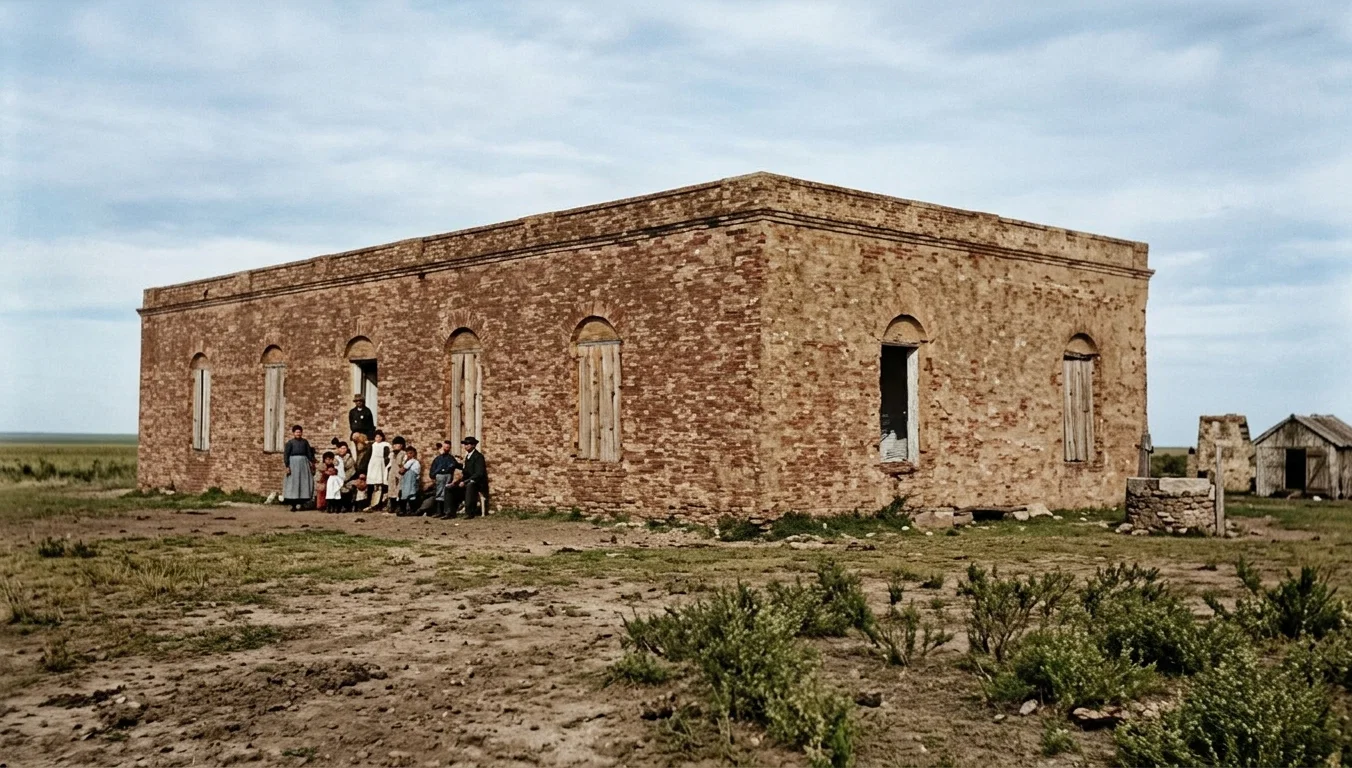
THE ENTRE RIOS SCHOOLHOUSE.
The brethren in Uruguay are of good courage, and from several places there are urgent calls for help. At one place several accepted the message without having seen a minister. They long to have one visit them.
The school in Entre Rios has at last opened. Several young persons who desire to prepare themselves for the work have gathered there. Others will soon join the company. We believe that many useful workers will be sent out from this place.
A revolution broke out lately in Entre Rios, and many of the horses of our brethren were taken away. Nearly all the horses of the Russian colony were also taken; but where the school is, the plague did not come. We have forty acres of land with the school, a team of horses, and a wagon. This gives the pupils some work. Pray for the school, brethren, that the Lord's blessing may rest upon it in great measure.
In the illustration the well can be seen to the right of the building, and the hut to the right of that is now a chicken-coop. It was our kitchen while building the house, and our dormitory during the making of the well. F. H. WESTPHAL.
Continue reading: NEBRASKA